REVIEW 3 major objections 7 minor 16 references
Second-order theory for multi-hinged directional wavemakers
T0 review · 3 major / 7 minor · reviewed 2026-08-07 · deepseek-v4-flash
Pith's one-line read Double-hinged wavemakers can cancel second-order spurious waves with a single paddle frequency.
desk verdict Solid extension of Schäffer's wavemaker theory with a surprising, experimentally supported single-harmonic cancellation result; the 'suppress spurious waves' claim is scoped to the progressive component only. read the letter →
The pith
A machine-rendered reading of the paper's core claim, the machinery that carries it, and where it could break.
The reading
What carries the argument
The load-bearing structure is the Stokes-expansion cascade of linear boundary-value problems, written in the paper's bound/free/correction split: the second-order field is decomposed into bound harmonics (21), parasitic free waves (22), and waves from corrective paddle motion (23). Each hinge enters through the Biésel transfer function $c_i(k)=\tanh kh/\Lambda(k)\Gamma_{i,1}(k)$, and the multi-hinge lateral condition is a superposition of single-hinge conditions valid up to second order. The decisive object is the two-equation system (32): for $N=2$ hinges it imposes both the desired first-order wave amplitude and $\hat{\eta}^{(22)}_{0nm}=0$, whose solution is the monochromatic, near-opposite-phase flap stroke that cancels the progressive spurious wave. The same formalism supplies the correction condition (23) and the zero-mode return-flow limit (30), which the paper shows converges to the Stokes drift.
What would settle it
Measure the double-frequency surface elevation at several stations spanning the evanescent decay length from the paddle, or compute the sum of $|\hat{\eta}^{(22)}_{pnm}|$ over $p>0$ for the optimized single-harmonic stroke; a residual comparable to the original progressive spurious amplitude would show that the wave field is only partly cleaned.
Extended reading notes
Core claim
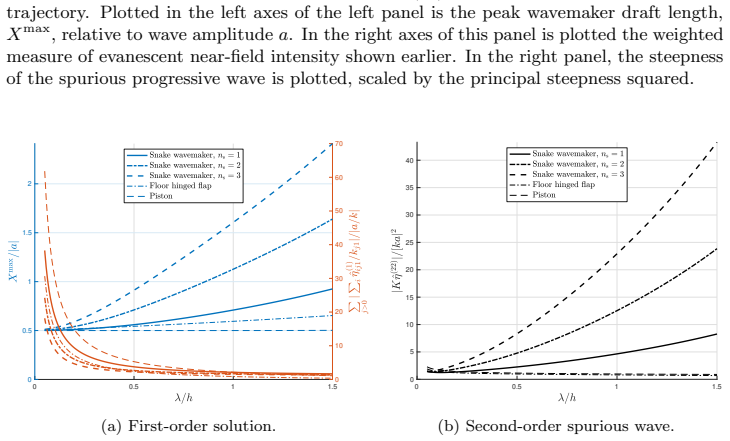
On the paper's own terms, the central discovery is that a double-hinged wavemaker has enough freedom to do what a single-hinged one cannot: generate a target monochromatic progressive wave while simultaneously satisfying $\hat{\eta}^{(22)}_{0nm}=0$, so that no progressive component of the second-order spurious free wave is radiated. Solving the two complex equations in (32) for the two hinge strokes produces flap motions that are almost always in near-opposite phase, with the largest horizontal displacement below the still-water line. Because of the opposing phases, the peak paddle draft is usually smaller than for a single flap generating the same wave. The paper reports that this single-harmonic motion suppresses the second-order spurious harmonic in experiments, with performance comparable to conventional double-harmonic correction, while the question of reduced third-order contamination is left inconclusive. The same framework, taken to an arbitrary number of hinges, approximates a fully flexible paddle: a paddle whose profile follows the linear particle trajectory eliminates linear evanescent waves but still produces second-order spurious waves of magnitude comparable to a single flap.
Load-bearing premise
The suppression claim cancels only the freely propagating ($p=0$) part of the second-order spurious wave; the evanescent part is left uncancelled, so if those evanescent modes are sizable in the test region the wave field is not fully cleaned.
Editorial extensions
If this is right
- Laboratory wave generation can suppress second-order parasitic waves with a single-frequency control signal, avoiding the double-frequency paddle motion that conventional correction requires.
- Double-hinged paddles typically need less stroke than a single flap for the same target wave, because the two flaps work in near-opposite phase with the largest displacement below the waterline.
- The strategy extends in principle to polychromatic fields: $N=N_\omega+1$ hinges for non-harmonic frequency sets and at least three hinges for uniformly spaced harmonics, though solving the resulting quadratic systems becomes hard for irregular seas.
- With many hinges the theory approximates fully flexible paddles; matching the linear particle trajectory removes linear evanescent modes but not second-order spurious waves, so an ideal wavemaker must match particle motion at second order too.
- The complete second-order solution includes the zero-mode return flow exactly balancing the Stokes drift, so the generated wave field conserves mass in the Lagrangian sense.
Reading between the lines
- Only the progressive ($p=0$) part of the second-order free wave is cancelled; a quantitative comparison of the $p>0$ evanescent components for the optimized motion would show whether the total residual field is clean near the paddle.
- The near-opposite-phase result contradicts the in-phase assumption used in earlier double-hinged studies, so similar re-optimization could be applied to other multi-hinge objectives such as minimizing near-field intensity or structural loads.
- A flexible paddle whose profile is matched to second-order particle trajectories is the natural next step suggested by the paper's conclusion that linear matching is insufficient.
- A higher-precision experiment or numerical simulation comparing single-harmonic and double-harmonic correction could settle whether the single-harmonic strategy reduces third-order contamination; the paper's experiment was too noisy to decide.
Editorial analysis
A structured set of objections, weighed in public.
Referee Report
Summary. This paper generalizes the second-order directional wavemaker theory of Schäffer and Steenberg (2003) to paddles with an arbitrary number of hinges, including combined piston–flap systems. The author derives the second-order bound, free, and correction wave components, validates the boundary conditions numerically, and includes the zero-mode return flow, showing that it converges to the Stokes drift. The central application is a double-hinged monochromatic motion that satisfies Eq. (32), i.e., zero progressive second-order free wave for a prescribed linear wave amplitude, yielding near-opposite-phase flap strokes. The paper reports an experimental comparison of this single-harmonic correction with conventional double-harmonic correction and discusses flexible wavemakers as limiting multi-hinge systems.
Significance. The main contribution is a first-principles extension of an established wavemaker theory that yields a testable design rule: a double-hinged paddle can cancel the progressive component of the second-order spurious free wave using monochromatic motion, thereby avoiding double-frequency paddle motion and its attendant third-order contamination. The derivation is systematic and reproduces the expected Stokes-drift back-flow, and the boundary-condition checks in Figs. 4–5 support the algebra. The paper also honestly tests an idealized flexible wavemaker and finds no second-order benefit. The practical claim, however, is narrower than the abstract suggests: only the p=0 component is cancelled, and the experimental evidence is presented without uncertainty quantification.
major comments (3)
- [§2.3 and §3.1, Eq. (32)] The cancellation condition (32) and correction equation (23) set only the progressive p=0 component of the second-order free wave to zero. The evanescent components \hat\eta^{(22)}_{pnm}, p>0, are neither cancelled nor quantified for the optimized motions in Figs. 6–9, and the experimental decomposition (34) contains only progressive wavenumbers, so Fig. 14b is blind to them. The abstract's unqualified 'suppress spurious waves' and the summary's 'eliminate second-order spurious waves' are therefore established only for the freely propagating component. Please provide an estimate or bound for the evanescent part, for example \sum_{p>0}|\hat\eta^{(22)}_{pnm}| and its decay length for the cases studied, and qualify the claims accordingly.
- [§3.1, Eq. (32)] For N=2, Eq. (32) is a system of two complex equations in two complex unknowns, and since \hat\eta^{(22)}_{011} is quadratic in the first-order amplitudes, imposing the amplitude sum leaves a quadratic equation with up to two distinct solutions. The paper does not state which branch is plotted in Figs. 6–9 or whether both branches are admissible under the small-displacement assumption. Because the qualitative conclusions, such as opposite phase and reduced draft, may be branch-dependent, the solution selection should be documented.
- [§3.2, Fig. 14] The experimental evidence in Fig. 14 is reported without error bars or confidence intervals, and residual second-order spurious waves remain for all cases (Fig. 14b). The fitted model (34) also includes third-order terms whose amplitudes the paper itself describes as indicative and possibly contaminated. The statement in the abstract that the ability to suppress spurious waves is 'verified experimentally' should therefore be replaced by a more cautious statement, for example that the progressive component was measured to be substantially reduced in a small set of deep-water tests, with residual levels comparable to conventional correction.
minor comments (7)
- [Eq. (13)] The second free-surface condition is written with \phi^{(3)}_z; this should be \phi^{(23)}_z to be consistent with the subproblem being solved.
- [Eq. (24)] The correction amplitude is introduced as \hat X^{(2)}_{inm} in Eq. (20), but Eq. (24) uses \hat X^{(23)}_{inm}; the notation should be made uniform.
- [Abstract and Section 4] The abstract and summary refer to the evanescent-free profile as 'exponential,' but Eq. (37) is a cosh profile; the literal exponential profile (38) is the snake example and is shown to perform poorly. Please align the terminology.
- [Section 3.2] The second hinge depth is written as δ1=2.62 m, but it should presumably be δ2=2.62 m.
- [Fig. 14 caption] The normalization of the second-order spurious amplitude by \langle\eta^{(1)}_I\rangle^2 should specify over which gauges and time window the mean is taken, and the normalization for the third-order panel should also be defined.
- [Eq. (33)] The hinge angle notation \hat\theta^{(1)}_i omits the frequency index n used elsewhere; please clarify.
- [Throughout] There are numerous typographical errors, e.g., 'thsee', 'foots', 'mantioned', 'amplirtude', 'corss-modes', and 'favemakers'; a careful proofread is needed.
Circularity Check
No circularity: the multi-hinged second-order derivation is a first-principles extension of Schäffer's external theory; the cancellation condition is imposed post-derivation and the opposite-phase result is emergent.
full rationale
The paper's derivation chain is self-contained and non-circular. It starts from the Laplace equation and surface/wall boundary conditions, performs a Stokes expansion, and derives first-order transfer functions by projecting the wall condition onto an orthogonal basis (Eqs. 8-10). The second-order solution is split into bound, free, and correction components (Eqs. 11-13), each obtained by solving independent boundary-value problems with source terms computed from first-order quantities. The central 'single-harmonic suppression' result is obtained by imposing a design condition, Eq. (32), which sets the progressive second-order free-wave amplitude to zero while fixing the total first-order wave amplitude; the resulting paddle strokes, including their near-opposite phase, are the solution of this nonlinear system, not an input to it. The experimental validation in Sec. 3.2 independently measures the second-order free harmonic amplitude using a gauge-array regression model (Eq. 34), so the agreement in Figure 14b is genuine empirical confirmation rather than a fitted consequence. The only self-citation, Fouques et al. (2022), which includes the present author, is used to motivate the comparison and to report an earlier in-phase assumption, but it is not load-bearing: the theory does not rely on it, and the paper explicitly contradicts its in-phase assumption on the basis of the newly derived equations. No equation is equivalent to its own input by construction, and no fitted parameter is renamed as a prediction. Therefore the paper exhibits no significant circularity.
Assumptions & free parameters
free parameters (1)
- Correction weight distribution w_i =
w_i = 1/N in the examples (Eq. 24)
assumptions (6)
- domain assumption The flow is inviscid, incompressible, and irrotational, described by a velocity potential satisfying Laplace's equation (Eq. 1a).
- domain assumption The Stokes expansion is convergent for the conditions considered, so second-order terms dominate the error and terms of O(a^3) can be neglected.
- domain assumption The multi-hinged paddle motion can be represented as a superposition of single-hinge displacement fields to second order (Eq. B.3).
- domain assumption Cancelling the progressive (p=0) component of the second-order free wave is sufficient to suppress spurious waves; evanescent free-wave components are neglected (Eqs. 23 and 32).
- standard math The vertical eigenfunctions of the water wave problem are orthogonal with weight given by Lambda (Eq. A.1).
- domain assumption The wave gauge model (34) with ten complex harmonics and additive noise is a complete description of the measured surface elevation in the basin.
Cite this review
Pith. "Pith review of Second-order theory for multi-hinged directional wavemakers." pith.science (2026). https://pith.science/paper/OTG4P4ZU
@misc{pith2026250209586,
  author       = {Pith},
  title        = {Pith review of: Second-order theory for multi-hinged directional wavemakers},
  year         = {2026},
  howpublished = {\url{https://pith.science/paper/OTG4P4ZU}},
  note         = {Machine review of arXiv:2502.09586}
}
read the original abstract
The second-order directional wavemaker theory for regular and irregular waves is extended to multi-hinged wavemakers and combined piston--flap wavemaker systems. Derived expressions enable second-order signal correction, common in single-hinged wavemakers, to be applied to multi-hinged systems. Multi-hinged wavemakers offer additional degrees of freedom, with different combinations of paddle motion producing the same progressive wave. This is here exploited to better understand wavemaker behaviour. Single-harmonic signals are computed for double-hinged wavemakers that suppress spurious waves without introducing double-harmonic motions. Surprisingly, these flap motions are almost always in opposite phase, with the larger draft found underneath the water surface. %contradicting to assumptions from earlier studies. Due to the opposing paddle phase, the double-hinged wavemaker draft is usually smaller than the corresponding single-hinged draft. The ability of thsee systems to suppress spurious waves with single-harmonic motion is verified experimentally. The wavemaker theory further supports an arbitrary number of flap hinges, enabling the approximation of a fully flexible wavemaker through piecewise-linear segments. This is demonstrated with an exponential wavemaker profile that does not generate any evanescent waves at linear order. Such a wavemaker is likely to limit wave breaking and cross-modes, but is found to produce spurious second-order waves of a magnitude comparable to a single flap. The presented solution is complete, intrinsically including return flow through the second-order zero mode. This return flow is found to precisely match the Stokes drift.
Figures


Figures from the paper (14 more)



Reference graph
Works this paper leans on
-
[1]
V. Barthel, E. Mansard, S. Sand, and F. Vis. Group bounded long waves in physical models. Ocean Engineering, 10 0 (4): 0 261--294, 1983
work page 1983
-
[2]
F. Bi \'e sel and F. Suquet. Les appareils g \'e n \'e rateurs de houle en laboratoire. La houille blanche, 0 (2): 0 147--165, 1951
work page 1951
-
[3]
M. R. Eldrup and T. Lykke Andersen. Applicability of nonlinear wavemaker theory. Journal of Marine Science and Engineering, 7 0 (1): 0 14, 2019
work page 2019
- [4]
-
[5]
S. Fouques, S. Lafl \`e che, A. Akselsen, and T. Sauder. On the quality of laboratory water waves generated mechanically by flap favemakers. In International Conference on Offshore Mechanics and Arctic Engineering. American Society of Mechanical Engineers, 2022
work page 2022
-
[6]
T. H. Havelock. Lix. forced surface-waves on water. The London, Edinburgh, and Dublin Philosophical Magazine and Journal of Science, 8 0 (51): 0 569--576, 1929
work page 1929
-
[7]
R. T. Hudspeth and W. Sulisz. Stokes drift in two-dimensional wave flumes. Journal of Fluid Mechanics, 230: 0 209--229, 1991
work page 1991
-
[8]
Linear theory for single and double flap wavemakers
W. Kusumawinahyu, N. Karjanto, and G. Klopman. Linear theory for single and double flap wavemakers. arXiv preprint arXiv:1703.09445, 2017
work page Pith review arXiv 2017
Show all 16 references
-
[9]
O. S. Madsen. On the generation of long waves. Journal of Geophysical Research, 76 0 (36): 0 8672--8683, 1971
1971
-
[10]
Pezzutto
P. Pezzutto. Extension of 2d second-order irregular waves generation equations to non-continuous wavemaker shapes. Coastal Engineering, 116: 0 207--219, 2016
2016
-
[11]
S. E. Sand. Long wave problems in laboratory models. Journal of the Waterway, Port, Coastal and Ocean Division, 108 0 (4): 0 492--503, 1982
1982
-
[12]
S. E. Sand and B. Donslund. Influence of wave board type on bounded long waves. Journal of hydraulic research, 23 0 (2): 0 147--163, 1985
1985
-
[13]
H. A. Sch \"a ffer. Second-order wavemaker theory for irregular waves. Ocean Engineering, 23 0 (1): 0 47--88, 1996. doi:10.1016/0029-8018(95)00013-B
1996 doi
-
[14]
H. A. Sch \"a ffer and C. M. Steenberg. Second-order wavemaker theory for multidirectional waves. Ocean Engineering, 30 0 (10): 0 1203--1231, 2003
2003
-
[15]
Zhang and H
H. Zhang and H. A. Sch \"a ffer. Approximate stream function wavemaker theory for highly non-linear waves in wave flumes. Ocean engineering, 34 0 (8-9): 0 1290--1302, 2007
2007
-
[16]
Zhang, H
H. Zhang, H. A. Sch \"a ffer, and K. P. Jakobsen. Deterministic combination of numerical and physical coastal wave models. Coastal engineering, 54 0 (2): 0 171--186, 2007
2007
Reviewed August 7, 2026 · model on record in the stance chip above.
Discussion (0). Continue with ORCID to comment.