REVIEW 2 major objections 1 minor 54 references
Tidal deformability in neutron stars from a microscopic point of view
T0 review · 2 major / 1 minor · reviewed 2026-05-25 · grok-4.3
Pith's one-line read A microscopic equation of state from chiral nucleon forces produces neutron star tidal deformabilities consistent with GW170817 constraints.
desk verdict The tidal results depend on a phenomenological high-density extension of the chiral EFT EOS whose robustness is not yet clear from the abstract. read the letter →
The pith
A machine-rendered reading of the paper's core claim, the machinery that carries it, and where it could break.
The reading
What carries the argument
The microscopic equation of state for beta-stable neutron matter, continued to high density, which supplies the pressure-density relation for solving the stellar structure and tidal perturbation equations.
What would settle it
A gravitational-wave or electromagnetic measurement that places a neutron star radius clearly above 13 km while also requiring a tidal deformability outside the range predicted by the microscopic equation of state would falsify the central claim.
Extended reading notes
Core claim
Using a microscopic equation of state for cold beta-stable neutron matter from high-precision two-neutron forces and required chiral three-neutron forces, the tidal deformability, Love number k2, and binary effective deformability are calculated. These quantities lie within multimessenger constraints. Stiff equations of state that yield radii larger than about 13 km are ruled out by the GW170817 data.
Load-bearing premise
The chosen high-density continuation of the microscopic equation of state remains valid up to the central densities of the neutron stars considered.
Editorial extensions
If this is right
- The calculated tidal deformabilities and Love numbers remain inside current multimessenger bounds.
- Stiff equations of state producing radii larger than about 13 km are excluded by the GW170817 constraint.
- The effective deformability for binary systems provides a direct observable that can be compared with future gravitational-wave events.
- The microscopic starting point from two- and three-nucleon forces offers a controlled alternative to phenomenological models for neutron-star structure.
Reading between the lines
- Future detections of binary neutron-star mergers could tighten bounds on the high-density continuation and test the chiral-force predictions at higher densities.
- The same microscopic equation of state could be used to compute additional observables such as the moment of inertia or cooling rates for direct comparison with pulsar timing or X-ray data.
- Low-density portions of the equation of state could be cross-checked against nuclear scattering or heavy-ion collision experiments to strengthen the overall foundation.
Editorial analysis
A structured set of objections, weighed in public.
Referee Report
Summary. The paper computes the tidal Love number k2 and binary effective deformability for neutron stars using a microscopic cold beta-stable EOS derived from high-precision chiral EFT two-nucleon forces plus three-nucleon forces at the chosen order. It reviews and motivates a high-density continuation of this microscopic EOS, presents the resulting tidal predictions, and concludes that they lie well within multimessenger constraints while stiff EOS yielding radii larger than about 13 km are ruled out by GW170817.
Significance. If the high-density continuation is reliable, the work supplies a direct microscopic link from chiral nuclear forces to tidal observables that can be confronted with gravitational-wave data, complementing purely phenomenological EOS models.
major comments (2)
- [high-density continuation section] High-density continuation section: The claim that the microscopic predictions are consistent with GW170817 (and that R>13 km EOS are ruled out) is load-bearing on the chosen phenomenological continuation remaining accurate up to central densities of ~4-7 n_sat. The manuscript motivates the functional form and matching but provides no quantitative sensitivity study to variations in matching density, stiffness parameter, or functional ansatz, all of which directly affect the integrated k2 and Lambda.
- [Abstract and results section] Abstract and results section: The statement of consistency with constraints is given without accompanying numerical tables, error bands on k2 or Lambda, or explicit integration details for the TOV and tidal equations, preventing direct verification of the quoted radius bound and the multimessenger comparison.
minor comments (1)
- Notation for the effective binary deformability should be defined explicitly on first use rather than assumed from context.
Simulated Author's Rebuttal
We thank the referee for the careful reading and constructive comments on our manuscript. We address the two major comments below and will revise the paper accordingly to strengthen the presentation and robustness of the results.
read point-by-point responses
-
Referee: [high-density continuation section] High-density continuation section: The claim that the microscopic predictions are consistent with GW170817 (and that R>13 km EOS are ruled out) is load-bearing on the chosen phenomenological continuation remaining accurate up to central densities of ~4-7 n_sat. The manuscript motivates the functional form and matching but provides no quantitative sensitivity study to variations in matching density, stiffness parameter, or functional ansatz, all of which directly affect the integrated k2 and Lambda.
Authors: We agree that the conclusions regarding consistency with GW170817 and the exclusion of stiff EOS with R>13 km rely on the high-density continuation. The manuscript motivates the functional form and matching procedure, but we acknowledge that a quantitative sensitivity study is absent. In the revised manuscript we will add such a study, systematically varying the matching density, the stiffness parameter, and considering at least one alternative functional ansatz. We will report the resulting ranges for k2 and Lambda to quantify the sensitivity and thereby provide a more complete assessment of the robustness of the tidal predictions. revision: yes
-
Referee: [Abstract and results section] Abstract and results section: The statement of consistency with constraints is given without accompanying numerical tables, error bands on k2 or Lambda, or explicit integration details for the TOV and tidal equations, preventing direct verification of the quoted radius bound and the multimessenger comparison.
Authors: We agree that the absence of numerical tables, error bands, and explicit integration details limits verifiability. In the revision we will include tables listing the computed values of radii, k2, and Lambda for the EOS considered, together with any estimated uncertainties arising from the high-density continuation. We will also add a dedicated subsection or appendix describing the numerical methods used to solve the Tolman-Oppenheimer-Volkoff equations and the tidal perturbation equations, including convergence checks and the integration procedure. revision: yes
Circularity Check
No significant circularity; predictions compared to independent external constraints
full rationale
The paper constructs the EOS from high-precision two- and three-neutron forces taken from prior literature, applies a reviewed high-density continuation, computes k2 and tidal deformability from the resulting pressure-density relation, and then compares those outputs to GW170817 bounds as an external filter. No parameter fitting to the multimessenger data occurs, no self-citation chain is invoked to justify uniqueness or forbid alternatives, and no fitted quantity is relabeled as a prediction. The central claim therefore rests on independent microscopic inputs plus an explicit (if phenomenological) continuation choice, remaining self-contained against external benchmarks.
Assumptions & free parameters
free parameters (1)
- high-density continuation parameters
assumptions (2)
- domain assumption Chiral effective field theory at the chosen order plus three-nucleon forces accurately describes neutron matter up to the matching density.
- domain assumption The high-density extension preserves causality and thermodynamic stability.
Cite this review
Pith. "Pith review of Tidal deformability in neutron stars from a microscopic point of view." pith.science (2026). https://pith.science/paper/PBB77POY
@misc{pith2026251200354,
  author       = {Pith},
  title        = {Pith review of: Tidal deformability in neutron stars from a microscopic point of view},
  year         = {2026},
  howpublished = {\url{https://pith.science/paper/PBB77POY}},
  note         = {Machine review of arXiv:2512.00354}
}
abstract
We present results for the tidal deformability in neutron stars, the tidal Love number $k_2$, and the effective deformability of a binary system. The microscopic equation of state for cold $\beta$-stable neutron matter is based upon high-precision two-neutron forces and includes the chiral three-neutron forces required at the chosen order. We review and motivate our choices for the high-density continuation of the microscopic equation of state. We discuss our predictions and observe that they are well within multimessenger constraints. In contrast, stiff equations of state that yield radii larger than about 13 km are ruled out by GW170817 constraints.
Figures


Figures from the paper (4 more)



Lean theorems connected to this paper
-
IndisputableMonolith/Cost/FunctionalEquation.leanwashburn_uniqueness_aczel unclear?
unclearRelation between the paper passage and the cited Recognition theorem.
The microscopic equation of state for cold β-stable neutron matter is based upon high-precision two-neutron forces and includes the chiral three-neutron forces required at the chosen order. We review and motivate our choices for the high-density continuation of the microscopic equation of state.
-
IndisputableMonolith/Foundation/DimensionForcing.leanalexander_duality_circle_linking unclear?
unclearRelation between the paper passage and the cited Recognition theorem.
stiff equations of state that yield radii larger than about 13 km are ruled out by GW170817 constraints
What do these tags mean?
- matches
- The paper's claim is directly supported by a theorem in the formal canon.
- supports
- The theorem supports part of the paper's argument, but the paper may add assumptions or extra steps.
- extends
- The paper goes beyond the formal theorem; the theorem is a base layer rather than the whole result.
- uses
- The paper appears to rely on the theorem as machinery.
- contradicts
- The paper's claim conflicts with a theorem or certificate in the canon.
- unclear
- Pith found a possible connection, but the passage is too broad, indirect, or ambiguous to say the theorem truly supports the claim.
Reference graph
Works this paper leans on
-
[1]
3, we show the dimensionless tidal deformability for the four cases considered in Table I
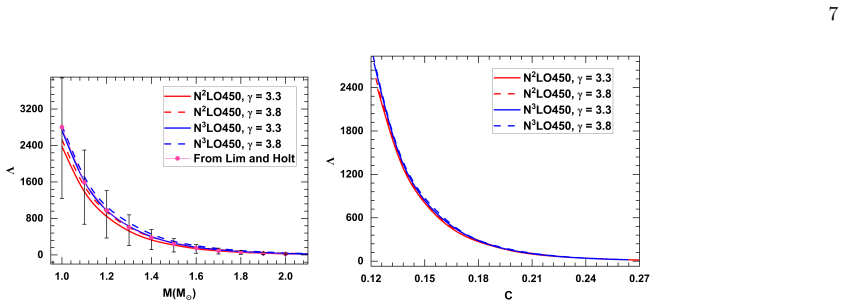
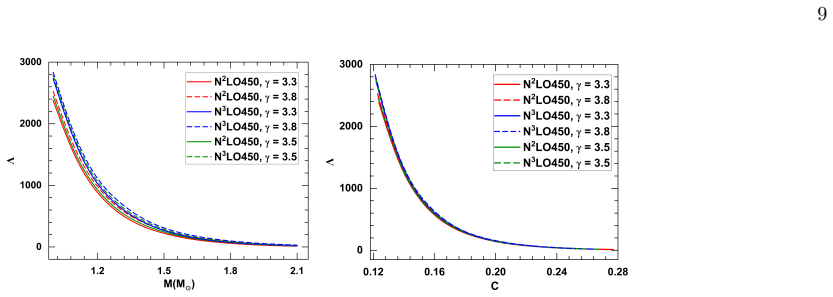
Tidal deformability and tidal Love number On the left side of Fig. 3, we show the dimensionless tidal deformability for the four cases considered in Table I. For comparison, the pink dots are taken from the Bayesian analysis of Ref. [33] and represent the most probable values from sampling 300,000 EoS models based on chiral EFT and experimental constraint...
-
[2]
The mass-weighted tidal deformability Here, we focus on our results for the effective tidal deformability, ˜Λ, for a binary with masses (deformabilities) M1(Λ1) andM 2(Λ2). First, we recall that Λ 1 or Λ2 cannot be disentangled in the observed gravitational wave, and thus are not directly observable. Instead, it is possible to constrain the mass-weighted ...
-
[3]
Additional discussion Our predictions are generally consistent with multimessenger constraints, as well as terrestrial laboratory con- straints. For the purpose of rendering the paper more selfcontained, this short section will address recent terrestrial constraints. 11 0 0.2 0.4 0.6 0.8 1 1.2 1.4 0 ρ/ρ0 5 10 15 20 25 30 35 40 ) (MeV)0 ρ/ρS(-EFT χHIC isod...
-
[4]
B. P. Abbott, et al., GW170817: Observation of Gravitational Waves from a Binary Neutron Star Inspiral, Phys. Rev. Lett. 119 (16) (2017) 161101
work page 2017
-
[5]
Abbott, B. P. and others, Multi-messenger Observations of a Binary Neutron Star Merger, Astrophys. J. Lett. 848 (2) (2017) L12
work page 2017
-
[6]
Abbott, B. P. and others, GW170817: Measurements of neutron star radii and equation of state, Phys. Rev. Lett. 121 (16) (2018) 161101
work page 2018
-
[7]
B. P. Abbott, et al., GWTC-1: A Gravitational-Wave Transient Catalog of Compact Binary Mergers Observed by LIGO and Virgo during the First and Second Observing Runs, Phys. Rev. X 9 (2019) 031040
work page 2019
-
[8]
M. C. Miller, et al., PSR J0030+0451 mass and radius from NICER and implications for the properties of neutron star matter, Astrophys. J. Lett. 887 (2019) L24
work page 2019
Show all 54 references
-
[9]
M. C. Miller, et al., The Radius of PSR J0740+6620 from NICER and XMM-Newton Data, Astrophys. J. Lett. 918 (2) (2021) L28
2021
-
[10]
Soumi, D
D. Soumi, D. Finstad, J. M. Lattimer, D. A. Brown, E. Berger, C. M. Biwer, Tidal deformabilities and radii of neutron stars from the observation of gw170817, Phys. Rev. Lett. 121 (2018) 091102
2018
-
[11]
M. C. Miller, N. Yunes, The new frontier of gravitational waves, Nature (London) 568 (2019) 469
2019
-
[12]
J. L. Cervantes-Cota, et al., A brief history of gravitational waves, Universe 2(3) (2016) 22
2016
-
[13]
P. D. Lasky, Gravitational waves from neutron stars: A review, Publications of the Astronomical Society of Australia 32 (2015) e034
2015
-
[14]
E. E. Flanagan, T. Hinderer, Constraining neutron star tidal love numbers with gravitational wave detectors, Phys. Rev. D 77 (2008) 021502
2008
-
[15]
Hinderer, Tidal love numbers of neutron stars, Astrophys
T. Hinderer, Tidal love numbers of neutron stars, Astrophys. J. 677 (2008) 1216
2008
-
[16]
J. A. Faber, F. A. Rasio, Binary neutron star mergers, Living Reviews in Relativity 15 (2012) 8
2012
-
[17]
Baiotti, L
L. Baiotti, L. Rezzolla, Binary neutron-star mergers: a review of eistein’s richest laboratory, Rep. Prog. Phys. 80 (2017) 096901
2017
-
[18]
Baiotti, Gravitational waves from neutron star mergers and their relation to the nuclear equation of state, Prog
L. Baiotti, Gravitational waves from neutron star mergers and their relation to the nuclear equation of state, Prog. Part. Nucl. Phys. 109 (2019) 103714
2019
-
[19]
Adams, et al., Advanced LIGO, Class
C. Adams, et al., Advanced LIGO, Class. Quantum Grav. 32 (2015) 074001
2015
-
[20]
Acernese, et al., Advanced Virgo: a second-generation interferometric gravitational wave detector, Class
F. Acernese, et al., Advanced Virgo: a second-generation interferometric gravitational wave detector, Class. Quantum Grav. 32 (2015) 024001
2015
-
[21]
Khadkikar,et al., Precise and accurate neutron star radius measurements with next-generation gravitational wave detectors, Phys
S. Khadkikar,et al., Precise and accurate neutron star radius measurements with next-generation gravitational wave detectors, Phys. Rev. D 112 (2025) 063020
2025
-
[22]
Sammarruca, T
F. Sammarruca, T. Ajagbonna, General features of the stellar matter equation of state from microscopic theory, new maximum-mass constraints, and causality, Front. Astron. Space Sci. 12 (2025) 1554123
2025
-
[23]
Machleidt, D
R. Machleidt, D. R. Entem, Chiral effective field theory and nuclear forces, Phys. Rept. 503 (2011) 1–75
2011
-
[24]
Epelbaum, H
E. Epelbaum, H. Krebs, U. G. Meißner, Improved chiral nucleon-nucleon potential up to next-to-next-to-next-to-leading order, Eur. Phys. J. A 51 (5) (2015) 53
2015
-
[25]
Epelbaum, H
E. Epelbaum, H. Krebs, P. Reinert, High-precision nuclear forces from chiral EFT: State-of-the-art, challenges and outlook, Front. in Phys. 8 (2020) 98
2020
-
[26]
Epelbaum, H
E. Epelbaum, H. Krebs, P. Reinart, Semi-local nuclear forces from chiral EFT: state-of-the-art and challenges, in: Tanihata, I., Toki, H., Kajino, T. (eds), Handbook of Nuclear Physics, Springer, Singapore (2023). 13
2023
-
[27]
Bernard, E
V. Bernard, E. Epelbaum, H. Krebs, U.-G. Meissner, Subleading contributions to the chiral three-nucleon force. I. Long- range terms, Phys. Rev. C 77 (2008) 064004
2008
-
[28]
Bernard, E
V. Bernard, E. Epelbaum, H. Krebs, U. G. Meissner, Subleading contributions to the chiral three-nucleon force II: Short- range terms and relativistic corrections, Phys. Rev. C 84 (2011) 054001
2011
-
[29]
Krebs, E
H. Krebs, E. Epelbaum, Towards consistent nuclear interactions from chiral Lagrangians I: The path integral approach (2023).\path{arXiv:2311.10893}
2023
-
[30]
Krebs, E
H. Krebs, E. Epelbaum, Towards consistent nuclear interactions from chiral Lagrangians II: Symmetry preserving regular- ization nucl-th (2023).\path{arXiv:2312.13932}
2023
-
[31]
Kanakis-Pegios, P
A. Kanakis-Pegios, P. S. Koliogiannis, C. C. Moustakidis, Probing the nuclear equation of state from the existence of a ≈2.6 m⊙ neutron star: The gw190814 puzzle, Symmetry 13 (2021) 183
2021
-
[32]
I. Tews, J. Carlson, S. Gandolfi, S. Reddy, Constraining the speed of sound inside neutron stars with chiral effective field theory interactions and observations, Astrophys. J. 860 (2) (2018) 149
2018
-
[33]
Brandes, W
L. Brandes, W. Weise, N. Kaiser, Inference of the sound speed and related properties of neutron stars, Phys. Rev. D 107 (2023) 014011
2023
-
[34]
R. F. P. Mendes, C. F. Sodr´ e, F. T. Falciano, Exceeding the conformal limit inside rotating neutron stars: Implication to modified theories of gravity, Phys. Rev. D 110 (2024) 104027
2024
-
[35]
E. D. Van Oeveren, J. L. Friedman, Upper limit set by causality on the tidal deformability of a neutron star, Phys. Rev. D 95 (2017) 083014
2017
-
[36]
Y. Lim, J. W. Holt, Bayesian modeling of the nuclear equation of state for neutron star tidal deformabilities and GW170817, Eur. Phys. J. A 55 (11) (2019) 209
2019
-
[37]
Huang, Model-independent determination of the tidal deformability of a 1.4m ⊙ neutron star from gravitational-wave measurements, Astro
C. Huang, Model-independent determination of the tidal deformability of a 1.4m ⊙ neutron star from gravitational-wave measurements, Astro. J. 985 (2025) 216
2025
-
[38]
B. T. Reed, F. J. Fattoyev, C. J. Horowitz, J. Piekarewicz, Implications of PREX-2 on the Equation of State of Neutron- Rich Matter, Phys. Rev. Lett. 126 (17) (2021) 172503
2021
-
[39]
Hotokezaka, K
K. Hotokezaka, K. Kyutoku, Y.-I. Sekiguchi, M. Shibata, Measurability of the tidal deformability by gravitational waves from coalescing binary neutron stars, Phys. Rev. D 93 (2016) 064082
2016
-
[40]
Damour, A
T. Damour, A. Nagar, L. Villain, Measurability of the tidal polarizability of neutron stars in late-inspiral gravitational-wave signals, Phys. Rev. D 85 (2012) 123007
2012
-
[41]
Del Pozzo, T
W. Del Pozzo, T. Li, M. Agathos, C. Van Den Broeck, S. Vitale, Demonstrating the Feasibility of Probing the Neutron-Stars Equation of State Second-Generation Gravitational-Wave Detectors, Phys. Rev. Lett. 111 (2013) 071101
2013
-
[42]
Agathos,et al., Constraining the neutron star equation of state with gravitational wave signals from coalescing binary neutron stars, Phys
M. Agathos,et al., Constraining the neutron star equation of state with gravitational wave signals from coalescing binary neutron stars, Phys. Rev. D 92 (2015) 023012
2015
-
[43]
Wade,et al., Systematic and statistical errors in a Bayesian approach to the estimation of the neutron-star equation of state using advanced gravitational wave detectors, Phys
L. Wade,et al., Systematic and statistical errors in a Bayesian approach to the estimation of the neutron-star equation of state using advanced gravitational wave detectors, Phys. Rev. D 89 (2014) 103012
2014
-
[44]
M. W. Coughlin, et al., Constraints on the neutron star equation of state from at2017gfo using radiative transfer simulations, MNRAS 480 (2018) 3871
2018
-
[45]
P. S. Koliogiannis, A. Kanakis-Pegios, C. C. Moustakidis, Neutron stars and Gravitational Waves: the Key Role of Nuclear Equation of State , Foundations 1 (2021) 217
2021
-
[46]
W. G. Lynch, M. B. Tsang, Decoding the density dependence of the nuclear symmetry energy, Phys. Lett. B 830 (2022) 137098.\path{arXiv:2106.10119},\path{doi:10.1016/j.physletb.2022.137098}
2022 doi
-
[47]
Sammarruca, The Symmetry Energy: Current Status of Ab Initio Predictions vs
F. Sammarruca, The Symmetry Energy: Current Status of Ab Initio Predictions vs. Empirical Constraints, Symmetry 15 (2) (2023) 450
2023
-
[48]
Sammarruca, The neutron skin of 48Ca and 208Pb: A critical analysis, Symmetry 16 (2024) 34
F. Sammarruca, The neutron skin of 48Ca and 208Pb: A critical analysis, Symmetry 16 (2024) 34
2024
-
[49]
Sammarruca, Neutron skin systematics from microscopic equations of state, Phys
F. Sammarruca, Neutron skin systematics from microscopic equations of state, Phys. Rev. C 105 (6) (2022) 064303
2022
-
[50]
Koehn,et al., From existing and new nuclear and astrophysical constraints to stringent limits on the equation of state of neutron-rich dense matter, Phys
H. Koehn,et al., From existing and new nuclear and astrophysical constraints to stringent limits on the equation of state of neutron-rich dense matter, Phys. Rev. X 15 (2025) 021014
2025
-
[51]
Ciampi,et al., Constraining the nuclear symmetry energy with fermi-energy heavy ion collisions, Phys
C. Ciampi,et al., Constraining the nuclear symmetry energy with fermi-energy heavy ion collisions, Phys. Lett. B 868 (2025) 139815
2025
- [52]
-
[53]
Tang, Y.-J
S.-P. Tang, Y.-J. Huang, Y.-Z. Fan, Phase transition and nuclear symmetry energy from neutron star observations: Con- straints in light ofpsr jo614-3329 (2015).\path{arXiv:2507.10025v2}
2015
-
[54]
Cui,et al., Constraint on the symmetry energy at high density from neutron star observations using relativistic mean- field models, Nuclear Science and Techniques 36 (2025) 141
Y. Cui,et al., Constraint on the symmetry energy at high density from neutron star observations using relativistic mean- field models, Nuclear Science and Techniques 36 (2025) 141
2025
Reviewed May 25, 2026 · model on record in the stance chip above.
Discussion (0). Continue with ORCID to comment.