REVIEW 2 major objections 5 minor 51 references
A Multispecies ESBGK Model for Gas Mixtures with Variable Hard Sphere Transport: Theory and Verification
T0 review · 2 major / 5 minor · reviewed 2026-07-14 · grok-4.5
Pith's one-line read A single-term ESBGK model for gas mixtures now matches Boltzmann species relaxation rates and the mixture Prandtl number.
desk verdict Solid single-operator multi-species ESBGK that finally gets species T/u/σ rates right via Grad-13 VHS relative targets; empirical frequency is the practical soft spot, not a structural flaw. read the letter →
The pith
A machine-rendered reading of the paper's core claim, the machinery that carries it, and where it could break.
The reading
What carries the argument
Species-specific relative relaxation targets (u^(α,rel), T^(α,rel), σ^(α,rel)) obtained by adding the Grad-13 VHS production rates to the current species moments and subtracting the kinematic corrections induced by the target velocity itself; these targets are inserted into a single ellipsoidal ESBGK collision term per species.
What would settle it
A binary mixture with extreme mass and density ratios in which species heat fluxes are driven in opposite directions: if the model’s species heat-flux histories then diverge from Boltzmann or DSMC while the empirical frequency is used, the truncation that justifies the frequency is falsified.
Extended reading notes
Core claim
By replacing the usual Maxwellian or ellipsoidal target of each species with a relative target whose velocity, temperature, and traceless pressure tensor are shifted by the Grad-13 VHS production rates divided by a single species frequency, a multi-species ESBGK operator with only one relaxation term per species recovers the correct Boltzmann exchange rates for species velocity, temperature, and pressure tensor and the correct mixture Prandtl number. An empirical harmonic-mean frequency systematically gives the best agreement with DSMC.
Load-bearing premise
Only the leading term of the Grad-13 heat-flux production is kept when defining the per-species frequency, so higher-order exchanges that can grow or re-orient heat flux between species are discarded.
Editorial extensions
If this is right
- Particle-based continuum solvers can treat multi-species thermal and velocity non-equilibrium at continuum cost without needing N collision operators per species.
- Existing ESBGK particle codes need only local moment corrections and a frequency choice; no change to the stochastic particle framework is required.
- Correct Fickian diffusion and species temperature separation become available inside the same single-term operator used for viscosity and heat conduction.
- The same relative-target construction can be reused for polyatomic mixtures once internal-energy production rates are supplied.
Reading between the lines
- If the relative-target idea survives strong vibrational non-equilibrium, the same framework could supply a practical continuum partner for DSMC in re-entry chemistry without multi-term complexity.
- The empirical harmonic mean may be replaceable by a closed-form blend once the neglected Grad-13 heat-flux cross terms are estimated, removing the only free empirical choice.
- Because the equilibrium proof already requires ω_VHS < 1, species whose VHS exponents violate that bound will need a different positivity argument or a fall-back target.
Signed reviews
Editorial analysis
A structured set of objections, weighed in public.
Referee Report
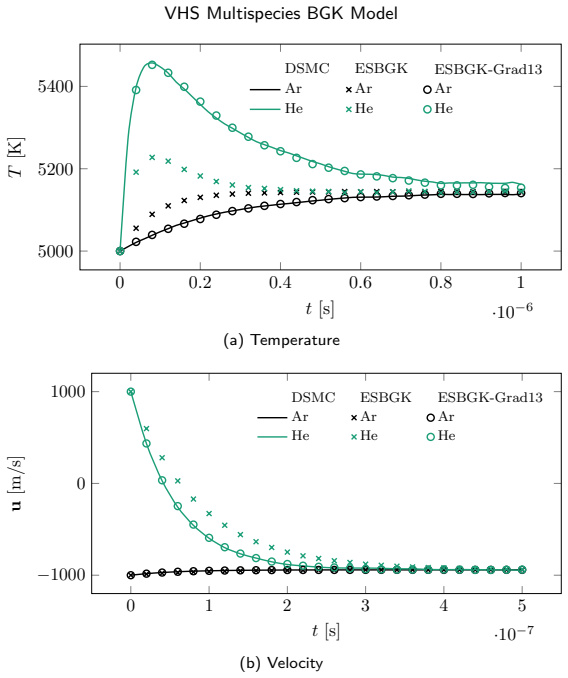
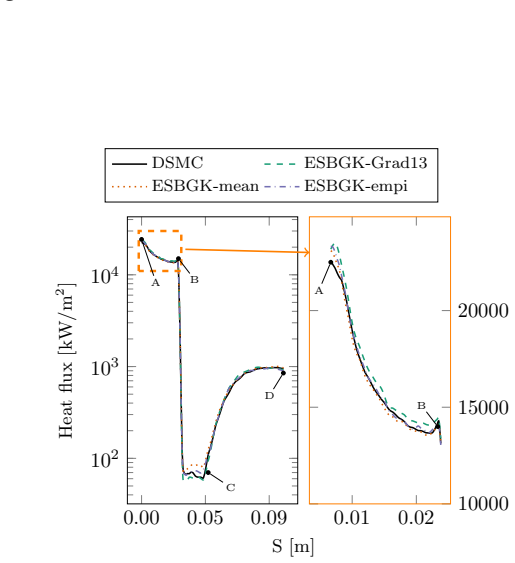
Summary. The paper proposes a multi-species ESBGK model that retains a single relaxation operator per species while matching Boltzmann/Grad-13 VHS production rates for species velocities, temperatures, and pressure tensors (Eqs. 1–4, 33–35). Relative targets u^(α,rel), T^(α,rel), σ^(α,rel) encode inter-species exchange, with BGK self-corrections T^(α,corr) and σ^(α,corr). Three relaxation frequencies are defined: Grad-13 per-species (Eq. 38), mixture-mean (Eq. 39), and their empirical harmonic mean (Eq. 42). Equilibrium is proved under ω_VHS < 1 (§2.2). The model is implemented in PICLas and verified against DSMC for 0D reservoirs (binary/ternary/quaternary, large mass ratios), mass diffusion, supersonic Couette, and hypersonic 70° blunted-cone flows; the empirical frequency consistently performs best and recovers species separation that the prior single-term ESBGK model misses.
Significance. If the construction holds, the work closes a known gap in single-term mixture BGK models: correct species-wise velocity, temperature, and stress relaxation without N operators per species. That combination is practically valuable for particle–continuum hybrid methods in hypersonic and multi-scale rarefied flows, where multi-term models are expensive and prior single-term models fail on temperature/velocity separation at large mass ratios. Strengths include an explicit equilibrium proof (§2.2), transparent derivation of targets from independent Grad-13/VHS production rates (Gupta/Hepp), open discussion of the heat-flux truncation and negative-T fallback, and a broad DSMC verification suite spanning 0D, diffusion, Couette, and 70° cone binary/ternary cases. The empirical frequency is a modelling choice rather than a free fit to the verification data.
major comments (2)
- §2, Eq. (38) and the paragraph preceding it: ν_Grad13 retains only the leading Grad-13 heat-flux term and neglects higher-order inter-species heat-flux exchange so that a single scalar frequency remains usable inside ESBGK. The paper states this limitation clearly and notes that heat flux can only decrease in magnitude under the truncation. Because ν_empi (Eq. 42) is built from ν_Grad13, the best-performing frequency inherits that modelling assumption. The verification suite shows good agreement even in strong non-equilibrium, but the manuscript would be stronger if it quantified (e.g., in one 0D or cone case) the size of the neglected Grad-13 terms relative to the retained term, or stated more explicitly the regime in which the truncation is expected to fail.
- §2.1 and mass-diffusion Cases 2–3: when T^(α,rel) becomes negative the fallback u^(α,rel)=u (then T^(α,rel)=T) is invoked and produces visible local density errors (Figs. 9–10). The procedure preserves conservation but sacrifices the exchange rates that are the model’s central claim. The paper should state more clearly how often the fallback is triggered in the reported runs and whether any of the 70° cone or Couette results required it; without that, the practical robustness of the relative-target construction remains incompletely documented.
minor comments (5)
- Notation: ̂ω^(αβ) and ω^(αβ,VHS) appear with slightly inconsistent hats/subscripts across Eqs. (21)–(28); a single consistent definition would help.
- Table 1 lists N and O as monatomic with VHS parameters; the text elsewhere refers to polyatomic extensions of prior work. A one-sentence clarification that the present verification is monatomic-only would avoid confusion.
- Figs. 1–2, 6: when all three frequencies coincide the legend still lists all three; a note that curves overlie would improve readability.
- §2.2 equilibrium proof: the condition ω_VHS < 1 is sufficient and is noted as not holding for every species in Bird’s tables; a short remark on practical consequences for those species would be useful.
- References: the recent multi-relaxation BGK and Fokker–Planck mixture papers cited in the introduction could be cross-referenced more explicitly when discussing the single-term vs multi-term trade-off.
Circularity Check
Mild post-hoc selection of the empirical frequency; core relative-target construction non-circularly enforces independent Grad-13 rates by design and is verified externally vs DSMC.
-
other
[Section 2 (after Eq. 39, introducing Eq. 42) and cross-reference to Section 4]
"The results in Section 4 show that the average relaxation frequency ν(α)mean produces good heat flux relaxation rates for the mixture as a whole, but over- or underestimates those of the individual species. ... the Grad 13 relaxation frequency ν(α)Grad13 behaves in exactly the opposite manner ... For this reason, a third, empirical approach is proposed here, in which the harmonic mean of the Grad 13 and the mean relaxation frequencies is used: ν(α)empi = 2 / (1/νmean + 1/ν(α)Grad13). ... As shown by the results in Section 4, the empirical relaxation frequency matches both the mean heat fluxes an"
The empirical frequency form is introduced and justified by the complementary errors of the two principled frequencies that are observed only after running the verification suite (Section 4); it is then presented as the consistently best-performing choice. This is mild post-hoc model selection rather than an a-priori derivation, although the paper correctly labels the choice “empirical” and the main relative-target construction remains independent of it.
full rationale
The load-bearing construction defines species-relative targets u^(α,rel), T^(α,rel), σ^(α,rel) (Eqs. 33–35) explicitly from the external Grad-13/VHS production rates of Gupta and Hepp (Eqs. 1–4) so that a single BGK operator per species reproduces those rates by design; this is standard moment-matching model building, not a self-definitional loop or a prediction that reduces to its own input. Equilibrium is proved self-contained (§2.2) under the mild condition ω_VHS < 1. Verification is performed against independent DSMC benchmarks (0D reservoirs, mass diffusion, Couette, 70° cone) rather than against the authors’ prior single-term ESBGK model (which is shown only for contrast). Prior author papers supply the particle framework and mixture Prandtl correction factor but are not used as the source of the production rates or as the truth standard. The sole mild circularity is the empirical harmonic-mean frequency (Eq. 42), which is motivated by complementary over-/under-estimation observed in the verification results themselves and then reported as consistently best; the paper labels it empirical and does not claim first-principles status. No uniqueness theorems, ansatz smuggling, or renaming of known results appear. Score 2 therefore reflects only this minor post-hoc model-selection step.
Assumptions & free parameters
free parameters (2)
- ν_empi harmonic-mean blend
- Prandtl correction factor γ under ∇T^(α)=∇T
assumptions (5)
- domain assumption Grad-13 (lower-order) VHS production rates of Gupta/Hepp correctly represent Boltzmann exchange of species velocity, temperature, and stress for the regimes of interest.
- ad hoc to paper Only the first dominant term of Grad-13 heat-flux relaxation is kept; heat flux of each species is assumed larger than m n Θ u_d so a single scalar ν^(α) suffices.
- domain assumption ESBGK target form with ellipsoidal matrix A^(α) produces the correct mixture Prandtl number once ν is set from viscosity/conductivity mixing rules.
- standard math ω^(αβ,VHS) < 1 is sufficient for the quadratic-form equilibrium proof that stress deviators vanish.
- ad hoc to paper When T^(α,rel) would go negative, setting u^(α,rel)=u then T^(α,rel)=T preserves conservation at the cost of local exchange-rate error.
invented entities (2)
-
Species relative relaxation targets u^(α,rel), T^(α,rel), σ^(α,rel) with BGK self-correction terms T^(α,corr), σ^(α,corr)
-
Empirical harmonic-mean species relaxation frequency ν_empi
Cite this review
Pith. "Pith review of A Multispecies ESBGK Model for Gas Mixtures with Variable Hard Sphere Transport: Theory and Verification." pith.science (2026). https://pith.science/paper/PEME2WHH
@misc{pith2026260709934,
  author       = {Pith},
  title        = {Pith review of: A Multispecies ESBGK Model for Gas Mixtures with Variable Hard Sphere Transport: Theory and Verification},
  year         = {2026},
  howpublished = {\url{https://pith.science/paper/PEME2WHH}},
  note         = {Machine review of arXiv:2607.09934}
}
read the original abstract
A multi-species Bhatnagar-Gross-Krook (BGK) model for gas mixtures is presented that achieves the correct species-wise relaxation of velocities, temperatures, and pressure tensors according to the Boltzmann collision integral, as well as the correct mixture Prandtl number, while retaining a single relaxation term per species. The model extends the ellipsoidal statistical BGK (ESBGK) model by introducing relative relaxation targets for each species, derived from the Variable Hard Sphere (VHS) production rates of the Grad 13 approximation. Three approaches for the species relaxation frequency are proposed and analyzed: a Grad 13-based per-species frequency, a mixture-averaged frequency, and an empirical harmonic mean of the two. The model is implemented in the particle-based code PICLas and verified against Direct Simulation Monte Carlo (DSMC) results for a range of test cases, including 0D reservoir relaxation, mass diffusion, supersonic Couette flow, and hypersonic flow around a 70{\deg} blunted cone for binary and ternary gas mixtures. Across all test cases, the proposed model reproduces the correct Prandtl number, species temperature, velocity relaxation rates and pressure tensor relaxation, with the empirical relaxation frequency consistently yielding the best agreement with DSMC.
Figures


Figures from the paper (20 more)


Reference graph
Works this paper leans on
-
[1]
A consistent bgk-type model for gas mixtures.Journal of Statistical Physics, 106:993–1018, 2002
Pierre Andries, Kazuo Aoki, and Benoit Perthame. A consistent bgk-type model for gas mixtures.Journal of Statistical Physics, 106:993–1018, 2002
2002
-
[2]
Asymptotic analysis of multiple-relaxation-time lattice boltzmann schemes for mixture modeling
Pietro Asinari. Asymptotic analysis of multiple-relaxation-time lattice boltzmann schemes for mixture modeling. Computers & Mathematics with Applications, 55(7):1392–1407, 2008
2008
-
[3]
P. L. Bhatnagar, E. P. Gross, and M. Krook. A Model for Collision Processes in Gases. I. Small Amplitude Processes in Charged and Neutral One-Component Systems. Phys. Rev., 94:511–525, 1954. doi: 10.1103/PhysRev.94.511
-
[4]
G. A. Bird. Molecular Gas Dynamics and the Direct Simulation of Gas Flows . Oxford University Press, New York, 1994
1994
-
[5]
A mixed boltzmann–bgk model for inert gas mixtures
Marzia Bisi, Maria Groppi, Enrico Lucchin, Giorgio Martalo, et al. A mixed boltzmann–bgk model for inert gas mixtures. Kinetic and Related Models, 17(5):674–696, 2024
2024
-
[6]
A general consistent bgk model for gas mixtures
Alexander V Bobylev, Marzia Bisi, Maria Groppi, Giampiero Spiga, and Irina F Potapenko. A general consistent bgk model for gas mixtures. Kinetic & Related Models , 11(6), 2018
2018
-
[7]
S. Brull. An ellipsoidal statistical model for gas mixtures. Commun. Math. Sci., 13:1–13, 2014. doi: 10.4310/CMS.2015.v13.n1.a1
-
[8]
S. Brull. An ellipsoidal statistical model for a monoatomic and a polyatomic gas mixture. Commun. Math. Sci., 19(8):2177–2194, 2021
2021
Show all 51 references
-
[9]
J. M. Burt and I. D. Boyd. A low diffusion particle method for simulating compressible inviscid flows. J. Comput. Phys., 227(9):4653–4670,
-
[10]
doi: 10.1016/j.jcp.2008.01.020
2008 doi
-
[11]
Evaluation of a particle method for the ellipsoidal statistical bhatnagar-gross-krook equation
Jonathan Burt and Iain Boyd. Evaluation of a particle method for the ellipsoidal statistical bhatnagar-gross-krook equation. In 44th AIAA aerospace sciences meeting and exhibit , page 989, 2006
2006
-
[12]
Fasoulas, C.-D
S. Fasoulas, C.-D. Munz, M. Pfeiffer, J. Beyer, T. Binder, S. Copplestone, A. Mirza, P. Nizenkov, P. Ortwein, and W. Reschke. Combining particle-in-cell and direct simulation Monte Carlo for the simulation of reactive plasma flows. Phys. Fluids , 31:072006, 2019. doi: 10.1063/1.5097638
2019 doi
-
[13]
A benchmark study of kinetic models for shock waves
Fei Fei, Haihong Liu, Zhaohui Liu, and Jun Zhang. A benchmark study of kinetic models for shock waves. AIAA Journal, 58(6):2596–2608, 2020. M. Pfeiffer et al.: Preprint submitted to Elsevier Page 25 of 27 VHS Multispecies BGK Model
2020
-
[14]
A unified stochastic particle Bhatnagar-Gross-Krook method for multiscale gas flows
Fei Fei, Jun Zhang, Jing Li, and ZhaoHui Liu. A unified stochastic particle Bhatnagar-Gross-Krook method for multiscale gas flows. J. Comput. Phys., 400:108972, 2020. doi: 10.1016/j.jcp.2019.108972
2020 doi
-
[15]
An efficient algorithm of the unified stochastic particle Bhatnagar-Gross-Krook method for the simulation of multi-scale gas flows
Fei Fei, Yang Ma, Jie Wu, and Jun Zhang. An efficient algorithm of the unified stochastic particle Bhatnagar-Gross-Krook method for the simulation of multi-scale gas flows. Advances in Aerodynamics, 3(1):18, July 2021. ISSN 2524-6992. doi: 10.1186/s42774-021-00069-8
2021 doi
-
[16]
Numerical and theoretical analysis of model equations for multicomponent rarefied gas
Anna Averkievna Frolova. Numerical and theoretical analysis of model equations for multicomponent rarefied gas. Computational Mathematics and Mathematical Physics , 63(12):2257–2266, 2023
2023
-
[17]
M. A. Gallis and J. R. Torczynski. Investigation of the ellipsoidal-statistical BhatnagarGrossKrook kinetic model applied to gas-phase transport of heat and tangential momentum between parallel walls. Phys. Fluids, 23:030601, 2011. doi: 10.1063/1.3558869
2011 doi
-
[18]
A kinetic model for a multicomponent gas
Vicente Garzó, Andres Santos, and J Javier Brey. A kinetic model for a multicomponent gas. Physics of Fluids A: Fluid Dynamics , 1(2): 380–383, 1989
1989
-
[19]
M. H. Gorji and P. Jenny. An efficient particle FokkerPlanck algorithm for rarefied gas flows. J. Comput. Phys. , 262:325–343, 2014. doi: 10.1016/j.jcp.2013.12.046
2014 doi
-
[20]
Discrete unified gas kinetic scheme for all Knudsen number flows: Low-speed isothermal case.Physical Review E, 88(3):033305, September 2013
Zhaoli Guo, Kun Xu, and Ruijie Wang. Discrete unified gas kinetic scheme for all Knudsen number flows: Low-speed isothermal case.Physical Review E, 88(3):033305, September 2013. ISSN 1539-3755, 1550-2376. doi: 10.1103/PhysRevE.88.033305
2013 doi
-
[21]
Mathematical modeling of rarefied gas mixtures
Vinay Kumar Gupta. Mathematical modeling of rarefied gas mixtures . PhD thesis, Dissertation, Aachen, Techn. Hochsch., 2015, 2015
2015
-
[22]
Kinetic model for binary gas mixtures
Bernard B Hamel. Kinetic model for binary gas mixtures. The Physics of Fluids , 8(3):418–425, 1965
1965
-
[23]
A kinetic fokker–planck approach to model hard-sphere gas mixtures
Christian Hepp, Martin Grabe, and Klaus Hannemann. A kinetic fokker–planck approach to model hard-sphere gas mixtures. Physics of Fluids, 32(2), 2020
2020
-
[24]
A kinetic fokker–planck approach for modeling variable hard-sphere gas mixtures
Christian Hepp, Martin Grabe, and Klaus Hannemann. A kinetic fokker–planck approach for modeling variable hard-sphere gas mixtures. AIP Advances, 10(8), 2020
2020
-
[25]
Hild and M
F. Hild and M. Pfeiffer. Multi-species modeling in the particle-based ellipsoidal statistical Bhatnagar-Gross-Krook method including internal degrees of freedom. Journal of Computational Physics, 514:113226, 2024. ISSN 0021-9991. doi: https://doi.org/10.1016/j.jcp.2024.113226
2024 doi
-
[26]
H. L. Holway Jr. New Statistical Models for Kinetic Theory: Methods of Construction. Phys. Fluids , 9:1658–1673, 1966. doi: 10.1063/1.1761920
1966 doi
-
[27]
Hossein Gorji
Eunji Jun, Marcel Pfeiffer, Luc Mieussens, and M. Hossein Gorji. Comparative Study Between Cubic and Ellipsoidal FokkerPlanck Kinetic Models. AIAA J., 57(6):2524–2533, 2019. doi: 10.2514/1.J057935
2019 doi
-
[28]
A particle multi-relaxation bhatnagar-gross-krook method for rarefied monatomic gas mixtures
Inchan Kim, Joonbeom Kim, Woonghwi Park, and Eunji Jun. A particle multi-relaxation bhatnagar-gross-krook method for rarefied monatomic gas mixtures. arXiv preprint arXiv:2604.24244, 2026
2026 arXiv
-
[29]
A particle fokker–planck method for rarefied gas flows of monatomic mixtures
Sanghun Kim and Eunji Jun. A particle fokker–planck method for rarefied gas flows of monatomic mixtures. Physics of Fluids, 37(1), 2025
2025
-
[30]
A stochastic particle method based on the fokker–planck master equation for rarefied gas flows of diatomic mixtures
Sanghun Kim and Eunji Jun. A stochastic particle method based on the fokker–planck master equation for rarefied gas flows of diatomic mixtures. Physics of Fluids, 37(3), 2025
2025
-
[31]
A consistent kinetic model for a two-component mixture with an application to plasma
Christian Klingenberg, Marlies Pirner, and Gabriella Puppo. A consistent kinetic model for a two-component mixture with an application to plasma. arXiv preprint arXiv:1806.09462, 2018
2018 arXiv
-
[32]
Kinetic es-bgk models for a multi-component gas mixture
Christian Klingenberg, Marlies Pirner, and Gabriella Puppo. Kinetic es-bgk models for a multi-component gas mixture. In Theory, Numerics and Applications of Hyperbolic Problems II: Aachen, Germany, August 2016 , pages 195–208. Springer, 2018
2016
-
[33]
Kinetic modelling of rarefied gas mixtures with disparate mass in strong non-equilibrium flows
Qi Li, Jianan Zeng, and Lei Wu. Kinetic modelling of rarefied gas mixtures with disparate mass in strong non-equilibrium flows. Journal of Fluid Mechanics, 1001:A5, 2024
2024
-
[34]
Unified gas-kinetic wave-particle methods I: Continuum and rarefied gas flow
Chang Liu, Yajun Zhu, and Kun Xu. Unified gas-kinetic wave-particle methods I: Continuum and rarefied gas flow. Journal of Computational Physics, 401:108977, January 2020. ISSN 0021-9991. doi: 10.1016/j.jcp.2019.108977
2020 doi
-
[36]
A fokker–planck model of the boltzmann equation with correct prandtl number
Julien Mathiaud and Luc Mieussens. A fokker–planck model of the boltzmann equation with correct prandtl number. Journal of Statistical Physics, 162:397–414, 2016
2016
-
[37]
Discrete velocity model and implicit scheme for the bgk equation of rarefied gas dynamics.Mathematical Models and Methods in Applied Sciences , 10(08):1121–1149, November 2000
Luc Mieussens. Discrete velocity model and implicit scheme for the bgk equation of rarefied gas dynamics.Mathematical Models and Methods in Applied Sciences , 10(08):1121–1149, November 2000. ISSN 0218-2025. doi: 10.1142/S0218202500000562
-
[38]
M. Pfeiffer. Extending the particle ellipsoidal statistical Bhatnagar-Gross-Krook method to diatomic molecules including quantized vibrational energies. Phys. Fluids, 30:116103, 2018. doi: 10.1063/1.5054961
2018 doi
-
[39]
M. Pfeiffer. Particle-based fluid dynamics: Comparison of different Bhatnagar-Gross-Krook models and the direct simulation Monte Carlo method for hypersonic flows. Phys. Fluids, 30:106106, 2018. doi: 10.1063/1.5042016
2018 doi
-
[40]
Pfeiffer and M
M. Pfeiffer and M. H. Gorji. Adaptive particlecell algorithm for FokkerPlanck based rarefied gas flow simulations. Comput. Phys. Commun., 213:1–8, 2017. doi: 10.1016/j.cpc.2016.11.003
2017 doi
-
[41]
Pfeiffer, A
M. Pfeiffer, A. Mirza, and P. Nizenkov. Extension of Particle-based BGK Models to Polyatomic Species in Hypersonic Flow around a Flat-faced Cylinder. AIP Conference Proceedings, 2132:100001, 2019. doi: 10.1063/1.5119596
2019 doi
-
[42]
Evaluation of particle-based continuum methods for a coupling with the direct simulation Monte Carlo method based on a nozzle expansion
M Pfeiffer, A Mirza, and P Nizenkov. Evaluation of particle-based continuum methods for a coupling with the direct simulation Monte Carlo method based on a nozzle expansion. Phys. Fluids, 31:073601, 2019. doi: 10.1063/1.5098085
2019 doi
-
[43]
Pfeiffer, A
M. Pfeiffer, A. Mirza, and P. Nizenkov. Multi-species modeling in the particle-based ellipsoidal statistical BhatnagarGrossKrook method for monatomic gas species. Phys. Fluids, 33:036106, 2021. doi: 10.1063/5.0037915
2021 doi
-
[44]
Pfeiffer, F
M. Pfeiffer, F. Garmirian, and M. H. Gorji. Exponential Bhatnagar-Gross-Krook integrator for multiscale particle-based kinetic simulations. Phys. Rev. E, 106:025303, 2022. doi: 10.1103/PhysRevE.106.025303
2022 doi
-
[45]
An optimized collision-averaged variable soft sphere parameter set for air, carbon, and corresponding ionized species
Marcel Pfeiffer. An optimized collision-averaged variable soft sphere parameter set for air, carbon, and corresponding ionized species. Physics of Fluids, 34(11), 2022
2022
-
[46]
A shakhov-based bhatnagar-gross-krook model for polyatomic molecules and for atomic as well as polyatomic mixtures, 2026
Marcel Pfeiffer and Franziska Tuttas. A shakhov-based bhatnagar-gross-krook model for polyatomic molecules and for atomic as well as polyatomic mixtures, 2026. URL https://arxiv.org/abs/2604.01377. M. Pfeiffer et al.: Preprint submitted to Elsevier Page 26 of 27 VHS Multispecies...
2026
-
[47]
M. Pirner. A Review on BGK Models for Gas Mixtures of Mono and Polyatomic Molecules. Fluids, 6:393, 2021. doi: 10.3390/fluids6110393
2021
-
[48]
Schwartzentruber and I.D
T.E. Schwartzentruber and I.D. Boyd. A hybrid particle-continuum method applied to shock waves. J. Comput. Phys., 215(2):402–416, 2006. ISSN 0021-9991. doi: https://doi.org/10.1016/j.jcp.2005.10.023
2006 doi
-
[49]
E. M. Shakhov. Generalization of the Krook Kinetic Relaxation Equation. Fluid Dyn., 33:95–96, 1968. doi: 10.1007/BF01029546
1968 doi
-
[50]
B. N. Todorova and R. Steijl. Derivation and numerical comparison of Shakhov and Ellipsoidal Statistical kinetic models for a monoatomic gas mixture. Eur. J. Mech. B/Fluids, 76:390–402, 2019. doi: 10.1016/j.euromechflu.2019.04.001
2019 doi
-
[51]
B. N. Todorova, C. White, and R. Steijl. Modeling of nitrogen and oxygen gas mixture with a novel diatomic kinetic model. AIP Adv., 10: 095218, 2020. doi: 10.1063/5.0021672
2020 doi
-
[52]
Particle-based hybrid and multiscale methods for nonequilibrium gas flows
Jun Zhang, Benzi John, Marcel Pfeiffer, Fei Fei, and Dongsheng Wen. Particle-based hybrid and multiscale methods for nonequilibrium gas flows. Adv. Aerodyn., 1:1–15, 2019. doi: 10.1186/s42774-019-0014-7. M. Pfeiffer et al.: Preprint submitted to Elsevier Page 27 of 27
2019 doi
Reviewed July 14, 2026 · model on record in the stance chip above.
Discussion (0). Continue with ORCID to comment.