REVIEW 3 major objections 5 minor 77 references
Calibrated correlation between heavy-quark masses and Hadronic Vacuum Polarization observables at the precision frontier
T0 review · 3 major / 5 minor · reviewed 2026-08-14 · deepseek-v4-flash
Pith's one-line read The charm and bottom quark masses and their hadronic vacuum polarization contributions are two views of one spectral integral, and the paper determines both at once from a single calibrated sum rule.
desk verdict A genuine new method—promoting the HVP kernel to the weight of a moment sum rule—presented with unusual honesty, but the one-parameter continuum ansatz carries the entire error budget and is calibrated only through the zeroth moment. read the letter →
The pith
A machine-rendered reading of the paper's core claim, the machinery that carries it, and where it could break.
The reading
What carries the argument
The carrier of the argument is the generalized kernel-weighted moment $A_n[K]$ of Eq. (23), which reduces to the ordinary moment $M_n$ when $K=1$ and to the HVP integral itself at $n=1$ when $K=\hat K^{(2)}$. The zeroth moment, defined through the ultraviolet limit of the dispersion relation, is the piece most sensitive to the continuum and is what breaks the near-degeneracy between the mass and the continuum shape parameter $\lambda_3^q$; imposing $A_n^{\rm th}[K]=A_n^{\rm had}[K]$ for a pair that includes it fixes $m_q$ and $\lambda_3^q$ simultaneously.
What would settle it
A sub-percent measurement of $R(s)$ for $e^+e^-\to$ hadrons across the open-charm window from about 3.7 to 4.8 GeV would settle it: computing the kernel-weighted zeroth and second moments directly from those data must give a continuum shape parameter compatible with the sum-rule value. A lattice computation of $a_\mu^{c,\mathrm{LO}}$ with uncertainty below $0.05\times 10^{-10}$ that disagrees with $14.46(13)\times 10^{-10}$ would likewise falsify the extraction.
Extended reading notes
Core claim
The central claim is that the heavy-quark mass $\hat m_q$ and its HVP contribution $a_\mu^{q}$ are determined by the same spectral function $R_q(s)$ through different kernels, so a consistent sum-rule determination must fix them jointly. The paper defines generalized moments $A_n[K]=\int ds\, K(s)R_q(s)/s^{n+1}$ and imposes equality between the perturbative and hadronic evaluations, Eq. (33), for a pair of moments that always includes the zeroth moment. With $K=\hat K^{(2)}$ as the weight, the pair $(M_0,M_2)$ for charm and $(M_0,M_6)$ for bottom yields the quoted masses and $a_\mu$ values together with their correlation matrices. Because the two quantities are anticorrelated, quoting them as a pair reduces the uncertainty on $a_\mu$ compared with treating the mass as an external input, and the residual mismatch of the two evaluations at other moment pairs becomes a direct measure of duality violation and continuum-model systematics.
Load-bearing premise
The load-bearing premise is that one free shape parameter, $\lambda_3^q$, accurately describes the smooth part of the production cross-section above the charm and bottom thresholds for every weighting kernel and every moment order used; if the true spectrum bends differently from that single-parameter curve, the extracted masses and the muon g-2 pieces shift together.
Editorial extensions
If this is right
- The extracted $\hat m_q$ and $a_\mu^q$ must be reported as a correlated pair; changing one while holding the other fixed is inconsistent with the sum-rule framework.
- Compared with a naive data-driven estimate that ignores the correlation, the quoted uncertainty on $a_\mu^{c,\mathrm{LO}}$ drops by about 45% and that on $a_\mu^{b,\mathrm{LO}}$ by about 90%.
- The residual spread between the theory-side and hadronic-side evaluations at moment pairs other than the calibration pair becomes an observable-specific diagnostic of quark-hadron duality violations and continuum-model ambiguity.
- The same generalized construction applies to any observable expressible as a kernel-weighted dispersive integral over the same spectral function, provided the kernel admits the required analytic subtractions.
Reading between the lines
- If the anticorrelation is as strong as reported, several existing heavy-quark $a_\mu$ values that treat the mass as external input may be quoting inflated uncertainties; re-running those analyses with the correlation could sharpen them without new data.
- The likely next test is the light-quark sector, where the data-versus-lattice HVP tension lives; the $\hat K^{(4a)}$ example in this paper indicates the main obstacle there will be finding kernels with the right subtraction properties, not the sum-rule matching itself.
- A direct check of the method's reach would be to apply the generalized condition to the NLO kernels $\hat K^{(4a)}_{\rm sub}$ and $\hat K^{(4b)}$ at several moment pairs and see whether the moment-pair independence that holds at LO survives, exposing where the one-parameter continuum ansatz breaks.
Editorial analysis
A structured set of objections, weighed in public.
Referee Report
Summary. The paper proposes a generalized moment-sum-rule framework in which the HVP kernel K(s) is promoted to the weight of the moment, so that the heavy-quark mass m_q and the heavy-quark contribution to a_mu are extracted simultaneously from the same hadronic spectral function. Specializing to K = K^(2), the authors obtain m_c(m_c) = 1267.1(6.8) MeV with a_c(LO) = 14.46(13) x 10^-10, and m_b(m_b) = 4182.3(7.2) MeV with a_b(LO) = 0.3009(17) x 10^-10, together with NLO results for the 4a and 4b kernels. The paper includes detailed uncertainty breakdowns, correlation matrices, and a data-driven calibration of the continuum-shape parameter lambda_3^q. The central claim is that the mass and the HVP contribution are not independent observables, and that the anticorrelation between them can be exploited to reduce the final uncertainty, with the residual spread between theory-side and hadronic-side evaluations serving as a diagnostic of duality/model systematics.
Significance. If the framework is correct, it provides a genuinely new way to organize heavy-quark sum rules: instead of treating a_mu as a derived quantity after a mass determination, it determines both from one self-consistent condition, with an explicit correlation built in. The paper is unusually transparent about the point where the construction becomes circular, namely the 0th+1st moment pair with K = K^(2), and deliberately adopts other pairs for the final numbers. The explicit input tables, correlated uncertainty propagation, and correlation matrices are valuable and make the analysis reproducible in principle. The claimed uncertainty reductions relative to previous dispersive evaluations, roughly 45% for charm and 90% for bottom, are striking and would be important if the error budget can be defended. The main weakness, however, is that the entire extraction relies on a one-parameter continuum ansatz whose uncertainty is calibrated only through a partial zeroth moment in a limited energy window; this is the load-bearing assumption that needs further scrutiny before the quoted precision can be accepted.
major comments (3)
- [Sec. IV, Eq. (35)] The continuum model in Eq. (9) has a single free shape parameter lambda_3^q, which is assumed to describe R_cont(s) above the open-heavy-flavor threshold for every kernel and every moment order used in Eq. (33). The data calibration in Sec. V.B, however, constrains only the partial zeroth moment over finite windows (up to 4.8 GeV for charm and 11.2 GeV for bottom), as summarized in Table IV. This does not independently validate the kernel-weighted higher moments that carry the bulk of the a_mu information. Because the spread across moment pairs shown in Figs. 3b and 4b is generated inside the same ansatz, it cannot expose a common model error. I therefore request a direct sensitivity test, for example allowing a second shape parameter for the O(m^4/s^2) term or an n-dependent lambda_3, and an estimate of the shift in both m_q and a_mu when the calibrated window and the continuum shape are varied; the resulting shift should be included in the error budget.
- [Sec. V.A, Tables II and III] The extra Euclidean term in A_0^{pQCD}[K^(i)] is dropped with the statement that it is numerically suppressed at the per-mil level, but no numerical estimate or bound is provided. Since the zeroth moment is one of the two constraints used in Eq. (33) to fix m_q and lambda_3^q, even a per-mil shift in A_0 can propagate into a larger shift in the extracted mass and in a_mu. The authors should quantify this term explicitly, or include it in the analysis, before the quoted uncertainties can be considered complete.
- [Sec. V.A, Tables II and III] The final a_mu values are described as the average of the central values and uncertainties of the theory-side and hadronic-side evaluations at the default moment pair. These two evaluations are strongly correlated (rho = 0.90 for charm and rho = 0.81 for bottom in Tables VI and VII), so a simple arithmetic average of their uncertainties is not a statistically defined combination. The paper should state the exact prescription used to form the blue band, including whether the covariance is used, and should report the resulting covariance or correlation. This is directly relevant to the central precision claim, since the quoted errors of 0.13 x 10^-10 and 0.0017 x 10^-10 are the headline results.
minor comments (5)
- [Sec. V.B] There is a typo in the sentence 'due to the extensions versos these previous works'; 'versos' should be 'versus' or 'with respect to'.
- [Fig. 10] The label 'HPQCD-14' appears twice in the same figure; the two points should be distinguished, for example by citing the two different HPQCD determinations explicitly.
- [Eq. (35)] The phrase 'scope at the per-mil level' is unclear; it should be rephrased as, for example, 'accurate at the per-mil level'.
- [Sec. V.A] The description of the blue band as 'generously covers' the deviations should be replaced by a numerical prescription for how the band width is obtained from the two evaluations.
- [Abstract] The abstract and main text use inconsistent formatting for the muon symbol and for the units of a_mu; a uniform notation would improve readability.
Circularity Check
Final central values avoid the explicit self-pinning of the (A0,A1) pair; one acknowledged by-construction identity is confined to an illustrative point, while the continuum model is a correctness risk rather than circularity.
-
self definitional
[Sec. IV (after Eq. 33) and Sec. V A, Fig. 3b, point '0th+1st']
"Using a pair including the n=1 generalized moment, A_1[\hat K^{(i)}], together with the zeroth moment, to fix m_q and \lambda_3 makes the two descriptions of a^{(i)}_\mu coincide exactly by construction."
A_1[\hat K] is defined in Eq. (23) as the same integral over the hadronic spectral function that enters a_\mu in Eq. (1), up to a known prefactor. Imposing Eq. (33) for the pair (A_0[\hat K], A_1[\hat K]) therefore uses the equality of the two descriptions of a_\mu as one of the two equations that fix (m_q, \lambda_3), so the 'agreement' of the blue solid and empty points at 0th+1st is an identity, not a test. The paper openly acknowledges this and does not use that pair for the final quotes: the adopted pairs are (A_0[\hat K^{(2)}], A_2[\hat K^{(2)}]) for charm and (A_0[\hat K^{(2)}], A_6[\hat K^{(2)}]) for bottom. The quoted a_\mu values are therefore not literally fitted to themselves; the circularity is confined to the illustrative self-consistency point.
full rationale
The central derivation is otherwise self-contained: masses and HVP contributions are determined by solving Eq. (33) for a pair of generalized moments and then evaluating a_\mu from the same spectral function with the fitted parameters, with the default pairs avoiding the n=1 HVP moment whose agreement is definitional. The paper explicitly flags the by-construction case and uses other moment pairs for its quoted results, so the final numbers are not statistically forced to reproduce a_\mu. The calibration of \lambda_3^{q,exp} against experimental moments is used only to assign an uncertainty, not to set the central value, as stated in Sec. V B. The main residual concern, the one-parameter continuum ansatz of Eq. (9) controlling both the mass and a_\mu, is a modeling and correctness risk (the data calibration covers only partial zeroth moments and limited energy windows), not a circular reduction. Self-citations to Refs. [7-9] and [51] supply the adopted formalism and a lattice comparison, but the framework extends the ansatz and is checked against independent experimental data; they do not by themselves force the claimed result. Score 4 reflects the explicit self-definitional identity at (A_0, A_1), which is acknowledged and avoided in the final extraction.
Assumptions & free parameters
free parameters (2)
- λ3^q (continuum shape parameter, charm and bottom) =
not stated explicitly for the sum-rule solution; λ3^exp = 0.673(86) (charm, K=Khat) and 0.696(45) (bottom, K=Khat) for…
- κ (global normalization of sub-threshold data) =
0.998 ± 0.011
assumptions (6)
- domain assumption The continuum ansatz Eq. (9), with a single shape parameter λ3^q, correctly describes the hadronic spectral function above the open-heavy-flavor threshold for all kernels and moment orders used.
- domain assumption Global quark-hadron duality holds for the integrated moments, meaning the pQCD expression can be equated to the hadronic integral on average.
- standard math The high-energy expansion of the HVP kernels, Eq. (26), truncated at j=3, is accurate at the quoted precision.
- domain assumption The perturbative QCD series for the vector correlator through O(α_s^3), with the truncation estimate of Eq. (19), is valid for the moments used.
- domain assumption The logarithmic-moment coefficients C^(i)_{n,r} reconstructed following Refs. [21,33] are correct.
- ad hoc to paper The additional term in the generalized zeroth moment, Eq. (35), is numerically suppressed and can be dropped at the per-mil level.
Cite this review
Pith. "Pith review of Calibrated correlation between heavy-quark masses and Hadronic Vacuum Polarization observables at the precision frontier." pith.science (2026). https://pith.science/paper/PI55U3JH
@misc{pith2026260810112,
  author       = {Pith},
  title        = {Pith review of: Calibrated correlation between heavy-quark masses and Hadronic Vacuum Polarization observables at the precision frontier},
  year         = {2026},
  howpublished = {\url{https://pith.science/paper/PI55U3JH}},
  note         = {Machine review of arXiv:2608.10112}
}
abstract
The theoretical prediction of the muon anomalous magnetic moment $a_\mu$ depends crucially on the Hadronic Vacuum Polarization (HVP), and the tension between its dispersive and lattice-QCD determinations remains unresolved. We show that part of this puzzle can be addressed in the heavy-quark sector, where both descriptions are theoretically clean, by recognizing that the heavy-quark mass and its contribution to $a_\mu$ are not independent quantities: both follow from integrals of the same hadronic spectral function, differing only in their integration kernel. Promoting this kernel to a free choice within the relativistic QCD Sum Rules used to determine heavy-quark masses, we break with the conventional notion of a single valid sum rule and instead determine the mass and its HVP contribution simultaneously, from a common, self-consistent framework. This intrinsic construction exploits the anticorrelation between the two quantities to sharpen the final uncertainty, and turns the residual disagreement between the perturbative and hadronic descriptions of the observable into a direct observable-specific diagnostic of residual theory/model dependence, including duality-violation and continuum-modeling effects, unavailable to a determination of the mass alone. We obtain $a_\mu^{\rm HVP_{c+b},LO} =(14.46(13)+0.3009(17))\times 10^{-10}$ at leading and $a_\mu^{\rm HVP_{c+b}, NLO_{a,b}} = ( -0.5738(95) - 0.01822(13) )\times 10^{-10}$ at next-to-leading order, for charm and bottom contributions, respectively. We compare our next-to-leading-order results with its first available lattice determination, finding good agreement in the charm sector. As a byproduct, we obtain $\hat m_c(\hat m_c)=1267.1(6.8)$ MeV and $\hat m_b(\hat m_b) = 4182.3(7.2)$ MeV, with unprecedented phenomenological precision.
Figures


Figures from the paper (9 more)


Reference graph
Works this paper leans on
-
[1]
Jegerlehner, Springer Tracts Mod
F. Jegerlehner, Springer Tracts Mod. Phys.274(2017), pp.1-693 Springer, 2017,
work page 2017
-
[2]
13 in Appendix D, for the charm case)
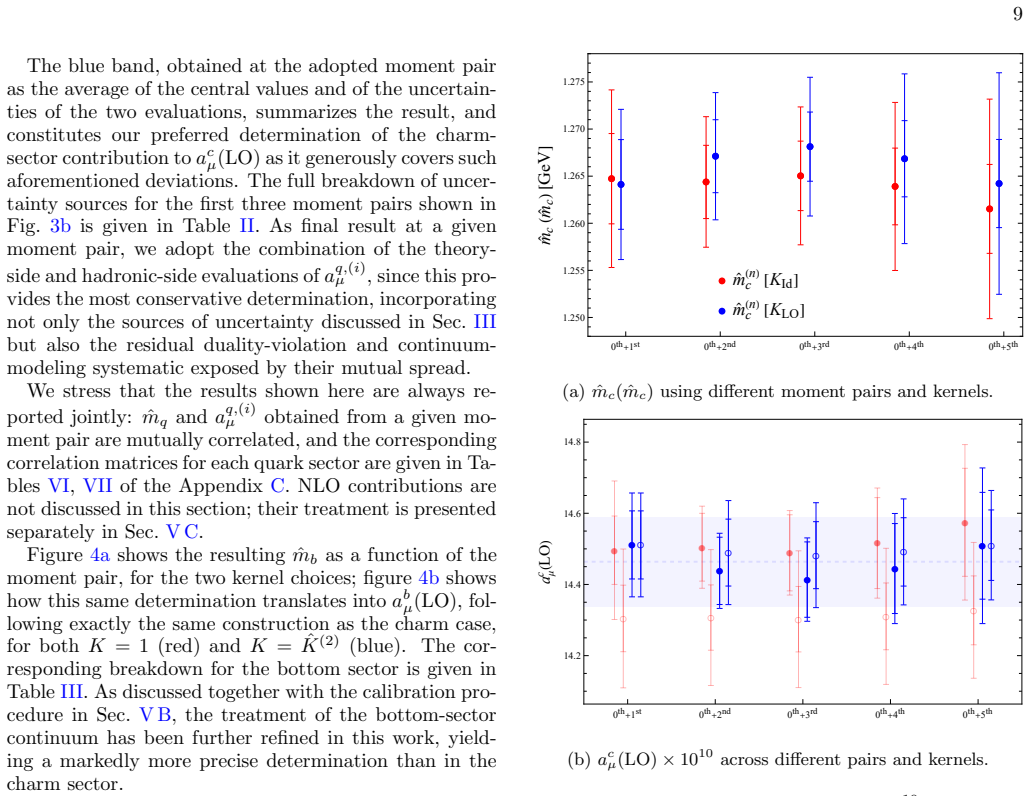
at the intersection of two such bands (c.f., Fig. 13 in Appendix D, for the charm case). Two evaluations ofa c µ(LO) then follow from the same ex- tracted pair: a theory-side evaluation (circle), obtained by inserting ˆmc into Eq. (29), the generalized analogue of Eq. (13), combined with the condensate contribution of Eq. (17); and a hadronic-side evaluat...
-
[3]
plane rather than a single curve, and a given pair of moments fixes ( ˆmq, λq
-
[4]
into the same ˆK (2)(s)/s2- 8 TABLE II: Charm-sector results for ˆm c and the leading-order contribution toa c µ(LO) (in units of 10 −10), obtained from the sum rule weighted by ˆK (2), for the moment pairs (M 0,M 1), (M0,M 2), and (M 0,M 3), together with the breakdown of the uncertainty sources discussed in Sec. III.a c,th µ denotes the theory-side dete...
-
[5]
(5), carries no direct relation toa c µ(LO), i.e
BecauseK= 1 was used to fix the mass, andM 1 in Eq. (5), carries no direct relation toa c µ(LO), i.e. Eq. (1), there is no reason for the two evaluations (solid and empty circles) to agree, and indeed a visible offset is already present at this first pair. Even though we use the same kernel to obtain the mass, to obtain ac µ(LO) we use another kernel, and...
-
[6]
If it does, the result is reassessed and the uncertainty calibrated. We describe here the extraction ofλ q,exp 3 for both quark sectors. The experimental moments entering this calibration were already obtained, forK= 1, in Refs. [8, 9] for the charm and bottom sectors, respectively. Since the generalized sum rules of Sec. IV additionally require the corre...
work page 2021
-
[7]
The choice of the particular pair of moments is crucial for the result
plane. The choice of the particular pair of moments is crucial for the result. These figures show the results of individual mo- ments’ sum rule where each moment equation is solved via a parameter scan of the variables ( ˆmc, λc 3). Colored bands indicate the uncertainty propagation. The com- bination 0 th + 3rd is the one most perpendicular, thus introdu...
-
[8]
A pair of moments determines ( ˆmc, λc
plane along which the consistency conditionA had n − Ath n = 0 holds for a given momentn, including its uncertainty, for (a) the ordinary moments,K= 1, and (b) the moments weighted by the kernel of the observable,K= ˆK (2). A pair of moments determines ( ˆmc, λc
Show all 77 references
-
[9]
19 TABLE IX: Experimental data entering the continuum analysis for the charm sector
at the intersection of the corresponding two bands; the degree to which the remaining bands also pass through that intersection reflects the consistency of the extraction. 19 TABLE IX: Experimental data entering the continuum analysis for the charm sector. Experiment Year Ener...
-
[10]
Aoyama, N
T. Aoyama, N. Asmussen, M. Benayoun, J. Bijnens, T. Blum, M. Bruno, I. Caprini, C. M. Carloni Calame, M. C` e and G. Colangelo,et al.Phys. Rept.887(2020), 1-166 [arXiv:2006.04822 [hep-ph]]
2020 arXiv
-
[11]
Aliberti, T
R. Aliberti, T. Aoyama, E. Balzani, A. Bashir, G. Ben- ton, J. Bijnens, V. Biloshytskyi, T. Blum, D. Boito and M. Bruno,et al.Phys. Rept.1143(2025), 1-158 [arXiv:2505.21476 [hep-ph]]
2025 arXiv
-
[12]
V. A. Novikov, L. B. Okun, M. A. Shifman, A. I. Vain- shtein, M. B. Voloshin and V. I. Zakharov, Phys. Rept. 41, 1 (1978)
1978
-
[13]
M. A. Shifman, A. I. Vainshtein and V. I. Zakharov, Nucl. Phys. B147, 385 (1979)
1979
-
[14]
M. A. Shifman, A. I. Vainshtein and V. I. Zakharov, Nucl. Phys. B147, 448 (1979)
1979
-
[15]
Erler and M
J. Erler and M. x. Luo, Phys. Lett. B558(2003), 125-131 [arXiv:hep-ph/0207114 [hep-ph]]
2003 arXiv
-
[16]
Erler, P
J. Erler, P. Masjuan and H. Spiesberger, Eur. Phys. J. C 77(2017) no.2, 99 [arXiv:1610.08531 [hep-ph]]
2017 arXiv
-
[17]
Erler, P
J. Erler, P. Masjuan and H. Spiesberger, Eur. Phys. J. C 82(2022) no.11, 1023 [arXiv:2203.02348 [hep-ph]]
2022 arXiv
-
[18]
Bouchiat and L
C. Bouchiat and L. Michel, J. Phys. Radium22(1961) no.2, 121-121
1961
-
[19]
S. J. Brodsky and E. De Rafael, Phys. Rev.168(1968), 1620-1622
1968
-
[20]
B. E. Lautrup and E. De Rafael, Phys. Rev.174(1968), 1835-1842
1968
-
[21]
Gourdin and E
M. Gourdin and E. De Rafael, Nucl. Phys. B10(1969), 667-674
1969
-
[22]
B. A. Kniehl, Acta Phys. Polon. B27(1996), 3631-3644 [arXiv:hep-ph/9607255 [hep-ph]]
1996 arXiv
-
[23]
Takahashiet al.[Particle Data Group], Int
F. Takahashiet al.[Particle Data Group], Int. J. Mod. Phys. A 41, 2630011 (2026)
2026
-
[24]
Dehnadi, A
B. Dehnadi, A. H. Hoang, V. Mateu and S. M. Zebarjad, JHEP09(2013), 103 [arXiv:1102.2264 [hep-ph]]
2013 arXiv
-
[25]
K. G. Chetyrkin, R. V. Harlander and J. H. Kuhn, Nucl. Phys. B586(2000), 56-72 [erratum: Nucl. Phys. B634 (2002), 413-414] [arXiv:hep-ph/0005139 [hep-ph]]
2000 arXiv
-
[26]
K. G. Chetyrkin, J. H. Kuhn and M. Steinhauser, Nucl. Phys. B505(1997), 40-64 [arXiv:hep-ph/9705254 [hep- ph]]
1997 arXiv
-
[27]
Maier, P
A. Maier, P. Maierhofer and P. Marquard, Nucl. Phys. B 797(2008), 218-242 [arXiv:0711.2636 [hep-ph]]
2008 arXiv
-
[28]
Y. Kiyo, A. Maier, P. Maierhofer and P. Marquard, Nucl. Phys. B823(2009), 269-287 [arXiv:0907.2120 [hep-ph]]
2009 arXiv
-
[29]
Greynat, P
D. Greynat, P. Masjuan and S. Peris, Phys. Rev. D85(2012), 054008 doi:10.1103/PhysRevD.85.054008 [arXiv:1104.3425 [hep-ph]]
2012 arXiv
-
[30]
Tarrach, Nucl
R. Tarrach, Nucl. Phys. B183(1981), 384-396
1981
-
[31]
Fleischer, F
J. Fleischer, F. Jegerlehner, O. V. Tarasov and O. L. Veretin, Nucl. Phys. B539(1999), 671-690 [er- ratum: Nucl. Phys. B571(2000), 511-512] [arXiv:hep- ph/9803493 [hep-ph]]
1999
-
[32]
D. J. Broadhurst, J. Fleischer and O. V. Tarasov, Z. Phys. C60(1993), 287-302 [arXiv:hep-ph/9304303 [hep- ph]]
1993 arXiv
-
[33]
P. Ball, M. Beneke and V. M. Braun, Nucl. Phys. B452 (1995), 563-625 [arXiv:hep-ph/9502300 [hep-ph]]
1995 arXiv
-
[34]
K. G. Chetyrkin and M. Steinhauser, Nucl. Phys. B573 (2000), 617-651 [arXiv:hep-ph/9911434 [hep-ph]]
2000 arXiv
-
[35]
Melnikov and T
K. Melnikov and T. v. Ritbergen, Phys. Lett. B482 (2000), 99-108 [arXiv:hep-ph/9912391 [hep-ph]]
2000 arXiv
-
[36]
D. J. Broadhurst, P. A. Baikov, V. A. Ilyin, J. Fleischer, O. V. Tarasov and V. A. Smirnov, Phys. Lett. B329 (1994), 103-110 [arXiv:hep-ph/9403274 [hep-ph]]
1994 arXiv
-
[37]
J. H. Kuhn, M. Steinhauser and C. Sturm, Nucl. Phys. B778(2007), 192-215 [arXiv:hep-ph/0702103 [hep-ph]]
2007 arXiv
-
[38]
Chetyrkin, J
K. Chetyrkin, J. H. Kuhn, A. Maier, P. Maierhofer, P. Marquard, M. Steinhauser and C. Sturm, Theor. Math. Phys.170(2012), 217-228 [arXiv:1010.6157 [hep- ph]]
2012 arXiv
-
[39]
C. A. Dominguez, L. A. Hernandez, K. Schilcher and H. Spiesberger, JHEP03(2015), 053 [arXiv:1410.3779 [hep-ph]]
2015 arXiv
-
[40]
Krause, Phys
B. Krause, Phys. Lett. B390(1997), 392-400 [arXiv:hep- ph/9607259 [hep-ph]]
1997
-
[41]
Greynat and S
D. Greynat and S. Peris, Phys. Rev. D82(2010), 034030 [erratum: Phys. Rev. D82(2010), 119907] doi:10.1103/PhysRevD.82.119907 [arXiv:1006.0643 [hep- ph]]
2010 arXiv
-
[42]
Barbieri and E
R. Barbieri and E. Remiddi, Nucl. Phys. B90(1975), 233-266
1975
-
[43]
Balzani, S
E. Balzani, S. Laporta and M. Passera, Phys. Lett. B 834(2022), 137462 [arXiv:2112.05704 [hep-ph]]
2022 arXiv
-
[44]
Keshavarzi, D
A. Keshavarzi, D. Nomura and T. Teubner, Phys. Rev. D97(2018) no.11, 114025 [arXiv:1802.02995 [hep-ph]]
2018 arXiv
-
[45]
Boito and M
D. Boito and M. Caram, Phys. Rev. D112(2025) no.9, 9 [arXiv:2509.12956 [hep-ph]]
2025
-
[46]
A. L. Kataev and K. Y. Todyshev, [arXiv:2603.29803 [hep-ph]]
-
[47]
Aubertet al.[BaBar], Phys
B. Aubertet al.[BaBar], Phys. Rev. Lett.102(2009), 012001 [arXiv:0809.4120 [hep-ex]]
2009 arXiv
-
[48]
Santelet al.[Belle], Phys
D. Santelet al.[Belle], Phys. Rev. D93(2016) no.1, 011101 [arXiv:1501.01137 [hep-ex]]
2016 arXiv
-
[49]
X. K. Dong, X. H. Mo, P. Wang and C. Z. Yuan, Chin. Phys. C44(2020) no.8, 083001 [arXiv:2002.09838 [hep- ph]]
2020 arXiv
-
[50]
Colquhoun, R
B. Colquhoun, R. J. Dowdall, C. T. H. Davies, K. Horn- bostel and G. P. Lepage, Phys. Rev. D91(2015) no.7, 074514 [arXiv:1408.5768 [hep-lat]]
2015 arXiv
-
[51]
C. T. H. Davieset al.[Fermilab Lattice, LATTICE- HPQCD and MILC], Phys. Rev. D101(2020) no.3, 034512 [arXiv:1902.04223 [hep-lat]]
2020 arXiv
-
[52]
Bodenstein, C
S. Bodenstein, C. A. Dominguez and K. Schilcher, Phys. Rev. D85(2012), 014029 [erratum: Phys. Rev. D87 (2013) no.7, 079902] [arXiv:1106.0427 [hep-ph]]
2012 arXiv
-
[53]
J. P. A. Erler, P. Masjuan and H. Spiesberger, PoS CHARM2020(2021), 012
2021
-
[54]
P. D. Kennedy, J. Erler and H. Spiesberger, [arXiv:2111.13016 [hep-ph]]
-
[55]
Hattonet al.[HPQCD], Phys
D. Hattonet al.[HPQCD], Phys. Rev. D102(2020) no.5, 054511 [arXiv:2005.01845 [hep-lat]]
2020 arXiv
-
[56]
Borsanyi, Z
S. Borsanyi, Z. Fodor, J. N. Guenther, C. Hoelbling, S. D. Katz, L. Lellouch, T. Lippert, K. Miura, L. Parato and K. K. Szabo,et al.Nature593(2021) no.7857, 51-55 [arXiv:2002.12347 [hep-lat]]
2021 arXiv
-
[57]
Alexandrouet al.[Extended Twisted Mass], Phys
C. Alexandrouet al.[Extended Twisted Mass], Phys. Rev. D111(2025) no.5, 054502 [arXiv:2411.08852 [hep- lat]]. 21
2025 arXiv
-
[58]
Djukanovic, G
D. Djukanovic, G. von Hippel, S. Kuberski, H. B. Meyer, N. Miller, K. Ottnad, J. Parrino, A. Risch and H. Wittig, JHEP04(2025), 098 [arXiv:2411.07969 [hep-lat]]
2025 arXiv
-
[59]
Beltran, A
A. Beltran, A. Conigli, S. Kuberski, H. B. Meyer, K. Ot- tnad and H. Wittig, [arXiv:2603.06806 [hep-lat]]
-
[60]
J. Z. Baiet al.[BES], Phys. Rev. Lett.84(2000), 594-597 [arXiv:hep-ex/9908046 [hep-ex]]
2000 arXiv
-
[61]
J. Z. Baiet al.[BES], Phys. Rev. Lett.88(2002), 101802 [arXiv:hep-ex/0102003 [hep-ex]]
2002 arXiv
-
[62]
Ablikimet al.[BES], Phys
M. Ablikimet al.[BES], Phys. Rev. Lett.97(2006), 262001 [arXiv:hep-ex/0612054 [hep-ex]]
2006 arXiv
-
[63]
Ablikimet al.[BES], Phys
M. Ablikimet al.[BES], Phys. Lett. B641(2006), 145- 155 [arXiv:hep-ex/0605105 [hep-ex]]
2006 arXiv
-
[64]
Ablikimet al.[BES], Phys
M. Ablikimet al.[BES], Phys. Lett. B677(2009), 239- 245 [arXiv:0903.0900 [hep-ex]]
2009 arXiv
-
[65]
Ablikimet al.[BESIII], Phys
M. Ablikimet al.[BESIII], Phys. Rev. Lett.128(2022) no.6, 062004 [arXiv:2112.11728 [hep-ex]]
2022
-
[66]
Criegee and G
L. Criegee and G. Knies, Phys. Rept.83(1982), 151-280
1982
-
[67]
Siegrist, R
J. Siegrist, R. Schwitters, M. S. Alam, A. Boyarski, M. Breidenbach, F. Bulos, J. T. Dakin, J. Dorfan, G. J. Feldman and D. Fryberger,et al.Phys. Rev. D 26(1982), 969
1982
-
[68]
V. V. Anashin, V. M. Aulchenko, E. M. Baldin, A. K. Barladyan, A. Y. Barnyakov, M. Y. Barnyakov, S. E. Baru, I. Y. Basok, A. M. Batrakov and A. E. Blinov,et al.Phys. Lett. B753(2016), 533-541 [arXiv:1510.02667 [hep-ex]]
2016 arXiv
-
[69]
V. V. Anashin, V. M. Aulchenko, E. M. Baldin, A. K. Barladyan, A. Y. Barnyakov, M. Y. Barnyakov, S. E. Baru, I. Y. Basok, A. M. Batrakov and A. E. Blinov,et al.Phys. Lett. B770(2017), 174-181 [arXiv:1610.02827 [hep-ex]]
2017 arXiv
-
[70]
V. V. Anashinet al.[KEDR], Phys. Lett. B788(2019), 42-51 [arXiv:1805.06235 [hep-ex]]
2019 arXiv
-
[71]
Ablikimet al.[BES], Phys
M. Ablikimet al.[BES], Phys. Lett. B603(2004), 130- 137 [arXiv:hep-ex/0411013 [hep-ex]]
2004 arXiv
-
[72]
Osterheld, R
A. Osterheld, R. Hofstadter, R. Horisberger, I. Kirkbride, H. Kolanoski, K. Konigsmann, A. Liberman, J. O’Reilly, J. Tompkins and R. Partridge,et al.SLAC-PUB-4160
-
[73]
Cronin-Hennessyet al.[CLEO], Phys
D. Cronin-Hennessyet al.[CLEO], Phys. Rev. D80 (2009), 072001 [arXiv:0801.3418 [hep-ex]]
2009 arXiv
-
[74]
Edwards, R
C. Edwards, R. Partridge, C. Peck, F. Porter, D. Antreasyan, Y. F. Gu, W. S. Kollmann, K. Strauch, K. Wacker and A. Weinstein,et al.SLAC-PUB-5160
-
[75]
Ammaret al.[CLEO], Phys
R. Ammaret al.[CLEO], Phys. Rev. D57(1998), 1350- 1358 [arXiv:hep-ex/9707018 [hep-ex]]
1998 arXiv
-
[76]
Bessonet al.[CLEO], Phys
D. Bessonet al.[CLEO], Phys. Rev. D76(2007), 072008 [arXiv:0706.2813 [hep-ex]]
2007 arXiv
-
[77]
A. E. Blinov, V. E. Blinov, A. E. Bondar, A. D. Bukin, V. R. Groshev, S. G. Klimenko, A. P. Onuchin, V. S. Panin, I. Y. Protopopov and A. G. Shamov,et al.Z. Phys. C70(1996), 31-38
1996
Reviewed August 14, 2026 · model on record in the stance chip above.
Discussion (0). Continue with ORCID to comment.