REVIEW 2 major objections 3 minor 120 references
Re-weighting estimator for ab initio path integral Monte Carlo simulations of fictitious identical particles
T0 review · 2 major / 3 minor · reviewed 2026-08-15 · deepseek-v4-flash
Pith's one-line read A single path integral Monte Carlo simulation can now recover the full dependence of any observable on the fictitious quantum statistics parameter $\xi$, replacing the 10--20 simulations previously needed for $\xi$-extrapolation.
desk verdict Eq. (8) is a simple importance-sampling identity, correctly applied to xi for the first time and well validated on small systems, but the headline claim that one simulation removes the 10-20 simulation bottleneck needs a quantitative variance/overlap analysis before it is established at larger N. read the letter →
The pith
A machine-rendered reading of the paper's core claim, the machinery that carries it, and where it could break.
The reading
What carries the argument
The load-bearing object is the ratio identity for configuration weights, $$\frac{W_{\xi}(X)}{W_{\xi_{\mathrm{ref}}}(X)}=\left(\frac{\xi}{\xi_{\mathrm{ref}}}\right)^{N_{\mathrm{pp}}(X)},$$ where $N_{\mathrm{pp}}(X)$ counts pair exchanges in the permutation cycles of configuration $X$. Substituting this ratio into the definition of the expectation value converts any $\xi$-average into a ratio of two $\xi_{\mathrm{ref}}$-averages, giving Equation (8). The identity does the work of propagating the permutation-cycle statistics of one simulation across the whole $\xi$-axis; its practical power is bounded only by how well the reference sample covers the cycles that dominate the target $\xi$.
What would settle it
Run the estimator at $\xi_{\mathrm{ref}}=0.1$ for the uniform electron gas at $r_s=0.5$, $\Theta=1$ with $N=66$ and compare the reweighted $\xi=-1$ energy against configuration PIMC; if the result is biased or carries an error bar that swamps the value, the practical claim that a single reference value always suffices would be falsified for that regime.
Extended reading notes
Core claim
The central result is Equation (8): for any observable $\hat{O}$, $$\langle \hat{O}\rangle_{\xi} = \frac{\langle \hat{O} \, (\xi/\xi_{\mathrm{ref}})^{N_{\mathrm{pp}}}\rangle_{\xi_{\mathrm{ref}}}}{\langle (\xi/\xi_{\mathrm{ref}})^{N_{\mathrm{pp}}}\rangle_{\xi_{\mathrm{ref}}}},$$ where $N_{\mathrm{pp}}$ is the number of pair exchanges in a given path configuration. This identity reweights a Monte Carlo sample collected at $\xi_{\mathrm{ref}}$ to any target $\xi$ by the weight ratio $(\xi/\xi_{\mathrm{ref}})^{N_{\mathrm{pp}}}$ and normalizes by the same ratio to account for the partition function. The tests show that this works in practice: for suitable reference choices such as $\xi_{\mathrm{ref}}=0.5$, a single sign-free simulation reproduces exact benchmark data down to the fermionic limit, with the uniform electron gas energy at $r_s=0.5$, $\Theta=1$ agreeing with configuration PIMC and direct sign-afflicted PIMC, and the beryllium imaginary-time correlation function and static response $\chi(q,0)$ agreeing with sign-afflicted PIMC. Statistical errors grow when the reference and target permutation-cycle distributions overlap poorly, with $\xi_{\mathrm{ref}}=0.5$ emerging as a balanced practical choice.
Load-bearing premise
The estimator is practically useful only when the configurations sampled at $\xi_{\mathrm{ref}}$ overlap strongly with the configurations that dominate at the target $\xi$, and the paper gives no quantitative criterion for that overlap, basing the $\xi_{\mathrm{ref}}=0.5$ recommendation on two test systems.
Editorial extensions
If this is right
- The cost of $\xi$-extrapolation drops by a factor of 10--20, since one simulation replaces the previously required set of independent runs.
- Existing sign-free PIMC data, originally collected at $\xi\ge 0$, can be reweighted after the fact to probe the fermionic regime without new simulations.
- Larger system sizes become accessible for fermionic PIMC, where running 10--20 independent simulations was prohibitive.
- The method transfers directly to path integral molecular dynamics and to other Fermi systems, including quantum dots, ultracold atoms, and warm dense plasmas.
- A mid-range reference, $\xi_{\mathrm{ref}}=0.5$, appears to give balanced accuracy over the full $\xi$-range, although the paper stops short of a general optimal-choice criterion.
Reading between the lines
- The efficiency of the estimator is fundamentally a permutation-cycle overlap problem, so one could design adaptive or multi-reference schemes that bridge the cycle distributions and guarantee controlled variance at any target $\xi$.
- Applied to the average sign as the observable, the same re-weighting identity may yield fermionic free energies from a single simulation, extending recent sign-based free-energy estimators.
- Monitoring the reweighted variance as a function of $\xi$ could serve as a built-in diagnostic for when overlap is lost, turning the paper's qualitative ergodicity warning into a quantitative stopping rule.
- For strongly degenerate or low-temperature systems, a single reference will likely cover a narrower $\xi$-window; a practical protocol would combine two reference runs to maintain accuracy across the full fermionic branch.
Signed reviews
Editorial analysis
A structured set of objections, weighed in public.
Referee Report
Summary. The paper introduces a re-weighting estimator, Eq. (8), that allows path integral Monte Carlo (PIMC) expectation values for fictitious identical particles at any statistics parameter xi to be computed from a single simulation at a reference value xi_ref. The estimator is derived exactly from the definition of the partition function and expectation values, with the configuration-weight ratio reducing to (xi/xi_ref)^{Npp}. The authors demonstrate the approach on the uniform electron gas at rs=0.5, Theta=1 for N up to 66, reproducing previous xi-extrapolation data and configuration PIMC benchmarks, and on warm dense beryllium at N_Be=10, comparing favorably with direct sign-afflicted PIMC for the imaginary-time correlation function and static density response. The central claim is that the new estimator removes the need for the 10-20 independent simulations previously required by the xi-extrapolation method.
Significance. If the practical claim holds, this is a substantial methodological advance for finite-temperature fermionic PIMC. The mathematical identity underlying Eq. (8) is exact and parameter-free, and the paper is not circular: the re-weighting formula follows from the definitions, and the only fitted element is the pre-existing quadratic extrapolation of Eq. (5). The empirical validation against CPIMC and direct sign-afflicted PIMC is convincing for the tested systems and observables. The paper also provides open-source code (ISHTAR) and promises an online repository for the data, which is valuable for reproducibility. The main weakness is that the practical scope of the single-simulation claim is limited by the overlap of the reference and target configuration spaces, and the paper does not provide a quantitative characterization of this limitation.
major comments (2)
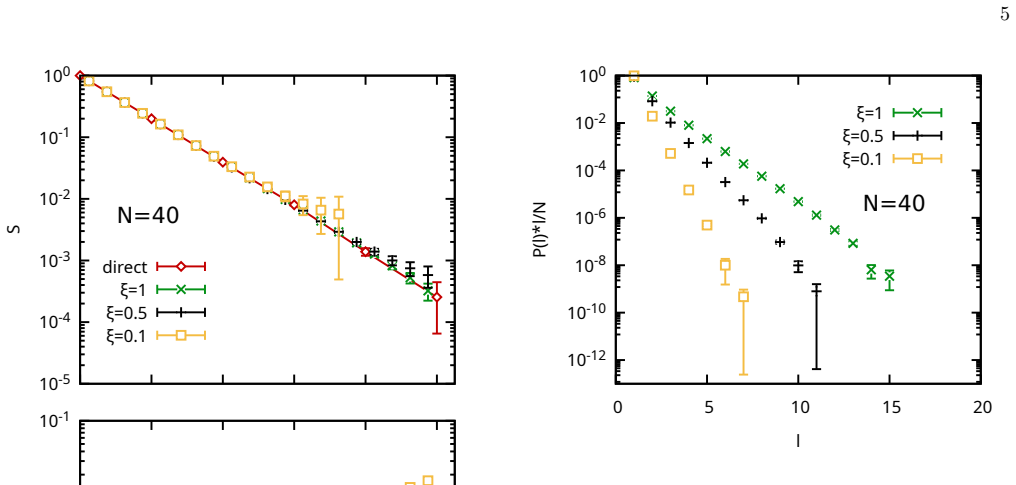
- [III.A, Eq. (8)] The exactness of Eq. (8) is not in question, but the central practical claim—that one simulation at xi_ref yields the full xi-dependence and removes the 10-20 simulation bottleneck—requires the ratio estimator to have acceptable variance. For target xi<0, the denominator <(xi/xi_ref)^{Npp}>_{xi_ref} is a sign-like expectation that is exponentially small in N, while the unnormalized weights can be exponentially large on rare long-permutation-cycle configurations. The paper only states qualitatively in Section III.A that an extreme xi_ref 'might eventually lead to ergodicity problems', and the recommendation of xi_ref=0.5 is based on two test systems. A quantitative criterion is needed, for example an effective-sample-size or overlap diagnostic, together with a demonstration of how the estimator variance scales with N at fixed computational cost. As it stands, the single-simulation claim is convincingly established only in the regime where the sign problem is mild (N<=66 for the UEG and N_Be=10 for beryllium).
- [III.A, Figs. 1 and 4] The numerical validation itself shows the limitations that motivate the need for a quantitative overlap criterion. In Fig. 1, the reweighted average sign cannot be resolved below S~1e-4 for N=66, and in Fig. 4 the choice xi_ref=1 leads to substantially increased error bars near xi=0 because single-particle-exchange configurations are under-sampled. This is precisely the large-N regime where the 10-20 simulation cost is most prohibitive. I therefore ask for an N-scaling test at the same thermodynamic conditions (e.g., N=100-200) demonstrating that the reweighted extrapolation to xi=-1 retains its accuracy, or, if it fails, a quantitative statement of the N-range over which the method is valid. Without such a test, the headline claim that the bottleneck is removed is not fully supported beyond the tested sizes.
minor comments (3)
- [II.C, Eq. (6) and III.B, Eq. (13)] In the provided manuscript, the derivations of Eq. (6) and Eq. (13) contain garbled non-typeset control sequences that obscure the mathematics. Please replace these with clean, properly typeset expressions.
- [Fig. 1] The text states that the average sign decreases exponentially for xi<0, but the horizontal axis of Fig. 1 appears to span 0 to 1. Please clarify the axis label (e.g., using |xi| or -xi) so the reader can connect the plot to the text.
- [References] Reference [101] says that a link to the repository will be made available upon publication. Since the abstract and Section III state that the data are freely accessible, please provide a permanent DOI or repository link in the final version.
Circularity Check
No circularity: Eq. (8) is an exact algebraic identity validated against independent benchmarks.
full rationale
The central estimator, Eq. (8), is derived algebraically from the definitions of the partition function and expectation values, Eqs. (1)-(3), together with the weight ratio Eq. (9); it is not fitted to data and does not presuppose the results it is used to obtain. The quadratic xi-extrapolation of Eq. (5) is explicitly labeled an 'empirical parabolic ansatz' and is tested against independent exact references (CPIMC and direct sign-afflicted PIMC), so it is not a fitted parameter being relabeled as a prediction of the new estimator. Self-citations such as Ref. [49] appear as validation data, but they are not load-bearing premises of the derivation; the identity in Eq. (8) stands independently of them, and the benchmarks include external and exact methods. The paper's qualitative discussion of overlap and ergodicity limitations (Section III.A) is a practical applicability caveat, not a circular step. No claim in the derivation chain reduces by construction to its own inputs.
Assumptions & free parameters
free parameters (2)
- Quadratic fit coefficients a_O, b_O, c_O =
not reported; fitted per observable
- Reference statistics parameter xi_ref =
0.5, 1, or 0.1 in demonstrations
assumptions (3)
- domain assumption Path integral Monte Carlo with a finite number of time slices P accurately represents the quantum system for the studied parameters.
- ad hoc to paper The expectation value O(xi) is analytic in xi and the quadratic ansatz Eq. (5) is sufficient for extrapolation to xi = -1.
- ad hoc to paper The sampled configurations at xi_ref provide adequate overlap with target xi configurations so that reweighted estimators have finite variance.
Cite this review
Pith. "Pith review of Re-weighting estimator for ab initio path integral Monte Carlo simulations of fictitious identical particles." pith.science (2026). https://pith.science/paper/PIN2DPGS
@misc{pith2026250812323,
  author       = {Pith},
  title        = {Pith review of: Re-weighting estimator for ab initio path integral Monte Carlo simulations of fictitious identical particles},
  year         = {2026},
  howpublished = {\url{https://pith.science/paper/PIN2DPGS}},
  note         = {Machine review of arXiv:2508.12323}
}
abstract
The fermion sign problem constitutes one of the most fundamental obstacles in quantum many-body theory. Recently, it has been suggested to circumvent the sign problem by carrying out path integral simulations with a fictitious quantum statistics variable $\xi$, which allows for a smooth interpolation between the bosonic and fermionic limits [\textit{J.~Chem.~Phys.}~\textbf{157}, 094112 (2022)]. This $\xi$-extrapolation method has subsequently been applied to a variety of systems and has facilitated the analysis of an x-ray scattering measurement taken at the National Ignition Facility with unprecedented accuracy [\textit{Nature Commun.}~\textbf{16}, 5103 (2025)]. Yet, it comes at the cost of performing an additional $10-20$ simulations, which, in combination with the required small error bars, can pose a serious practical limitation. Here, we remove this bottleneck by presenting a new re-weighting estimator, which allows the study of the full $\xi$-dependence from a single path integral Monte Carlo (PIMC) simulation. This is demonstrated for various observables of the uniform electron gas and also warm dense beryllium. We expect our work to be useful for future PIMC simulations of Fermi systems, including ultracold atoms, electrons in quantum dots, and warm dense quantum plasmas.
Figures


Figures from the paper (4 more)


Reference graph
Works this paper leans on
-
[1]
Path-Integral Calculation of the Two-Particle Slater Sum for He 4,
Lloyd D. Fosdick and Harry F. Jordan, “Path-Integral Calculation of the Two-Particle Slater Sum for He 4,” Phys. Rev. 143, 58–66 (1966)
1966
-
[2]
Monte carlo calculation of quantum systems,
Minoru Takahashi and Masatoshi Imada, “Monte carlo calculation of quantum systems,” Journal of the Physi- cal Society of Japan 53, 963–974 (1984)
1984
-
[3]
On path integral monte carlo simulations,
M. F. Herman, E. J. Bruskin, and B. J. Berne, “On path integral monte carlo simulations,” The Journal of Chemical Physics 76, 5150–5155 (1982)
1982
-
[4]
Worm algorithm and diagrammatic Monte Carlo: A new approach to continuous-space path integral Monte Carlo simulations,
M. Boninsegni, N. V. Prokofev, and B. V. Svistunov, “Worm algorithm and diagrammatic Monte Carlo: A new approach to continuous-space path integral Monte Carlo simulations,” Phys. Rev. E 74, 036701 (2006)
2006
-
[5]
Worm algorithm for continuous-space path integral Monte Carlo simulations,
M. Boninsegni, N. V. Prokofev, and B. V. Svistunov, “Worm algorithm for continuous-space path integral Monte Carlo simulations,” Phys. Rev. Lett 96, 070601 (2006)
2006
-
[6]
Hexatic and mesoscopic phases in a 2d quantum coulomb system,
Bryan K. Clark, Michele Casula, and D. M. Ceper- ley, “Hexatic and mesoscopic phases in a 2d quantum coulomb system,” Phys. Rev. Lett. 103, 055701 (2009)
2009
-
[7]
Analyzing quantum correlations made 9 simple,
T. Dornheim, H. Thomsen, P. Ludwig, A. Filinov, and M. Bonitz, “Analyzing quantum correlations made 9 simple,” Contributions to Plasma Physics 56, 371–379 (2016)
2016
-
[8]
Computational complex- ity and fundamental limitations to fermionic quantum Monte Carlo simulations,
M. Troyer and U. J. Wiese, “Computational complex- ity and fundamental limitations to fermionic quantum Monte Carlo simulations,” Phys. Rev. Lett 94, 170201 (2005)
2005
Show all 120 references
-
[9]
Sign problem in the numerical simulation of many-electron systems,
E. Y. Loh, J. E. Gubernatis, R. T. Scalettar, S. R. White, D. J. Scalapino, and R. L. Sugar, “Sign problem in the numerical simulation of many-electron systems,” Phys. Rev. B 41, 9301–9307 (1990)
1990
-
[10]
Fermion sign problem in path inte- gral Monte Carlo simulations: Quantum dots, ultracold atoms, and warm dense matter,
T. Dornheim, “Fermion sign problem in path inte- gral Monte Carlo simulations: Quantum dots, ultracold atoms, and warm dense matter,” Phys. Rev. E 100, 023307 (2019)
2019
-
[11]
Bcs – bec crossover, collective excitations, and hydrodynamics of superfluid quantum liquids and gases,
M Yu Kagan and A V Turlapov, “Bcs – bec crossover, collective excitations, and hydrodynamics of superfluid quantum liquids and gases,” Physics-Uspekhi 62, 215 (2019)
2019
-
[12]
Observation of a roton collec- tive mode in a two-dimensional fermi liquid,
Henri Godfrin, Matthias Meschke, Hans-Jochen Lauter, Ahmad Sultan, Helga M. B¨ ohm, Eckhard Krotscheck, and Martin Panholzer, “Observation of a roton collec- tive mode in a two-dimensional fermi liquid,” Nature 483, 576–579 (2012)
2012
-
[13]
Ab initio path integral Monte Carlo results for the dy- namic structure factor of correlated electrons: From the electron liquid to warm dense matter,
T. Dornheim, S. Groth, J. Vorberger, and M. Bonitz, “Ab initio path integral Monte Carlo results for the dy- namic structure factor of correlated electrons: From the electron liquid to warm dense matter,” Phys. Rev. Lett. 121, 255001 (2018)
2018
-
[14]
Electronic pair alignment and roton feature in the warm dense electron gas,
Tobias Dornheim, Zhandos Moldabekov, Jan Vorberger, Hanno K¨ ahlert, and Michael Bonitz, “Electronic pair alignment and roton feature in the warm dense electron gas,” Communications Physics 5, 304 (2022)
2022
-
[15]
Short-range excitonic phenomena in low-density met- als,
Jaakko Koskelo, Lucia Reining, and Matteo Gatti, “Short-range excitonic phenomena in low-density met- als,” (2023), arXiv:2301.00474 [cond-mat.str-el]
2023 arXiv
-
[16]
Emergence of an excitonic collec- tive mode in the dilute electron gas,
Yasutami Takada, “Emergence of an excitonic collec- tive mode in the dilute electron gas,” Phys. Rev. B 94, 245106 (2016)
2016
-
[17]
Second roton feature in the strongly coupled electron liquid,
Thomas M. Chuna, Jan Vorberger, Panagiotis To- lias, Alexander Benedix Robles, Michael Hecht, Phil- Alexander Hofmann, Zhandos A. Moldabekov, and To- bias Dornheim, “Second roton feature in the strongly coupled electron liquid,” The Journal of Chemical Physics 163, 034117 (2025)
2025
-
[18]
Crossover from fermi liquid to wigner molecule behav- ior in quantum dots,
R. Egger, W. H¨ ausler, C. H. Mak, and H. Grabert, “Crossover from fermi liquid to wigner molecule behav- ior in quantum dots,” Phys. Rev. Lett. 82, 3320–3323 (1999)
1999
-
[19]
Wigner crystallization in mesoscopic 2d electron sys- tems,
A. V. Filinov, M. Bonitz, and Yu. E. Lozovik, “Wigner crystallization in mesoscopic 2d electron sys- tems,” Phys. Rev. Lett. 86, 3851–3854 (2001)
2001
-
[20]
Roadmap for warm dense matter physics,
Jan Vorberger, Frank Graziani, David Riley, Andrew D. Baczewski, Isabelle Baraffe, Mandy Bethkenhagen, Si- mon Blouin, Maximilian P. B¨ ohme, Michael Bonitz, Michael Bussmann, Alexis Casner, Witold Cayzac, Pe- ter Celliers, Gilles Chabrier, Nicolas Chamel, Dave Chapman, Mohan ...
2025
-
[21]
Graziani, M
F. Graziani, M. P. Desjarlais, R. Redmer, and S. B. Trickey, eds., Frontiers and Challenges in Warm Dense Matter (Springer, International Publishing, 2014)
2014
-
[22]
Ab initio simulation of warm dense matter,
M. Bonitz, T. Dornheim, Zh. A. Moldabekov, S. Zhang, P. Hamann, H. K¨ ahlert, A. Filinov, K. Ramakrishna, and J. Vorberger, “Ab initio simulation of warm dense matter,” Phys. Plasmas 27, 042710 (2020)
2020
-
[23]
Electronic density response of warm dense mat- ter,
Tobias Dornheim, Zhandos A. Moldabekov, Kushal Ra- makrishna, Panagiotis Tolias, Andrew D. Baczewski, Dominik Kraus, Thomas R. Preston, David A. Chap- man, Maximilian P. B¨ ohme, Tilo D¨ oppner, Frank Graziani, Michael Bonitz, Attila Cangi, and Jan Vor- berger, “Electronic den...
2023
-
[24]
Progress in warm dense matter study with applications to planetology,
Alessandra Benuzzi-Mounaix, St´ ephane Mazevet, Alessandra Ravasio, Tommaso Vinci, Adrien De- noeud, Michel Koenig, Nourou Amadou, Erik Bram- brink, Floriane Festa, Anna Levy, Marion Harmand, St´ ephanie Brygoo, Gael Huser, Vanina Recoules, Johan Bouchet, Guillaume Morard, Fra...
2014
-
[25]
A suppres- sion of differential rotation in jupiter’s deep interior,
T. Guillot, Y. Miguel, B. Militzer, W. B. Hubbard, Y. Kaspi, E. Galanti, H. Cao, R. Helled, S. M. Wahl, L. Iess, W. M. Folkner, D. J. Stevenson, J. I. Lunine, D. R. Reese, A. Biekman, M. Parisi, D. Durante, J. E. P. Connerney, S. M. Levin, and S. J. Bolton, “A suppres- sion of...
2018
-
[26]
Ab initio equations of state for hydrogen (h-reos.3) and helium (he-reos.3) and their implications for the interior of brown dwarfs,
A. Becker, W. Lorenzen, J. J. Fortney, N. Nettelmann, M. Sch¨ ottler, and R. Redmer, “Ab initio equations of state for hydrogen (h-reos.3) and helium (he-reos.3) and their implications for the interior of brown dwarfs,” As- trophys. J. Suppl. Ser 215, 21 (2014)
2014
-
[27]
Current challenges in the physics of white dwarf stars,
Didier Saumon, Simon Blouin, and Pier-Emmanuel Tremblay, “Current challenges in the physics of white dwarf stars,” Phys. Rep.988, 1–63 (2022), current Chal- lenges in the Physics of White Dwarf Stars
2022
-
[28]
First-principles equation-of-state table of deuterium for inertial confinement fusion applications,
S. X. Hu, B. Militzer, V. N. Goncharov, and S. Skupsky, “First-principles equation-of-state table of deuterium for inertial confinement fusion applications,” Phys. Rev. B 84, 224109 (2011)
2011
-
[29]
Inertial-confinement fu- sion with lasers,
R. Betti and O. A. Hurricane, “Inertial-confinement fu- sion with lasers,” Nature Physics 12, 435–448 (2016)
2016
-
[30]
Physics principles of inertial confinement fu- sion and u.s. program overview,
O. A. Hurricane, P. K. Patel, R. Betti, D. H. Froula, S. P. Regan, S. A. Slutz, M. R. Gomez, and M. A. 10 Sweeney, “Physics principles of inertial confinement fu- sion and u.s. program overview,” Rev. Mod. Phys. 95, 025005 (2023)
2023
-
[31]
Drake, High-Energy-Density Physics: Founda- tion of Inertial Fusion and Experimental Astrophysics , Graduate Texts in Physics (Springer International Pub- lishing, 2018)
R.P. Drake, High-Energy-Density Physics: Founda- tion of Inertial Fusion and Experimental Astrophysics , Graduate Texts in Physics (Springer International Pub- lishing, 2018)
2018
-
[32]
Burning plasma achieved in inertial fusion,
A. B. Zylstra, O. A. Hurricane, D. A. Callahan, A. L. Kritcher, J. E. Ralph, H. F. Robey, J. S. Ross, C. V. Young, K. L. Baker, D. T. Casey, T. D¨ oppner, L. Di- vol, M. Hohenberger, S. Le Pape, A. Pak, P. K. Pa- tel, R. Tommasini, S. J. Ali, P. A. Amendt, L. J. Atherton, B. B...
2022
-
[33]
Achievement of target gain larger than unity in an inertial fusion experiment,
H. Abu-Shawareb, R. Acree, P. Adams, J. Adams, B. Addis, R. Aden, P. Adrian, B. B. Afeyan, M. Ag- gleton, L. Aghaian, A. Aguirre, D. Aikens, J. Akre, F. Albert, et al. (The Indirect Drive ICF Collabora- tion), “Achievement of target gain larger than unity in an inertial fusion...
2024
-
[34]
Demonstration of hot-spot fuel gain exceeding unity in direct-drive iner- tial confinement fusion implosions,
C. A. Williams, R. Betti, V. Gopalaswamy, J. P. Knauer, C. J. Forrest, A. Lees, R. Ejaz, P. S. Farmakis, D. Cao, P. B. Radha, K. S. Anderson, S. P. Regan, V. Yu Glebov, R. C. Shah, C. Stoeckl, S. Ivancic, K. Churnet- ski, R. T. Janezic, C. Fella, M. J. Rosenberg, M. J. Bonino,...
2024
-
[35]
Future for inertial-fusion energy in europe: a roadmap,
Dimitri Batani, Arnaud Cola¨ ıtis, Fabrizio Consoli, Colin N. Danson, Leonida Antonio Gizzi, Javier Hon- rubia, Thomas K¨ uhl, Sebastien Le Pape, Jean-Luc Miquel, Jose Manuel Perlado, and et al., “Future for inertial-fusion energy in europe: a roadmap,” High Power Laser Scienc...
2023
-
[36]
Path-integral monte carlo sim- ulation of the warm dense homogeneous electron gas,
Ethan W. Brown, Bryan K. Clark, Jonathan L. DuBois, and David M. Ceperley, “Path-integral monte carlo sim- ulation of the warm dense homogeneous electron gas,” Phys. Rev. Lett. 110, 146405 (2013)
2013
-
[37]
Ab initio thermodynamic results for the degenerate electron gas at finite temperature,
T. Schoof, S. Groth, J. Vorberger, and M. Bonitz, “Ab initio thermodynamic results for the degenerate electron gas at finite temperature,” Phys. Rev. Lett.115, 130402 (2015)
2015
-
[38]
Density-matrix quantum monte carlo method,
N. S. Blunt, T. W. Rogers, J. S. Spencer, and W. M. C. Foulkes, “Density-matrix quantum monte carlo method,” Phys. Rev. B 89, 245124 (2014)
2014
-
[39]
High-order path-integral monte carlo methods for solving quantum dot problems,
Siu A. Chin, “High-order path-integral monte carlo methods for solving quantum dot problems,” Phys. Rev. E 91, 031301 (2015)
2015
-
[40]
In- teraction picture density matrix quantum monte carlo,
Fionn D. Malone, N. S. Blunt, James J. Shepherd, D. K. K. Lee, J. S. Spencer, and W. M. C. Foulkes, “In- teraction picture density matrix quantum monte carlo,” The Journal of Chemical Physics 143, 044116 (2015)
2015
-
[41]
Accurate exchange-correlation en- ergies for the warm dense electron gas,
Fionn D. Malone, N. S. Blunt, Ethan W. Brown, D. K. K. Lee, J. S. Spencer, W. M. C. Foulkes, and James J. Shepherd, “Accurate exchange-correlation en- ergies for the warm dense electron gas,” Phys. Rev. Lett. 117, 115701 (2016)
2016
-
[42]
Permutation blocking path integral monte carlo: a highly efficient approach to the simu- lation of strongly degenerate non-ideal fermions,
Tobias Dornheim, Simon Groth, Alexey Filinov, and Michael Bonitz, “Permutation blocking path integral monte carlo: a highly efficient approach to the simu- lation of strongly degenerate non-ideal fermions,” New Journal of Physics 17, 073017 (2015)
2015
-
[43]
Ab initio quantum monte carlo simulations of the uniform electron gas without fixed nodes,
S. Groth, T. Schoof, T. Dornheim, and M. Bonitz, “Ab initio quantum monte carlo simulations of the uniform electron gas without fixed nodes,” Phys. Rev. B 93, 085102 (2016)
2016
-
[44]
A phaseless auxiliary-field quantum monte carlo perspective on the uniform electron gas at finite tem- peratures: Issues, observations, and benchmark study,
Joonho Lee, Miguel A. Morales, and Fionn D. Mal- one, “A phaseless auxiliary-field quantum monte carlo perspective on the uniform electron gas at finite tem- peratures: Issues, observations, and benchmark study,” J. Chem. Phys. 154, 064109 (2021)
2021
-
[45]
Path integral molecular dynamics for fermions: Alleviating the sign problem with the bogoliubov in- equality,
Barak Hirshberg, Michele Invernizzi, and Michele Par- rinello, “Path integral molecular dynamics for fermions: Alleviating the sign problem with the bogoliubov in- equality,” The Journal of Chemical Physics152, 171102 (2020)
2020
-
[46]
Attenuating the fermion sign problem in path integral Monte Carlo simulations us- ing the Bogoliubov inequality and thermodynamic inte- gration,
Tobias Dornheim, Michele Invernizzi, Jan Vorberger, and Barak Hirshberg, “Attenuating the fermion sign problem in path integral Monte Carlo simulations us- ing the Bogoliubov inequality and thermodynamic inte- gration,” The Journal of Chemical Physics 153, 234104 (2020). 11
2020
-
[47]
On the thermody- namic properties of fictitious identical particles and the application to fermion sign problem,
Yunuo Xiong and Hongwei Xiong, “On the thermody- namic properties of fictitious identical particles and the application to fermion sign problem,” The Journal of Chemical Physics 157, 094112 (2022)
2022
-
[48]
Quadratic scaling path integral molecular dynamics for fictitious identical particles and its application to fermion systems,
Yunuo Xiong, Shujuan Liu, and Hongwei Xiong, “Quadratic scaling path integral molecular dynamics for fictitious identical particles and its application to fermion systems,” Phys. Rev. E 110, 065303 (2024)
2024
-
[49]
Fermionic physics from ab initio path inte- gral Monte Carlo simulations of fictitious identical par- ticles,
Tobias Dornheim, Panagiotis Tolias, Simon Groth, Zhandos A. Moldabekov, Jan Vorberger, and Barak Hirshberg, “Fermionic physics from ab initio path inte- gral Monte Carlo simulations of fictitious identical par- ticles,” The Journal of Chemical Physics 159, 164113 (2023)
2023
-
[50]
Ab initio path integral Monte Carlo simulations of the uniform electron gas on large length scales,
Tobias Dornheim, Sebastian Schwalbe, Zhandos A. Moldabekov, Jan Vorberger, and Panagiotis Tolias, “Ab initio path integral Monte Carlo simulations of the uniform electron gas on large length scales,” J. Phys. Chem. Lett. 15, 1305–1313 (2024)
2024
-
[51]
Un- raveling electronic correlations in warm dense quantum plasmas,
Tobias Dornheim, Tilo D¨ oppner, Panagiotis Tolias, Maximilian P. B¨ ohme, Luke B. Fletcher, Thomas Gawne, Frank R. Graziani, Dominik Kraus, Michael J. MacDonald, Zhandos A. Moldabekov, Sebastian Schwalbe, Dirk O. Gericke, and Jan Vorberger, “Un- raveling electronic correlatio...
2025
-
[52]
Exchange-correlation effect in the charge response of a warm dense electron gas,
Peng-Cheng Hou, Bao-Zong Wang, Kristjan Haule, Youjin Deng, and Kun Chen, “Exchange-correlation effect in the charge response of a warm dense electron gas,” Phys. Rev. B 106, L081126 (2022)
2022
-
[53]
First- principles equation of state database for warm dense matter computation,
Burkhard Militzer, Felipe Gonz´ alez-Cataldo, Shuai Zhang, Kevin P. Driver, and Fran ¸ cois Soubiran, “First- principles equation of state database for warm dense matter computation,” Phys. Rev. E 103, 013203 (2021)
2021
-
[54]
All-electron path integral monte carlo simulations of warm dense matter: Appli- cation to water and carbon plasmas,
K. P. Driver and B. Militzer, “All-electron path integral monte carlo simulations of warm dense matter: Appli- cation to water and carbon plasmas,” Phys. Rev. Lett. 108, 115502 (2012)
2012
-
[55]
Path inte- gral monte carlo simulations of warm dense aluminum,
K. P. Driver, F. Soubiran, and B. Militzer, “Path inte- gral monte carlo simulations of warm dense aluminum,” Phys. Rev. E 97, 063207 (2018)
2018
-
[56]
Restricted configuration path integral monte carlo,
A. Yilmaz, K. Hunger, T. Dornheim, S. Groth, and M. Bonitz, “Restricted configuration path integral monte carlo,” The Journal of Chemical Physics 153, 124114 (2020)
2020
-
[57]
Momentum distribution function and short-range correlations of the warm dense electron gas: Ab initio quantum monte carlo results,
Kai Hunger, Tim Schoof, Tobias Dornheim, Michael Bonitz, and Alexey Filinov, “Momentum distribution function and short-range correlations of the warm dense electron gas: Ab initio quantum monte carlo results,” Phys. Rev. E 103, 053204 (2021)
2021
-
[58]
Chemical potential of the warm dense elec- tron gas from ab initio path integral monte carlo simu- lations,
Tobias Dornheim, Michael Bonitz, Zhandos A. Mold- abekov, Sebastian Schwalbe, Panagiotis Tolias, and Jan Vorberger, “Chemical potential of the warm dense elec- tron gas from ab initio path integral monte carlo simu- lations,” Phys. Rev. B 111, 115149 (2025)
2025
-
[59]
Toward first principles-based sim- ulations of dense hydrogen,
Michael Bonitz, Jan Vorberger, Mandy Bethkenhagen, Maximilian P. B¨ ohme, David M. Ceperley, Alexey Fil- inov, Thomas Gawne, Frank Graziani, Gianluca Gre- gori, Paul Hamann, Stephanie B. Hansen, Markus Holz- mann, S. X. Hu, Hanno K¨ ahlert, Valentin V. Karasiev, Uwe Kleinschmi...
2024
-
[60]
Nor- mal liquid 3he studied by path integral monte carlo with a parametrized partition function,
Tommaso Morresi and Giovanni Garberoglio, “Nor- mal liquid 3he studied by path integral monte carlo with a parametrized partition function,” (2024), arXiv:2410.01569 [cond-mat.quant-gas]
2024 arXiv
-
[61]
Ab initio path integral Monte Carlo simulations of warm dense two-component systems without fixed nodes: Structural properties,
Tobias Dornheim, Sebastian Schwalbe, Maximilian P. B¨ ohme, Zhandos A. Moldabekov, Jan Vorberger, and Panagiotis Tolias, “Ab initio path integral Monte Carlo simulations of warm dense two-component systems without fixed nodes: Structural properties,” J. Chem. Phys. 160, 164111 (2024)
2024
-
[62]
Ab initio density response and lo- cal field factor of warm dense hydrogen,
Tobias Dornheim, Sebastian Schwalbe, Panagiotis To- lias, Maximilian P. B¨ ohme, Zhandos A. Moldabekov, and Jan Vorberger, “Ab initio density response and lo- cal field factor of warm dense hydrogen,” Matter Radiat. Extrem. 9, 057401 (2024)
2024
-
[63]
Model-free rayleigh weight from x-ray thom- son scattering measurements,
T. Dornheim, H. M. Bellenbaum, M. Bethkenhagen, S. B. Hansen, M. P. B¨ ohme, T. D¨ oppner, L. B. Fletcher, T. Gawne, D. O. Gericke, S. Hamel, D. Kraus, M. J. MacDonald, Zh. A. Moldabekov, T. R. Preston, R. Red- mer, M. Sch¨ orner, S. Schwalbe, P. Tolias, and J. Vor- berger, “M...
2025
-
[64]
Static linear density response from x-ray thomson scattering measurements: a case study of warm dense beryllium,
Sebastian Schwalbe, Hannah Bellenbaum, Tilo D¨ oppner, Maximilian B¨ ohme, Thomas Gawne, Dominik Kraus, Michael J. MacDonald, Zhandos Moldabekov, Panagiotis Tolias, Jan Vorberger, and Tobias Dornheim, “Static linear density response from x-ray thomson scattering measurements: ...
2025 arXiv
-
[65]
Study of the uniform elec- tron gas through parametrized partition functions,
Tommaso Morresi, Giovanni Garberoglio, Hongwei Xiong, and Yunuo Xiong, “Study of the uniform elec- tron gas through parametrized partition functions,” (2025), arXiv:2506.10113 [cond-mat.mtrl-sci]
2025 arXiv
-
[66]
Fermionic free energies from ab initio path integral monte carlo simulations of fictitious identical particles,
Tobias Dornheim, Zhandos Moldabekov, Sebastian Schwalbe, Panagiotis Tolias, and Jan Vorberger, “Fermionic free energies from ab initio path integral monte carlo simulations of fictitious identical particles,” (2025), arXiv:2502.15288 [cond-mat.quant-gas]
2025 arXiv
-
[67]
Accelerated free en- ergy estimation in ab initio path integral monte carlo simulations,
Pontus Svensson, Fotios Kalkavouras, Uwe Hernandez Acosta, Zhandos A. Moldabekov, Panagiotis Tolias, Jan Vorberger, and Tobias Dornheim, “Accelerated free en- ergy estimation in ab initio path integral monte carlo simulations,” (2025), arXiv:2507.12960 [physics.chem- ph]
2025 arXiv
-
[68]
The uniform electron gas at warm dense matter conditions,
T. Dornheim, S. Groth, and M. Bonitz, “The uniform electron gas at warm dense matter conditions,” Phys. Reports 744, 1–86 (2018)
2018
-
[69]
Giuliani and G
G. Giuliani and G. Vignale, Quantum Theory of the Electron Liquid (Cambridge University Press, Cam- bridge, 2008)
2008
-
[70]
The uniform electron gas,
P.-F. Loos and P. M. W. Gill, “The uniform electron gas,” Comput. Mol. Sci 6, 410–429 (2016)
2016
-
[71]
Ab initio quantum monte carlo simulations of the uniform electron gas without fixed nodes: The unpolarized case,
T. Dornheim, S. Groth, T. Schoof, C. Hann, and M. Bonitz, “Ab initio quantum monte carlo simulations of the uniform electron gas without fixed nodes: The unpolarized case,” Phys. Rev. B 93, 205134 (2016)
2016
-
[72]
Observing the onset of pressure-driven k-shell delocalization,
T. D¨ oppner, M. Bethkenhagen, D. Kraus, P. Neu- mayer, D. A. Chapman, B. Bachmann, R. A. Bag- gott, M. P. B¨ ohme, L. Divol, R. W. Falcone, L. B. 12 Fletcher, O. L. Landen, M. J. MacDonald, A. M. Saun- ders, M. Sch¨ orner, P. A. Sterne, J. Vorberger, B. B. L. Witte, A. Yi, R....
2023
-
[73]
Path integral monte carlo approach to the structural properties and collec- tive excitations of liquid 3he without fixed nodes,
Tobias Dornheim, Zhandos A. Moldabekov, Jan Vor- berger, and Burkhard Militzer, “Path integral monte carlo approach to the structural properties and collec- tive excitations of liquid 3he without fixed nodes,” Sci. Rep. 12, 708 (2022)
2022
-
[74]
Path-integral monte carlo simula- tions of quantum dipole systems in traps: Superfluidity, quantum statistics, and structural properties,
Tobias Dornheim, “Path-integral monte carlo simula- tions of quantum dipole systems in traps: Superfluidity, quantum statistics, and structural properties,” Phys. Rev. A 102, 023307 (2020)
2020
-
[75]
Path-integral calculations of normal liquid 3He,
D. M. Ceperley, “Path-integral calculations of normal liquid 3He,” Phys. Rev. Lett. 69, 331–334 (1992)
1992
-
[76]
Elec- tronic structure of quantum dots,
Stephanie M. Reimann and Matti Manninen, “Elec- tronic structure of quantum dots,” Rev. Mod. Phys. 74, 1283–1342 (2002)
2002
-
[77]
Abnormal quan- tum moment of inertia and structural properties of elec- trons in 2d and 3d quantum dots: an ab initio path- integral monte carlo study,
Tobias Dornheim and Yangqian Yan, “Abnormal quan- tum moment of inertia and structural properties of elec- trons in 2d and 3d quantum dots: an ab initio path- integral monte carlo study,” New Journal of Physics24, 113024 (2022)
2022
-
[78]
Re- cent progress in the theory and simulation of strongly correlated plasmas: phase transitions, transport, quan- tum, and magnetic field effects,
Torben Ott, Hauke Thomsen, Jan Willem Abra- ham, Tobias Dornheim, and Michael Bonitz, “Re- cent progress in the theory and simulation of strongly correlated plasmas: phase transitions, transport, quan- tum, and magnetic field effects,” The European Physical Journal D 72, 84 (2018)
2018
-
[79]
Strongly coupled electron liquid: Ab initio path integral monte carlo simulations and di- electric theories,
Tobias Dornheim, Travis Sjostrom, Shigenori Tanaka, and Jan Vorberger, “Strongly coupled electron liquid: Ab initio path integral monte carlo simulations and di- electric theories,” Phys. Rev. B 101, 045129 (2020)
2020
-
[80]
Inte- gral equation theory based dielectric scheme for strongly coupled electron liquids,
P. Tolias, F. Lucco Castello, and T. Dornheim, “Inte- gral equation theory based dielectric scheme for strongly coupled electron liquids,” J. Chem. Phys. 155, 134115 (2021)
2021
-
[81]
Quantum version of the integral equation theory-based dielectric scheme for strongly coupled elec- tron liquids,
Panagiotis Tolias, Federico Lucco Castello, and Tobias Dornheim, “Quantum version of the integral equation theory-based dielectric scheme for strongly coupled elec- tron liquids,” J. Chem. Phys. 158, 141102 (2023)
2023
-
[82]
Low-density phase diagram of the three-dimensional electron gas,
Sam Azadi and N. D. Drummond, “Low-density phase diagram of the three-dimensional electron gas,” Phys. Rev. B 105, 245135 (2022)
2022
-
[83]
Diffusion quantum monte carlo study of three-dimensional wigner crystals,
N. D. Drummond, Z. Radnai, J. R. Trail, M. D. Towler, and R. J. Needs, “Diffusion quantum monte carlo study of three-dimensional wigner crystals,” Phys. Rev. B 69, 085116 (2004)
2004
-
[84]
Estimates of the dynamic structure factor for the finite temperature electron liquid via analytic con- tinuation of path integral monte carlo data,
Thomas Chuna, Nicholas Barnfield, Jan Vorberger, Michael P. Friedlander, Tim Hoheisel, and Tobias Dorn- heim, “Estimates of the dynamic structure factor for the finite temperature electron liquid via analytic con- tinuation of path integral monte carlo data,” (2025), arXiv:250...
2025
-
[85]
Dynamical structure factor of the homogeneous electron liquid: Its accurate shape and the interpretation of experiments on aluminum,
Yasutami Takada and Hiroshi Yasuhara, “Dynamical structure factor of the homogeneous electron liquid: Its accurate shape and the interpretation of experiments on aluminum,” Phys. Rev. Lett. 89, 216402 (2002)
2002
-
[86]
Effective electronic forces and potentials from ab initio path in- tegral monte carlo simulations,
Tobias Dornheim, Panagiotis Tolias, Zhandos A. Mold- abekov, Attila Cangi, and Jan Vorberger, “Effective electronic forces and potentials from ab initio path in- tegral monte carlo simulations,” J. Chem. Phys. 156, 244113 (2022)
2022
-
[87]
Predic- tion of a roton-type feature in warm dense hydrogen,
Paul Hamann, Linda Kordts, Alexey Filinov, Michael Bonitz, Tobias Dornheim, and Jan Vorberger, “Predic- tion of a roton-type feature in warm dense hydrogen,” Phys. Rev. Res. 5, 033039 (2023)
2023
-
[88]
The uniform electron gas at high temperatures: ab initio path integral monte carlo simulations and analytical theory,
Tobias Dornheim, Jan Vorberger, Zhandos Moldabekov, Gerd R¨ opke, and Wolf-Dietrich Kraeft, “The uniform electron gas at high temperatures: ab initio path integral monte carlo simulations and analytical theory,” High Energy Density Physics 45, 101015 (2022)
2022
-
[89]
Virial coefficients of the uniform electron gas from path-integral monte carlo simulations,
G. R¨ opke, T. Dornheim, J. Vorberger, D. Blaschke, and B. Mahato, “Virial coefficients of the uniform electron gas from path-integral monte carlo simulations,” Phys. Rev. E 109, 025202 (2024)
2024
-
[90]
Accurate homogeneous electron gas exchange-correlation free energy for local spin-density calculations,
Valentin V. Karasiev, Travis Sjostrom, James Dufty, and S. B. Trickey, “Accurate homogeneous electron gas exchange-correlation free energy for local spin-density calculations,” Phys. Rev. Lett. 112, 076403 (2014)
2014
-
[91]
Ab initio exchange– correlation free energy of the uniform electron gas at warm dense matter conditions,
S. Groth, T. Dornheim, T. Sjostrom, F. D. Malone, W. M. C. Foulkes, and M. Bonitz, “Ab initio exchange– correlation free energy of the uniform electron gas at warm dense matter conditions,” Phys. Rev. Lett. 119, 135001 (2017)
2017
-
[92]
The static local field correction of the warm dense electron gas: An ab initio path integral Monte Carlo study and machine learning representation,
T. Dornheim, J. Vorberger, S. Groth, N. Hoffmann, Zh.A. Moldabekov, and M. Bonitz, “The static local field correction of the warm dense electron gas: An ab initio path integral Monte Carlo study and machine learning representation,” J. Chem. Phys 151, 194104 (2019)
2019
-
[93]
Analytical representation of the local field correction of the uniform electron gas within the effec- tive static approximation,
Tobias Dornheim, Zhandos A. Moldabekov, and Pana- giotis Tolias, “Analytical representation of the local field correction of the uniform electron gas within the effec- tive static approximation,” Phys. Rev. B 103, 165102 (2021)
2021
-
[94]
Effective static approximation: A fast and re- liable tool for warm-dense matter theory,
Tobias Dornheim, Attila Cangi, Kushal Ramakrishna, Maximilian B¨ ohme, Shigenori Tanaka, and Jan Vor- berger, “Effective static approximation: A fast and re- liable tool for warm-dense matter theory,” Phys. Rev. Lett. 125, 235001 (2020)
2020
-
[95]
Path integrals in the theory of con- densed helium,
D. M. Ceperley, “Path integrals in the theory of con- densed helium,” Rev. Mod. Phys 67, 279 (1995)
1995
-
[96]
Simulation of quan- tum many-body systems by path-integral methods,
E. L. Pollock and D. M. Ceperley, “Simulation of quan- tum many-body systems by path-integral methods,” Phys. Rev. B 30, 2555–2568 (1984)
1984
-
[97]
Equation of state calculations by fast comput- ing machines,
Nicholas Metropolis, Arianna W. Rosenbluth, Mar- shall N. Rosenbluth, Augusta H. Teller, and Edward Teller, “Equation of state calculations by fast comput- ing machines,” J. Chem. Phys. 21, 1087–1092 (1953)
1953
-
[98]
Path integral monte carlo simulation of degener- ate electrons: Permutation-cycle properties,
T. Dornheim, S. Groth, A. V. Filinov, and M. Bonitz, “Path integral monte carlo simulation of degener- ate electrons: Permutation-cycle properties,” J. Chem. Phys. 151, 014108 (2019)
2019
-
[99]
Ab initio path integral monte carlo approach to the momentum distribution of the uni- form electron gas at finite temperature without fixed nodes,
Tobias Dornheim, Maximilian B¨ ohme, Burkhard Mil- itzer, and Jan Vorberger, “Ab initio path integral monte carlo approach to the momentum distribution of the uni- form electron gas at finite temperature without fixed nodes,” Phys. Rev. B 103, 205142 (2021)
2021
-
[100]
ISHTAR - Imaginary-time Stochastic High- performance Tool for Ab initio Research,
Tobias Dornheim, Maximilian B¨ ohme, and Sebastian Schwalbe, “ISHTAR - Imaginary-time Stochastic High- performance Tool for Ab initio Research,” (2024)
2024
-
[101]
A link to a repository containing all PIMC results will be made available upon publication
-
[102]
The national ignition facility: Usher- ing in a new age for high energy density science,
E. I. Moses, R. N. Boyd, B. A. Remington, C. J. Keane, and R. Al-Ayat, “The national ignition facility: Usher- ing in a new age for high energy density science,” Phys. 13 Plasmas 16, 041006 (2009)
2009
-
[103]
Direct free energy cal- culation from ab initio path integral monte carlo sim- ulations of warm dense matter,
Tobias Dornheim, Zhandos A. Moldabekov, Sebastian Schwalbe, and Jan Vorberger, “Direct free energy cal- culation from ab initio path integral monte carlo sim- ulations of warm dense matter,” Phys. Rev. B 111, L041114 (2025)
2025
-
[104]
η-ensemble path integral monte carlo approach to the free energy of the warm dense electron gas and the uniform electron liquid,
Tobias Dornheim, Panagiotis Tolias, Zhandos A. Mold- abekov, and Jan Vorberger, “ η-ensemble path integral monte carlo approach to the free energy of the warm dense electron gas and the uniform electron liquid,” Phys. Rev. Res. 7, 023250 (2025)
2025
-
[105]
Exchange-correlation energy for the three-dimensional homogeneous electron gas at arbitrary temperature,
Ethan W. Brown, Jonathan L. DuBois, Markus Holz- mann, and David M. Ceperley, “Exchange-correlation energy for the three-dimensional homogeneous electron gas at arbitrary temperature,” Phys. Rev. B 88, 081102 (2013)
2013
-
[106]
Ab initio quantum monte carlo simulation of the warm dense electron gas,
Tobias Dornheim, Simon Groth, Fionn D. Malone, Tim Schoof, Travis Sjostrom, W. M. C. Foulkes, and Michael Bonitz, “Ab initio quantum monte carlo simulation of the warm dense electron gas,” Phys. Plasmas24, 056303 (2017)
2017
-
[107]
Imaginary-time cor- relation function thermometry: A new, high-accuracy and model-free temperature analysis technique for x-ray Thomson scattering data,
Tobias Dornheim, Maximilian P. B¨ ohme, David A. Chapman, Dominik Kraus, Thomas R. Preston, Zhan- dos A. Moldabekov, Niclas Schl¨ unzen, Attila Cangi, Tilo D¨ oppner, and Jan Vorberger, “Imaginary-time cor- relation function thermometry: A new, high-accuracy and model-free tem...
2023
-
[108]
Effects of mosaic crys- tal instrument functions on x-ray thomson scattering diagnostics,
Thomas Gawne, Hannah Bellenbaum, Luke B. Fletcher, Karen Appel, Carsten Baehtz, Victorien Bouffetier, Erik Brambrink, Danielle Brown, Attila Cangi, Adrien Descamps, Sebastian Goede, Nicholas J. Hartley, Marie- Luise Herbert, Philipp Hesselbach, Hauke H¨ oppner, Oliver S. Humph...
2024
-
[109]
Accurate temperature di- agnostics for matter under extreme conditions,
Tobias Dornheim, Maximilian B¨ ohme, Dominik Kraus, Tilo D¨ oppner, Thomas R. Preston, Zhandos A. Mold- abekov, and Jan Vorberger, “Accurate temperature di- agnostics for matter under extreme conditions,” Nature Communications 13, 7911 (2022)
2022
-
[110]
X-ray thomson scattering absolute intensity from the f-sum rule in the imaginary- time domain,
T. Dornheim, T. D¨ oppner, A. D. Baczewski, P. Tolias, M. P. B¨ ohme, Zh. A. Moldabekov, Th. Gawne, D. Ran- jan, D. A. Chapman, M. J. MacDonald, Th. R. Preston, D. Kraus, and J. Vorberger, “X-ray thomson scattering absolute intensity from the f-sum rule in the imaginary- time ...
2024
-
[111]
Physi- cal insights from imaginary-time density–density corre- lation functions,
Tobias Dornheim, Zhandos Moldabekov, Panagiotis To- lias, Maximilian B¨ ohme, and Jan Vorberger, “Physi- cal insights from imaginary-time density–density corre- lation functions,” Matter and Radiation at Extremes 8, 056601 (2023)
2023
-
[112]
Analysing the dy- namic structure of warm dense matter in the imaginary- time domain: theoretical models and simulations,
Tobias Dornheim, Jan Vorberger, Zhandos A. Mold- abekov, and Maximilian B¨ ohme, “Analysing the dy- namic structure of warm dense matter in the imaginary- time domain: theoretical models and simulations,” Philosophical Transactions of the Royal Society A: Mathematical, Physica...
2023
-
[113]
X-ray thomson scat- tering spectra from density functional theory molecular dynamics simulations based on a modified chihara for- mula,
Maximilian Sch¨ orner, Mandy Bethkenhagen, Tilo D¨ oppner, Dominik Kraus, Luke B. Fletcher, Siegfried H. Glenzer, and Ronald Redmer, “X-ray thomson scat- tering spectra from density functional theory molecular dynamics simulations based on a modified chihara for- mula,” Phys. ...
2023
-
[114]
First-principles analysis of the warm dense plasma jets in double-cone ignition experiments,
N. Y. Shi, J. H. Liang, C. J. Mo, D. Wu, X. H. Yuan, and J. Zhang, “First-principles analysis of the warm dense plasma jets in double-cone ignition experiments,” (2025), arXiv:2504.04317 [physics.plasm-ph]
2025 arXiv
-
[115]
Revealing non- equilibrium and relaxation in laser heated matter,
Jan Vorberger, Thomas R. Preston, Nikita Medvedev, Maximilian P. B¨ ohme, Zhandos A. Moldabekov, Do- minik Kraus, and Tobias Dornheim, “Revealing non- equilibrium and relaxation in laser heated matter,” Physics Letters A 499, 129362 (2024)
2024
-
[116]
Toward model-free temper- ature diagnostics of warm dense matter from multiple scattering angles,
H. M. Bellenbaum, B. Bachmann, D. Kraus, Th. Gawne, M. P. B¨ ohme, T. D¨ oppner, L. B. Fletcher, M. J. MacDonald, Zh. A. Moldabekov, T. R. Preston, J. Vor- berger, and T. Dornheim, “Toward model-free temper- ature diagnostics of warm dense matter from multiple scattering angle...
2025
-
[117]
Estimating ionization states and continuum low- ering from ab initio path integral monte carlo simu- lations for warm dense hydrogen,
Hannah M. Bellenbaum, Maximilian P. B¨ ohme, Michael Bonitz, Tilo D¨ oppner, Luke B. Fletcher, Thomas Gawne, Dominik Kraus, Zhandos A. Moldabekov, Se- bastian Schwalbe, Jan Vorberger, and Tobias Dorn- heim, “Estimating ionization states and continuum low- ering from ab initio ...
2025
-
[118]
Ab initio path integral Monte Carlo approach to the static and dynamic density response of the uniform electron gas,
S. Groth, T. Dornheim, and J. Vorberger, “Ab initio path integral Monte Carlo approach to the static and dynamic density response of the uniform electron gas,” Phys. Rev. B 99, 235122 (2019)
2019
-
[119]
Gpu acceleration of ab initio simula- tions of large-scale identical particles based on path in- tegral molecular dynamics,
Yunuo Xiong, “Gpu acceleration of ab initio simula- tions of large-scale identical particles based on path in- tegral molecular dynamics,” (2024), arXiv:2404.02628 [physics.comp-ph]
2024
-
[120]
Path integral molecular dynamics for bosons,
Barak Hirshberg, Valerio Rizzi, and Michele Parrinello, “Path integral molecular dynamics for bosons,” Pro- ceedings of the National Academy of Sciences 116, 21445–21449 (2019)
2019
Reviewed August 15, 2026 · model on record in the stance chip above.
Discussion (0). Continue with ORCID to comment.