REVIEW 3 major objections 7 minor 1 cited by
Revisiting relativistic corrections to inclusive $J/\psi$ production at B factories: Complete expansion for three-body quarkonium production
T0 review · 3 major / 7 minor · reviewed 2026-07-31 · grok-4.5
Pith's one-line read A complete expansion of three-body final-state kinematics yields self-consistent O(v²) corrections that suppress J/ψ + open-charm by ~15% and enhance the non-charm channel by ~12%.
desk verdict Solid technical fix to three-body O(v²) expansions—scheme independence and fragmentation matching are real—but they drop a same-order phase-space Jacobian without a number, and the headline percentages are internally inconsistent. read the letter →
The pith
A machine-rendered reading of the paper's core claim, the machinery that carries it, and where it could break.
The reading
What carries the argument
The first-order expansion coefficients z_i^(1) of the dimensionless final-state energy variables, together with the new term they generate in the squared amplitude; that term restores integration-scheme independence and high-energy consistency with fragmentation.
What would settle it
A fixed-order calculation that keeps the phase-space Jacobian and does not force angular independence of q², or a complete O(α_s v²) evaluation of both channels whose result either closes or deepens the remaining gap with Belle’s measured cross sections.
Extended reading notes
Core claim
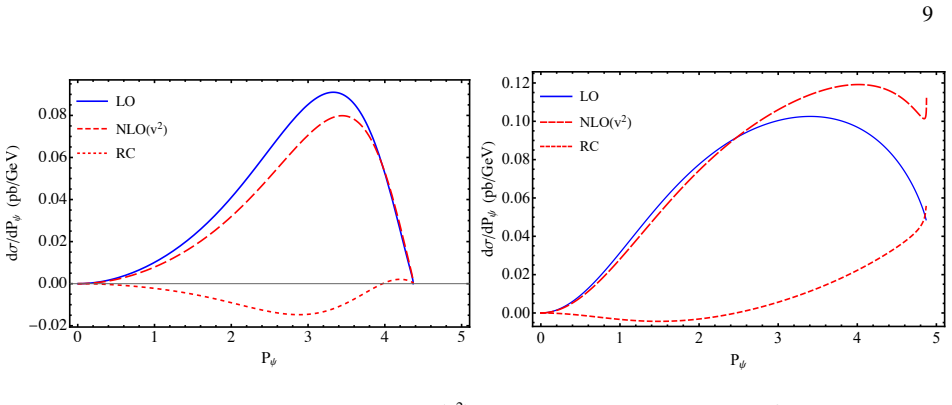
For three-body quark-level subprocesses that produce J/ψ, expanding every final-state kinematic variable—not only the relative momentum q and the quark energy E_q—produces O(v²) relativistic corrections that are theoretically self-consistent and independent of the choice of phase-space integration variables. Numerically these corrections suppress the J/ψ + X_c¯c cross section by ~14.55% and enhance the J/ψ + X_non-c¯c cross section by ~12%, while both the high-energy cross-section ratios and the shapes of the momentum distributions agree with fragmentation-function calculations.
Load-bearing premise
Outgoing particle angles are treated as independent of the relative quark momentum squared, three-momenta are assumed to scale uniformly, and the O(v²) piece of the three-body phase-space Jacobian is dropped as negligible.
Editorial extensions
If this is right
- Earlier O(v²) numbers that kept only q and E_q derivatives must be replaced by the full-expansion values (~–14.55% and ~+12%).
- High-energy O(v²) fragmentation results for S-wave quarkonium are now corroborated by fixed-order three-body calculations.
- Residual theory–experiment tension shows that incomplete O(α_s, v²) prompt sums are still insufficient.
- Color-octet matrix elements fitted at hadron colliders remain inconsistent with B-factory data once the new corrections are included.
- Analogous full kinematic expansions are required for other three-body quarkonium processes such as inclusive h_c production.
Reading between the lines
- The same z_i expansion should become standard for any three-body NRQCD process at moderate energies where 1/s suppression is not tiny.
- If future O(α_s v²) results still undershoot the double-charm channel, production mechanisms beyond ordinary color-singlet plus color-octet may be required.
- The sign change of the O(v²) correction across the J/ψ momentum spectrum is a differential signature that improved Belle-II spectra could test directly.
- Scheme independence under the full expansion can serve as a practical diagnostic for incomplete relativistic calculations in other exclusive and inclusive quarkonium channels.
Editorial analysis
A structured set of objections, weighed in public.
Referee Report
Summary. The manuscript revisits O(v²) relativistic corrections to inclusive J/ψ production in e⁺e⁻ annihilation at B-factory energies, focusing on the three-body quark-level subprocesses e⁺e⁻ → J/ψ + c c̄ and e⁺e⁻ → J/ψ + gg. The central technical claim is that previous calculations were incomplete because they expanded the amplitude only in the relative momentum q and E_q while holding final-state kinematic parameters fixed; the authors derive closed-form expansion coefficients for the dimensionless energy fractions z_i (Eqs. 12–17) and add the corresponding ∂M/∂z_i terms to the amplitude expansion (Eqs. 19–21). They demonstrate numerically (Table I footnote) that with these terms the total O(v²) correction is invariant under the choice of phase-space integrand, whereas the q, E_q-only result is not. They find the full O(v²) correction suppresses σ(J/ψ + X_cc̄) by ~14.55% and enhances σ(J/ψ + X_non-cc̄) by ~12%, show high-energy agreement with fragmentation-function calculations (Fig. 1), and conclude that theory–experiment tension persists after combining O(α_s), color-octet, two-photon, and feed-down contributions.
Significance. If the result holds, it resolves a genuine and long-standing technical defect in the literature: prior O(v²) calculations for three-body quarkonium production gave scheme-dependent answers, and this paper identifies the missing z_i-derivative terms as the cure. The strengths are concrete: closed-form kinematic identities valid to arbitrary order in q² (Eqs. 16–17); a direct numerical demonstration of integrand independence, with the partial corrections (−0.692 vs +1.389 fb; −25.942 vs −28.023 fb) canceling to a scheme-independent total (Table I footnote); a falsifiable cross-check against fragmentation functions in both normalization and line shape (Figs. 1–2); and channel-resolved quantitative predictions relevant to the Belle tension. The downward revision of the X_cc̄ relativistic correction from prior values and the reduction of the X_non-cc̄ enhancement from 20–30% to ~12% would materially change the phenomenological ledger for prompt J/ψ production.
major comments (3)
- [§II, Eq. (18) vs. Eqs. (16), (20)–(21)] Eq. 18 and the paragraph following it: the O(q²) phase-space Jacobian term (∂z₃⁽¹⁾/∂z₃⁽⁰⁾ + ∂z₄⁽¹⁾/∂z₄⁽⁰⁾)𝒒² is dropped as 'suppressed by the s term in the denominators of z_i⁽¹⁾, and ... negligible.' This justification is internally inconsistent: by Eq. (16), z_i⁽¹⁾ = 8ba_i/s, so the z_i-derivative amplitude terms retained in Eqs. (20)–(21) carry exactly the same 1/s suppression. The paper's own Table I footnote shows those equally-suppressed terms contribute −25.9 to −28.0 fb — the dominant piece of the total correction — which refutes '1/s suppressed ⇒ negligible' as a power-counting argument for this class of terms. A consistent O(v²) expansion of ∫dΦ₃(q²)|M(q²)|² contains both the measure term and the amplitude terms at the same order. No estimate, bound, or integrated value of the Jacobian contribution is given; at B-factory energies r = 4m_c²/s ≈ 0.08 this is not parametrically ti
- [Footnote 3 / Ref. [49]; §III] Footnote 3 cites Ref. [49] (Li, Liu, Huang, Sang), described as giving semi-analytical results for J/ψ + X_non-cc̄ through O(α_s v²) with the 'conventional expansion approach' that 'yield negligible contributions to the O(v²) and O(α_s v²) corrections.' If accurate, an independent calculation finding a negligible LO O(v²) correction for the non-cc̄ channel directly contradicts the ~12% enhancement reported here — one of the paper's two headline numbers. Burying this in a footnote is not adequate. The manuscript needs a dedicated comparison: do the authors reproduce/disagree with Ref. [49]'s LO v² SDC, and if they disagree, where (e.g., the z_i-derivative terms, the treatment of the phase-space measure)? This is a correctness-risk issue for the central quantitative claim, not a consensus issue.
- [Abstract; §III first paragraph; §IV; Table I] The two headline percentages are stated inconsistently. The abstract gives −14.55% (X_cc̄) and +12.18% (X_non-cc̄). The first paragraph of §III states the reverse assignment ('increases the LO cross section by 14.6%' for X_non-cc̄ and 'suppresses the LO yield by 12.2%' for X_cc̄). §IV gives 14.55% and 12.54%. Meanwhile Table I implies 0.027/0.183 ≈ 14.8% and 0.018/0.121 ≈ 14.9% for X_cc̄, and 0.038/0.329 ≈ 11.6% and 0.025/0.218 ≈ 11.5% for X_non-cc̄ — none of which equals 14.55%, 12.18%, or 12.54% exactly. For a paper whose deliverable is precision percentages, the channel assignment in §III must be corrected and every quoted number reconciled with Table I (specifying μ_r and rounding).
minor comments (7)
- [§II, paragraph preceding Eq. (8)] The statement that the final-state scattering angles 'are Lorentz scalars, which ensures manifest covariance order-by-order' is misleading: CM-frame angles are frame-defined quantities, not Lorentz invariants. The expansion procedure (fixed angles, uniformly scaled three-momenta) is standard and defensible on its own; please reword rather than claim manifest covariance.
- [§III, Eq. (23)] The value ⟨v²⟩_J/ψ = 0.23 is introduced without a citation or provenance (potential-model estimate? which one?). Please cite the source, and likewise state the source for ⟨v²⟩_χcJ = 0.23 used for Eq. (25).
- [Table I footnote; Fig. 1 caption] Table I footnote: 'amount to −0.692 fb for the J/ψ + X_cc̄ channels, respectively' — 'respectively' with a single channel; also state which μ_r the fb-level values correspond to. In the caption of Fig. 1, 'NLOa' is defined via a superscript footnote on the figure, which is easy to miss; define it in the caption text.
- [§III, Table I footnote] The scheme-independence claim rests on a numerical cancellation between two specific integrands (Eq. 8 vs. Refs. [9,13]). An analytic argument (e.g., that the z_i-derivative terms are precisely the chain-rule completion making the expanded integral a total derivative under reparametrization) would substantially strengthen §III and would also clarify whether a retained Jacobian term preserves the invariance.
- [Eqs. (20)–(21); various] Notation: m_Q appears in Eqs. (20)–(21) while m_c is used everywhere else; Π^{αβ} = −g^{αβ} + p^αp^β/p² uses p where P (the meson momentum) is presumably meant. 'form the derivative terms' → 'from the derivative terms' (Table I footnote); 'both at both LO and NLO' (§III); 'One may tune the values of m_c and the renormalization scale can bring...' (§III) needs grammatical repair.
- [Eq. (25); §IV] The χ_cJ cross sections in Eq. (25) appear with minimal setup (inputs only 'same as Ref. [10]'); please state the P-wave LDMEs used and whether the suppression factors 0.661/0.542/0.697 carry any scale dependence. Also, Ref. [48] is cited as 'in preparation' while being invoked in §IV as supporting evidence for the importance of complete expansions in P-wave production — soften this claim or wait for a citable version.
- [Fig. 2; §III] Fig. 2 would benefit from stating the μ_r choice and from indicating the fragmentation-calculation curve for the non-cc̄ channel if available, parallel to what is shown for the cc̄ channel; currently the 'twofold validation' statement in §III references fragmentation only for the cc̄ line shape.
Circularity Check
No significant circularity: O(v²) kinematic expansion is derived from Lorentz constraints and NRQCD matching, with external LDMEs and independent fragmentation cross-checks.
full rationale
The paper’s central result—the complete O(v²) expansion of three-body final-state kinematics z_i (Eqs. 12–21) and the resulting scheme-independent cross-section corrections—is obtained from on-shell and three-momentum conservation identities plus the standard NRQCD amplitude expansion; nothing in that chain is defined in terms of the output percentages or the Belle data. LDMEs (|R_S(0)|², ⟨v²⟩, color-octet values) are taken from external literature and used as fixed inputs. High-energy agreement with fragmentation-function calculations is an a-posteriori consistency check against an independent two-body method, not a fit or a definitional identity. Self-citations (e.g., prior relativistic-correction factors for color-octet channels) supply conventional numerical inputs and are not load-bearing uniqueness theorems for the new z_i terms. The residual theory–experiment tension is reported rather than absorbed by retuning. No step reduces a claimed prediction to its own inputs by construction.
Assumptions & free parameters
free parameters (5)
- m_c =
1.5 GeV (default)
- ⟨v²⟩_J/ψ =
0.23
- |R_S(0)|² =
1.01 GeV³
- color-octet LDMEs =
3.04e-2, 1.68e-3, -9.08e-3 GeV^(3/5); 0.215e-2 GeV³
- renormalization scale μ_r =
2m_c or √s/2
assumptions (5)
- domain assumption NRQCD factorization of the inclusive J/ψ cross section into SDCs × LDMEs through O(v²) (Eq. 3).
- ad hoc to paper Final-state angular directions are independent of q²; three-momenta scale uniformly (Eq. 12).
- ad hoc to paper O(q²) contribution to the three-body phase-space measure is negligible and may be dropped (after Eq. 18).
- domain assumption Color-singlet Lorentz-covariant spin/color projectors with standard Dirac normalization (Eq. 6).
- domain assumption Fragmentation-function relativistic corrections for ³S₁ states equal −(11/6)⟨v²⟩, etc., taken from high-energy literature.
Cite this review
Pith. "Pith review of Revisiting relativistic corrections to inclusive $J/\psi$ production at B factories: Complete expansion for three-body quarkonium production." pith.science (2026). https://pith.science/paper/PR5HSHVT
@misc{pith2026260724432,
  author       = {Pith},
  title        = {Pith review of: Revisiting relativistic corrections to inclusive $J/\psi$ production at B factories: Complete expansion for three-body quarkonium production},
  year         = {2026},
  howpublished = {\url{https://pith.science/paper/PR5HSHVT}},
  note         = {Machine review of arXiv:2607.24432}
}
abstract
We revisit the calculations of relativistic corrections to inclusive $J/\psi$ production at B factories. For quark-level subprocesses with three-body final states, we carry out a full expansion of the final-state kinematic parameters. The resulting cross sections are theoretically self-consistent and independent of the choice of integration variables. In the high-energy limit, both cross-section magnitudes and the line shapes of correction curves for energy and momentum distributions agree remarkably well with fragmentation-function calculations. We find that $\mathcal{O}(v^2)$ corrections suppress the cross section by roughly $14.55\%$ in the $J/\psi + X_{c\bar{c}}$ channel and enhance it by approximately $12.18\%$ for the $J/\psi + X_{\text{non-}c\bar{c}}$ channel. After incorporating published $\mathcal{O}(\alpha_s)$ corrections, color-octet contributions, two-photon production channels, and feed-down effects, tension persists between theoretical predictions and experimental measurements. This indicates that complete prompt-quarkonium calculations through $\mathcal{O}(\alpha_s, v^2)$, or evaluations incorporating higher-order corrections, are required to resolve this tension.
Figures


Figures from the paper (1 more)

Forward citations
Cited by 1 Pith paper
-
Automated NRQCD and NRQED simulations of quarkonium and leptonium production with P-wave states and physical-mass effects
MadSONS extends MadGraph to automated LO NRQCD/NRQED event generation for arbitrary S- and P-wave bound states, with dual-number projectors and physical-mass reshuffling.
Reference graph
Works this paper leans on
-
[49]
X.-P. Wang, G.-Z. Xu, and K.-Y. Liu, Double heavy quarkonia production with color-octet channels at a Z factory and at the CEPC and FCC-ee,Phys. Rev. D111, 116007 (2025), arXiv:2501.15575 [hep-ph]
arXiv 2025
-
[1]
+ 𝑋 2 . (4) Here 1/(2𝑠) denotes the Lorentz-invariant flux factor, while𝑠 stands for the squared center-of-mass (CM) collision energy, and the sumÍ averages over initial-state spins and sums over final-state spins. The scatter- ing amplitude M is constructed as follows M 𝑒+𝑒− →𝑐 ¯𝑐(3𝑆1
-
[2]
(5) We adopt the Lorentz-covariant spinor projection technique to project the𝑐 ¯𝑐 pair onto the spin-triplet 3𝑆1 1 state [27–30]
+ 𝑋 = Õ 𝑠 ¯𝑠,𝑖 𝑗 ⟨ 1 2,𝑠 ; 1 2, ¯𝑠 | 1,𝑆 𝑧⟩⟨3𝑖; 3 ¯𝑗 | 1⟩ × A (𝑒+𝑒− →𝑐𝑠,𝑖 + ¯𝑐 ¯𝑠, ¯𝑗 +𝑋). (5) We adopt the Lorentz-covariant spinor projection technique to project the𝑐 ¯𝑐 pair onto the spin-triplet 3𝑆1 1 state [27–30]. The corresponding Lorentz-covariant spin and color projection operators are written as Õ 𝑠 ¯𝑠 𝑣(𝑞, ¯𝑠)𝑢(𝑞,𝑠 ) 1 2,𝑠 ; 1 2, ¯𝑠 1,𝑆 𝑧 = − ...
-
[3]
(19) 6 where M (0) = M (0,𝑚 𝑐,𝑧 (0) 𝑖 ), M (2) = 1 2𝑞 𝛼𝑞𝛽 𝜕2M 𝜕𝑞 𝛼𝜕𝑞 𝛽 + 𝒒2 2𝑚𝑄 𝜕 hq 𝑚𝑐 𝐸𝑞 M𝑞→0 i 𝜕𝐸 𝑞 + 𝒒2 5Õ 𝑖=3 𝜕M𝑞→0 𝜕𝑧 𝑖 𝑧 (1) 𝑖
+ 𝑋 = M (0) + M (2) 𝐸𝑞→𝑚𝑐 ,𝑧 𝑖→𝑧 (0) 𝑖 + O (𝑣4). (19) 6 where M (0) = M (0,𝑚 𝑐,𝑧 (0) 𝑖 ), M (2) = 1 2𝑞 𝛼𝑞𝛽 𝜕2M 𝜕𝑞 𝛼𝜕𝑞 𝛽 + 𝒒2 2𝑚𝑄 𝜕 hq 𝑚𝑐 𝐸𝑞 M𝑞→0 i 𝜕𝐸 𝑞 + 𝒒2 5Õ 𝑖=3 𝜕M𝑞→0 𝜕𝑧 𝑖 𝑧 (1) 𝑖 . (20) The factor (𝑚𝑐/𝐸𝑞)1/2 arises from the relativistic normalization of the 𝑐 ¯𝑐 state. For the S-wave case, the replacement𝑞 𝛼𝑞𝛽 → 1 3 𝒒2Π 𝛼𝛽 is applied, whereΠ 𝛼𝛽 = −𝑔 𝛼...
-
[4]
G. T. Bodwin, E. Braaten, and G. P. Lepage, Rigorous QCD analysis of inclusive annihilation and produc- tion of heavy quarkonium, Phys. Rev. D 51, 1125 (1995), [Erratum: Phys.Rev.D 55, 5853 (1997)], arXiv:hep- ph/9407339
arXiv 1995
-
[5]
N. Brambilla et al. (Quarkonium Working Group),Heavy Quarkonium Physics(2004), arXiv:hep-ph/0412158
arXiv 2004
- [6]
-
[7]
E. Braaten and J. Lee, Exclusive Double Charmonium Production from𝑒+𝑒− Annihilation into a Virtual Photon, Phys. Rev. D67, 054007 (2003), [Erratum: Phys.Rev.D 72, 099901 (2005)],arXiv:hep-ph/0211085
arXiv 2003
Show all 52 references
-
[8]
Zhang, Y.-j
Y.-J. Zhang, Y.-j. Gao, and K.-T. Chao, Next-to-leading order QCD correction to e+ e- —> J / psi + eta(c) at s**(1/2) = 10.6-GeV,Phys. Rev. Lett.96, 092001 (2006), arXiv:hep-ph/0506076
2006 arXiv
-
[9]
Gong and J.-X
B. Gong and J.-X. Wang, QCD corrections to𝐽/𝜓 plus𝜂𝑐 production in𝑒+𝑒− annihilation at𝑆 (1/2) = 10.6-GeV, Phys. Rev. D77, 054028 (2008), arXiv:0712.4220 [hep-ph]
2008 arXiv
-
[10]
Huang, B
X.-D. Huang, B. Gong, and J.-X. Wang, Next-to-next-to-leading-order QCD corrections to J/𝜓 plus𝜂𝑐 production at the B factories, JHEP 02, 049, arXiv:2212.03631 [hep-ph]
-
[11]
F. Feng, Y. Jia, Z. Mo, W.-L. Sang, and J.-Y. Zhang, Next-to-next-to-leading-order QCD corrections to e+e− → J/𝜓𝜂c at B factories, Phys. Lett. B 850, 138506 (2024), arXiv:1901.08447 [hep-ph]
2024 arXiv
-
[12]
Z.-G. He, Y. Fan, and K.-T. Chao, Relativistic corrections to J/psi exclusive and inclusive double charm produc- tion at B factories, Phys. Rev. D75, 074011 (2007), arXiv:hep-ph/0702239
2007 arXiv
-
[13]
Liu, Z.-G
K.-Y. Liu, Z.-G. He, and K.-T. Chao, Inclusive charmonium production via double𝑐 ¯𝑐 in𝑒+𝑒− annihilation, Phys. Rev. D69, 094027 (2004), arXiv:hep-ph/0301218
2004 arXiv
-
[14]
Liu, Z.-G
K.-Y. Liu, Z.-G. He, and K.-T. Chao, Production of𝐽/𝜓 +𝑐 ¯𝑐 through two photons in 𝑒+𝑒− annihilation, Phys. Rev. D68, 031501 (2003), arXiv:hep-ph/0305084
2003 arXiv
-
[15]
Zhang and K.-T
Y.-J. Zhang and K.-T. Chao, Double charm production𝑒+𝑒− → 𝐽/𝜓 +𝑐 ¯𝑐 at B factories with next-to-leading order QCD correction, Phys. Rev. Lett.98, 092003 (2007), arXiv:hep-ph/0611086. 3 Recently, analytical results for𝐽/𝜓 +𝑋non-𝑐 ¯𝑐 up to O (𝛼𝑠𝑣2) using the conventional expansi...
2007 arXiv
-
[16]
Z.-G. He, Y. Fan, and K.-T. Chao, Relativistic correction to𝑒+𝑒− → 𝐽/𝜓 +𝑔𝑔 at B factories and constraint on color-octet matrix elements, Phys. Rev. D81, 054036 (2010), arXiv:0910.3636 [hep-ph]
2010 arXiv
-
[17]
Ma, Y.-J
Y.-Q. Ma, Y.-J. Zhang, and K.-T. Chao, QCD correction to𝑒+𝑒− → 𝐽/𝜓 +𝑔𝑔 at B Factories, Phys. Rev. Lett. 102, 162002 (2009), arXiv:0812.5106 [hep-ph]
2009 arXiv
-
[18]
Gong and J.-X
B. Gong and J.-X. Wang, Next-to-Leading-Order QCD Corrections to𝑒+𝑒− →𝐽/𝜓𝑔𝑔 at the B Factories, Phys. Rev. Lett.102, 162003 (2009), arXiv:0901.0117 [hep-ph]
2009 arXiv
-
[19]
Hagiwara, E
K. Hagiwara, E. Kou, Z. H. Lin, C. F. Qiao, and G. H. Zhu, Inclusive𝐽/𝜓 productions at𝑒+𝑒− colliders, Phys. Rev. D70, 034013 (2004), arXiv:hep-ph/0401246
2004 arXiv
-
[20]
Chen, X.-B
A.-P. Chen, X.-B. Jin, Y.-Q. Ma, and C. Meng, Color-octet contributions for 𝐽/𝜓 inclusive production at B factories in soft gluon factorization,JHEP 03, 202, arXiv:2201.04492 [hep-ph]
-
[21]
Shao, Initial state radiation effects in inclusive 𝐽/𝜓 production at B factories, JHEP 04, 182 , arXiv:1402.5840 [hep-ph]
H.-S. Shao, Initial state radiation effects in inclusive 𝐽/𝜓 production at B factories, JHEP 04, 182 , arXiv:1402.5840 [hep-ph]
-
[22]
Pakhlov (Belle), in 32nd International Conference on High Energy Physics (2004) pp
P. Pakhlov (Belle), in 32nd International Conference on High Energy Physics (2004) pp. 636–639, arXiv:hep- ex/0412041
2004
-
[23]
Aubert et al
B. Aubert et al. (BaBar), Measurement of double charmonium production in 𝑒+𝑒− annihilations at √𝑠 = 10.6 GeV,Phys. Rev. D72, 031101 (2005), arXiv:hep-ex/0506062
2005 arXiv
-
[24]
Aubert et al
B. Aubert et al. (BaBar), Measurement of𝐽/𝜓 production in continuum𝑒+𝑒− annihilations near √𝑠 = 10.6 GeV, Phys. Rev. Lett.87, 162002 (2001), arXiv:hep-ex/0106044
2001 arXiv
-
[25]
Abe et al
K. Abe et al. (Belle), Observation of double c anti-c production in𝑒+𝑒− annihilation at √𝑠 approximately 10.6- GeV,Phys. Rev. Lett.89, 142001 (2002), arXiv:hep-ex/0205104
2002 arXiv
-
[26]
Abe et al
K. Abe et al. (Belle), Production of prompt charmonia in e+ e- annihilation at √𝑠 is approximately 10.6-GeV, Phys. Rev. Lett.88, 052001 (2002), arXiv:hep-ex/0110012
2002 arXiv
-
[27]
Pakhlovet al
P. Pakhlovet al. (Belle), Measurement of the𝑒+𝑒− → 𝐽/𝜓𝑐 ¯𝑐 cross section at √𝑠 ≃ 10.6 GeV,Phys. Rev. D79, 071101 (2009), arXiv:0901.2775 [hep-ex]
2009 arXiv
-
[28]
Gong and J.-X
B. Gong and J.-X. Wang, Next-to-leading-order QCD corrections to𝑒+𝑒− → 𝐽/𝜓(𝑐𝑐) at the B factories, Phys. Rev. D80, 054015 (2009), arXiv:0904.1103 [hep-ph]
2009 arXiv
-
[29]
Jia, J.-X
Y. Jia, J.-X. Wang, and D. Yang, Bridging light-cone and NRQCD approaches: asymptotic behavior of𝐵𝑐 elec- tromagnetic form factor,JHEP 10, 105, arXiv:1012.6007 [hep-ph]
-
[30]
E. L. Berger and D. L. Jones, Inelastic Photoproduction of𝐽/𝜓 and Upsilon by Gluons, Phys. Rev. D 23, 1521 (1981)
1981
-
[31]
G. T. Bodwin and A. Petrelli, Order-𝑣4 corrections to𝑆-wave quarkonium decay,Phys. Rev. D66, 094011 (2002), [Erratum: Phys.Rev.D 87, 039902 (2013)],arXiv:hep-ph/0205210
2002 arXiv
-
[32]
Keung and I
W.-Y. Keung and I. J. Muzinich, Beyond the Static Limit for Quarkonium Decays,Phys. Rev. D27, 1518 (1983)
1983
-
[33]
Braaten and Y.-Q
E. Braaten and Y.-Q. Chen, Helicity decomposition for inclusive J / psi production,Phys. Rev. D54, 3216 (1996), arXiv:hep-ph/9604237
1996 arXiv
-
[34]
Ma, General form of s, t, and u symmetric polynomials and heavy quarkonium physics,Phys
Y.-Q. Ma, General form of s, t, and u symmetric polynomials and heavy quarkonium physics,Phys. Rev. D 87, 034001 (2013), arXiv:1207.3073 [hep-ph]. 14
2013 arXiv
-
[35]
Li, G.-Z
Y.-J. Li, G.-Z. Xu, K.-Y. Liu, and Y.-J. Zhang, Relativistic Correction to J/psi and Upsilon Pair Production,JHEP 07, 051, arXiv:1303.1383 [hep-ph]
-
[36]
Xu, Y.-J
G.-Z. Xu, Y.-J. Li, K.-Y. Liu, and Y.-J. Zhang, Relativistic Correction to Color Octet J/psi Production at Hadron Colliders, Phys. Rev. D86, 094017 (2012), arXiv:1203.0207 [hep-ph]
2012 arXiv
-
[37]
He and B
Z.-G. He and B. A. Kniehl, Relativistic corrections to prompt𝐽/𝜓 photo- and hadroproduction, Phys. Rev. D90, 014045 (2014), [Erratum: Phys.Rev.D 94, 079903 (2016)],arXiv:1507.03882 [hep-ph]
2014 arXiv
-
[38]
A. V. Berezhnoy and A. K. Likhoded, Processes e+ e- —> c anti-c c anti-c and e+ e- —> J / psi + gg at s**(1/2) = 10.59-GeV,Phys. Atom. Nucl.67, 757 (2004), arXiv:hep-ph/0303145
2004 arXiv
-
[39]
G. T. Bodwin and J. Lee, Relativistic corrections to gluon fragmentation into spin triplet S wave quarkonium, Phys. Rev. D69, 054003 (2004), arXiv:hep-ph/0308016
2004 arXiv
-
[40]
Jia, Color-singlet relativistic correction to inclusive𝐽/𝜓 production associated with light hadrons at B factories, Phys
Y. Jia, Color-singlet relativistic correction to inclusive𝐽/𝜓 production associated with light hadrons at B factories, Phys. Rev. D82, 034017 (2010), arXiv:0912.5498 [hep-ph]
2010 arXiv
-
[41]
Sang, L.-F
W.-L. Sang, L.-F. Yang, and Y.-Q. Chen, Relativistic corrections to heavy quark fragmentation to S-wave heavy mesons, Phys. Rev. D80, 014013 (2009)
2009
-
[42]
Cui, S.-J
S. Cui, S.-J. Jiang, G.-Z. Xu, and K.-Y. Liu, Order-v2 relativistic corrections to heavy-quark fragmentation into P-wave quarkonium states,JHEP 04, 110, arXiv:2602.05615 [hep-ph]
-
[43]
Zhang, Y.-Q
Y.-J. Zhang, Y.-Q. Ma, K. Wang, and K.-T. Chao, QCD radiative correction to color-octet𝐽/𝜓 inclusive produc- tion at B Factories, Phys. Rev. D81, 034015 (2010), arXiv:0911.2166 [hep-ph]
2010 arXiv
-
[44]
Butenschoen and B
M. Butenschoen and B. A. Kniehl, World data of J/psi production consolidate NRQCD factorization at NLO, Phys. Rev. D84, 051501 (2011), arXiv:1105.0820 [hep-ph]
2011 arXiv
-
[45]
Li, G.-Z
Y.-J. Li, G.-Z. Xu, P.-P. Zhang, Y.-J. Zhang, and K.-Y. Liu, Study of Color Octet Matrix Elements Through𝐽/𝜓 Production in𝑒+𝑒− Annihilation, Eur. Phys. J. C77, 597 (2017), arXiv:1409.2293 [hep-ph]
2017 arXiv
-
[46]
Y.-Q. Ma, K. Wang, and K.-T. Chao, QCD radiative corrections to𝜒𝑐𝐽 production at hadron colliders,Phys. Rev. D 83, 111503 (2011), arXiv:1002.3987 [hep-ph]
2011 arXiv
-
[47]
Li, G.-Z
Y.-J. Li, G.-Z. Xu, K.-Y. Liu, and Y.-J. Zhang, Search for𝐶 = + charmonium and XYZ states in𝑒+𝑒− →𝛾 +𝐻 at BESIII, JHEP 01, 022, arXiv:1310.0374 [hep-ph]
-
[48]
Xu, Y.-J
G.-Z. Xu, Y.-J. Li, K.-Y. Liu, and Y.-J. Zhang,𝛼𝑠𝑣2 corrections to𝜂𝑐 and𝜒𝑐𝐽 production recoiled with a photon at𝑒+𝑒− colliders, JHEP 10, 071, arXiv:1407.3783 [hep-ph]
-
[50]
Wang, Y.-J
X.-P. Wang, Y.-J. Li, G.-Z. Xu, and K.-Y. Liu, Associated Production of Charmonia-Bottomonia with Color-Octet Channels at the Z Factory, CEPC and FCC-ee (2026),arXiv:2602.11676 [hep-ph]
2026
-
[51]
Jiang, Relativistic corrections to inclusiveℎ𝑐 production in𝑒+𝑒− annihilations (2026), in preparation
S.-J. Jiang, Relativistic corrections to inclusiveℎ𝑐 production in𝑒+𝑒− annihilations (2026), in preparation
2026
-
[52]
Li, H.-Y
C. Li, H.-Y. Liu, X.-D. Huang, and W.-L. Sang, Semi-analytical results for𝑒+𝑒− →𝐽/ +𝑋non 𝑐 ¯𝑐 up to O (𝑠𝑣2) at B factories (2026), arXiv:2606.17827 [hep-ph]
2026 arXiv
Reviewed July 31, 2026 · model on record in the stance chip above.
Discussion (0). Continue with ORCID to comment.