REVIEW 2 major objections 5 minor 48 references
Lens based Kinetic Inductance Detectors with Distributed Dual Polarised Absorbers for Far Infra-red Space-based Astronomy
T0 review · 2 major / 5 minor · reviewed 2026-08-07 · deepseek-v4-flash
Pith's one-line read A fabricated 25-element array of lens-absorber KIDs at 6.98 THz matches the spectral model's predicted optical coupling, indirectly validating a 54% aperture efficiency and reaching a limiting NEP of $8\times10^{-20}$ W/√Hz.
desk verdict First lens-absorber KID array works, but the 54% aperture efficiency is shakier than the abstract suggests. read the letter →
The pith
A machine-rendered reading of the paper's core claim, the machinery that carries it, and where it could break.
The reading
What carries the argument
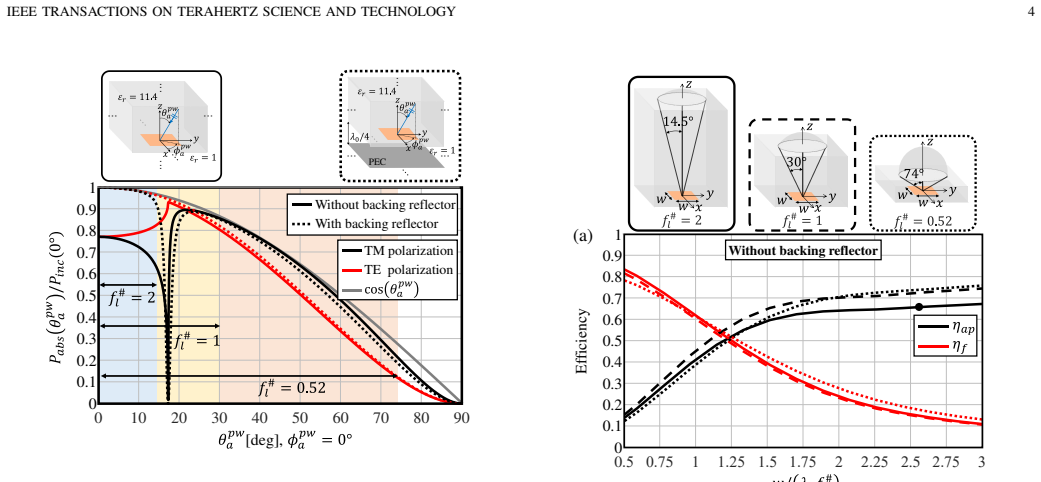
The central object is the dual-polarized distributed absorber: a tightly periodic array of two meandering aluminum strips, about 380 nm wide in the fabricated device, whose combined sheet impedance is tuned so the absorber resonates against the unit cell's own capacitance and inductance at the target THz frequency. The absorber is shorted to ground on one side and joined to an open-ended NbTiN coplanar-waveguide resonator on the other, making the meander the inductive part of the KID. Around it, the design and analysis rest on a Floquet-wave equivalent circuit: the lens converts an incident plane wave into a spectrum of plane waves (a plane-wave spectrum) limited by the lens subtended angle $\theta_L$; each spectral component is processed through the absorber's two-port impedance network; and coherent summation gives the absorbed power and the reception power pattern. The design guideline is to co-choose the lens $f$-number and the absorber spectral response so the aperture efficiency is maximized while the absorber stays small enough for dense focal-plane packing and low sensitivity to stray light.
What would settle it
Measure the transmission of the complete filter stack (both band-pass and both high-pass filters) at 4 K with a cryogenic Fourier-transform spectrometer and recompute the absolute power incident on the detectors; if the inferred optical efficiency shifts by more than the reported scatter, the agreement with the model—and the indirectly validated $54\%$ aperture efficiency—would not hold. A more direct check is a coherent-source measurement of the aperture efficiency at $6.98$ THz that does not depend on photon-noise-limited behavior.
Extended reading notes
Core claim
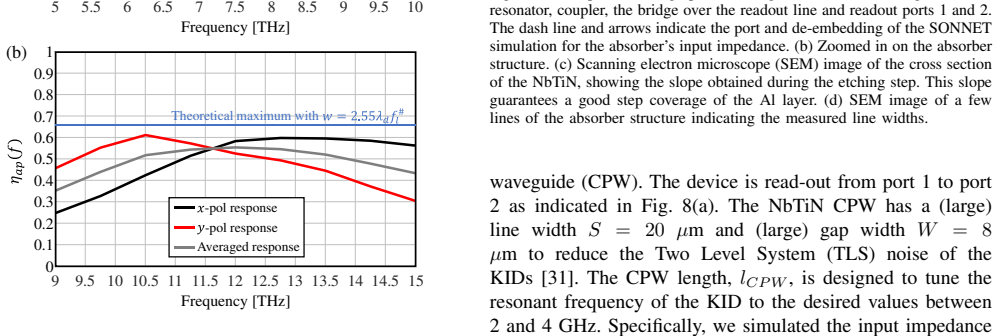
The central claim is that a KID whose aluminum meander acts simultaneously as the radiation absorber and as the resonator's kinetic inductor, sitting at the focal plane of an elliptical silicon lens, is accurately described by a spectral Floquet-wave transmission-line model, and that the fabricated prototype behaves as the model says. The measured optical coupling—how much of the power from an incoherent distributed source is absorbed, relative to a single spatial mode and polarization—matches the model for the 23 working detectors (a 92% yield). Because the reception power pattern is controlled almost entirely by the lens diameter and absorber size, the paper argues the measured optical coupling leaves no room for the aperture efficiency to differ from the model's value, which is $54\%$ for the fabricated geometry. The limiting NEP of $8\times10^{-20}\ \mathrm{W/\sqrt{Hz}}$ at 100 Hz modulation is reached when the detector noise is dominated by photon shot noise and wave-bunching noise, i.e., the fundamental limit set by the background radiation. On its own terms, the paper establishes the lens-absorber KID as a scalable, background-limited detector for future FIR space missions, with relaxed alignment tolerances compared with lens-antenna KIDs.
Load-bearing premise
The measured optical efficiency, and thus the indirectly inferred aperture efficiency of $54\%$, rests on the assumptions that the KIDs are photon-noise limited for blackbody temperatures above 18 K and that the absolute power incident on the detectors is known; the filter-stack transmission was calibrated with a 4 K measurement of only one band-pass filter, while the two high-pass filters were modeled from manufacturer data.
Editorial extensions
If this is right
- The same spectral-model workflow can be reused for other bands: the 12 THz design extends the dual-meander absorber family to the 25–30 µm range with predicted 1-dB bandwidth of 5.1 THz.
- The reported 92% array yield and agreement of measured versus modeled optical coupling support scaling the approach to kilo-pixel arrays read out by a single microwave backend.
- At 100 Hz modulation the limiting NEP is $8\times10^{-20}\ \mathrm{W/\sqrt{Hz}}$, below the $10^{-19}$ threshold needed for background-limited spectroscopy from an actively cooled telescope.
- Because the tolerated lateral misalignment for lens absorbers is far looser than for lens antennas, the design relaxes the assembly precision required for FIR focal planes.
- The measured optical efficiency of about 5.95 times a single-mode, single-polarization coupling is consistent with the multi-mode effective-area model, meaning the same formulas can predict how a full instrument will couple to an extended astronomical source.
Reading between the lines
- A direct cryogenic measurement of both high-pass filters would be the quickest way to test the paper's power calibration; the authors' own data show the 4 K correction changes the coupled power by 30%, so the remaining unmeasured filters bound the systematic uncertainty of the 54% aperture efficiency.
- The paper quotes NEP at 100 Hz modulation because a 1/f component dominates below that; whether the array delivers its sensitivity in a realistic spectral survey depends on how that 1/f noise is handled at the slow chop frequencies typical of space observations.
- Since the two meander orientations are quasi-independently tunable, a natural extension—not pursued here—is a polarization-sensitive variant that reads out the two orientations separately.
- The plane-wave illumination used in the validation is a single-direction idealization; a full end-to-end test with a real reflector feed would show whether the reception power pattern, including the measured 4.6° beam tilt from misalignment, delivers the predicted array observing speed.
Editorial analysis
A structured set of objections, weighed in public.
Referee Report
Summary. The manuscript proposes an array concept in which distributed, dual-polarised meandering-strip absorbers are integrated with silicon lenses and kinetic-inductance resonators for far-infrared space astronomy. Using a previously developed spectral Floquet/plane-wave-spectrum model, the authors derive design guidelines, present lens-absorber designs for 6.98 and 12 THz, and fabricate a 25-element prototype at 6.98 THz. The experimental section reports resonator yield and quality factors, the optical coupling (normalized throughput) obtained from NEP measurements, an indirectly inferred aperture efficiency of 54% averaged over two polarizations, and a limiting NEP of 8e-20 W/sqrt(Hz) at 100 Hz modulation. The core evidence is a comparison of the measured optical efficiency per KID with model predictions, including a correction for a common lens-absorber misalignment that is tied to an independent small-aperture measurement.
Significance. If confirmed, the result is significant for future FIR space missions such as PRIMA: it demonstrates a lens-absorber KID focal-plane array with multi-mode optical coupling that is quantitatively understood, and it provides design rules for scaling to 12 THz. The paper's strengths are that the NEP is a genuine measured quantity, the optical-efficiency comparison is made without fitting spectral-model constants, the only ad hoc parameter is a common misalignment anchored to an independent small-aperture measurement, and the supplementary tolerance study addresses realistic fabrication uncertainties. The main weakness is that the headline 54% aperture efficiency is not measured directly but is inferred through a chain whose absolute scale depends on the calibration of the filter stack.
major comments (2)
- [Sec. IV-B and App. E, Eq. (26)] The absolute calibration of the filter-stack transmission Fil(f) is load-bearing for the reported aperture efficiency. In Eq. (26) the numerator is linear in Fil(f) through P_sf, while the dominant experimental denominator term NEP^2_exp,Ps scales as Fil^2; hence a fractional error in the reconstructed 4 K stack transmission propagates almost one-for-one into the inferred eta_opt and, through Eq. (16), into eta_ap. The calibration is only partial: one band-pass filter is measured at 4 K, the second is assumed identical, and the two high-pass filters are modeled from manufacturer data for a similar filter with a 2.5% correction, while the total 4 K-to-300 K power correction is 30%. Because the small-aperture experiment in Appendix F uses the same Fil(f), it can validate the angular response but cannot separate a global calibration offset from the absolute efficiency scale. Please provide a quantitative systematic uncertainty on eta_ap from this chain, or an independent absolute power calibration.
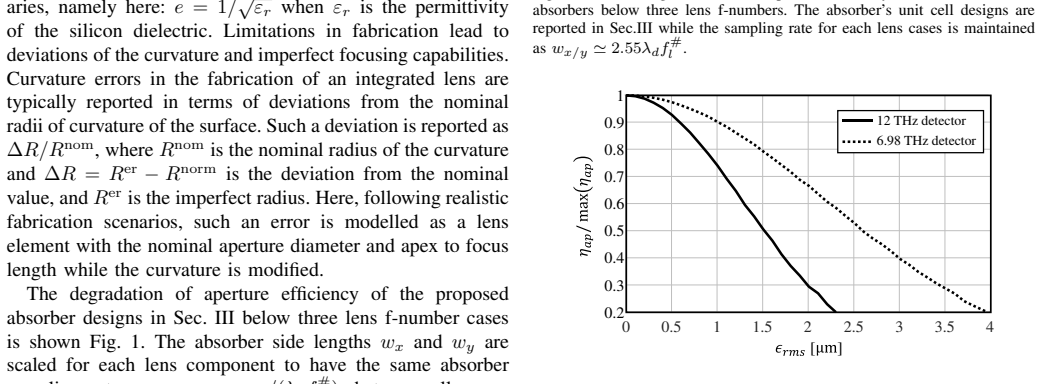
- [Sec. IV-B, Eq. (16), and Fig. 13] The experimental validation of the 54% aperture efficiency is indirect and model-dependent. The measured quantity is eta_opt; eta_ap is obtained by dividing out the model values of the spillover and focusing efficiencies, and the agreement is conditioned on a common lens-absorber misalignment inferred from the same measurement family (Fig. 13 and Appendix F). The argument that the reception pattern is well controlled by the absorber size and lens diameter is plausible, but Appendix F checks the relative angular response using the same model quantities and the same absolute calibration. Please add an uncertainty budget for the derived eta_ap that includes the model assumptions and the sensitivity to the inferred misalignment, or demonstrate the absolute efficiency scale with a controlled illumination whose incident power is known independently.
minor comments (5)
- [Fig. 7 and Sec. IV-A] The Fig. 7 caption states that solid and dotted lines correspond to the designed and fabricated devices, while Sec. IV-A describes the fabricated-unit-cell curve as dash-dotted; please reconcile the line-style nomenclature.
- [Abstract and Sec. I] The phrase 'averaged over two polarisation' should read 'averaged over two polarizations'; there are a few similar grammatical slips elsewhere in the text.
- [Fig. 12(c)] The y-axis label appears garbled as '[dB C/Hz]' in the typeset version; please check the rendering.
- [Sec. IV-B and Fig. 20] The NEP spectra for all KIDs are shown without any uncertainty indication; please state the measurement uncertainty or reproducibility of the NEP values in the text or add error bars.
- [Appendix C, Eqs. (8)-(10)] The symbols g_g and g_c are used without definition; please state explicitly that these are the gap and ground-plane contributions to the kinetic inductance per unit length.
Circularity Check
No construction-level circularity; the measured NEP-to-optical-efficiency comparison is an independent measurement-versus-model test, with only a moderate reliance on the authors' previously validated spectral model and a known filter-stack calibration caveat.
full rationale
The paper's quantitative chain is a measurement-versus-model comparison: measured phase noise and responsivity enter NEP_exp,Ps (Eq. 3), and the photon-noise-limited inversion in Eq. (26) yields the optical efficiency, which is then compared with the model value from Eqs. (16) and (27). No constant is fitted to the 6.98 THz dataset used for the headline optical-efficiency and 54% aperture-efficiency statements; the absorber geometry and Al resistivity entering the model are independently measured film/geometry values, and the measured NEP is not used to tune them. The aperture-efficiency inference does depend on the authors' previously published spectral model for the reception power pattern and focusing/spillover efficiencies, so a model error in those terms would propagate into the inferred aperture efficiency; however, the paper cites prior full-wave and bolometer validation of that model ([19], [23]) and provides a small-aperture cross-check (Appendix F) that partially tests the angular response. The incomplete 4 K filter-stack calibration (only one BPF measured directly, HPFs modeled from a 'similar filter' with a 2.5% correction, and the second BPF assumed identical) is a real absolute-power uncertainty that propagates almost inversely into eta_opt and hence into the inferred aperture efficiency, but it is a systematic accuracy limitation rather than a logical reduction of the result to its inputs. No step in the derivation equates an input to the claimed output by definition, and the central comparisons remain independent of any fitted parameter, so this is not a circular derivation; the low nonzero score reflects the central reliance on the group's own previously developed model and the shared calibration chain in both aperture configurations.
Assumptions & free parameters
free parameters (1)
- Lens-absorber lateral misalignment shift =
29.9 x + 15.1 y um
assumptions (4)
- domain assumption The Floquet wave model with a two-port impedance network accurately represents the absorber's spectral response to plane waves.
- domain assumption The detector NEP is photon-noise limited when the noise spectrum is white, allowing Eq. (26) to extract optical efficiency from measured NEP.
- domain assumption The absolute power from the blackbody is correctly computed from the filter stack transmission, including the 4 K correction based on one measured band-pass filter.
- standard math The standard CPW kinetic inductance and phase velocity expressions (Appendix C) give the correct resonator input impedance for the KID design.
Cite this review
Pith. "Pith review of Lens based Kinetic Inductance Detectors with Distributed Dual Polarised Absorbers for Far Infra-red Space-based Astronomy." pith.science (2026). https://pith.science/paper/PWAEP6UB
@misc{pith2026250603359,
  author       = {Pith},
  title        = {Pith review of: Lens based Kinetic Inductance Detectors with Distributed Dual Polarised Absorbers for Far Infra-red Space-based Astronomy},
  year         = {2026},
  howpublished = {\url{https://pith.science/paper/PWAEP6UB}},
  note         = {Machine review of arXiv:2506.03359}
}
abstract
Future space-based far infra-red astronomical observations require background limited detector sensitivities and scalable focal plane array solutions to realise their vast potential in observation speed. In this work, a focal plane array of lens absorber coupled Kinetic Inductance Detectors (KIDs) is proposed to fill this role. The figures of merit and design guidelines for the proposed detector concept are derived by employing a previously developed electromagnetic spectral modelling technique. Two designs operating at central frequencies of $6.98$ and $12$ THz are studied. A prototype array of the former is fabricated, and its performance is experimentally determined and validated. Specifically, the optical coupling of the detectors to incoherent distributed sources (i.e. normalised throughput) is quantified experimentally with good agreement with the estimations provided by the model. The coupling of the lens absorber prototypes to an incident plane wave, i.e. aperture efficiency, is also indirectly validated experimentally matching the expected value of $54\%$ averaged over two polarisation. The noise equivalent power of the KIDs are also measured with limiting value of $8\times10^{-20}$ $\mathrm{W/\sqrt{Hz}}$.
Figures


Figures from the paper (19 more)





Reference graph
Works this paper leans on
-
[1]
H. Dole , G. Lagache , J.-L. Puget , K. I. Caputi , N. Fern \'a ndez-Conde , E. Le Floc'h , C. Papovich , P. G. P \'e rez-Gonz \'a lez , G. H. Rieke , and M. Blaylock , `` The cosmic infrared background resolved by Spitzer. Contributions of mid-infrared galaxies to the far-infrared background ,'' Astronomy and Astrophysics, vol. 451, pp. 417--429, May 2006
work page 2006
-
[2]
D. Farrah , K. E. Smith , D. Ardila , C. M. Bradford , M. Dipirro , C. Ferkinhoff , J. Glenn , P. Goldsmith , D. Leisawitz , T. Nikola , N. Rangwala , S. A. Rinehart , J. Staguhn , M. Zemcov , J. Zmuidzinas , J. Bartlett , S. Carey , W. J. Fischer , J. Kamenetzky , J. Kartaltepe , M. Lacy , D. C. Lis , L. Locke , E. Lopez-Rodriguez , M. MacGregor , E. Mil...
work page 2019
-
[3]
J. Glenn and et al., ``Prima: the probe far-infrared mission for astrophysics,'' SPIE Astronomical Telescopes + Instrumentation, vol. 13092, Aug. 2024. [Online]. Available: https://doi.org/10.1117/12.3017620
-
[4]
Glenn and et al., `` The PRIMA Mission Concept ,'' Accepted for publication in JATIS, 2025
J. Glenn and et al., `` The PRIMA Mission Concept ,'' Accepted for publication in JATIS, 2025
work page 2025
-
[5]
L. Ciesla, D. Burgarella, C. D. Dowell, M. Sauvage, J. Baselmans, C. M. Bradford, L. Ferrari, J. Floriot, J. Glenn, M. J. Griffin, W. Jellema, E. Luthman, L. Martin, T. Pamplona, \'E . Prieto, T. Prouv \'e , J. Staguhn, and C. Tucker, `` PRIMA: PRIMAger, a far infrared hyperspectral and polarimetric instrument ,'' vol. 13092, p. 130920K, 2024. [Online]. A...
-
[6]
K. Pontoppidan and et al., `` The Far-Infrared Enhanced Survey Spectrometer (FIRESS) for PRIMA: Science Drivers ,'' Accepted for publication in JATIS, 2025
work page 2025
-
[7]
K. Irwin and G. Hilton, Transition-Edge Sensors. 1em plus 0.5em minus 0.4em Springer Berlin Heidelberg, Jul. 2005, p. 63–150. [Online]. Available: http://dx.doi.org/10.1007/10933596_3
-
[8]
P. C. Nagler , J. E. Sadleir , and E. J. Wollack , `` Demonstration of ultra-low noise equivalent power using a longitudinal proximity effect transition-edge sensor ,'' arXiv e-prints, p. arXiv:2012.06543, Dec. 2020
work page Pith review arXiv 2012
Show all 48 references
-
[9]
P. M. Echternach, A. D. Beyer, and C. M. Bradford, `` Large array of low-frequency readout quantum capacitance detectors ,'' Journal of Astronomical Telescopes, Instruments, and Systems, vol. 7, no. 1, pp. 1 -- 8, 2021. [Online]. Available: https://doi.org/10.1117/1.JATIS.7.1.011003
2021 doi
-
[10]
P. K. Day, H. G. LeDuc, B. A. Mazin, A. Vayonakis, and J. Zmuidzinas, ``A broadband superconducting detector suitable for use in large arrays,'' Nature, vol. 425, p. 817, 2003
2003
-
[11]
J. J. A. Baselmans , J. Bueno , S. J. C. Yates , O. Yurduseven , N. Llombart , K. Karatsu , A. M. Baryshev , L. Ferrari , A. Endo , D. J. Thoen , P. J. de Visser , R. M. J. Janssen , V. Murugesan , E. F. C. Driessen , G. Coiffard , J. Martin-Pintado , P. Hargrave , and M. Grif...
2017
-
[12]
Bueno , V
J. Bueno , V. Murugesan , K. Karatsu , D. J. Thoen , and J. J. A. Baselmans , `` Ultrasensitive Kilo-Pixel Imaging Array of Photon Noise-Limited Kinetic Inductance Detectors Over an Octave of Bandwidth for THz Astronomy ,'' Journal of Low Temperature Physics, vol. 193, no. 3-4...
2018
-
[13]
J. J. A. Baselmans , F. Facchin , A. Pascual Laguna , J. Bueno , D. J. Thoen , V. Murugesan , N. Llombart , and P. J. de Visser , `` Ultra-sensitive THz microwave kinetic inductance detectors for future space telescopes ,'' Astronomy and Astrophysics, vol. 665, p. A17, Sep. 2022
2022
-
[14]
P. K. Day , N. F. Cothard , C. Albert , L. Foote , E. Kane , B. H. Eom , R. Basu Thakur , R. M. J. Janssen , A. Beyer , P. M. Echternach , S. van Berkel , S. Hailey-Dunsheath , T. R. Stevenson , S. Dabironezare , J. J. A. Baselmans , J. Glenn , C. M. Bradford , and H. G. Leduc...
2024
-
[15]
Masi , P
S. Masi , P. de Bernardis , A. Paiella , F. Piacentini , L. Lamagna , A. Coppolecchia , P. A. R. Ade , E. S. Battistelli , M. G. Castellano , I. Colantoni , F. Columbro , G. D'Alessandro , M. De Petris , S. Gordon , C. Magneville , P. Mauskopf , G. Pettinari , G. Pisano , G. P...
2019
-
[16]
Hailey-Dunsheath , A
S. Hailey-Dunsheath , A. C. M. Barlis , J. E. Aguirre , C. M. Bradford , J. G. Redford , T. S. Billings , H. G. LeDuc , C. M. McKenney , and M. I. Hollister , `` Development of Aluminum LEKIDs for Balloon-Borne Far-IR Spectroscopy ,'' Journal of Low Temperature Physics, vol. 1...
2018
-
[17]
Karatsu , A
K. Karatsu , A. Endo , J. Bueno , P. J. de Visser , R. Barends , D. J. Thoen , V. Murugesan , N. Tomita , and J. J. A. Baselmans , `` Mitigation of cosmic ray effect on microwave kinetic inductance detector arrays ,'' Applied Physics Letters, vol. 114, no. 3, p. 032601, Jan. 2019
2019
-
[18]
Karatsu , A
K. Karatsu , A. Dominjon , T. Fujino , T. Funaki , M. Hazumi , F. Irie , H. Ishino , Y. Kida , T. Matsumura , K. Mizukami , M. Naruse , T. Nitta , T. Noguchi , N. Oka , S. Sekiguchi , Y. Sekimoto , M. Sekine , S. Shu , Y. Yamada , and T. Yamashita , `` Radiation Tolerance of A...
2016
-
[19]
Llombart, S
N. Llombart, S. O. Dabironezare, G. Carluccio, A. Freni, and A. Neto, ``Reception power pattern of distributed absorbers in focal plane arrays: A fourier optics analysis,'' IEEE Transactions on Antennas and Propagation, vol. 66, no. 11, p. 5990–6002, Nov. 2018. [Online]. Avail...
2018
-
[20]
Calvo and et
M. Calvo and et. al, ``The nika2 instrument, a dual-band kilopixel kid array for millimetric astronomy,'' Journal of Low Temperature Physics, vol. 184, no. 3–4, p. 816–823, Mar. 2016. [Online]. Available: http://dx.doi.org/10.1007/s10909-016-1582-0
2016 doi
-
[21]
P. S. Barry and et al., ``Design and performance of the antenna-coupled lumped-element kinetic inductance detector,'' Journal of Low Temperature Physics, vol. 193, p. 176–183, Nov. 2018
2018
-
[22]
Llombart, B
N. Llombart, B. Blazquez, A. Freni, and A. Neto, ``Fourier optics for the analysis of distributed absorbers under thz focusing systems,'' IEEE Transactions on Terahertz Science and Technology, vol. 5, no. 4, p. 573–583, Jul. 2015. [Online]. Available: http://dx.doi.org/10.1109...
2015
-
[23]
S. O. Dabironezare, J. Hassel, E. Gandini, L. Gronberg, H. Sipola, V. Vesterinen, and N. Llombart, ``A dual-band focal plane array of kinetic inductance bolometers based on frequency-selective absorbers,'' IEEE Transactions on Terahertz Science and Technology, vol. 8, no. 6, p...
2018
-
[24]
S. O. Dabironezare, G. Carluccio, A. Freni, A. Neto, and N. Llombart, ``Coherent fourier optics model for the synthesis of large format lens-based focal plane arrays,'' IEEE Transactions on Antennas and Propagation, vol. 69, no. 2, p. 734–746, Feb. 2021. [Online]. Available: h...
2021
-
[25]
van Berkel, S
S. van Berkel, S. Dabironezare, G. Chattopadhyay, M. Foote, J. Glenn, J. Baselmans, and C. Bradford, ``Relative observing speed of lens-coupled absorber focal plane arrays for far-ir imaging and spectroscopy: a prima case study,'' Journal of Astronomical Telescopes, Instrument...
2025 doi
-
[26]
M. J. Griffin, J. J. Bock, and W. K. Gear, ``Relative performance of filled and feedhorn-coupled focal-plane architectures,'' Appl. Opt., vol. 41, no. 31, pp. 6543--6554, Nov 2002. [Online]. Available: https://opg.optica.org/ao/abstract.cfm?URI=ao-41-31-6543
2002
-
[27]
Blazquez, N
B. Blazquez, N. Llombart, D. Cavallo, A. Freni, and A. Neto, ``A rigorous equivalent network for linearly polarized thz absorbers,'' IEEE Transactions on Antennas and Propagation, vol. 62, no. 10, p. 5077–5088, Oct. 2014. [Online]. Available: http://dx.doi.org/10.1109/TAP.2014.2341292
2014
-
[28]
Available: http://www.cst.com
CST , ``Cst microwave studio.'' [Online]. Available: http://www.cst.com
-
[29]
Matick, Transmission Lines for Digital and Communication Networks
R. Matick, Transmission Lines for Digital and Communication Networks. 1em plus 0.5em minus 0.4em London: IEEE Press, 1995
1995
-
[30]
Molero, M
C. Molero, M. Garcia-Vigueras, R. Rodriguez-Berral, F. Mesa, and N. Llombart, ``Equivalent circuit approach for practical applications of meander-line gratings,'' IEEE Antennas and Wireless Propagation Letters, vol. 16, p. 3088–3091, 2017. [Online]. Available: http://dx.doi.or...
2017
-
[31]
J. Gao, J. Zmuidzinas, B. A. Mazin, H. G. LeDuc, and P. K. Day, ``Noise properties of superconducting coplanar waveguide microwave resonators,'' Appl. Phys. Lett., vol. 90, p. 102507, 2007
2007
-
[32]
Available: https://www.sonnetsoftware.com/
Sonnet software , ``Sonnet.'' [Online]. Available: https://www.sonnetsoftware.com/
-
[33]
S. J. C. Yates , A. M. Baryshev , O. Yurduseven , J. Bueno , K. K. Davis , L. Ferrari , W. Jellema , N. Llombart , V. Murugesan , D. J. Thoen , and J. J. A. Baselmans , `` Surface Wave Control for Large Arrays of Microwave Kinetic Inductance Detectors ,'' IEEE Transactions on ...
2017
-
[34]
D. J. Thoen , B. G. C. Bos , E. A. F. Haalebos , T. M. Klapwijk , J. J. A. Baselmans , and A. Endo , `` Superconducting NbTiN Thin Films With Highly Uniform Properties Over a 100 mm Wafer ,'' IEEE Transactions on Applied Superconductivity, vol. 27, no. 4, p. 2631948, Jun. 2017
2017
-
[35]
S. J. C. Yates , J. J. A. Baselmans , A. M. Baryshev , S. Doyle , A. Endo , L. Ferrari , S. Hochg \"u rtel , and B. Klein , `` Clean Beam Patterns with Low Crosstalk Using 850 GHz Microwave Kinetic Inductance Detectors ,'' Journal of Low Temperature Physics, vol. 176, pp. 761-...
2014
-
[36]
H. G. Leduc, B. Bumble, P. K. Day, B. H. Eom, J. Gao, S. Golwala, B. A. Mazin, S. McHugh, A. Merrill, D. C. Moore, O. Noroozian, A. D. Turner, and J. Zmuidzinas, ``Titanium nitride films for ultrasensitive microresonator detectors,'' Appl. Phys. Lett., vol. 97, p. 102509, 2010
2010
-
[37]
[Online]
Veldlaser. [Online]. Available: https://www.veldlaser.nl/
-
[38]
M. Ji, C. Musante, S. Yngvesson, A. J. Gatesman, and J. Waldman, ``Study of parylene as anti-reflection coating for silicon optics at thz frequencies,'' Proceedings of the 11th International Symposium on Space Terahertz Technology, Ann Arbor, Michigan, USA, pp. p398--406, 2000
2000
-
[39]
Baselmans, S
J. Baselmans, S. Yates, P. Diener, and P. de Visser, ``Ultra low background cryogenic test facility for far-infrared radiation detectors,'' J. Low Temp. Phys., vol. 167, pp. 360--366, 2012
2012
-
[40]
S. Shu, M. Calvo, J. Goupy, S. Leclercq, A. Catalano, A. Bideaud, A. Monfardini, and E. F. C. Driessen, ``Increased multiplexing of superconducting microresonator arrays by post-characterization adaptation of the on-chip capacitors,'' Applied Physics Letters, vol. 113, no. 8, ...
2018 doi
-
[41]
R. M. J. Janssen, J. J. A. Baselmans, A. Endo, L. Ferrari, S. J. C. Yates, A. M. Baryshev, and T. M. Klapwijk, ``High optical efficiency and photon noise limited sensitivity of microwave kinetic inductance detectors using phase readout,'' Appl. Phys. Lett., vol. 103, no. 20, p...
2013 doi
-
[42]
S. A. H. de Rooij, J. J. A. Baselmans, J. Bueno, V. Murugesan, D. J. Thoen, and P. J. de Visser, ``Volume dependence of microwave induced excess quasiparticles in superconducting resonators,'' 2025. [Online]. Available: https://arxiv.org/abs/2503.07443
2025 arXiv
-
[43]
J. W. Goodman, Statistical Optics, 2nd ed. 1em plus 0.5em minus 0.4em Wiley, p. 211, 2015
2015
-
[44]
Collin, Foundations for microwave engineering, 2nd edition
R. Collin, Foundations for microwave engineering, 2nd edition. 1em plus 0.5em minus 0.4em New York: McGraw-Hill College, 1992
1992
-
[45]
J. J. A. Baselmans and S. J. C. Yates, ``Long quasiparticle lifetime in aluminium microwave kinetic inductance detectors using coaxial stray light filters,'' AIP Conference Proceedings, vol. 1185, pp. 160--163, 2009
2009
-
[46]
Ferrari , O
L. Ferrari , O. Yurduseven , N. Llombart , S. J. C. Yates , J. Bueno , V. Murugesan , D. J. Thoen , A. Endo , A. M. Baryshev , and J. J. A. Baselmans , `` Antenna Coupled MKID Performance Verification at 850 GHz for Large Format Astrophysics Arrays ,'' IEEE Transactions on Ter...
2018
-
[47]
Pascual Laguna and et
A. Pascual Laguna and et. al, ``Lens-antenna-coupled mkids for ultra-sensitive terahertz arrays,'' IEEE Transaction on Terahertz Science and Technology, p. in preparation
-
[48]
Ruze, ``Antenna tolerance theory;a review,'' Proceedings of the IEEE, vol
J. Ruze, ``Antenna tolerance theory;a review,'' Proceedings of the IEEE, vol. 54, no. 4, p. 633–640, 1966. [Online]. Available: http://dx.doi.org/10.1109/PROC.1966.4784
1966
Reviewed August 7, 2026 · model on record in the stance chip above.
Discussion (0). Continue with ORCID to comment.