REVIEW 5 major objections 5 minor 1 cited by
Observational constraints on a generalized equation of state model
T0 review · 5 major / 5 minor · reviewed 2026-08-10 · deepseek-v4-flash
Pith's one-line read The paper claims that the late-time universe is described by a single three-parameter equation of state in which dark energy evolves from a matter-like phase to a quintessence-like value of about $-0.69$ today, rather than sitting at the…
desk verdict Correct total-EoS fit, but ω0≈-0.69 is exactly what ΛCDM's total EoS predicts, so the quintessence claim does not follow. read the letter →
The pith
A machine-rendered reading of the paper's core claim, the machinery that carries it, and where it could break.
The reading
What carries the argument
The load-bearing object is the parametrized total equation of state $\omega_{\mathrm{eff}}(z) = \alpha/(1+\beta(1+z)^n)$, a three-parameter generalization of a form due to Mukherjee in which $\alpha$ sets the late-time asymptotic value, $\beta$ controls the transition rate, and $n$ shapes the redshift dependence. Its role is to be inserted into the Friedmann-derived identity $\omega = -1 + \frac{2}{3}(1+z)\frac{H'}{H}$, which turns the ansatz into a solvable differential equation for $H(z)$; the resulting closed-form $H(z)$ is the function actually fitted to the data. The parameter $\alpha$ carries the physics claim: $\alpha=-1$ recovers $\Lambda$CDM at late times, while $\alpha>-1$ gives quintessence-like behavior and $\alpha<-1$ gives phantom-like behavior.
What would settle it
Re-run the joint MCMC fit using the official Pantheon+ covariance matrix and read off the posterior of $\omega(0)$: if the $95\%$ credible interval for $\omega_0$ includes $-1$, the dynamical-dark-energy conclusion loses its statistical support. A second, independent test is to measure the growth rate of cosmic structure over $0.5 \lesssim z \lesssim 2$; the fitted background expansion predicts a specific growth history that differs from $\Lambda$CDM at these redshifts.
Extended reading notes
Core claim
The central claim is that a single three-parameter formula for the total equation of state, $\omega_{\mathrm{eff}}(z) = \alpha/(1+\beta(1+z)^n)$, jointly describes the matter-dominated past, the present accelerating epoch, and the asymptotic future with only four free parameters including $H_0$. Inserting this parametrization into the Friedmann equations yields an exact Hubble law $H(z) = H_0(1+z)^{3(\alpha+1)/2}\,\left[\frac{1+\beta(1+z)^n}{1+\beta}\right]^{-3\alpha/(2n)}$, which is then compared with $H(z)$ and Pantheon+ data. The joint fit prefers $\alpha = -0.93^{+0.31}_{-0.13}$, $\beta = 0.34^{+0.11}_{-0.32}$, $n = 3.38^{+0.51}_{-1.1}$, giving $\omega_0 \approx -0.69$; the authors interpret this as quintessence-like and evolving, distinct from the constant $\omega = -1$ of a cosmological constant. The same best fit places the deceleration-to-acceleration transition near $z \approx 0.64$ and, extrapolated to the future, predicts null-energy-condition violation and negative $c_s^2$.
Load-bearing premise
The result depends on the Pantheon+ likelihood being computed with its full covariance matrix, which the paper does not explicitly state; if the covariance is dropped, the reported $68\%$ intervals are too small and the present-day value $\omega_0 \approx -0.69$ may be statistically consistent with $-1$.
Editorial extensions
If this is right
- A single four-parameter fit reproduces the full late-time expansion history, so future $H(z)$ measurements above $z \sim 1$ can discriminate the model from $\Lambda$CDM.
- The deceleration-acceleration transition at $z \approx 0.64$ is consistent with independent estimates, but the late-time deceleration parameter is dataset-dependent, including $q < -1$ for the joint sample.
- If the fit is trusted, dark energy at present is in the quintessence window ($-1 < \omega_0 < -1/3$), and $\omega$ cannot be the constant $-1$ at the quoted precision.
- The future evolution implied by the best fit is unstable ($c_s^2 < 0$) and violates the null energy condition, so the model predicts either a phantom phase or a breakdown of the parametrization at late times.
Reading between the lines
- The paper quotes $\omega_0$ without an error bar; propagating the full MCMC chains would show that $\omega_0 \approx -0.69$ is probably within 1-2$\sigma$ of $-1$, making the 'dynamical dark energy' claim more tentative than the abstract suggests (editorial inference).
- Because the fit uses only background expansion data, the same parameters can be tested against growth-rate data; a growth prediction is a natural extension the paper does not make.
- Demanding stability of the future epoch ($c_s^2 \ge 0$ as $z \to -1$) would act as a prior that cuts out part of the allowed parameter space; applying it could shift the best fit toward $\alpha \approx -1$.
- The transition redshift $z \approx 0.64$ is a sharp, falsifiable number: targeted supernova and cosmic-chronometer observations around $z \sim 0.5$-$0.8$ would measure $q(z)$ directly and check it.
Editorial analysis
A structured set of objections, weighed in public.
Referee Report
Summary. The paper proposes a three-parameter parametrization of the total (effective) equation of state, ω_eff(z) = α/[1 + β(1+z)^n], and fits H0, α, β, n to 31 cosmic-chronometer H(z) data points and 1701 Pantheon+ supernova data points using MCMC. From the joint fit the authors obtain H0 = 69.01 ± 0.99, α = −0.93^{+0.31}_{−0.13}, β = 0.34^{+0.11}_{−0.32}, n = 3.38^{+0.51}_{−1.1}, and quote ω0 ≈ −0.69, a transition redshift z ≈ 0.64, and evolution of the deceleration and jerk parameters. They conclude that dark energy is dynamical and quintessence-like rather than a cosmological constant, and they analyze energy conditions and the speed of sound to discuss viability and future stability.
Significance. The H(z) derivation leading to Eq. (26) is correct, and the paper is transparent that this is a fitting exercise with four free parameters. If the statistical and interpretive issues were fixed, the parametrization could be a useful phenomenological description of the total EoS, and the comparison with ΛCDM would be of interest. As it stands, the paper's central physical conclusion is not supported: the fitted quantity is the total EoS, whose present value is approximately −0.7 even in flat ΛCDM, so the quoted ω0 ≈ −0.69 does not constitute evidence for quintessence or for dynamical dark energy. The absence of a model-selection statistic and the incomplete description of the Pantheon+ likelihood further weaken the central claim. The energy-condition section also contains an internal inconsistency concerning the DEC.
major comments (5)
- [Section II.B and Section IV.A, Eq. (16)] The parametrization is defined for the total/effective EoS, not for the dark-energy component. For flat ΛCDM with matter density Ωm and cosmological constant ΩΛ, the total EoS is ω_tot(z) = −1/[1 + (Ωm/ΩΛ)(1+z)^3], which is exactly Eq. (16) with α = −1, n = 3, and β = Ωm/ΩΛ; at z = 0 this gives ω_tot ≈ −ΩΛ ≈ −0.7. The joint best-fit ω0 ≈ −0.69 is therefore the value already predicted by ΛCDM, so the abstract's statement that the results indicate 'dark energy is dynamically evolving rather than acting as a cosmological constant' does not follow. The authors must either fit a separate dark-energy EoS after subtracting matter/radiation or explicitly reframe all conclusions as constraints on the total EoS and remove the dynamical-DE interpretation.
- [Section III.C and Section IV] No model comparison with ΛCDM is reported. The text says the model aligns with observations and Fig. 1 compares the two curves, but no Δχ², AIC, BIC, or evidence ratio is given, and the best-fit χ² values are not stated. Without this, the claims of agreement and of any preference over ΛCDM are unquantified. Please add information criteria or a likelihood-ratio comparison for each dataset combination used in the analysis.
- [Section III.A and Section III.C] The Pantheon+ likelihood is incompletely specified. The χ²_SNe Ia is defined without presenting the Pantheon+ covariance matrix, the SH0ES Cepheid distance likelihood, or the treatment of the absolute magnitude M. If only diagonal uncertainties were used, the reported 68% intervals for α, β, n, and H0 are likely underestimated. In addition, the derived quantities ω0, q0, j0, and the transition redshift z_tr are quoted as point values with no propagated uncertainties; an error bar on ω0 in particular is essential before any claim that ω0 differs from the ΛCDM total-EoS value can be evaluated.
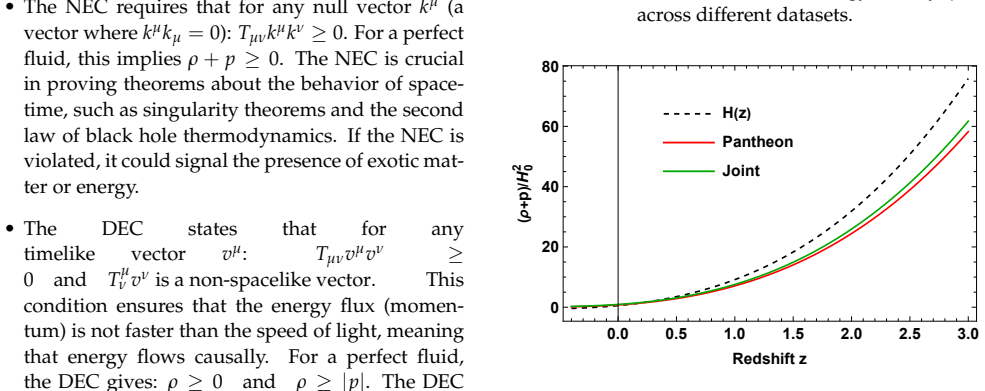
- [Section V.A and Figs. 7-8] The DEC analysis is internally inconsistent. For a perfect fluid the dominant energy condition requires both ρ + p ≥ 0 and ρ − p ≥ 0, equivalently ρ ≥ |p|. Fig. 7 shows ρ + p < 0 in the future for the joint dataset, which by itself violates the DEC; Fig. 8 plotting only ρ − p cannot establish that the DEC holds. The claim that the DEC is satisfied in the past, present, and future is therefore contradicted by the authors' own NEC plot. Please recompute and reinterpret the energy conditions using the full DEC inequalities.
- [Section IV.B, Eq. (29)] The deceleration parameter is misdefined: q = −1 − (1+z)/H dH/dz should be q = −1 + (1+z)/H dH/dz, which in the flat case gives q = (1 + 3ω)/2. Equation (30) and the figures use the correct expression, so Eq. (29) is inconsistent with the subsequent analysis. Relatedly, the text's assignment q < −1 for the combined dataset is inconsistent with the reported α = −0.93, which yields q(z → −1) = 1/2 + 3α/2 = −0.895 > −1; these statements should be corrected and reconciled.
minor comments (5)
- [Section II.B, Eqs. (21)-(26)] The intermediate split in the integration is misleading: the 'Term α + 1' is written as ∫(α+1)/(1+z) dz, but the denominator in Eq. (21) also contains 1 + β(1+z)^n. The final result Eq. (26) is correct, but the derivation should be rewritten, for example by using 1 + α/[1 + βx^n] before integrating, for clarity.
- [Reference list] Reference [65] should be to Foreman-Mackey et al. (2013), not 'Mackey et al.'; several author and affiliation strings also contain typos such as 'Pavn' and 'T ashkent'.
- [Section IV.A] The sentence describing the low-redshift behavior of ω(z) is repeated almost verbatim; please remove the duplication.
- [Fig. 2] The contour labels for the three datasets are small and overlapping, making the confidence regions difficult to distinguish; larger fonts or separate panels would improve readability.
- [Section III.C] The paper should report a goodness-of-fit statistic such as χ²/dof for each dataset combination, not only the best-fit parameter values, so that the quality of the fits can be assessed.
Circularity Check
No significant circularity: the paper is a transparent parameter-fitting exercise, and the derived EoS/kinematic quantities are algebraic consequences of the fitted ansatz rather than independent predictions.
full rationale
The paper's derivation chain is self-contained and transparent. It proposes a total (effective) EoS ansatz in Eq. (16), solves the Friedmann-consistency relation to obtain H(z) in Eq. (26), and then fits H0, alpha, beta, n to H(z) and Pantheon+ data. The reported present-day EoS value omega0 = alpha/(1+beta), the deceleration parameter q(z), and the jerk j(z) are all direct algebraic consequences of the fitted parameters and the model equations; the paper does not label these as independent predictions against held-out data, but as constrained results of the model. This is a normal parameter-estimation exercise, not a case of a fitted input being renamed as a prediction. The abstract's claim that dark energy is dynamically evolving rather than a cosmological constant is an interpretive inference from a total-EoS fit, and the skeptic's observation that a total omega0 near -0.7 is also what LambdaCDM predicts is a substantive scientific-validity objection about whether the model actually constrains the dark-energy component. That is a logical/interpretive gap, not circularity: the fit does not assume the conclusion. The self-citations present in the paper (e.g., refs. 31, 34-38, 49) are used for standard background equations and examples of modified-gravity models; none is load-bearing for the central parameter constraints or for excluding alternative models. The possible omission of the Pantheon+ covariance matrix, if real, would affect the quoted uncertainties and significance levels, but it would not make the derivation circular. No step can be exhibited in which the claimed result is equivalent by construction to its own input or justified only by a self-citation chain. Therefore the appropriate circularity score is 0.
Assumptions & free parameters
free parameters (4)
- H0 =
69.01 ± 0.99 (joint fit)
- α =
-0.93 +0.31/-0.13 (joint fit)
- β =
0.34 +0.11/-0.32 (joint fit)
- n =
3.38 +0.51/-1.1 (joint fit)
assumptions (4)
- standard math FLRW metric and Friedmann equations hold with zero spatial curvature (k=0).
- ad hoc to paper The total cosmic fluid is barotropic with EoS ω_eff(z)=α/[1+β(1+z)^n] given by Eq. (16).
- domain assumption Distance modulus residuals from Pantheon+ are statistically independent (diagonal covariance).
- domain assumption The H(z) cosmic-chronometer measurements are independent and Gaussian.
Cite this review
Pith. "Pith review of Observational constraints on a generalized equation of state model." pith.science (2026). https://pith.science/paper/Q3XOS2KL
@misc{pith2026241220073,
  author       = {Pith},
  title        = {Pith review of: Observational constraints on a generalized equation of state model},
  year         = {2026},
  howpublished = {\url{https://pith.science/paper/Q3XOS2KL}},
  note         = {Machine review of arXiv:2412.20073}
}
abstract
We investigate the cosmological implications of a generalized total equation of state (EoS) model by constraining its parameters using observational datasets to effectively characterize the universe's expansion history and its dynamic properties. We introduce three parameters: $\alpha$, $\beta$, and $n$ to capture the EoS behavior across different evolutionary phases. Our analysis indicates that at high redshifts ($z \gg 1$), the EoS approaches a matter- or radiation-dominated regime, transitioning to a dark energy-dominated phase as $z \to -1$, where it tends towards a constant value $\alpha$. Using a Markov Chain Monte Carlo (MCMC) method, we analyze a combined dataset that includes 31 data points from $H(z)$ and 1701 data points from the Pantheon+ dataset. The results reveal a smooth transition from deceleration to acceleration in the universe's expansion, with current EoS values suggesting quintessence-like behavior. The model aligns with observations and indicates that dark energy is dynamically evolving rather than acting as a cosmological constant. Furthermore, energy conditions and stability analyses highlight the nature and future of dark energy. This parametrized EoS model thus offers a robust framework for understanding the complexities of dark energy and the evolution of the cosmos.
Figures


Figures from the paper (5 more)




Forward citations
Cited by 1 Pith paper
-
An overview of what current data can (and cannot yet) say about evolving dark energy
The apparent preference for evolving dark energy depends strongly on which supernova catalog and which BAO survey are used, and is not robust across all independent data combinations.
Reference graph
Works this paper leans on
-
[1]
Term α + 1: R α+1 (1+z) dz = (α + 1) ln(1 + z)
-
[2]
Set u = 1 + β(1 + z)n, so du = βn(1 + z)n−1dz
Term β(1 + z)n: This term can be solved using sub- stitution. Set u = 1 + β(1 + z)n, so du = βn(1 + z)n−1dz. After solving, we get: Z β(1 + z)n (1 + z) 1 + β(1 + z)n dz = 1 n ln 1 + β(1 + z)n (24) Now, combine both parts of the integral: ln H(z) =3(α + 1) 2 ln(1 + z) − 3α 2n ln 1 + β(1 + z)n + C, (25) where C is the constant of integration. Now, we expo- ...
-
[3]
4 shows a distinct transition from a decel- erating to an accelerating universe
(30) Using the best-fit model parameters, the evolution of q(z) in Fig. 4 shows a distinct transition from a decel- erating to an accelerating universe. During the early universe, the deceleration parameter is positive, indicat- ing that the universe is dominated by matter and its ex- pansion is slowing down. As redshift decreases and DE 9 H(z) Pantheon J...
-
[4]
• The NEC requires that for any null vector kµ (a vector where kµkµ = 0): Tµνkµkν ≥ 0
The WEC ensures that the energy density seen by any observer is non-negative, preventing un- physical energy distributions. • The NEC requires that for any null vector kµ (a vector where kµkµ = 0): Tµνkµkν ≥ 0. For a perfect fluid, this implies ρ + p ≥ 0. The NEC is crucial in proving theorems about the behavior of space- time, such as singularity theorem...
-
[5]
Linde, Phys
A.D. Linde, Phys. Lett. B 108, 389-393 (1982)
1982
-
[6]
Riess et al., Astron
A.G. Riess et al., Astron. J. 116, 1009 (1998)
1998
-
[7]
Perlmutter et al., Astrophys
S. Perlmutter et al., Astrophys. J. 517, 565 (1999)
1999
-
[8]
Caldwell, M
R.R. Caldwell, M. Doran, Phys. Rev. D 69, 103517 (2004)
2004
Show all 89 references
-
[9]
Huang et al., J
Z.Y. Huang et al., J. Cosm. Astrop. Phys. 0605, 013 (2006)
2006
-
[10]
Eisenstein et al., Astrophys
D.J. Eisenstein et al., Astrophys. J. 633, 560 (2005)
2005
-
[11]
Percival at el., Mon
W.J. Percival at el., Mon. Not. R. Astron. Soc. 401, 2148 (2010)
2010
-
[12]
Koivisto, D.F
T. Koivisto, D.F. Mota, Phys. Rev. D 73, 083502 (2006)
2006
-
[13]
Daniel, Phys
S.F. Daniel, Phys. Rev. D 77, 103513 (2008)
2008
-
[14]
Astrophys
Planck Collaboration, Astron. Astrophys. 641, A6 (2020)
2020
-
[15]
Seljak, et al., Phys
U. Seljak, et al., Phys. Rev. D 71, 103515 (2005)
2005
-
[16]
Tegmark, et al., Phys
M. Tegmark, et al., Phys. Rev. D 74, 123507 (2006)
2006
-
[17]
B. Feng, X. Wang, and X. Zhang, Phys. Lett. B 607, 35-41 (2005)
2005
-
[18]
Jain and A
B. Jain and A. Taylor, Phys. Rev. Lett. 91, 141302 (2003)
2003
-
[19]
Oguri and K
M. Oguri and K. Takahashi, Phys. Rev. D 73, 123002 (2006)
2006
-
[20]
Hooper and S
D. Hooper and S. Dodelson, Astropart. Phys. 27, 113 13 (2007)
2007
-
[21]
Dalal et al., Phys
N. Dalal et al., Phys. Rev. Lett. 87, 141302 (2001)
2001
-
[22]
Weinberg, Rev
S. Weinberg, Rev. Mod. Phys. 61, 1 (1989)
1989
-
[23]
Zimdahl, D
W. Zimdahl, D. Pavn, and L.P . Chimento,Phys. Lett. B 521, 133–138 (2001)
2001
-
[24]
Amendola, Phys
L. Amendola, Phys. Rev. D 62, 043511 (2000)
2000
-
[25]
Nojiri, S
S. Nojiri, S. D. Odintsov, and S. Tsujikawa, Phys. Rev. D 71, 063004 (2005)
2005
-
[26]
R. R. Caldwell, M. Kamionkowski, and N. N. Weinberg, Phys. Rev. Lett. 91, 071301 (2003)
2003
-
[27]
Chiba et al., Phys
T. Chiba et al., Phys. Rev. D 62, 023511(2000)
2000
-
[28]
Armendariz-Picon et al., Phys
C. Armendariz-Picon et al., Phys. Rev. Lett. 85, 4438(2000)
2000
-
[29]
A. Y. Kamenshchik et al., Phys. Lett. B 511, 265 (2001)
2001
-
[30]
M. C. Bento et al., Phys. Rev. D 66, 043507(2002)
2002
-
[31]
A. Y. Kamenshchik et al., Phys. Lett. B 511, 265(2001)
2001
-
[32]
Appleby and R
S. Appleby and R. Battye, Phys. Lett. B 654, 7-12 (2007)
2007
-
[33]
Amendola et al., Phys
L. Amendola et al., Phys. Rev. D 75, 083504 (2007)
2007
-
[34]
Setare and N
M.R. Setare and N. Mohammadipour, J. Cosm. As- trop.Phys. 01, 015 (2013)
2013
-
[35]
Koussour and M
M. Koussour and M. Bennai, Class. Quantum Grav. 39 105001 (2022)
2022
-
[36]
J. B. Jim ´enez et al., Phys. Rev. D 98, 044048 (2018)
2018
-
[37]
Jim ´enez et al., Phys
J.B. Jim ´enez et al., Phys. Rev. D 101, 103507 (2020)
2020
-
[38]
Koussour et al., Phys
M. Koussour et al., Phys. Dark Univ. 36, 101051 (2022)
2022
-
[39]
Koussour et al., J
M. Koussour et al., J. High Energy Phys. 37, 15-24 (2023)
2023
-
[40]
Koussour and M
M. Koussour and M. Bennai, Chin. J. Phys. 79, 339-347 (2022)
2022
-
[41]
Koussour et al., Ann
M. Koussour et al., Ann. Phys. 445, 169092 (2022)
2022
-
[42]
Koussour et al., J
M. Koussour et al., J. High Energy Astrophys, 35, 43-51 (2022)
2022
-
[43]
Mukherjee, Mon
A. Mukherjee, Mon. Notices Royal Astron. Soc. 460, 273-282 (2016)
2016
-
[44]
Weller and A
J. Weller and A. Albrecht, Phys. Rev. D 65, 103512 (2002)
2002
-
[45]
Chevallier and D
M. Chevallier and D. Polarski, Int. J. Mod. Phys. D 10, 213 (2001)
2001
-
[46]
E. V . Linder,Phys. Rev. Lett. 90, 091301 (2003)
2003
-
[47]
Yang et al., Phys
W. Yang et al., Phys. Rev. D 99, 043543 (2019)
2019
-
[48]
Sendra and R
I. Sendra and R. Lazkoz, Mon. Not. R. Astron. Soc. 422, 776- 793 (2012)
2012
-
[49]
H. K. Jassal, J. S. Bagla, T. Padmanabhan, Mon. Not. R. Astron. Soc. Lett. 356, L11-L16 (2005)
2005
-
[50]
Liu et al., Mon
D.-J. Liu et al., Mon. Not. R. Astron. Soc. 388, 275 (2008)
2008
-
[51]
Ma and X
J.-Z. Ma and X. Zhang, Phys. Lett. B 669, 233 (2011)
2011
-
[52]
Ryden, Introduction to Cosmology; Addison Wesley: San Francisco, CA, USA (2003)
B. Ryden, Introduction to Cosmology; Addison Wesley: San Francisco, CA, USA (2003)
2003
-
[53]
Myrzakulov, M
N. Myrzakulov, M. Koussour and D.J. Gogoi, Eur. Phys. J. C, 83, 594 (2023)
2023
-
[54]
Yousaf et al., Phys
Z. Yousaf et al., Phys. Dark Universe, 46, 101727 (2024)
2024
-
[55]
Yousaf et al., Chin
Z. Yousaf et al., Chin. J. Phys., 88, 406-424 (2024)
2024
-
[56]
Khan and Z
S. Khan and Z. Yousaf, Phys. Scr., 99, 095304 (2024)
2024
-
[57]
Jimenez et al., Astrophys
R. Jimenez et al., Astrophys. J. 593, 622-629 (2003)
2003
-
[58]
Simon, L
J. Simon, L. Verde, and R. Jimenez, Phys. Rev. D 71, 123001 (2005)
2005
-
[59]
Stern et al., JCAP 02, 008 (2010)
D. Stern et al., JCAP 02, 008 (2010)
2010
-
[60]
Moresco et al., JCAP 08, 006 (2012)
M. Moresco et al., JCAP 08, 006 (2012)
2012
-
[61]
Zhang et al., Res
C. Zhang et al., Res. Astron. Astrophys. 14, 1221-1233 (2014)
2014
-
[62]
Moresco, Mon
M. Moresco, Mon. Not. Roy. Astron. Soc. 450, L16-L20 (2015)
2015
-
[63]
Moresco et al., JCAP 05, 014 (2016)
M. Moresco et al., JCAP 05, 014 (2016)
2016
-
[64]
Ratsimbazafy et al., Mon
A.L. Ratsimbazafy et al., Mon. Not. Roy. Astron. Soc. 467, 3239-3254 (2017)
2017
-
[65]
Riess et al., Astrophys
A.G. Riess et al., Astrophys. J. Lett. 934, L7 (2022)
2022
-
[66]
Brout et al., Astrophys
D. Brout et al., Astrophys. J. 938, 110 (2022)
2022
-
[67]
Brout et al., Astrophys
D. Brout et al., Astrophys. J. 938, 111 (2022)
2022
-
[68]
D Scolnic et al., Astrophys. J. 938, 113 (2022)
2022
-
[69]
D. F. Mackey et al., Publ. Astron. Soc. Pac. , 125, 306 (2013)
2013
-
[70]
Chen and B
G. Chen and B. Ratra , Publ. Astron. Soc. Pac. 123, 1127 (2011)
2011
-
[71]
G. Chen, S. Kumar and B. Ratra, Astrophys. J. 835, 86 (2017)
2017
-
[72]
Aubourg et al., Phys
E. Aubourg et al., Phys. Rev. D 92, 123516 (2015)
2015
-
[73]
Hernandez-Almada, et al., Eur
A. Hernandez-Almada, et al., Eur. Phys. J. C 79, 1-9 (2019)
2019
-
[74]
Q. J. Zhang, Y. L. Wu, J. Cosmol. Astropart. Phys. 2010, 038 (2010)
2010
-
[75]
Farooq and B
O. Farooq and B. Ratra, Astrophys. J. Lett. 766, L7 (2013)
2013
-
[76]
Farooq, et al., Astrophys
O. Farooq, et al., Astrophys. J. 835, 26–37 (2017)
2017
-
[77]
Jesus, et al., J
J.F. Jesus, et al., J. Cosmol. Astropart. Phys. 2020, 053 (2020)
2020
-
[78]
Garza, et al., Eur
J.R. Garza, et al., Eur. Phys. J. C 79, 890 (2019)
2019
-
[79]
Visser, Class
M. Visser, Class. Quantum Gravity 21, 2603 (2004)
2004
-
[80]
Visser, Gen
M. Visser, Gen. Relativ. Gravit. 37, 1541-1548 (2005)
2005
-
[81]
Raychaudhuri, Phys
A. Raychaudhuri, Phys. Rev. D 98, 1123 (1955)
1955
-
[82]
Nojiri and S
S. Nojiri and S. D. Odintsov, Int. J. Geom. Methods Mod. Phys. 04, 115 (2007)
2007
-
[83]
Ehlers, Int
J. Ehlers, Int. J. Mod. Phys. D 15, 1573 (2006)
2006
-
[84]
Barcelo, and M
C. Barcelo, and M. Visser, Int. J. Mod. Phys. D, 11, 1553 (2002)
2002
-
[85]
Moraes, and P .K
P .H.R.S. Moraes, and P .K. Sahoo, Eur. Phys. J. C, 77, 480 (2017)
2017
-
[86]
Visser, Phys
M. Visser, Phys. Rev. D, 56, 7578 (1997)
1997
-
[87]
Myung, Phys
Y.S. Myung, Phys. Lett. B, 652, 223 (2007)
2007
-
[88]
Kim, H.W
K.Y. Kim, H.W. Lee, and Y.S. Myung, Phys. Lett. B , 660, 118 (2008)
2008
-
[89]
Sanchez and G
N. Sanchez and G. Veneziano, Nucl. Phys. B , 333, 253-266 (1990)
1990
Reviewed August 10, 2026 · model on record in the stance chip above.
Discussion (0). Continue with ORCID to comment.