REVIEW 3 major objections 5 minor 76 references
Reeb-Wolf Improved Landauer Principle for Hairy Black Holes via Gravitational Decoupling
T0 review · 3 major / 5 minor · reviewed 2026-08-15 · deepseek-v4-flash
Pith's one-line read This paper claims that gravitational hair on black holes lowers the minimum energy required to erase one bit of information, by cooling the horizon while enlarging it.
desk verdict A competent Landauer/Reeb-Wolf application to two hairy black hole families whose central algebra checks out, but the DEC discrete sector has a real internal inconsistency that the authors wave away. read the letter →
The pith
A machine-rendered reading of the paper's core claim, the machinery that carries it, and where it could break.
The reading
What carries the argument
The machinery has four linked pieces. First, gravitational decoupling by extended geometric deformation deforms a Schwarzschild seed with parameter $\chi$ into hairy metrics; the SEC branch has hair scale $\ell$ with $f(r)=1-(2M+\chi\ell)/r+\chi e^{-r/M}$, and the DEC branch adds an effective charge $Q$ with a Reissner–Nordström-like term. Second, the Hawking temperature of the deformed horizon supplies the reservoir temperature in Landauer's bound. Third, the Reeb–Wolf equality $\beta\Delta Q = \Delta S + I(S':R') + D(\rho'_R\|\rho_R)$ turns the erasure cost into a sum of entropy decrease, correlations, and reservoir relative entropy, and its finite-size form gives the correction using $d_{\rm eff} \simeq \exp(S_{BH}/k_B)$. Fourth, Bekenstein area quantization $A_n = \gamma \ell_P^2 n$, with $\gamma = 4\ln 2$ and $S_n = \gamma k_B n/4$, converts one-bit entropy spacing into a discrete Landauer spectrum $E_{L,n} = k_B T_{H,n}\ln 2$.
What would settle it
A microscopic model of horizon microstates that assigns the reservoir an effective dimension polynomial in the area rather than exponential — for example $d_{\rm eff} \sim (A/\ell_P^2)^\alpha$ — would make the Reeb–Wolf correction comparable to $k_B T_H \ln 2$ instead of subdominant. More sharply, the prediction $I(S':R')=0$ for $\gamma = 4\ln 2$ could be checked by constructing an explicit unitary erasure model and computing the final mutual information: any positive value at exactly that spacing would contradict the minimal-correlation identification.
Extended reading notes
Core claim
The paper's central finding is that gravitational hair modifies the horizon's thermodynamic response to information erasure in a systematic way. For both hairy branches, the horizon radius $r_H$ enters the Hawking temperature $T_H = \hbar c / (4\pi k_B r_H)$ times a hair-dependent correction; because hair enlarges $r_H$ for the parameter ranges studied, $T_H$ and the Landauer cost $E_{\min} = k_B T_H \ln 2$ fall below their Schwarzschild values, whereas the area and entropy $S_{BH} = \pi k_B c^3 r_H^2 / (G\hbar)$ rise. The Reeb–Wolf finite-size correction adds a strictly positive amount $2(\ln 2)^2/[\ln^2(d_{\rm eff}-1)+4]$ per bit, with $d_{\rm eff} \simeq e^{S_{BH}/k_B}$, so it is subdominant for macroscopic horizons. Under Bekenstein area quantization, the one-bit spacing $\gamma = 4\ln 2$ makes the mutual-information term vanish while the relative-entropy term, fixed by the actual energy gap between neighboring levels, remains positive; the discrete Landauer cost $E_{L,n}$ decreases with $n$ in both branches, though the DEC branch shows charge-dependent behavior at low $n$.
Load-bearing premise
The quantitative corrections assume the horizon behaves like a heat bath whose number of internal states is given by the exponential of the Bekenstein–Hawking entropy; if the horizon's actual state space is different, the claimed finite-size corrections and their split into correlations and irreversible entropy would not follow.
Editorial extensions
If this is right
- In the SEC branch, switching off the decoupling parameter $\chi$ returns the Schwarzschild temperature and Landauer cost; in the DEC branch this requires simultaneously $\chi\to 0$ and $Q\to 0$, so charge alone leaves a Reissner–Nordström-like baseline below Schwarzschild.
- Because hair increases the horizon entropy, it pushes $d_{\rm eff} = \exp(S_{BH}/k_B)$ upward, driving the finite-reservoir correction down and making the ideal Landauer bound a better approximation for hairy horizons than for the seed.
- With the one-bit area spacing $\gamma = 4\ln 2$, the mutual-information contribution vanishes but the relative-entropy contribution remains positive, so erasure at a hairy horizon does not saturate the ideal Landauer limit even at minimal correlation.
- The quantized Landauer cost $E_{L,n}$ decreases with level number $n$ in both branches, so higher excited horizon states erase bits more cheaply; in the DEC branch the effective charge mainly affects low and intermediate levels.
- The same Reeb–Wolf machinery applies to any black hole whose Hawking temperature, entropy, and level spacing are known, so the framework extends beyond these two hair families.
Reading between the lines
- If hair lowers erasure cost while raising entropy, the cost per unit of added horizon entropy $E_{\min}/\Delta S_{BH}$ decreases; one could rank geometries by information-thermodynamic efficiency, a comparison the paper does not make.
- The split of the Reeb–Wolf correction into a $\gamma$-controlled mutual-information piece and an energy-gap-controlled relative-entropy piece suggests that measuring the temperature dependence of erasure corrections could constrain the area-spacing parameter $\gamma$ independently of the hair parameters.
- The heuristic identification $d_{\rm eff} = \exp(S_{BH}/k_B)$ is the soft spot; an open-quantum-system calculation with greybody factors, which the paper itself flags for future work, would replace it with a computed reservoir dimension and could make the corrections testable by scattering data.
- The DEC branch's requirement that $\Delta E_n \ge k_B T_{H,n}\ln 2$ imposes an inequality on $(\chi, \ell, Q, n)$ that could be used to exclude parameter combinations before any microscopic model is built.
Signed reviews
Editorial analysis
A structured set of objections, weighed in public.
Referee Report
Summary. The manuscript applies Landauer's principle to two families of hairy black holes obtained from the Schwarzschild seed via gravitational decoupling with extended geometric deformation (EGD). For the SEC branch and the DEC (Reissner–Nordström-like) branch it derives horizon radii, Hawking temperatures, Bekenstein–Hawking entropies, and continuous Landauer costs as functions of the decoupling parameter χ, the hair scale ℓ, and the effective charge Q. It then imposes Bekenstein area quantization, computes discrete Landauer spectra and weak-hair expansions for the asymptotic masses, and uses the Reeb–Wolf finite-size bound with an effective horizon-reservoir dimension d_eff=exp(S_BH/k_B). The final part splits the Reeb–Wolf correction into mutual-information and relative-entropy contributions. The central claims are that gravitational hair lowers the Hawking temperature and the Landauer erasure cost while increasing horizon area and entropy; that the finite-size correction is positive but subdominant; that the discrete cost decreases with the area level n; and that the two contributions to the Reeb–Wolf correction have distinct physical origins.
Significance. The core derivations are explicit and checkable: the temperatures in Eqs. (64)/(66), the horizon equations (46)/(57), the entropies (77)/(78), and the weak-hair mass expansions (99)/(107) are internally consistent, and the χ→0 limits behave correctly for both branches. This gives the paper a solid base and yields concrete, falsifiable predictions connecting hair parameters to information-erasure costs. The paper is also honest about the heuristic character of d_eff=exp(S_BH/k_B). The significance is nevertheless moderated by an internal inconsistency in the DEC discrete sector and by parameter ranges that violate the paper's own DEC validity condition, both of which need to be fixed before the central claims can be accepted as stated.
major comments (3)
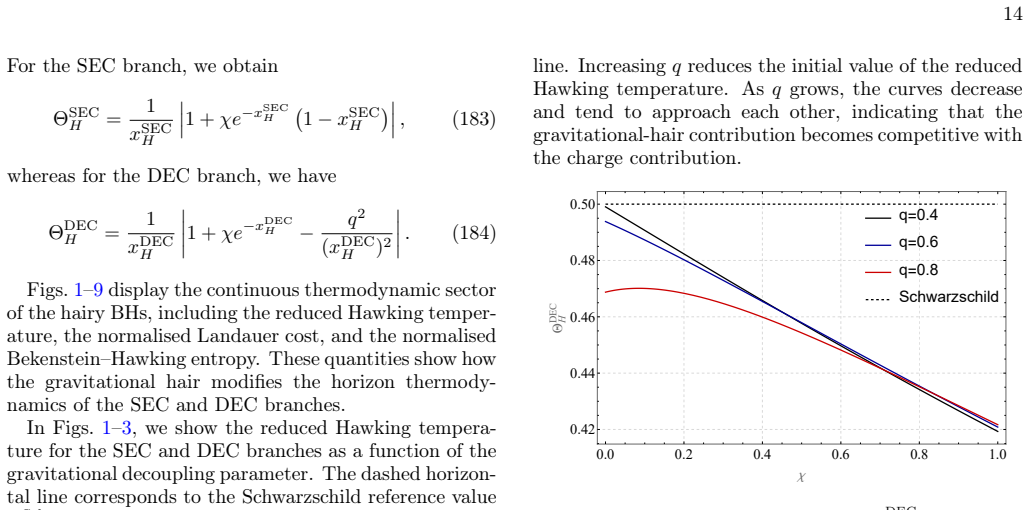
- [Sec. II.G, Eqs. (159)-(173); Sec. III.C, Figs. 20-21] For γ=4 ln2, Eq. (159) gives D_n^X=ΔE_n^X/(k_B T_{H,n}^X)−ln2, so Eq. (171) is equivalent to ΔE_n^X≥k_B T_{H,n}^X ln2, i.e., R_n^X=E_{L,n}^X/ΔE_n^X≤1. The DEC ratios plotted in Figs. 20 and 21 are above unity over the entire displayed range (q=0.2–0.8 with χ=0.3, and χ=0.0–0.3 with q=0.8). For those points D_n^DEC<0, directly contradicting Eq. (171). The statement in Sec. III.C that R_n>1 should be read as a 'diagnostic' does not resolve the contradiction, because Eq. (172) explicitly requires parameter ranges to be chosen so that non-negativity holds, and the plotted ranges do not satisfy this requirement. The claimed separation into non-negative mutual-information and relative-entropy contributions is therefore unsupported for the DEC discrete sector and must be either restricted to admissible parameters or reformulated.
- [Sec. II.C, Eq. (58); Figs. 2, 17, 20] The DEC branch is subject to the parameter restriction Q^2≥4χ(M/e)^2 (Eq. (58)), which for M=1 and χ=0.3 means q≥(4·0.3/e^2)^{1/2}≈0.403. Nevertheless Figs. 17 and 20 plot q=0.2 and q=0.4 with χ=0.3, and Fig. 2 plots q=0.4 and q=0.6 for values of χ beyond the thresholds where Eq. (58) is violated (χ≳0.30 for q=0.4 and χ≳0.67 for q=0.6). Those curves lie outside the DEC-consistent domain, so the corresponding statements about the DEC branch are not supported. Please enforce Eq. (58) in all plots or clearly mark exploratory regions outside the admissible parameter space.
- [Sec. II.G, Eqs. (152)-(155)] The mutual-information result I_n=γ/4−ln2 is not derived from the Reeb–Wolf dynamics; it follows immediately from the identification ΔS_R=γ/4 in Eq. (152). In particular, the statement that mutual information is 'governed by the area-spacing parameter' is a restatement of that effective-reservoir assumption rather than a dynamical consequence. The relative-entropy contribution in Eq. (159) does depend on the actual energy gap and is the substantive part of the split. The abstract and conclusions should be rephrased accordingly, presenting Eq. (155) as a consequence of the identification, not as an independently derived result.
minor comments (5)
- [Figs. 13-15; Eq. (190)] The axis labels of Figs. 13–15 indicate percentages, while Eq. (190) defines δ_fs as a dimensionless fraction; please specify whether the plotted quantity is 100δ_fs.
- [Sec. III.C] The phrase 'we first taken≥20' should read 'we first take n≥20'.
- [Eq. (94)] Please state explicitly that the discrete Landauer cost E_L,n=T_{H,n}ΔS_n uses thermodynamic entropy units (ΔS_n=k_B ln2), since Sec. II.G uses dimensionless entropies; this would avoid a units mismatch between the two sections.
- [Fig. 11 caption] The caption notes that the Schwarzschild dashed line is the finite-size corrected value; consider adding this information in the legend as well, since the corresponding classical curves in Figs. 4–6 use the uncorrected reference.
- [References] Reference [63] is a preprint; consider citing a peer-reviewed version or explicitly marking it as a preprint in the reference list.
Circularity Check
Core thermodynamic results are non-circular; the mutual-information/γ separation in Eq. (155) is a definitional consequence of the reservoir-entropy identification, with an acknowledged DEC R_n>1 consistency caveat.
-
self definitional
[Sec. II.G, Eqs. (152)-(155)]
"we identify the reservoir entropy increase with the corresponding increase of the Bekenstein–Hawking entropy, ∆SR = Sn−Sn−1 kB . (152) Then, using the area spectrum in Eq. (79) and the entropy spectrum in Eq. (91), we obtain ∆SR = γ/4. (153) ... Therefore, Eq. (140) gives In(S′ :R′) = γ/4−ln 2. (155)"
Eq. (140) defines I(S′:R′) = ∆S_R − ∆S by entropy conservation. Eq. (152) imposes ∆S_R = (S_n − S_{n−1})/k_B, and Eq. (91) with S_n = γk_B n/4 turns that into ∆S_R = γ/4. With ∆S = ln 2 fixed as the one-bit erasure input, Eq. (155) is an algebraic identity. The advertised result that mutual information is governed by the area-spacing parameter γ therefore contains no physics beyond the identification; it is a restatement of the input, not an independent prediction. The companion statement that relative entropy is fixed by the energy gap inherits the same structure once D = β∆Q − ∆S_R is used.
full rationale
The main thermodynamic chain is self-contained: the metrics (41)/(53) are taken from prior EGD work; the Hawking temperatures (64)/(66) follow from the standard surface-gravity formula; the Landauer costs (68)/(69) are k_B T_H ln 2; and the entropies (75)-(78) are the area law. The claim that hair lowers T_H and E_min while raising A_H and S_BH is a direct consequence of those formulas, not a fit. The Reeb-Wolf finite-size correction is computed from Reeb and Wolf's inequality using an independent, if heuristic, estimate d_eff ≃ exp(S_BH/k_B), so no fitted parameter is renamed as a prediction. The one load-bearing definitional step is in Sec. II.G: Eq. (155) follows from the explicit identification ∆S_R = (S_n − S_{n−1})/k_B, so the advertised separation of mutual information and relative entropy is true by construction rather than by independent derivation; the paper is transparent about the identification, but this sub-claim is still definitional. Separately, the DEC discrete sector has an acknowledged consistency limitation: with γ = 4 ln 2, Eq. (159) together with Eq. (171) requires R_n = E_L,n/ΔE_n ≤ 1, whereas Figs. 20-21 plot R_n > 1; the paper itself states in Sec. II.G and in the Fig. 20 caption that R_n > 1 should be read as a diagnostic rather than a saturation condition. That is an honest caveat, but it leaves the non-negative relative-entropy split unsupported for those plotted points; it is a correctness concern, not a circularity. No self-citation chain is load-bearing: Refs. [40], [61], [62], and [74] are external to the author list, and no author-specific uniqueness theorem is invoked to force the results. Overall, the central quantitative claims are non-circular; the separation claim is partially definitional, giving a moderate score.
Assumptions & free parameters
free parameters (4)
- gamma (area-spacing parameter) =
gamma = 4 ln 2 (chosen)
- chi (gravitational decoupling parameter) =
plotted in [0,1]
- l (hair length scale) =
plotted as 0.5, 1.0, 1.5 times M
- Q (effective charge, DEC branch) =
plotted as q = 0.2 to 0.8
assumptions (8)
- standard math Einstein field equations and the gravitational decoupling framework, Eqs. (6)-(28).
- standard math Bekenstein-Hawking area law S_BH = k_B c^3 A/(4 G hbar).
- standard math Hawking temperature formula T_H = hbar c |F'(r_H)|/(4 pi k_B).
- standard math Reeb-Wolf finite-size quantum Landauer bound, Eq. (120).
- domain assumption Bekenstein area quantization A_n = gamma l_P^2 n.
- ad hoc to paper The horizon reservoir has effective dimension d_eff = exp(S_BH/k_B).
- ad hoc to paper Reservoir entropy increase equals the Bekenstein-Hawking entropy increase between levels, Delta S_R = gamma/4.
- domain assumption Weak-hair expansion truncates at O(chi^2).
invented entities (1)
-
Effective horizon reservoir with d_eff = exp(S_BH/k_B)
Cite this review
Pith. "Pith review of Reeb-Wolf Improved Landauer Principle for Hairy Black Holes via Gravitational Decoupling." pith.science (2026). https://pith.science/paper/Q6VP4NNR
@misc{pith2026260812810,
  author       = {Pith},
  title        = {Pith review of: Reeb-Wolf Improved Landauer Principle for Hairy Black Holes via Gravitational Decoupling},
  year         = {2026},
  howpublished = {\url{https://pith.science/paper/Q6VP4NNR}},
  note         = {Machine review of arXiv:2608.12810}
}
read the original abstract
We investigated the thermodynamic and quantum-information cost of irreversible information erasure at the event horizon of hairy black holes generated through extended geometric deformation. Starting from the Schwarzschild black hole seed solution, we considered two families of hairy geometries satisfying the strong and dominant energy conditions. Lan-dauer's principle was used to relate the minimum energy required to erase one bit of information to the Hawking temperature of deformed horizon. We derived corresponding horizon radii, Hawking temperatures, Bekenstein-Hawking entropies and normalised Landauer costs as functions of decoupling parameter, the hair length scale and the effective charge associated with the additional gravitational sector. For the parameter ranges analyzed, our results show that gravitational hair tends to reduce the Hawking temperature and the minimum Landauer erasure cost while simultaneously increasing the horizon area and the Bekenstein-Hawking entropy. The Reeb-Wolf finite-size correction provides an additional positive contribution to the erasure cost but remains subdominant due to the large effective dimension of the horizon reservoir. We further separated the Reeb-Wolf correction into mutual-information and relative-entropy contributions, showing that the former is governed by the area-spacing parameter, whereas the latter is controlled by the actual energy gap between neighboring horizon levels. Furthermore, the Landauer spectrum obtained by quantizing the area decreases as the quantum number associated with the horizon increases, although this variation does not occur in the same way in the SEC and DEC branches. Overall, the presence of gravitational hair alters the thermodynamic properties of the horizon and, consequently, the Landauer cost associated with information erasure, both in the continuous regime and after quantizing the area.
Figures


Figures from the paper (12 more)


Reference graph
Works this paper leans on
-
[1]
Landauer, Irreversibility and heat generation in the computing process
R. Landauer, Irreversibility and heat generation in the computing process. IBM J. Res. Dev.5, 183–191 (1961)
work page 1961
-
[2]
Landauer, The physical nature of information
R. Landauer, The physical nature of information. Phys. Lett. A217, 188–193 (1996)
work page 1996
- [3]
- [4]
-
[5]
Herrera, Landauer principle and general relativity
L. Herrera, Landauer principle and general relativity. En- tropy22, 340 (2020)
work page 2020
-
[6]
C.A. Fuchs, Landauer’s principle and BH entropy, in Proceedings of the Workshop on Physics and Computa- tion, PhysComp ’92(IEEE Computer Society Press, Los Alamitos, 1992), pp. 86–92
work page 1992
-
[7]
J.D. Bekenstein, BHs and entropy. Phys. Rev. D7, 2333– 2346 (1973)
work page 1973
-
[8]
Bekenstein, BHs and the second law, inJacob Bekenstein: The Conservative Revolutionary, ed
J.D. Bekenstein, BHs and the second law, inJacob Bekenstein: The Conservative Revolutionary, ed. by L. Brink, V. Mukhanov, E. Rabinovici, K.K. Phua (World Scientific, Singapore, 2020), pp. 303–306
work page 2020
Show all 76 references
-
[9]
Bekenstein, Generalized second law of thermody- namics in BH physics
J.D. Bekenstein, Generalized second law of thermody- namics in BH physics. Phys. Rev. D9, 3292–3300 (1974)
1974
-
[10]
Bardeen, B
J.M. Bardeen, B. Carter, S.W. Hawking, The four laws of BH mechanics. Commun. Math. Phys.31, 161–170 (1973)
1973
-
[11]
Wald, The thermodynamics of BHs
R.M. Wald, The thermodynamics of BHs. Living Rev. Relativ.4, 6 (2001)
2001
-
[12]
D. Song, E. Winstanley, Information erasure and the gen- eralized second law of BH thermodynamics. Int. J. Theor. Phys.47, 1692–1698 (2008)
2008
-
[13]
Israel, Event horizons in static vacuum space-times
W. Israel, Event horizons in static vacuum space-times. Phys. Rev.164, 1776–1779 (1967)
1967
-
[14]
Carter, Axisymmetric BH has only two degrees of free- dom
B. Carter, Axisymmetric BH has only two degrees of free- dom. Phys. Rev. Lett.26, 331–333 (1971)
1971
-
[15]
Robinson, Uniqueness of the Kerr BH
D.C. Robinson, Uniqueness of the Kerr BH. Phys. Rev. Lett.34, 905–906 (1975)
1975
-
[16]
Heusler,BH Uniqueness Theorems(Cambridge Uni- versity Press, Cambridge, 1996) 22
M. Heusler,BH Uniqueness Theorems(Cambridge Uni- versity Press, Cambridge, 1996) 22
1996
-
[17]
Herdeiro, E
C.A.R. Herdeiro, E. Radu, Asymptotically flat BHs with scalar hair: a review. Int. J. Mod. Phys. D24, 1542014 (2015)
2015
-
[18]
Volkov, D.V
M.S. Volkov, D.V. Gal’tsov, Non-Abelian Einstein– Yang–Mills BHs. JETP Lett.50, 346–350 (1989)
1989
-
[19]
Bizon, Colored BHs
P. Bizon, Colored BHs. Phys. Rev. Lett.64, 2844–2847 (1990)
1990
-
[20]
Volkov, D.V
M.S. Volkov, D.V. Gal’tsov, Gravitating non-Abelian solitons and BHs with Yang–Mills fields. Phys. Rep.319, 1–83 (1999)
1999
-
[21]
Herdeiro, E
C.A.R. Herdeiro, E. Radu, Kerr BHs with scalar hair. Phys. Rev. Lett.112, 221101 (2014)
2014
-
[22]
Sotiriou, S.-Y
T.P. Sotiriou, S.-Y. Zhou, BH hair in generalized scalar- tensor gravity. Phys. Rev. Lett.112, 251102 (2014)
2014
-
[23]
Hawking, M.J
S.W. Hawking, M.J. Perry, A. Strominger, Soft hair on BHs. Phys. Rev. Lett.116, 231301 (2016)
2016
-
[24]
Haco, S.W
S. Haco, S.W. Hawking, M.J. Perry, A. Strominger, BH entropy and soft hair. J. High Energy Phys.12, 098 (2018)
2018
-
[25]
Herdeiro, E
C.A.R. Herdeiro, E. Radu, H. Rúnarsson, Kerr BHs with Proca hair. Class. Quantum Gravity33, 154001 (2016)
2016
-
[26]
Doneva, S.S
D.D. Doneva, S.S. Yazadjiev, New Gauss–Bonnet BHs with curvature-induced scalarization in extended scalar- tensor theories. Phys. Rev. Lett.120, 131103 (2018)
2018
-
[27]
Silva, J
H.O. Silva, J. Sakstein, L. Gualtieri, T.P. Sotiriou, E. Berti, Spontaneous scalarization of BHs and compact stars from a Gauss–Bonnet coupling. Phys. Rev. Lett. 120, 131104 (2018)
2018
-
[28]
Cunha, C.A.R
P.V.P. Cunha, C.A.R. Herdeiro, E. Radu, Spontaneously scalarized Kerr BHs in extended scalar-tensor–Gauss– Bonnet gravity. Phys. Rev. Lett.123, 011101 (2019)
2019
-
[29]
A. Dima, E. Barausse, N. Franchini, T.P. Sotiriou, Spin- induced BH spontaneous scalarization. Phys. Rev. Lett. 125, 231101 (2020)
2020
-
[30]
Capuano, L
L. Capuano, L. Santoni, E. Barausse, BH hairs in scalar- tensor gravity and the lack thereof. Phys. Rev. D108, 064058 (2023)
2023
-
[31]
Bakopoulos, C
A. Bakopoulos, C. Charmousis, P. Kanti, N. Lecoeur, T. Nakas, BHs with primary scalar hair. Phys. Rev. D109, 024032 (2024)
2024
-
[32]
Astorino, Static hairy BH in 4D general relativity
M. Astorino, Static hairy BH in 4D general relativity. Phys. Rev. D113, 024047 (2026)
2026
-
[33]
Gal’tsov, R
D. Gal’tsov, R. Karsanov, Charged nutty BHs are hairy. Phys. Lett. B876, 140431 (2026)
2026
-
[34]
Ovalle, Searching exact solutions for compact stars in braneworld: a conjecture
J. Ovalle, Searching exact solutions for compact stars in braneworld: a conjecture. Mod. Phys. Lett. A23, 3247– 3263 (2008)
2008
-
[35]
Ovalle, R
J. Ovalle, R. Casadio, A generalization of the minimal geometric deformation, inBeyond Einstein Gravity: The Minimal Geometric Deformation Approach in the Brane- World(Springer, Cham, 2020), pp. 77–93
2020
-
[36]
Ovalle, Decoupling gravitational sources in general rel- ativity: from perfect to anisotropic fluids
J. Ovalle, Decoupling gravitational sources in general rel- ativity: from perfect to anisotropic fluids. Phys. Rev. D 95, 104019 (2017)
2017
-
[37]
Ovalle, R
J. Ovalle, R. Casadio, R. da Rocha, A. Sotomayor, Anisotropic solutions by gravitational decoupling. Eur. Phys. J. C78, 122 (2018)
2018
-
[38]
Ovalle, Decoupling gravitational sources in general rel- ativity: the extended case
J. Ovalle, Decoupling gravitational sources in general rel- ativity: the extended case. Phys. Lett. B788, 213–218 (2019)
2019
-
[39]
Ovalle, R
J. Ovalle, R. Casadio, R. da Rocha, A. Sotomayor, Z. Stuchlík, BHs by gravitational decoupling. Eur. Phys. J. C78, 960 (2018)
2018
-
[40]
Ovalle, R
J. Ovalle, R. Casadio, E. Contreras, A. Sotomayor, Hairy BHs by gravitational decoupling. Phys. Dark Universe 31, 100744 (2021)
2021
-
[41]
Contreras, J
E. Contreras, J. Ovalle, R. Casadio, Gravitational decou- pling for axially symmetric systems and rotating BHs. Phys. Rev. D103, 044020 (2021)
2021
-
[42]
Zhang, M
C.-M. Zhang, M. Zhang, D.-C. Zou, Gravitational decou- pling for hairy BHs in asymptotic AdS spacetimes. Chin. Phys. C47, 015106 (2023)
2023
-
[43]
Mahapatra, I
S. Mahapatra, I. Banerjee, Rotating hairy BHs and ther- modynamics from gravitational decoupling. Phys. Dark Universe39, 101172 (2023)
2023
-
[44]
Avalos, P
R. Avalos, P. Bargueño, E. Contreras, A static and spher- ically symmetric hairy BH in the framework of the grav- itational decoupling. Fortschr. Phys.71, 2200171 (2023)
2023
-
[45]
Y. Yang, D. Liu, A. Övgün, Z.W. Long, Z. Xu, Probing hairy black holes caused by gravitational decoupling us- ing quasinormal modes and greybody bounds. Phys. Rev. D107, 064042 (2023)
2023
-
[46]
Ditta, F
A. Ditta, F. Javed, S.K. Maurya, G. Mustafa, F. Ata- murotov, Thermal stability and effects of thermal fluc- tuations on the static and spherically symmetric hairy black hole by gravitational decoupling. Phys. Dark Univ. 42, 101345 (2023)
2023
-
[47]
Ovalle, R
J. Ovalle, R. Casadio, A. Giusti, Regular hairy BHs through Minkowski deformation. Phys. Lett. B844, 138085 (2023)
2023
-
[48]
Tello-Ortiz, R
F. Tello-Ortiz, R. Avalos, Y. Gómez-Leyton, E. Contr- eras, Charged BHs by gravitational decoupling satisfying a non-local equation of state. Phys. Dark Universe46, 101547 (2024)
2024
-
[49]
Y.Hua, Z.Ban, T.-Y.Ren, J.-J.Yin, R.-J.Yang, Regular hairyBHsthroughgravitationaldecouplingmethod.Eur. Phys. J. C86, 44 (2026)
2026
-
[50]
Navarro, R
H. Navarro, R. da Rocha, Coherent quantum hairy BHs from gravitational decoupling. arXiv:2602.20386 [hep-th] (2026)
2026 arXiv
-
[51]
Berkimbayev, Regular hairy BHs by gravita- tional decoupling: Bardeen and Minkowski-core seeds
D. Berkimbayev, Regular hairy BHs by gravita- tional decoupling: Bardeen and Minkowski-core seeds. arXiv:2605.09941 [gr-qc] (2026)
2026 arXiv
-
[52]
Ramos, C
A. Ramos, C. Arias, R. Avalos, E. Contreras, Geodesic motion around hairy BHs. Ann. Phys.431, 168557 (2021)
2021
-
[53]
Avalos, E
R. Avalos, E. Contreras, Quasi normal modes of hairy BHs at higher-order WKB approach. Eur. Phys. J. C83, 155 (2023)
2023
-
[54]
Afrin, R
M. Afrin, R. Kumar, S.G. Ghosh, Parameter estimation of hairy Kerr BHs from its shadow and constraints from M87*. Mon. Not. R. Astron. Soc.504, 5927–5940 (2021)
2021
-
[55]
Islam, S.G
S.U. Islam, S.G. Ghosh, Strong field gravitational lensing by hairy Kerr BHs. Phys. Rev. D103, 124052 (2021)
2021
-
[56]
Meert, R
P. Meert, R. da Rocha, Gravitational decoupling, hairy BHs and conformal anomalies. Eur. Phys. J. C82, 175 (2022)
2022
-
[57]
Cavalcanti, R.C
R.T. Cavalcanti, R.C. de Paiva, R. da Rocha, Echoes of the gravitational decoupling: scalar perturbations and quasinormal modes of hairy BHs. Eur. Phys. J. Plus137, 1185 (2022)
2022
-
[58]
Mustafa, S.K
G. Mustafa, S.K. Maurya, Testing strong gravitational lensing effects of various supermassive compact objects for the static and spherically symmetric hairy BH by gravitational decoupling. Eur. Phys. J. C84, 686 (2024)
2024
-
[59]
Rehman, G
H. Rehman, G. Abbas, Accretion around a hairy BH in the framework of gravitational decoupling theory. Chin. Phys. C47, 125106 (2023) 23
2023
-
[60]
Ribeiro, R.B
G.P. Ribeiro, R.B. Magalhães, L.C.B. Crispino, Hairy black holes via gravitational decoupling: light rings, ab- sorption and spectral lines. Phys. Rev. D112, 124082 (2025)
2025
-
[61]
Cavalcanti, K
R.T. Cavalcanti, K. dos Santos Alves, J.M. Hoff da Silva, Near-horizon thermodynamics of hairy black holes from gravitational decoupling. Universe8, 363 (2022)
2022
-
[62]
Reeb, M.M
D. Reeb, M.M. Wolf, An improved Landauer principle with finite-size corrections. New J. Phys.16, 103011 (2014)
2014
-
[63]
Rahnama, BHs as Landauer-saturating erasure chan- nels: horizon diagnostics, area quantization and the measurement counterpart
M. Rahnama, BHs as Landauer-saturating erasure chan- nels: horizon diagnostics, area quantization and the measurement counterpart. Preprints2026, 202603.0676 (2026)
2026
-
[64]
Kemple, A Landauer bound on BH information pro- cessing:N max = 2NBH
K. Kemple, A Landauer bound on BH information pro- cessing:N max = 2NBH. Phys. Lett. B877, 140493 (2026)
2026
-
[65]
J.A. Neto, R. Thibes, Generalized entropies and BH area quantization from Landauer’s principle. arXiv:2605.26386 [gr-qc] (2026)
2026 arXiv
-
[66]
Herrera, N.O
L. Herrera, N.O. Santos, Local anisotropy in self- gravitating systems. Phys. Rep.286, 53–130 (1997)
1997
-
[67]
M.K. Mak, T. Harko, Anisotropic stars in general rela- tivity. Proc. R. Soc. Lond. A459, 393–408 (2003)
2003
-
[68]
Hawking, G.F.R
S.W. Hawking, G.F.R. Ellis,The Large Scale Structure of Space-Time, 50th Anniversary Edition (Cambridge Uni- versity Press, Cambridge, 2023)
2023
-
[69]
Hawking, R
S.W. Hawking, R. Penrose, The singularities of gravi- tational collapse and cosmology. Proc. R. Soc. Lond. A 314, 529–548 (1970)
1970
-
[70]
Hawking, Particle creation by black holes
S.W. Hawking, Particle creation by black holes. Com- mun. Math. Phys.43, 199–220 (1975)
1975
-
[71]
Wald,General Relativity(University of Chicago Press, Chicago, 1984)
R.M. Wald,General Relativity(University of Chicago Press, Chicago, 1984)
1984
-
[72]
InJacob Bekenstein: The Conservative Rev- olutionary, ed
J.D.Bekenstein, ThequantummassspectrumoftheKerr black hole. InJacob Bekenstein: The Conservative Rev- olutionary, ed. by L. Brink, V.F. Mukhanov, E. Rabi- novici, K.K. Phua (World Scientific, Singapore, 2020), pp. 331–334
2020
-
[73]
Bekenstein, BHs: classical properties, thermody- namics and heuristic quantization, arXiv:gr-qc/9808028 (1998)
J.D. Bekenstein, BHs: classical properties, thermody- namics and heuristic quantization, arXiv:gr-qc/9808028 (1998)
1998 arXiv
-
[74]
Bagchi, A
B. Bagchi, A. Ghosh, S. Sen, Landauer’s principle and black hole area quantization. Gen. Relativ. Gravit.56, 108 (2024)
2024
-
[75]
Nielsen, I.L
M.A. Nielsen, I.L. Chuang,Quantum Computation and Quantum Information(Cambridge University Press, Cambridge, 2010)
2010
-
[76]
Breuer, F
H.P. Breuer, F. Petruccione,The Theory of Open Quan- tum Systems(Oxford University Press, Oxford, 2002)
2002
Reviewed August 15, 2026 · model on record in the stance chip above.
Discussion (0). Continue with ORCID to comment.