REVIEW 2 major objections
Lifshitz-Kosevich Theory of Anomalous Landau Levels in Topological Flat Bands
T0 review · 2 major / 0 minor · reviewed 2026-07-14 · grok-4.5
Pith's one-line read Thermal damping of flat-band quantum oscillations measures the quantum metric through a field-dependent Lifshitz–Kosevich mass.
desk verdict Clean LK reformulation for geometry-generated flat-band LLs; the 1/(B tr g) mass relation is solid inside the ideal model and worth engaging. read the letter →
The pith
A machine-rendered reading of the paper's core claim, the machinery that carries it, and where it could break.
The reading
What carries the argument
Local Landau-level spacing v^{α,η}_μ = |∂E^α_η(n,B)/∂n| evaluated at the Fermi filling; it replaces the ordinary cyclotron energy inside the Lifshitz–Kosevich factor and, for the anomalous branches, equals a B^{2} times the quantum-metric trace.
What would settle it
Measure the temperature damping of magnetization (or resistance) oscillations on a known topological flat-band sample across several magnetic-field windows and check whether the extracted Lifshitz–Kosevich mass scales as 1/B and matches the independently known quantum-metric trace.
Extended reading notes
Core claim
For anomalous Landau levels of ideal topological flat bands, the Lifshitz–Kosevich thermal factor is set by the local level spacing at the chemical potential. That spacing produces a finite, strongly field-dependent effective mass that, in the weak-field semi-classical limit, equals the inverse of the product of the magnetic field and the trace of the quantum metric, so thermal damping of the oscillations measures the flat-band quantum metric.
Load-bearing premise
The entire derivation and the clean 1/(B times quantum-metric) formula assume an idealized continuum two-band model tuned exactly to perfect flatness and ideal quantum geometry; real materials only approximate that limit.
Editorial extensions
If this is right
- Quantum oscillations remain observable in topological flat bands and need not be dismissed as thermally suppressed.
- The field dependence of the fitted Lifshitz–Kosevich mass distinguishes anomalous flat-band Landau levels from ordinary dispersive ones.
- Temperature-dependent oscillation amplitudes become a spectroscopic probe of the quantum metric of flat bands.
- Moiré platforms that host topological flat bands can use thermal-damping data to extract geometric information without requiring transport or optical geometry measurements.
Reading between the lines
- Even modest residual dispersion or lattice cutoffs in real moiré bands will renormalize the extracted mass, so quantitative metric extraction will need a controlled expansion around the ideal-flat-band point.
- The same local-spacing construction should apply to other thermodynamic and transport quantum-oscillation channels (specific heat, resistivity), not only magnetization.
- Strong-field windows where the anomalous spacing becomes linear in B again would recover a more conventional mass scale and provide an internal consistency check of the geometric origin.
Signed reviews
Editorial analysis
A structured set of objections, weighed in public.
Referee Report
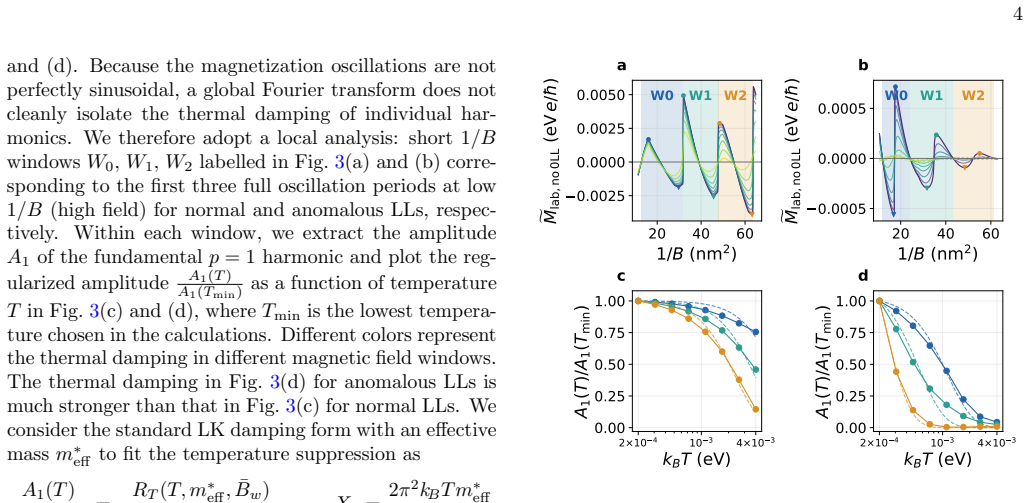
Summary. The paper develops a Lifshitz–Kosevich (LK) description of quantum oscillations for anomalous Landau levels (LLs) of ideal topological flat bands. Using a minimal two-band continuum model tuned to exact flatness (Δ_f = c²/a) and ideal quantum geometry (tr g = |Ω|), it obtains closed-form LL spectra, derives a branch-resolved LK formula in which thermal damping is controlled by the local LL spacing v^{α,η}_μ at the chemical potential, and analyzes fixed-density magnetization oscillations. Normal (dispersive) LLs yield small, nearly field-independent effective masses, while anomalous flat-band LLs yield much larger, strongly field-dependent masses. In the weak-field semi-classical limit the anomalous spacing reduces to v^{α,−}_μ ≈ a B² tr g_α(k_{n*}), so m*_eff ≈ 1/(a B tr g), implying that thermal damping of flat-band quantum oscillations measures the quantum metric.
Significance. If the result holds, it supplies a concrete experimental route—thermal damping of quantum oscillations—to extract the quantum metric of topological flat bands, a quantity of central interest in moiré materials. Strengths include exact LL eigenvalues (App. B), a transparent Poisson-summation derivation of the branch-resolved LK formula (App. C.1), analytic local-spacing formulas that recover the quantum-metric relation in the bulk limit (App. C.2, Eqs. C.16–C.26), and fixed-density numerics whose FFT frequencies match the LL-counting expectation 2π|ρ_S|. The ideal-model setting is clearly stated, and residual quantitative deviations between fitted and analytic masses are acknowledged rather than oversold. The work is a useful theoretical bridge between anomalous LL geometry and standard quantum-oscillation analysis.
major comments (2)
- The central claim m*_eff ≈ 1/(a B tr g) is derived under exact flatness and ideal geometry (Eqs. 2–3, App. A). Real moiré flat bands are only approximately flat and may violate tr g = |Ω|. The manuscript should quantify how small residual dispersion or non-ideal geometry corrections modify the local spacing v^{α,−}_μ and the extracted mass, at least with a controlled perturbation of Δ_f away from c²/a or a short discussion of lattice-scale cutoffs. Without that, the experimental claim that thermal damping “directly measures the quantum metric” remains model-limited.
- Appendix D (Fig. D.6, Table II) shows that fitted standard-LK masses for anomalous densities deviate quantitatively from the branch-resolved analytic curves, and for some windows (e.g. ρ = +0.020 nm⁻² W0) the p=1 projection is nearly temperature-independent. The main-text claim that a single effective mass “describes qualitatively the damping” (around Eq. 10 and Fig. 3) should be tempered: state more clearly when the single-mass LK form is only a qualitative diagnostic, and whether multi-branch or higher-harmonic contributions are needed for quantitative extraction of tr g.
Circularity Check
No significant circularity: the m*_eff ~ 1/(B tr g) relation is derived from the exact LL spectrum of a fully specified Hamiltonian, not forced by definition or fit.
full rationale
The paper starts from an explicit two-band continuum Hamiltonian (Eq. 2) tuned to the ideal flat-band point, computes its zero-field quantum metric (Eq. 3, App. A), solves the exact Landau-level spectrum under magnetic field (Eqs. 4–6, App. B), obtains the local LL spacing v_μ by differentiation (Eq. 7, App. C.2), inserts it into the standard Poisson-summation LK formula (Eqs. 8–9, App. C.1), and defines m*_eff = B/v_μ (Eq. 11). In the semi-classical bulk limit the same spacing expands to a B^{2} tr g (Eqs. C.24–C.26), yielding Eq. 12. Both sides of the claimed identity are computed independently from the same microscopic model; the identity is a derived asymptotic relation, not a redefinition. Fixed-density magnetization numerics (Figs. 2–4, App. D) are generated from the identical spectrum and merely confirm the analytic thermal scale; residual quantitative deviations between fitted and analytic masses are acknowledged (Fig. D.6, Table II) rather than hidden. The sole self-citation ([34]) supplies physical motivation for the model; every algebraic step needed for the central claim is re-derived in the appendices. No fitted parameter is re-presented as a prediction, no uniqueness theorem is imported, and no ansatz is smuggled. The ideal-geometry assumption is an explicit modeling choice, not a circularity.
Assumptions & free parameters
free parameters (3)
- band-curvature a and hybridization c
- carrier densities ρ and momentum cutoff Λ
- temperature grid and local 1/B windows
assumptions (4)
- domain assumption Ideal flat-band condition Δ_f = c²/a and ideal quantum geometry tr g = |Ω|
- standard math Standard Lifshitz–Kosevich Poisson-summation treatment of the grand potential with local LL spacing replacing ħω_c
- domain assumption Fixed-density (canonical) thermodynamics with smooth background subtraction and zero-mode exclusion for oscillatory magnetization
- standard math Semi-classical continuum limit n* ≫ 1 and slow variation of local spacing over k_B T
Cite this review
Pith. "Pith review of Lifshitz-Kosevich Theory of Anomalous Landau Levels in Topological Flat Bands." pith.science (2026). https://pith.science/paper/Q6YNR6QM
@misc{pith2026260710328,
  author       = {Pith},
  title        = {Pith review of: Lifshitz-Kosevich Theory of Anomalous Landau Levels in Topological Flat Bands},
  year         = {2026},
  howpublished = {\url{https://pith.science/paper/Q6YNR6QM}},
  note         = {Machine review of arXiv:2607.10328}
}
read the original abstract
In conventional metals, quantum oscillations arise from Landau quantization of Fermi-surface cyclotron orbits, whose dynamics are governed by the Fermi velocity and cyclotron effective mass within Lifshitz-Kosevich (LK) theory. A perfectly flat band, by contrast, has vanishing group velocity, which would naively imply an infinite cyclotron mass and complete thermal suppression of quantum oscillations. Yet topological flat bands can support anomalous Landau levels (LLs) whose finite-field spacing is generated by quantum geometry rather than band curvature, allowing quantum oscillations to persist. This work addresses how such anomalous flat-band LLs behave within the LK framework and whether their thermal damping can reveal quantum geometric information. Using a minimal model with exactly flat topological bands, we derive an LK theory for these anomalous LLs and analyze fixed-density magnetization oscillations. The resulting oscillations exhibit a finite LK effective mass that is substantially larger than the normal-band value and possesses a strong magnetic-field dependence. In the weak-field limit, this anomalous mass reflects the quantum geometric origin of the LL spacing and scales inversely with both the magnetic field and the trace of the quantum metric. Thus, thermal damping of flat-band quantum oscillations directly measures the quantum metric, establishing quantum oscillations as a probe to flat-band quantum geometry.
Figures


Reviewed July 14, 2026 · model on record in the stance chip above.
Discussion (0). Continue with ORCID to comment.