REVIEW 4 major objections 5 minor 58 references
Robust implicit quantum control of interacting spin chains
T0 review · 4 major / 5 minor · reviewed 2026-08-11 · deepseek-v4-flash
Pith's one-line read This paper claims that robust optimal control of spin chains can be done with polynomial cost, achieving 99.9% fidelity for 30-spin cluster states and 20-spin chains under 5% coupling errors.
desk verdict Extends implicit quantum control to robust ensemble optimization and parasitic terms, with real numerical evidence up to 30 qubits, but the headline claims outrun the verification: the n>10 parasitic robustness is inferred from a ratio, not an absolute error bound. read the letter →
The pith
A machine-rendered reading of the paper's core claim, the machinery that carries it, and where it could break.
The reading
What carries the argument
The machinery is the implicit-operator representation: $I(t)|\Psi(t)\rangle = \gamma|\Psi(t)\rangle$ with $I(t)$ evolving by $\dot I(t) = -i[H(t), I(t)]$. For the chain Hamiltonian the operator basis $\{a_j\}$ has $2n^2+3n+1$ elements, so the adjoint equation is a $d$-dimensional linear system with $d$ quadratic in $n$. Robustness comes from averaging the infidelity over an ensemble of Hamiltonians with different coupling values and sampling the average gradient over random points. For terms outside the closed basis, the key identity is $Q(\tau) = U_0^\dagger(t,t-\tau) H_P U_0(t,t-\tau)$, whose equation of motion can be integrated efficiently; since products of solutions are also solutions, the parasitic ZZ term is propagated as $U_0^\dagger Z_j U_0\, U_0^\dagger Z_{j+1} U_0$, leading to the first-order cancellation condition $C=0$.
What would settle it
Using the published optimized pulses for a 10-spin cluster state, set every coupling error to the hypercube corner $\epsilon_j = +\Delta\epsilon$ so that all couplings are 5% too strong, propagate the Schrödinger equation exactly, and compute the infidelity; if it exceeds $10^{-3}$, the claimed robustness over the entire 5% error interval fails.
Extended reading notes
Core claim
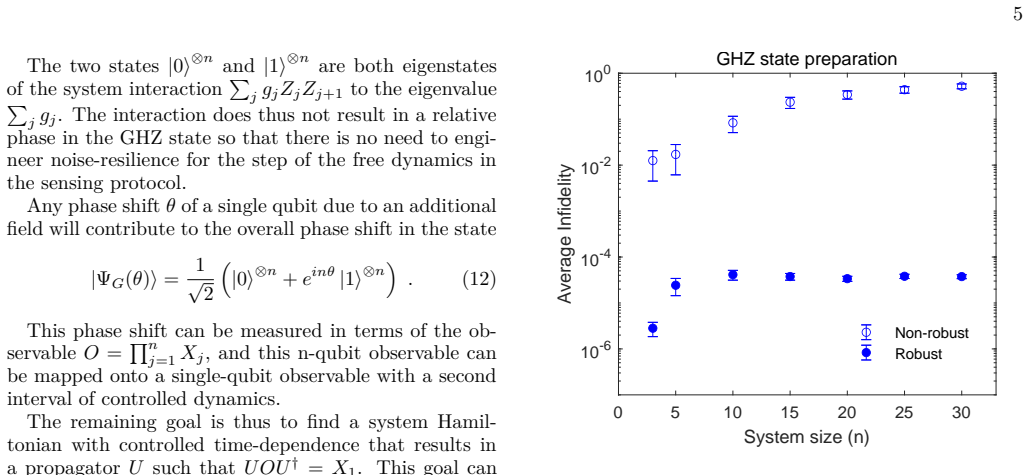
The paper's central claim is that robust control of interacting spin chains does not require an ensemble average over the exponentially many noise configurations or full-state simulation. A single time-dependent Hamiltonian, obtained by minimizing the ensemble-averaged infidelity over 60 random error samples and validated on 1000 fresh samples, keeps average infidelity around $10^{-3}$ for $n=30$ cluster-state preparation at $\Delta\epsilon/g = 5\%$; the same strategy improves GHZ-state preparation and the final measurement mapping by several orders of magnitude. For parasitic ZZ interactions, the paper introduces a perturbative measure $C$ whose vanishing removes the first-order effect of every parasitic strength $\lambda_j$ simultaneously, and shows that pulses satisfying it stay accurate up to $n=20$ chains.
Load-bearing premise
The claim that one pulse works for every error configuration in the $\pm5\%$ interval rests on the assumption that the 60 training points and the 1000 validation points represent the worst case in that continuous hypercube.
Editorial extensions
If this is right
- Cluster states for measurement-based quantum computing can be prepared on 30 spins with infidelity near $10^{-3}$ using pulses whose duration grows linearly with $n$ and whose amplitudes stay of order $g$.
- A complete Heisenberg-limited sensing protocol, including both entangled-state preparation and the final readout mapping, can be made robust against 5% coupling disorder, with four- and three-order-of-magnitude infidelity improvements respectively.
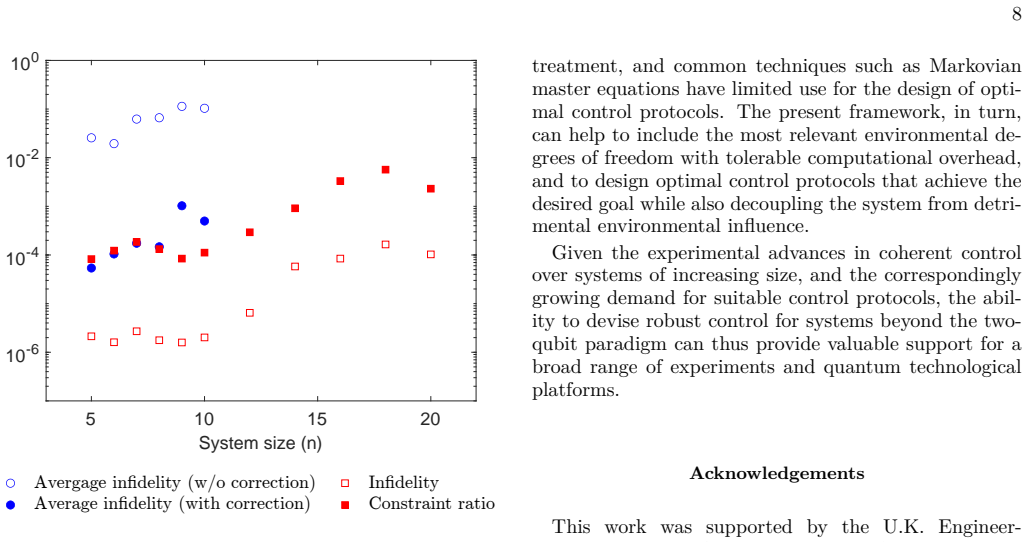
- Parasitic ZZ interactions, a dominant error in superconducting platforms, can be suppressed to first order for any unknown strength, and the suppression ratio $C_1/C_0$ grows only moderately with system size up to 20 spins.
- Mean infidelity below $10^{-3}$ can be obtained with 60 training samples, so the ensemble size needed for robust control need not grow exponentially with the number of fluctuating couplings.
Reading between the lines
- The paper leaves implicit that the perturbative cancellation should also work for any parasitic term that factorizes into operators from the closed basis; testing $X_j X_{j+1}$ or $Y_j Y_{j+1}$ parasitic terms would delimit how general the mechanism is.
- A reader should not assume the sampling-based robustness proof covers the full error hypercube; evaluating the published pulses at boundary configurations such as all $\epsilon_j = +\Delta\epsilon$ would convert the statistical evidence into a worst-case statement.
- Because the first-order condition removes the effect of every $\lambda_j$ at once, a natural further step is to combine the constraint with higher-order perturbative corrections to extend the robustness beyond the small-$\lambda$ regime.
Signed reviews
Editorial analysis
A structured set of objections, weighed in public.
Referee Report
Summary. This manuscript extends the implicit quantum control (IQC) framework of Ref. [46] to robust pulse design for spin chains. The system Hamiltonian in Eq. (6), with nearest-neighbor XX couplings, local Z fields, and end-chain drives, is used to prepare cluster states, GHZ states, and to implement a collective-to-single-qubit measurement mapping. Robustness against static fluctuations of the coupling constants is obtained by optimizing an ensemble-averaged operator infidelity (Eqs. (3) and (8)). For parasitic ZZ interactions, the paper introduces a first-order perturbative constraint C (Eq. (27)) that is jointly minimized with the noiseless infidelity. Exact verification via Lanczos propagation is presented for n≤10, and the authors infer robustness for chains up to n=20 from the ratio C1/C0 and the unperturbed infidelity in Fig. 5.
Significance. If the scaling claims are correct, the paper makes a useful step: it indicates that robust optimal control for interacting spin chains of tens of qubits can be approached with quadratic numerical effort, and it provides code and optimized pulses in a public repository. The exact verification for n≤10 and the explicit perturbative construction in Sec. V.A are concrete strengths. However, the headline claims go beyond what is directly verified: the n>10 parasitic result is an extrapolation from a constraint ratio, and the 99.9% robustness statement rests on averages over finite random samples. These gaps do not invalidate the method but need to be addressed before the central claims are fully supported.
major comments (4)
- [Section V.B, Fig. 5] For n>10 the manuscript states that robustness against parasitic ZZ interactions can be inferred from the magnitude of the constraint C, but Fig. 5 reports only the ratio C1/C0 and the unperturbed infidelity. The first-order parasitic correction in Eq. (25) is a sum of terms λ_j multiplied by coefficients, and C in Eq. (27) is a sum of squares of those coefficients. A small ratio C1/C0 does not imply that the absolute first-order error is small unless C0 is calibrated against the actual parasitic infidelity, and no such calibration is given for n>10. Please report the absolute constraint, or a normalized error bound, and show that its magnitude is consistent with the exact n≤10 data; otherwise the claim of explicit robust solutions for up to 20 spins in Sec. V.B is an unverified extrapolation.
- [Section IV, Appendix B] The statement that resampling the ensemble every 50 iterations yields pulses that are robust against any error within the error hypercube is stronger than the evidence. The objective is an average over 60 training samples, and validation uses 1000 random points in a hypercube of dimension n-1 (for example n=30 in Fig. 1). No worst-case bound, Lipschitz estimate, or covering argument is supplied. The 99.9% fidelity claim should therefore be phrased as average robustness over the sampled error distribution, or it should be supplemented by a deterministic certification method.
- [Eq. (3)] The objective J in Eq. (3) measures overlap in operator space, not state fidelity. Unless a spectral-gap argument is provided, a small operator infidelity does not directly imply high fidelity of the prepared eigenstate |ψ(T)> to the target state |ψ_T>. The abstract and Sec. I state '99.9% fidelity', which normally denotes state fidelity. Please either prove the connection in the IQC framework or present state-fidelity data for the small systems where exact propagation is available.
- [Section V.A] The perturbative constraint removes the parasitic term only to first order in λ_j. At the 5% error level used in Fig. 5, second-order corrections may be non-negligible, especially as n grows and the number of parasitic terms increases. The paper should quantify the regime of validity of the first-order treatment, for example by comparing the exact n≤10 parasitic infidelity with the first-order prediction based on Eq. (25).
minor comments (5)
- [Fig. 5] The axes labels contain typos: 'Avergage' and 'in-delity' should be corrected.
- [Appendix B] The notation [5%,-5%]^{n-1} is inconsistent with the interval [-Δε, Δε] used in the main text; the orientation of the interval should be fixed.
- [Appendix B, Eq. (B5)] The product of propagators in Eq. (B5) has an ambiguous ordering; the time ordering should be specified explicitly.
- [Sec. II B] The text says the objective function is 'maximized exactly' for the target, while Eq. (3) defines an infidelity that is minimized; the wording should be made consistent.
- [References] Ref. [46] is cited as 'to appear in PRX Quantum'; the citation should be updated to the published version if available, and otherwise the dependence of the closed-algebra construction on that work should be stated clearly.
Circularity Check
No significant circularity: the robust pulses and parasitic-correction constraint are independently derived and small-system-exact checked; the IQC self-citation is a framework citation, not a definitional reduction.
full rationale
The derivation chain is not circular. Robust pulses are produced by optimizing the ensemble-averaged infidelity of Eq. (8) on random training samples and are then evaluated on fresh validation samples (Sec. IV.A), so the reported infidelities are not the optimization objective evaluated on the training set. The parasitic-ZZ analysis is derived from a first-order Dyson series (Eqs. 13-27), and the penalty C is exactly the squared magnitude of the first-order parasitic contribution; pulses are optimized with J + wC, and the small-system robustness is independently checked with exact Lanczos propagation in the full Hilbert space for n <= 10 (Sec. V.B). This gives an external anchor for the claim that C is a meaningful proxy. Ref. [46] is cited for the IQC framework and the polynomial-size basis; although it shares authors with the present paper, it is an explicit mathematical framework whose equations and operator sets are restated here, and no present result is defined in terms of the present result. The genuine weakness is a support gap, not circularity: in Sec. V.B the paper says 'For larger system size, robustness can be inferred from the magnitude of the constraint C as it is a measure of the perturbation's effect,' but Fig. 5 reports only the ratio C1/C0 and the unperturbed infidelity, not the absolute C1, so the n > 10 and 20-spin parasitic-robustness claim is an extrapolation. Similarly, the 99.9%-fidelity claim rests on 60 training/1000 validation samples rather than a worst-case bound. These are correctness and evidence concerns, not circularity: no fitted parameter is renamed as a prediction, and no equation is equivalent to its own input by construction.
Assumptions & free parameters
free parameters (2)
- weight w for perturbative constraint =
1/C_nonrobust
- ensemble size for robust training and validation =
60 training, 1000 validation, 100 intermediate checks
assumptions (5)
- domain assumption The set {a_j} generated by nested commutators of the control Hamiltonian has size 2n^2+3n+1 for this spin chain.
- domain assumption Noise in coupling strengths is static and uniformly distributed in [−Δε, Δε] for each bond.
- domain assumption First-order perturbation theory in the parasitic Hamiltonian H_P is valid at the error levels considered.
- domain assumption The operator infidelity J in Eq. (3) is a valid proxy for state preparation fidelity.
- ad hoc to paper A finite random sample of 60 training and 1000 validation points represents the continuous error hypercube well enough to guarantee robustness everywhere within it.
Cite this review
Pith. "Pith review of Robust implicit quantum control of interacting spin chains." pith.science (2026). https://pith.science/paper/QL3KH6EY
@misc{pith2026241205656,
  author       = {Pith},
  title        = {Pith review of: Robust implicit quantum control of interacting spin chains},
  year         = {2026},
  howpublished = {\url{https://pith.science/paper/QL3KH6EY}},
  note         = {Machine review of arXiv:2412.05656}
}
read the original abstract
Robust quantum control can achieve noise-resilience of quantum systems and quantum technological devices. While the need for noise-resilience grows with the number of fluctuating quantities, and thus typically with the number of qubits, most numerically exact optimal control techniques are limited to systems of few interacting qubits. This paper exploits quantum control that avoids explicit reference to quantum states in exponentially large Hilbert space. Exemplary control protocols for spin chains are discussed in terms of noise-resilient preparation of highly entangled states.
Figures


Figures from the paper (3 more)


Reference graph
Works this paper leans on
-
[46]
where piece-wise constant driving is used soH is constant in each interval and the vector is expressed with a given interval as: zj(tn) = n∏ l=1 eiKl∆tzj(0), (C6) where Kl is the adjoint action of the HamiltonianHl in the time intervall and z is again the vector of coeffi- cients ofU†ZjU expanded over{aj} just as in equation
- [1]
-
[2]
C. A. Weidner, E. A. Reed, J. Monroe, B. Sheller, S. O’Neil, E. Maas, E. A. Jonckheere, F. C. Lang- bein, and S. G. Schirmer, Robust Quantum Control in Closed and Open Systems: Theory and Practice (2024), arXiv:2401.00294 [quant-ph]
arXiv 2024
-
[3]
M. H. Levitt, Composite pulses, Prog. NMR Spectrosc. 18, 61 (1986)
1986
-
[4]
T. Nöbauer, A. Angerer, B. Bartels, M. Trupke, S. Rot- ter, J. Schmiedmayer, F. Mintert, and J. Majer, Smooth Optimal Quantum Control for Robust Solid-State Spin Magnetometry, Phys. Rev. Lett.115, 190801 (2015)
work page 2015
-
[5]
A. R. R. Carvalho, H. Ball, M. J. Biercuk, M. R. Hush, and F. Thomsen, Error-Robust Quantum Logic Opti- mization Using a Cloud Quantum Computer Interface, Phys. Rev. Appl.15, 064054 (2021)
work page 2021
-
[6]
M. Cykiert and E. Ginossar, Robust optimal control for a systematic error in the control amplitude of transmon qubits, Phys. Scr.99, 105059 (2024)
work page 2024
-
[7]
Yi, Y.-J
K. Yi, Y.-J. Hai, K. Luo, J. Chu, L. Zhang, Y. Zhou, Y. Song, S. Liu, T. Yan, X.-H. Deng, Y. Chen, and D. Yu, Robust quantum gates against correlated noise in integrated quantum chips, Phys. Rev. Lett.132, 250604 (2024)
2024
Show all 58 references
-
[8]
Timoney, V
N. Timoney, V. Elman, S. Glaser, C. Weiss, M. Johan- ning, W. Neuhauser, and C. Wunderlich, Error-resistant single-qubit gates with trapped ions, Phys. Rev. A77, 052334 (2008)
2008
-
[9]
Kalra, A
R. Kalra, A. Laucht, C. D. Hill, and A. Morello, Robust two-qubit gates for donors in silicon controlled by hyper- fine interactions, Phys. Rev. X4, 021044 (2014)
2014
-
[10]
Setiawan, P
F. Setiawan, P. Groszkowski, and A. A. Clerk, Fast and robust geometric two-qubit gates for superconducting qubits and beyond, Phys. Rev. Appl.19, 034071 (2023)
2023
-
[11]
Manovitz, A
T. Manovitz, A. Rotem, R. Shaniv, I. Cohen, Y. Shapira, N. Akerman, A. Retzker, and R. Ozeri, Fast dynamical decouplingofthemølmer-sørensenentanglinggate,Phys. Rev. Lett.119, 220505 (2017)
2017
-
[12]
A. E. Webb, S. C. Webster, S. Collingbourne, D. Bre- taud, A. M. Lawrence, S. Weidt, F. Mintert, and W. K. Hensinger, Resilient Entangling Gates for Trapped Ions, Phys. Rev. Lett.121, 180501 (2018)
2018
-
[13]
Shapira, R
Y. Shapira, R. Shaniv, T. Manovitz, N. Akerman, and R. Ozeri, Robust entanglement gates for trapped-ion qubits, Phys. Rev. Lett.121, 180502 (2018)
2018
-
[14]
Zarantonello, H
G. Zarantonello, H. Hahn, J. Morgner, M. Schulte, A. Bautista-Salvador, R. F. Werner, K. Hammerer, and C. Ospelkaus, Robust and resource-efficient microwave near-field entangling 9be+ gate, Phys. Rev. Lett. 123, 260503 (2019)
2019
-
[15]
Manovitz, Y
T. Manovitz, Y. Shapira, L. Gazit, N. Akerman, and R. Ozeri, Trapped-ion quantum computer with robust entangling gates and quantum coherent feedback, PRX Quantum 3, 010347 (2022)
2022
-
[16]
Barthel, P
P. Barthel, P. H. Huber, J. Casanova, I. Arrazola, D. Ni- roomand, T. Sriarunothai, M. B. Plenio, and C. Wun- derlich, Robust two-qubit gates using pulsed dynamical decoupling, New J. Phys.25, 063023 (2023)
2023
-
[17]
T. Xie, Z. Zhao, S. Xu, X. Kong, Z. Yang, M. Wang, Y. Wang, F. Shi, and J. Du, 99.92%-fidelity cnot gates in solids by noise filtering, Phys. Rev. Lett.130, 030601 (2023)
2023
-
[18]
Y. Baum, M. Amico, S. Howell, M. Hush, M. Liuzzi, P. Mundada, T. Merkh, A. R. Carvalho, and M. J. Bier- cuk, Experimental deep reinforcement learning for error- robust gate-set design on a superconducting quantum computer, PRX Quantum2, 040324 (2021)
2021
-
[19]
Mitra, M
A. Mitra, M. J. Martin, G. W. Biedermann, A. M. Marino, P. M. Poggi, and I. H. Deutsch, Robust mølmer- sørensen gate for neutral atoms using rapid adiabatic ry- dberg dressing, Phys. Rev. A101, 030301 (2020)
2020
-
[20]
Mohan, R
M. Mohan, R. de Keijzer, and S. Kokkelmans, Robust control and optimal rydberg states for neutral atom two- qubit gates, Phys. Rev. Res.5, 033052 (2023)
2023
-
[21]
S. J. Evered, D. Bluvstein, M. Kalinowski, S. Ebadi, T. Manovitz, H. Zhou, S. H. Li, A. A. Geim, T. T. Wang, N. Maskara, H. Levine, G. Semeghini, M. Greiner, V. Vuletić, and M. D. Lukin, High-fidelity parallel entan- gling gates on a neutral-atom quantum computer, Nature 622, ...
2023
-
[22]
The total dura- tion is initialised asnπ 2 and the respective gradient is cal- culated via finite differences so the duration can change during the optimisation
This solution is exact because the Hamiltonian is constant within each interval, and the total propagator is split up as a product of propagators where each corre- sponds to a time bin (40 bins) and∆t is just the total duration divided by the number of bins. The total dura- ti...
-
[23]
B.-B. Liu, Z. Shan, M.-R. Yun, D.-Y. Wang, B.-J. Liu, L.-L. Yan, M. Feng, and S.-L. Su, Robust three-qubit search algorithm in rydberg atoms via geometric control, Phys. Rev. A106, 052610 (2022)
2022
-
[24]
D. W. Kanaar and J. P. Kestner, Neural-network- designed three-qubit gates robust against charge noise and crosstalk in silicon, Quantum Sci. Technol.9, 035011 (2024)
2024
-
[25]
Z. Zhou, R. Sitler, Y. Oda, K. Schultz, and G. Quiroz, Quantum Crosstalk Robust Quantum Control, Phys. Rev. Lett.131, 210802 (2023)
2023
-
[26]
Metz and M
F. Metz and M. Bukov, Self-correcting quantum many- body control using reinforcement learning with tensor networks, Nat Mach Intell5, 780 (2023)
2023
-
[27]
Caneva, T
T. Caneva, T. Calarco, and S. Montangero, Chopped random-basis quantum optimization, Phys. Rev. A84, 022326 (2011)
2011
-
[28]
Watanabe, Y
S. Watanabe, Y. Tabuchi, K. Heya, S. Tamate, and Y. Nakamura, ZZ-Interaction-Free Single-Qubit- Gate Optimization in Superconducting Qubits (2024), arXiv:2309.13927
2024 arXiv
-
[29]
R. L. Kosut, M. D. Grace, and C. Brif, Robust control of quantumgatesviasequentialconvexprogramming,Phys. Rev. A88, 052326 (2013)
2013
-
[30]
Khaneja, T
N. Khaneja, T. Reiss, C. Kehlet, T. Schulte-Herbrüggen, and S. J. Glaser, Optimal control of coupled spin dynam- ics: design of NMR pulse sequences by gradient ascent algorithms, J. Magn. Reson.172, 296 (2005)
2005
-
[31]
Goerz, D
M. Goerz, D. Basilewitsch, F. Gago-Encinas, M. G. Krauss, K. P. Horn, D. M. Reich, and C. Koch, Kro- tov: A Python implementation of Krotov’s method for quantum optimal control, SciPost Phys.7, 080 (2019)
2019
-
[32]
Leung, M
N. Leung, M. Abdelhafez, J. Koch, and D. Schuster, Speedup for quantum optimal control from automatic differentiation based on graphics processing units, Phys. Rev. A95, 042318 (2017)
2017
-
[33]
M. Y. Niu, S. Boixo, V. N. Smelyanskiy, and H. Neven, Universal quantum control through deep reinforcement learning, npj Quantum Inf5, 1 (2019)
2019
-
[34]
Bukov, A
M. Bukov, A. G. Day, D. Sels, P. Weinberg, A. Polkovnikov, and P. Mehta, Reinforcement Learning in Different Phases of Quantum Control, Phys. Rev. X 8, 031086 (2018)
2018
-
[35]
M. M. Müller, R. S. Said, F. Jelezko, T. Calarco, and 12 S. Montangero, One decade of quantum optimal con- trol in the chopped random basis, Rep. Prog. Phys.85, 076001 (2022)
2022
-
[36]
Propson, B
T. Propson, B. E. Jackson, J. Koch, Z. Manchester, and D. I. Schuster, Robust quantum optimal control with trajectory optimization, Phys. Rev. Appl. 17, 014036 (2022)
2022
-
[37]
J. L. Allen, R. Kosut, J. Joo, P. Leek, and E. Ginossar, Optimal control of two qubits via a single cavity drive in circuit quantum electrodynamics, Phys. Rev. A95, 042325 (2017), publisher: American Physical Society
2017
-
[38]
C. P. Koch, U. Boscain, T. Calarco, G. Dirr, S. Fil- ipp, S. J. Glaser, R. Kosloff, S. Montangero, T. Schulte- Herbrüggen, D. Sugny, and F. K. Wilhelm, Quantum op- timal control in quantum technologies. Strategic report on current status, visions and goals for research in Eu- ...
2022
-
[39]
B. Dive, A. Pitchford, F. Mintert, and D. Burgarth, In situ upgrade of quantum simulators to universal comput- ers, Quantum2, 80 (2018)
2018
-
[40]
N. H. Le, M. Cykiert, and E. Ginossar, Scalable and ro- bust quantum computing on qubit arrays with fixed cou- pling, npj Quantum Inf9, 1 (2023)
2023
-
[41]
Mukherjee, H
R. Mukherjee, H. Xie, and F. Mintert, Bayesian Optimal Control of Greenberger-Horne-Zeilinger States in Ryd- berg Lattices, Phys. Rev. Lett.125, 203603 (2020)
2020
-
[42]
Sauvage and F
F. Sauvage and F. Mintert, Optimal Quantum Control with Poor Statistics, PRX Quantum1, 020322 (2020), publisher: American Physical Society
2020
-
[43]
Petiziol, B
F. Petiziol, B. Dive, F. Mintert, and S. Wimberger, Fast adiabatic evolution by oscillating initial Hamiltonians, Phys. Rev. A98, 043436 (2018)
2018
-
[44]
Greenaway, F
S. Greenaway, F. Petiziol, H. Zhao, and F. Mintert, Vari- ational quantum gate optimization at the pulse level, Sci- Post Phys.16, 082 (2024)
2024
-
[45]
J. H. M. Jensen, F. S. Møller, J. J. Sørensen, and J. F. Sherson, Achieving fast high-fidelity optimal con- trol of many-body quantum dynamics, Phys. Rev. A104, 052210 (2021)
2021
-
[47]
P.Doria, T.Calarco,andS.Montangero,Optimalcontrol technique for many-body quantum dynamics, Phys. Rev. Lett. 106, 190501 (2011)
2011
-
[48]
Orozco-Ruiz, N
M. Orozco-Ruiz, N. H. Le, and F. Mintert, Quantum con- trol without quantum states (2024), to appear in PRX Quantum, arXiv:2405.15609 [quant-ph]
2024
-
[49]
H. R. Lewis and W. B. Riesenfeld, An Exact Quantum Theory of the Time-Dependent Harmonic Oscillator and of a Charged Particle in a Time-Dependent Electromag- netic Field, J. Math. Phys.10, 1458 (1969)
1969
-
[50]
Guéry-Odelin, A
D. Guéry-Odelin, A. Ruschhaupt, A. Kiely, E. Tor- rontegui, S. Martínez-Garaot, and J. G. Muga, Short- cuts to adiabaticity: Concepts, methods, and applica- tions, Rev. Mod. Phys.91, 045001 (2019)
2019
-
[51]
Krinner, P
S. Krinner, P. Kurpiers, B. Royer, P. Magnard, I. Tsit- silin, J.-C. Besse, A. Remm, A. Blais, and A. Wallraff, Demonstration of an All-Microwave Controlled-Phase Gate between Far-Detuned Qubits, Phys. Rev. Appl.14, 044039 (2020)
2020
-
[52]
Arute et al
F. Arute et al. , Quantum supremacy using a pro- grammable superconducting processor, Nature574, 505 (2019)
2019
-
[53]
S. Sra, S. Nowozin, and S. J. Wright, eds.,Optimization for machine learning , Neural information processing se- ries (MIT Press, Cambridge, Mass, 2012)
2012
-
[54]
Van den Nest, Measurement-based quantum compu- tation, Nature Phys5, 19 (2009)
H.J.Briegel, D.E.Browne, W.Dür, R.Raussendorf,and M. Van den Nest, Measurement-based quantum compu- tation, Nature Phys5, 19 (2009)
2009
-
[55]
Walther, K
P. Walther, K. J. Resch, T. Rudolph, E. Schenck, H. We- infurter, V. Vedral, M. Aspelmeyer, and A. Zeilinger, Experimental one-way quantum computing, Nature434, 169 (2005)
2005
-
[56]
Robust implicit quantum con- trol of interacting spin chains
Data for Stefanescu et al. “Robust implicit quantum con- trol of interacting spin chains” (2024), DOI: 10.5281/zen- odo.13975930
2024 doi
-
[57]
Degen, F
C. Degen, F. Reinhard, and P. Cappellaro, Quantum sensing, Rev. Mod. Phys.89, 035002 (2017)
2017
-
[58]
Ni et al
Z. Ni et al. , Scalable Method for Eliminating Residual ZZ Interaction between Superconducting Qubits, Phys. Rev. Lett.129, 040502 (2022)
2022
Reviewed August 11, 2026 · model on record in the stance chip above.
Discussion (0). Continue with ORCID to comment.