REVIEW 1 major objections 1 minor 128 references
Shadows of naked singularities and superspinars related to the revisited Kerr-de Sitter spacetimes
T0 review · 1 major / 1 minor · reviewed 2026-06-29 · grok-4.3
Pith's one-line read Shadows of superspinars in revisited Kerr-de Sitter spacetimes differ from standard ones only for unrealistically large cosmological constants.
desk verdict The paper extends shadow calculations to revisited KdS superspinars and shows differences from standard versions are too small to observe for realistic Lambda and masses. read the letter →
The pith
A machine-rendered reading of the paper's core claim, the machinery that carries it, and where it could break.
The reading
What carries the argument
Local escape cones in locally nonrotating frames near the static radius, which set the boundary of the shadow seen by distant static observers.
What would settle it
A high-resolution shadow image of a supermassive compact object with independently measured mass and cosmological constant that shows a shape difference exceeding the resolution limit predicted for the observed Lambda value.
Extended reading notes
Core claim
For all classes of the revisited Kerr-de Sitter naked singularity spacetimes the local escape cones are determined in the variety of fundamental frames and then applied to construct the shadow for distant static observers represented by the LNRFs located near the static radius or the superspinars radially approaching the cosmic horizon; differences of the shadows in the rKdSNS and standard KdSNS spacetimes are established and demonstrated for sufficiently large values of the dimensionless cosmological constant, but for the observationally given cosmological constant and masses of the largest objects in the Universe the shadow differences are not observable using recent observational instrume
Load-bearing premise
Distant static observers can be represented by locally nonrotating frames located near the static radius where the spacetime approximates the asymptotically flat Kerr region.
Editorial extensions
If this is right
- Shadows of superspinars can be built from escape cones calculated in LNRFs, radially escaping frames, and circular geodesic frames.
- Differences between revisited and standard Kerr-de Sitter superspinar shadows appear once the dimensionless cosmological constant exceeds a threshold value.
- The construction remains valid when superspinars approach the cosmic horizon due to cosmic expansion.
- For the measured cosmological constant the two families of shadows coincide within current instrumental precision.
Reading between the lines
- Higher-resolution instruments in the future could test whether the revisited model produces detectable deviations.
- Shadow observations alone may not distinguish the models, so other signatures such as orbital dynamics or accretion flows would be needed.
- The result limits the practical utility of shadow imaging for constraining modifications to Kerr-de Sitter geometry at the current level of precision.
Editorial analysis
A structured set of objections, weighed in public.
Referee Report
Summary. The paper constructs shadows of superspinars in revisited Kerr-de Sitter naked singularity (rKdSNS) spacetimes and compares them to those in standard KdSNS spacetimes. It determines local escape cones for LNRFs, radially escaping frames, and circular geodesic frames tied to marginally stable orbits, then uses these to build shadows as seen by distant static observers represented by LNRFs near the static radius (where the spacetime approaches the asymptotically flat Kerr region or superspinars approach the cosmic horizon due to expansion). Differences between rKdSNS and KdSNS shadows are shown for large dimensionless cosmological constant values, but the paper concludes that for observationally given Λ and masses of the largest objects, these differences are not observable with recent instruments.
Significance. If the central non-observability result holds under the stated observer construction, the work provides a concrete bound showing that shadow imaging cannot distinguish rKdSNS superspinars from standard KdSNS cases at realistic cosmological parameters, limiting the utility of current EHT-scale instruments for testing these exotic spacetimes. The explicit use of multiple fundamental frames (LNRFs, radial escape, circular geodesics) and the focus on the static-radius limit are strengths that make the comparison falsifiable in principle.
major comments (1)
- [Sections on observer frames, escape cones, and shadow construction for distant static observers] The non-observability claim for observational Λ and M rests on the shadow sizes computed for LNRF observers near the static radius. For superspinars radially approaching the cosmic horizon, the spacetime lacks the same asymptotic flatness as Kerr; the static radius itself shifts and the LNRF 4-velocity may not align with the Killing vector for distant static observers. This could alter the impact-parameter mapping or escape-cone projection, potentially changing whether the reported shadow difference falls below instrument resolution. The manuscript does not provide an explicit check or alternative frame (e.g., using the timelike Killing vector at large r) to confirm robustness of the conclusion.
minor comments (1)
- Notation for the revisited vs. standard spacetimes (rKdS vs. KdS, rKdSNS vs. KdSNS) is introduced without a dedicated comparison table; a brief table listing the metric parameters and horizon structures for each class would improve readability.
Simulated Author's Rebuttal
We thank the referee for the detailed review and the valuable comments on the observer frame construction and the robustness of our non-observability conclusion. We provide a point-by-point response below.
read point-by-point responses
-
Referee: The non-observability claim for observational Λ and M rests on the shadow sizes computed for LNRF observers near the static radius. For superspinars radially approaching the cosmic horizon, the spacetime lacks the same asymptotic flatness as Kerr; the static radius itself shifts and the LNRF 4-velocity may not align with the Killing vector for distant static observers. This could alter the impact-parameter mapping or escape-cone projection, potentially changing whether the reported shadow difference falls below instrument resolution. The manuscript does not provide an explicit check or alternative frame (e.g., using the timelike Killing vector at large r) to confirm robustness of the conclusion.
Authors: We appreciate this comment, which points to a possible subtlety in the limiting procedure. In the manuscript, the static radius is defined as the location where static observers can exist, and for the small values of the cosmological constant consistent with observations, the geometry near this radius is perturbatively close to the Kerr spacetime, allowing the LNRF to serve as a valid proxy for distant static observers. The alignment with the timelike Killing vector holds in this limit because the frame-dragging effects are suppressed at large r. For superspinars, the radial motion towards the cosmic horizon is accounted for by the expansion, but the local escape cones are computed at the static radius where the spacetime still approaches a Kerr-like region. We agree that an explicit verification using the Killing vector at large r would be beneficial for completeness. In the revision, we will include a short paragraph discussing the validity of the LNRF approximation for small Λ and confirm that the shadow differences remain negligible under this choice. For large Λ where differences are visible, the conclusion does not apply as stated. Therefore, the main result on non-observability for realistic parameters is unaffected. revision: partial
Circularity Check
No significant circularity; derivation uses standard GR geodesics and explicit frame assumptions
full rationale
The paper derives shadow boundaries from geodesic equations in rKdS and KdS spacetimes, applying local escape cones in LNRFs, radially escaping frames, and circular geodesic frames. These are computed directly from the metric and Killing vectors without fitting parameters to data or renaming fitted quantities as predictions. The choice to represent distant static observers via LNRFs near the static radius is stated as an approximation justified by the spacetime approaching the asymptotically flat Kerr region (or superspinars approaching the cosmic horizon); it is not defined in terms of the shadow result itself. Prior self-citations supply background on rKdS metrics but do not carry the load-bearing shadow-size comparison, which is performed anew here from the geodesic equations. The non-observability conclusion follows from explicit numerical differences for observational Λ and M values. No step reduces by construction to its inputs.
Assumptions & free parameters
assumptions (1)
- standard math Standard GR geodesic motion and local frame definitions apply to the rKdS metric.
Cite this review
Pith. "Pith review of Shadows of naked singularities and superspinars related to the revisited Kerr-de Sitter spacetimes." pith.science (2026). https://pith.science/paper/QM6ZHEUW
@misc{pith2026260529049,
  author       = {Pith},
  title        = {Pith review of: Shadows of naked singularities and superspinars related to the revisited Kerr-de Sitter spacetimes},
  year         = {2026},
  howpublished = {\url{https://pith.science/paper/QM6ZHEUW}},
  note         = {Machine review of arXiv:2605.29049}
}
read the original abstract
We construct shadows of superspinars described by the revisited Kerr-de Sitter (rKdS) naked singularity (NS) spacetimes and compare them with those of the standard KdSNS spacetimes. For all the classes of the rKdSNS spacetimes we determine local escape cones related to variety of fundamental frames: locally nonrotating frames (LNRFs), radially escaping frames, and circular geodesic frames related to marginally stable obits of the rKdSNS spacetimes. The local escape cones (and their complementary cones) are then applied to construct the shadow of the KdS superspinars related to the distant static observers represented by the LNRFs located near the so-called static radius where the spacetime is close to the asymptotically flat region of the Kerr spacetimes, or the superspinars radially approaching, due to the Universe's expansion, the cosmic horizon of the spacetime. Differences of the shadows in the rKdSNS and standard KdSNS spacetimes are established and demonstrated for sufficiently large values of the dimensionless cosmological constant. For the observationally given cosmological constant and masses of the largest objects in the Universe, the shadow differences are not observable using recent observational instruments.
Figures


Figures from the paper (33 more)









Reference graph
Works this paper leans on
-
[1]
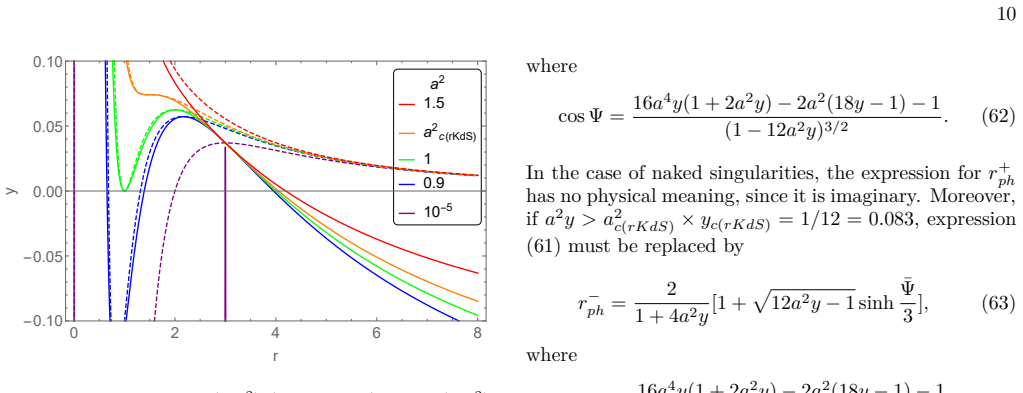
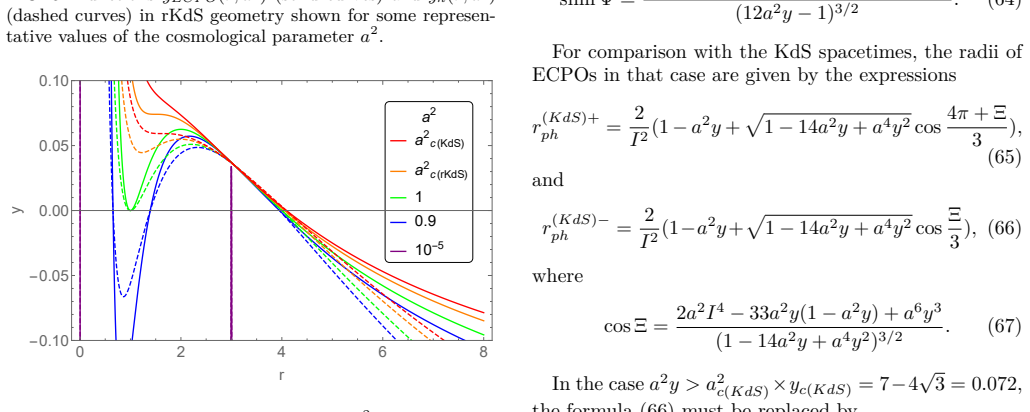
Polar SPOs The latter type of SPOs is given by the condition lSPO(r) = 0.(70) Solving Eq. (70) with respect to the variableyyields y=y pol(r;a 2)≡r2(3−r)−a2(1 +r) 2a2r3 .(71) The number and distribution of the radii of polar SPOs relative to the horizons can then be interpreted in the same manner as in the case of the ECPOs, with Fig. 7 displaying the beh...
-
[2]
into BH and NS spacetimes
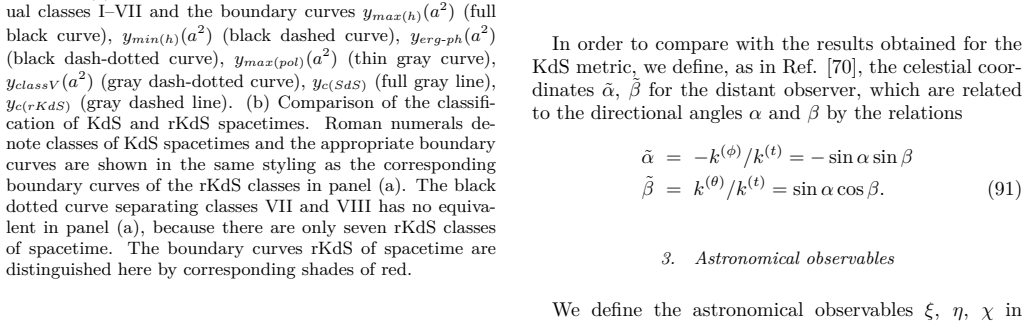
BH and NS spacetimes The main criterion for the classification of rKdS space- times is the number of horizons, i.e. into BH and NS spacetimes. In the(a 2-y)plane, this corresponds to the region bounded by theymin(h)(a2)andy max(h)(a2) curves, and the outer region, as discussed in Sec. IIA. However, according to other criteria, the family of BH spacetimes ...
-
[3]
(13) and (60) are coin- cident
Relative position of SPOs and ergosphere The reader can easily conclude that for the spacetime parametersa 2,y=y erg-ph(a2), where yerg-ph(a2)≡4( √ 9−16a2−1) (3 + √ 9−16a2)3,(80) the radiir + erg,r + ph given by Eqs. (13) and (60) are coin- cident. Thus, according to our classification proposed, the curvey=y erg-ph(a2)separates in the parameter plane(a 2-...
-
[4]
a" indicates a NS spacetime with two polar SPOs, while
Orientation and energy of SPOs The orientation of the SPOs is standardly defined by the sign of the ratiok (ϕ)/k(t) of the locally measured azimuthal and time components of the photon’s four- momentum, which defines a directional angleΨsuch that sinΨ=k (ϕ)/k(t). IfsinΨ >0, we call the appropriate SPOprograde, forsinΨ <0, we name itretrograde. Us- ing rela...
-
[5]
Stability and energy of SPOs The condition of the stability or instability of the SPOs with respect to radial perturbations is given by the ad- ditional relation d2 ¯R dr2 ≶0,(82) which must be satisfied simultaneously with Eq. (49). Theboundarybetweenstableandunstableorbitsisgiven by therms radius of marginally stable orbits, which are the solution to th...
-
[6]
(29): k(a) =ω(a) µkµ,(89) k(a) =e ν (a)kν.(90) Without loss of generality, we can, as usual, insert k(t) = 1into the relations (86)-(88)
Directional angles of photons in the LNRFs The locally measured directional angles (α,β) of a pho- ton are defined using the locally measured frame compo- nentsk (a) of the photon four-momentum by the standard relations [51] cosα=k (r)/k(t),(86) sinαcosβ=k (θ)/k(t),(87) sinαsinβ=k (ϕ)/k(t).(88) Here,k (a) are defined by relations analogous to Eq. (29): k(...
-
[7]
Celestial coordinates In order to compare with the results obtained for the KdS metric, we define, as in Ref. [70], the celestial coor- dinates˜α,˜βfor the distant observer, which are related to the directional anglesαandβby the relations ˜α=−k(ϕ)/k(t) =−sinαsinβ ˜β=k (θ)/k(t) = sinαcosβ.(91)
-
[8]
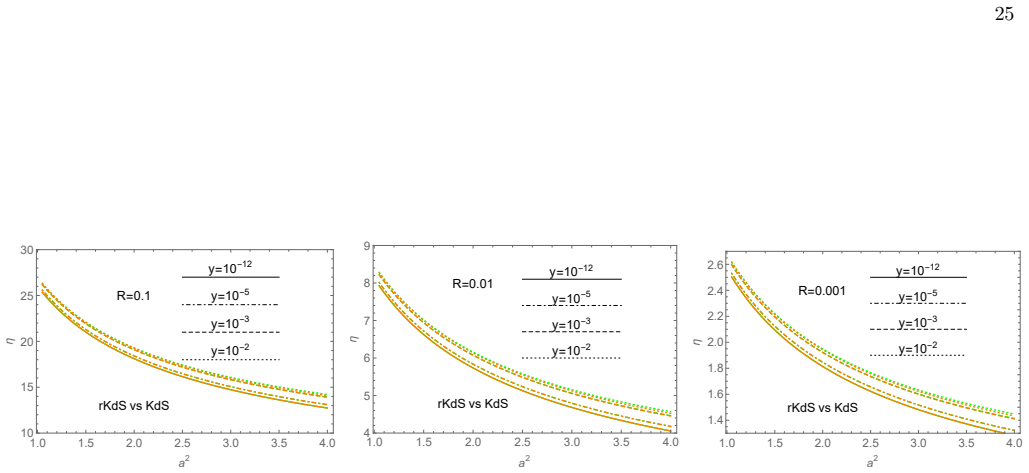
Astronomical observables We define the astronomical observablesξ,η,χin Fig. 13. Then, we give their behavior and special values 17 for both rKdS and KdS geometries. In order to com- pare these geometries, we choose a LNRF observer at a static radius that is identical for both geometries, which is convenient for this purpose. Figure 13 corresponds to an ob...
Show all 128 references
-
[9]
Appearance of observables corresponding to spacetimes with polar SPOs First, to get an idea of the angular size of the shadow of the superspinar on the observer’s sky, we present in Fig. 14 the angular radiusχof the osculating circle, which closely surrounds the observed shado...
-
[10]
20 for a selected representative value of the spin parametera 2 and some values of the cosmological param- etery
Appearance of observables corresponding to spacetimes with no polar SPOs The angular radiusχ, which characterizes the observed angular dimensions of the superspinar shadow, is given in Fig. 20 for a selected representative value of the spin parametera 2 and some values of the ...
-
[11]
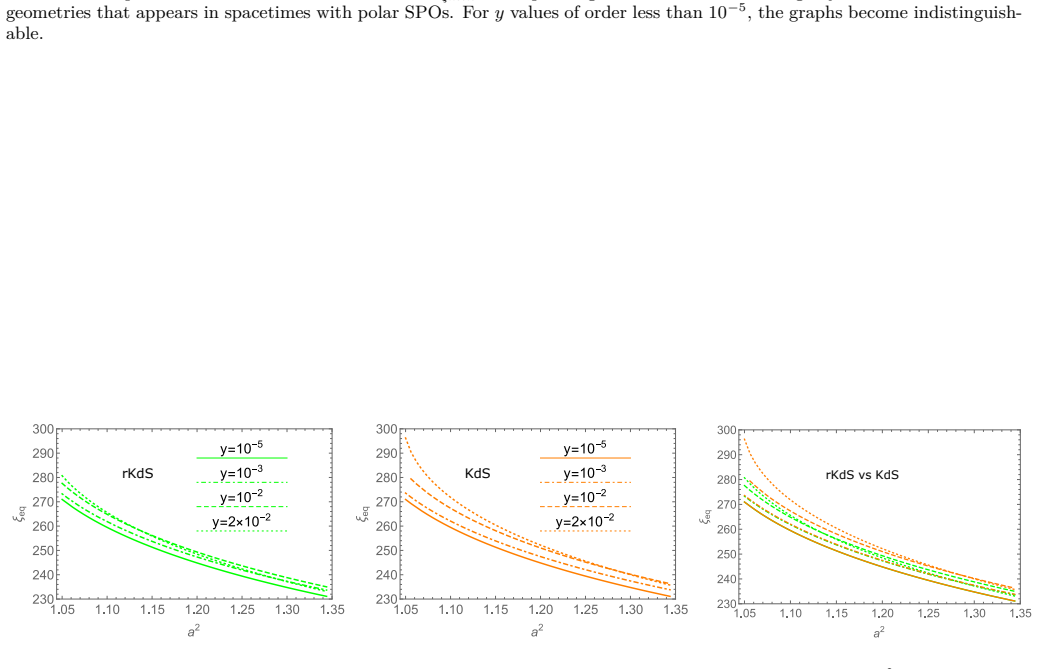
Appearance of observables corresponding to both types of spacetimes with and without polar orbits We compare the behavior of the peak angleηof the silhouette of the superspinar and the central angleξeq of the light arc observed from the equatorial plane as a function of the sp...
-
[12]
Radial geodesic frames Building on previous work [68], we define a radial geodetic reference frame (RGF) as a frame that is associ- atedwitharadiallyfallingorescapingobserver, forwhich the only nonzero velocity component, measured with re- spect to an LNRF currently orbiting t...
-
[13]
[69]), where for brevity we have used the symbolvto denote the relative velocity of the LNRF and RGF systems instead ofv(r)
Components of the four-momentum of a photon measured in RGFs The four-momentum photon componentsk (ˆa)mea- sured locally in the RGF are related to the LNRF com- ponentsk (b) by a standard Lorentz transformation k(ˆa)= Λ(ˆa) (b)k(b),(101) whereΛ (ˆa) (b) is the local Lorentz tr...
-
[14]
Directional angles of photons and celestial coordinates in the RGFs The ratios of thek (ˆa)components analogous to rela- tions (86-88) define the directional angles(ˆα,ˆβ)of the photon measured locally in the RGF. This transforma- tion leads to the well-known relation for aber...
-
[15]
We use the currently estimated value of the cos- mological constantΛ = 1.1×10−52m−2
Astronomical observables In this subsection, we compare the realistic shapes of the superspinar shadows within the KdS and rKdS met- rics assuming cosmological distances at which the effect of the radial velocity of the observer with respect to the source due to the expansion ...
-
[16]
Significant particle and photon orbits It is generally assumed that the boundaries of the Ke- plerian disk are given by marginally stable circular orbits of test particles in the equatorial plane. When we simul- taneously solve the conditions R(r) = 0 dR dr = 0(114) for the ex...
-
[17]
Circular geodesic frame TheCGFisdefinedsuchthatitmovesintheazimuthal directionwithrespecttotheLNRFwithlocallymeasured velocityv (ϕ), which can be expressed. By combining the relationships (94), (115), and (116), we obtain an ex- pression that can again be rewritten in a hybrid...
-
[18]
Directional angles of a photon measured in CGFs The components of photon four-momentum measured locally in CGF, which we denote byk(˜a), are linked to theLNRF componentsby transformationequationsanal- ogous to Eq. (101), where the local Lorentz transforma- tion matrix is given...
-
[19]
31); i.e., the source is corotating
The orbital velocity of the source isv=v (ϕ) + = 0.30/0.29for the rKdS/KdS spacetime (see Fig. 31); i.e., the source is corotating. 40 a2 = 1.5 y= 0.02 LNRF CGF rKdS KdS FIG. 36: Continuation of the previous figure for the view in the positive radial direction. 41 V. CONCLUSIO...
2026
-
[20]
J. M. Bardeen. Timelike and null geodesics in the Kerr metric. In C. DeWitt and B. S. DeWitt, editors,Black Holes (Les Astres Occlus), pages 215–239, New York,
-
[21]
Gordon and Breach Science Publishers
-
[22]
C. T. Cunningham and J. M. Bardeen. The Optical Appearance of a Star Orbiting an Extreme Kerr Black Hole.Astrophys. J., 173:L137, May 1972
1972
-
[23]
J.-P. Luminet. Image of a spherical black hole with thin accretion disk.Astronomy and Astrophysics, 75:228– 235, May 1979
1979
-
[24]
S. U. Viergutz. Image generation in Kerr geo- metry. I. Analytical investigations on the stationary emitter-observer problem.Astronomy and Astrophysics, 272:355, May 1993
1993
-
[25]
Viewing the shadow of the black hole at the Galactic center
Heino Falcke, Fulvio Melia, and Eric Agol. Viewing the shadow of the black hole at the Galactic center. Astrophysical Journal Letters, 528:L13–L16, 2000
2000
-
[26]
Extreme gravitational lensing near rotating black holes.Monthly Notices of the Royal Astronomical Society, 359:1217–1228, 2005
Kris Beckwith and Chris Done. Extreme gravitational lensing near rotating black holes.Monthly Notices of the Royal Astronomical Society, 359:1217–1228, 2005
2005
-
[27]
T. P. Sotiriou and V. Faraoni. f(R) Theories of Gravity. Reviews of Modern Physics, 82:451–497, 2010
2010
-
[28]
De Felice and S
A. De Felice and S. Tsujikawa. f(R) theories.Living Reviews in Relativity, 13:3, 2010
2010
-
[29]
Nojiri and S
S. Nojiri and S. D. Odintsov. Unified cosmic history in modified gravity: from F(R) theory to Lorentz non- invariant models.Physics Reports, 505:59–144, 2011
2011
-
[30]
Large mass hier- archy from a small extra dimension.Physical Review Letters, 83:3370–3373, 1999
Lisa Randall and Raman Sundrum. Large mass hier- archy from a small extra dimension.Physical Review Letters, 83:3370–3373, 1999
1999
-
[31]
Black holes on the brane.Physics Letters B, 487:1–6, 2000
Naresh Dadhich, Roy Maartens, Petros Papadopoulos, and Vahid Rezania. Black holes on the brane.Physics Letters B, 487:1–6, 2000
2000
-
[32]
Aliev and A
Anzhong A. Aliev and A. Emrah Gümrükçüoğlu. Charged rotating black holes on a 3-brane.Physical Review D, 71:104027, 2005
2005
-
[33]
Nonperturbative evolution equation for quantum gravity.Physical Review D, 57:971–985, 1998
Martin Reuter. Nonperturbative evolution equation for quantum gravity.Physical Review D, 57:971–985, 1998
1998
-
[34]
Renormalization group improved black hole spacetimes.Physical Review D, 62:043008, 2000
Alfio Bonanno and Martin Reuter. Renormalization group improved black hole spacetimes.Physical Review D, 62:043008, 2000
2000
-
[35]
Quantum Einstein gravity.New Journal of Physics, 14:055022, 2012
Martin Reuter and Frank Saueressig. Quantum Einstein gravity.New Journal of Physics, 14:055022, 2012
2012
-
[36]
Black holes in asymptotically safe gravity.arXiv:1503.06472, 2015
Frank Saueressig, Natalia Alkofer, Giulio D’Odorico, and Francesca Vidotto. Black holes in asymptotically safe gravity.arXiv:1503.06472, 2015
2015 arXiv
-
[37]
Astrid Eichhorn and Aaron Held.Black Holes in Asymptotically Safe Gravity and Beyond, pages 131–
-
[38]
Springer Nature Singapore, Singapore, 2023
2023
-
[39]
Lovelock
D. Lovelock. The Einstein Tensor and Its Generaliza- tions.Journal of Mathematical Physics, 12:498–501, 1971
1971
-
[40]
Boulware and Stanley Deser
David G. Boulware and Stanley Deser. String-generated gravity models.Physical Review Letters, 55:2656–2660, 1985
1985
-
[41]
Energetics and optical properties of 6-dimensional ro- 42 tating black hole in pure Gauss–Bonnet gravity.The European Physical Journal C, 75(8):1–11, 2015
Ahmadjon Abdujabbarov, Farruh Atamurotov, Naresh Dadhich, Bobomurat Ahmedov, and Zdeněk Stuchlík. Energetics and optical properties of 6-dimensional ro- 42 tating black hole in pure Gauss–Bonnet gravity.The European Physical Journal C, 75(8):1–11, 2015
2015
-
[42]
Imaging the Black Hole Silhouette of M87: Implications for Jet Forma- tion and Black Hole Spin.The Astrophysical Journal, 697:1164–1179, 05 2009
Avery Broderick and Abraham Loeb. Imaging the Black Hole Silhouette of M87: Implications for Jet Forma- tion and Black Hole Spin.The Astrophysical Journal, 697:1164–1179, 05 2009
2009
-
[43]
Broderick, Tim Johannsen, Abraham Loeb, and Dimitrios Psaltis
Avery E. Broderick, Tim Johannsen, Abraham Loeb, and Dimitrios Psaltis. Testing the No-Hair Theorem with Event Horizon Telescope Observations of Sagittar- ius A*.The Astrophysical Journal, 784(1):7, feb 2014
2014
-
[44]
Shadow Geometry of Kerr Naked Singularities.The As- trophysical Journal, 954(1):78, aug 2023
Bao Nguyen, Pierre Christian, and Chi-kwan Chan. Shadow Geometry of Kerr Naked Singularities.The As- trophysical Journal, 954(1):78, aug 2023
2023
-
[45]
Shadows of spherically symmetric black holes and naked singularities.Monthly Notices of the Royal Astronomical Society, 482(1):52– 64, 10 2018
Rajibul Shaikh, Prashant Kocherlakota, Ramesh Narayan, and Pankaj S Joshi. Shadows of spherically symmetric black holes and naked singularities.Monthly Notices of the Royal Astronomical Society, 482(1):52– 64, 10 2018
2018
-
[46]
Pedro V. P. Cunha, Carlos A. R. Herdeiro, Eugen Radu, and Helgi F. Rúnarsson. Shadows of Kerr Black Holes with Scalar Hair.Phys. Rev. Lett., 115:211102, Nov 2015
2015
-
[47]
Imaging a boson star at the Galactic center.Classical and Quantum Gravity, 33(10):105015, apr 2016
F H Vincent, Z Meliani, P Grandclément, E Gourgoul- hon, and O Straub. Imaging a boson star at the Galactic center.Classical and Quantum Gravity, 33(10):105015, apr 2016
2016
-
[48]
Wormhole shadows.Phys
Takayuki Ohgami and Nobuyuki Sakai. Wormhole shadows.Phys. Rev. D, 91:124020, Jun 2015
2015
-
[49]
Sokoliuk, S
O. Sokoliuk, S. Praharaj, A. Baransky, and P. K. Sa- hoo. Accretion flows around exotic tidal wormholes. I. Ray-tracing.Astronomy and Astrophysics, 665:A139, September 2022
2022
-
[50]
Shadows and photon spheres in static and rotating traversable wormholes
Takol Tangphati, Phongpichit Channuie, Kazuharu Bamba, and Davood Momeni. Shadows and photon spheres in static and rotating traversable wormholes. Nucl. Phys. B, 1014:116876, 2025
2025
-
[51]
New method for shadow calculations: Application to parametrized ax- isymmetric black holes.Phys
Ziri Younsi, Alexander Zhidenko, Luciano Rezzolla, Ro- man Konoplya, and Yosuke Mizuno. New method for shadow calculations: Application to parametrized ax- isymmetric black holes.Phys. Rev. D, 94:084025, Oct 2016
2016
-
[52]
The future ability to test theories of gravity with black-hole shadows.Nature Astronomy, 10:165–172, 11 2025
Akhil Uniyal, Indu Dihingia, Yosuke Mizuno, and Lu- ciano Rezzolla. The future ability to test theories of gravity with black-hole shadows.Nature Astronomy, 10:165–172, 11 2025
2025
-
[53]
Shin’ichi Nojiri and S. D. Odintsov. Black holes and their shadows inF(R)gravity.Physics of the Dark Universe, 47:101785, 2025
2025
-
[54]
Rodríguez, J
B. Rodríguez, J. Chagoya, and C. Ortiz. Shadows of black holes in dynamical Chern-Simons modified grav- ity.arXiv preprint arXiv:2403.13062 [gr-qc], 2024
2024
-
[55]
Kerr–Newman black holes in Weyl–Cartan theory: Shadows and EHT con- straints.Phys
Khadije Jafarzade, Seyed Hossein Hendi, Mubasher Jamil, and Sebastian Bahamonde. Kerr–Newman black holes in Weyl–Cartan theory: Shadows and EHT con- straints.Phys. Dark Univ., 45:101497, 2024
2024
-
[56]
Kerr-MOG-(A)dSblackholeanditsshadow in scalar-tensor-vector gravity theory.Journal of Cos- mology and Astroparticle Physics, 2024(08):035, aug 2024
Wentao Liu, Di Wu, Xiongjun Fang, Jiliang Jing, and JieciWang. Kerr-MOG-(A)dSblackholeanditsshadow in scalar-tensor-vector gravity theory.Journal of Cos- mology and Astroparticle Physics, 2024(08):035, aug 2024
2024
-
[57]
Black hole shadow of quan- tum Oppenheimer-Snyder–de Sitter spacetime.Phys
Shu Luo and Chenghao Li. Black hole shadow of quan- tum Oppenheimer-Snyder–de Sitter spacetime.Phys. Rev. D, 110:124042, Dec 2024
2024
-
[58]
Churilova, R.A
M.S. Churilova, R.A. Konoplya, Z. Stuchlík, and A. Zhi- denko. Wormholes without exotic matter: quasinormal modes, echoes and shadows.Journal of Cosmology and Astroparticle Physics, 2021(10):010, Oct 2021
2021
-
[59]
First M87 Event Horizon Tele- scope Results
Kazunori Akiyama et al. First M87 Event Horizon Tele- scope Results. I. The Shadow of the Supermassive Black Hole.The Astrophysical Journal Letters, 875(1):L1, Apr 2019
2019
-
[60]
First M87 Event Horizon Tele- scope Results
Kazunori Akiyama et al. First M87 Event Horizon Tele- scope Results. II. Array and Instrumentation.The As- trophysical Journal Letters, 875(1):L2, Apr 2019
2019
-
[61]
First M87 Event Horizon Tele- scope Results
Kazunori Akiyama et al. First M87 Event Horizon Tele- scope Results. III. Data Processing and Calibration. The Astrophysical Journal Letters, 875(1):L3, Apr 2019
2019
-
[62]
First M87 Event Horizon Telescope Results
Kazunori Akiyama et al. First M87 Event Horizon Telescope Results. IV. Imaging the Central Supermas- sive Black Hole.The Astrophysical Journal Letters, 875(1):L4, Apr 2019
2019
-
[63]
First M87 Event Horizon Tele- scope Results
Kazunori Akiyama et al. First M87 Event Horizon Tele- scope Results. V. Physical Origin of the Asymmetric Ring.The Astrophysical Journal Letters, 875(1):L5, Apr 2019
2019
-
[64]
First M87 Event Horizon Tele- scope Results
Kazunori Akiyama et al. First M87 Event Horizon Tele- scope Results. VI. The Shadow and Mass of the Central Black Hole.Astrophys. J. Lett., 875(1):L6, 2019
2019
-
[65]
First M87 Event Horizon Tele- scope Results
Kazunori Akiyama et al. First M87 Event Horizon Tele- scope Results. VII. Polarization of the Ring.The As- trophysical Journal Letters, 910(1):L12, Mar 2021
2021
-
[66]
First M87 Event Horizon Telescope Results
Kazunori Akiyama et al. First M87 Event Horizon Telescope Results. VIII. Magnetic Field Structure near The Event Horizon.The Astrophysical Journal Letters, 910(1):L13, Mar 2021
2021
-
[67]
Quantum Gravity at a Lifshitz Point
Petr Hořava. Quantum Gravity at a Lifshitz Point. Phys. Rev. D, 79:084008, 2009
2009
-
[68]
The Black Hole and FRW Geometries of Non-Relativistic Gravity
Alexios Kehagias and Konstantinos Sfetsos. The Black Hole and FRW Geometries of Non-Relativistic Gravity. Phys. Lett. B, 678:123–126, 2009
2009
-
[69]
E. G. Gimon and P. Horava. Astrophysical Violations of the Kerr Bound as a Possible Signature of String Theory.Physics Letters B, 672:299–302, 2009
2009
-
[70]
A. N. Aliev and A. E. Gümrükçüoğlu. Gravitational Field Equations on and off a 3-Brane World.Physical Review D, 71:104027, 2005
2005
-
[71]
Hledík, and K
Zdeněk Stuchlík, S. Hledík, and K. Truparová. Evo- lution of Kerr superspinars due to accretion coun- terrotating thin discs.Classical Quantum Gravity, 28(15):155017, August 2011
2011
-
[72]
Zdeněk Stuchlík and J. Schee. Appearance of Keple- rian discs orbiting Kerr superspinars.Classical Quan- tum Gravity, 27(21):215017 (39 pages), November 2010
2010
-
[73]
Observational phenom- ena related to primordial Kerr superspinars.Classical and Quantum Gravity, 29(6):065002, 2012
Zdeněk Stuchlík and Jan Schee. Observational phenom- ena related to primordial Kerr superspinars.Classical and Quantum Gravity, 29(6):065002, 2012
2012
-
[74]
Zdeněk Stuchlík and J. Schee. Ultra-high-energy col- lisions in the superspinning Kerr geometry.Classical Quantum Gravity, 30(7):075012, April 2013
2013
-
[75]
Nedkova, Vassil K
Petya G. Nedkova, Vassil K. Tinchev, and Stoytcho S. Yazadjiev. Shadow of a rotating traversable wormhole. Phys. Rev. D, 88:124019, Dec 2013
2013
-
[76]
Shadow of rotating wormholeinplasmaenvironment.Astrophys
Ahmadjon Abdujabbarov, Bakhtinur Juraev, Bobomu- rat Ahmedov, and Zdeněk Stuchlík. Shadow of rotating wormholeinplasmaenvironment.Astrophys. Space Sci., 361(7):226, 2016
2016
-
[77]
Optical 43 properties of a braneworld black hole: Gravitational lensing and retrolensing.Physical Review D, 96:084017, Oct 2017
Ahmadjon Abdujabbarov, Bobomurat Ahmedov, Naresh Dadhich, and Farruh Atamurotov. Optical 43 properties of a braneworld black hole: Gravitational lensing and retrolensing.Physical Review D, 96:084017, Oct 2017
2017
-
[78]
Reflection-asymmetric wormholes and their double shadows.Physical Review D, 102(8), Oct 2020
Maciek Wielgus, Jiří Horák, Frederic Vincent, and Marek Abramowicz. Reflection-asymmetric wormholes and their double shadows.Physical Review D, 102(8), Oct 2020
2020
-
[79]
Appearance of Keple- rian discs orbiting on both sides of reflection-symmetric wormholes.Journal of Cosmology and Astroparticle Physics, 2022(01):054, jan 2022
Jan Schee and Zdeněk Stuchlík. Appearance of Keple- rian discs orbiting on both sides of reflection-symmetric wormholes.Journal of Cosmology and Astroparticle Physics, 2022(01):054, jan 2022
2022
-
[80]
Riess, Alexei V
Adam G. Riess, Alexei V. Filippenko, Peter Challis, Alejandro Clocchiatti, Alan Diercks, Peter M. Gar- navich, Ronald L. Gilliland, Craig J. Hogan, Saurabh Jha, Robert P. Kirshner, Bruno Leibundgut, Mark M. Phillips, David Reiss, Brian P. Schmidt, Robert A. Schommer, R. Chris ...
1998
-
[81]
Knop, Peter Nugent, Peter G
Saul Perlmutter, Greg Aldering, Gerson Goldhaber, Robert A. Knop, Peter Nugent, Peter G. Castro, Su- sana Deustua, Sebastien Fabbro, Ariel Goobar, Don- ald E. Groom, Isobel Hook, Andrew G. Kim, Myung- shin Kim, Jae Lee, Nicolas J. Nunes, Reynald Pain, Carl R. Pennypacker, Robe...
1999
-
[82]
L. M. Krauss and M. S. Turner. The cosmological con- stant is back.Gen. Relativity Gravitation, 27(11):1137– 1144, November 1995
1995
-
[83]
L. M. Krauss. The end of the age problem, and the case for a cosmological constant revisited.Astrophys. J., 501(2):461–466, 1998
1998
-
[84]
Influence of cosmic repulsion and magnetic fields on accretion disks rotating around Kerr black holes.Universe, 6(2):26, 2020
Zdeněk Stuchlík, Martin Kološ, Jiří Kovář, Petr Slaný, and Arman Tursunov. Influence of cosmic repulsion and magnetic fields on accretion disks rotating around Kerr black holes.Universe, 6(2):26, 2020
2020
-
[85]
Slaný, and S
Zdeněk Stuchlík, P. Slaný, and S. Hledík. Equilibrium configurations of perfect fluid orbiting Schwarzschild– de Sitter black holes.Astronomy and Astrophysics, 363(2):425–439, November 2000
2000
-
[86]
Influence of the Relict Cosmological Constant on Accretion Discs.Modern Phys
Zdeněk Stuchlík. Influence of the Relict Cosmological Constant on Accretion Discs.Modern Phys. Lett. A, 20(8):561–575, March 2005
2005
-
[87]
ZdeněkStuchlíkandJ.Schee. Influenceofthecosmolog- ical constant on the motion of Magellanic Clouds in the gravitational field of Milky Way.Journal of Cosmology and Astroparticle Physics, 9:018, September 2011
2011
-
[88]
Zdeněk Stuchlík, Jan Novotný, and Jan Hladík. Dark matter halos modeled by polytropic spheres influenced by the relict cosmological constant and trapping poly- tropes forming supermassive black holes.Astronomy and Astrophysics, 702:A2, September 2025
2025
-
[89]
Light escape cones in local reference frames of Kerr– de Sitter black hole spacetimes and related black hole shadows.The European Physical Journal C, 78(3):180, Mar 2018
Zdeněk Stuchlík, Daniel Charbulák, and Jan Schee. Light escape cones in local reference frames of Kerr– de Sitter black hole spacetimes and related black hole shadows.The European Physical Journal C, 78(3):180, Mar 2018
2018
-
[90]
Shadows of Kerr–de Sitter naked singularities.Phys
Zdeněk Stuchlík and Daniel Charbulák. Shadows of Kerr–de Sitter naked singularities.Phys. Rev. D, 109(6):064008, 2024
2024
-
[91]
Light escape cones in the locally nonrotating reference frames of the Kerr–de Sitter superspinars and related superspinar shadows.Phys
Daniel Charbulák and Zdeněk Stuchlík. Light escape cones in the locally nonrotating reference frames of the Kerr–de Sitter superspinars and related superspinar shadows.Phys. Rev. D, 110:124050, Dec 2024
2024
-
[92]
Ovalle, E
J. Ovalle, E. Contreras, and Z. Stuchlík. Kerr–de Sitter black hole revisited.Physical Review D, 103(8), Apr 2021
2021
-
[93]
Fabris, and Hermano Velten
Eunice Omwoyo, Humberto Belich, Júlio C. Fabris, and Hermano Velten. Remarks on the black hole shadows in Kerr-de Sitter space times.The European Physical Journal C, 82(5), May 2022
2022
-
[94]
Eunice Omwoyo, Humberto Belich, J. C. Fabris, and Hermano Velten. Black hole lensing in Kerr-de Sit- ter spacetimes.The European Physical Journal Plus, 138(11):1043, 2023
2023
-
[95]
P. Slaný. Test particle motion along equatorial circular orbits in the revisited Kerr-de Sitter spacetime.Phys. Rev. D, 108(8):084026, 2023
2023
-
[96]
Photon motion in Kerr–de Sitter spacetimes.The European Physical Journal C, 77(12):897, Dec 2017
Daniel Charbulák and Zdeněk Stuchlík. Photon motion in Kerr–de Sitter spacetimes.The European Physical Journal C, 77(12):897, Dec 2017
2017
-
[97]
Planck 2018 results
Planck Collaboration. Planck 2018 results. VI. Cosmo- logical parameters.Astronomy & Astrophysics, 641:A6, 2020
2018
-
[98]
Shemmer, H
O. Shemmer, H. Netzer, R. Maiolino, E. Oliva, and S. Croom. Near-infrared spectroscopy of high-redshift active galactic nuclei. I. A metallicity–accretion rate relationship.The Astrophysical Journal, 614:547–557, 2004
2004
-
[99]
Masses of Black Holes in the Uni- verse.Chin
Janusz Ziolkowski. Masses of Black Holes in the Uni- verse.Chin. J. Astron. Astrophys. Suppl., 8:273–280, 2008
2008
-
[100]
C. W. Misner, K. S. Thorne, and J. A. Wheeler.Grav- itation. 1973
1973
-
[101]
Bičák and Zdeněk Stuchlík
J. Bičák and Zdeněk Stuchlík. On the latitudinal and radial motion in the field of a rotating black hole.Bull. Astronom. Inst. Czechoslovakia, 27(3):129–133, 1976
1976
-
[102]
Schee and Z
J. Schee and Z. Stuchlík. Optical phenomena in the field of braneworld Kerr black holes.International Journal of Modern Physics D, 18(06):983–1024, 2009
2009
-
[103]
Equatorial circular orbits and the motion of the shell of dust in the field of a rotating naked singularity.Bull
Zdeněk Stuchlík. Equatorial circular orbits and the motion of the shell of dust in the field of a rotating naked singularity.Bull. Astronom. Inst. Czechoslovakia, 31:129–144, 1980
1980
-
[104]
Keenan, Amy J
Ryan C. Keenan, Amy J. Barger, and Lennox L. Cowie. Evidence for a 300 Megaparsec Scale Under-density in the Local Galaxy Distribution.The Astrophysical Jour- nal, 775:62, 2013
2013
-
[105]
Tully, Helene Courtois, Yehuda Hoffman, and Daniel Pomarède
R. Tully, Helene Courtois, Yehuda Hoffman, and Daniel Pomarède. The Laniakea supercluster of galaxies.Na- ture, 513, 09 2014
2014
-
[106]
Zdeněk Stuchlík and P. Slaný. Equatorial circular orbits in the Kerr–de Sitter spacetimes.Physical Review D, 69:064001, 2004
2004
-
[107]
Radiative Penrose process: Energy gain by a single ra- diating charged particle in the ergosphere of rotating black hole.Physical Review D, 103(2), Jan 2021
Martin Kološ, Arman Tursunov, and Zdeněk Stuchlík. Radiative Penrose process: Energy gain by a single ra- diating charged particle in the ergosphere of rotating black hole.Physical Review D, 103(2), Jan 2021
2021
-
[108]
Zdeněk Stuchlík and S. Hledík. Equatorial photon motion in the Kerr–Newman spacetimes with a non- 44 zero cosmological constant.Classical Quantum Gravity, 17(21):4541–4576, November 2000
2000
-
[109]
Shin’ichi Nojiri and S. D. Odintsov. Black holes and their shadows inF(R)gravity, 2024
2024
-
[110]
Shadow of a charged rotating black hole in f(R) gravity
Sara Dastan, Reza Saffari, and Saheb Soroushfar. Shadow of a charged rotating black hole in f(R) gravity. The European Physical Journal Plus, 137, 09 2022
2022
-
[111]
Bharat Ratra and P. J. E. Peebles. Cosmological conse- quences of a rolling homogeneous scalar field.Physical Review D, 37:3406–3427, 1988
1988
-
[112]
Caldwell, Rahul Dave, and Paul J
Robert R. Caldwell, Rahul Dave, and Paul J. Stein- hardt. Cosmological imprint of an energy component with general equation of state.Physical Review Letters, 80:1582–1585, 1998
1998
-
[113]
V. Faraoni. Inflation and quintessence with nonminimal coupling.Phys. Rev. D, 62(2):023504, July 2000
2000
-
[114]
Extended quintessence, inflation and stable de sitter spaces.Clas- sical and Quantum Gravity, 23(9):3005, 2006
Valerio Faraoni and Michael N Jensen. Extended quintessence, inflation and stable de sitter spaces.Clas- sical and Quantum Gravity, 23(9):3005, 2006
2006
-
[115]
Caldwell
Robert R. Caldwell. A phantom menace? Cosmological consequences of a dark energy component with super- negativeequationofstate.Physics Letters B,545:23–29, 2002
2002
-
[116]
Carroll, Mark Hoffman, and Mark Trodden
Sean M. Carroll, Mark Hoffman, and Mark Trodden. Can the dark energy equation-of-state parameter w be less than−1?Physical Review D, 68:023509, 2003
2003
-
[117]
Riess et al
Adam G. Riess et al. A 2.4% determination of the local value of the Hubble constant.Astrophysical Journal, 826:56, 2016
2016
-
[118]
Licia Verde, Tommaso Treu, and Adam G. Riess. Ten- sions between the early and late Universe.Nature As- tronomy, 3:891–895, 2019
2019
-
[119]
Chameleon dark energy can resolve the Hubble tension.Phys
Rong-Gen Cai, Zong-Kuan Guo, Li Li, Shao-Jiang Wang, and Wang-Wei Yu. Chameleon dark energy can resolve the Hubble tension.Phys. Rev. D, 103:L121302, Jun 2021
2021
-
[120]
Eleonora Di Valentino, Luis A. Anchordoqui, Özgür Akarsu, Yacine Ali-Haimoud, Luca Amendola, Nikki Arendse, Marika Asgari, Mario Ballardini, Spyros Basi- lakos, Elia Battistelli, Micol Benetti, Simon Birrer, François R. Bouchet, Marco Bruni, Erminia Calabrese, David Camarena, ...
2021
-
[121]
While the cosmological constant represents the simplestrealization, recentobservationshaveraisedten- sions concerning its interpretation [96–99]
Dark energy may also be described by alternative mod- els, such as quintessence [90–93] or phantom energy [94, 95]. While the cosmological constant represents the simplestrealization, recentobservationshaveraisedten- sions concerning its interpretation [96–99]
-
[122]
Here and in the following we restrict our discussion to positive values of radiir>0
-
[123]
Of course, the parametersa 2,yof the spacetimes de- scribed by the rKdS metric can give arbitrary values a2y >0
-
[124]
It is clear that the results obtained in this work for y→0must be the same as in the case of the stan- dard KdS spacetime, since in this limiting case both KdS and rKdS geometries describe the same, i.e., the Kerr spacetime
-
[125]
That is, if the ’latitudinal conditions’ are satisfied, the ’radial conditions’ are au- tomatically satisfied
Forq <0, the conditions for reality of the latitudinal motion imply a constraint−a2 <q <0, while the con- straints imposed on the impact parameterXin this case are stronger than those arising from the conditions for the reality of radial motion. That is, if the ’latitudinal co...
-
[126]
Hereandinthefollowingdiscussionwerestrictourselves to the ’northern hemisphere’0◦≤θ≤90◦for reasons of symmetry
-
[127]
Building on the work of [85] and [74], in this subsection we will express all the relevant radii using the charac- teristic functions of the forma2(r;y)
-
[128]
Thereisanotherfunctiondescribing ECPO, butitisnot relevant to our considerations because it corresponds to parameters under which the Keplerian disk does not exist
Reviewed June 29, 2026 · model on record in the stance chip above.
Discussion (0). Continue with ORCID to comment.