REVIEW 3 major objections 6 minor 46 references
DMRS-Based Uplink Channel Estimation for MU-MIMO Systems with Location-Specific SCSI Acquisition
T0 review · 3 major / 6 minor · reviewed 2026-08-07 · deepseek-v4-flash
Pith's one-line read The paper claims that statistical channel state information tied to user location can suppress DMRS pilot interference, with the proposed estimators reaching about -21.5 dB NMSE at 15 dB SNR where baselines stay above -17 dB.
desk verdict A genuinely new VSTD-based SCSI database construction combined with MMSE channel estimation, but the unvalidated grid-size assumption and unquantified approximations leave the headline gains conditional. read the letter →
The pith
A machine-rendered reading of the paper's core claim, the machinery that carries it, and where it could break.
The reading
What carries the argument
The load-bearing structure is the fourth-order tensor $\mathcal{H}_g$ formed by concatenating $W$ least-squares channel estimates from sampling points inside one grid. Its canonical polyadic decomposition has factor matrices $B^{(1)}, B^{(2)}, B^{(3)}$ that are Vandermonde matrices with generators $z_{1,l}=e^{-\bar{\jmath}2\pi\Delta f\bar{\tau}_{g,l}}$, $z_{2,l}=e^{-\bar{\jmath}\pi\cos\bar{\theta}_{g,l}}$, and $z_{3,l}=e^{-\bar{\jmath}\pi\sin\bar{\theta}_{g,l}\cos\bar{\varphi}_{g,l}}$, together with a factor $B^{(4)}$ holding path gains. Vandermonde-structured tensor decomposition (VSTD) uses spatial smoothing and SVD to build shift-invariance relations, reads the Vandermonde generators by eigenvalue decomposition, and reconstructs delays, angles, and powers from those generators. On the estimation side, the windowed beam-delay MMSE estimator (SA-WBCE) is the complexity-reduction mechanism: windowing concentrates channel energy so that the delay- and beam-domain correlation matrices become band matrices, lowering inversion complexity from $O(N^3+M^3)$ to $O(N B_f^2 + M B_s^2)$.
What would settle it
Run the same VSTD database construction and SA-BCE pipeline on a measured or simulated channel whose spatial correlation distance is known, then sweep the grid size $d$. If SCSI accuracy or NMSE degrades sharply while $d$ is still well below the correlation distance, or if the gain over the SOMP baseline vanishes once the database is built from noisy finite samples, the grid-consistency assumption is falsified. A second check is to compare high-SNR NMSE against the ideal-SCSI upper bound: the claim that SCSI-assisted estimators significantly outperform baselines would fail if they fall back to baseline level in that comparison.
Extended reading notes
Core claim
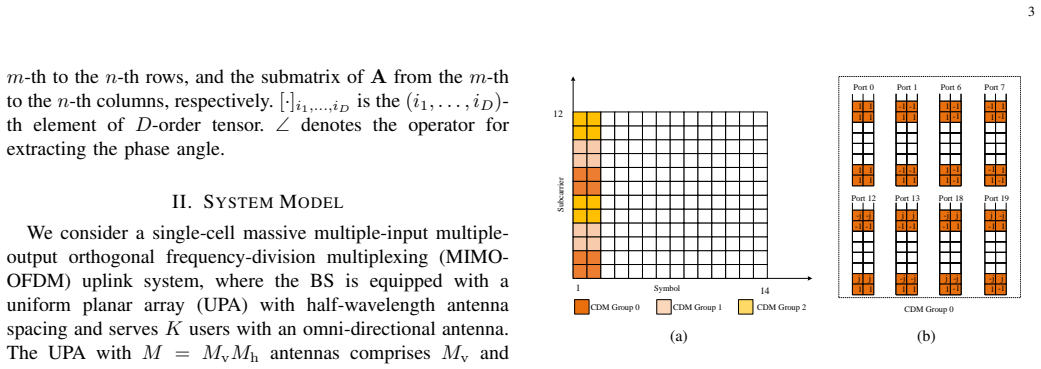
The paper's central claim is that code-domain DMRS pilot interference in uplink MU-MIMO can be substantially undone once the base station knows the users' statistical channel parameters, and that those parameters can be learned from noisy received signals rather than assumed perfect. Two estimators carry the claim: SA-BCE applies a frequency-domain MMSE step to separate the frequency-domain OCC and an antenna-domain MMSE step to suppress noise, while SA-WBCE moves both steps to the beam-delay domain and uses windowing so that the correlation matrices become band matrices, cutting matrix inversion cost. The SCSI itself is delivered by a grid-based location-specific database: each grid is represented by one common set of delays, elevation and azimuth angles, and path powers, recovered by Vandermonde-structured tensor decomposition of least-squares channel estimates from W sampling points inside the grid. The simulation evidence shows the database reaching a SCSI accuracy around -23.5 dB at $N_d=180$ and 10 dB SNR, and the estimators reaching NMSE around -21.5 dB (SA-BCE) and -19.5 dB (SA-WBCE) at 15 dB SNR, with all compared baselines above -17 dB.
Load-bearing premise
The whole scheme rests on the assumption that every user inside the same $d\times d$ grid sees the same multi-path delays, angles, and powers, so the grid size must be far smaller than the channel's spatial correlation distance; if that is not true in a deployment, the database stores wrong statistics and the estimation gain disappears.
Editorial extensions
If this is right
- With the location-specific SCSI database, SA-BCE and SA-WBCE outperform OMP, VSD, EM-AMP, and an SOMP-database baseline across SNR; at 15 dB SNR they reach about -21.5 dB and -19.5 dB NMSE versus above -17 dB for the baselines.
- The SCSI-assisted estimators are nearly immune to delay spread: increasing delay spread from 200 ns to 500 ns costs only about 0.5 dB for the proposed schemes, compared with about 6.5 dB degradation for VSD and EM-AMP.
- SA-WBCE keeps most of the estimation gain while replacing cubic-complexity matrix inversions with band-matrix inversions, and the Kaiser window offers about 2 dB improvement over a rectangular window at the tested band sizes.
- Grid size directly trades database storage against acquisition cost: holding SCSI accuracy near -23.4 dB needs $N_d=120$ subcarriers at grid size $d=2$ m but $N_d=240$ at $d=5$ m.
- Because the environment is assumed quasi-static over a period $T$, one database construction serves DMRS-based estimation over many subsequent OFDM symbols, avoiding frequent real-time SCSI estimation.
Reading between the lines
- Editorial inference: the spatial-consistency grid is the scheme's fragile link; the paper fixes $d=2$ m in simulation without measurement-based validation that this is below the true correlation distance, so a natural extension is to size the grid from measured correlation distance or adapt it per cluster.
- Editorial inference: the relaxed uniqueness condition (34) is checked numerically rather than proven for noisy finite-sample recovery; a deterministic noise tolerance bound for the shift-invariance eigenvalue step would harden the central claim.
- Editorial inference: the same tensor machinery could be reused for database refresh as the environment changes, treating each refresh as a low-cost update rather than a full rebuild from scratch.
Signed reviews
Editorial analysis
A structured set of objections, weighed in public.
Referee Report
Summary. The paper addresses uplink DMRS-based channel estimation for MU-MIMO systems under the 3GPP Release 18 Type II OCC pattern. It proposes two SCSI-assisted Bayesian estimators, SA-BCE and its windowed low-complexity variant SA-WBCE, and a location-specific SCSI database constructed from noisy received signals using a Vandermonde-structured tensor decomposition (VSTD). The authors derive the MMSE estimators, prove the equivalence of the beam-delay domain form (Lemma 1), approximate the windowed correlations as band matrices (Eq. 18), and evaluate the method in a QuaDRiGa UMa scenario, reporting NMSE near -21.5 dB for SA-BCE at 15 dB SNR against baselines above -17 dB.
Significance. If the reported performance is robust, the paper would be a useful contribution: it targets a relevant 3GPP Release 18 configuration, combines SCSI database construction with noisy received signals rather than idealized samples, and proposes a complexity-reducing banded windowed estimator. The algebraic derivations of SA-BCE and the beam-delay equivalence are correct, and the simulations include meaningful baselines (SOMP-based SCSI database, OMP, VSD, EM-AMP) that strengthen the claims. The main value depends on whether the grid spatial-consistency approximation and the band-matrix approximation are quantitatively justified, since both are load-bearing for the central NMSE improvements.
major comments (3)
- [Section IV-A, Eqs. (21)-(23); Section V-C, Fig. 4] The central assumption that all users in a d by d grid share identical delays, angles, and powers is not validated. In Eq. (22), the representation error Delta H_v is introduced, but in Eq. (23) it is absorbed into the Gaussian noise term without any quantification or justification. The simulation fixes d=2 m while the QuaDRiGa channel parameters are explicitly said to vary with position according to a spatial consistency procedure, so Delta H_v is nonzero. Fig. 4 shows that the SCSI accuracy degrades by roughly 5 dB when d increases from 2 m to 6 m, indicating that the choice of d is not benign. The authors should quantify the empirical representation error E||Delta H_v||_F^2/(N_d M) as a function of d and compare it with the noise variance at SNR_SC=10 dB; if it is not well below sigma^2, the claimed NMSE advantage over SOMP and other baselines is not secured.
- [Section III-B, Eq. (18)] The band-matrix approximation underlying SA-WBCE is unquantified. Equation (18) simply sets entries beyond band B_phi to zero, and the text claims that 'Due to the characteristics of the window functions, both Xi_f and Xi_s are band matrices with narrow band sizes.' For a finite DFT of a Kaiser or Hamming window, the transformed matrices are not exactly banded; they only decay away from the diagonal. The paper provides no bound on the approximation error ||eR_phi - bR_phi||_2 or on the resulting MMSE loss, so the claim that SA-WBCE maintains performance while reducing complexity is not supported. The authors should provide a perturbation analysis or at least a numerical study showing that the chosen band sizes (e.g., B_tau=15, B_a=20 in Fig. 8) make the truncation error negligible relative to the noise and interference terms.
- [Section IV-C, Lemma 3 and Eq. (34)] The relaxed uniqueness condition for the high-rank CPD is not established for the noisy finite-sample case. Lemma 3 is cited to prior work, and Eq. (34) reduces the rank conditions to a dimension inequality min((K_1-1)K_2K_3, L_1L_2L_3W) >= Lbar. This is a generic necessary dimension condition, not a sufficient guarantee in the presence of noise and finite samples, and it does not account for the representation error absorbed in Eq. (23). Since VSTD's ability to recover hundreds of sub-paths is the basis for the SCSI database accuracy, the authors should provide either a perturbation bound for the subspace estimates in Eqs. (43)-(49) or an empirical identifiability check, such as recovery success rate versus SNR_SC and versus W, for the configuration used in Section V.
minor comments (6)
- [Equation (52)] The normalization in E_f uses 1/N_d, but R_f and tilde R_f are defined as N_c by N_c matrices; the trace normalization should be 1/N_c. The normalization factor only shifts all curves by a constant, but it should be corrected for consistency.
- [Equation (53)] The NMSE metric averages the per-sample dB values, i.e., 10 log10 of each ratio, rather than computing 10 log10 of the ratio of summed powers. Averaging in dB can bias the reported values; please clarify whether this is intentional and, if not, use the standard ratio-of-sums definition.
- [Equation (35)] The first row of the matricization X_[3] repeats [H_g]_{1,1,1,1} twice; the second entry should be [H_g]_{1,1,1,2} (and similarly for subsequent rows).
- [Lemma 1] The proof of Lemma 1 is stated as 'substitution directly yields' the equivalence; the algebra is correct but a two-line derivation showing the identity (A + sigma^2 I)^{-1} = F_N(D + sigma^2 I)^{-1} F_N^H would make the proof self-contained.
- [Notation and figures] There is a typo 'respectivelv' in the Notations paragraph; also, the y-axis of Fig. 3 and Fig. 4 is labelled 'Accuracy of SCSI (dB)' although the metric in Eq. (51) is an MSE; consider using 'MSE (dB)' or adding a note that lower values mean higher accuracy.
- [Table I and Fig. 8] The Kaiser window shape parameter is listed in Table I, but the Hamming and rectangular windows used in Fig. 8 are not parameterized; please specify their definitions or cite the chosen formulations.
Circularity Check
No significant circularity: the SCSI database is extracted from uplink sounding signals and then used in MMSE estimators that are benchmarked against ideal-SCSI and external baselines; self-citations are background only.
full rationale
The paper's derivation chain is self-contained. The SCSI-assisted estimators SA-BCE and SA-WBCE are standard MMSE estimators (Eqs. 9-13 and 14-16) that take channel correlation matrices as inputs; those correlation matrices are obtained from the location-specific SCSI database built by the VSTD tensor-decomposition algorithm (Eqs. 29-50) using uplink received signals collected within each grid. No fitted parameter is renamed as a prediction: the SCSI parameters (delays, angles, powers) are estimated by tensor decomposition, and the channel-estimation NMSE is evaluated against ground-truth channels and compared with ideal-SCSI and external baselines (OMP, VSD, EM-AMP, SOMP). The SCSI accuracy metric LSCSI in Eqs. (51)-(52) compares the estimated covariance with the ideal covariance, which is a standard accuracy measure rather than a circular definition. The self-citations ([15], [35], [36]) are used only as background for asymptotic sparsity and multilinear structure; the load-bearing uniqueness conditions are cited to external works ([8], [39], [40]), and the VSTD derivation is carried out in the paper. The unvalidated grid-size assumption d = 2 m is a correctness or robustness concern, not a circularity, because the paper does not define grid size in terms of the target NMSE or fit the reported gains to it. Thus no circular step can be exhibited with a specific equation-level reduction, and the appropriate finding is no significant circularity.
Assumptions & free parameters
free parameters (4)
- Grid size d =
2 m (simulation)
- Kaiser window shape parameter =
3.95
- Band sizes Btau and Ba =
15 and 20 in SA-WBCE
- VSTD smoothing parameters (Ks, Ls) =
not specified
assumptions (7)
- domain assumption Channel model (Eq. 3): channel is a sum of L discrete multi-path components with delays, elevation/azimuth AoAs, and complex gains.
- domain assumption Uncorrelated scattering (Eq. 4): path gains are uncorrelated across paths, with power rho_l.
- domain assumption Quasi-static environment and spatial consistency (Eq. 19): SCSI depends only on user location and is constant over T OFDM symbols.
- domain assumption Grid-based SCSI sharing (Eqs. 21-22): all users within a grid of size d share identical delays, angles, and powers.
- domain assumption Channel constancy over consecutive OFDM symbols (used in Eq. 7): channel coefficients unchanged over the T_p pilot symbols.
- domain assumption Asymptotic sparsity of beam-delay domain and banded approximation (Prop. 1, Eq. 18): correlation matrices become diagonal asymptotically and band matrices for finite arrays and windows.
- ad hoc to paper Representation error Delta H_v is treated as i.i.d. complex Gaussian and absorbed into noise (Eq. 23).
Cite this review
Pith. "Pith review of DMRS-Based Uplink Channel Estimation for MU-MIMO Systems with Location-Specific SCSI Acquisition." pith.science (2026). https://pith.science/paper/QO4EXVRF
@misc{pith2026250611899,
  author       = {Pith},
  title        = {Pith review of: DMRS-Based Uplink Channel Estimation for MU-MIMO Systems with Location-Specific SCSI Acquisition},
  year         = {2026},
  howpublished = {\url{https://pith.science/paper/QO4EXVRF}},
  note         = {Machine review of arXiv:2506.11899}
}
read the original abstract
With the growing number of users in multi-user multiple-input multiple-output (MU-MIMO) systems, demodulation reference signals (DMRSs) are efficiently multiplexed in the code domain via orthogonal cover codes (OCC) to ensure orthogonality and minimize pilot interference. In this paper, we investigate uplink DMRS-based channel estimation for MU-MIMO systems with Type II OCC pattern standardized in 3GPP Release 18, leveraging location-specific statistical channel state information (SCSI) to enhance performance. Specifically, we propose a SCSI-assisted Bayesian channel estimator (SA-BCE) based on the minimum mean square error criterion to suppress the pilot interference and noise, albeit at the cost of cubic computational complexity due to matrix inversions. To reduce this complexity while maintaining performance, we extend the scheme to a windowed version (SA-WBCE), which incorporates antenna-frequency domain windowing and beam-delay domain processing to exploit asymptotic sparsity and mitigate energy leakage in practical systems. To avoid the frequent real-time SCSI acquisition, we construct a grid-based location-specific SCSI database based on the principle of spatial consistency, and subsequently leverage the uplink received signals within each grid to extract the SCSI. Facilitated by the multilinear structure of wireless channels, we formulate the SCSI acquisition problem within each grid as a tensor decomposition problem, where the factor matrices are parameterized by the multi-path powers, delays, and angles. The computational complexity of SCSI acquisition can be significantly reduced by exploiting the Vandermonde structure of the factor matrices. Simulation results demonstrate that the proposed location-specific SCSI database construction method achieves high accuracy, while the SA-BCE and SA-WBCE significantly outperform state-of-the-art benchmarks in MU-MIMO systems.
Figures


Figures from the paper (3 more)


Reference graph
Works this paper leans on
-
[23]
Interference- cancellation-based channel knowledge map construction and its appli- cations to channel estimation,
W. Jiang, X. Yuan, B. Teng, H. Wang, and J. Qian, “Interference- cancellation-based channel knowledge map construction and its appli- cations to channel estimation,” IEEE Trans. Wireless Commun. , 2025
2025
-
[1]
H. Zhou, Y . Deng, and A. Nallanathan, “Novel listen-before-talk access scheme with adaptive backoff procedure for uplink centric broadband communication,” IEEE Internet Things J. , vol. 10, no. 22, pp. 19 981– 19 992, Nov. 2023
work page 2023
-
[2]
A vision of an XR-aided teleoperation system toward 5G/B5G,
F. Hu, Y . Deng, H. Zhou, T. H. Jung, C.-B. Chae, and A. H. Aghvami, “A vision of an XR-aided teleoperation system toward 5G/B5G,” IEEE Commun. Mag., vol. 59, no. 1, pp. 34–40, Jan. 2021
work page 2021
-
[3]
Huawei’s David Wang: Defining 5.5G for a bet- ter, intelligent world
“Huawei’s David Wang: Defining 5.5G for a bet- ter, intelligent world.” Nov. 2020. [Online]. Available: https://www.huawei.com/en/news/2020/11/mbbf-shanghai-huawei- david-wang-5dot5g
work page 2020
-
[4]
5G-advanced toward 6G: Past, present, and future,
W. Chen, X. Lin, J. Lee, A. Toskala, S. Sun, C. F. Chiasserini, and L. Liu, “5G-advanced toward 6G: Past, present, and future,” IEEE J. Sel. Areas Commun. , vol. 41, no. 6, pp. 1592–1619, Jun. 2023
2023
-
[5]
An overview of 5G advanced evolution in 3GPP release 18,
X. Lin, “An overview of 5G advanced evolution in 3GPP release 18,” IEEE Commun. Stand. Mag. , vol. 6, no. 3, pp. 77–83, Sep. 2022
work page 2022
-
[6]
Physical channels and modulation, Version 18.4.0. Standard 3GPP T.R. 38.211, Sep. 2024
work page 2024
-
[7]
NR, Physical channels and modulation, Version 16.6.0. Standard 3GPP T.S. 38.211, Jun. 2021
work page 2021
Show all 46 references
-
[8]
Estimating channels with hundreds of sub-paths for MU-MIMO uplink: A structured high-rank tensor approach,
P. Chen and L. Cheng, “Estimating channels with hundreds of sub-paths for MU-MIMO uplink: A structured high-rank tensor approach,” IEEE Signal Process. Lett. , vol. 31, pp. 2320–2324, Sep. 2024
2024
-
[9]
Deep learning aided channel estimation approach for 5G communication systems,
U. Mutlu and Y . Kabalci, “Deep learning aided channel estimation approach for 5G communication systems,” in 2022 4th Global Power, Energy and Communication Conference (GPECOM) . IEEE, 2022, pp. 655–660
2022
-
[10]
MMSE channel estimation for two-port demodulation reference signals in new radio,
D. Kong, X.-G. Xia, P. Liu, and Q. Zhu, “MMSE channel estimation for two-port demodulation reference signals in new radio,” arXiv preprint arXiv:2007.14168, 2020
2007 arXiv
-
[11]
Beam divi- sion multiple access transmission for massive MIMO communications,
C. Sun, X. Gao, S. Jin, M. Matthaiou, Z. Ding, and C. Xiao, “Beam divi- sion multiple access transmission for massive MIMO communications,” IEEE Trans. Commun. , vol. 63, no. 6, pp. 2170–2184, Jun. 2015
2015
-
[12]
Statistical channel state information acquisition for massive MIMO communications,
Z. Zheng, C. Zhu, B. Jiang, W. Zhong, and X. Gao, “Statistical channel state information acquisition for massive MIMO communications,” in Proc. WCSP 2015 , Nanjing, China, Oct. 2015, pp. 1–5
2015
-
[13]
Expectation-maximization Gaussian-mixture approximate message passing,
J. P. Vila and P. Schniter, “Expectation-maximization Gaussian-mixture approximate message passing,” IEEE Trans. Signal Process. , vol. 61, no. 19, pp. 4658–4672, Oct. 2013
2013
-
[14]
Channel esti- mation for massive MIMO using Gaussian-mixture Bayesian learning,
C.-K. Wen, S. Jin, K.-K. Wong, J.-C. Chen, and P. Ting, “Channel esti- mation for massive MIMO using Gaussian-mixture Bayesian learning,” IEEE Trans. Wireless Commun. , vol. 14, no. 3, pp. 1356–1368, Mar. 2015
2015
-
[15]
Joint channel estimation and prediction for massive MIMO with frequency hopping sounding,
Y . Zhu, J. Zhuang, G. Sun, H. Hou, L. You, and W. Wang, “Joint channel estimation and prediction for massive MIMO with frequency hopping sounding,” IEEE Trans. Commun. , Dec. 2024, Early Access
2024
-
[16]
Statistical CSI acquisition in the nonstationary massive MIMO environment,
G. Wang, W. Peng, D. Li, T. Jiang, and F. Adachi, “Statistical CSI acquisition in the nonstationary massive MIMO environment,” IEEE Trans. Veh. Technol., vol. 67, no. 8, pp. 7181–7190, Aug. 2018
2018
-
[17]
2D beam domain statistical CSI estimation for massive MIMO uplink,
A.-A. Lu, Y . Chen, and X. Gao, “2D beam domain statistical CSI estimation for massive MIMO uplink,” IEEE Trans. Wireless Commun., vol. 23, no. 1, pp. 749–761, Jan. 2023
2023
-
[18]
Toward environment-aware 6G communications via channel knowledge map,
Y . Zeng and X. Xu, “Toward environment-aware 6G communications via channel knowledge map,” IEEE Wireless Commun. , vol. 28, no. 3, pp. 84–91, Jun. 2021
2021
-
[19]
A tutorial on environment-aware communications via channel knowledge map for 6G,
Y . Zeng, J. Chen, J. Xu, D. Wu, X. Xu, S. Jin, X. Gao, D. Gesbert, S. Cui, and R. Zhang, “A tutorial on environment-aware communications via channel knowledge map for 6G,” IEEE Commun. Surv. Tutor , vol. 26, no. 3, pp. 1478–1519, Feb. 2024
2024
-
[20]
Channel knowledge map for environment-aware communications: EM algorithm for map construc- tion,
K. Li, P. Li, Y . Zeng, and J. Xu, “Channel knowledge map for environment-aware communications: EM algorithm for map construc- tion,” in IEEE WCNC, 2022, pp. 1659–1664
2022
-
[21]
An I2I inpainting approach for efficient channel knowledge map construction,
Z. Jin, L. You, J. Wang, X.-G. Xia, and X. Gao, “An I2I inpainting approach for efficient channel knowledge map construction,” IEEE Trans. Wireless Commun., vol. 24, no. 2, pp. 1415–1429, Feb. 2025
2025
-
[22]
Channel prediction in high-mobility massive MIMO: From spatio-temporal autoregression to deep learning,
C. Wu, X. Yi, Y . Zhu, W. Wang, L. You, and X. Gao, “Channel prediction in high-mobility massive MIMO: From spatio-temporal autoregression to deep learning,” IEEE J. Sel. Areas Commun. , vol. 39, no. 7, pp. 1915–1930, Jul. 2021
1915
-
[24]
Tse and P
D. Tse and P. Viswanath, Fundamentals of Wireless Communication . Cambridge university press, 2005
2005
-
[25]
Channel acquisition for massive MIMO-OFDM with adjustable phase shift pilots,
L. You, X. Gao, A. L. Swindlehurst, and W. Zhong, “Channel acquisition for massive MIMO-OFDM with adjustable phase shift pilots,” IEEE Trans. Signal Process., vol. 64, no. 6, pp. 1461–1476, Mar. 2016
2016
-
[26]
S. M. Kay, Fundamentals of Statistical Signal Processing: Estimation Theory. Hoboken, NJ, USA: Prentice-Hall, Inc., 1993
1993
-
[27]
Wireless channel sparsity: Measurement, analysis, and exploitation in estimation,
R. He, B. Ai, G. Wang, M. Yang, C. Huang, and Z. Zhong, “Wireless channel sparsity: Measurement, analysis, and exploitation in estimation,” IEEE Wireless Commun. Mag. , vol. 28, no. 4, pp. 113–119, 2021
2021
-
[28]
Statistical sparse channel modeling for measured and simulated wireless temporal channels,
P.-F. Cui, J. A. Zhang, W.-J. Lu, Y . J. Guo, and H. Zhu, “Statistical sparse channel modeling for measured and simulated wireless temporal channels,” IEEE Trans. Wireless Commun. , vol. 18, no. 12, pp. 5868– 5881, Dec. 2019
2019
-
[29]
Bayesian deep end-to-end learning for MIMO-OFDM system with delay-domain sparse precoder,
N. K. Jha, H. Guo, and V . K. N. Lau, “Bayesian deep end-to-end learning for MIMO-OFDM system with delay-domain sparse precoder,” arXiv preprint: 2504.20777, 2025
2025 arXiv
-
[30]
Robust precoding for HF skywave massive MIMO,
X. Yu, X. Gao, A.-A. Lu, J. Zhang, H. Wu, and G. Y . Li, “Robust precoding for HF skywave massive MIMO,” IEEE Trans. Wireless Commun., vol. 22, no. 10, pp. 6691–6705, Oct. 2023
2023
-
[31]
Windowed information geometry approach for low-complexity channel estimation in massive MIMO-OFDM systems,
C. Cai, J. Yang, F. Yang, H. Wu, and X. Gao, “Windowed information geometry approach for low-complexity channel estimation in massive MIMO-OFDM systems,” IEEE Trans. Wireless Commun., vol. 24, no. 1, pp. 244–259, 2025
2025
-
[32]
Beam struc- tured turbo receiver for HF skywave massive MIMO,
L. Song, D. Shi, X. Gao, G. Y . Li, and X.-G. Xia, “Beam struc- tured turbo receiver for HF skywave massive MIMO,” arXiv preprint arXiv:2501.07041, 2025
2025
-
[33]
Integrated sensing and communications: Toward dual-functional wire- less networks for 6G and beyond,
F. Liu, Y . Cui, C. Masouros, J. Xu, T. X. Han, Y . C. Eldar, and S. Buzzi, “Integrated sensing and communications: Toward dual-functional wire- less networks for 6G and beyond,” IEEE J. Sel. Areas Commun., vol. 40, no. 6, pp. 1728–1767, Jun. 2022
2022
-
[34]
Improvement of the cluster-level spatial consistency of channel simulator with reference points transition method,
C. Wu, Y . Zhu, W. Wang, C.-X. Wang, and X. Gao, “Improvement of the cluster-level spatial consistency of channel simulator with reference points transition method,” IEEE Trans. Veh. Technol., vol. 71, no. 6, pp. 5867–5879, Jun. 2022
2022
-
[35]
A tensor-structured approach to dynamic channel prediction for mas- sive MIMO systems with temporal non-stationarity,
H. Hou, Y . Wang, Y . Zhu, X. Yi, W. Wang, D. Slock, and S. Jin, “A tensor-structured approach to dynamic channel prediction for mas- sive MIMO systems with temporal non-stationarity,” arXiv preprint arXiv:2412.06713, 2024
2024 arXiv
-
[36]
Towards unified AI models for MU-MIMO communications: A tensor equivariance framework,
Y . Wang, H. Hou, X. Yi, W. Wang, and S. Jin, “Towards unified AI models for MU-MIMO communications: A tensor equivariance framework,” arXiv preprint arXiv:2406.09022 , 2024
2024 arXiv
-
[37]
Tensor decomposition for signal processing and machine learning,
N. D. Sidiropoulos, L. De Lathauwer, X. Fu, K. Huang, E. E. Papalex- akis, and C. Faloutsos, “Tensor decomposition for signal processing and machine learning,” IEEE Trans. Signal Process. , vol. 65, no. 13, pp. 3551–3582, Jul. 2017
2017
-
[38]
Tensor decompositions, alternating least squares and other tales,
P. Comon, X. Luciani, and A. L. De Almeida, “Tensor decompositions, alternating least squares and other tales,” J. Chemometrics: A J. Chemo- metrics Soc., vol. 23, no. 7-8, pp. 393–405, Apr. 2009
2009
-
[39]
Three-way arrays: rank and uniqueness of trilinear decompositions, with application to arithmetic complexity and statistics,
J. B. Kruskal, “Three-way arrays: rank and uniqueness of trilinear decompositions, with application to arithmetic complexity and statistics,” Linear Algebra Appl. , vol. 18, no. 2, pp. 95–138, 1977
1977
-
[40]
Blind signal separation via tensor decomposition with Vandermonde factor: Canonical polyadic decompo- sition,
M. Sørensen and L. De Lathauwer, “Blind signal separation via tensor decomposition with Vandermonde factor: Canonical polyadic decompo- sition,” IEEE Trans. Signal Process. , vol. 61, no. 22, pp. 5507–5519, Nov. 2013
2013
-
[41]
Almost sure identifiability of constant modulus multidimensional harmonic retrieval,
X. Liu and N. D. Sidiropoulos, “Almost sure identifiability of constant modulus multidimensional harmonic retrieval,” IEEE Trans. Signal Process., vol. 50, no. 9, pp. 2366–2368, Sep. 2002
2002
-
[42]
Detection of number of components in CANDECOMP/PARAFAC models via minimum description length,
K. Liu, J. P. C. Da Costa, H. C. So, L. Huang, and J. Ye, “Detection of number of components in CANDECOMP/PARAFAC models via minimum description length,” Digit. Signal Process. , vol. 51, pp. 110– 123, Jan. 2016
2016
-
[43]
QuaDRiGa: A 3- D multi-cell channel model with time evolution for enabling virtual field trials,
S. Jaeckel, L. Raschkowski, K. B ¨orner, and L. Thiele, “QuaDRiGa: A 3- D multi-cell channel model with time evolution for enabling virtual field trials,” IEEE Trans. Antennas Propagat., vol. 62, no. 6, pp. 3242–3256, Jun. 2014
2014
-
[44]
document 3GPP T.R
Study on channel model for frequencies from 0.5 to 100 GHz, Version 16.1.0. document 3GPP T.R. 38.901, Dec. 2019
2019
-
[45]
Signal recovery from random mea- surements via orthogonal matching pursuit,
J. A. Tropp and A. C. Gilbert, “Signal recovery from random mea- surements via orthogonal matching pursuit,” IEEE Trans. Inf. Theory , vol. 53, no. 12, pp. 4655–4666, Dec. 2007
2007
-
[46]
On the exact recovery condition of simultaneous orthogonal matching pursuit,
J.-F. Determe, J. Louveaux, L. Jacques, and F. Horlin, “On the exact recovery condition of simultaneous orthogonal matching pursuit,” IEEE Signal Process. Lett. , vol. 23, no. 1, pp. 164–168, Jan. 2015
2015
Reviewed August 7, 2026 · model on record in the stance chip above.
Discussion (0). Continue with ORCID to comment.