REVIEW 3 major objections 4 minor 1 cited by
On one-loop amplitudes in gauge theories
T0 review · 3 major / 4 minor · reviewed 2026-08-11 · deepseek-v4-flash
Pith's one-line read This paper claims that every one-loop n-gluon integrand in a general gauge theory is a linear combination of universal scalar-loop integrands, with all theory dependence carried by gauge-invariant trace prefactors.
desk verdict Genuinely new organizing formula for one-loop gauge-theory integrands, but the published argument for integrand-level reconstruction leans on an unpublished paper; worth refereeing, not yet proven in print. read the letter →
The pith
A machine-rendered reading of the paper's core claim, the machinery that carries it, and where it could break.
The reading
What carries the argument
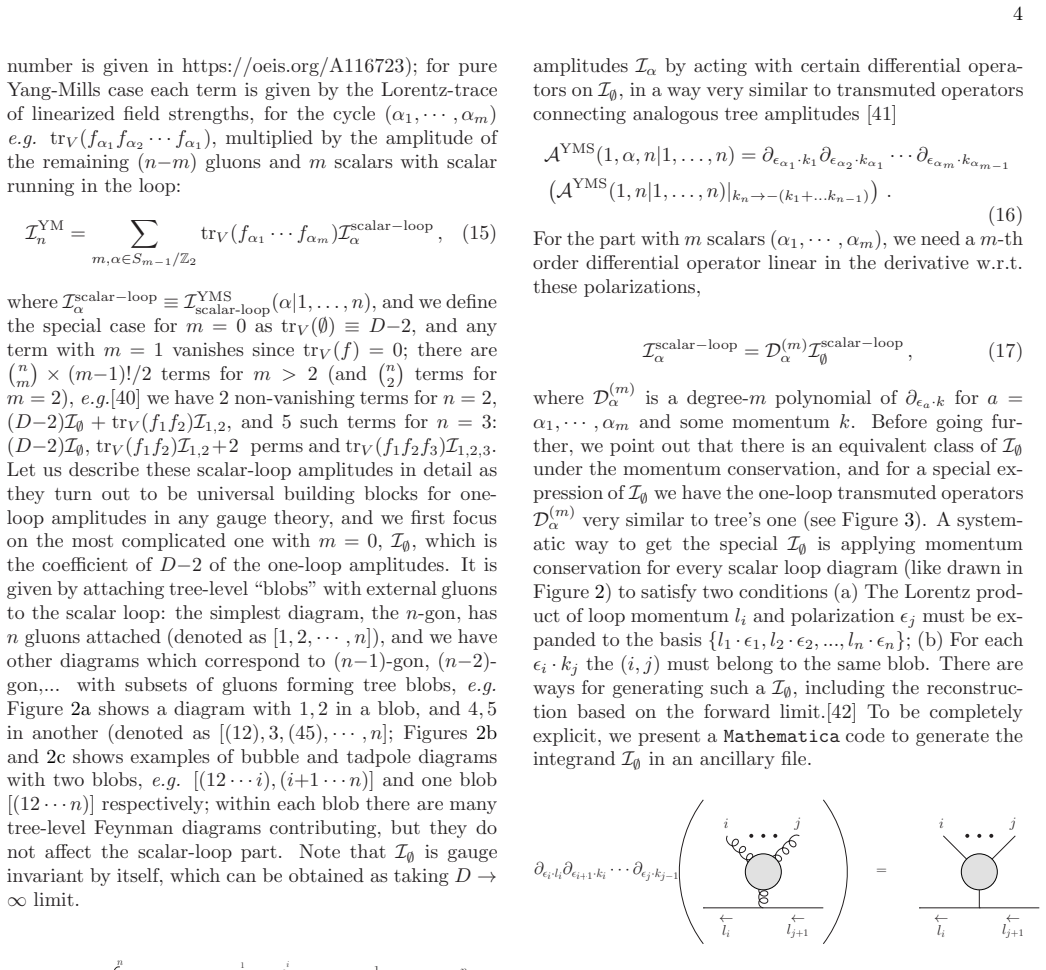
The load-bearing identity is the universal expansion itself, Eq. (15), together with its general-gauge-theory form Eq. (26). The prefactors $\operatorname{tr}_V(f_{\alpha_1}\cdots f_{\alpha_m})$ are Lorentz traces of linearized field strengths; $\operatorname{tr}_S$ is the corresponding spinor trace, and the combination $T_{\alpha_1\cdots\alpha_m}=n_v\operatorname{tr}_V-\frac{n_f}{2}\operatorname{tr}_S$ encodes the matter content. The universal objects are the scalar-loop integrands $I_\alpha^{\rm scalar\text{-}loop}$, whose $m=0$ member $I_\emptyset$ is proportional to $D$ and is generated by gluing tree-level gluon blobs to a scalar loop. The reconstruction formula (12) assembles the full integrand from its single cuts by adding each cut with earlier $\tilde Y_i$'s set to zero, which removes overlapping terms; this is the step that lifts cut-level agreement to integrand-level equality. Finally, the one-loop transmuted operators $D^{(m)}_\alpha$ in Eqs. (17)-(20) express every mixed scalar-loop amplitude as derivatives acting on $I_\emptyset$, providing closed-form generation of the building blocks.
What would settle it
Generate the $n=4$ pure Yang-Mills integrand from Eq. (15) using the ancillary code, integrate it over the loop momentum in $D=4$, and compare against the standard color-ordered one-loop four-gluon amplitude computed from Feynman diagrams; any disagreement in the finite part, or in any non-scaleless coefficient, would falsify the claimed universal expansion.
Extended reading notes
Core claim
On the paper's own terms, the discovery is that the one-loop $n$-gluon integrand in any gauge theory with gluons, fermions, or scalars in the loop can be written as $$$I_n^{{\rm YM}}$ = \sum_{m,\$\alpha$\in S_{m-1}/\mathbb{Z}_2} \operatorname{tr}_V(f_{\alpha_1}\cdots f_{\alpha_m})\, $I^{{\rm scalar\text{-}}$loop}_\$\alpha$,$$ with the general-theory version replacing the prefactor by $T_{\alpha_1\cdots\alpha_m}=n_v\operatorname{tr}_V - (n_f/2)\operatorname{tr}_S$ and with $T_\emptyset$ counting on-shell degrees of freedom. Here $f_i^{\mu\nu}=k_i^\mu\epsilon_i^\nu-k_i^\nu\epsilon_i^\mu$ is the linearized field strength, and $I^{\rm scalar\text{-}loop}_\alpha$ is a universal integrand with $n-m$ gluons and $m$ scalars attached to a scalar loop. The paper further claims the scalar-loop integrands are explicit: they are built from tree-level blobs attached to the scalar loop, and the $m>0$ pieces are obtained from the $m=0$, $D$-proportional piece $I_\emptyset$ by differential operators $D^{(m)}_\alpha$. The proof verifies that the single cuts of the expansion reproduce the forward limits of the corresponding tree amplitudes, and then invokes a reconstruction lemma to conclude that the integrands agree.
Load-bearing premise
The proof assumes that knowing the residue of the integrand when each loop propagator goes on shell fixes the entire integrand up to terms that vanish after loop integration; this reconstruction lemma is cited to an unpublished reference rather than proved in the paper.
Editorial extensions
If this is right
- Every one-loop $n$-gluon amplitude in a gauge theory with vectors, fermions, or scalars in the loop is fixed once the universal scalar-loop integrands are known; the only theory-dependent input is the trace prefactor.
- The same scalar-loop building blocks transfer between theories: pure Yang-Mills, $\mathcal{N}=1$ SYM, and general gauge theories differ only in the combination $T_{\alpha_1\cdots\alpha_m}$.
- For maximally supersymmetric theories the prefactor vanishes for $m<4$, so triangle and bubble contributions cancel and an $r$-gon has numerator power $\ell^{r-4}$, matching the expected SYM power-counting.
- Because the expansion holds in general $D$ dimensions with quadratic propagators, it gives a direct construction of integrands suitable for standard loop integration, not only for worldsheet-style linear propagators.
- The $m=0$ $D$-proportional integrand is the master building block: all mixed scalar-loop integrands follow from it by the differential operators $D^{(m)}_\alpha$, so a computation of $I_\emptyset$ suffices to generate the full expansion.
Reading between the lines
- A corollary the paper leaves implicit: if the single-cut reconstruction lemma extends to higher loops, the same scalar-loop building blocks should organize $L$-loop gluon integrands, with theory dependence again confined to trace prefactors.
- The dominance of the $D$-proportional term suggests a testable approximation: at large $D$, truncating the expansion to the $m=0$ piece should capture the leading behavior of finite-$D$ one-loop amplitudes, giving a cheap check of the formula.
- The trace-prefactor structure is naturally suited to double-copy probes: replacing $T_{\alpha_1\cdots\alpha_m}$ with gravity-like kinematic factors in the scalar-loop building blocks may generate one-loop gravity integrands, though the paper does not make this claim.
- The ancillary code can be used as a practical cross-check: generating the $n=4$ and $n=5$ integrands and comparing their loop-momentum integrals with known one-loop QCD results in $D=4$ would test the expansion independently of the reconstruction lemma.
Editorial analysis
A structured set of objections, weighed in public.
Referee Report
Summary. The paper proposes a 'universal expansion' for one-loop n-gluon integrands in general gauge theories. The central formula, Eq. (15) for pure Yang-Mills and Eq. (26) for general gauge theories, expresses the one-loop integrand as a sum over cycles of trace prefactors (trV of linearized field strengths, or T_alpha for general matter content) multiplying universal scalar-loop integrands I_alpha. The paper derives the single-cut residues of these integrands by taking forward limits of tree-level amplitudes, using the universal tree expansion of Refs. [23,24]. It then claims that the full integrand is reconstructed from these single cuts by the non-overlapping-sum formula Eq. (12), and that the mixed scalar-loop integrands I_alpha can alternatively be obtained by differential operators D_alpha^{(m)} acting on the m=0 term. Explicit counting for n=2 and n=3 is given, and an ancillary Mathematica file is advertised for generating explicit integrands.
Significance. If the central claim is correct, it provides a striking organizational principle: the entire one-loop n-gluon amplitude in any gauge theory is a linear combination of universal scalar-loop integrands, with all theory dependence isolated in gauge-invariant trace prefactors. This generalizes the authors' earlier surfaceology-based constructions and connects them to conventional quadratic-propagator integrands. The paper is explicitly falsifiable: the ancillary Mathematica code generates concrete integrands whose cuts and known low-multiplicity results can be checked. The absence of fitted parameters and the explicit n=2 and n=3 examples are strengths. However, the main proof step, from single cuts to the full integrand, currently rests on a reconstruction lemma cited to an unpublished placeholder, and the differential-operator construction is asserted rather than proved. These gaps are load-bearing for the paper's central integrand-level equality.
major comments (3)
- [Reconstruction of one-loop integrands, Eq. (12)] The uplift from single cuts to the full integrand is load-bearing for Eq. (15), yet it is justified only by the n=2 example and by a citation to the unpublished placeholder [43]. The text asserts 'All constant terms are zero/scaleless' for arbitrary n without proof, and it does not rule out integrands with vanishing single cuts but nonvanishing integrals or numerator dependence on the Yi that would invalidate the non-overlapping sum in Eq. (12). Since Eq. (15) is an equality of integrands, not merely of residues, the reconstruction lemma must either be proved in this paper or replaced by an independent verification, such as a direct comparison of the right-hand side of Eq. (15) with known integrands for several n.
- [Eqs. (17)-(20)] The differential-operator construction I_alpha^scalar-loop = D_alpha^{(m)} I_empty is asserted with only a four-point example; no proof is given that the operators in Eq. (20) satisfy the correct single-cut equations or that the equivalence relation (22) together with the cancellations (23)-(24) suffices to define D_alpha^{(m)} unambiguously for all alpha. This matters because the paper presents the operators as an alternative closed-form construction of the scalar-loop integrands. The authors should either supply a derivation or state clearly that Eqs. (17)-(20) are conjectural and verified order-by-order in the ancillary code.
- [Eqs. (26)-(28)] The general-gauge-theory formula (26) inherits the same reconstruction gap as Eq. (15), and the replacement of the vector trace by T_alpha in Eq. (27) is justified only by the tree-level forward-limit expansions of Refs. [24,33]. In particular, the claim that T_alpha vanishes for m<4 in maximally supersymmetric theories is stated without derivation; a short proof or explicit trace identity is needed to support the SYM power-counting discussion following Eq. (28).
minor comments (4)
- [References, [43]] Reference [43] is cited as 'arXiv:2xxx.xxxx' and is therefore not verifiable; a placeholder citation cannot support the load-bearing reconstruction lemma in Eq. (12).
- [Eq. (1) and surrounding text] The word 'compliment' should be 'complement', and the notation A^YMS(-, alpha, + | 1, 2, ..., i-1, -, +, i, ..., n) is confusing because the legs -, + appear both before and after the vertical bar; the ordering should be defined explicitly in the text.
- [Eq. (28)] The notation 'cyc.' in Eq. (28) is not defined; please specify the cyclic sum convention explicitly so that the t8 trace identity can be checked by the reader.
- [Figure 1 caption] The caption contains a grammatical error ('Each curve (red line) assigned a planar variables'); this should be corrected, and the definition of the regulator variables Xi,i and Xi,i+1 should be stated more clearly near Eq. (9).
Circularity Check
No circularity: the central expansion is derived from independent tree-level CHY/forward-limit inputs and verified by cut-matching; the reconstruction lemma is a cited gap, not a circular reduction.
full rationale
The universal expansion (15)/(26) is not obtained by fitting parameters or by defining the target amplitude into the input. The tree-level expansions (1) and (2) are imported from [23] and [24], which are themselves grounded in CHY/ambitwistor formulas [34-36] and are parameter-free; the author overlap in [23-25] does not make the input circular because the expansions are independently derivable from those external CHY results. The loop-level proof matches the single cuts of the proposed RHS to forward limits of these tree amplitudes (Eqs. (6), (8)) and then invokes the surface-inspired reconstruction formula (12) to lift cut equality to integrand equality. That lift is the paper's main unproved assumption: 'All constant terms are zero/scaleless' and the general-n validity of the reconstruction are asserted with reference to the unpublished placeholder [43], so the proof has a genuine gap. But a missing proof is not a circularity: Eq. (12) is not equivalent to Eq. (15) by construction, and the scalar-loop integrands I_alpha are independent objects rather than quantities fitted to reproduce I_n^YM. No fitted-input-called-prediction, self-definitional, or ansatz-smuggled-via-citation step is present.
Assumptions & free parameters
assumptions (5)
- domain assumption Tree-level universal expansions (Eq (1) for gluons, Eq (2) for fermions) are valid, including their behavior under forward limits.
- domain assumption In the forward limit, the polarization sum reduces to the eta term with prefactors D-2 or 2^{D/2-1}, and q-dependent terms do not contribute (Eqs (3)-(7)).
- ad hoc to paper A one-loop integrand is uniquely determined by its single cuts up to scaleless boundary terms (Eqs (10)-(12)).
- ad hoc to paper The one-loop transmuted operators D^m reproduce the mixed scalar-loop integrands (Eqs (17) and (20)).
- domain assumption Boundary terms independent of all Y_i are scaleless and integrate to zero (footnote [39]).
Cite this review
Pith. "Pith review of On one-loop amplitudes in gauge theories." pith.science (2026). https://pith.science/paper/QZRNTXSC
@misc{pith2026241219629,
  author       = {Pith},
  title        = {Pith review of: On one-loop amplitudes in gauge theories},
  year         = {2026},
  howpublished = {\url{https://pith.science/paper/QZRNTXSC}},
  note         = {Machine review of arXiv:2412.19629}
}
abstract
We propose a new ``universal expansion" for one-loop amplitudes with arbitrary number of gluons in $D$ dimensions, which holds for general gauge theories with gluons/fermions/scalars in the loop, including pure and supersymmetric Yang-Mills theories. It expresses the $n$-gluon amplitudes as a linear combination of universal scalar-loop amplitudes with $n{-}m$ gluons and $m$ scalars, multiplied by gauge-invariant building blocks (defined for general gauge theories); the integrands of these scalar-loop amplitudes are given in terms of tree-level objects attached to the scalar loop, or by differential operators acting on the most important part which is proportional to $D$ (with $m=0$). We present closed-formula for these one-loop integrands and prove them by showing that the single cuts are correctly reproduced by the gluing of an additional pair of gluons (fermions/scalars) in the forward limit, plus $n$ gluons in a tree amplitude.
Figures


Figures from the paper (1 more)

Forward citations
Cited by 1 Pith paper
-
On differential operators for scalar-scaffolded gluons
Differential operators on scalar-scaffolded variables extract individual phi^3 diagrams from gluon amplitudes, and the independent mixed amplitudes are counted by Catalan numbers.
Reference graph
Works this paper leans on
-
[43]
Of course the full one-loop two-point integrand is scale- less, the point is the N0 analog for higher multiplicity is always scaleless since it does not contain any Yi’s in the denominator
- [1]
-
[2]
the forward limit only differs in the prefactor, where we have: ¯χ−ξ+ F.L. − −− →2D/2−1, ¯χ−⁄f α1⁄f α2···⁄f αm ξ+ F.L. − −− →trS(⁄f α1⁄f α2···⁄f αm ). (7) where we have defined tr S(⁄f α1⁄f α2···⁄f αm ) = (fα1fα2 . . . fαm)β γ δγ β ⏐ ⏐ ⏐ even , and we only focus on the parity-even part of the contraction. The tr S can also be expanded as a linear combinatio...
-
[3]
to satisfy two conditions (a) The Lorentz prod- uct of loop momentum li and polarization ǫj must be ex- panded to the basis {l1· ǫ1, l2· ǫ2, ..., ln· ǫn}; (b) For each ǫi· kj the ( i, j) must belong to the same blob. There are ways for generating such a I∅, including the reconstruc- tion based on the forward limit.[42] To be completely explicit, we presen...
-
[4]
and the entire expression of D(m) α are defined as ∂± (b1,b2,...,bq) := ∂± b1 ∂± (b2,b1)∂± (b3,b2)··· ∂± (bq,bq− 1), (19) 5 D(2) ij = ∂+ i ∂+ j , D(m>2) α = ∑ G⊂Γ[ α] ∏ B∈G ∂+ B + ∑ G⊂Γ[ ˜α] ∏ B∈G ∂− B , (20) where ˜α denotes the reversed α and Γ[ α] is a set of scalar loop diagrams with scalar blobs, referred to as scalar skeleton diagrams. ...
-
[5]
Z. Bern, J. J. M. Carrasco, and H. Jo- hansson, Phys. Rev. D 78, 085011 (2008) , arXiv:0805.3993 [hep-ph]
arXiv 2008
-
[6]
or ( 8), crucially the prefactors on the right-hand side are never involved since they are free of Yi’s, therefore we simply uplift the expansion of the single cut into the integrand level. Note that the expansion we proposed for the integrand with quadratic propagators is valid for various gauge the- ories, differing only in the prefactor. For instance, f...
-
[7]
J. M. Henn and J. C. Plefka, Scattering Amplitudes in Gauge Theories , Vol. 883 (Springer, Berlin, 2014)
work page 2014
Show all 55 references
-
[8]
Travaglini et al
G. Travaglini et al. , J. Phys. A 55, 443001 (2022) , arXiv:2203.13011 [hep-th]
2022 arXiv
-
[9]
C. R. Mafra and O. Schlotterer, Phys. Rept. 1020, 1 (2023) , arXiv:2210.14241 [hep-th]
2023 arXiv
-
[10]
Z. Bern, J. J. M. Carrasco, and H. Jo- hansson, Phys. Rev. Lett. 105, 061602 (2010) , arXiv:1004.0476 [hep-th]
2010 arXiv
-
[11]
Z. Bern, J. J. Carrasco, M. Chiodaroli, H. Johans- son, and R. Roiban, J. Phys. A 57, 333002 (2024) , arXiv:1909.01358 [hep-th]
2024 arXiv
-
[12]
J. J. M. Carrasco and N. H. Pavao, JHEP 01, 019 (2024) , arXiv:2307.16812 [hep-th]
2024 arXiv
-
[13]
Edison, J
A. Edison, J. Mangan, and N. H. Pavao, JHEP 03, 163 (2024) , arXiv:2309.16558 [hep-th]
2024 arXiv
- [14]
-
[15]
Z. Li, G. Yang, and G. Zhu, (2024), arXiv:2410.17041 [hep-th]
2024 arXiv
-
[16]
Z. Bern, E. Herrmann, R. Roiban, M. S. Ruf, and M. Zeng, (2024), arXiv:2408.06686 [hep-th]
2024 arXiv
-
[17]
Arkani-Hamed, H
N. Arkani-Hamed, H. Frost, G. Salvatori, P.-G. Plamon- don, and H. Thomas, (2023), arXiv:2309.15913 [hep-th]
2023 arXiv
-
[18]
Arkani-Hamed, H
N. Arkani-Hamed, H. Frost, G. Salvatori, P.-G. Plamon- don, and H. Thomas, (2023), arXiv:2311.09284 [hep-th]
2023 arXiv
-
[19]
Arkani-Hamed, Q
N. Arkani-Hamed, Q. Cao, J. Dong, C. Figueiredo, and S. He, JHEP 10, 231 (2024) , arXiv:2312.16282 [hep-th]
2024 arXiv
-
[20]
Arkani-Hamed, Q
N. Arkani-Hamed, Q. Cao, J. Dong, C. Figueiredo, and S. He, (2023), arXiv:2401.00041 [hep-th]
2023 arXiv
-
[21]
Arkani-Hamed, Q
N. Arkani-Hamed, Q. Cao, J. Dong, C. Figueiredo, and S. He, (2024), arXiv:2401.05483 [hep-th]
2024 arXiv
-
[22]
Arkani-Hamed, C
N. Arkani-Hamed, C. Figueiredo, H. Frost, and G. Sal- vatori, (2024), arXiv:2402.06719 [hep-th]
2024 arXiv
-
[23]
Cachazo, S
F. Cachazo, S. He, and E. Y. Yuan, Phys. Rev. D 90, 065001 (2014) , arXiv:1306.6575 [hep-th]
2014 arXiv
-
[24]
Cachazo, S
F. Cachazo, S. He, and E. Y. Yuan, JHEP 07, 033 (2014) , arXiv:1309.0885 [hep-th]
2014 arXiv
-
[25]
Cachazo, S
F. Cachazo, S. He, and E. Y. Yuan, Phys. Rev. Lett. 113, 171601 (2014) , arXiv:1307.2199 [hep-th]
2014 arXiv
-
[26]
Cachazo, S
F. Cachazo, S. He, and E. Y. Yuan, JHEP 07, 149 (2015) , arXiv:1412.3479 [hep-th]
2015 arXiv
-
[27]
J. Dong, S. He, and L. Hou, Phys. Rev. D 105, 105007 (2022) , arXiv:2111.10525 [hep-th] . 7
2022 arXiv
-
[28]
Edison, S
A. Edison, S. He, O. Schlotterer, and F. Teng, JHEP 09, 079 (2020) , arXiv:2005.03639 [hep-th]
2020 arXiv
-
[29]
Arkani-Hamed, Q
N. Arkani-Hamed, Q. Cao, J. Dong, C. Figueiredo, and S. He, (2024), arXiv:2408.11891 [hep-th]
2024 arXiv
-
[30]
He and E
S. He and E. Y. Yuan, Phys. Rev. D 92, 105004 (2015) , arXiv:1508.06027 [hep-th]
2015 arXiv
-
[31]
Cachazo, S
F. Cachazo, S. He, and E. Y. Yuan, JHEP 08, 008 (2016) , arXiv:1512.05001 [hep-th]
2016 arXiv
-
[32]
Geyer, L
Y. Geyer, L. Mason, R. Monteiro, and P. Tourkine, JHEP 03, 114 (2016) , arXiv:1511.06315 [hep-th]
2016 arXiv
-
[33]
He and O
S. He and O. Schlotterer, Phys. Rev. Lett. 118, 161601 (2017) , arXiv:1612.00417 [hep-th]
2017 arXiv
-
[34]
S. He, O. Schlotterer, and Y. Zhang, Nucl. Phys. B 930, 328 (2018) , arXiv:1706.00640 [hep-th]
2018 arXiv
- [35]
-
[36]
Caron-Huot, JHEP 05, 080 (2011) , arXiv:1007.3224 [hep-ph]
S. Caron-Huot, JHEP 05, 080 (2011) , arXiv:1007.3224 [hep-ph]
2011 arXiv
-
[37]
Edison, S
A. Edison, S. He, H. Johansson, O. Schlotterer, F. Teng, and Y. Zhang, JHEP 02, 164 (2023) , arXiv:2211.00638 [hep-th]
2023 arXiv
-
[38]
C. S. Lam and Y.-P. Yao, Phys. Rev. D 93, 105008 (2016) , arXiv:1602.06419 [hep-th]
2016 arXiv
-
[39]
Fu, Y.-J
C.-H. Fu, Y.-J. Du, R. Huang, and B. Feng, JHEP 09, 021 (2017) , arXiv:1702.08158 [hep-th]
2017 arXiv
- [40]
-
[41]
Kosmopoulos, Phys
D. Kosmopoulos, Phys. Rev. D 105, 056025 (2022) , arXiv:2009.00141 [hep-th]
2022 arXiv
-
[42]
Our reconstruction is similar to the recursion for scalar theories [43], but we can directly apply this to gauge theories
-
[44]
Here we have omitted the superscript scalar-loop in the I scalar− loop α
-
[45]
Cheung, C.-H
C. Cheung, C.-H. Shen, and C. Wen, JHEP 02, 095 (2018) , arXiv:1705.03025 [hep-th]
2018 arXiv
-
[46]
To achieve this, we demand the tree amplitudes have solved kn like ( 16), and trans every li·ǫj to li ·ǫi manually
-
[47]
Arkani-Hamed, H
N. Arkani-Hamed, H. Frost, and G. Salvatori, (202x), arXiv:2xxx.xxxx [hep-th]
-
[48]
Edison, M
A. Edison, M. Guillen, H. Johansson, O. Schlot- terer, and F. Teng, JHEP 12, 007 (2021) , arXiv:2107.08009 [hep-th]
2021 arXiv
-
[49]
B. Feng, S. He, Y. Zhang, and Y.-Q. Zhang, JHEP 08, 240 (2022) , arXiv:2204.13659 [hep-th]
2022 arXiv
-
[50]
Rodriguez, O
C. Rodriguez, O. Schlotterer, and Y. Zhang, JHEP 05, 256 (2024) , arXiv:2309.15836 [hep-th]
2024 arXiv
-
[51]
Dong, Y.-Q
J. Dong, Y.-Q. Zhang, and Y. Zhang, Phys. Rev. D 109, L101905 (2024) , arXiv:2312.01580 [hep-th]
2024 arXiv
-
[52]
Zhang, JHEP 05, 255 (2024) , arXiv:2403.18078 [hep-th]
Y. Zhang, JHEP 05, 255 (2024) , arXiv:2403.18078 [hep-th]
2024 arXiv
-
[53]
F. M. Balli, A. Edison, and O. Schlotterer, (2024), arXiv:2410.19641 [hep-th]
2024 arXiv
- [54]
- [55]
Reviewed August 11, 2026 · model on record in the stance chip above.
Discussion (0). Continue with ORCID to comment.