REVIEW 5 minor 48 references
For a single ideal absorber hidden among d paths, any one-shot interaction-free localization strategy has success probability at most (d−1)²/d³, and a balanced multipath circuit attains it exactly.
Reviewed by Pith at T0; open to challenge. T0 means a machine referee read the full paper against a public rubric. the ladder, T0–T4 →
T0 review · deepseek-v4-flash
2026-08-01 00:15 UTC pith:QZY5FODV
load-bearing objection Exact one-shot bound and the two-use adaptive hierarchy for interaction-free localization are real, carefully proven results; the main caveats are the ideal absorber model and the unreleased SDP code.
Optimal Interaction Free Localization with Multipath Interferometers
The pith
A machine-rendered reading of the paper's core claim, the machinery that carries it, and where it could break.
Core claim
The balanced multiport interferometer converts the no-absorption branch into a (d−1)-dimensional dark subspace that hosts a regular-simplex ensemble of states, one for each possible absorber location. Because a two-path dark event is binary, this location-carrying structure is genuinely new for d≥3. The paper proves the one-shot optimum (d−1)²/d³ is universal: the interaction-free constraint—no location report when the interferometer is empty—forces every conclusive measurement to be blind to the empty state, so only the absorber-induced component orthogonal to it carries information; ancillas cannot enlarge that geometry. The final balanced multiport implements the square-root measurement,
What carries the argument
The dark subspace of a balanced d-path interferometer built from dephased complex Hadamard multiports. The first multiport prepares a balanced superposition, the inverse multiport creates a bright port for the empty interferometer, and when an absorber removes one amplitude the surviving branch occupies a (d−1)-dimensional dark subspace. Conditioning on no absorption yields a regular-simplex ensemble of states with pairwise overlap 1/(d−1), and the final multiport realizes the optimal square-root measurement. For multi-pass strategies, the paper uses the causal tester formalism (quantum comb) to optimize over all finite-round adaptive strategies with memory, feedforward, and final measuremen
Load-bearing premise
The optimality theorems treat the absorber as a perfect projector that only removes the occupied path amplitude, leaving the surviving field otherwise unchanged; real absorbers may phase-shift, scatter, or distort the surviving modes, altering the exact constants.
What would settle it
Implement a d=3 balanced multiport one-shot localization with a single-photon source and an ideal blocking absorber; if the measured correct-location probability repeatedly exceeds 4/27—or if any ancilla-assisted single-pass strategy beats (d−1)²/d³—the theorem fails.
If this is right
- For d≥3, a single photon can localize an absorber with probability (d−1)²/d³ in one pass, exceeding the two-path sequential value and improving with d toward 1/2.
- Ancillas, general POVMs, and arbitrary probe states cannot beat the balanced multiport in the one-shot setting.
- Multiple absorbers are encoded collectively: one dark-branch photon can distinguish subsets, and in symmetric cases like d=4, k=2 it perfectly resolves any two path-sharing subsets.
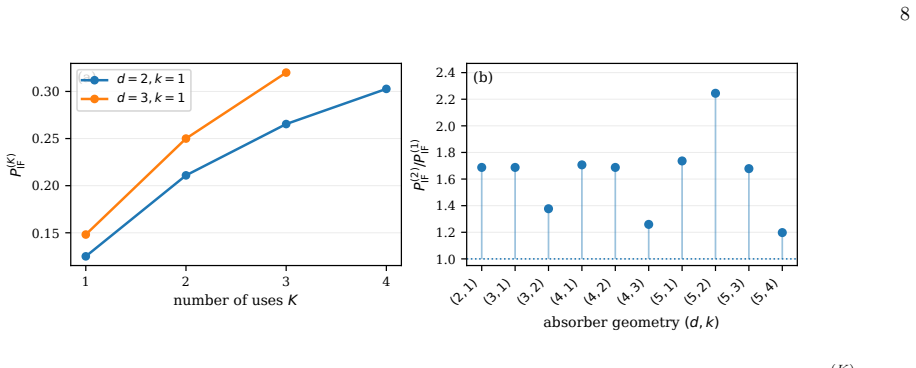
- Two-use adaptive strategies strictly surpass the one-shot ceiling, with exact values 27/128 (unassisted) and 25/72 (reference-assisted), showing the sequential EV scan (1/4) is not the optimal use of a promised empty rail.
- Under propagation loss, coherent multipath localization outperforms sequential Zeno scanning below a crossover transmissivity, because loss is paid once per pass rather than compounded with scan depth.
Where Pith is reading between the lines
- The one-shot bound implies that the interaction-free branch's information capacity is set entirely by the dark subspace dimension; similar bounds may govern other quantum reading tasks with lossless 'no-interaction' constraints.
- The exact hierarchy 1/8 < 27/128 < 1/4 < 25/72 suggests a resource-theoretic view where a promised empty rail is a distinct strategy resource, separate from absorber hypotheses and from temporal coherence.
- A direct experimental test of the two-use coherent strategy (path weights 1/2, 1/4, 1/4) should yield 25/72, exceeding both the one-shot value and the sequential scan; this is measurable with current integrated photonic devices.
- The loss crossover near t≈0.975 provides a practical design rule: for fragile, absorption-sensitive samples or lossy channels, coherent multipath interrogation is preferable to Zeno-type sequential scans.
Editorial analysis
A structured set of objections, weighed in public.
Referee Report
Summary. The paper proposes and analyzes multipath interaction-free localization (IFL). For one ideal absorber hidden uniformly among d paths, it proves (Theorem 1, Eq. (12)) that the optimal one-shot success probability is exactly (d−1)^2/d^3, and that the balanced three-multiport interferometer attains it. The proof reduces the interaction-free constraint to a pure-state discrimination problem on the orthogonal complement of the empty-interferometer state, shows that ancillas do not change the informative Gram matrix, and supplies a dual certificate for the resulting path-weight optimization. The paper then extends the architecture to k absorbers, deriving the collective dark-port state geometry and the optimal symmetric readout. It further formulates multi-pass IFL in the quantum-comb tester formalism, proves an exact two-use hierarchy for two candidate paths (unassisted 27/128, finite EV scan 1/4, reference-assisted 25/72), and gives explicit attaining circuits. Finally, it analyzes loss robustness, calibrated non-ideal absorbers, and practical feasibility.
Significance. If the results hold, the paper establishes a fundamental one-shot limit for interaction-free localization and shows that the dark port of a multipath interferometer is not merely a presence witness but a location-resolving quantum register. The proof of Theorem 1 is clean, self-contained, and parameter-free: the Gram-matrix argument, the ancilla-elimination step, and the dual certificate are all explicit and checkable. The exact two-use results in Appendix E are accompanied by explicit isometries, Gram matrices, and final POVMs, which is a notable strength. The quantum-comb formulation gives a unified causal framework in which sequential scanning, bright-port recycling, Zeno interrogation, and coherent multipath strategies become feasible testers of one process model, and the loss analysis provides a concrete operational comparison. The main limitation is that the exact optimality theorems are for the ideal projective absorber model; the paper addresses this honestly through calibrated processes in Sec. VI and App. C, but the headline numbers (d−1)^2/d^3, 27/128, and 25/72 are for that ideal model.
minor comments (5)
- [Appendix E, Eq. (E63)] The support identity behind Theorem 3 is central to the 25/72 upper bound, but it is introduced as the result of 'matching coefficients' without a derivation. The manuscript would be substantially easier to verify if this calculation were expanded, or if the accompanying matrices and identities were provided in an ancillary file.
- [Secs. III and V, Eq. (11)] Theorem 1 states that 'arbitrary finite-dimensional ancillas' do not improve the one-shot optimum. This is correct only if the ancilla is a tensor factor on which N_a acts trivially and cannot serve as a promised-empty spatial rail. The distinction is made in App. E, but it should appear in the main text next to Theorem 1, because otherwise the reference-assisted one-use values in Table IV (e.g. R_{2,1}=27/128 > 1/8) appear to contradict the theorem.
- [Sec. V, Tables II–V] The numerical SDP results for d=3,4,5 are reported to several digits but no code, input files, or dual certificates are provided, and solver precision is not stated. Please provide the optimization code/SDP files or clearly state their availability, so the numerical claims in Figs. 3–5 can be reproduced.
- [Sec. VI, Eq. (33)] The Zeno scan formula is stated compactly. It would help to state explicitly that loss in any recursion, including in empty tests, is a terminal failure, and that the sum over q accounts for the uniform absorber position. This is implied by the derivation in App. F but should be said in the main text.
- [General] Minor presentation issues: 'FilatovandAuzinsh' is missing a space in Sec. I; Eq. (34) uses ρ_in while the rest of the paper uses ρ_SA; and the notation P_max^guess|s in Eq. (6) is awkward and would benefit from a definition in the main text.
Circularity Check
No significant circularity: the central optimality claims are derived from the stated interaction-free constraints and explicit Gram-matrix/dual-certificate proofs, not from fitted inputs or self-citations.
full rationale
The paper's main theorem (Theorem 1, Eq. (12)) is a genuine derivation from the task definition, not a restatement of an input. The proof begins with the one-shot success expression (Eq. (10)) and the empty-interferometer constraint (Eq. (11)), then reduces the problem to minimum-error discrimination of subnormalized states (App. A1). The ancilla-elimination step is proved by showing that the Gram matrix of the informative vectors depends only on the path weights p_i (Eqs. (A10)-(A15)); this is an equality argument, not an assumption. The upper bound Ploc(p) ≤ (d-1)/d^2 (1 - Σ p_i^2) is obtained via a feasible dual certificate Y = ((d-1)/d)W (Eqs. (A24)-(A27)), and the uniform distribution maximizes the bound. The balanced multiport construction then attains equality by explicit calculation, with the dark-port states forming the regular simplex and the final multiport implementing the square-root measurement (Eqs. (2)-(8), (B11)-(B15)). Nothing is fitted to the result: the uniform prior and the empty-device condition are task definitions, not parameters tuned to the answer. The multi-use results (Proposition 1, Theorem 3) are similarly derived from explicit Gram-matrix/Helstrom reductions (App. E), with exact values 27/128 and 25/72 obtained by optimization, not by construction of the answer. Citations to the quantum-comb realization theorem [22,23] are external, parameter-free results and are not self-citations; citations to multiport hardware ([24]-[26],[28]) are implementation-oriented and do not carry the optimality proof. No load-bearing step reduces to a self-citation, a renamed known result, or an ansatz smuggled in by citation. The only scope limitation is the ideal projective absorber model used in the exact theorems, which the paper explicitly states and later addresses through calibrated processes; this is an assumption about the physical model, not circularity.
Axiom & Free-Parameter Ledger
axioms (6)
- domain assumption Ideal absorber acts as a projective removal: surviving branch is N_a ρ N_a with N_a = I−|a⟩⟨a|; no phase, scattering, or mode distortion.
- domain assumption Uniform prior over absorber locations (or k-subsets), and the absorber configuration is fixed across uses.
- domain assumption Hard interaction-free constraint: the empty interferometer must never yield a conclusive location report, Tr(T_j Σ_∅)=0.
- standard math Quantum comb realization theorem: every causal tester is physically realizable and vice versa.
- standard math Minimum-error discrimination of pure-state ensembles depends only on the Gram matrix.
- standard math Dephased complex Hadamard unitaries with |u_jk|=1 exist for every d, e.g. the Fourier matrix.
read the original abstract
Interaction-free measurement (IFM) certifies the presence of an absorbing object without a photon ever being absorbed by it. When several candidate locations are available, existing protocols can also identify which one holds the absorber, but they do so by testing paths sequentially through two-path interferometers, resolving a binary presence question at each step. We propose a different approach: probing all candidate locations at once, with the photon prepared in a coherent superposition across every path before a single measurement resolves the outcome. We prove that a three-stage protocol built on a $d$-path interferometer attains the exact one-shot optimum for this task, and we extend it to $k$ absorbers among $d$ paths, where the no-absorption branch encodes the entire absorber subset coherently rather than revealing individual locations one by one. The dark port therefore ceases to be a mere witness of presence and becomes a location-resolving signal. We then move beyond single-pass strategies using the quantum-comb formalism, casting the problem as an exact optimization over all multi-pass strategies and showing that adaptive protocols surpass the one-shot ceiling. Enriching the interferometer geometry with one additional path guaranteed to be empty, we show that sequential scanning, bright-port recycling, and Zeno-type interrogation all become particular feasible strategies within this same optimization, rather than separate benchmarks to compare against. This unified formulation identifies the optimal interaction-free localization strategy for any given set of resources, opening a route toward loss-resilient quantum imaging protocols for the study of fragile, absorption-sensitive samples.
Figures




Reference graph
Works this paper leans on
-
[1]
This entails no loss of generality
From interaction-free localization to state discrimination Let the probe and ancilla be prepared in a pure state |Ψ⟩SA. This entails no loss of generality. The feasible set is convex in the input state, the objective is linear, and any mixed state can be purified by enlarging the ancilla. The empty-device condition in the main text is ⟨Ψ|M a |Ψ⟩= 0∀a.(A1)...
-
[2]
Eliminating the ancilla Write the pure probe-ancilla state as |Ψ⟩= d−1X i=0 |i⟩ |ηi⟩, p i =⟨η i|ηi⟩, X i pi = 1.(A7) The numberp i is the weight placed on pathi. Since (Na ⊗I A)|Ψ⟩=|Ψ⟩ − |a⟩ |ηa⟩,(A8) projection withQgives |wa⟩=p a |Ψ⟩ − |a⟩ |ηa⟩.(A9) The Gram matrix of the informative vectors is therefore ⟨wa|wa⟩=p a(1−p a),(A10) ⟨wa|wb⟩=−p apb, a̸=b.(A1...
-
[3]
Dual certificate for fixed path weights Fix the probability vectorp= (p 0, . . . , pd−1). LetA be the linear map whosea-th column is|ua⟩, and define W= 1 d AA† = 1 d d−1X a=0 |ua⟩ ⟨ua|.(A16) The primal minimum-error discrimination problem is max {Ma} X a Tr(Maτa), X a Ma ≤I, M a ⪰0. (A17) 14 The dual problem is min Y TrY, Y⪰τ a ∀a.(A18) Thus any positive ...
-
[4]
Therefore 1− X a p2 a ≤1− 1 d = d−1 d ,(A28) with equality if and only ifpa = 1/dfor alla
Optimization over path weights and saturation The termP a p2 a is minimized by the uniform distribu- tion. Therefore 1− X a p2 a ≤1− 1 d = d−1 d ,(A28) with equality if and only ifpa = 1/dfor alla. Combining Eqs. (A27) and (A28) gives Ploc ≤ (d−1) 2 d3 .(A29) It remains to check that the bound is attainable. For the uniform probe, |ua⟩= 1 d |ψbal⟩ −1√ d |...
-
[5]
These spaces may include path, po- larization, frequency, temporal mode, spatial mode, and accessible auxiliary output modes
One use of a general absorber LetAbe the Hilbert space entering the object region andBthe Hilbert space returning from it on the non- absorbing branch. These spaces may include path, po- larization, frequency, temporal mode, spatial mode, and accessible auxiliary output modes. For absorber configu- rationj, the non-absorption subchannel is a completely po...
-
[6]
Choi representation Choose an orthonormal basis{|α⟩}forA, and define the unnormalized maximally entangled vector |Φ⟩AA′ = X α |α⟩A |α⟩A′ .(C5) For a mapM:A→B, define J(M) = (M ⊗idA′)(|Φ⟩ ⟨Φ|).(C6) After identifyingA ′ ≃A, the Choi operator acts onB⊗ A. Expanding the definition gives J(M) = X α,β M(|α⟩ ⟨β|)⊗ |α⟩ ⟨β|.(C7) The map is recovered by contracting...
-
[7]
TheK-use object process ForKuses, introduce ordered slotsA r →B r,r= 1, . . . , K. If the same calibrated operation is inserted independently at each use, then Σexp j = (σexp j )⊗K .(C13) This tensor product is a statement about the object. It does not impose a memoryless strategy. If the object or detector has memory across uses,Σexp j is instead the mea...
-
[8]
, K−1,(C14) and ends with a measurement onBKRK−1
Adaptive strategies and tester elements A general adaptive strategy begins with a state on R0A1, applies channels Λr :B rRr−1 →R rAr+1, r= 1, . . . , K−1,(C14) and ends with a measurement onBKRK−1. Intermedi- ate measurements and feedforward are included because a measurement followed by a classically controlled opera- tion is a channel that writes the ou...
-
[9]
Ideal and calibrated interaction-free constraints LetΣ ∅ be the empty-device process. In the ideal IFM problem, no conclusive location report is allowed in the empty device: NX i=1 Tr(TiΣ∅) = 0.(C21) All terms are nonnegative, so this is equivalent to Tr(TiΣ∅) = 0for eachi. IfΣ ∅ =|v ∅⟩ ⟨v∅|, then for Ti ⪰0, Tr(TiΣ∅) = 0⇐ ⇒T i |v∅⟩= 0.(C22) This is the nu...
-
[10]
, N),Ω− NX j=1 Tj ⪰0, Ω =I BK ⊗Q K, TrAr Qr =I Br−1 ⊗Q r−1, r= 2,
Calibrated adaptive benchmark and exactness For a tolerated empty-device conclusive backgroundϵ, the calibrated adaptive value is 18 P (K) ϵ = max {Tj },Ω,{Qr} 1 N NX j=1 Tr(TjΣexp j )(C24) subject toT j ⪰0 (j= 1, . . . , N),Ω− NX j=1 Tj ⪰0, Ω =I BK ⊗Q K, TrAr Qr =I Br−1 ⊗Q r−1, r= 2, . . . , K, TrA1 Q1 = 1, Q r ⪰0, NX j=1 Tr(TjΣexp ∅ )≤ϵ. Every physical ...
-
[11]
Appendix D: Adaptive benchmark data and verification This appendix lists the numerical values behind the adaptive figures
Reduction to the one-shot constraint AtK= 1, an inputρand final conclusive effectM i define Ti =M i ⊗ρ T .(C25) For the ideal processSj(ρ) = ¯Pjρ ¯Pj, Tr(Tiσj) = Tr[MiSj(ρ)].(C26) For the empty processS∅(ρ) =ρ, Tr(Tiσ∅) = Tr(Miρ).(C27) The ideal no-false-report condition is therefore exactly the one-shot empty-interferometer constraint. Appendix D: Adapti...
-
[12]
The three-path one-absorber value increases from4/27to 0.250000at two uses and0.319997at three uses
Unassisted benchmarks The ideal table (Table II) shows that the two-path one-absorber value increases from1/8at one use to 0.210938at two uses and0.302714at four uses. The three-path one-absorber value increases from4/27to 0.250000at two uses and0.319997at three uses. At (d, k, K) = (5,2,2), the gain over the corresponding one- use benchmark is2.244701. T...
-
[13]
For one absorber hidden uniformly amongdcandidate paths, letU d,K (t)denote the optimum over unassisted K-use strategies (acting only on thedcandidate paths)
Reference-assisted benchmarks We now quantify the effect of a promised empty refer- ence rail across all computed single-absorber instances. For one absorber hidden uniformly amongdcandidate paths, letU d,K (t)denote the optimum over unassisted K-use strategies (acting only on thedcandidate paths). LetS d,K (t)denote the finite balanced Elitzur–Vaidman (E...
-
[14]
By recording every intermediate outcome coherently in the memory, the strategy may be purified without chang- ing its success probability
Common reduction to binary discrimination A general two-use strategy may contain arbitrary memory, intermediate measurements, and feedforward. By recording every intermediate outcome coherently in the memory, the strategy may be purified without chang- ing its success probability. We may therefore describe its finalsurvivingbranchesbypure, generallysubnor...
-
[15]
Arbitrary ancillary systems and coherent memory are allowed, but no additional path is promised to remain empty
Exact unassisted two-use optimum We first restrict the optical path space to the two can- didate paths. Arbitrary ancillary systems and coherent memory are allowed, but no additional path is promised to remain empty. For convenience, hypothesisjlabels the candidate path that survives; the absorber occupies the other path. This is only a relabelling of the...
-
[16]
At the first encounter, a balanced EV interferometer tests candidate path0againstr
Finite balanced two-path EV scan The finite scan uses one additional railrthat is promised empty. At the first encounter, a balanced EV interferometer tests candidate path0againstr. If can- didate path0is empty, the photon exits the bright port 23 with certainty and is routed to the second encounter, which tests candidate path1against the same rail. If th...
-
[17]
The optical path basis is{|r⟩,|0⟩,|1⟩}, while the absorber hypothe- ses remain only candidate paths0and1
Exact reference-assisted two-use optimum We now optimize over all two-use causal strategies sup- plied with the same promised empty rail. The optical path basis is{|r⟩,|0⟩,|1⟩}, while the absorber hypothe- ses remain only candidate paths0and1. A general pure input, including arbitrary memory, is |Ψ⟩=|r⟩ |ηr⟩+|0⟩ |η0⟩+|1⟩ |η1⟩,(E38) where pq =⟨η q |η q⟩, p...
-
[18]
Exact hierarchy and resource interpretation The one-shot theorem givesP(1) IF (2,1) = 1/8. Combin- ing this value with the two exact optima and the finite balanced scan gives 1 8 < 27 128 < 1 4 < 25 72 .(E93) The first inequality is the gain from a second encounter with the absorber region. The second reflects the addi- tion of a promised empty rail, whic...
-
[19]
A. C. Elitzur and L. Vaidman, Foundations of Physics 23, 987 (1993)
1993
-
[20]
Kwiat, H
P. Kwiat, H. Weinfurter, T. Herzog, A. Zeilinger, and M.A.Kasevich,PhysicalReviewLetters74,4763(1995)
1995
-
[21]
A. G. White, J. R. Mitchell, O. Nairz, and P. G. Kwiat, Phys. Rev. A58, 605 (1998)
1998
-
[22]
A. M. Pălici, T.-A. Isdrailă, S. Ataman, and R. Ionicioiu, Phys. Rev. A105, 013529 (2022). 28
2022
-
[23]
Cohen, S
R. Cohen, S. Shwartz, and E. Cohen, Optica Quantum 3, 7 (2025)
2025
-
[24]
Y. Yang, H. Liang, X. Xu, L. Zhang, S. Zhu, and X.-s. Ma, npj Quantum Information9, 2 (2023)
2023
-
[25]
P. G. Kwiat, A. G. White, J. R. Mitchell, O. Nairz, G. Weihs, H. Weinfurter, and A. Zeilinger, Phys. Rev. Lett.83, 4725 (1999)
1999
-
[26]
X.-s. Ma, X. Guo, C. Schuck, K. Y. Fong, L. Jiang, and H. X. Tang, Phys. Rev. A90, 042109 (2014)
2014
-
[27]
Peise, B
J. Peise, B. Lücke, L. Pezzé, F. Deuretzbacher, W. Ert- mer, L.Santos, A.Smerzi, J.Arlt,andC.Klempt,Nature Communications6, 6811 (2015)
2015
-
[28]
Mitchison and R
G. Mitchison and R. Jozsa, Proceedings of the Royal Society A: Mathematical, Physical and Engineering Sci- ences457, 1175 (2001)
2001
-
[29]
Hosten, M
O. Hosten, M. T. Rakher, J. T. Barreiro, N. A. Peters, and P. G. Kwiat, Nature439, 949 (2006)
2006
-
[30]
Salih, Z.-H
H. Salih, Z.-H. Li, M. Al-Amri, and M. S. Zubairy, Phys- ical Review Letters110, 170502 (2013)
2013
-
[31]
I. A. Calafell, T. Strömberg, D. Arvidsson-Shukur, L. Rozema, V. Saggio, C. Graganti, N. Harris, M. Prabhu, J. Carolan, M. Hochberg, T. Baehr-Jones, D. Englund, C. Barnes, and P. Walther, inConference on Lasers and Electro-Optics(Optica Publishing Group,
-
[32]
W.-W. Pan, X. Liu, X.-Y. Xu, Q.-Q. Wang, Z.-D. Cheng, J. Wang, Z.-D. Liu, G. Chen, Z.-Q. Zhou, C.-F. Li, G.-C. Guo, J. Dressel, and L. Vaidman, npj Quantum Informa- tion9, 87 (2023)
2023
-
[33]
Budroni, A
C. Budroni, A. Cabello, O. Gühne, M. Kleinmann, and J.-A. Larsson, Rev. Mod. Phys.94, 045007 (2022)
2022
-
[34]
Wagner, A
R. Wagner, A. Camillini, and E. F. Galvão, Quantum8, 1240 (2024)
2024
-
[35]
T. Giordani, R. Wagner, C. Esposito, A. Camillini, F. Hoch, G. Carvacho, C. Pentangelo, F. Cec- carelli, S. Piacentini, A. Crespi, N. Spag- nolo, R. Osellame, E. F. Galvão, and F. Scia- rrino, Science Advances9, eadj4249 (2023), https://www.science.org/doi/pdf/10.1126/sciadv.adj4249
-
[36]
Nakamura, D
K. Nakamura, D. Sugio, T. Manabe, A. Kageyama, T. Matsumoto, and M. Tomita, Scientific Reports13, 8097 (2023)
2023
-
[37]
Filatov and M
S. Filatov and M. Auzinsh, Applied Physics B130, 121 (2024)
2024
-
[38]
S. Franco, A. Camillini, and E. F. Galvão, arXiv preprint (2026), arXiv:2604.04691 [quant-ph]
Pith/arXiv arXiv 2026
-
[39]
J. A. Bergou, Journal of Modern Optics57, 160 (2010), https://doi.org/10.1080/09500340903477756
-
[40]
Chiribella, G
G. Chiribella, G. M. D’Ariano, and P. Perinotti, Phys. Rev. Lett.101, 060401 (2008)
2008
-
[41]
Chiribella, G
G. Chiribella, G. M. D’Ariano, and P. Perinotti, Phys. Rev. A80, 022339 (2009)
2009
-
[42]
Cariñe, G
J. Cariñe, G. Cañas, P. Skrzypczyk, I. Šupić, N. Guer- rero, T. Garcia, L. Pereira, M. A. S. Prosser, G. B. Xavier, A. Delgado, S. P. Walborn, D. Cavalcanti, and G. Lima, Optica7, 542 (2020)
2020
-
[43]
Martínez, E
D. Martínez, E. S. Gómez, J. Cariñe, L. Pereira, A. Del- gado, S. P. Walborn, A. Tavakoli, and G. Lima, Nature Physics19, 190 (2023)
2023
-
[44]
Martínez, L
D. Martínez, L. Pereira, K. Sawada, P. González, J. Car- iñe, M. Muñoz, A. Delgado, E. S. Gómez, S. P. Walborn, and G. Lima, Phys. Rev. Res.7, 033119 (2025)
2025
-
[45]
P. A. A. Yasir and P. van Loock, Compactifying linear optical unitaries using multiport beamsplitters (2025), arXiv:2505.11371 [quant-ph]
arXiv 2025
-
[46]
M. Malik, M. Kues, T. Ikuta, H. Takesue, D. Bajoni, D. J. Moss, R. Morandotti, A. Forbes, S. Walborn, E. Karimi, Y. Ding, S. Paesani, C. Vigliar, B. Brecht, C. Silberhorn, F. Bouchard, M. Karpiński, B. Sussman, J. M. Lukens, Y. Bromberg, R. Fickler, T. Giordani, F. Sciarrino, Y. Zheng, J. Wang, M. Huber, A. Tavakoli, R. Uola, N. Brunner, N. Friis, N. Herr...
Pith/arXiv arXiv 2026
-
[47]
G. L. Zanin, M. J. Jacquet, M. Spagnolo, P. Schiansky, I. A. Calafell, L. A. Rozema, and P. Walther, Opt. Ex- press29, 3425 (2021)
2021
-
[48]
D. Duggan, S. Filgis, A. B. Bregnsbo, J. Saalmüller, J. S. Neergaard-Nielsen, T. Wintermantel, and U. L. Ander- sen, FPGA based feedforward system for photonic quan- tum computing applications (2026), arXiv:2606.03500 [quant-ph]
Pith/arXiv arXiv 2026
discussion (0)
Sign in with ORCID, Apple, or X to comment. Anyone can read and Pith papers without signing in.