REVIEW 4 major objections 5 minor 16 references
Single-taste staggered fermions work on dynamical lattices: counterterms stay small and a pion can be measured.
Reviewed by Pith at T0; open to challenge. T0 means a machine referee read the full paper against a public rubric. the ladder, T0–T4 →
T0 review · grok-4.5
2026-07-12 03:59 UTC pith:R2AAGTBF
load-bearing objection First dynamical Nf=2 runs with the single-taste staggered operator; counterterms look small but the claim is still under-supported by ~10 configs and a 1.7 GeV pion. the 4 major comments →
Staggered fermions with taste splitting mass term on dynamical configurations
The pith
A machine-rendered reading of the paper's core claim, the machinery that carries it, and where it could break.
Core claim
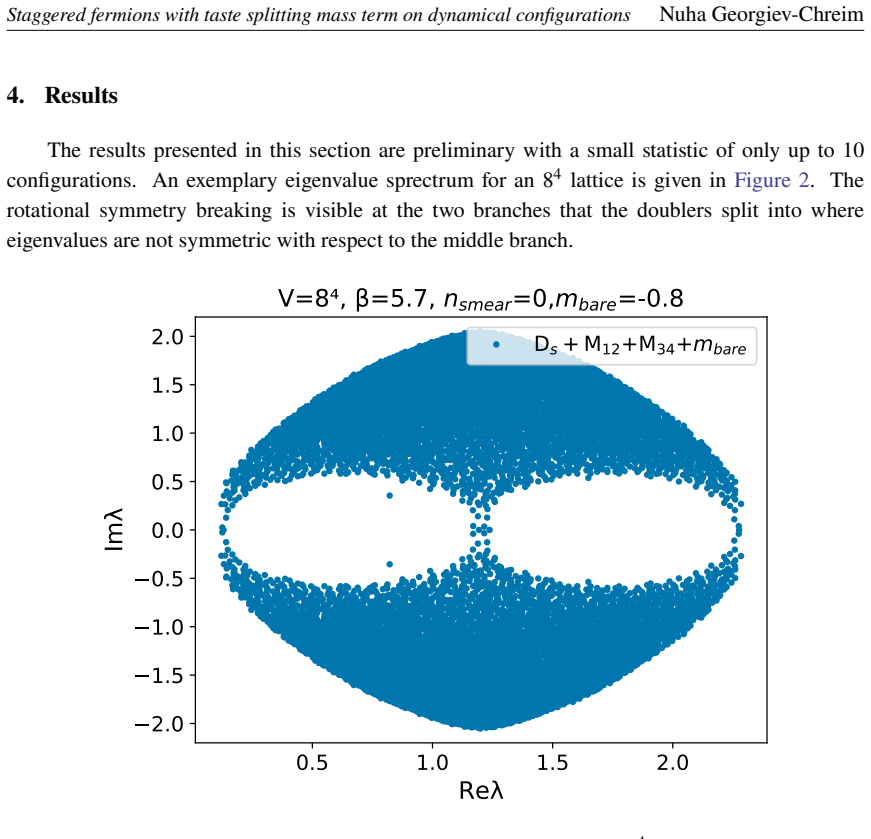
On dynamical Nf=2 configurations generated with the single-taste operator DH = Dst + M12 + M34, the gluonic counterterms that arise from rotational-symmetry breaking stay numerically negligible, the eigenvalue spectrum exhibits the expected taste splitting, and a pion propagator can be measured, albeit with a still-too-heavy mass of roughly 1740 MeV.
What carries the argument
The single-taste mass operator MH = M12 + M34 (built from the two-hop staggered tensor operators), which splits the four staggered tastes while leaving a residual discrete symmetry subgroup that still allows controlled dynamical simulation.
Load-bearing premise
That a handful of configurations on lattices no larger than 16^4 is already enough to declare the dangerous counterterms insignificant and the formulation viable.
What would settle it
Repeat the plaquette-difference measurement of the counterterms on a statistically larger ensemble or at a finer lattice spacing; a clear non-zero signal for Delta_12+34 that grows under renormalization would overturn the claim that the counterterms remain negligible.
If this is right
- Dynamical simulations with single-taste staggered fermions become practical without large gluonic counterterm corrections.
- Taste-split staggered actions can be explored as an alternative to Wilson or overlap fermions for Nf=2 QCD.
- Scale setting and spectroscopy can proceed once the bare mass is retuned to bring the pion mass down to the physical region.
- The residual discrete symmetries that survive the taste-split mass term remain sufficient for controlled continuum extrapolations.
Where Pith is reading between the lines
- If the counterterms continue to vanish at larger volumes and finer spacings, the formulation could offer a cheaper route to single-flavor dynamical QCD than domain-wall or overlap fermions.
- The heavy pion mass reported here is likely an artifact of the chosen bare mass; a modest retuning campaign should bring it into the few-hundred-MeV range and enable meaningful chiral-extrapolation studies.
- The same operator construction may be combinable with stout smearing or other improvement techniques already standard in staggered codes, lowering the barrier to adoption.
Editorial analysis
A structured set of objections, weighed in public.
Referee Report
Summary. The manuscript reports first dynamical Nf=2 simulations of staggered fermions with a single-taste mass term DH = Dst + M12 + M34 (stout-smeared, β=5.7, volumes up to 16^4). It measures the eigenvalue spectrum of the Dirac operator, the gluonic counterterm Δ12+34 that arises from the broken rotational symmetry of MH, and the pseudoscalar correlator. With statistics of at most ten configurations the authors find the expected taste splitting in the spectrum, a numerically small plaquette difference Δ, and a pion mass of roughly 1740 MeV after Wilson-flow scale setting. They conclude that the formulation is viable for dynamical simulations and that the counterterms remain insignificant, as previously observed in pure gauge.
Significance. If the counterterms truly stay negligible once the pion is lightened and statistics are increased, the single-taste staggered operator would become a practical alternative for dynamical simulations that retain a remnant of chiral symmetry while removing taste degeneracy. The work is a natural and useful extension of the authors’ pure-gauge study and of the existing theoretical classification of taste-splitting mass terms. The numerical checks (spectrum, Δ, correlator) use standard lattice methods and the paper is appropriately cautious that the present pion mass is still far too heavy. The result is therefore of genuine interest to the staggered-fermion community, but only once the numerical evidence is strengthened.
major comments (4)
- [Section 4, Figure 3] Section 4 and Figure 3: the central claim that the gluonic counterterms are “negligible” / “insignificant” rests on Δ12+34 measured with “only up to 10 configurations” on a single volume and a single β. No statistical errors are quoted on Δ, no continuum or volume study is presented, and the pure-gauge precedent does not automatically guarantee the same suppression once sea quarks are dynamical. With so few samples the statement that the counterterms remain insignificant is not yet established; either substantially larger statistics with error bars or a clear quantitative bound (e.g., |Δ| < X relative to the plaquette) is required before the viability claim can be made.
- [Section 3, Figures 1–5] Section 3 versus Figures 1–5: the bare mass is given as mbare = −0.98 in the text but as mbare = −0.8 in every figure caption and in the scale-setting plot. This inconsistency must be resolved; it affects both the reported lattice spacing and the extracted pion mass of 1740(59) MeV.
- [Section 4, Conclusion] Section 4 and Conclusion: the measured pion mass is ~1740 MeV. The authors correctly note that further tuning is needed, yet the claim that the formulation is already viable for dynamical simulations is drawn from this heavy-mass regime. Rotational-symmetry-breaking effects (and the size of the counterterms) may grow once the pion is lightened. At minimum the paper should discuss this caveat quantitatively or present at least one lighter-mass ensemble.
- [Eq. (14), Table 1] Equation (14) and Table 1: only one value of β and essentially one volume are used for the dynamical measurements that support the main conclusions. Without at least a second lattice spacing or a finite-volume check, it is impossible to judge whether the observed smallness of Δ is an artifact of the present lattice parameters.
minor comments (5)
- [Abstract, Section 4] Abstract and Introduction: “Preliminary numerical results are given for lattice sizes up to 16^4” is accurate, but the body should state the number of configurations used for each observable more prominently (currently only mentioned once in Section 4).
- [Eqs. (13), (15)] Equation (13) versus Equation (15): the general definition of Δ uses U hoσ twice in the second parenthesis; the concrete measurement (15) corrects this. Align the two expressions.
- [Figure 2, Eq. (16)] Figure 2 caption: the operator is written “Ds + (2 + M12 + M34) + mbare” while the text uses DH = Dst + M12 + M34; the additive constant 2 should be explained or made consistent with the definition of DsW in Eq. (16).
- [Throughout] Several typographical issues: missing spaces (“forasingletasteoperator”, “Preliminarynumericalresults”), inconsistent capitalization of “dirac”, and the footnote marker ‡ on charge conjugation is not rendered as a proper footnote.
- [References] Reference [10] is cited as the pure-gauge precursor; giving the arXiv number (2411.07780) already in the text would help readers locate it.
Circularity Check
Minor non-load-bearing self-citation to authors' pure-gauge precursor; dynamical counterterm and pion measurements are independent numerical checks with no definitional or fitted circularity.
specific steps
-
self citation load bearing
[Section 4 (Results) and Section 5 (Conclusion)]
"The counterterms are negligible, just as was observed for pure gauge configurations [10]. … The gluonic counterterms are still insignificant numerically as was observed in pure gauge SU(3) simulations [10]."
The numerical smallness of Δ12+34 on dynamical ensembles is presented as confirmation of the authors' own pure-gauge result [10]. While the dynamical measurement (Fig. 3) is an independent computation and therefore not forced by the citation, the paper leans on the self-citation for the interpretive claim that the counterterms 'remain' insignificant, giving a minor self-referential framing that does not, however, reduce the new data to the prior result by construction.
full rationale
The paper's central results are new Monte-Carlo measurements on Nf=2 dynamical ensembles generated with the single-taste operator DH = Dst + M12 + M34: the plaquette difference Δ12+34 (Fig. 3), the eigenvalue spectrum (Fig. 2), and the pseudoscalar correlator/effective mass (Figs. 4-5). These quantities are computed directly from the configurations; none is obtained by algebraic rearrangement of an input definition, by re-using a fitted parameter as a 'prediction', or by importing a uniqueness theorem. Scale setting employs the external Wilson-flow value √t0,phys = 0.1539(12) fm. The only self-reference is the comparative remark that the measured counterterms remain 'negligible, just as was observed for pure gauge configurations [10]'. That citation supplies historical context and an expectation, not a derivation of the dynamical numbers themselves; the dynamical data stand alone. Consequently the circularity is limited to a single minor, non-load-bearing self-citation and scores 2.
Axiom & Free-Parameter Ledger
free parameters (4)
- bare quark mass mbare =
-0.98 (text) / -0.8 (figures)
- gauge coupling β =
5.7
- stout smearing parameter ρ =
0.12
- number of stout smearing steps nsmear =
0 or 10
axioms (3)
- domain assumption The staggered Dirac operator plus the two-hop operators Mμν correctly realize a single-taste mass term that splits the four tastes while preserving a remnant chiral symmetry.
- domain assumption The Wilson-flow scale √t0 = 0.1539(12) fm determined for Nf=2 can be used to convert lattice units to physical units on these ensembles.
- domain assumption The plaquette combination Δμν+ρσ measures the difference of the two classes of gluonic counterterms generated by rotational-symmetry breaking.
read the original abstract
We present numerical results of staggered fermions with a taste splitting mass term on dynamical configurations. The rise of gluonic counterterms from rotational symmetry breaking is studied for a single taste operator and the pion propagator is computed. Preliminary numerical results are given for lattice sizes up to 16^4.
Figures



Reference graph
Works this paper leans on
-
[1]
Susskind,Lattice Fermions, Phys
L. Susskind,Lattice Fermions, Phys. Rev. D16(1977), 3031
1977
-
[2]
Bankset al.,Strong Coupling Calculations of the Hadron Spectrum of Quantum Chromo- dynamics, Phys
T. Bankset al.,Strong Coupling Calculations of the Hadron Spectrum of Quantum Chromo- dynamics, Phys. Rev. D15(1977), 1111
1977
-
[3]
M. F. L. Golterman and J. Smit,Selfenergy and Flavor Interpretation of Staggered Fermions, Nucl. Phys. B245(1984), 61. 7 Staggered fermions with taste splitting mass term on dynamical configurationsNuha Georgiev-Chreim
1984
-
[4]
D. H. Adams,Pairs of chiral quarks on the lattice from staggered fermions, Phys. Lett. B699 (2011), 394 [1008.2833]
Pith/arXiv arXiv 2011
-
[5]
Hoelbling,Single flavor staggered fermions, Phys
C. Hoelbling,Single flavor staggered fermions, Phys. Lett. B696(2011), 422 [1009.5362]
Pith/arXiv arXiv 2011
-
[6]
P.deForcrandetal.,Numericalpropertiesofstaggeredoverlapfermions,PoSLATTICE2010 080, [1102.1000]
-
[7]
Durr,Taste-split staggered actions: eigenvalues, chiralities and Symanzik improvement, Phys
S. Durr,Taste-split staggered actions: eigenvalues, chiralities and Symanzik improvement, Phys. Rev. D87(2013), 114501 [1302.0773]
Pith/arXiv arXiv 2013
-
[8]
Misumiet al.,Strong-coupling Analysis of Parity Phase Structure in Staggered-Wilson Fermions, Phys
T. Misumiet al.,Strong-coupling Analysis of Parity Phase Structure in Staggered-Wilson Fermions, Phys. Rev. D86(2012), 034501 [1205.6545]
Pith/arXiv arXiv 2012
-
[9]
C. Hoelbling and C. Zielinski,Spectral properties and chiral symmetry violations of (stag- gered) domain wall fermions in the Schwinger model, Phys. Rev. D94(2016), 014501 [1602.08432]
Pith/arXiv arXiv 2016
-
[10]
Chreimet al.,Symmetry properties of staggered fermions with taste splitting mass term, [2411.07780]
-
[11]
Sharpe,Comments on new fermionsTalk @ Kyoto Workshop (2012)
S. Sharpe,Comments on new fermionsTalk @ Kyoto Workshop (2012)
2012
-
[12]
Daniel and S
D. Daniel and S. N. Sheard,Perturbative corrections to staggered-fermion lattice operators, Nucl. Phys. B302(1988), 471
1988
-
[13]
G.W.KilcupandS.R.Sharpe,AToolKitforStaggeredFermions, Nucl.Phys.B283(1987), 493
1987
-
[14]
Golterman,Staggered fermions,[2406.02906]
M. Golterman,Staggered fermions,[2406.02906]
-
[15]
Lüscher,Properties and uses of the Wilson flow in lattice QCD,[1006.4518]
M. Lüscher,Properties and uses of the Wilson flow in lattice QCD,[1006.4518]
-
[16]
Sommer,Scale setting in lattice QCD,[1401.3270]
R. Sommer,Scale setting in lattice QCD,[1401.3270]. 8
discussion (0)
Sign in with ORCID, Apple, or X to comment. Anyone can read and Pith papers without signing in.