REVIEW 3 major objections 4 minor 142 references
Two-qubit gate protocols with microwave-dressed Rydberg ions in a linear Paul trap
T0 review · 3 major / 4 minor · reviewed 2026-08-11 · deepseek-v4-flash
Pith's one-line read The paper claims that an optimized microwave-dressed Rydberg-ion protocol can run a 200 ns controlled-phase gate at 99.25% Bell-state fidelity even with finite Rydberg lifetime, placing trapped-ion gates in the submicrosecond…
desk verdict Solid theoretical framework for Rydberg-ion gates, but the 99.25% fidelity claim depends on an unquantified two-photon scattering error that the paper itself flags. read the letter →
The pith
A machine-rendered reading of the paper's core claim, the machinery that carries it, and where it could break.
The reading
What carries the argument
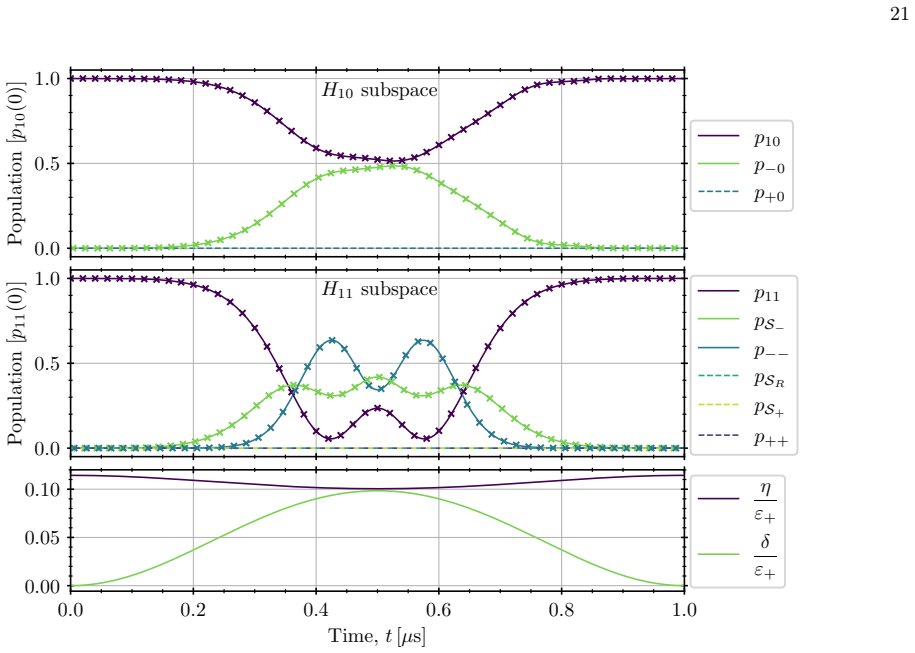
The load-bearing mechanism is microwave dressing of the two Rydberg states |3> and |4> (an S and a P state of the ion). A microwave field couples them into dressed states |+> and |->; the electric dipole-dipole interaction between ions then becomes a strong, long-range, state-dependent interaction whose strength is set by the detuning and Rabi frequency. The qubit state |1> is coupled to this dressed manifold by a two-photon laser excitation through a far-detuned intermediate state |2>, which is adiabatically eliminated, and the analysis is reduced to a five-state subspace with the vibrational motion of the ions decoupled. A differential-evolution optimization over laser detuning and Rabi-frequency parameters then searches for the best fidelity for each pulse protocol.
What would settle it
Simulate or implement the optimized 200 ns Protocol B pulse on a pair of 88Sr+ Rydberg ions with a full open-system model that adds laser intensity and phase noise and ion-motion heating to the Rydberg decay; if the Bell fidelity falls below roughly 99%, or an experimental realization measures a fidelity significantly below 99.25%, the central claim of error-correction-ready performance is not supported.
Extended reading notes
Core claim
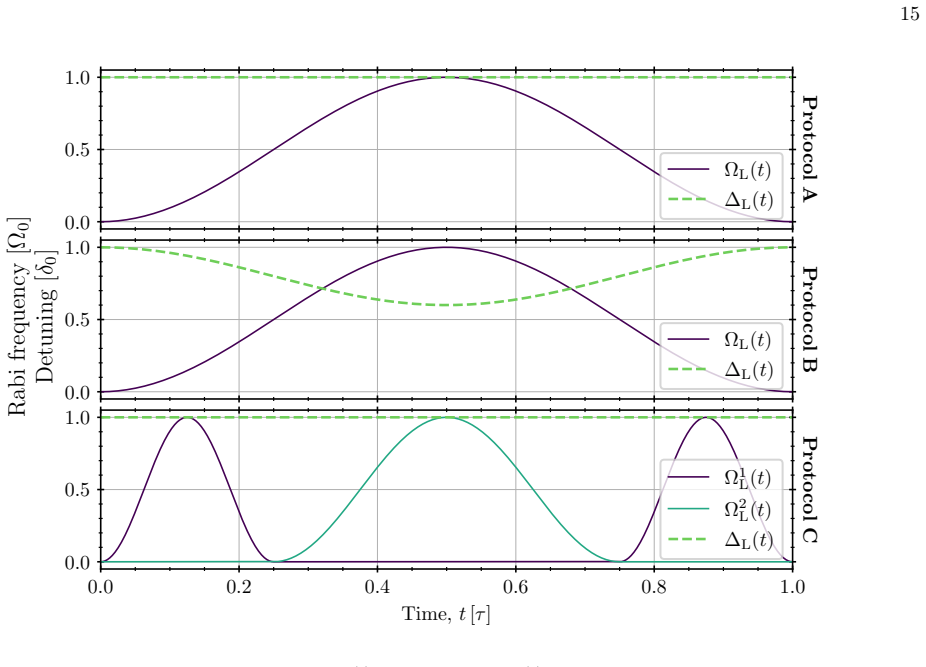
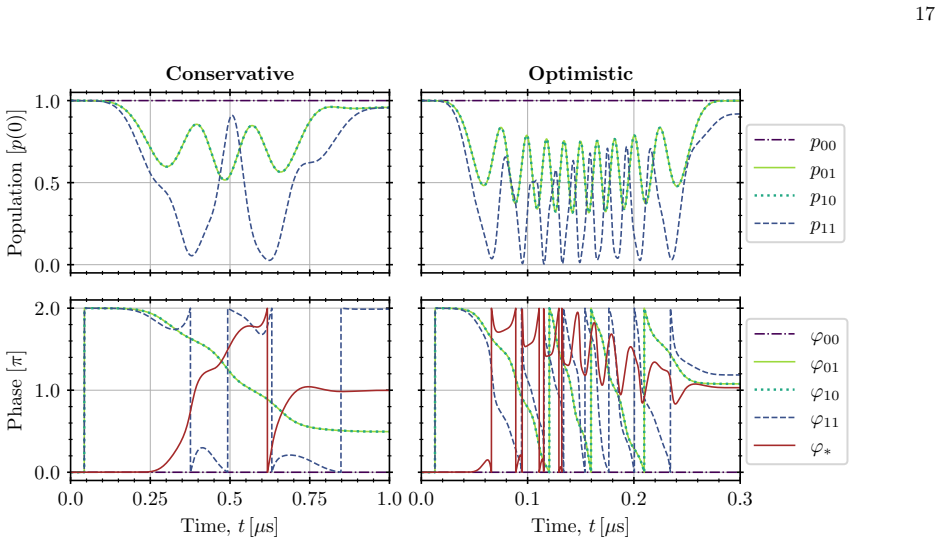
The paper's central claim is that a controlled-phase gate between two microwave-dressed Rydberg ions in a linear Paul trap can be made both very fast and very accurate if the laser pulse shape is optimized. For the best scheme, Protocol B, the optimized parameters yield a Bell-state fidelity above 99.99% for a 300 ns gate when decoherence is ignored, and 99.25% for a 200 ns gate when the finite Rydberg radiative lifetime is included through a non-Hermitian decay term. The fidelity loss in the realistic case is dominated by the time spent in the Rydberg manifold, and faster gates reduce that loss. The paper further shows that the simplest pulse scheme, Protocol A, suffers population loss from non-adiabatic transitions, while the neutral-atom pi-2pi-pi scheme, Protocol C, is inadequate at submicrosecond times because its Rabi frequency is not small compared with the interaction strength.
Load-bearing premise
The headline fidelity assumes that a simple non-Hermitian decay term with equal Rydberg decay rates captures all relevant decoherence; if laser noise, motional dephasing, ionization, or addressing crosstalk each contribute at the 0.75% level, the 99.25% number is not realized.
Editorial extensions
If this is right
- A 200 ns entangling gate at 99.25% fidelity would be roughly an order of magnitude faster than typical phonon-mediated trapped-ion gates, while staying above the 99% accuracy usually associated with error-corrected computing.
- Protocol B's simultaneous modulation of detuning and Rabi frequency is the key improvement; simpler constant-detuning pulses and the pi-2pi-pi sequence fail to reach submicrosecond high fidelity.
- The optimization and adiabatic-elimination reduction extend beyond two qubits, pointing toward design of multi-ion Rydberg-ion gates and native gate sets.
- Because the remaining error is dominated by finite Rydberg lifetime, choosing higher principal quantum numbers or shorter optimized pulses should further reduce infidelity, subject to ionization and laser-power constraints.
Reading between the lines
- If the 99.25% fidelity transfers to experiment, the cycle time of a logical qubit could shrink proportionally, but only if single-qubit gates and readout can keep up with a 200 ns two-qubit gate; the paper does not address this system-level balance.
- The optimistic regime assumes a large effective Rabi frequency of 2*pi*84.37 MHz; before building a full gate, one can test whether available laser power and addressability sustain that value without crosstalk to neighbouring ions.
- The paper's effective-Hamiltonian reduction suggests an analytic formula for the entangling phase could be derived by integrating instantaneous eigenenergies, which would allow pulse-shape design without stochastic optimization.
- Extending the model to N ions may reveal whether the microwave-dressed interaction avoids the phonon-mode closure problem that limits large phonon-bus gates, a scalability question the two-ion study leaves open.
Editorial analysis
A structured set of objections, weighed in public.
Referee Report
Summary. The paper develops a microscopic model of microwave-dressed Rydberg ions in a linear Paul trap, derives the effective two-ion Hamiltonian of Eq. (60), and uses it to design and optimize three controlled-phase gate protocols. The authors compare a simple Rabi pulse (Protocol A), a Rabi plus detuning-modulated pulse (Protocol B), and a pi-2pi-pi protocol (Protocol C) in conservative and optimistic parameter regimes. In the absence of decoherence, optimized Protocol B exceeds 99.99% Bell-state fidelity; after adding a non-Hermitian Rydberg decay term with gamma_R = 0.13 per microsecond, the optimistic Protocol B reaches 99.25% fidelity at a 200 ns gate time. The appendices contain a detailed derivation of the model potential, the multipole expansion, phonon-mode diagonalization, and radial/angular matrix elements, and the code is deposited on Zenodo.
Significance. If the headline fidelity estimate were fully established, this would be a valuable step toward submicrosecond Rydberg-ion entangling gates operating above nominal fault-tolerance thresholds. The derivation from the microscopic Coulomb and trap Hamiltonian to Eq. (60) is systematic and largely internally consistent, and the cross-check of the non-Hermitian decay model against the integral approximation in Fig. 10 is a useful validation. The optimization of the two-control-parameter Protocol B is a concrete, transferable contribution. However, the claim that the 200 ns, 99.25% gate represents a "realistic scenario" is not yet established: the paper itself identifies intermediate-state photon scattering as a fidelity-loss mechanism, but this channel is absent from the Hamiltonian, the optimization, and the reported fidelity. The central result is therefore conditional on an unquantified decoherence source.
major comments (3)
- [Section III C, Eq. (53), Table I] The 99.25% fidelity claim is obtained from Hamiltonian (62), in which the intermediate state |2> has been adiabatically eliminated and the effective Rabi frequency is Omega_L = Omega_3 Omega_2 / (2 Delta_2). The optimized Protocol B parameter Omega_0 = 2*pi*84.37 MHz is an effective two-photon Rabi frequency, but the manuscript never specifies Omega_2, Omega_3, or Delta_2, nor does it verify the adiabatic-elimination conditions for those values. Section III C explicitly identifies additional photon scattering from the two-photon excitation as a source of fidelity loss, yet this channel is absent from the Hamiltonian, the optimization, and Fig. 10. Because the infidelity budget is only 0.75%, even a modest scattering probability from the 6P_3/2 intermediate state can invalidate the headline number. Please provide a concrete two-photon parameter set, quantify the scattering error with an explicit expression, and show that the optimized fidelity survives inclusion of this channel.
- [Section II D, Eqs. (30) and (60)] The choice Delta_MW = 0 maximizes the dipole-dipole interaction strength, but the accompanying neglect of vibrational degrees of freedom is an assumption rather than a demonstrated property for the optimized parameters. The coupling Hamiltonian H_co in Eq. (30) contains static axial terms that are not removed by the rotating-wave transformation, and the vanishing-polarizability dressing condition cited from Refs. [69,74] is not satisfied at Delta_MW = 0. The paper should quantify the residual spin-phonon coupling for the parameters in Table I, or restrict the validity claim to parameters that satisfy the polarizability-cancellation condition.
- [Section III C, Eqs. (81)-(82)] The decay model assumes equal rates gamma_3 = gamma_4 = 0.13 per microsecond, even though |3> and |4> are different Rydberg states with different radiative properties. Since the reported fidelity margin above 99% is only 0.75%, the equality should be justified for the specific nS and nP states, and a sensitivity analysis with unequal rates, or a Lindblad master-equation calculation, should be provided to bound the error introduced by this simplification.
minor comments (4)
- [Table I and Section III A (Protocol C)] The fidelity values for Protocol C are inconsistent between the table and the text: Table I lists 84.36% (conservative) and 74.95% (optimistic), while the text quotes 84.26% and 74.80%.
- [Figure 8 caption] The caption refers to "parameters tabulated in Fig. I"; this should be Table I.
- [Eq. (83)] The integral approximation in Eq. (83) uses populations obtained from the no-decay evolution; please state explicitly that this is a first-order-in-gamma_R approximation and specify its regime of validity beyond the qualitative statement that decay must be the dominant error source.
- [Figure 10] The 200 ns point in Fig. 10 should indicate whether the fidelity was computed with Eq. (65) or Eq. (67), i.e., whether single-qubit phase corrections are included, since the main text distinguishes these two definitions.
Circularity Check
No significant circularity: the optimized fidelities are outputs of the authors' own Hamiltonian simulation and optimization, not fitted re-statements of the target.
full rationale
The derivation chain is self-contained: the effective Hamiltonian is obtained from a microscopic model with matrix elements computed from a published parametric model potential fitted to NIST energy levels (App. A, Ref. [87]), and the gate fidelities are produced by a differential-evolution maximization of the stated Bell-state fidelity over the pulse parameters (Eqs. 65-67, Table I). There is no step in which a fitted parameter is renamed as a prediction; the 99.25% figure is the value of the optimization objective at the reported optimum of the authors' own Hamiltonian, not an externally validated prediction. Self-citations to the group's earlier Rydberg-ion work [1,69,74] supply the dressed-state method, the decoupling approximation, and the Rydberg lifetime tau_R = 7.8 microseconds; these are either re-derived in the present paper (Sec. II, Apps. E-H) or are independent experimental/atomic inputs, so they are not load-bearing in the circular sense. The paper itself flags the omission of two-photon scattering (Sec. III C: 'Another source of decoherence is the two-photon excitation mechanism ... additional photon scattering') and states that the no-decay fidelities 'should be interpreted as a benchmark for performance of the different protocols, but not as realistic fidelities reachable in experiments'; this is a completeness/correctness caveat, not a circular reduction, because the omitted channel is not implicitly defined as the reported fidelity. No equation is exhibited in which the claimed result equals an input by construction.
Assumptions & free parameters
free parameters (7)
- Omega0, optimized laser Rabi frequency =
2 pi by 84.37 MHz (Protocol B, optimistic; 2 pi by 9.80 MHz conservative)
- delta0, base laser detuning =
2 pi by 39.94 MHz (Protocol B, optimistic; 2 pi by 37.44 MHz conservative)
- Delta0, detuning modulation amplitude =
2 pi by 197.13 MHz (Protocol B, optimistic; 2 pi by 12.10 MHz conservative)
- V, dipole-dipole interaction strength =
2 pi by 25 MHz (optimistic regime); 2 pi by 10 MHz (conservative regime)
- Omega_MW, microwave Rabi frequency =
2 pi by 250 MHz (optimistic regime); 2 pi by 100 MHz (conservative regime)
- gamma_R, Rydberg decay rate =
0.13 per microsecond (tau_R = 7.8 microseconds)
- n, principal quantum number of Rydberg states =
46
assumptions (9)
- domain assumption The ion can be treated as a core plus one valence electron with the parametric model potential V(r) from Ref. [87].
- domain assumption The electronic subspace is limited to the five states |0> through |4> of 88Sr+; all other states are neglected.
- domain assumption The multipole expansion of the ion-ion interaction is truncated at second order.
- domain assumption The rotating wave approximation and neglect of micromotion are valid.
- domain assumption The intermediate state |2> and the dressed state |+> can be adiabatically eliminated.
- domain assumption Only the Rydberg dipole-dipole interaction between |3> and |4> is retained; all other multipole couplings are negligible.
- ad hoc to paper Rydberg decay is described by a non-Hermitian term with equal rates gamma3 = gamma4.
- ad hoc to paper The optimistic parameter bounds are experimentally feasible, including Omega0 up to 2 pi by 100 MHz.
- ad hoc to paper Setting Delta_MW = 0 maximizes the interaction strength while leaving vibrational decoupling valid.
Cite this review
Pith. "Pith review of Two-qubit gate protocols with microwave-dressed Rydberg ions in a linear Paul trap." pith.science (2026). https://pith.science/paper/R6ROWXXE
@misc{pith2026241213699,
  author       = {Pith},
  title        = {Pith review of: Two-qubit gate protocols with microwave-dressed Rydberg ions in a linear Paul trap},
  year         = {2026},
  howpublished = {\url{https://pith.science/paper/R6ROWXXE}},
  note         = {Machine review of arXiv:2412.13699}
}
abstract
Ultracold trapped atomic ions excited into highly energetic Rydberg states constitute a promising platform for scalable quantum information processing. Elementary building blocks for such tasks are high-fidelity and sufficiently fast entangling two-qubit gates, which can be achieved via strong dipole-dipole interactions between microwave-dressed Rydberg ions, as recently demonstrated in a breakthrough experiment at https://www.nature.com/articles/s41586-020-2152-9 . We theoretically investigate the performance of three protocols leading to controlled-phase gate operations. Starting from a microscopic description of Rydberg ions in a linear Paul trap, we derive an effective Hamiltonian that faithfully captures the essential dynamics underlying the gate protocols. We then use an optimization scheme to fine-tune experimentally controllable parameters like laser detuning and Rabi frequency to yield maximal gate fidelity under each studied protocol. We show how non-adiabatic transitions resulting from fast laser driving relative to the characteristic time scales of the system detrimentally affect the fidelity. Despite this, we demonstrate that in the realistic scenario of Rydberg ions with finite radiative lifetimes, optimizing the best found gate protocol enables achievement of fidelities as high as $99.25\,\%$ for a gate time of $0.2\,\mu\mathrm{s}$. This considerably undercuts entangling gate durations between ground-state ions, for which gate times are typically limited by the comparably slower time scales of vibrational modes. Overall, this places trapped Rydberg ions into the regime where fast high-accuracy quantum computing and eventually quantum error correction become possible.
Figures


Figures from the paper (8 more)




Reference graph
Works this paper leans on
-
[1]
(23) which reads Hex = 1 2M NX i=1 P2 i + Vex with Vex = M ω2 2 NX i=1 X u γ2 uR2 i;u + Ce 2 2 NX i,j=1 j̸=i 1 |Rij|
External vibrational dynamics To start, we recall the Hamiltonian governing the external vibrational dynamics in Eq. (23) which reads Hex = 1 2M NX i=1 P2 i + Vex with Vex = M ω2 2 NX i=1 X u γ2 uR2 i;u + Ce 2 2 NX i,j=1 j̸=i 1 |Rij| . (E1) The former kinetic term is invariant under the harmonic expansion and evaluation at the center of mass equilibrium p...
-
[2]
(b) AsΩMW ≈ 2∆L, the detuning∆− decreases while ∆+ increases. Within this regime we can therefore adiabatically eliminate the state|+⟩ whenever its coupling strength to state|1⟩ is sufficiently small compared to its energy splitting, i.e.,ΩL ≪ ∆L. This leads to an energy level scheme wherein the ground state|1⟩ is coupled to only one Rydberg state|−⟩. (c)...
-
[3]
Coupled vibronic dynamics Let us now consider the Hamiltonian in Eq. (29) accounting for the coupled vibronic dynamics, Hco = −2eα cos(νt) NX i=1 [Ri;xri;x − Ri;yri;y] − 2eβ NX i=1 [3Ri;zri;z − Ri · ri] + Vco, (E8) 32 where Vco denotes the contributions to the coupled dynamics arising from the multipole expansion of the interaction potential (cf. App. C) ...
-
[4]
(27), which is Hin = NX i=1 p2 i 2m + V (|ri|) − eα cos(νt) NX i=1 [r2 i;x − r2 i;y] − eβ NX i=1 [3r2 i;z − r2 i ] − e NX i=1 ri · E(t) + Vin
Internal electronic dynamics Now, we consider the Hamiltonian describing the internal electronic dynamics in Eq. (27), which is Hin = NX i=1 p2 i 2m + V (|ri|) − eα cos(νt) NX i=1 [r2 i;x − r2 i;y] − eβ NX i=1 [3r2 i;z − r2 i ] − e NX i=1 ri · E(t) + Vin. (E14) Here, we have identified by Vin the terms of the internal dynamics coming from the multipole ex...
-
[5]
Numeric computation of radial matrix elements The radial matrix elements are computed numerically using the radial wavefunctionsΦnlj(r) which are themselves computed numerically by solving the radial Schrödinger equation, see App. A. In particular, by inserting resolutions of the identity over the radial coordinate basis (i.e.,1 = R dr r2|r⟩ ⟨r|), the rad...
-
[6]
Analytic calculation of angular matrix elements In contrast to the radial matrix elements, the angular matrix elements are calculated analytically using angular momentum algebra [112]. To start, we insert resolutions of the identity over the orbital and spin angular momentum bases (i.e., 1 = P ml,ms |l, ml, s, ms⟩ ⟨l, ml, s, ms|) such that we can write ⟨l...
-
[7]
Zhang, F
C. Zhang, F. Pokorny, W. Li, G. Higgins, A. Pöschl, I. Lesanovsky, and M. Hennrich, Submicrosecond entangling gate between trapped ions via Rydberg interaction, Nature580, 345 (2020)
2020
-
[8]
J. I. Cirac and P. Zoller, Quantum computations with cold trapped ions, Phys. Rev. Lett.74, 4091 (1995)
1995
Show all 142 references
-
[9]
J. I. Cirac and P. Zoller, A scalable quantum computer with ions in an array of microtraps, Nature404, 579 (2000)
2000
-
[10]
Häffner, C
H. Häffner, C. F. Roos, and R. Blatt, Quantum computing with trapped ions, Phys. Rep.469, 155 (2008)
2008
-
[11]
Schindler, D
P. Schindler, D. Nigg, T. Monz, J. T. Barreiro, E. Martinez, S. X. Wang, S. Quint, M. F. Brandl, V. Nebendahl, C. F. Roos, et al., A quantum information processor with trapped ions, New J. Phys.15, 123012 (2013)
2013
-
[12]
C. J. Ballance, T. P. Harty, N. M. Linke, M. A. Sepiol, and D. M. Lucas, High-fidelity quantum logic gates Using trapped-ion hyperfine qubits, Phys. Rev. Lett.117, 060504 (2016)
2016
-
[13]
C. D. Bruzewicz, J. Chiaverini, R. McConnell, and J. M. Sage, Trapped-ion quantum computing: progress and challenges, Appl. Phys. Rev.6, 021314 (2019)
2019
-
[14]
Schmidt-Kaler, H
F. Schmidt-Kaler, H. Häfnner, M. Riebe, S. Gulde, G. P. T. Lancaster, T. Deuschle, C. Becher, C. F. Roos, J. Eschner, and R. Blatt, Realization of the Cirac–Zoller controlled-NOT quantum gate, Nature422, 408 (2003)
2003
-
[15]
Blatt and D
R. Blatt and D. Wineland, Entangled states of trapped atomic ions, Nature453, 1008 (2008)
2008
-
[16]
Duan and C
L.-M. Duan and C. Monroe, Colloquium: quantum networks with trapped ions, Rev. Mod. Phys.82, 1209 (2010)
2010
-
[17]
Bermudez, X
A. Bermudez, X. Xu, R. Nigmatullin, J. O’Gorman, V. Negnevitsky, P. Schindler, T. Monz, U. G. Poschinger, C. Hempel, J. Home,et al., Assessing the progress of trapped-ion processors towards fault-tolerant quantum computation, Phys. Rev. X 7, 041061 (2017)
2017
-
[18]
S. A. Moses, C. H. Baldwin, M. S. Allman, R. Ancona, L. Ascarrunz, C. Barnes, J. Bartolotta, B. Bjork, P. Blanchard, M. Bohn, et al., A race-track trapped-ion quantum processor, Phys. Rev. X13, 041052 (2023)
2023
-
[19]
Porras and J
D. Porras and J. I. Cirac, Effective quantum spin systems with trapped ions, Phys. Rev. Lett.92, 207901 (2004)
2004
-
[20]
Kim, M.-S
K. Kim, M.-S. Chang, S. Korenblit, R. Islam, E. E. Edwards, J. K. Freericks, G.-D. Lin, L.-M. Duan, and C. Monroe, Quantum simulation of frustrated Ising spins with trapped ions, Nature465, 590 (2010)
2010
-
[21]
J. T. Barreiro, M. Müller, P. Schindler, D. Nigg, T. Monz, M. Chwalla, M. Hennrich, C. F. Roos, P. Zoller, and R. Blatt, An open-system quantum simulator with trapped ions, Nature470, 486 (2011)
2011
-
[22]
Friedenauer, H
A. Friedenauer, H. Schmitz, J. T. Glueckert, D. Porras, and T. Schaetz, Simulating a quantum magnet with trapped ions, Nature Phys.4, 757 (2008)
2008
-
[23]
Blatt and C
R. Blatt and C. Roos, Quantum simulations with trapped ions, Nature Phys.8, 277 (2012)
2012
-
[24]
I. M. Georgescu, S. Ashhab, and F. Nori, Quantum simulation, Rev. Mod. Phys.86, 153 (2014)
2014
-
[25]
Monroe, W
C. Monroe, W. C. Campbell, L.-M. Duan, Z.-X. Gong, A. V. Gorshkov, P. W. Hess, R. Islam, K. Kim, N. M. Linke, G. Pagano, et al., Programmable quantum simulations of spin systems with trapped ions, Rev. Mod. Phys.93, 025001 (2021). 38
2021
-
[26]
Baumgart, J.-M
I. Baumgart, J.-M. Cai, A. Retzker, M. B. Plenio, and C. Wunderlich, Ultrasensitive magnetometer using a single atom, Phys. Rev. Lett.116, 240801 (2016)
2016
-
[27]
C. L. Degen, F. Reinhard, and P. Cappellaro, Quantum sensing, Rev. Mod. Phys.89, 035002 (2017)
2017
-
[28]
Hempel, B
C. Hempel, B. P. Lanyon, P. Jurcevic, R. Gerritsma, R. Blatt, and C. F. Roos, Entanglement-enhanced detection of single-photon scattering events, Nat. Photonics7, 630 (2013)
2013
-
[29]
Kotler, N
S. Kotler, N. Akerman, Y. Glickman, A. Keselman, and R. Ozeri, Single-ion quantum lock-in amplifier, Nature473, 61 (2011)
2011
-
[30]
W. C. Campbell and P. Hamilton, Rotation sensing with trapped ions, J. Phys. B: At. Mol. Opt. Phys.50, 064002 (2017)
2017
-
[31]
Carney, H
D. Carney, H. Häffner, D. C. Moore, and J. M. Taylor, Trapped electrons and ions as particle detectors, Phys. Rev. Lett. 127, 061804 (2021)
2021
-
[32]
K. A. Gilmore, M. Affolter, R. J. Lewis-Swan, D. Barberena, E. Jordan, A. M. Rey, and J. J. Bollinger, Quantum-enhanced sensing of displacements and electric fields with two-dimensional trapped-ion crystals, Science373, 673 (2021)
2021
-
[33]
J. P. Gaebler, T. R. Tan, Y. Lin, Y. Wan, R. Bowler, A. C. Keith, S. Glancy, K. Coakley, E. Knill, D. Leibfried, and D. J. Wineland, High-fidelity universal gate set for9Be + ion qubits, Phys. Rev. Lett.117, 060505 (2016)
2016
-
[34]
Benhelm, G
J. Benhelm, G. Kirchmair, C. F. Roos, and R. Blatt, Towards fault-tolerant quantum computing with trapped ions, Nat. Phys. 4, 463 (2008)
2008
-
[35]
Ryan-Anderson, J
C. Ryan-Anderson, J. G. Bohnet, K. Lee, D. Gresh, A. Hankin, J. P. Gaebler, D. Francois, A. Chernoguzov, D. Lucchetti, N. C. Brown,et al., Realization of real-time fault-tolerant quantum error correction, Phys. Rev. X11, 041058 (2021)
2021
-
[36]
Heußen, L
S. Heußen, L. Postler, M. Rispler, I. Pogorelov, C. D. Marciniak, T. Monz, P. Schindler, and M. Müller, Strategies for a practical advantage of fault-tolerant circuit design in noisy trapped-ion quantum computers, Phys. Rev. A107, 042422 (2023)
2023
-
[37]
Postler, F
L. Postler, F. Butt, I. Pogorelov, C. D. Marciniak, S. Heußen, R. Blatt, P. Schindler, M. Rispler, M. Müller, and T. Monz, Demonstration of fault-tolerant Steane quantum error correction, PRX Quantum5, 030326 (2024)
2024
-
[38]
Pogorelov, F
I. Pogorelov, F. Butt, L. Postler, C. D. Marciniak, P. Schindler, M. Müller, and T. Monz, Experimental fault-tolerant code switching, arXiv:2403.13732 [quant-ph] (2024)
2024 arXiv
-
[39]
Paetznick, M
A. Paetznick, M. P. da Silva, C. Ryan-Anderson, J. M. Bello-Rivas, J. P. Campora III, A. Chernoguzov, J. M. Dreiling, C. Foltz, F. Frachon, J. P. Gaebler,et al., Demonstration of logical qubits and repeated error correction with better-than- physical error rates, arXiv:2404.02...
2024 arXiv
-
[40]
B. W. Reichardt, D. Aasen, R. Chao, A. Chernoguzov, W. van Dam, J. P. Gaebler, D. Gresh, D. Lucchetti, M. Mills, S. A. Moses,et al., Demonstration of quantum computation and error correction with a tesseract code, arXiv:2409.04628 [quant-ph] (2024)
2024 arXiv
-
[41]
Berthusen, J
N. Berthusen, J. Dreiling, C. Foltz, J. P. Gaebler, T. M. Gatterman, D. Gresh, N. Hewitt, M. Mills, S. A. Moses, B. Neyenhuis,et al., Experiments with the 4D surface code on a QCCD quantum computer, arXiv:2408.08865 [quant-ph] (2024)
2024 arXiv
-
[42]
Y. Wang, S. Simsek, T. M. Gatterman, J. A. Gerber, K. Gilmore, D. Gresh, N. Hewitt, C. V. Horst, M. Matheny, T. Mengle, et al., Fault-tolerant one-bit addition with the smallest interesting color code, Sci. Adv.10, eado9024 (2024)
2024
-
[43]
V. M. Schäfer, C. J. Ballance, K. Thirumalai, L. J. Stephenson, T. G. Ballance, A. M. Steane, and D. M. Lucas, Nature 555, 75 (2018)
2018
-
[44]
Y. Wang, M. Um, J. Zhang, S. An, M. Lyu, J.-N. Zhang, L.-M. Duan, D. Yum, and K. Kim, Single-qubit quantum memory exceeding ten-minute coherence time, Nat. Photonics11, 646 (2017)
2017
-
[45]
Schmidt-Kaler, H
F. Schmidt-Kaler, H. Häffner, S. Gulde, M. Riebe, G. P. T. Lancaster, T. Deuschle, C. Becher, W. Hänsel, J. Eschner, C. F. Roos, and R. Blatt, How to realize a universal quantum gate with trapped ions, Applied Physics B77, 789 (2003)
2003
-
[46]
P. C. Haljan, K.-A. Brickman, L. Deslauriers, P. J. Lee, and C. Monroe, Spin-dependent forces on trapped ions for phase-stable quantum gates and entangled states of spin and motion, Phys. Rev. Lett.94, 153602 (2005)
2005
-
[47]
Kim, M.-S
K. Kim, M.-S. Chang, R. Islam, S. Korenblit, L.-M. Duan, and C. Monroe, Entanglement and tunable spin-spin couplings between trapped ions Using multiple transverse modes, Phys. Rev. Lett.103, 120502 (2009)
2009
-
[48]
Müller, K
M. Müller, K. Hammerer, Y. L. Zhou, C. F. Roos, and P. Zoller, Simulating open quantum systems: from many-body interactions to stabilizer pumping, New J. Phys.13, 085007 (2011)
2011
-
[49]
Schneider, D
C. Schneider, D. Porras, and T. Schaetz, Experimental quantum simulations of many-body physics with trapped ions, Rep. Prog. Phys.75, 024401 (2012)
2012
-
[50]
Behrle, T
T. Behrle, T. L. Nguyen, F. Reiter, D. Baur, B. de Neeve, M. Stadler, M. Marinelli, F. Lancellotti, S. F. Yelin, and J. P. Home, Phonon laser in the quantum regime, Phys. Rev. Lett.131, 043605 (2023)
2023
-
[51]
Weimer, M
H. Weimer, M. Müller, I. Lesanovsky, P. Zoller, and H. P. Büchler, A Rydberg quantum simulator, Nature Phys.6, 382 (2010)
2010
-
[52]
Saffman, T
M. Saffman, T. G. Walker, and K. Mølmer, Quantum information with Rydberg atoms, Rev. Mod. Phys.82, 2313 (2010)
2010
-
[53]
C. S. Adams, J. D. Pritchard, and J. P. Shaffer, Rydberg atom quantum technologies, J. Phys. B: At. Mol. Opt. Phys. 53, 012002 (2019)
2019
-
[54]
Browaeys and T
A. Browaeys and T. Lahaye, Many-body physics with individually controlled Rydberg atoms, Nat. Phys.16, 132 (2020)
2020
-
[55]
T. F. Gallagher,Rydberg Atoms, 1st ed. (Cambridge University Press, 1994)
1994
-
[56]
C. Ates, T. Pohl, T. Pattard, and J. M. Rost, Antiblockade in Rydberg excitation of an ultracold lattice gas, Phys. Rev. Lett. 98, 023002 (2007)
2007
-
[57]
Ubran, T
E. Ubran, T. A. Johnson, T. Henage, L. Isenhower, D. D. Yavuz, T. G. Walker, and M. Saffman, Observation of Rydberg blockade between two atoms, Nat. Phys.5, 110 (2009). 39
2009
-
[58]
Gaëtan, Y
A. Gaëtan, Y. Miroshnychenko, T. Wilk, A. Chotia, M. Viteau, D. Comparat, P. Pillet, A. Browaeys, and P. Grangier, Observation of collective excitation of two individual atoms in the Rydberg blockade regime, Nat. Phys.5, 115 (2009)
2009
-
[59]
Amthor, C
T. Amthor, C. Giese, C. S. Hofmann, and M. Weidemüller, Evidence of antiblockade in an ultracold Rydberg gas, Phys. Rev. Lett.104, 013001 (2010)
2010
-
[60]
Y. O. Dudin, L. Li, F. Bariani, and A. Kuzmich, Observation of coherent many-body Rabi oscillations, Nat. Phys.8, 790 (2012)
2012
-
[61]
Marcuzzi, J
M. Marcuzzi, J. Minář, D. Barredo, S. de Léséleuc, H. Labuhn, T. Lahaye, A. Browaeys, E. Levi, and I. Lesanovsky, Facilitation dynamics and localization phenomena in Rydberg lattice gases with position disorder, Phys. Rev. Lett.118, 063606 (2017)
2017
-
[62]
Jaksch, J
D. Jaksch, J. I. Cirac, P. Zoller, S. L. Rolston, R. Côté, and M. D. Lukin, Fast quantum gates for neutral atoms, Phys. Rev. Lett.85, 2208 (2000)
2000
-
[63]
Møller, L
D. Møller, L. B. Madsen, and K. Mølmer, Quantum gates and multiparticle entanglement by Rydberg excitation blockade and adiabatic passage, Phys. Rev. Lett.100, 170504 (2008)
2008
-
[64]
Isenhower, E
L. Isenhower, E. Urban, X. L. Zhang, A. T. Gill, T. Henage, T. A. Johnson, T. G. Walker, and M. Saffman, Demonstration of a neutral atom controlled-NOT quantum gate, Phys. Rev. Lett.104, 010503 (2010)
2010
-
[65]
T. Wilk, A. Gaëtan, C. Evellin, J. Wolters, Y. Miroshnychenko, P. Grangier, and A. Browaeys, Entanglement of two individual neutral atoms Using Rydberg blockade, Phys. Rev. Lett.104, 010502 (2010)
2010
-
[66]
K. M. Maller, M. T. Lichtman, T. Xia, Y. Sun, M. J. Piotrowicz, A. W. Carr, L. Isenhower, and M. Saffman, Rydberg- blockade controlled-NOT gate and entanglement in a two-dimensional array of neutral-atom qubits, Phys. Rev. A92, 022336 (2015)
2015
-
[67]
L. S. Theis, F. Motzoi, F. K. Wilhelm, and M. Saffman, High-fidelity Rydberg-blockade entangling gate using shaped, analytic pulses, Phys. Rev. A94, 032306 (2016)
2016
-
[68]
Levine, A
H. Levine, A. Keesling, G. Semeghini, A. Omran, T. T. Wang, S. Ebadi, H. Bernien, M. Greiner, V. Vuletić, H. Pichler, and M. D. Lukin, Parallel implementation of high-fidelity multiqubit gates with neutral atoms, Phys. Rev. Lett.123, 170503 (2019)
2019
-
[69]
T. M. Graham, M. Kwon, B. Grinkemeyer, Z. Marra, X. Jiang, M. T. Lichtman, Y. Sun, M. Ebert, and M. Saffman, Rydberg-mediated entanglement in a two-dimensional neutral atom qubit array, Phys. Rev. Lett.123, 230501 (2019)
2019
-
[70]
T. M. Graham, Y. Song, J. Scott, C. Poole, L. Phuttitarn, K. Jooya, P. Eichler, X. Jiang, A. Marra, B. Grinkemeyer, et al., Multi-qubit entanglement and algorithms on a neutral-atom quantum computer, Nature604, 457 (2022)
2022
-
[71]
S. J. Evered, D. Bluvstein, M. Kalinowski, S. Ebadi, T. Manovitz, H. Zhou, S. H. Li, A. A. Geim, T. T. Wang, N. Maskara, et al., High-fidelity parallel entangling gates on a neutral-atom quantum computer, Nature622, 268 (2023)
2023
-
[72]
Bluvstein, S
D. Bluvstein, S. J. Evered, A. A. Geim, S. H. Li, H. Zhou, T. Manovitz, S. Ebadi, M. Cain, M. Kalinowski, D. Hangleiter, et al., Logical quantum processor based on reconfigurable atom arrays, Nature626, 58 (2024)
2024
-
[73]
B. W. Reichardt, A. Paetznick, D. Aasen, I. Basov, J. M. Bello-Rivas, P. Bonderson, R. Chao, W. van Dam, M. B. Hastings, A. Paz, et al., Logical computation demonstrated with a neutral atom quantum processor, arXiv:2411.11822 [quant-ph] (2024)
2024 arXiv
-
[74]
A. G. Radnaev, W. C. Chung, D. C. Cole, D. Mason, T. G. Ballance, M. J. Bedalov, D. A. Belknap, M. R. Berman, M. Blakely, I. L. Bloomfield,et al., A universal neutral-atom quantum computer with individual optical addressing and non-destructive readout, arXiv:2408.08288 [quant-...
2024
-
[75]
Müller, L
M. Müller, L. Liang, I. Lesanovsky, and P. Zoller, Trapped Rydberg ions: from spin chains to fast quantum gates, New J. Phys.10, 093009 (2008)
2008
-
[76]
Schmidt-Kaler, T
F. Schmidt-Kaler, T. Feldker, D. Kolbe, J. Walz, M. Müller, P. Zoller, W. Li, and I. Lesanovsky, Rydberg excitation of trapped cold ions: a detailed case study, New J. Phys.13, 075014 (2011)
2011
-
[77]
Mokhberi, M
A. Mokhberi, M. Hennrich, and F. Schmidt-Kaler, Trapped Rydberg ions: a new platform for quantum information processing (Academic Press, 2020) Chap. 4, pp. 233–306
2020
-
[78]
H. Bao, J. Vogel, U. Poschinger, and F. Schmidt-Kaler, Quantum computing architecture with Rydberg gates in trapped ions, arXiv:2411.19684 [quant-ph] (2024)
2024 arXiv
-
[79]
Saffman, Quantum computing with atomic qubits and Rydberg interactions: progress and challenges, J
M. Saffman, Quantum computing with atomic qubits and Rydberg interactions: progress and challenges, J. Phys. B: Atom. Mol. Opt. Phys.49, 202001 (2016)
2016
-
[80]
J. W. P. Wilkinson, W. Li, and I. Lesanovsky, Spectral signatures of vibronic coupling in trapped cold ionic Rydberg systems, Phys. Rev. Lett.132, 223401 (2024)
2024
-
[81]
Zhang, M
Z. Zhang, M. Yuan, B. Sundar, and K. R. A. Hazzard, Motional decoherence in ultracold Rydberg atom quantum simulators of spin models, arXiv:2201.08463 [cond-mat.quant-gas] (2022)
2022 arXiv
-
[82]
Bharti, S
V. Bharti, S. Sugawa, M. Kunimi, V. S. Chauhan, T. P. Mahesh, M. Mizoguchi, T. Matsubara, T. Tomita, S. de Léséleuc, and K. Ohmori, Strong spin-motion coupling in the ultrafast quantum many-body dynamics of Rydberg atoms in a Mott-insulator lattice, arXiv:2311.15575 [quant-ph] (2023)
2023 arXiv
-
[83]
F. M. Gambetta, C. Zhang, M. Hennrich, I. Lesanovsky, and W. Li, Long-range multibody interactions and three-body antiblockade in a trapped Rydberg ion chain, Phys. Rev. Lett.125, 133602 (2020)
2020
-
[84]
F. M. Gambetta, C. Zhang, M. Hennrich, I. Lesanovsky, and W. Li, Exploring the many-body dynamics near a conical intersection with trapped Rydberg ions, Phys. Rev. Lett.126, 233404 (2021)
2021
-
[85]
Magoni, R
M. Magoni, R. Joshi, and I. Lesanovsky, Molecular dynamics in Rydberg tweezer arrays: spin-phonon entanglement and Jahn-Teller effect, Phys. Rev. Lett.131, 093002 (2023)
2023
-
[86]
W. S. Martins, J. W. P. Wilkinson, M. Hennrich, and I. Lesanovsky, Impact of micromotion on the excitation of Rydberg states of ions in a Paul trap, arXiv:2410.24047 [physics.atom-ph] (2024). 40
2024 arXiv
-
[87]
Feldker,Rydberg excitation of trapped ions , Ph.D
T. Feldker,Rydberg excitation of trapped ions , Ph.D. thesis, University of Mainz (2017)
2017
-
[88]
Higgins, A single trapped Rydberg ion , Ph.D
G. Higgins, A single trapped Rydberg ion , Ph.D. thesis, Stockholm University (2018)
2018
-
[89]
Pokorny,A microwave dressed Rydberg ion , Ph.D
F. Pokorny,A microwave dressed Rydberg ion , Ph.D. thesis, Stockholm University (2020)
2020
-
[90]
Vogel,Rydberg ions in motion , Ph.D
J. Vogel,Rydberg ions in motion , Ph.D. thesis, University of Mainz (2021)
2021
-
[91]
T. F. Gallagher, Rydberg atoms, Rep. Prog. Phys.51, 143 (1988)
1988
-
[92]
T. F. Gallagher, Rydberg atoms, inSpringer Handbook of Atomic, Molecular, and Optical Physics , edited by G. W. F. Drake (Springer, 2023) Chap. 15
2023
-
[93]
Aymar, C
M. Aymar, C. H. Greene, and E. Luc-Koenig, Multichannel Rydberg spectroscopy of complex atoms, Rev. Mod. Phys. 68, 1015 (1996)
1996
-
[94]
M. J. Seaton, Quantum defect theory, Rep. Prog. Phys.46, 167 (1983)
1983
-
[95]
Kramida, Y
A. Kramida, Y. Ralchenko, J. Reader, and NIST ASD Team, NIST Atomic Spectra Database (v. 5.11) (2024)
2024
-
[96]
Grant, Relativistic Atomic Structure, in Springer Handbook of Atomic, Molecular, and Optical Physics , edited by G
I. Grant, Relativistic Atomic Structure, in Springer Handbook of Atomic, Molecular, and Optical Physics , edited by G. W. F. Drake (Springer, 2023) Chap. 23
2023
-
[97]
Pawlak and H
M. Pawlak and H. R. Sadeghpour, Rydberg spectrum of a single trappedCa+ ion: a Floquet analysis, Phys. Rev. A101, 052510 (2020)
2020
-
[98]
Paul, Electromagnetic traps for charged and neutral particles, Rev
W. Paul, Electromagnetic traps for charged and neutral particles, Rev. Mod. Phys.62, 531 (1990)
1990
-
[99]
L. S. Brown, Quantum motion in a Paul trap, Phys. Rev. Lett.66, 527 (1991)
1991
-
[100]
M. G. Raizen, J. M. Gilligan, J. C. Bergquist, W. M. Itano, and D. J. Wineland, Ionic crystals in a linear Paul trap, Phys. Rev. A45, 6493 (1992)
1992
-
[101]
D. J. Wineland, C. Monroe, W. M. Itano, D. Leibfried, B. E. King, and D. M. Meekhof, Experimental issues in coherent quantum-state manipulation of trapped atomic ions, J. Res. Natl. Inst. Stand. Technol.103, 259 (1998)
1998
-
[102]
Leibfried, R
D. Leibfried, R. Blatt, C. Monroe, and D. J. Wineland, Quantum dynamics of single trapped ions, Rev. Mod. Phys.75, 281 (2003)
2003
-
[103]
F. G. Major, V. N. Gheorghe, and G. Werth,Charged Particle Traps, 1st ed. (Springer, 2005)
2005
-
[104]
Hucul, M
D. Hucul, M. Yeo, S. Olmschenk, C. Monroe, W. K. Hensinger, and J. Rabchuk, On the transport of atomic ions in linear and multidimensional ion trap arrays, Quant. Inf. Comput.8, 501 (2008)
2008
-
[105]
C. F. Foot,Atomic Physics, 1st ed., Oxford Master Series in Physics (Oxford University Press, 2004)
2004
-
[106]
D. A. Steck, Quantum and Atom Optics (2024)
2024
-
[107]
D. J. Berkeland, J. D. Miller, J. C. Bergquist, W. M. Itano, and D. J. Wineland, Minimization of ion micromotion in a Paul trap, J. Appl. Phys.83, 5025 (1998)
1998
-
[108]
R. J. Cook, D. G. Shankland, and A. L. Wells, Quantum theory of particle motion in a rapidly oscillating field, Phys. Rev. A31, 564 (1985)
1985
-
[109]
D. F. V. James, Quantum dynamics of cold trapped ions with application to quantum computation, Appl. Phys. B66, 181 (1998)
1998
-
[110]
Weber, C
S. Weber, C. Tresp, H. Menke, A. Urvoy, O. Firstenberg, H. P. Büchler, and S. Hofferberth, Calculation of Rydberg interaction potentials, J. Phys. B: At. Mol. Opt. Phys.50, 133001 (2017)
2017
-
[111]
H. B. G. Casimir and D. Polder, The influence of retardation on the London-van der Waals forces, Phys. Rev.73, 360 (1948)
1948
-
[112]
R. J. Le Roy, Long-range potential coefficients from RKR turning points:C6 and C8 for B(3Π+ Ou)-state Cl2, Br2, and I2, Can. J. Phys.52, 246 (1974)
1974
-
[113]
Friedrich,Theoretical Atomic Physics, 4th ed
H. Friedrich,Theoretical Atomic Physics, 4th ed. (Springer, 2017)
2017
-
[114]
Higgins, F
G. Higgins, F. Pokorny, C. Zhang, and M. Hennrich, Highly polarizable Rydberg ion in a Paul trap, Phys. Rev. Lett. 123, 153602 (2019)
2019
-
[115]
J. J. Bollinger, D. Wineland, and D. H. E. Dubin, Non-neutral ion plasmas and crystals, laser cooling, and atomic clocks, Phys. Plasmas1, 1403 (1994)
1994
-
[116]
D. G. Enzer, M. M. Schauer, J. J. Gomez, M. S. Gulley, M. H. Holzscheiter, P. G. Kwiat, S. K. Lamoreaux, C. G. Peterson, V. D. Sandberg, D. Tupa,et al., Observation of power-law scaling for phase transitions in linear trapped ion crystals, Phys. Rev. Lett.85, 2466 (2000)
2000
-
[117]
Fishman, G
S. Fishman, G. De Chiara, T. Calarco, and G. Morigi, Structural phase transitions in low-dimensional ion crystals, Phys. Rev. B77, 064111 (2008)
2008
-
[118]
J. D. Louck, Angular Momentum Theory, inSpringer Handbook of Atomic, Molecular, and Optical Physics , edited by G. W. F. Drake (Springer, 2023) Chap. 2
2023
-
[119]
Higgins, W
G. Higgins, W. Li, F. Pokorny, C. Zhang, F. Kress, C. Maier, J. Haag, Q. Bodart, I. Lesanovsky, and M. Hennrich, Single strontium Rydberg ion confined in a Paul trap, Phys. Rev. X7, 021038 (2017)
2017
-
[120]
Higgins, F
G. Higgins, F. Pokorny, C. Zhang, Q. Bodart, and M. Hennrich, Coherent control of a single trapped Rydberg ion, Phys. Rev. Lett.119, 220501 (2017)
2017
-
[121]
Li and I
W. Li and I. Lesanovsky, Entangling quantum gate in trapped ions via Rydberg blockade, Appl. Phys. B: Lasers and Optics 114, 37 (2014)
2014
-
[122]
M. A. Nielsen and I. L. Chuang,Quantum Computation and Quantum Information , 10th ed. (Cambridge University Press, 2010)
2010
-
[123]
Benseny and K
A. Benseny and K. Mølmer, Adiabatic theorem revisited: The unexpectedly good performance of adiabatic passage, Phys. Rev. A103, 062215 (2021)
2021
-
[124]
Virtanen, R
P. Virtanen, R. Gommers, T. E. Oliphant, M. Haberland, T. Reddy, D. Cournapeau, E. Burovski, P. Peterson, W. Weckesser, J. Bright,et al., SciPy 1.0: fundamental algorithms for scientific computing in Python, Nat. Methods 41 17, 261 (2020)
2020
-
[125]
Storn and K
R. Storn and K. Price, Differential evolution - a simple and efficient heuristic for global optimization over continuous spaces, J. Glob. Optim.11, 341 (1997)
1997
-
[126]
Leibfried, B
D. Leibfried, B. DeMarco, V. Meyer, D. Lucas, M. Barrett, J. Britton, W. M. Itano, B. Jelenković, C. Langer, T. Rosen- band, and D. J. Wineland, Experimental demonstration of a robust, high-fidelity geometric two ion-qubit phase gate, Nature 422, 412 (2003)
2003
-
[127]
Saffman, I
M. Saffman, I. I. Beterov, A. Dalal, E. J. Páez, and B. C. Sanders, Symmetric Rydberg controlled-Z gates with adiabatic pulses, Phys. Rev. A101, 062309 (2020)
2020
-
[128]
Y. Sun, P. Xu, P.-X. Chen, and L. Liu, Controlled phase gate protocol for neutral atoms via off-resonant modulated driving, Phys. Rev. Appl.13, 024059 (2020)
2020
-
[129]
Mohan, R
M. Mohan, R. de Keijzer, and S. Kokkelmans, Robust control and optimal Rydberg states for neutral atom two-qubit gates, Phys. Rev. Res.5, 033052 (2023)
2023
-
[130]
Bachor, T
P. Bachor, T. Feldker, J. Walz, and F. Schmidt-Kaler, Addressing single trapped ions for Rydberg quantum logic, J. Phys. B: At. Mol. Opt. Phys.49, 154004 (2016)
2016
-
[131]
Paulisch, H
V. Paulisch, H. Rui, H. K. Ng, and B.-G. Englert, Beyond adiabatic elimination: A hierarchy of approximations for multi-photon processes, Eur. Phys. J. Plus129, 12 (2014)
2014
-
[132]
Brion, L
E. Brion, L. H. Pedersen, and K. Mølmer, Adiabatic elimination in a lambda system, J. Phys. A: Math. Theor.40, 1033 (2007)
2007
-
[133]
Preskill, Reliable quantum computers, Proc
J. Preskill, Reliable quantum computers, Proc. R. Soc. A454, 385 (1998)
1998
-
[134]
Pagano, S
A. Pagano, S. Weber, D. Jaschke, T. Pfau, F. Meinert, S. Montangero, and H. P. Büchler, Error budgeting for a controlled- phase gate with strontium-88 Rydberg atoms, Phys. Rev. Res.4, 033019 (2022)
2022
-
[135]
I. I. Beterov, I. I. Ryabtsev, D. B. Tretyakov, and V. M. Entin, Quasiclassical calculations of blackbody-radiation-induced depopulation rates and effective lifetimes of RydbergnS, nP, and nD alkali-metal atoms withn ≤ 80, Phys. Rev. A79, 052504 (2009)
2009
-
[136]
K. M. F. Magalhães, A. L. de Oliveira, R. A. D. S. Zanon, V. S. Bagnato, and L. G. Marcassa, Lifetime determination of high excited states of 85Rb using a sample of cold atoms, Opt. Commun.184, 385 (2000)
2000
-
[137]
M. F. Brandl, M. W. Van Mourik, L. Postler, A. Nolf, K. Lakhmanskiy, R. R. Paiva, S. Möller, N. Daniilidis, H. Häffner, V. Kaushal, et al., Cryogenic setup for trapped ion quantum computing, Rev. Sci. Instrum.87, 113103 (2016)
2016
-
[138]
Two-qubit gate protocols with microwave-dressed Rydberg ions in a linear Paul trap
J. W. P. Wilkinson, K. Bolsmann, T. L. M. Guedes, M. Müller, and I. Lesanovsky, Code, data, and figures for “Two-qubit gate protocols with microwave-dressed Rydberg ions in a linear Paul trap” (2024)
2024
-
[139]
Marinescu, H
M. Marinescu, H. R. Sadeghpour, and A. Dalgarno, Dispersion coefficients for alkali-metal dimers, Phys. Rev. A49, 982 (1994)
1994
-
[140]
E. U. Condon and G. H. Shortley,The Theory of Atomic Spectra , 2nd ed. (Cambridge University Press, 1951)
1951
-
[141]
Li and I
W. Li and I. Lesanovsky, Electronically excited cold ion crystals, Phys. Rev. Lett.108, 023003 (2012)
2012
-
[142]
G. W. F. Drake,Springer Handbook of Atomic, Molecular, and Optical Physics , 2nd ed., Springer Handbooks (Springer, 2023)
2023
Reviewed August 11, 2026 · model on record in the stance chip above.
Discussion (0). Continue with ORCID to comment.