REVIEW 3 major objections 6 minor 1 cited by
Categorical Schr\"odinger Bridge Matching
T0 review · 3 major / 6 minor · reviewed 2026-08-09 · deepseek-v4-flash
Pith's one-line read In finite discrete spaces with full-support marginals and a Markov reference, the dynamic Schrödinger bridge is the unique process that is both Markovian and reciprocal, and the D-IMF alternating-projection scheme provably converges to it…
desk verdict A genuinely new characterization theorem for Schrödinger bridges on discrete spaces, paired with an algorithm whose convergence guarantee is cited rather than proved. read the letter →
The pith
A machine-rendered reading of the paper's core claim, the machinery that carries it, and where it could break.
The reading
What carries the argument
The central object is a finite-state discrete-time process that is simultaneously Markovian and reciprocal. Reciprocity means that, conditionally on the two endpoints, the interior path follows the same bridge as the reference process, while Markovianity means transitions factor one step at a time. The load-bearing identity is equation (11): for any intermediate time $t_n$, $\log q(x_1|x_0)-\log q_{\mathrm{ref}}(x_0,x_1)$ splits as $f_0(x_0,x_{t_n})+f_1(x_{t_n},x_1)$, which forces the endpoint coupling to have the Schrödinger-bridge form $\psi(x_0)\,q_{\mathrm{ref}}(x_1|x_0)\,\phi(x_1)$. The algorithmic machinery is D-IMF, the alternating reciprocal and Markovian projections, implemented with a neural network that samples an endpoint from a factorized learned distribution and then uses the reference bridge to move between states.
What would settle it
Run D-IMF analytically on a small finite state space with a full-support Markov reference and compute the exact Sinkhorn bridge $q^*$. If the iterates' $\mathrm{KL}(q^l\,\|\,q^*)$ does not approach zero, or if two different processes are simultaneously Markovian and reciprocal with the same endpoint marginals, Theorem 3.1 and Corollary 3.2 would be refuted.
Extended reading notes
Core claim
The central discovery is a characterization theorem for the dynamic Schrödinger bridge in finite discrete spaces with a general Markov reference process. Theorem 3.1 says: if $q^*$ has the prescribed endpoint marginals $p_0$ and $p_1$, is Markovian, and is reciprocal with respect to $q_{\mathrm{ref}}$ (meaning its bridges between endpoints coincide with $q_{\mathrm{ref}}$'s), then $q^*$ is the unique minimizer of $\mathrm{KL}(q\,\|\,q_{\mathrm{ref}})$ over all processes with those endpoint marginals. The proof rewrites the joint density of a Markov-reciprocal process as $q(x_0,x_1)=\psi(x_0)\,q_{\mathrm{ref}}(x_1|x_0)\,\phi(x_1)$, the canonical form of the static entropic optimal transport plan, and then invokes the standard identification of that plan as the Schrödinger bridge. Corollary 3.2 then states that D-IMF iterates converge in KL to $q^*$, which is the theoretical foundation the D-IMF procedure previously lacked for discrete spaces.
Load-bearing premise
The claim leans on the assumption that the D-IMF alternating projection scheme converges in KL to the unique Markovian-reciprocal process in finite discrete spaces, a transfer from a generic existing proof rather than a proof worked out in this paper.
Editorial extensions
If this is right
- D-IMF now has a convergence guarantee on finite discrete spaces with a general Markov reference, not just continuous Euclidean setups.
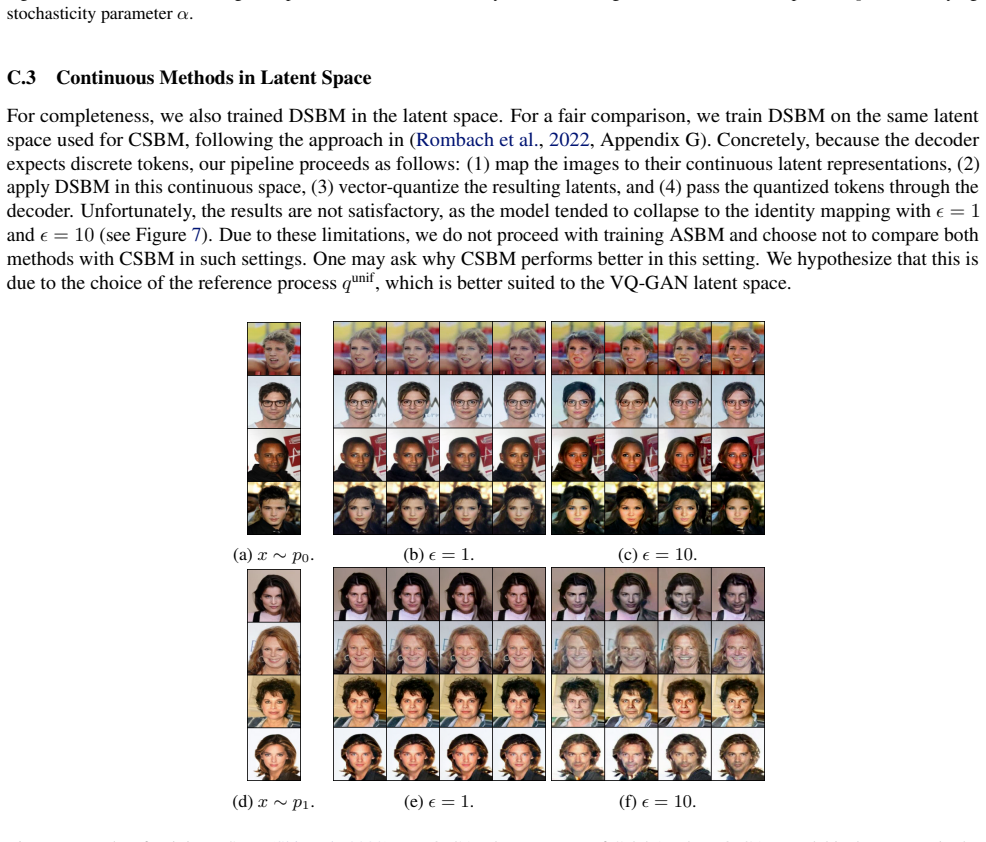
- CSBM can be applied to discrete data such as vector-quantized codebooks, text tokens, and categorical variables, as demonstrated on colored MNIST, CelebA latent spaces, and Amazon reviews.
- The theory requires only a finite number of time steps, and the paper notes that even $N=1$ intermediate step is enough for the characterization to hold.
- The practical algorithm works with both uniform and Gaussian-like categorical reference processes and inherits the diffusion-style training objective from discrete diffusion models.
- The paper's experiments indicate that CSBM attains competitive generative quality on unpaired image translation while operating directly on discrete tokens rather than continuous pixel space.
Reading between the lines
- An inference beyond the paper: the proof argument is stated to apply to general state spaces, which suggests the same characterization could yield a discrete-free variant of D-IMF for continuous spaces with arbitrary Markov references, not just the Wiener-process case.
- An inference beyond the paper: the full-support assumption on $p_0$, $p_1$, and $q_{\mathrm{ref}}$ is load-bearing, because the proof takes logarithms of strictly positive densities; extending the result to sparse or degenerate marginals may require a limiting argument or an explicit support-conditioned formulation.
- An inference beyond the paper: the algorithmic factorization over dimensions is not covered by the theorem, so the visual pixelation reported in the paper likely reflects this implementation gap rather than the convergence result; a testable extension would compare factorized transitions against copula-based or energy-based joint transitions on the same tasks.
- An inference beyond the paper: the paper observes that convergence behavior depends on the number of time steps $N$, so a quantitative convergence-rate analysis as a function of $N$, $\alpha$, and the reference process would be a natural next step.
Editorial analysis
A structured set of objections, weighed in public.
Referee Report
Summary. The paper studies the Schrödinger Bridge (SB) problem on finite discrete spaces X = S^D with a general full-support Markov reference process. Its main theoretical contribution is Theorem 3.1, which states that in this setting the dynamic SB solution q* is the unique process that is both Markov and reciprocal with respect to the reference. Based on this characterization, Corollary 3.2 claims that the discrete-time Iterative Markovian Fitting (D-IMF) procedure converges to q* in KL divergence. The paper then proposes a practical algorithm, Categorical Schrödinger Bridge Matching (CSBM), which implements the reciprocal and Markov projections using neural networks with a factorized parameterization, and reports experiments on synthetic data, colored MNIST, CelebA (via VQ-GAN latent codebooks), and Amazon Reviews sentiment transfer. The paper includes code and extensive appendices.
Significance. If the main claims hold, the paper fills a genuine gap in the Schrödinger Bridge literature: the discrete-state, discrete-time setting with a general Markov reference was listed as an open case in the authors' Table 1, whereas continuous-space analogues were covered by prior work (Shi et al. 2023; Gushchin et al. 2024b). The characterization theorem is clean and its proof is mostly self-contained, citing Leonard's standard result for the static SB. The proposed CSBM algorithm is a natural extension of D3PM-style discrete diffusion to a Schrödinger bridge setting, and the authors provide code and a range of experiments. However, the algorithmic convergence guarantee—the paper's central practical claim—is not actually proved, and the experimental comparison against continuous-space baselines is confounded by operating in different data spaces. These issues are load-bearing for the paper's core narrative, but they are fixable within the manuscript's scope.
major comments (3)
- [Section 4.4, Table 2] The convergence of D-IMF is asserted with the sentence 'the convergence easily follows from the generic proof argument in (Shi et al., 2023, Theorem 8)' and no proof is provided. Shi et al.'s Theorem 8 is a continuous-time result, and its proof relies on continuous-time machinery (Brownian bridges, Girsanov-type arguments) that does not automatically transfer to the finite discrete state space and arbitrary full-support Markov reference qref considered here. Theorem 3.1 characterizes q* but does not by itself establish that the alternating KL projections in Eq. (6) converge, or that the limit is q* rather than some other fixed point. Since Corollary 3.2 is the paper's core algorithmic guarantee, this is not a local omission: the authors should either give a self-contained proof for finite spaces (e.g., by viewing Eq. (6) as cyclic KL projections and invoking a finite-state alternating minimization theorem, or by adapting the argument of Shi et al. explicitly to this setting) or state a precise theorem with conditions under which convergence is guaranteed and defer to a complete proof.
- [Section 4.1] The quantitative comparison with ASBM and DSBM is not apples-to-apples: CSBM operates on discrete VQ-GAN latent tokens (S=1024, D=256), whereas ASBM and DSBM operate in continuous pixel space, and the comparison numbers are taken from (Gushchin et al., 2024b) rather than re-evaluated in a shared protocol. The better FID/CMMD/LPIPS values for CSBM could partly reflect the information already lost or organized in the VQ-GAN latent space, not a superiority of the SB solver. In addition, the CSBM metrics in Table 2 are reported without error bars or multiple seeds, so the claim that 'our approach achieves better results' is not statistically substantiated. I recommend reframing these results as an illustration rather than a head-to-head win, or providing a same-space comparison (e.g., decoding both methods' outputs to pixels and then computing metrics on the same decoded images).
- [Section 4.1] The numerical verification of D-IMF convergence is restricted to the symmetric qunif and qgauss reference processes. Corollary 3.2 claims convergence for any full-support Markov qref. Please add at least one asymmetric, non-reversible reference process (e.g., a Markov chain with a drift) to the synthetic convergence study, or explicitly state that the general case is not empirically tested. Without such a test, the paper's evidence for the broad claim in Corollary 3.2 is incomplete.
minor comments (6)
- [Figure 1 caption] The word 'stochastisity' should be 'stochasticity'.
- [Section 4, first paragraph] 'additional immages' should be 'additional images'.
- [Eq. (10)] The displayed L(m) has a minus sign before the term E_{qref(x_{t_N}|x_0,x_1)}[log m(x_1|x_{t_N})] that follows from the KL decomposition; the formatting makes it look like a separate term, so please clarify the derivation or restructure the equation.
- [Algorithm 1] In the forward step, sampling n ~ U[1, N+1] and then sampling x_{t_{n-1}} ~ qref(x_{t_{n-1}}|x_0,x_1) is ambiguous when n = N+1 because x_{t_N} is not defined as a state before x_1 in the forward chain; please clarify the indexing (e.g., define x_{t_0}=x_0, x_{t_{N+1}}=x_1, or restrict n to 1..N).
- [Table 5] The rows 'D-IMF=1 grad updates' and 'D-IMF grad updates' are confusing; consider renaming them 'gradient updates per D-IMF sweep' and 'total gradient updates per outer iteration'.
- [Appendix C.4] The statement 'manual inspection of the samples in Table 4 suggests that most generations convey the correct polarity' is subjective; reporting a quantitative polarity score on the generated samples would be more convincing.
Circularity Check
No significant circularity: the main characterization is derived from first principles against external static-SB theory; the D-IMF convergence corollary is an unproved transfer from Shi et al., not a circular reduction.
full rationale
The derivation chain is not circular. Theorem 3.1 starts from the assumed Markov and reciprocal properties of q* and derives log q(x1|x0) - log qref(x0,x1) = f0(x0,xtn) + f1(xtn,x1); fixing x-dagger shows the additive separation into g0(x0)+g1(x1), yielding q(x0,x1) = psi(x0) qref(x1|x0) phi(x1). The identification of this factorized form with the static Schrodinger Bridge solution is imported from Leonard (2013, Theorem 2.8), an external measure-theoretic result, not from the present authors' prior work. The dynamic conclusion then follows because q* carries the reference conditional bridge, i.e. is reciprocal, which is the standard decomposition in Eq. (4), not an assumption equivalent to the conclusion. Corollary 3.2 is the one genuinely unsupported step: it asserts KL convergence of the D-IMF iterates by saying it 'easily follows from the generic proof argument in (Shi et al., 2023, Theorem 8)' without supplying the transfer argument for finite state spaces and general Markov qref. That is an omitted proof and a transfer risk, but it is not circular: Shi et al. is external, and the convergence claim is not obtained by renaming a fitted parameter or by defining q* as the limit of Eq. (6). Self-citations to Gushchin et al. (2024b) define the D-IMF projections and supply Proposition 3.5 used in Proposition 3.3; these are non-load-bearing for the main characterization, and the cited claims are independently checkable mathematical statements. The free parameters alpha and lambda are tuning choices, and the convergence experiment uses the Sinkhorn algorithm as an external ground truth. Appendix A itself flags the factorization limitation and a negligible implementation discrepancy; those are limitations, not circular reductions. No step reduces by construction to its own input, so the paper receives a low score reflecting only minor, non-load-bearing self-citations.
Assumptions & free parameters
free parameters (3)
- stochasticity parameter α =
per-experiment: 0.005, 0.01 for CelebA; 0.01, 0.05 for MNIST; etc.
- loss weight λ (L_simple) =
0.001 for all experiments
- number of time steps N =
varies: 2,4,10,25,50,100
assumptions (3)
- domain assumption The reference process qref is Markov with full support on X^{N+2}, and p0, p1 have full support.
- standard math The static Schrödinger Bridge solution has the form q(x0,x1)=ψ(x0)qref(x1|x0)φ(x1) (Leonard 2013, Theorem 2.8).
- domain assumption The D-IMF alternating projection scheme (Eq. 6) converges in KL to the unique Markovian-reciprocal process; this is assumed to transfer from Shi et al. 2023, Theorem 8.
Cite this review
Pith. "Pith review of Categorical Schr\"odinger Bridge Matching." pith.science (2026). https://pith.science/paper/RRWOBAVJ
@misc{pith2026250201416,
  author       = {Pith},
  title        = {Pith review of: Categorical Schr\"odinger Bridge Matching},
  year         = {2026},
  howpublished = {\url{https://pith.science/paper/RRWOBAVJ}},
  note         = {Machine review of arXiv:2502.01416}
}
abstract
The Schr\"odinger Bridge (SB) is a powerful framework for solving generative modeling tasks such as unpaired domain translation. Most SB-related research focuses on continuous data space $\mathbb{R}^{D}$ and leaves open theoretical and algorithmic questions about applying SB methods to discrete data, e.g, on finite spaces $\mathbb{S}^{D}$. Notable examples of such sets $\mathbb{S}$ are codebooks of vector-quantized (VQ) representations of modern autoencoders, tokens in texts, categories of atoms in molecules, etc. In this paper, we provide a theoretical and algorithmic foundation for solving SB in discrete spaces using the recently introduced Iterative Markovian Fitting (IMF) procedure. Specifically, we theoretically justify the convergence of discrete-time IMF (D-IMF) to SB in discrete spaces. This enables us to develop a practical computational algorithm for SB, which we call Categorical Schr\"odinger Bridge Matching (CSBM). We show the performance of CSBM via a series of experiments with synthetic data and VQ representations of images. The code of CSBM is available at https://github.com/gregkseno/csbm.
Figures


Figures from the paper (9 more)




Forward citations
Cited by 1 Pith paper
-
Discrete Diffusion Models: A Unified Framework from Tokenization to Generation
Discrete diffusion models are re-framed as instances of a tokenization-centric, four-component design space (corruption, denoiser, objective, sampler) in a broad survey with no new experimental or theoretical results.
Reference graph
Works this paper leans on
-
[1]
write newline
" write newline "" before.all 'output.state := FUNCTION n.dashify 't := "" t empty not t #1 #1 substring "-" = t #1 #2 substring "--" = not "--" * t #2 global.max substring 't := t #1 #1 substring "-" = "-" * t #2 global.max substring 't := while if t #1 #1 substring * t #2 global.max substring 't := if while FUNCTION format.date year duplicate empty "emp...
-
[2]
D., Ho, J., Tarlow, D., and Van Den Berg, R
Austin, J., Johnson, D. D., Ho, J., Tarlow, D., and Van Den Berg, R. Structured denoising diffusion models in discrete state-spaces. Advances in Neural Information Processing Systems, 34: 0 17981--17993, 2021
2021
-
[3]
Banerjee, A., Merugu, S., Dhillon, I. S., and Ghosh, J. Clustering with Bregman divergences. Journal of machine learning research, 6 0 (Oct): 0 1705--1749, 2005
work page 2005
-
[4]
Campbell, A., Yim, J., Barzilay, R., Rainforth, T., and Jaakkola, T. Generative flows on discrete state-spaces: Enabling multimodal flows with applications to protein co-design. In Salakhutdinov, R., Kolter, Z., Heller, K., Weller, A., Oliver, N., Scarlett, J., and Berkenkamp, F. (eds.), Proceedings of the 41st International Conference on Machine Learning...
work page 2024
-
[5]
Likelihood training of Schr \"o dinger bridge using forward-backward SDEs theory
Chen, T., Liu, G.-H., and Theodorou, E. Likelihood training of Schr \"o dinger bridge using forward-backward SDEs theory. In International Conference on Learning Representations, 2022
work page 2022
-
[6]
Sinkhorn distances: Lightspeed computation of optimal transport
Cuturi, M. Sinkhorn distances: Lightspeed computation of optimal transport. Advances in neural information processing systems, 26, 2013
2013
-
[7]
Diffusion Schr \"o dinger bridge with applications to score-based generative modeling
De Bortoli, V., Thornton, J., Heng, J., and Doucet, A. Diffusion Schr \"o dinger bridge with applications to score-based generative modeling. Advances in Neural Information Processing Systems, 34: 0 17695--17709, 2021
work page 2021
-
[8]
Schr\"odinger bridge flow for unpaired data translation
De Bortoli, V., Korshunova, I., Mnih, A., and Doucet, A. Schr\"odinger bridge flow for unpaired data translation. In The Thirty-eighth Annual Conference on Neural Information Processing Systems, 2024. URL https://openreview.net/forum?id=1F32iCJFfa
work page 2024
Show all 66 references
-
[9]
Rates of estimation of optimal transport maps using plug-in estimators via barycentric projections
Deb, N., Ghosal, P., and Sen, B. Rates of estimation of optimal transport maps using plug-in estimators via barycentric projections. Advances in Neural Information Processing Systems, 34: 0 29736--29753, 2021
2021
-
[10]
Decentralize and randomize: Faster algorithm for W asserstein barycenters
Dvurechenskii, P., Dvinskikh, D., Gasnikov, A., Uribe, C., and Nedich, A. Decentralize and randomize: Faster algorithm for W asserstein barycenters. In Advances in Neural Information Processing Systems, pp.\ 10760--10770, 2018
2018
-
[11]
Computational optimal transport: Complexity by accelerated gradient descent is better than by Sinkhorn ’s algorithm
Dvurechensky, P., Gasnikov, A., and Kroshnin, A. Computational optimal transport: Complexity by accelerated gradient descent is better than by Sinkhorn ’s algorithm. In International conference on machine learning, pp.\ 1367--1376. PMLR, 2018
2018
-
[12]
Taming transformers for high-resolution image synthesis
Esser, P., Rombach, R., and Ommer, B. Taming transformers for high-resolution image synthesis. In Proceedings of the IEEE/CVF conference on computer vision and pattern recognition, pp.\ 12873--12883, 2021
2021
-
[13]
T., Synnaeve, G., Adi, Y., and Lipman, Y
Gat, I., Remez, T., Shaul, N., Kreuk, F., Chen, R. T., Synnaeve, G., Adi, Y., and Lipman, Y. Discrete flow matching. In The Thirty-eighth Annual Conference on Neural Information Processing Systems, 2024
2024
-
[14]
Generative adversarial nets
Goodfellow, I., Pouget-Abadie, J., Mirza, M., Xu, B., Warde-Farley, D., Ozair, S., Courville, A., and Bengio, Y. Generative adversarial nets. In Advances in neural information processing systems, pp.\ 2672--2680, 2014
2014
-
[15]
Vector quantized diffusion model for text-to-image synthesis
Gu, S., Chen, D., Bao, J., Wen, F., Zhang, B., Chen, D., Yuan, L., and Guo, B. Vector quantized diffusion model for text-to-image synthesis. In Proceedings of the IEEE/CVF conference on computer vision and pattern recognition, pp.\ 10696--10706, 2022
2022
-
[16]
Entropic neural optimal transport via diffusion processes
Gushchin, N., Kolesov, A., Korotin, A., Vetrov, D., and Burnaev, E. Entropic neural optimal transport via diffusion processes. In Advances in Neural Information Processing Systems, 2023 a
2023
-
[17]
Building the bridge of Schr\"odinger : A continuous entropic optimal transport benchmark
Gushchin, N., Kolesov, A., Mokrov, P., Karpikova, P., Spiridonov, A., Burnaev, E., and Korotin, A. Building the bridge of Schr\"odinger : A continuous entropic optimal transport benchmark. In Thirty-seventh Conference on Neural Information Processing Systems Datasets and Bench...
2023
-
[18]
Light and optimal Schr \"o dinger bridge matching
Gushchin, N., Kholkin, S., Burnaev, E., and Korotin, A. Light and optimal Schr \"o dinger bridge matching. In Forty-first International Conference on Machine Learning, 2024 a
2024
-
[19]
Adversarial Schr\"odinger bridge matching
Gushchin, N., Selikhanovych, D., Kholkin, S., Burnaev, E., and Korotin, A. Adversarial Schr\"odinger bridge matching. In The Thirty-eighth Annual Conference on Neural Information Processing Systems, 2024 b . URL https://openreview.net/forum?id=L3Knnigicu
2024
-
[20]
A probabilistic formulation of unsupervised text style transfer
He, J., Wang, X., Neubig, G., and Berg-Kirkpatrick, T. A probabilistic formulation of unsupervised text style transfer. In International Conference on Learning Representations, 2020
2020
-
[21]
GAN s trained by a two time-scale update rule converge to a local Nash equilibrium
Heusel, M., Ramsauer, H., Unterthiner, T., Nessler, B., and Hochreiter, S. GAN s trained by a two time-scale update rule converge to a local Nash equilibrium. In Advances in neural information processing systems, pp.\ 6626--6637, 2017
2017
-
[22]
Denoising diffusion probabilistic models
Ho, J., Jain, A., and Abbeel, P. Denoising diffusion probabilistic models. Advances in Neural Information Processing Systems, 33: 0 6840--6851, 2020
2020
-
[23]
Argmax flows and multinomial diffusion: Learning categorical distributions
Hoogeboom, E., Nielsen, D., Jaini, P., Forr \'e , P., and Welling, M. Argmax flows and multinomial diffusion: Learning categorical distributions. Advances in Neural Information Processing Systems, 34: 0 12454--12465, 2021
2021
-
[24]
and Rigollet, P
H \"u tter, J.-C. and Rigollet, P. Minimax estimation of smooth optimal transport maps. 2021
2021
-
[25]
Categorical reparameterization with Gumbel -softmax
Jang, E., Gu, S., and Poole, B. Categorical reparameterization with Gumbel -softmax. In International Conference on Learning Representations, 2017
2017
-
[26]
Rethinking FID : Towards a better evaluation metric for image generation
Jayasumana, S., Ramalingam, S., Veit, A., Glasner, D., Chakrabarti, A., and Kumar, S. Rethinking FID : Towards a better evaluation metric for image generation. In Proceedings of the IEEE/CVF Conference on Computer Vision and Pattern Recognition, pp.\ 9307--9315, 2024
2024
-
[27]
Diffusion & adversarial Schr\"odinger bridges via iterative proportional Markovian fitting
Kholkin, S., Ksenofontov, G., Li, D., Kornilov, N., Gushchin, N., Burnaev, E., and Korotin, A. Diffusion & adversarial Schr\"odinger bridges via iterative proportional Markovian fitting. arXiv preprint arXiv:2410.02601, 2024
2024
-
[28]
H., Kim, S., Moon, S., Kim, H., Woo, J., and Kim, W
Kim, J. H., Kim, S., Moon, S., Kim, H., Woo, J., and Kim, W. Y. Discrete diffusion Schr\"odinger bridge matching for graph transformation. arXiv preprint arXiv:2410.01500, 2024
2024 arXiv
-
[29]
Light Schr \"o dinger bridge
Korotin, A., Gushchin, N., and Burnaev, E. Light Schr \"o dinger bridge. In The Twelfth International Conference on Learning Representations, 2024
2024
-
[30]
and Richardson, J
Kudo, T. and Richardson, J. SentencePiece : A simple and language independent subword tokenizer and detokenizer for neural text processing. In Proceedings of the 2018 Conference on Empirical Methods in Natural Language Processing: System Demonstrations, pp.\ 66--71, 2018
2018
-
[31]
A survey of the Schr\"odinger problem and some of its connections with optimal transport
L \'e onard, C. A survey of the Schr\"odinger problem and some of its connections with optimal transport. arXiv preprint arXiv:1308.0215, 2013
2013 arXiv
-
[32]
Reciprocal processes
L \'e onard, C., R lly, S., and Zambrini, J.-C. Reciprocal processes. a measure-theoretical point of view. Probability Surveys, 11: 0 237--269, 2014
2014
-
[33]
Delete, retrieve, generate: a simple approach to sentiment and style transfer
Li, J., Jia, R., He, H., and Liang, P. Delete, retrieve, generate: a simple approach to sentiment and style transfer. In Proceedings of the 2018 Conference of the North American Chapter of the Association for Computational Linguistics: Human Language Technologies, Volume 1 (Lo...
2018
-
[34]
Liu, A., Broadrick, O., Niepert, M., and Broeck, G. V. d. Discrete copula diffusion. arXiv preprint arXiv:2410.01949, 2024
2024 arXiv
-
[35]
Deep generalized Schr \"o dinger bridge
Liu, G.-H., Chen, T., So, O., and Theodorou, E. Deep generalized Schr \"o dinger bridge. Advances in Neural Information Processing Systems, 35: 0 9374--9388, 2022 a
2022
-
[36]
I ^2 sb: Image-to-image Schr \"o dinger bridge
Liu, G.-H., Vahdat, A., Huang, D.-A., Theodorou, E., Nie, W., and Anandkumar, A. I ^2 sb: Image-to-image Schr \"o dinger bridge. In International Conference on Machine Learning, pp.\ 22042--22062. PMLR, 2023
2023
-
[37]
Flow straight and fast: Learning to generate and transfer data with rectified flow
Liu, X., Gong, C., et al. Flow straight and fast: Learning to generate and transfer data with rectified flow. In The Eleventh International Conference on Learning Representations, 2022 b
2022
-
[38]
Towards fine-grained text sentiment transfer
Luo, F., Li, P., Yang, P., Zhou, J., Tan, Y., Chang, B., Sui, Z., and Sun, X. Towards fine-grained text sentiment transfer. In Proceedings of the 57th Annual Meeting of the Association for Computational Linguistics, pp.\ 2013--2022, 2019
2013
-
[39]
CrystalFlow : A flow-based generative model for crystalline materials
Luo, X., Wang, Z., Lv, J., Wang, L., Wang, Y., and Ma, Y. CrystalFlow : A flow-based generative model for crystalline materials. arXiv preprint arXiv:2412.11693, 2024
2024
-
[40]
Plugin estimation of smooth optimal transport maps
Manole, T., Balakrishnan, S., Niles-Weed, J., and Wasserman, L. Plugin estimation of smooth optimal transport maps. The Annals of Statistics, 52 0 (3): 0 966--998, 2024
2024
-
[41]
Energy-guided entropic neural optimal transport
Mokrov, P., Korotin, A., Kolesov, A., Gushchin, N., and Burnaev, E. Energy-guided entropic neural optimal transport. In The Twelfth International Conference on Learning Representations, 2024. URL https://openreview.net/forum?id=d6tUsZeVs7
2024
-
[42]
Balancing the style-content trade-off in sentiment transfer using polarity-aware denoising
Mukherjee, S., Kasner, Z., and Du s ek, O. Balancing the style-content trade-off in sentiment transfer using polarity-aware denoising. In International Conference on Text, Speech, and Dialogue, pp.\ 172--186. Springer, 2022
2022
-
[43]
Justifying recommendations using distantly-labeled reviews and fine-grained aspects
Ni, J., Li, J., and McAuley, J. Justifying recommendations using distantly-labeled reviews and fine-grained aspects. In Proceedings of the 2019 conference on empirical methods in natural language processing and the 9th international joint conference on natural language process...
2019
-
[44]
BLEU : a method for automatic evaluation of machine translation
Papineni, K., Roukos, S., Ward, T., and Zhu, W.-J. BLEU : a method for automatic evaluation of machine translation. In Proceedings of the 40th annual meeting of the Association for Computational Linguistics, pp.\ 311--318, 2002
2002
-
[45]
Unbalanced diffusion Schr\"odinger bridge
Pariset, M., Hsieh, Y.-P., Bunne, C., Krause, A., and De Bortoli, V. Unbalanced diffusion Schr\"odinger bridge. arXiv preprint arXiv:2306.09099, 2023
2023 arXiv
-
[46]
and Xie, S
Peebles, W. and Xie, S. Scalable diffusion models with transformers. In Proceedings of the IEEE/CVF international conference on computer vision, pp.\ 4195--4205, 2023
2023
-
[47]
Diffusion bridge mixture transports, Schr \"o dinger bridge problems and generative modeling
Peluchetti, S. Diffusion bridge mixture transports, Schr \"o dinger bridge problems and generative modeling. Journal of Machine Learning Research, 24 0 (374): 0 1--51, 2023
2023
-
[48]
Computational optimal transport
Peyr \'e , G., Cuturi, M., et al. Computational optimal transport. Foundations and Trends in Machine Learning , 11 0 (5-6): 0 355--607, 2019
2019
-
[49]
and Niles-Weed, J
Pooladian, A.-A. and Niles-Weed, J. Entropic estimation of optimal transport maps. arXiv preprint arXiv:2109.12004, 2021
2021 arXiv
-
[50]
Prabhumoye, S., Tsvetkov, Y., Salakhutdinov, R., and Black, A. W. Style transfer through back-translation. In Proceedings of the 56th Annual Meeting of the Association for Computational Linguistics (Volume 1: Long Papers), pp.\ 866--876, 2018
2018
-
[51]
DeFoG : Discrete flow matching for graph generation
Qin, Y., Madeira, M., Thanou, D., and Frossard, P. DeFoG : Discrete flow matching for graph generation. arXiv preprint arXiv:2410.04263, 2024
2024 arXiv
-
[52]
Language models are unsupervised multitask learners
Radford, A., Wu, J., Child, R., Luan, D., Amodei, D., Sutskever, I., et al. Language models are unsupervised multitask learners. OpenAI blog, 1 0 (8): 0 9, 2019
2019
-
[53]
High-resolution image synthesis with latent diffusion models
Rombach, R., Blattmann, A., Lorenz, D., Esser, P., and Ommer, B. High-resolution image synthesis with latent diffusion models. In Proceedings of the IEEE/CVF Conference on Computer Vision and Pattern Recognition, pp.\ 10684--10695, 2022
2022
-
[54]
U-net: Convolutional networks for biomedical image segmentation
Ronneberger, O., Fischer, P., and Brox, T. U-net: Convolutional networks for biomedical image segmentation. In Medical image computing and computer-assisted intervention--MICCAI 2015: 18th international conference, Munich, Germany, October 5-9, 2015, proceedings, part III 18, ...
2015
-
[55]
Improved techniques for training GAN s
Salimans, T., Goodfellow, I., Zaremba, W., Cheung, V., Radford, A., and Chen, X. Improved techniques for training GAN s. In Advances in neural information processing systems, pp.\ 2234--2242, 2016
2016
-
[56]
o dinger, E. \
Schr \"o dinger, E. \"U ber die Umkehrung der Naturgesetze . Verlag der Akademie der Wissenschaften in Kommission bei Walter De Gruyter u. Company, 1931
1931
-
[57]
Style transfer from non-parallel text by cross-alignment
Shen, T., Lei, T., Barzilay, R., and Jaakkola, T. Style transfer from non-parallel text by cross-alignment. Advances in neural information processing systems, 30, 2017
2017
-
[58]
D., Campbell, A., and Doucet, A
Shi, Y., Bortoli, V. D., Campbell, A., and Doucet, A. Diffusion Schr\"odinger bridge matching. In Thirty-seventh Conference on Neural Information Processing Systems, 2023. URL https://openreview.net/forum?id=qy07OHsJT5
2023
-
[59]
Y., Malkin, N., Fatras, K., Atanackovic, L., Zhang, Y., Huguet, G., Wolf, G., and Bengio, Y
Tong, A. Y., Malkin, N., Fatras, K., Atanackovic, L., Zhang, Y., Huguet, G., Wolf, G., and Bengio, Y. Simulation-free Schr \"o dinger bridges via score and flow matching. In International Conference on Artificial Intelligence and Statistics, pp.\ 1279--1287. PMLR, 2024
2024
-
[60]
Neural discrete representation learning
Van Den Oord, A., Vinyals, O., et al. Neural discrete representation learning. Advances in neural information processing systems, 30, 2017
2017
-
[61]
Solving Schr \"o dinger bridges via maximum likelihood
Vargas, F., Thodoroff, P., Lamacraft, A., and Lawrence, N. Solving Schr \"o dinger bridges via maximum likelihood. Entropy, 23 0 (9): 0 1134, 2021
2021
-
[62]
Digress: Discrete denoising diffusion for graph generation
Vignac, C., Krawczuk, I., Siraudin, A., Wang, B., Cevher, V., and Frossard, P. Digress: Discrete denoising diffusion for graph generation. arXiv preprint arXiv:2209.14734, 2022
2022 arXiv
-
[63]
Controllable unsupervised text attribute transfer via editing entangled latent representation
Wang, K., Hua, H., and Wan, X. Controllable unsupervised text attribute transfer via editing entangled latent representation. Advances in Neural Information Processing Systems, 32, 2019
2019
-
[64]
Energy-based diffusion language models for text generation
Xu, M., Geffner, T., Kreis, K., Nie, W., Xu, Y., Leskovec, J., Ermon, S., and Vahdat, A. Energy-based diffusion language models for text generation. arXiv preprint arXiv:2410.21357, 2024
2024 arXiv
-
[65]
A., Shechtman, E., and Wang, O
Zhang, R., Isola, P., Efros, A. A., Shechtman, E., and Wang, O. The unreasonable effectiveness of deep features as a perceptual metric. In Proceedings of the IEEE conference on computer vision and pattern recognition, pp.\ 586--595, 2018
2018
-
[66]
Zhu, J.-Y., Park, T., Isola, P., and Efros, A. A. Unpaired image-to-image translation using cycle-consistent adversarial networks. In Proceedings of the IEEE international conference on computer vision, pp.\ 2223--2232, 2017
2017
Reviewed August 9, 2026 · model on record in the stance chip above.
Discussion (0). Continue with ORCID to comment.