REVIEW 3 major objections 6 minor 67 references
Stage-V galaxy surveys can resolve the mass-dependent shape of inflationary non-Gaussianity, not only its amplitude, once local PNG is detected at high significance.
Reviewed by Pith at T0; open to challenge. T0 means a machine referee read the full paper against a public rubric. the ladder, T0–T4 →
T0 review · grok-4.5
2026-07-30 11:00 UTC pith:RXEQRUA3
load-bearing objection Solid methods-and-forecast paper: first real-data beyond-local ACF on DESI Imaging plus a usable Stage-V σ(Δ)–σ(f_NL^loc) planning bridge, carefully caveated and not oversold. the 3 major comments →
Searching for signatures of inflationary massive fields in DESI Imaging data and Stage-V galaxy surveys
The pith
A machine-rendered reading of the paper's core claim, the machinery that carries it, and where it could break.
Core claim
For Stage-V LBG surveys near the local limit (Δ^fid=0, f_NL,Δ^fid=4), free-bias forecasts give σ(Δ)≃0.17 (WST), 0.34 (MUST) and 0.50 (Spec-S5). Above a reference local significance of roughly 4, the constraints from different surveys collapse onto the common power law σ(Δ)≃1.27 SNR_loc,ref^−0.90; the same scaling can be generalized to nonzero Δ^fid through fitted amplitude and slope functions of Δ. DESI Imaging under a less aggressive weight set yields a non-robust preference f_NL,Δ≈5×10^3, Δ≈0.91 that illustrates how such a mapping works on real data.
What carries the argument
The linear scale-dependent bias induced by the squeezed massive-field bispectrum: b(k,z)=b+f_NL,Δ(k R_*)^Δ 2δ_c(b−p)α(k,z), with Δ=3/2−√(9/4−m²/H²). This single expression carries both the DESI parameter mapping and the Stage-V forecast relation between σ(Δ) and local-PNG sensitivity.
Load-bearing premise
The whole analysis assumes the massive-field signal is completely captured by that linear k^{Δ−2} bias formula with fixed universality and a single short-mode smoothing radius; if higher-order bias or residual large-scale systematics change the shape, both the DESI mapping and the forecast relation misestimate the true reach.
What would settle it
Inject controlled Δ signatures into DESI-like imaging mocks, re-run the identical angular-correlation pipeline under the same weight maps, and check whether the recovered (f_NL,Δ, Δ) posterior centers on the injected values and whether the Stage-V power-law σ(Δ)–SNR relation still holds when the mocks include realistic residual systematics.
If this is right
- A Stage-V detection of local PNG at SNR≳4 automatically supplies a quantitative handle on whether the signal is exactly local or carries a massive-field tilt Δ.
- External priors that pin down galaxy bias can shrink σ(Δ) by roughly 60 percent, turning a marginal shape measurement into a decisive one.
- The inverted relation σ_req(f_NL^loc)≃f_NL,Δ^fid [σ_target(Δ)/A(Δ)]^{1/m(Δ)} gives survey designers a concrete sensitivity target for any predicted (f_NL,Δ, Δ) pair.
- Larger fiducial Δ weakens the scale dependence and forces surveys to reach still smaller σ(f_NL^loc) before Δ itself becomes measurable.
Where Pith is reading between the lines
- If residual imaging systematics can mimic Δ≈0.9 as readily as they mimic local f_NL, then any future claim of massive fields from photometry will need multi-tracer or spectroscopic cross-checks before it can be trusted.
- The same SNR-scaling logic should apply to other squeezed templates (e.g., equilateral-to-squeezed hybrids) once their effective Δ is defined, offering a cheap forecast shortcut without full Fisher matrices.
- A null Stage-V result at the forecasted σ(Δ) would push the lightest extra fields during inflation above m∼H, tightening the window on quasi-single-field models.
Editorial analysis
A structured set of objections, weighed in public.
Referee Report
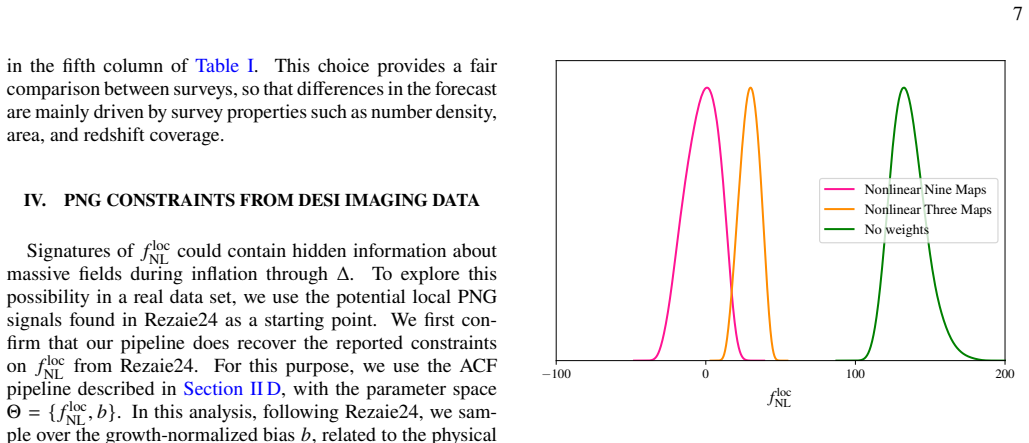
Summary. This paper searches for inflationary massive-field signatures via beyond-local primordial non-Gaussianity in the scale-dependent galaxy bias, parameterized by amplitude f_NL,Δ and scaling Δ (Eq. 5). Using the angular correlation function on DESI Legacy Imaging LRGs, the authors validate their pipeline against the local-PNG results of Rezaie et al. (2024), recover no local signal under the most aggressive (nine-map) decontamination, and find a non-robust preference f_NL^loc≈27 and (f_NL,Δ,Δ)≈(5×10^3,0.91) under three-map weights, which they present only as a methodological showcase given residual systematics. They then forecast Stage-V LBG surveys (WST, MUST, Spec-S5), reporting σ(Δ)≃0.17–0.50 around Δ^fid=0 for f_NL,Δ^fid=4, and derive an empirical bridge σ(Δ)≃A(Δ^fid) SNR_loc,ref^{-m(Δ^fid)} that can be inverted into a required local-PNG sensitivity for a target σ(Δ).
Significance. If the forecast results hold within the stated model class, the paper supplies a practical planning relation connecting Stage-V local-PNG reach to the ability to resolve departures from the local squeezed limit—something not previously quantified for WST/MUST/Spec-S5 LBG samples in this parameterization. Strengths include: (i) real-data validation of the ACF+integral-constraint pipeline against Rezaie24 across three systematics treatments; (ii) nested sampling of the highly degenerate (f_NL,Δ,Δ,b) space with explicit prior-volume discussion; (iii) clear non-claim of a massive-field detection in DESI Imaging; and (iv) a falsifiable, survey-comparable SNR scaling that collapses different Stage-V setups onto a common curve above a significance threshold. The work is incremental rather than transformative, but useful for Stage-V design discussions.
major comments (3)
- [Section V, Eqs. (22)–(27)] §V.A–B, Eqs. (22)–(27) and Figs. 4 and 6: The central planning tool σ(Δ)≃A(Δ^fid) SNR_loc,ref^{-m(Δ^fid)} is obtained by fitting the authors’ own forecasts after discarding the low-SNR funnel regime (SNR_loc,ref≲4 for Δ^fid=0; analogous cuts for nonzero Δ^fid). The fit therefore inherits the full forecast idealization—linear scale-dependent bias with fixed p=1 and single R_* (Eq. 5), linear Kaiser RSD, fixed cosmology, and diagonal PS covariance. The abstract and §VI present the inverted relation as a general survey-sensitivity estimator. Please state the domain of validity explicitly (model class and SNR cuts), and either (a) add a brief robustness test varying p and/or R_*, or (b) reframe Eq. (27)/Table IV as an in-model benchmark rather than a model-independent requirement. Without that, the claimed generality for survey planning is overstated.
- [Section II.A, Equation (5)] §II.A, Eq. (5): The entire DESI mapping and Stage-V σ(Δ)–SNR relation assume b(k,z)=b+f_NL,Δ(kR_*)^Δ 2δ_c(b−p)α(k,z) with universality p=1 and a single short-mode radius R_*≃2.66 h^{-1} Mpc tied to 10^{13} M_⊙ halos. LBGs in the Stage-V forecasts are lower-mass, higher-z tracers; a tracer-dependent p or R_* would change the k^{Δ−2} shape that breaks the f_NL,Δ–Δ degeneracy. The paper should quantify (even approximately) how σ(Δ) and the fitted A(Δ), m(Δ) shift under plausible p≠1 or R_* variations, or justify why the LRG-calibrated R_* remains appropriate for the LBG forecasts in Table I.
- [Section IV, Table II] §IV, Table II and the Δχ^2=3.95 (≈2.3σ via Chernoff) preference for beyond-local PNG under Nonlinear Three Maps at 0.5°<θ<25°: The text correctly states the preference is not robust and is likely residual systematics, yet still quotes closed 1D constraints Δ=0.91^{+0.25}_{-0.19} and a model-comparison significance. Given that the nine-map case yields only a prior-driven one-sided limit and the unweighted sample produces a spurious closed Δ≈0.22, please either (i) demote the Three-Maps beyond-local numbers to an appendix illustration without 1D medians in the main table, or (ii) add a quantitative statement that no decontamination scheme yields a stable Δ preference, so that the showcase cannot be misread as a data-driven mass constraint.
minor comments (6)
- [Abstract / full text] Throughout the compiled text there are widespread missing word spaces (e.g., abstract opening, §I). These appear to be PDF-extraction artifacts but should be checked in the journal source.
- [Section II.D] §II.D: DESI Imaging uses Ω_m=0.25, n_s=0.95, h=0.7 while Stage-V forecasts use Planck 2018 values. A one-sentence justification that this does not affect the pipeline validation or the relative Stage-V comparison would help.
- [Section II.C, Figure 1] Figure 1 bottom panel and Eq. (13): θ_lim∼140° for the integral constraint vs θ_max=20–25° in the data vector is important; consider marking θ_lim on the figure or stating the RR-weighted effective scale more explicitly.
- [Table I] Table I: Spec-S5 is listed with only u- and g-dropouts (no r-dropout), while WST/MUST include r-dropouts. The text explains LSST-based selection, but a footnote in the table would prevent misreading the survey comparison.
- [Section V.B, Figure 5] §V.B, Figure 5: For Δ^fid=1.0 the free-bias posterior hits the Δ prior edge; the caption could note that the reported lower limit is prior-bounded, consistent with the DESI nine-map behavior.
- [References] References: several 2025–2026 arXiv entries are cited as published journal pages (e.g., JCAP 2025/2026). Verify final bibliographic status at acceptance.
Circularity Check
No load-bearing circularity: DESI fits are external-data constraints; Stage-V scalings are honest empirical summaries of the authors' own forecasts, not disguised first-principles predictions.
specific steps
-
fitted input called prediction
[§V.A–B, Eqs. 22–27, Figs. 4 and 6]
"For the free-bias case, the common trend is well described by the empirical relation σ(Δ)≃1.27 SNR_loc,ref^{-0.90}... After removing the low significance points affected by projection effects, the constraints are well described by the empirical relation σ(Δ)≃A(Δ^fid)SNR_loc,ref^{-m(Δ^fid)}. ... For a target uncertainty σ_target(Δ), the same relation can be inverted to estimate the local PNG sensitivity required... σ_req(f_NL^loc)≃f_NL,Δ^fid [σ_target(Δ)/A(Δ)]^{1/m(Δ)}."
SNR_loc,ref and σ(Δ) are both outputs of the same Stage-V forecast pipeline; the power-law coefficients (and the SNR≳4 cut) are fit to those outputs, then inverted to quote a 'required' σ(f_NL^loc). The inverted requirement therefore restates the fitted forecast grid inside the assumed linear bias model rather than independently predicting survey reach. Mild and disclosed as empirical—not a definitional identity or a fake detection.
full rationale
The DESI Imaging section applies an external massive-field bias template (Eq. 5, from the literature) to public catalogs under stated systematics treatments; posteriors on (f_NL,Δ, Δ) are ordinary likelihood fits, and the paper explicitly disclaims cosmological interpretation when the signal is mitigation-dependent. Stage-V results are standard theory-vector forecasts: the data vector equals the model at Θ_fid by construction (stated in §II.D), which is the normal setup for sensitivity studies and does not force the reported σ(Δ) values or the near-inverse SNR scaling. The empirical relations σ(Δ)≃1.27 SNR_loc,ref^{-0.90} and the later A(Δ^fid), m(Δ^fid) fits (§V, Eqs. 23–27) are fitted summaries of that same forecast grid, then inverted as a planning tool. That is mild re-packaging of self-generated numbers, not a self-definitional loop or a statistically forced 'prediction' of an independent observable. Self-citations (Riquelme23 pipeline; Rezaie24 data) supply methods and comparison benchmarks and are cross-checked against an independent harmonic-space analysis. No uniqueness theorem or ansatz is smuggled in to forbid alternatives. Overall circularity is negligible.
Axiom & Free-Parameter Ledger
free parameters (6)
- f_NL,Δ (and f_NL^loc) =
DESI Three Maps: 5.12^{+6.13}_{-3.62}×10^3; forecasts use fiducials 4 and 18 (and 16)
- Δ =
DESI Three Maps showcase: 0.91^{+0.25}_{-0.19}
- galaxy linear bias b =
fiducial DESI ~1.9; Stage-V dropout fiducials 4.5–6.4
- R_* short-mode smoothing scale =
2.66 h^{-1} Mpc
- Empirical SNR scaling coefficients (1.27, −0.90; A(Δ), m(Δ)) =
σ(Δ)≃1.27 SNR^{-0.90}; m≃0.72+0.50Δ; A≃0.32 e^{5.60Δ} (fixed-bias)
- Fixed background cosmology =
DESI: Ωm=0.25, σ8=0.8, h=0.7; Stage-V: Planck-like Ωm=0.31, As=2.1e-9
axioms (6)
- domain assumption Squeezed massive-field bispectrum B_ζ ∝ f_NL,Δ (k_S/k_L)^Δ P_ζ(k_S)P_ζ(k_L) for m<3H/2, with Δ=3/2−√(9/4−m²/H²)
- domain assumption PNG imprints only through linear scale-dependent bias with universal mass-function response p=1 and δ_c=1.686
- domain assumption Observed clustering on used scales is described by linear Kaiser RSD times matter PS from CAMB, with Gaussian covariance
- domain assumption Flat priors and fixed-ΛCDM background; integral constraint fully captures survey-mean effects on large-angle ACF
- ad hoc to paper Stage-V LBG number densities, areas, and bias(z) from white papers plus Wilson & White-style bias formula are adequate forecast inputs
- standard math Nested-sampling posterior widths under the model equal expected experimental uncertainties
read the original abstract
We investigate the cosmological imprints of massive fields during inflation through primordial non-Gaussianity (PNG). When these fields are sufficiently light, they produce a signal in galaxy clustering, $\propto f_{\rm NL,\Delta}k^{\Delta-2}$ with $\Delta\in(0,3/2]$, corresponding to a beyond-local PNG contribution to the scale-dependent bias. We use the angular correlation function to constrain $f_{\rm NL,\Delta}$ and $\Delta$ using imaging data used for the targeting of the Dark Energy Spectroscopic Instrument (DESI). For the most aggressive systematics treatment, there is no evidence for local PNG, hence no constraint on $\Delta$. However, when considering a less aggressive treatment, a hint is found with $f_{\rm NL}^{\rm loc}=27^{+10}_{-9}$, consistent with previous analyses. For beyond-local PNG, that signal gives a preference for $f_{\rm NL, \Delta}=5.12^{+6.13}_{-3.62}\times10^{3}$ and $\Delta=0.91^{+0.25}_{-0.19}$. This preference is not robust under decontamination choices, likely driven by residual systematics, and we present it as a showcase for future constraints. Additionally, we forecast the sensitivity of upcoming Stage-V surveys, the Wide-field Spectroscopic Telescope (WST), the MUltiplexed Survey Telescope (MUST), and the Spectroscopic Stage 5 Experiment (Spec-S5), to constrain $\Delta$ using Lyman-break galaxies. Around the local limit, $\Delta^{\rm fid}=0$, we find that they can reach uncertainties of $\sigma(\Delta)\simeq0.17-0.50$, depending on the survey, for a fiducial $f_{\rm NL,\Delta}^{\rm fid}=4$. The constraining power on $\Delta$ increases as we increase $f_{\rm NL,\Delta}^{\rm fid}$ and decreases for larger fiducial $\Delta$. Finally, we derive a relation between the detectability of $\Delta$ and the local PNG constraints, $\sigma(f_{\rm NL}^{\rm loc})$. This provides a tool to estimate the survey sensitivity required to resolve massive-field signatures.
Figures



Reference graph
Works this paper leans on
-
[1]
E. Komatsu and D. N. Spergel, Acoustic signatures in the primary microwave background bispectrum, Phys. Rev. D63, 063002 (2001), arXiv:astro-ph/0005036 [astro-ph]
Pith/arXiv arXiv 2001
-
[2]
T. Tanaka and Y. Urakawa, Dominance of gauge artifact in the consistencyrelationfortheprimordialbispectrum,JCAP2011, 014 (2011), arXiv:1103.1251 [astro-ph.CO]
Pith/arXiv arXiv 2011
-
[3]
E. Pajer, F. Schmidt, and M. Zaldarriaga, The Observed squeezedlimitofcosmologicalthree-pointfunctions,Phys.Rev. D88, 083502 (2013), arXiv:1305.0824 [astro-ph.CO]
Pith/arXiv arXiv 2013
-
[4]
N. Dalal, O. Doré, D. Huterer, and A. Shirokov, Imprints of primordial non-Gaussianities on large-scale structure: Scale- dependent bias and abundance of virialized objects, Phys. Rev. D77, 123514 (2008), arXiv:0710.4560 [astro-ph]
Pith/arXiv arXiv 2008
-
[5]
A. Slosar, C. Hirata, U. Seljak, S. Ho, and N. Padmanab- han,Constraintsonlocalprimordialnon-Gaussianityfromlarge scalestructure,JCAP2008,031(2008),arXiv:0805.3580[astro- ph]
Pith/arXiv arXiv 2008
-
[6]
S. Matarrese and L. Verde, The Effect of Primordial Non-Gaussianity on Halo Bias, ApJ677, L77 (2008), 14 arXiv:0801.4826 [astro-ph]
Pith/arXiv arXiv 2008
-
[7]
A. Albrecht, G. Bernstein, R. Cahn, W. L. Freedman, J. Hewitt, et al., Report of the Dark Energy Task Force, arXiv e-prints , astro-ph/0609591 (2006), arXiv:astro-ph/0609591 [astro-ph]
Pith/arXiv arXiv 2006
-
[8]
A. J. Ross, W. J. Percival, A. Carnero, G.-b. Zhao, M. Manera, et al.,TheclusteringofgalaxiesintheSDSS-IIIBaryonOscilla- tionSpectroscopicSurvey: measuring𝑓 NLfromtheclusteringof massive galaxies, MNRAS428, 1116 (2013), arXiv:1208.1491 [astro-ph.CO]
Pith/arXiv arXiv 2013
-
[9]
T. Giannantonio, A. J. Ross, W. J. Percival, R. Crittenden, D. Bacher, M. Kilbinger, R. Nichol, and J. Weller, Improved primordial non-Gaussianity constraints from measurements of galaxy clustering and the integrated Sachs-Wolfe effect, Phys. Rev. D89, 023511 (2014), arXiv:1303.1349 [astro-ph.CO]
Pith/arXiv arXiv 2014
-
[10]
S. Ho, N. Agarwal, A. D. Myers, R. Lyons, A. Disbrow,et al., Sloan Digital Sky Survey III photometric quasar clustering: probing the initial conditions of the Universe, JCAP2015, 040 (2015), arXiv:1311.2597 [astro-ph.CO]
Pith/arXiv arXiv 2015
-
[11]
Lett.113, 221301 (2014), arXiv:1405.4315 [astro-ph.CO]
B.Leistedt,H.V.Peiris,andN.Roth,ConstraintsonPrimordial Non-Gaussianityfrom800,000PhotometricQuasars,Phys.Rev. Lett.113, 221301 (2014), arXiv:1405.4315 [astro-ph.CO]
Pith/arXiv arXiv 2014
-
[12]
E.Castorina,N.Hand,U.Seljak,F.Beutler,C.-H.Chuang,et al., Redshift-weighted constraints on primordial non-Gaussianity fromtheclusteringoftheeBOSSDR14quasarsinFourierspace, JCAP2019, 010 (2019), arXiv:1904.08859 [astro-ph.CO]
Pith/arXiv arXiv 2019
-
[13]
E.-M.Mueller,M.Rezaie,W.J.Percival,A.J.Ross,J.Bautista, et al., The clustering of galaxies in the completed SDSS-IV extended Baryon Oscillation Spectroscopic Survey: Primordial non-Gaussianity in Fourier Space, MNRAS514, 3396 (2022), arXiv:2106.13725 [astro-ph.CO]
Pith/arXiv arXiv 2022
-
[14]
DESI Collaboration, A. Aghamousa, J. Aguilar, S. Ahlen, S. Alam, L. E. Allen,et al., The DESI Experiment Part I: Science,Targeting, and Survey Design, arXiv e-prints , arXiv:1611.00036 (2016), arXiv:1611.00036 [astro-ph.IM]
Pith/arXiv arXiv 2016
-
[15]
A. Dey, D. J. Schlegel, D. Lang, R. Blum, K. Burleigh,et al., Overview of the DESI Legacy Imaging Surveys, AJ157, 168 (2019), arXiv:1804.08657 [astro-ph.IM]
Pith/arXiv arXiv 2019
-
[16]
M. Rezaie, A. J. Ross, H.-J. Seo, H. Kong, A. Porredon,et al., Local primordial non-Gaussianity from the large-scale cluster- ing of photometric DESI luminous red galaxies, MNRAS532, 1902 (2024), arXiv:2307.01753 [astro-ph.CO]
Pith/arXiv arXiv 1902
-
[17]
E. Chaussidon, C. Yèche, A. de Mattia, C. Payerne, P. Mc- Donald,et al., Constraining primordial non-Gaussianity with DESI 2024 LRG and QSO samples, JCAP2025, 029 (2025), arXiv:2411.17623 [astro-ph.CO]
Pith/arXiv arXiv 2024
-
[18]
A. J. Rosado-Marín, A. J. Ross, H. Seo, E. Chaussidon, J.Aguilar,et al.,Localprimordialnon-Gaussianityusingcross- correlationsofDESItracers,arXive-prints,arXiv:2604.05213 (2026), arXiv:2604.05213 [astro-ph.CO]
Pith/arXiv arXiv 2026
-
[19]
S. Chiarenza, A. Krolewski, M. Bonici, E. Chaussidon, R. de Belsunce,et al., Constrainingprimordial non-Gaussianity from DESIDR1quasarsandPlanckPR4CMBLensing,JCAP2026, 098 (2026), arXiv:2512.17865 [astro-ph.CO]
Pith/arXiv arXiv 2026
-
[20]
A. Chudaykin, M. M. Ivanov, and O. H. E. Philcox, Rean- alyzing DESI DR1. III. Constraints on inflation from galaxy power spectra and bispectra, Phys. Rev. D113, 063552 (2026), arXiv:2512.04266 [astro-ph.CO]
arXiv 2026
-
[21]
V. Mainieri, R. I. Anderson, J. Brinchmann, A. Cimatti, R. S. Ellis,et al., The Wide-field Spectroscopic Telescope (WST) ScienceWhitePaper,arXive-prints,arXiv:2403.05398(2024), arXiv:2403.05398 [astro-ph.IM]
Pith/arXiv arXiv 2024
-
[22]
C. Zhao, S. Huang, M. He, P. Montero-Camacho, Y. Liu, et al., MUltiplexed Survey Telescope: Perspectives for Large- Scale Structure Cosmology in the Era of Stage-V Spec- troscopic Survey, arXiv e-prints , arXiv:2411.07970 (2024), arXiv:2411.07970 [astro-ph.CO]
Pith/arXiv arXiv 2024
-
[23]
R. Besuner, A. Dey, A. Drlica-Wagner, H. Ebina, G. Fernandez Moroni,et al., The Spectroscopic Stage-5 Experiment, arXiv e-prints , arXiv:2503.07923 (2025), arXiv:2503.07923 [astro- ph.CO]
arXiv 2025
-
[24]
V. Ruhlmann-Kleider, C. Yèche, C. Magneville, H. Coquinot, E. Armengaud,et al., High redshift LBGs from deep broad- bandimagingforfuturespectroscopicsurveys,JCAP2024,059 (2024), arXiv:2404.03569 [astro-ph.CO]
Pith/arXiv arXiv 2024
-
[25]
I. Ye, P. Bull, R. A. A. Bowler, R. K. Cochrane, N. J. Adams, andM.J.Jarvis,AngularcorrelationfunctionsofbrightLyman- break galaxies at 3≲z≲5, MNRAS543, 3196 (2025), arXiv:2507.02515 [astro-ph.CO]
arXiv 2025
-
[26]
J. F. Crenshaw, B. Leistedt, M. L. Graham, C. Payerne, A. J. Connolly, and The LSST Dark Energy Science Collaboration, Quantifying the Impact of LSST u-band Survey Strategy on Photometric Redshift Estimation and the Detection of Lyman- breakGalaxies,ApJS281,54(2025),arXiv:2503.06016[astro- ph.CO]
arXiv 2025
-
[27]
C.Payerne,W.d’Assignies,C.Yèche,H.Hildebrandt,D.Lang, T. de Boer, and S. Fabbro, Forecasting local primordial non- Gaussianities from UNIONS Lyman-break galaxies and Planck CMBlensing,A&A709,A70(2026),arXiv:2511.22243[astro- ph.CO]
Pith/arXiv arXiv 2026
-
[28]
Planck Collaboration, Planck 2018 results. IX. Constraints on primordial non-Gaussianity, A&A641, A9 (2020), arXiv:1905.05697 [astro-ph.CO]
Pith/arXiv arXiv 2018
-
[29]
W. d’Assignies D, C. Zhao, J. Yu, and J.-P. Kneib, Cosmolog- ical Fisher forecasts for next-generation spectroscopic surveys, MNRAS521, 3648 (2023), arXiv:2301.02289 [astro-ph.CO]
Pith/arXiv arXiv 2023
-
[30]
X. Chen and Y. Wang, Quasi-single field inflation and non- Gaussianities, JCAP2010, 027 (2010), arXiv:0911.3380 [hep- th]
Pith/arXiv arXiv 2010
-
[31]
D. Green, M. Lewandowski, L. Senatore, E. Silver- stein, and M. Zaldarriaga, Anomalous dimensions and non- gaussianity, Journal of High Energy Physics2013, 171 (2013), arXiv:1301.2630 [hep-th]
Pith/arXiv arXiv 2013
-
[32]
J. Noreña, L. Verde, G. Barenboim, and C. Bosch, Prospects for constraining the shape of non-Gaussianity with the scale- dependent bias, JCAP2012, 019 (2012), arXiv:1204.6324 [astro-ph.CO]
Pith/arXiv arXiv 2012
-
[33]
E. Sefusatti, J. R. Fergusson, X. Chen, and E. P. S. Shellard, Effects and detectability of quasi-single field inflation in the large-scale structure and cosmic microwave background, JCAP 2012, 033 (2012), arXiv:1204.6318 [astro-ph.CO]
Pith/arXiv arXiv 2012
-
[34]
J. Gleyzes, R. de Putter, D. Green, and O. Doré, Biasing and thesearchforprimordialnon-Gaussianitybeyondthelocaltype, JCAP2017, 002 (2017), arXiv:1612.06366 [astro-ph.CO]
Pith/arXiv arXiv 2017
-
[35]
N. Agarwal, S. Ho, and S. Shandera, Constraining the initial conditions of the Universe using large scale structure, JCAP 2014, 038 (2014), arXiv:1311.2606 [astro-ph.CO]
Pith/arXiv arXiv 2014
-
[36]
D. Green, Y. Guo, J. Han, and B. Wallisch, Light fields during inflationfromBOSSandfuturegalaxysurveys,JCAP2024,090 (2024), arXiv:2311.04882 [astro-ph.CO]
Pith/arXiv arXiv 2024
-
[37]
W. Riquelme, S. Avila, J. García-Bellido, A. Porredon, I. Fer- rero,et al.,Primordialnon-Gaussianitywithangularcorrelation function: integral constraint and validation for DES, MNRAS 523, 603 (2023), arXiv:2209.07187 [astro-ph.CO]
Pith/arXiv arXiv 2023
-
[38]
R. Zhou, B. Dey, J. A. Newman, D. J. Eisenstein, K. Dawson, et al., Target Selection and Validation of DESI Luminous Red Galaxies, AJ165, 58 (2023), arXiv:2208.08515 [astro-ph.CO]
Pith/arXiv arXiv 2023
-
[39]
N.Arkani-Hamed,D.Baumann,H.Lee,andG.L.Pimentel,The CosmologicalBootstrap: InflationaryCorrelatorsfromSymme- 15 tries and Singularities, JHEP04, 105, arXiv:1811.00024 [hep- th]
-
[40]
V. Desjacques, D. Jeong, and F. Schmidt, Large-scale galaxy bias,Phys.Rep.733,1(2018),arXiv:1611.09787[astro-ph.CO]
Pith/arXiv arXiv 2018
-
[41]
L. Verde and S. Matarrese, Detectability of the Effect of Infla- tionary Non-Gaussianity on Halo Bias, ApJ706, L91 (2009), arXiv:0909.3224 [astro-ph.CO]
Pith/arXiv arXiv 2009
-
[42]
D. Baumann, S. Ferraro, D. Green, and K. M. Smith, Stochas- tic bias from non-Gaussian initial conditions, JCAP2013, 001 (2013), arXiv:1209.2173 [astro-ph.CO]
Pith/arXiv arXiv 2013
-
[43]
V. Assassi, D. Baumann, and F. Schmidt, Galaxy bias and primordial non-Gaussianity, JCAP2015, 043 (2015), arXiv:1510.03723 [astro-ph.CO]
Pith/arXiv arXiv 2015
-
[44]
J. A. Fillmore and P. Goldreich, Self-similar gravitational col- lapse in an expanding universe, Astrophys. J.281, 1 (1984)
1984
-
[45]
E.-M. Mueller, W. J. Percival, and R. Ruggeri, Optimizing pri- mordial non-Gaussianity measurements from galaxy surveys, MNRAS485, 4160 (2019), arXiv:1702.05088 [astro-ph.CO]
Pith/arXiv arXiv 2019
-
[46]
A. Lewis, A. Challinor, and A. Lasenby, Efficient Computa- tion of Cosmic Microwave Background Anisotropies in Closed Friedmann-Robertson-Walker Models, Astrophys. J.538, 473 (2000), arXiv:astro-ph/9911177 [astro-ph]
Pith/arXiv arXiv 2000
-
[47]
C. Howlett, A. Lewis, A. Hall, and A. Challinor, CMB power spectrumparameterdegeneraciesintheeraofprecisioncosmol- ogy, JCAP2012, 027 (2012), arXiv:1201.3654 [astro-ph.CO]
Pith/arXiv arXiv 2012
-
[48]
E. V. Linder, Cosmic growth history and expansion history, Phys.Rev.D72,043529(2005),arXiv:astro-ph/0507263[astro- ph]
Pith/arXiv arXiv 2005
-
[49]
Planck Collaboration, Planck 2018 results. VI. Cosmological parameters, A&A641, A6 (2020), arXiv:1807.06209 [astro- ph.CO]
Pith/arXiv arXiv 2018
-
[50]
E. Krause and T. Eifler, cosmolike - cosmological likelihood analyses for photometric galaxy surveys, MNRAS470, 2100 (2017), arXiv:1601.05779 [astro-ph.CO]
Pith/arXiv arXiv 2017
-
[51]
X. Fang, T. Eifler, and E. Krause, 2D-FFTLog: efficient com- putationofreal-spacecovariancematricesforgalaxyclustering andweaklensing,MNRAS497,2699(2020),arXiv:2004.04833 [astro-ph.CO]
Pith/arXiv arXiv 2020
-
[52]
H.-J.SeoandD.J.Eisenstein,ProbingDarkEnergywithBary- onic Acoustic Oscillations from Future Large Galaxy Redshift Surveys,Astrophys.J.598,720(2003),arXiv:astro-ph/0307460 [astro-ph]
Pith/arXiv arXiv 2003
-
[53]
R. de Putter and O. Doré, Designing an inflation galaxy sur- vey: How to measure𝜎(f𝑁𝐿)∼1 using scale-dependent galaxy bias, Phys. Rev. D95, 123513 (2017), arXiv:1412.3854 [astro- ph.CO]
Pith/arXiv arXiv 2017
-
[54]
J. U. Lange, NAUTILUS: boosting Bayesian importance nested sampling with deep learning, MNRAS525, 3181 (2023), arXiv:2306.16923 [astro-ph.IM]
Pith/arXiv arXiv 2023
-
[55]
A.Lewis,GetDist: aPythonpackageforanalysingMonteCarlo samples, JCAP2025, 025 (2025), arXiv:1910.13970 [astro- ph.IM]
Pith/arXiv arXiv 2025
-
[56]
L.Herold,E.G.M.Ferreira,andL.Heinrich,Profilelikelihoods in cosmology: When, why, and how illustrated withΛCDM, massive neutrinos, and dark energy, Phys. Rev. D111, 083504 (2025), arXiv:2408.07700 [astro-ph.CO]
Pith/arXiv arXiv 2025
-
[57]
P.Virtanen,R.Gommers,andSciPy1.0Contributors,SciPy1.0: Fundamental Algorithms for Scientific Computing in Python, Nature Methods17, 261 (2020)
2020
-
[58]
R.StornandK.Price,DifferentialEvolution-ASimpleandEffi- cientHeuristicforglobalOptimizationoverContinuousSpaces, Journal of Global Optimization11, 341 (1997)
1997
-
[59]
H. Zou, X. Zhou, X. Fan, T. Zhang, Z. Zhou,et al., Project Overview of the Beijing-Arizona Sky Survey, PASP129, 064101 (2017), arXiv:1702.03653 [astro-ph.GA]
Pith/arXiv arXiv 2017
-
[60]
B.Flaugher,H.T.Diehl,K.Honscheid,T.M.C.Abbott,O.Al- varez, and DES Collaboration, The Dark Energy Camera, AJ 150, 150 (2015), arXiv:1504.02900 [astro-ph.IM]
Pith/arXiv arXiv 2015
-
[61]
M. Rezaie, H.-J. Seo, A. J. Ross, and R. C. Bunescu, Improv- ing galaxy clustering measurements with deep learning: anal- ysis of the DECaLS DR7 data, MNRAS495, 1613 (2020), arXiv:1907.11355 [astro-ph.CO]
Pith/arXiv arXiv 2020
-
[62]
M. Rezaie, A. J. Ross, H.-J. Seo, E.-M. Mueller, W. J. Per- cival,et al., Primordial non-Gaussianity from the completed SDSS-IV extended Baryon Oscillation Spectroscopic Survey - I: Catalogue preparation and systematic mitigation, MNRAS 506, 3439 (2021), arXiv:2106.13724 [astro-ph.CO]
Pith/arXiv arXiv 2021
- [63]
-
[64]
Z. Ivezić, S. M. Kahn, J. A. Tyson,et al., LSST: From Science Drivers to Reference Design and Anticipated Data Products, Astrophys. J.873, 111 (2019), arXiv:0805.2366 [astro-ph]
Pith/arXiv arXiv 2019
-
[65]
M.J.WilsonandM.White,Cosmologywithdropoutselection: straw-man surveys & CMB lensing, JCAP2019, 015 (2019), arXiv:1904.13378 [astro-ph.CO]
Pith/arXiv arXiv 2019
-
[66]
Chernoff, On the Distribution of the Likelihood Ratio, The Annals of Mathematical Statistics25, 573 (1954)
H. Chernoff, On the Distribution of the Likelihood Ratio, The Annals of Mathematical Statistics25, 573 (1954)
1954
-
[67]
S. S. Wilks, The Large-Sample Distribution of the Likelihood Ratio for Testing Composite Hypotheses, The Annals of Math- ematical Statistics9, 60 (1938)
1938
discussion (0)
Sign in with ORCID, Apple, or X to comment. Anyone can read and Pith papers without signing in.