REVIEW 3 major objections 4 minor 105 references
Orbital instability rates and quasi-periodic oscillation frequencies both reproduce the Van der Waals-like thermodynamic phase transitions of a magnetic AdS black hole, and the two are connected by a mapping that inherits the same phase bra
Reviewed by Pith at T0; open to challenge. T0 means a machine referee read the full paper against a public rubric. the ladder, T0–T4 →
T0 review · deepseek-v4-flash
2026-08-04 09:44 UTC pith:SPQ7ACPZ
load-bearing objection QPO section has a load-bearing sign error and inner inconsistency; the Lyapunov part is fine but the 'mapping' claim isn't supported. the 3 major comments →
Mapping Quasi-Periodic Oscillations to Lyapunov Exponent across Black Hole Thermodynamic Phase Transitions
The pith
A machine-rendered reading of the paper's core claim, the machinery that carries it, and where it could break.
Core claim
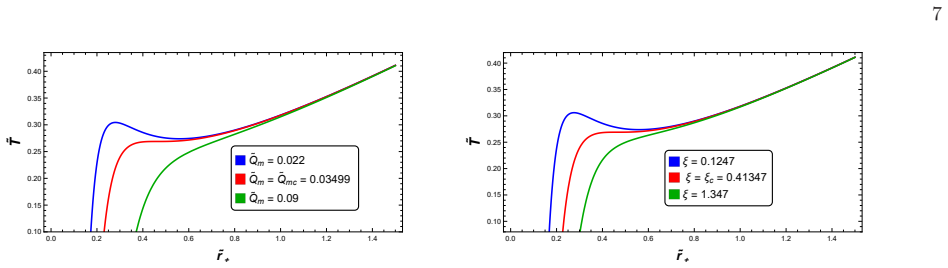
The thermodynamics of the nonminimal coupled magnetic AdS black hole—with its small, intermediate and large black hole phases and a Van der Waals-like first-order transition terminated by a critical point—is imprinted in the dynamics of timelike test particles. For unstable circular orbits, the Lyapunov exponent λ, computed from the effective potential, is a multivalued function of the Hawking temperature in the same temperature window where the free energy shows a swallowtail; the small-, intermediate- and large-black-hole branches map onto distinct branches of λ. Perturbing the same circular orbit and applying the relativistic precession model gives upper and lower QPO frequencies ν_U = ν_
What carries the argument
The central object is the effective potential V_ε(r) = N(r)(1 + L²/r²) for equatorial timelike geodesics in the metric (5), where the metric function N(r) depends on the magnetic charge Q_m and the nonminimal coupling parameter ξ. The Lyapunov exponent λ is obtained from the second derivative of V_ε at the unstable circular orbit; the QPO frequencies follow from the radial and vertical epicyclic frequencies and the azimuthal frequency under small perturbations, with the relativistic precession model fixing ν_U = ν_φ and ν_L = ν_φ − ν_r. Because every one of these dynamical quantities is ultimately a function of the horizon radius r_+ (through the metric and the temperature), and because the
Load-bearing premise
The QPO analysis assumes that small perturbations around the unstable circular orbit oscillate harmonically with a real radial frequency, even though the effective-potential curvature there is negative; if that assumption fails, the real-valued QPO frequencies and the ν_L = ν_φ − ν_r branch structure no longer follow.
What would settle it
Compute Ω_r² for the same parameters used in Fig. 10 (e.g., ξ=0, Q_m=0.03, L=20) using the standard sign for an unstable orbit, i.e., without the minus-sign flip in Eq. (23). If Ω_r² comes out negative, the plotted radial frequency ν_r and the lower QPO frequency ν_L = ν_φ − ν_r are not real-valued, and the QPO phase-transition mapping cannot be sustained as stated.
If this is right
- Below the critical parameter values, both λ and the QPO frequencies are multi-valued in a temperature window bounded by two turning points, giving a dynamical signature of a first-order transition and of the coexistence of small and large black hole phases.
- At the critical point the three branches in each dynamical observable merge into one continuous curve, so the onset of a second-order transition can be read off from the closure of the gap between branches.
- Above the critical parameter values, λ and the QPO frequencies become single-valued and smooth, matching the absence of phase transitions in the free energy.
- The QPO–Lyapunov mapping remains valid in regimes without phase transitions, indicating that the relation between epicyclic frequencies and orbital instability is a geometric feature of the spacetime, not a coincidence confined to the transition.
- Because the upper and lower QPO frequencies are expressed in physical units (Hz), the results give concrete, in-principle testable frequency–temperature relations for the magnetic AdS black hole.
Where Pith is reading between the lines
- A natural extension is to test whether the same branch-preserving QPO–Lyapunov correspondence holds for other AdS black holes with Van der Waals-like transitions (e.g., charged, rotating, or with other matter couplings); if it does, the mapping would be a general diagnostic rather than a feature of this specific nonminimal model.
- The paper's perturbation treatment of the unstable orbit as a harmonic oscillator is the point most likely to need revision; if the radial frequency is genuinely imaginary, a consistent QPO model would have to place the oscillations on stable orbits or reinterpret the epicyclic frequencies, which would shift the quantitative predictions while possibly preserving the qualitative branch structure.
- Real accreting black holes are not AdS, but the idea that epicyclic frequencies can carry thermodynamic information suggests searching QPO data from X-ray binaries for analogous branch-like or gap-like features as a function of inferred mass accretion rate or spectral state.
Editorial analysis
A structured set of objections, weighed in public.
Referee Report
Summary. The paper studies a nonminimally coupled magnetic AdS black hole and claims that two dynamical observables of orbiting timelike particles—the Lyapunov exponent of unstable circular orbits and quasi-periodic oscillation (QPO) frequencies of perturbed circular orbits—inherit the thermodynamic branch structure of the black hole, including first-order and critical phase transitions. The thermodynamic part computes the free energy and identifies a Van der Waals-like small/intermediate/large black hole phase structure. The dynamics part computes the Lyapunov exponent as a function of Hawking temperature and then computes QPO frequencies within the relativistic precession model, plotting upper and lower frequencies versus temperature. The paper further claims to establish a 'QPO-Lyapunov exponent mapping' that inherits the same branch structure.
Significance. If the central claims were correct, the paper would extend the existing literature on Lyapunov exponents as thermodynamic phase-transition probes to QPO observables, potentially offering an observational route to black hole phase structure. The thermodynamic part is a routine application of established methods and appears internally consistent. However, the QPO analysis rests on a sign error that invalidates the computed frequencies, and the claimed QPO-Lyapunov mapping is never actually derived. The paper does include standard formulas and reproduces the expected swallowtail behavior, but the novel dynamical claims are not supported.
major comments (3)
- [§IV.A, Eqs. (22)-(24)] The perturbation equations are written as harmonic oscillators with real Ω_r around an unstable circular orbit. But Eq. (18) defines the unstable orbit by V_eff''(r0) < 0. From the radial equation derived from Eq. (16), d²δr/dt² + [V_eff''(r0)/(2 \dot t0²)] δr = 0, so the coefficient is negative; Ω_r² is negative and the radial mode grows exponentially, not oscillates. The extra minus sign in Eq. (23) reverses this, giving a positive Ω_r² precisely where the orbit is unstable. For stable orbits the same sign would give Ω_r² < 0, so the formula is inconsistent in either case. Thus Eqs. (22)-(24) do not produce physical QPO frequencies for the orbits considered.
- [§IV.B, Figs. 10, 11, 13] The plotted QPO frequencies are internally inconsistent with Eq. (27). Fig. 10 shows ν_r ≈ 5×10⁵–2×10⁶ Hz while ν_φ ≈ 6×10⁴–1.2×10⁵ Hz over the same horizon-radius range, so ν_L = ν_φ − ν_r is negative throughout. Yet Figs. 11 and 13 plot positive ν_L ≈ 20–80 kHz. This is not a minor plotting issue: since Ω_r is imaginary for the unstable orbit, the 'lower QPO frequency' is not a real frequency at all. The branch structure shown in the QPO figures therefore does not follow from the stated equations.
- [Abstract and §V] The claimed 'QPO-Lyapunov exponent mapping' is never derived. The Lyapunov exponent λ in Eq. (20) and the frequencies in Eqs. (23)-(25) are all independent functions of the circular-orbit radius r0, which is itself a function of r+; the Hawking temperature is also a function of r+. Any smooth function of r+ will produce a multi-valued swallowtail when T(r+) is non-monotonic. Without an explicit relation λ = f(ν_r, ν_φ, ν_θ) or a derivation showing that the correspondence is not merely parametric, the central claim of the paper—that a QPO-Lyapunov mapping inherits the thermodynamic branch structure—is unsupported.
minor comments (4)
- [Title/Abstract] The arXiv abstract is titled 'Mapping Quasi-Periodic Oscillations to Lyapunov Exponent across Black Hole Thermodynamic Phase Transitions', while the article text is titled 'Probing thermodynamic phase transitions by dynamics of timelike particle around a magnetic AdS black hole'. The title and conclusion should be aligned with what is actually demonstrated.
- [§IV.A, Eq. (22)] The second equation in (22) reads d²δθ/dt² + Ω_r² δθ = 0; the characteristic frequency should be Ω_θ, not Ω_r. This is likely a typographical error, but it obscures the presentation.
- [Fig. 10 caption and text] The text says 'Fig. 10 shows the radial (left) and vertical (right) oscillatory response', but the right panel is labeled ν_φ (orbital frequency), not the vertical/angular frequency ν_θ. No ν_θ plot is shown, and the caption refers to 'radial and vertical oscillatory responses' while plotting ν_r and ν_φ.
- [General] There are typographical issues such as 'tim elike' in the header and the inconsistent use of tildes for dimensionless quantities in some equations. These should be corrected in a revision.
Circularity Check
QPO frequencies are generated by a sign flip in Eq. (23), and the claimed QPO-Lyapunov mapping is a shared-r+ parametrization artifact; the Lyapunov calculation itself is not circular.
specific steps
-
self definitional
[Section IV.A, Eqs. (22)-(24), together with condition (18)]
"V'_epsilon |_{r~=r~0} = 0, and V''_epsilon |_{r~=r~0} < 0 ... d2δr/dt2 + Ω2r δr = 0 ... Ω2r = − N(r~)/(2 tdot^2) ∂²V_epsilon/∂r~² |_{r~=r~0, θ=π/2}"
From the radial equation (16), the linearized equation about r0 is d2δr/dt2 + [V''/(2 tdot^2)]δr = 0. Condition (18) explicitly requires V''<0 for the unstable circular orbit, so the correct coefficient is negative: the perturbation grows exponentially and the radial frequency is imaginary, not a physical QPO frequency. The extra minus sign in Eq. (23) flips this into a positive Ωr², manufacturing real epicyclic oscillations precisely where the orbit is unstable. All subsequent quantities—νr, νL=νφ−νr, and the QPO phase-transition plots in Figs. 10-13—are therefore fixed by this sign convention rather than derived from the geodesic dynamics. The QPO prediction is, by construction, equivalent to the sign choice in Eq. (23).
-
renaming known result
[Abstract; Section IV.B, Figs. 10-13]
"More importantly, we establish a QPO-Lyapunov exponent mapping and demonstrate that the resulting relation inherits the same thermodynamic branch structure."
No equation connecting the Lyapunov exponent λ to the QPO frequencies is derived anywhere in the paper. λ, νφ, νr, and the free-energy branches are all evaluated from the same circular-orbit radius r0 found from (18), and all are parametrized by the horizon radius r+ through T=T(r+). In the phase-transition window T(r+) is nonmonotonic, so any smooth function f(r+) plotted against T(r+) automatically produces the same three-branch swallowtail. The claimed mapping and its inherited branch structure are therefore consequences of the shared r+ parametrization—the known free-energy swallowtail relabeled in dynamical coordinates—rather than evidence of an independent dynamical relation between λ and QPOs.
full rationale
The Lyapunov-exponent part is essentially self-contained: λ is computed from the standard Cardoso-type formula (20) using V'' of the metric, with no thermodynamic data fitted and no load-bearing self-citation. The paper's own prior work [43] is cited only as background among many independent references; the formula itself is attributed to [46]. The central circularity lies in the QPO construction. Equations (22)-(24) impose harmonic-oscillator equations on perturbations of an unstable circular orbit, while condition (18) gives V''<0, so the correct coefficient in the linearized radial equation is negative. The extra minus in Eq. (23) reverses this and creates real Ωr values by fiat; the frequencies plotted and the claimed QPO signature are outputs of that sign convention. Additionally, the abstract's QPO-Lyapunov mapping is never actually derived; because every plotted dynamical quantity is a function of the same r+ parameter and T(r+) is nonmonotonic, the branch structure is a parametrization artifact. This makes the QPO pillar partially circular, but the independent Lyapunov and free-energy analyses keep the overall circularity from reaching the 8-10 range.
Axiom & Free-Parameter Ledger
free parameters (2)
- test particle angular momentum L =
20
- BH mass M (for Hz conversion) =
not specified
axioms (5)
- domain assumption The nonminimal Einstein-Yang-Mills action (1) with q1=-ξ, q2=4ξ, q3=-6ξ admits the exact magnetic AdS black hole solution (5).
- domain assumption Wald entropy formula yields S = πr_+² − 2πξQ_m²/r_+² (Eq. 8); the grand-canonical free energy is F = M − TS (Eq. 9).
- standard math Test particles follow geodesics of the background metric and do not backreact.
- ad hoc to paper The radial and vertical perturbation equations about the circular orbit are harmonic oscillators with real frequencies (Eqs. 22-24).
- domain assumption Entropy and temperature must be non-negative for the phase structure to be physical.
read the original abstract
We investigate the thermodynamic phase structure of a nonminimally coupled magnetic AdS black hole through the dynamics of timelike particles. The free energy analysis reveals a Van der Waalslike phase transition characterized by small, intermediate, and large black hole phases. We show that both the Lyapunov exponent of unstable circular orbits and the quasi-periodic oscillation (QPO) frequencies associated with stable circular orbits exhibit clear signatures of underlying thermodynamic phase structure, including first order and critical phase transitions. More importantly, we establish a QPO-Lyapunov exponent mapping and demonstrate that the resulting relation inherits the same thermodynamic branch structure. Although the Lyapunov exponent and QPO frequencies originate from unstable and stable circular orbits, respectively, their correspondence emerges from the common black hole spacetime geometry and remains valid even in the absence of phase transitions. Our results reveal an unexplored connection among orbital instability, QPO phenomenology, and black hole thermodynamics, suggesting a potential observational route for probing chaotic orbital dynamics and thermodynamic phases through QPO measurements.
Figures




Reference graph
Works this paper leans on
-
[1]
Observation of Gravitational Waves from a Binary Blac k Hole Merger,
LIGO Scientific, Virgo Collaboration, B. P. Abbott et al., “Observation of Gravitational Waves from a Binary Blac k Hole Merger,” Phys. Rev. Lett. 116 no. 6, (2016) 061102 , arXiv:1602.03837 [gr-qc]
Pith/arXiv arXiv 2016
-
[2]
First M87 Event Horizon Telescope Results. I. The Shadow of the Supermassive Black Hole,
Event Horizon Telescope Collaboration, K. Akiyama et al., “First M87 Event Horizon Telescope Results. I. The Shadow of the Supermassive Black Hole,” Astrophys. J. Lett. 875 (2019) L1 , arXiv:1906.11238 [astro-ph.GA]
Pith/arXiv arXiv 2019
-
[3]
Event Horizon Telescope Collaboration, K. Akiyama et al., “First Sagittarius A* Event Horizon Telescope Results . I. The Shadow of the Supermassive Black Hole in the Center of t he Milky Way,” Astrophys. J. Lett. 930 no. 2, (2022) L12 , arXiv:2311.08680 [astro-ph.HE]
Pith/arXiv arXiv 2022
-
[4]
Black holes and entropy,
J. D. Bekenstein, “Black holes and entropy,” Phys. Rev. D 7 (1973) 2333–2346
1973
-
[5]
The Four laws of black hole mechanics,
J. M. Bardeen, B. Carter, and S. W. Hawking, “The Four laws of black hole mechanics,” Commun. Math. Phys. 31 (1973) 161–170
1973
-
[6]
Particle Creation by Black Holes,
S. W. Hawking, “Particle Creation by Black Holes,” Commun. Math. Phys. 43 (1975) 199–220 . [Erratum: Commun.Math.Phys. 46, 206 (1976)]
1975
-
[7]
Entropy and black-hole thermodynamics,
R. M. Wald, “Entropy and black-hole thermodynamics,” Phys. Rev. D 20 (1979) 1271–1282
1979
-
[8]
The thermodynamics of black holes,
R. M. Wald, “The thermodynamics of black holes,” Living Rev. Rel. 4 (2001) 6 , arXiv:gr-qc/9912119
Pith/arXiv arXiv 2001
-
[9]
Thermodynamics of Black Hol es in anti-De Sitter Space,
S. W. Hawking and D. N. Page, “Thermodynamics of Black Hol es in anti-De Sitter Space,” Commun. Math. Phys. 87 (1983) 577
1983
-
[10]
Thermodynamic Phase Transitions of Ke rr-Newman Black Holes in De Sitter Space,
P. C. W. Davies, “Thermodynamic Phase Transitions of Ke rr-Newman Black Holes in De Sitter Space,” Class. Quant. Grav. 6 (1989) 1909 . 15
1989
-
[11]
The cosmological constant and the black ho le equation of state,
B. P. Dolan, “The cosmological constant and the black ho le equation of state,” Class. Quant. Grav. 28 (2011) 125020 , arXiv:1008.5023 [gr-qc]
Pith/arXiv arXiv 2011
-
[12]
Where is the pdv in the first law of black hole thermodynamics?,
B. P. Dolan, “Where is the pdv in the first law of black hole thermodynamics?,” Open Questions in Cosmology (2012) 291–315
2012
-
[13]
P-V criticality of charged A dS black holes,
D. Kubiznak and R. B. Mann, “P-V criticality of charged A dS black holes,” JHEP 07 (2012) 033 , arXiv:1205.0559 [hep-th]
Pith/arXiv arXiv 2012
-
[14]
Kerr-AdS analogue of triple point and solid/liquid/gas phase transition,
N. Altamirano, D. Kubizˇ n´ ak, R. B. Mann, and Z. Sherkatghanad, “Kerr-AdS analogue of triple point and solid/liquid/gas phase transition,” Class. Quant. Grav. 31 (2014) 042001 , arXiv:1308.2672 [hep-th]
Pith/arXiv arXiv 2014
-
[15]
Reentrant p hase transitions in rotating anti–de Sitter black holes,
N. Altamirano, D. Kubiznak, and R. B. Mann, “Reentrant p hase transitions in rotating anti–de Sitter black holes,” Phys. Rev. D 88 no. 10, (2013) 101502 , arXiv:1306.5756 [hep-th]
Pith/arXiv arXiv 2013
-
[16]
C. V. Johnson, “Holographic Heat Engines,” Class. Quant. Grav. 31 (2014) 205002 , arXiv:1404.5982 [hep-th]
Pith/arXiv arXiv 2014
-
[17]
Joule–Thomson expansion of Kerr–AdS black holes,
¨O. ¨Okc¨ u and E. Aydıner, “Joule–Thomson expansion of Kerr–AdS black holes,” Eur. Phys. J. C 78 no. 2, (2018) 123 , arXiv:1709.06426 [gr-qc]
Pith/arXiv arXiv 2018
-
[18]
Black hole chemistr y: thermodynamics with Lambda,
D. Kubiznak, R. B. Mann, and M. Teo, “Black hole chemistr y: thermodynamics with Lambda,” Class. Quant. Grav. 34 no. 6, (2017) 063001 , arXiv:1608.06147 [hep-th]
Pith/arXiv arXiv 2017
-
[19]
Holographic heat engine wi th momentum relaxation,
L.-Q. Fang and X.-M. Kuang, “Holographic heat engine wi th momentum relaxation,” Sci. China Phys. Mech. Astron. 61 (2018) 080421 , arXiv:1710.09054 [hep-th]
Pith/arXiv arXiv 2018
-
[20]
Holographic heat engine in Ho rndeski model with the k-essence sector,
S.-Q. Hu and X.-M. Kuang, “Holographic heat engine in Ho rndeski model with the k-essence sector,” Sci. China Phys. Mech. Astron. 62 no. 6, (2019) 60411 , arXiv:1808.00176 [hep-th]
Pith/arXiv arXiv 2019
-
[21]
Nonlinear electrodynamics AdS black hole and rela ted phenomena in the extended thermodynamics,
X.-M. Kuang, B. Liu, and A. ¨Ovg¨ un, “Nonlinear electrodynamics AdS black hole and rela ted phenomena in the extended thermodynamics,” Eur. Phys. J. C 78 no. 10, (2018) 840 , arXiv:1807.10447 [gr-qc]
Pith/arXiv arXiv 2018
-
[22]
Joule-Thomson expansion in AdS black holes with momentum relaxation,
A. Cisterna, S.-Q. Hu, and X.-M. Kuang, “Joule-Thomson expansion in AdS black holes with momentum relaxation,” Phys. Lett. B 797 (2019) 134883 , arXiv:1808.07392 [gr-qc]
Pith/arXiv arXiv 2019
-
[23]
Joule-Thomson ex pansion for hairy black holes,
J.-T. Xing, Y. Meng, and X.-M. Kuang, “Joule-Thomson ex pansion for hairy black holes,” Phys. Lett. B 820 (2021) 136604
2021
-
[24]
Thermodynamic curvature: pure fluids to black holes,
G. Ruppeiner, “Thermodynamic curvature: pure fluids to black holes,” J. Phys. Conf. Ser. 410 (2013) 012138 , arXiv:1210.2011 [gr-qc]
Pith/arXiv arXiv 2013
-
[25]
Ruppeiner Geometr y, Phase Transitions, and the Microstructure of Charged AdS Black Holes,
S.-W. Wei, Y.-X. Liu, and R. B. Mann, “Ruppeiner Geometr y, Phase Transitions, and the Microstructure of Charged AdS Black Holes,” Phys. Rev. D 100 no. 12, (2019) 124033 , arXiv:1909.03887 [gr-qc]
Pith/arXiv arXiv 2019
-
[26]
Y.-G. Miao and Z.-M. Xu, “Microscopic structures and th ermal stability of black holes conformally coupled to scala r fields in five dimensions,” Nucl. Phys. B 942 (2019) 205–220 , arXiv:1711.01757 [hep-th]
Pith/arXiv arXiv 2019
-
[27]
S.-W. Wei, Y.-X. Liu, and R. B. Mann, “Repulsive Interac tions and Universal Properties of Charged Anti–de Sitter Black Hole Microstructures,” Phys. Rev. Lett. 123 no. 7, (2019) 071103 , arXiv:1906.10840 [gr-qc]
Pith/arXiv arXiv 2019
-
[28]
Y. Liu, D.-C. Zou, and B. Wang, “Signature of the Van der W aals like small-large charged AdS black hole phase transition in quasinormal modes,” JHEP 09 (2014) 179 , arXiv:1405.2644 [hep-th]
Pith/arXiv arXiv 2014
-
[29]
Thermodynamics, Phase Transition and Q uasinormal modes with Weyl corrections,
S. Mahapatra, “Thermodynamics, Phase Transition and Q uasinormal modes with Weyl corrections,” JHEP 04 (2016) 142 , arXiv:1602.03007 [hep-th]
Pith/arXiv arXiv 2016
-
[30]
Photon orbits and thermodynam ic phase transition of d-dimensional charged AdS black holes,
S.-W. Wei and Y.-X. Liu, “Photon orbits and thermodynam ic phase transition of d-dimensional charged AdS black holes,” Phys. Rev. D 97 no. 10, (2018) 104027 , arXiv:1711.01522 [gr-qc]
Pith/arXiv arXiv 2018
-
[31]
Circular o rbit of a test particle and phase transition of a black hole,
M. Zhang, S.-Z. Han, J. Jiang, and W.-B. Liu, “Circular o rbit of a test particle and phase transition of a black hole,” Phys. Rev. D 99 no. 6, (2019) 065016 , arXiv:1903.08293 [hep-th]
Pith/arXiv arXiv 2019
-
[32]
Can shadows reflect phase structure s of black holes?,
M. Zhang and M. Guo, “Can shadows reflect phase structure s of black holes?,” Eur. Phys. J. C 80 no. 8, (2020) 790 , arXiv:1909.07033 [gr-qc]
Pith/arXiv arXiv 2020
-
[33]
Quasinormal modes of black holes with multiple photon spheres,
G. Guo, P. Wang, H. Wu, and H. Yang, “Quasinormal modes of black holes with multiple photon spheres,” JHEP 06 (2022) 060 , arXiv:2112.14133 [gr-qc]
Pith/arXiv arXiv 2022
-
[34]
Appearance o f an infalling star in black holes with multiple photon spheres,
Y. Chen, G. Guo, P. Wang, H. Wu, and H. Yang, “Appearance o f an infalling star in black holes with multiple photon spheres,” Sci. China Phys. Mech. Astron. 65 no. 12, (2022) 120412 , arXiv:2206.13705 [gr-qc]
Pith/arXiv arXiv 2022
-
[35]
Quasinormal modes of hairy black holes with mixed couplings,
Y. Weng, Y. Liu, Y. Cao, and J. Tao, “Quasinormal modes of hairy black holes with mixed couplings,” Nucl. Phys. B 1017 (2025) 116973
2025
-
[36]
Lyapunov exponents and phase transitions of Born-Infeld AdS black holes,
S. Yang, J. Tao, B. Mu, and A. He, “Lyapunov exponents and phase transitions of Born-Infeld AdS black holes,” JCAP 07 (2023) 045 , arXiv:2304.01877 [gr-qc]
Pith/arXiv arXiv 2023
-
[37]
Probing the thermodynamics of charged Gauss Bonnet AdS black holes with the Lyapunov exponent,
X. Lyu, J. Tao, and P. Wang, “Probing the thermodynamics of charged Gauss Bonnet AdS black holes with the Lyapunov exponent,” Eur. Phys. J. C 84 no. 9, (2024) 974 , arXiv:2312.11912 [gr-qc]
Pith/arXiv arXiv 2024
-
[38]
Lyapunov expone nts and phase structure of Lifshitz and hyperscaling violating black holes,
A. N. Kumara, S. Punacha, and M. S. Ali, “Lyapunov expone nts and phase structure of Lifshitz and hyperscaling violating black holes,” JCAP 07 (2024) 061 , arXiv:2401.05181 [gr-qc]
Pith/arXiv arXiv 2024
-
[39]
Y.-Z. Du, H.-F. Li, Y.-B. Ma, and Q. Gu, “Phase structure and optical properties of the de Sitter Spacetime with KR field based on the Lyapunov exponent,” Eur. Phys. J. C 85 no. 1, (2025) 78 , arXiv:2403.20083 [hep-th]
Pith/arXiv arXiv 2025
-
[40]
Interp lay between the Lyapunov exponents and phase transitions of charged AdS black holes,
B. Shukla, P. P. Das, D. Dudal, and S. Mahapatra, “Interp lay between the Lyapunov exponents and phase transitions of charged AdS black holes,” Phys. Rev. D 110 no. 2, (2024) 024068 , arXiv:2404.02095 [hep-th]
Pith/arXiv arXiv 2024
-
[41]
Lyapunov expon ents and phase transition of Hayward AdS black hole,
N. J. Gogoi, S. Acharjee, and P. Phukon, “Lyapunov expon ents and phase transition of Hayward AdS black hole,” Eur. Phys. J. C 84 no. 11, (2024) 1144 , arXiv:2404.03947 [hep-th]
Pith/arXiv arXiv 2024
-
[42]
Lyapunov exponents as prob es for a phase transition of a Kerr-AdS black hole,
D. Chen, C. Yang, and Y. Liu, “Lyapunov exponents as prob es for a phase transition of a Kerr-AdS black hole,” Phys. Lett. B 865 (2025) 139463 , arXiv:2501.16999 [hep-th] . 16
Pith/arXiv arXiv 2025
-
[43]
Probing thermodynamic phase transitions via Lyapunov exponent in AdS black hole with perfect fluid dark matter,
R. H. Ali and X.-M. Kuang, “Probing thermodynamic phase transitions via Lyapunov exponent in AdS black hole with perfect fluid dark matter,” Eur. Phys. J. C 85 no. 1131, (2025)
2025
-
[44]
J. Maldacena, S. H. Shenker, and D. Stanford, “A bound on chaos,” JHEP 08 (2016) 106 , arXiv:1503.01409 [hep-th]
Pith/arXiv arXiv 2016
-
[45]
Static Equilibria of Ch arged Particles Around Charged Black Holes: Chaos Bound and Its Violations,
Q.-Q. Zhao, Y.-Z. Li, and H. Lu, “Static Equilibria of Ch arged Particles Around Charged Black Holes: Chaos Bound and Its Violations,” Phys. Rev. D 98 no. 12, (2018) 124001 , arXiv:1809.04616 [gr-qc]
Pith/arXiv arXiv 2018
-
[46]
Geodesic stability, Lyapunov exponents and quasinormal modes,
V. Cardoso, A. S. Miranda, E. Berti, H. Witek, and V. T. Za nchin, “Geodesic stability, Lyapunov exponents and quasinormal modes,” Phys. Rev. D 79 no. 6, (2009) 064016 , arXiv:0812.1806 [hep-th]
Pith/arXiv arXiv 2009
-
[47]
Lewin and M
W. Lewin and M. Van der Klis, Compact stellar X-ray sources, vol. 39. Cambridge University Press, 2006
2006
-
[48]
Quasi periodic oscillations in black hole binaries,
S. E. Motta, “Quasi periodic oscillations in black hole binaries,” Astron. Nachr. 337 no. 4/5, (2017) 398–403 , arXiv:1603.07885 [astro-ph.HE]
Pith/arXiv arXiv 2017
-
[49]
Accretion in Strong Field Gravity with eXTP,
eXTP Collaboration, A. De Rosa et al., “Accretion in Strong Field Gravity with eXTP,” Sci. China Phys. Mech. Astron. 62 no. 2, (2019) 29504 , arXiv:1812.04022 [astro-ph.HE]
Pith/arXiv arXiv 2019
-
[50]
Lense-Thirring precession an d QPOS in low mass x-ray binaries,
L. Stella and M. Vietri, “Lense-Thirring precession an d QPOS in low mass x-ray binaries,” Astrophys. J. Lett. 492 (1998) L59 , arXiv:astro-ph/9709085
Pith/arXiv arXiv 1998
-
[51]
L. Stella, M. Vietri, and S. Morsink, “Correlations in t he qpo frequencies of low mass x-ray binaries and the relativ istic precession model,” Astrophys. J. Lett. 524 (1999) L63–L66 , arXiv:astro-ph/9907346
Pith/arXiv arXiv 1999
-
[52]
Determining the propertie s of accretion-gap neutron stars,
W. Kluzniak and R. Wagoner, “Determining the propertie s of accretion-gap neutron stars,” The Astrophysical Journal 358 (1990) 538–544
1990
-
[53]
The emission positions of kHz QPOs and Kerr spacetime influence,
C. M. Zhang, Y. C. Wei, H. X. Yin, Y. H. Zhao, Y. J. Lei, L. M. Song, F. Zhang, and Y. Yan, “The emission positions of kHz QPOs and Kerr spacetime influence,” Sci. China Phys. Mech. Astron. 53 (2010) 114–116 , arXiv:0912.0768 [astro-ph.HE]
Pith/arXiv arXiv 2010
-
[54]
C. Bambi, “Probing the space-time geometry around blac k hole candidates with the resonance models for high-freque ncy QPOs and comparison with the continuum-fitting method,” JCAP 09 (2012) 014 , arXiv:1205.6348 [gr-qc]
Pith/arXiv arXiv 2012
-
[55]
A. Maselli, L. Gualtieri, P. Pani, L. Stella, and V. Ferr ari, “Testing Gravity with Quasi Periodic Oscillations fro m accreting Black Holes: the Case of the Einstein-Dilaton-Ga uss-Bonnet Theory,” Astrophys. J. 801 no. 2, (2015) 115 , arXiv:1412.3473 [astro-ph.HE]
Pith/arXiv arXiv 2015
-
[56]
K. Jusufi, M. Azreg-A ¨ ınou, M. Jamil, S.-W. Wei, Q. Wu, an d A. Wang, “Quasinormal modes, quasiperiodic oscillations , and the shadow of rotating regular black holes in nonminimal ly coupled Einstein-Yang-Mills theory,” Phys. Rev. D 103 no. 2, (2021) 024013 , arXiv:2008.08450 [gr-qc]
Pith/arXiv arXiv 2021
-
[57]
Shadow, quasinormal modes, and quasiperiodic oscillations of rotating Kaluza-Klein black holes,
M. Ghasemi-Nodehi, M. Azreg-A ¨ ınou, K. Jusufi, and M. Ja mil, “Shadow, quasinormal modes, and quasiperiodic oscillations of rotating Kaluza-Klein black holes,” Phys. Rev. D 102 no. 10, (2020) 104032 , arXiv:2011.02276 [gr-qc]
Pith/arXiv arXiv 2020
-
[58]
S. Chen, Z. Wang, and J. Jing, “Testing gravity of a disfo rmal Kerr black hole in quadratic degenerate higher-order scalar-tensor theories by quasi-periodic oscillations,” JCAP 06 (2021) 043 , arXiv:2103.11788 [gr-qc]
Pith/arXiv arXiv 2021
-
[59]
Testing no-hair theorem by qu asi-periodic oscillations: the quadrupole of GRO J1655–40 ,
A. Allahyari and L. Shao, “Testing no-hair theorem by qu asi-periodic oscillations: the quadrupole of GRO J1655–40 ,” JCAP 10 (2021) 003 , arXiv:2102.02232 [gr-qc]
Pith/arXiv arXiv 2021
-
[60]
Quasiperiodic oscillations around rotating traversable wormholes,
E. Deligianni, J. Kunz, P. Nedkova, S. Yazadjiev, and R. Zheleva, “Quasiperiodic oscillations around rotating traversable wormholes,” Phys. Rev. D 104 no. 2, (2021) 024048 , arXiv:2103.13504 [gr-qc]
Pith/arXiv arXiv 2021
-
[61]
Testing Kerr black hole mimickers with quasi-periodic oscillations from GRO J1655-40,
X. Jiang, P. Wang, H. Yang, and H. Wu, “Testing Kerr black hole mimickers with quasi-periodic oscillations from GRO J1655-40,” Eur. Phys. J. C 81 no. 11, (2021) 1043 , arXiv:2107.10758 [gr-qc] . [Erratum: Eur.Phys.J.C 82, 5 (2022)]
Pith/arXiv arXiv 2021
-
[62]
Testing black holes in non-linear electr odynamics from the observed quasi-periodic oscillations,
I. Banerjee, “Testing black holes in non-linear electr odynamics from the observed quasi-periodic oscillations, ” JCAP 08 no. 08, (2022) 034 , arXiv:2203.10890 [gr-qc]
Pith/arXiv arXiv 2022
-
[63]
C onstraints on the rotating self-dual black hole with quasi-periodic oscillations,
C. Liu, H. Siew, T. Zhu, Q. Wu, Y. Sun, Y. Zhao, and H. Xu, “C onstraints on the rotating self-dual black hole with quasi-periodic oscillations,” JCAP 11 (2023) 096 , arXiv:2305.12323 [gr-qc]
Pith/arXiv arXiv 2023
-
[64]
Testing regular black holes with X-ray data of GX 339–4,
S. Riaz, M. Kyriazis, A. B. Abdikamalov, C. Bambi, and S. Shashank, “Testing regular black holes with X-ray data of GX 339–4,” JCAP 03 (2025) 022 , arXiv:2306.09673 [astro-ph.HE]
Pith/arXiv arXiv 2025
-
[65]
Quasiperiodic oscillations around hairy black holes in Horndeski gravity,
J. Rayimbaev, K. F. Dialektopoulos, F. Sarikulov, and A . Abdujabbarov, “Quasiperiodic oscillations around hairy black holes in Horndeski gravity,” Eur. Phys. J. C 83 no. 7, (2023) 572 , arXiv:2307.03019 [gr-qc]
Pith/arXiv arXiv 2023
-
[66]
F. Abdulkhamidov, P. Nedkova, J. Rayimbaev, J. Kunz, an d B. Ahmedov, “Parameter constraints on traversable wormholes within beyond Horndeski theories through quasip eriodic oscillations,” Phys. Rev. D 109 no. 10, (2024) 104074 , arXiv:2403.08356 [gr-qc]
Pith/arXiv arXiv 2024
-
[67]
Circular motion and QPOs near black holes in Kalb–Ramond gravity,
S. Jumaniyozov, S. U. Khan, J. Rayimbaev, A. Abdujabbar ov, S. Urinbaev, and S. Murodov, “Circular motion and QPOs near black holes in Kalb–Ramond gravity,” Eur. Phys. J. C 84 no. 9, (2024) 964
2024
-
[68]
Parameter constraints on a black hole with Minkowski core through quasiperiodic oscillations,
M.-Y. Guo, M.-H. Wu, X.-M. Kuang, and H. Guo, “Parameter constraints on a black hole with Minkowski core through quasiperiodic oscillations,” Eur. Phys. J. C 85 no. 1, (2025) 95 , arXiv:2504.00360 [gr-qc]
Pith/arXiv arXiv 2025
-
[69]
Parameter constrain ts on Horndeski rotating black hole through quasiperiodic oscillations,
M.-H. Wu, H. Guo, and X.-M. Kuang, “Parameter constrain ts on Horndeski rotating black hole through quasiperiodic oscillations,” arXiv:2508.13974 [gr-qc]
-
[70]
Using precession and Lense-Thirring effect to constrain a rotating regular black hole,
M.-H. Wu, H. Guo, and X.-M. Kuang, “Using precession and Lense-Thirring effect to constrain a rotating regular black hole,” arXiv:2509.26270 [gr-qc]
-
[71]
Can Quasi Periodic Oscillat ions Encode Traces of Black Hole Phase Transitions ?,
B. Hazarika and P. Phukon, “Can Quasi Periodic Oscillat ions Encode Traces of Black Hole Phase Transitions ?,” arXiv:2504.11205 [gr-qc]
-
[72]
Non-minimal Wu-Yang mon opole,
A. B. Balakin and A. E. Zayats, “Non-minimal Wu-Yang mon opole,” Phys. Lett. B 644 (2007) 294–298 , arXiv:gr-qc/0612019
Pith/arXiv arXiv 2007
-
[73]
Zur theorie der elementarteilchen,
W. Scherrer, “Zur theorie der elementarteilchen,” Verhandlungen der Schweizer Naturforschenden Gesellschaft 121 (1941) 86–87. 17
1941
-
[74]
Zur projektiven relativit¨ atstheorie,
P. Jordan, “Zur projektiven relativit¨ atstheorie,” Nachr. Akad. Wiss. G¨ ottingen,II (1945) 39–41
1945
-
[75]
Mach’s principle and a relativ istic theory of gravitation,
C. Brans and R. H. Dicke, “Mach’s principle and a relativ istic theory of gravitation,” Physical review 124 no. 3, (1961) 925
1961
-
[76]
F. W. Hehl and Y. N. Obukhov, “How does the electromagnet ic field couple to gravity, in particular to metric, nonmetricity, torsion, and curvature?,” Lect. Notes Phys. 562 (2001) 479 , arXiv:gr-qc/0001010
Pith/arXiv arXiv 2001
-
[77]
Modification of Einstein Yang-Mi lls Theory From Dimensional Reduction of the Gauss-Bonnet Action,
F. Mueller-Hoissen, “Modification of Einstein Yang-Mi lls Theory From Dimensional Reduction of the Gauss-Bonnet Action,” Class. Quant. Grav. 5 (1988) L35
1988
-
[78]
Non-minimal isotropic cosmological model with Yang-Mills and Higgs fields,
A. B. Balakin, H. Dehnen, and A. E. Zayats, “Non-minimal isotropic cosmological model with Yang-Mills and Higgs fields,” Int. J. Mod. Phys. D 17 (2008) 1255–1269 , arXiv:0710.4992 [gr-qc]
Pith/arXiv arXiv 2008
-
[79]
Non-minimal coupling of pho tons and axions,
A. B. Balakin and W.-T. Ni, “Non-minimal coupling of pho tons and axions,” Class. Quant. Grav. 27 (2010) 055003 , arXiv:0911.2946 [gr-qc]
Pith/arXiv arXiv 2010
-
[80]
Static Spherically Symmetric Soluti ons to a System of Generalized Einstein-Maxwell Field Equations,
G. W. Horndeski, “Static Spherically Symmetric Soluti ons to a System of Generalized Einstein-Maxwell Field Equations,” Phys. Rev. D 17 (1978) 391–395
1978
discussion (0)
Sign in with ORCID, Apple, or X to comment. Anyone can read and Pith papers without signing in.