REVIEW 4 major objections 4 minor 42 references
Revisiting critical orbits of test particles traveling in a black hole background
T0 review · 4 major / 4 minor · reviewed 2026-08-03 · deepseek-v4-flash
Pith's one-line read This paper claims that critical orbits — trajectories that neither plunge into the black hole nor escape to infinity but asymptotically circle a fixed radius — are precisely those for which the radial kinetic function has a double or triple
desk verdict A useful synthesis of mostly known critical-orbit formulas, but the central 'exact' classification over-counts in the timelike rotating cases until physical-conditions checks are added. read the letter →
The pith
A machine-rendered reading of the paper's core claim, the machinery that carries it, and where it could break.
The reading
What carries the argument
The load-bearing object is the radial kinetic function R(r) (or f(u) after the inversion u = 1/r), built from the first integrals of the Hamilton–Jacobi equation: energy, angular momentum, a fourth conserved quantity measuring non-equatorial motion, mass, charge-to-mass ratio, and the black-hole parameters. Critical orbits are defined by requiring R to have a double root (R = R' = 0) or triple root (R = R' = R'' = 0) at r_c. This single algebraic condition generates all parameter formulas; the θ-motion, governed separately by Θ, must be compatible, and in the Kerr null case one spurious double-root solution is discarded precisely because it gives Θ ≤ 0.
What would settle it
Pick a claimed critical parameter set from the timelike Kerr-Newman double-root formulas, integrate the full geodesic equations from large radius, and check whether the orbit asymptotically approaches r_c; any configuration with R = R' = 0 and Θ ≥ 0 that instead falls into the horizon or escapes would falsify the claim that the double-root condition characterizes critical orbits.
Extended reading notes
Core claim
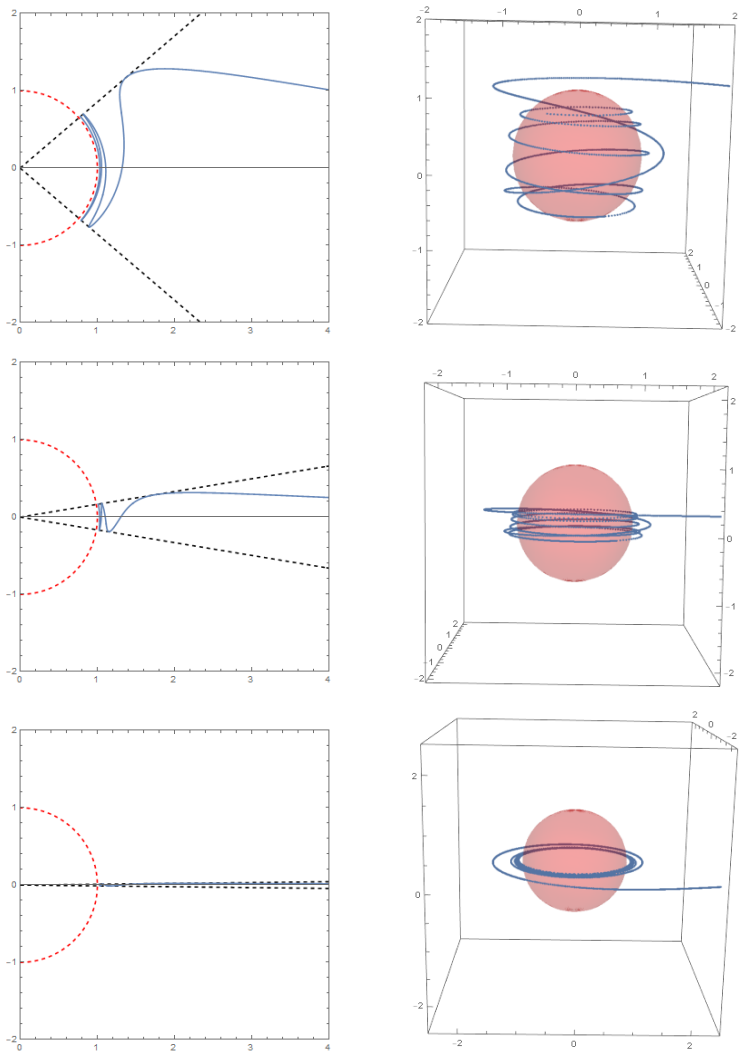
The paper's central claim is that in any of the four black hole backgrounds, a critical orbit is precisely a trajectory at which the radial kinetic function R(r) (or, in spherical symmetry, f(u) with u = 1/r) possesses either a double real root or a triple real root. Solving R = R' = 0 (and, for triple roots, R'' = 0) yields explicit expressions for the energy E, angular momentum L, and, where relevant, charge-to-mass ratio e in terms of the critical radius r_c. For null geodesics this reproduces the photon sphere and shadow boundary: r_c = 3M and shadow radius 3√3 M in Schwarzschild, a smaller shadow in Reissner-Nordström, a D-shaped shadow in Kerr, and the extreme case r_c = M only when a
Load-bearing premise
In rotating spacetimes, a double root of the radial function is treated as defining a critical orbit provided the θ-motion is separately permitted, but the paper does not prove that every such parameter set corresponds to a trajectory arriving from infinity without crossing an unphysical region.
Editorial extensions
If this is right
- The capture–scatter boundary for any test particle incident from infinity can be read off analytically from the double-root formulas, without per-orbit integration.
- Black-hole shadow boundaries follow from the null critical parameters; the paper presents them for equatorial observers and the construction extends to general inclination.
- The explicit orbit solutions (tanh-type for spherical spacetimes, elliptic-integral form for axisymmetric ones) give closed-form spiral trajectories that asymptote to r_c.
- The paper's accretion-model motivation is served directly: critical orbits mark the phase-space separatrix between absorbed and scattered particles in a collisionless gas.
- The triple-root condition, which in Kerr and Reissner-Nordström marks the innermost or extremal circular orbit, is shown to occur only at extremal spin or charge for null geodesics.
Reading between the lines
- The double-root criterion as stated is necessary but not sufficient in rotating spacetimes; the paper's own discard of a Kerr null solution with R = R' = 0 but Θ ≤ 0 suggests a cleaner definition would be 'double root of R plus admissible θ-motion and a connecting orbit from infinity,' which the timelike and charged cases should be checked against.
- The parameterization by r_c suggests a one-parameter (plus black-hole parameters) family of critical orbits; for Kerr-Newman timelike particles the family may trace out a surface in parameter space that could be mapped numerically to complete the classification the paper leaves open.
- The same root-structure program should transfer to other separable spacetimes (e.g., with cosmological constant), where the radial function is still a quartic (or higher) polynomial and critical orbits are again double- or triple-root configurations.
- If physical triple-root timelike orbits in Kerr-Newman do not exist, that itself is a structural statement: the absence would mean charged massive particles cannot asymptotically hover at the innermost circular orbit, sharpening the known ISCO analysis.
Signed reviews
Editorial analysis
A structured set of objections, weighed in public.
Referee Report
Summary. The manuscript revisits the classification of critical orbits—trajectories that asymptotically approach an unstable circular orbit—for neutral and charged test particles in Schwarzschild, Reissner–Nordström, Kerr, and Kerr–Newman spacetimes. The authors identify critical orbits with configurations in which the radial kinetic function R(r) has a double or triple real root, derive parameter relations (energy, angular momentum, charge-to-mass ratio) versus the critical radius for null and timelike cases, present analytic orbital solutions in the spherically symmetric cases and partially in the rotating cases, and give numerical trajectory plots. The stated aim is a consistent parameterization of the capture/scatter boundary, black-hole shadows, and Vlasov accretion models.
Significance. The root-based approach is natural and economically reproduces standard photon-sphere and shadow results in the Schwarzschild and Reissner–Nordström null limits; the algebraic route avoids fitted parameters, and the spherically symmetric sections are essentially complete. However, the central claim that critical orbits are exactly the double/triple-root configurations is not established for rotating spacetimes: the null Kerr case itself provides a counterexample (Eq. (94)) that is discarded only by a separate Θ check, and the analogous check is missing for the timelike Kerr and Kerr–Newman double-root sectors. The timelike Kerr–Newman explicit formulas promised in the abstract are also not delivered. If the missing physical filters and derivations are supplied, the paper would be a useful reference; in its present form it overstates the completeness of its classification.
major comments (4)
- [Sec. V.B, Eqs. (109)–(112); Sec. VI.B, Eq. (133)] The double-root condition is necessary but not sufficient for a physical critical orbit in rotating spacetimes. The paper itself shows this in the null Kerr case: the solution (94) satisfies R=R'=0 but is discarded because the polar function in (80) is non-positive. Yet in Sec. V.B the timelike parameters ξ_c, η_c are obtained from Eqs. (109)–(110) using only R=0, R'=0; there is no check that Θ≥0 for some admissible θ-interval or that the quadratic factor in Eq. (112) is positive on (r_c,∞). If that quadratic has a real root larger than r_c, then R<0 in an interval and a particle from infinity reaches an outer turning point before r_c; the orbit is not the critical one. The same omission applies to the Kerr–Newman timelike factorization in Eq. (133). Without an added physical-conditions filter, the classification over-counts and the abstract's claim that critical orbits are 'exactly' tho
- [Sec. V.B, Eq. (114)] The coefficient b in Eq. (114) is defined as 2r_c+M(1−χ²). With the factorization in Eq. (112), substituting x=1/(r−r_c) gives a quadratic in x whose linear coefficient is 2[2r_c+M(χ²−1)], so b should be 2r_c+M(χ²−1). The minus sign on the M term makes Eq. (113) inconsistent with Eq. (112) for χ≠1. Since Eq. (113) is the analytical integration used for timelike Kerr critical orbits, this is a load-bearing error that must be corrected.
- [Sec. VI.B; Abstract] The abstract promises explicit expressions 'in each case', but Sec. VI.B states that the double-root Kerr–Newman timelike solutions are 'extremely complex, and we will not list them here', and that the triple-root quartic (130) cannot be solved explicitly, with no physical parameter set found. The paper therefore does not provide the promised explicit parameterization for the timelike Kerr–Newman sector. The authors should either complete this sector or explicitly narrow the abstract and conclusions.
- [Appendix A, Eq. (146)] Appendix A excludes triple-root timelike Kerr geodesics by showing that χ_c² from Eq. (146) is negative for r_c>r_+. However, the decisive monotonicity and sign assertions (f(r_c) decreasing, C(r_c) increasing, f(r_+)≤0, C(r_+)≥0) are stated without proof. Since this exclusion is part of the claimed complete taxonomy, a derivation or a reference for these steps is required.
minor comments (4)
- [Sec. IV.A, Eq. (51)] The two signs in u_c correspond to a small-charge divergent branch and the physical branch; specify that the physical critical radius uses the minus sign, consistent with the expansion in Eq. (53).
- [Sec. V.A, text after Eq. (94)] The expression 'Θ = −ρ²E²/(a² sin²θ)' is not consistent with the normalization of Θ in Eq. (80) (which gives Θ/E²). The sign conclusion is unchanged, but the formula should be corrected.
- [Throughout] Several typographical and OCR errors remain, e.g., 'phone sphere' in the Fig. 6 caption, 'govering' in Sec. IV.A, 'statisfys' after Eq. (70), 'ElliptiPi' in Eq. (106), and 'en' in Eq. (148). A careful proofread is needed.
- [Secs. V–VI, numerical figures] The numerical figures would be easier to reproduce if the integration method, tolerances, and the ranges of allowed parameters were stated; no code or data repository is provided.
Circularity Check
No significant circularity: critical-orbit parameters are solved algebraically from the defining double/triple-root condition on R(r); the sole self-citation (Ref. [38]) is motivational and not load-bearing.
full rationale
The derivation chain is self-contained. Section II obtains the decoupled radial/angular equations (16)-(19) from standard Hamilton–Jacobi separability, citing Carter [10] — an external, independently established result. The paper defines critical orbits by the double/triple-root condition on R(r) (Sec. I: "Critical orbits are defined as those trajectories for which the radial kinetic energy function admits either a double or triple real root") and in every case solves that condition for the conserved parameters in terms of the critical radius: Schwarzschild Eqs. (36), (41)-(42); RN Eqs. (51)-(52), (61)-(62); Kerr Eqs. (94)-(95), (109)-(111); KN Eqs. (119)-(120), (127)-(130). These are algebraic outputs of the defining equations, not fitted values renamed as predictions, and no parameter is fitted to any subset of data. The standard benchmarks (Schwarzschild photon sphere r=3M, shadow R_c=3√3M; Kerr shadow, e.g., Fig. 5) agree with the external literature, so the results are benchmarked outside the paper's own values. The only self-citation is Ref. [38] (authors' prior RN Fermi-gas accretion paper), cited once in the Introduction purely as motivation for the accretion program; it supplies no equation, no uniqueness claim, and no ansatz to the central derivation, so it is not load-bearing. The paper also performs physical filtering where needed (discarding the null-Kerr solution (94) via Θ≤0) and honestly flags incompleteness in Sec. VI.B ("the expressions ... are extremely complex, and we will not list them here"; "We have not found a completely reasonable set of parameter values ..."). Those admissions, like the reviewer's concern that timelike Kerr/KN double-root solutions are not separately checked for Θ≥0 or outer turning points, concern physical sufficiency/completeness of the classification — a correctness risk — not whether any result reduces by construction to its inputs. No imported uniqueness theorem, no ansatz smuggled via self-citation, and no definitional circularity: the 'identification' of critical orbits with root structure is the paper's explicit definition, and the derived parameterizations and trajectories are the non-trivial derived content. Score 1 reflects only the presence of a single minor, non-load-bearing self-citation.
Assumptions & free parameters
assumptions (5)
- standard math The Hamilton-Jacobi equation is separable in Kerr-Newman, giving the Carter constant D for charged test particles.
- domain assumption A double or triple real root of the radial effective potential defines a critical orbit.
- domain assumption In spherically symmetric spacetimes, the squared angular momentum is conserved and orbits are planar, so the equatorial plane suffices.
- domain assumption The black hole horizon exists, i.e., 0 ≤ a^2 + Q^2 ≤ M^2.
- domain assumption Unbound critical orbits from infinity require E > m; E = m free-fall is excluded.
Cite this review
Pith. "Pith review of Revisiting critical orbits of test particles traveling in a black hole background." pith.science (2026). https://pith.science/paper/SV377JM6
@misc{pith2026260209568,
  author       = {Pith},
  title        = {Pith review of: Revisiting critical orbits of test particles traveling in a black hole background},
  year         = {2026},
  howpublished = {\url{https://pith.science/paper/SV377JM6}},
  note         = {Machine review of arXiv:2602.09568}
}
read the original abstract
This paper systematically revisits the critical orbits of test particles in various black hole backgrounds, including Schwarzschild, Reissner-Nordstr\"{o}m, Kerr, and Kerr-Newman spacetimes. We identify the critical orbits directly from the root structure of the radial equation, and we provide explicit expressions that relate the relevant parameters - energy, angular momentum, and charge-to-mass ratio - to the critical radius, as well as explicit formulas for the critical orbits in each case. Special attention is given to the relationships among the photon spheres, black hole shadows, and critical null geodesics. We also present extensive numerical results.
Figures


Figures from the paper (9 more)




Reference graph
Works this paper leans on
-
[1]
null geodesic We then consider the radial motion
, µ2 2 −µ 2 1 µ2 2 # +C.(90) A. null geodesic We then consider the radial motion. For the massless particles traveling in Kerr geometry m= 0 andχ= 1,Rreduce to R E2 =r 4 + (a2 −ξ 2 −η)r 2 + 2M[η+ (ξ−a) 2]r−a 2η.(91) For the critical orbitsR= 0 andR ′ = 0, there are r4 + (a2 −ξ 2 −η)r 2 + 2M[η+ (ξ−a) 2]r−a 2η= 0,(92) 4r3 + 2(a2 −ξ 2 −η)r+ 2M[η+ (ξ−a) 2] = ...
-
[2]
In Reissner-Nordstr¨ om (RN) spacetime, Grunau and Kagramanova [3] provided an analytical solution for the motion of electrically and mag- netically charged test particles
has remained a classic reference. In Reissner-Nordstr¨ om (RN) spacetime, Grunau and Kagramanova [3] provided an analytical solution for the motion of electrically and mag- netically charged test particles. Much of this work is built on the foundational theory of Weierstrass elliptic functions, though significant research [4–9] has also been developed us-...
1968
-
[3]
Whenµ 2 =µ 2 2, the orbits reach the turning anglesθ= π 2 ±θ m, where θm = arccosµ 2
Here,µ 2 = 0 corresponds to equatorial planeθ= π 2 . Whenµ 2 =µ 2 2, the orbits reach the turning anglesθ= π 2 ±θ m, where θm = arccosµ 2. In other words, these orbits cross the equatorial plane and oscillate symmetrically about it. The integration yields 1√ E2 −m 2 Z µ dµp ˜Θ = 1 a p µ2 1 +µ 2 2 EllipticF " arcsin p µ2 2 −µ 2 µ2 , µ2 2 µ2 1 +µ 2 2 # +C,(...
-
[4]
A. R. Forsyth, Note on the central differential equation in the relativity theory of gravitation, Proc. R. Soc. Lond. A97, 145-151 (1920)
1920
-
[5]
J. Droste, The Field of a Single Centre in Einstein’s Theory of Gravitation, and the Motion of a Particle in That Field,Huygens Institute - Royal Netherlands Academy of Arts and Sciences (KNA W)197-215; ”Golden Oldie”: The Field of a Single Centre in Einstein’s Theory of Gravitation, and the Motion of a Particle in That Field,Gen. Relativ. Gravit.34, 1545...
2002
-
[6]
Hagihara, Theory of the Relativistic Trajectories in a Gravitational Field of Schwarzschild, Japanese Journal of Astronomy and Geophysics8, 67-176 (1931)
Y. Hagihara, Theory of the Relativistic Trajectories in a Gravitational Field of Schwarzschild, Japanese Journal of Astronomy and Geophysics8, 67-176 (1931)
1931
-
[7]
Grunau and V
S. Grunau and V. Kagramanova, Geodesics of electrically and magnetically charged test par- ticles in the Reissner-Nordstr¨ om space-time: analytical solutions,Phys. Rev. D83, 044009 (2011)
2011
-
[8]
C. M. Rodr ´ ıguez, Orbits in general relativity: The Jacobian elliptic functions,Nuov. Cim. B, 98, 87-96 (1987)
1987
Show all 42 references
-
[9]
A. G. Greenhill, Newton-Einstein planetary orbits,The London, Edinburgh, and Dublin Philo- sophical Magazine and Journal of Science41, 143 (1921)
1921
-
[10]
Darwin, The gravity field of a particle,Proc
C.G. Darwin, The gravity field of a particle,Proc. R. Soc. Lond. A249, 180-194
-
[11]
Darwin, The gravity field of a particle II,Proc
C.G. Darwin, The gravity field of a particle II,Proc. R. Soc. Lond. A263, 39-50
-
[12]
Fujita and W
R. Fujita and W. Hikida, Analytical solutions of timelike geodesic orbits in Kerr spacetime geodesic orbits in Kerr spacetime,Classical Quantum Gravity26, 135002 (2009). 33
2009
-
[13]
Scharf, Schwarzchild Geodesics in terms of Elliptic functions and the related red shift,J
G. Scharf, Schwarzchild Geodesics in terms of Elliptic functions and the related red shift,J. Mod. Phys2, 274-283
-
[14]
Carter, Global structure of Kerr family of gravitational fields,Phys
B. Carter, Global structure of Kerr family of gravitational fields,Phys. Rev.174, 1559 (1968)
1968
-
[15]
Mino, Perturbative approach to an orbital evolution around a supermassive black hole, Phys
Y. Mino, Perturbative approach to an orbital evolution around a supermassive black hole, Phys. Rev. D67, 084027 (2003)
2003
-
[16]
D. V. Galtsov and K. V. Kobialko, Completing characterization of photon orbits in Kerr and Kerr-Newman metrics,Phys. Rev. D99, 084043 (2019)
2019
-
[17]
S. E. Gralla and A. Lupsasca, Null geodesics of the Kerr exterior,Phys. Rev. D 101, 044032 (2020)
2020
-
[18]
Chen-Yu Wang, Da-Shin Lee and Chi-Yong Lin, Geodesic motion of netural particles around a Kerr-Newman black hole,Classical Quantum Gravity34, 235008 (2017)
2017
-
[19]
Chen-Yu Wang, Da-Shin Lee and Chi-Yong Lin, Null and timelike geodesics in the Kerr- Newman Black hole exterior,Phys. Rev. D106, 084048 (2022)
2022
-
[20]
Hackmann and C
E. Hackmann and C. L¨ ammerzahl, Analytic solutions of the geodesic equation in higher di- mensional static spherically symmetric space-times,Phys. Rev. D78, 124018 (2008)
2008
-
[21]
Bo-Ruei Chen, Tien Hsieh and Da-Shin Lee, Null geodesics in extremal Kerr-Newman black holes,Phys. Rev. D111, 024058 (2025)
2025
-
[22]
Hackmann and C
E. Hackmann and C. L¨ ammerzahl, Complete Analytic Solution of the Geodesic Equation in Schwarzschild- (Anti-) de Sitter Spacetimes,Phys. Rev. Lett.100, 171108 (2008)
2008
-
[23]
Hackmann and C
E. Hackmann and C. L¨ ammerzahl, Geodesic equation in Schwarzschild- (anti-) de Sitter space- times: Analytical solutions and applications,Phys. Rev. D78, 024035 (2008)
2008
-
[24]
O’Neill,The Geometry of Kerr Black Holes(A K Peters, Ltd., Natick, Massachusetts, 1995)
B. O’Neill,The Geometry of Kerr Black Holes(A K Peters, Ltd., Natick, Massachusetts, 1995)
1995
-
[25]
Hackmann, C
E. Hackmann, C. L¨ ammerzahl, V. Kagramanova and J. Kunz, Analytical solution of the geodesic equation in Kerr-(anti) de Sitter space-times,Phys. Rev. D81, 044020 (2008)
2008
-
[26]
J. M. Bardeen, Timelike and null geodesics in the Kerr metric, inBlack Holes(Les astres Occlus), edited by C. Dewitt and B. S. Dewitt (Gordon and Breach Science Pulishers, New York, 1973), pp 215-283
1973
-
[27]
Chandrasekhar,The Mathematical Theory of Black Holes(Clarendon Press, Oxford, 1983)
S. Chandrasekhar,The Mathematical Theory of Black Holes(Clarendon Press, Oxford, 1983)
1983
-
[28]
Mach and A
P. Mach and A. Odrzywo lek, Accretion of Dark Matter onto a Moving Schwarzschild Black 34 Hole: An Exact Solution,Phys. Rev. Lett.126, 101104 (2021)
2021
-
[29]
Lammerzahl and E
C. Lammerzahl and E. Hackmann, Analytical solutions for geodesic equation in black hole spacetimes,Springer Proc. Phys.170, 43 (2016)
2016
-
[30]
In a related development, Mach et al
and Kerr [31–33] black holes. In a related development, Mach et al. constructed a numerical framework using Monte Carlo methods to simulate the motion of collisionless gas in a Schwarzschild background [34, 35]. Since our focus is on accretion models, we are particularly inter...
-
[31]
Rioseco and O
P. Rioseco and O. Sarbach, Accretion of a relativistic, collisionless kinetic gas into a Schwarzschild black hole,Classical Quantum Gravity34, 095007 (2017)
2017
-
[32]
Rioseco and O
P. Rioseco and O. Sarbach, Spherical steady-state accretion of a relativistic collisionless gas into a Schwarzschild black hole,J. Phys. Conf. Ser.831, 012009 (2017)
2017
-
[33]
Mach and A
P. Mach and A. Odrzywo lek, Accretion of the relativistic Vlasov gas onto a moving Schwarzschild black hole: Exact solutions,Phys. Rev. D103, 024044 (2021)
2021
-
[34]
Cie´ slik and P
A. Cie´ slik and P. Mach, Accretion of the Vlasov gas on Reissner-Nordstr¨ om black holes,Phys. Rev. D102, 024032 (2020)
2020
-
[35]
Ping Li, Yong-qiang Liu and Xiang-hua Zhai, Accretion of the relativistic Vlasov gas onto a Kerr black hole,Phys. Rev. D108, 124022 (2023)
2023
-
[36]
Patryk Mach, Mehrab Momennia, Olivier Sarbach, Accretion of a Vlasov gas by a Kerr black hole, arXiv: 2508.04783
-
[37]
Patryk Mach, Mehrab Momennia, Olivier Sarbach, Bondi-type accretion onto a Kerr black hole in the kinetic regime, arXiv: 2508.20189
-
[38]
P. Mach, A. Cie´ slik and A. Odrzywo lek, Monte Carlo methods for stationary solutions of general-relativistic Vlasov systems: Collisionless accretion onto black holes,Phys. Rev. D 108, 124057 (2023)
2023
-
[39]
Cie´ slik, P
A. Cie´ slik, P. Mach and A. Odrzywo lek, Monte Carlo methods for stationary solutions of general-relativistic Vlasov systems: Planar accretion onto a moving Schwarzschild black hole, Phys. Rev. D110, 084014 (2024)
2024
-
[40]
Adam Cie´ slik, Patryk Mach, Revisiting timelike and null geodesics in the Schwarzschild space- time: general expressions in terms of Weierstrass elliptic functions,Classical Quantum Gravity 39, 225003 (2022)
2022
-
[41]
Adam Cie´ slik, Patryk Mach, Timelike and null geodesics in the Schwarzschild space-time: Analytical solutions,Acta Phys. Polon. Supp.166-A10 (2023)
2023
-
[42]
Ping Li, Jiang-he Yang and Siwei Xu, Accretion of the degenerate Fermi gas onto a Reissner- Nordstr¨ om black hole,Physics Letters B,866139555 (2025). 35
2025
Reviewed August 3, 2026 · model on record in the stance chip above.
Discussion (0). Continue with ORCID to comment.