REVIEW 4 major objections 5 minor 1 cited by
Darkness Visible: N-Body Simulations of Dark Matter Spikes in Hernquist Haloes
T0 review · 4 major / 5 minor · reviewed 2026-08-12 · deepseek-v4-flash
Pith's one-line read Dark matter spikes formed by adiabatic black hole growth follow a new empirical profile, with radius and halo depletion set by a single mass ratio.
desk verdict First fully numerical attempt at DM spikes, but the fitted spike parameters lie far below the convergence radius, so the empirical profile is unsupported. read the letter →
The pith
A machine-rendered reading of the paper's core claim, the machinery that carries it, and where it could break.
The reading
What carries the argument
The central object is the empirical spike profile of Eq. (12), a multiplicative factor on the Hernquist density that combines a depletion term β and a broken power-law spike (r/r_sp)^{1-γ_sp}; the scaling relations of Eqs. (14)-(15) reduce the profile to a function of a single parameter, the mass ratio μ = M_BH/M_tot. The numerical scheme is a modified version of the SWIFT N-body code with a growing point-mass 'DAB' black hole, Hernquist initial conditions drawn from the Eddington distribution function, and the Power et al. (2003) softening with convergence radius r_conv = 2.5ε that defines the resolved fitting range. The gravitational-wave dephasing is computed with the HaloFeedback code of Kavanagh et al. (2020).
What would settle it
A simulation with enough particles to resolve radii below the predicted spike radius (≈0.002 kpc for the $10^{4}$ M_sun halo) would settle whether the fitted r_sp and γ_sp are physical: if the density in that region does not follow the power-law spike of Eq. (12) with the same fitted parameters, the proposed scalings are numerical artifacts of the limited resolution.
Extended reading notes
Core claim
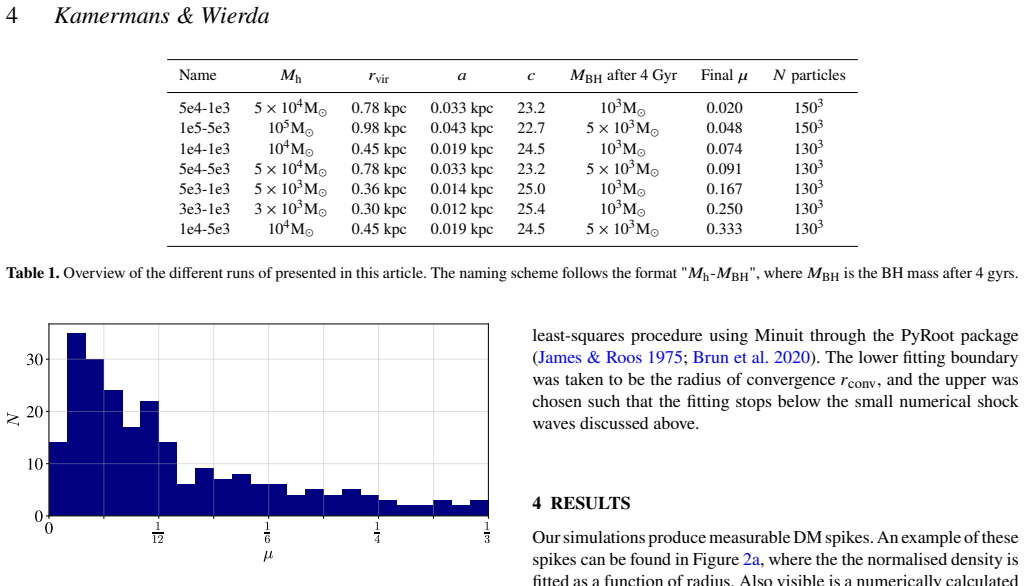
Using the modified SWIFT code with a growing point-mass black hole ('DAB'), the authors simulate seven Hernquist haloes with masses between 3×$10^{3}$ and $10^{5}$ M_sun and black holes grown adiabatically to $10^{3}$–5×$10^{3}$ M_sun, recording 235 snapshots. They fit the final density as ρ(r) = ρ_Hernq(r)[β + (r/r_sp)^{1-γ_sp}] and find that the best-fit depletion and spike radius depend only on μ: β = 1 − 0.998 $μ^{{0.858}}$ and r_sp/a = 0.801 $μ^{{2.29}}$/($μ^{{1.78}}$ + 9.1×$10^{{-4}}$). The spike slope γ_sp is consistent with 7/3 for μ ≳ 0.06 but is not well constrained below; the depletion reaches β ≈ 0.8 at the highest μ. Compared with the 'Modified G&S' spike, the new profile changes the gravitational-wave dephasing of a $10^{3}$ M_sun primary with a solar-mass secondary by up to a factor of two at γ_sp = 7/3, and nearly eliminates the dephasing if the slope is shallower (γ_sp = 2).
Load-bearing premise
The fitted spike parameters r_sp and γ_sp are treated as physical even though the spike radius lies far below the convergence radius, so the spike's shape and scalings are inferred by extrapolation rather than directly resolved.
Editorial extensions
If this is right
- If the profile is correct, the dark matter density around intermediate-mass black holes is lower in the outer spike region than the standard G&S spike for the same μ, and the outer halo is depleted by up to ~20% at μ ~ 0.25.
- The spike radius scaling r_sp ~ 0.8 a √μ at high μ and a steeper power at low μ replaces the often-used r_sp = r_h/5, so analyses that assume the Merritt radius will misestimate the spike's normalization and extent.
- Gravitational-wave dephasing forecasts for LISA (extreme and intermediate mass-ratio inspirals) should be re-evaluated: the new profile can double the dephasing for a 10^4 M_sun halo at γ_sp = 7/3, or make it nearly vanish if the low-μ slope is actually 2.
- The claim that results transfer to NFW haloes at fixed μ (due to the identical inner cusp) means the empirical profile, if confirmed, would apply to cosmologically motivated haloes without modification.
Reading between the lines
- Editorially: the steep low-μ scaling r_sp ∝ μ^2.29, if real, implies a much stronger dependence of spike size on black hole mass than adiabatic theory's μ^0.5; a simulation with higher resolution at low μ would test whether this is a physical effect or a fitting artifact.
- Editorially: the depletion of the outer halo might be observable in the rotation curves or stellar kinematics of dwarf galaxies hosting IMBHs, since β < 1 changes the enclosed mass at radii of order a; a targeted observational search could constrain the profile independently of the simulations.
- Editorially: the authors' own convergence analysis shows that γ_sp is the least constrained parameter; a next step would be to run a single simulation with much higher particle number (they estimate ~5×10^10 particles for the 10^4 M_sun halo) to pin down the slope, rather than adding more μ values at fixed resolution.
Editorial analysis
A structured set of objections, weighed in public.
Referee Report
Summary. The paper presents seven N-body simulations of Hernquist dark matter haloes (N ≈ 1300 particles) with a central black hole grown adiabatically in a modified version of the SWIFT code. From 235 recorded snapshots spanning mass ratios μ = M_BH/M_tot, the authors propose an empirical post-growth density profile (Eq. 12) consisting of the original Hernquist profile multiplied by a depletion factor β plus a power-law spike with slope γ_sp and radius r_sp. They fit β(μ), r_sp(μ), and γ_sp(μ), report scalings in Eqs. (14) and (15), and use the HaloFeedback code to estimate gravitational-wave dephasing for the new profile. The paper claims to be the first fully numerical demonstration of dark matter spike formation.
Significance. If the central claims were supported, this would be a significant contribution: it would offer the first N-body check of adiabatic spike formation in Hernquist haloes, a simple one-parameter empirical profile, and updated predictions for gravitational-wave dephasing. The authors deserve credit for releasing their code, for presenting detailed appendices on the convergence radius and on fitting validation, and for candidly acknowledging some resolution limitations. However, the main claims about the spike radius and slope are extracted from scales far below the stated convergence radius, and the validation appendix does not test the actual fitting configuration. The headline profile and mass-ratio scalings are therefore not established by the presented simulations.
major comments (4)
- [Sec. 4.1, Table 1, Eq. (15)] The fitted spike parameters lie far below the resolution limit. For the 1e4-1e3 run, ε = 6 r_vir/√N ≈ 0.075 kpc and, with the adopted δ = 2.5, r_conv = 2.5ε ≈ 0.19 kpc. Equation (15) with μ = 0.074 gives r_sp ≈ 0.0037 kpc, about 50 times smaller than r_conv; even for the highest-μ run (1e4-5e3, μ = 0.333), r_sp ≈ 0.0086 kpc, still about 22 times below r_conv. Since the fitting lower boundary is r_conv, the spike term in Eq. (13) contributes only (r_conv/r_sp)^{1-γ_sp} ≈ 0.5% for γ_sp = 7/3 and about 2% for γ_sp = 2 at the first fitted radius, and it decreases outward. The binned density above r_conv is therefore essentially β times the original Hernquist profile and contains no direct information about r_sp or γ_sp. The two-orders-of-magnitude smaller RMSE reported in Table 2 is an artifact of fitting an extrapolated, unresolved parameter and does not establish a new scaling. This undermines the central claim of the abstract and of Section 4.1.
- [Appendix C2, Sec. 4.1] The validation in Appendix C2 does not mimic the actual fitting configuration. The 'zoomed' fit in Tables C1-C4 covers 10^{-3} ≤ r ≤ 10^0 in units of a and brackets the injected artificial spike radii r_sp = 0.05 and 0.25. In the real N-body fits, the lower boundary is r_conv ≈ 10a for the 10^4 M_sun haloes (0.19 kpc versus a = 0.019 kpc), so the actual fitting interval starts at roughly 50 r_sp. The artificial-data tests therefore only demonstrate parameter recovery when the fitted range contains the spike; they do not address the situation in which the spike lies far below the first fitted radius. The paper's own admissions in Section 4.1 that low-μ spikes 'manifest below r_conv' and that the low-μ γ_sp values may be resolution artifacts apply equally to r_sp, so the scaling in Eq. (15) is not supported by the validation presented.
- [Sec. 3.3, Eqs. (14)-(15)] The reported bin counts and fit quality are internally inconsistent. Section 3.3 states that more than 10^4 particles are present in the least populated radial bins, but each run has only N = 1303 DM particles; with logarithmic radial binning, the innermost resolved bins can contain at most a few tens to a few hundred particles, not 10^4. The quoted χ²_red values of order 10^{-5} for the secondary fits in Eqs. (14) and (15) and the small 1σ errors therefore cannot follow from the stated Poisson error model applied to single snapshots. Either the error model is mis-described, or the 235 snapshots are being treated as independent even though they are strongly correlated within each of the seven runs. In either case, the formal significance assigned to the empirical scalings is not trustworthy.
- [Sec. 4.2, Table 3] The gravitational-wave dephasing estimates inherit the resolution problem. Table 3 compares inspirals in the proposed profile with γ_sp = 7/3 and γ_sp = 2, but both cases use an r_sp that is unconstrained by the simulations, and the γ_sp = 2 case uses a slope that the authors themselves attribute to limited fitting range. The qualitative statement that dephasing can be smaller for shallower spikes is reasonable, but the numerical values in Table 3 and the associated conclusions in Section 5 should not be presented as predictions of the simulated profile until the spike parameters are resolved.
minor comments (5)
- [Sec. 3.1 vs Appendix B] Section 3.1 states r_conv = 2ε, while Appendix B concludes that δ = 2.5 should be used; please reconcile this inconsistency.
- [Fig. 2 caption] The caption for panel (c) says the lower sub-panel shows 'values of β divided by the best fit'; it should refer to r_sp.
- [Eqs. (12)-(13)] The notation \(\tilde{r}_{\rm sp}\) in Eq. (12) is not defined until Eq. (13); please state explicitly that \(\tilde{r}_{\rm sp} = r_{\rm sp}/a\).
- [Abstract and conclusions] The phrase 'fully numerically simulated cold dark matter spikes' in the abstract is stronger than what the resolution analysis in Section 4.1 and Appendix C2 supports; please qualify it.
- [Data availability] Making the reduced density profiles and the fit catalog publicly available, rather than only upon reasonable request, would substantially improve reproducibility.
Circularity Check
No significant circularity; the proposed profile is an empirical fit to independent N-body data, and the resolution concerns flagged in the paper are correctness risks, not circular reductions.
full rationale
The paper's central result, the empirical profile of Eq. (12) with the fits of Eqs. (14) and (15), is obtained by least-squares fitting to density histograms of N-body simulations, not by assuming the conclusion. The comparison against Gondolo & Silk (1999), the Modified G&S profile, and the HaloFeedback inspiral code are external benchmarks, and the quoted RMSE improvement is an independent comparison. The only self-citation in the load-bearing vicinity is the Numerical G&S implementation 'based on code developed for Bertone et al. (2024)', where one of the present authors is a co-author; however, this implementation is used only for the comparison curve and the RMSE table, and the central fit does not reduce to that code. The paper itself explicitly flags that low-mass-ratio spikes 'manifest below r_conv' and that low-μ values of γ_sp are 'likely due to limited fitting range as discussed in Appendix C2'; Appendix C2 also concedes that 'the resolution of these simulations is too low to determine γ_sp with the same level of accuracy'. These are genuine resolution and validation limitations, but they are not circular: the fitted parameters are not defined in terms of the claimed scalings, and no fitted input is renamed as a prediction. Accordingly, the circularity score is low, reflecting only the minor, non-load-bearing self-citation and the need to interpret the unresolved-spike fitting range as a correctness caveat rather than a circularity defect.
Assumptions & free parameters
free parameters (10)
- α1 =
0.998 ± 0.008
- α2 =
0.858 ± 0.004
- α3 =
0.801 ± 0.004
- α4 =
2.29 ± 0.07
- α5 =
1.78 ± 0.07
- α6 =
(9.1 ± 2.4) × 10^-4
- β, r_sp, γ_sp (per snapshot) =
varies
- softening constant α in ε = α r_vir/√N =
6
- time-step parameter η =
0.005
- δ = r_conv/ε =
2.5
assumptions (8)
- standard math Adiabatic invariance of actions during slow BH growth (Binney & Tremaine 2008)
- domain assumption The Hernquist inner cusp (ρ ∝ r^{-1}) is representative of NFW, so the results carry over to NFW haloes
- domain assumption Baryonic mass is negligible for the spike calculation
- domain assumption Newtonian point-mass treatment of the BH is sufficient at resolved radii
- ad hoc to paper The initial numerical shock wave does not significantly affect the fitted results
- ad hoc to paper The functional form of the empirical profile (Eq. 12), Hernquist density times [β + power-law], is a valid ansatz
- standard math Poisson √N_bin errors in radial bins and bin independence
- domain assumption The mass ratio μ alone determines the profile, independent of halo mass or absolute size
Cite this review
Pith. "Pith review of Darkness Visible: N-Body Simulations of Dark Matter Spikes in Hernquist Haloes." pith.science (2026). https://pith.science/paper/SZ6GJJ2Y
@misc{pith2026241112007,
  author       = {Pith},
  title        = {Pith review of: Darkness Visible: N-Body Simulations of Dark Matter Spikes in Hernquist Haloes},
  year         = {2026},
  howpublished = {\url{https://pith.science/paper/SZ6GJJ2Y}},
  note         = {Machine review of arXiv:2411.12007}
}
read the original abstract
Dark matter is theorised to form massive haloes, which could be further condensed into so-called spikes when a black hole grows at the centre of such a halo. The existence of these spikes is instrumental for several dark matter detection schemes such as indirect detection and imprints on gravitational wave inspirals, but all previous work on their formation has been (semi-)analytical. We present fully numerically simulated cold dark matter spikes using the SWIFT code. Based on these results, we propose a simple empirical density profile - dependent on only a single mass-ratio parameter between the black hole and total mass - for dark matter spikes grown in Hernquist profiles. We find that the radius of the spike scales differently compared to theoretical predictions, and show a depletion of the outer halo that is significant for high mass-ratio systems. We critically assess approximations of the spike as used in the field, show that our profile significantly deviates, and contextualise the potential influence for future dark matter detections by simulating binary black hole inspirals embedded in our profile.
Figures

Forward citations
Cited by 1 Pith paper
-
Tidal Love numbers and quasi-normal modes of the Schwarzschild-Hernquist black hole
For a Schwarzschild black hole in a relativistic Hernquist dark matter halo, quasinormal-mode frequency shifts scale as (MDM/rs)^(3/2) rather than linearly, while tidal Love numbers are small and sensitive to the choi...
Reference graph
Works this paper leans on
-
[1]
Aghanim N., et al., 2020, @doi [A&A] 10.1051/0004-6361/201833910 , 641, A6 @eprint arXiv 1807.06209
arXiv 2020
-
[2]
F., Vecchi M., 2024, @doi [JCAP] 10.1088/1475-7516/2024/09/005 , 09, 005 @eprint arXiv 2401.14072
Aschersleben J., Bertone G., Horns D., Moulin E., Peletier R. F., Vecchi M., 2024, @doi [JCAP] 10.1088/1475-7516/2024/09/005 , 09, 005 @eprint arXiv 2401.14072
arXiv 2024
-
[3]
Baes, M. Dejonghe, H. Buyle, P. 2005, @doi [A&A] 10.1051/0004-6361:20041907 , 432, 411 @eprint arXiv astro-ph/0411202
arXiv 2005
-
[4]
Bandara K., Crampton D., Simard L., 2009, @doi [ApJ] 10.1088/0004-637X/704/2/1135 , 704, 1135 @eprint arXiv 0909.0269
arXiv 2009
-
[5]
Bertone G., Zentner A. R., Silk J., 2005, @doi [Phys. Rev. D] 10.1103/PhysRevD.72.103517 , 72, 103517 @eprint arXiv astro-ph/0509565
arXiv 2005
-
[6]
Bertone G., Wierda A. R. A. C., Gaggero D., Kavanagh B. J., Volonteri M., Yoshida N., 2024 @eprint arXiv 2404.08731
arXiv 2024
-
[7]
Princeton University Press
Binney J., Tremaine S., 2008, Galactic Dynamics: Second Edition. Princeton University Press
2008
-
[8]
Booth C. M., Schaye J., 2010, @doi [MNRAS.] 10.1111/j.1745-3933.2010.00832.x , 405, L1 @eprint arXiv 0911.0935
arXiv 2010
Show all 44 references
-
[9]
Brun R., et al., 2020, @doi 10.5281/zenodo.3895860
2020 doi
-
[10]
S., Boylan-Kolchin M., 2017, @doi [ARA&A] 10.1146/annurev-astro-091916-055313 , 55, 343 @eprint arXiv 1707.04256
Bullock J. S., Boylan-Kolchin M., 2017, @doi [ARA&A] 10.1146/annurev-astro-091916-055313 , 55, 343 @eprint arXiv 1707.04256
2017 arXiv
-
[11]
S., Bertone G., Coogan A., Gaggero D., Karydas T., Kavanagh B
Cole P. S., Bertone G., Coogan A., Gaggero D., Karydas T., Kavanagh B. J., Spieksma T. F. M., Tomaselli G. M., 2023, @doi [Nature Astron.] 10.1038/s41550-023-01990-2 , 7, 943 @eprint arXiv 2211.01362
2023
-
[12]
Colpi M., et al., 2024 @eprint arXiv 2402.07571
2024 arXiv
-
[13]
J., Nichols D
Coogan A., Bertone G., Gaggero D., Kavanagh B. J., Nichols D. A., 2022, @doi [Phys. Rev. D] 10.1103/PhysRevD.105.043009 , 105, 043009 @eprint arXiv 2108.04154
2022 arXiv
-
[14]
A., Wyithe J
Correa C. A., Wyithe J. S. B., Schaye J., Duffy A. R., 2015, @doi [MNRAS] 10.1093/mnras/stv1363 , 452, 1217 @eprint arXiv 1502.00391
2015 arXiv
-
[15]
Eda K., Itoh Y., Kuroyanagi S., Silk J., 2013, @doi [Phys. Rev. Lett.] 10.1103/PhysRevLett.110.221101 , 110, 221101 @eprint arXiv 1301.5971
2013 arXiv
-
[16]
Eda K., Itoh Y., Kuroyanagi S., Silk J., 2015, @doi [Phys. Rev. D] 10.1103/PhysRevD.91.044045 , 91, 044045 @eprint arXiv 1408.3534
2015 arXiv
-
[17]
Farrell S., Webb N., Barret D., Godet O., Rodrigues J., 2009, @doi [Nature] 10.1038/nature08083 , 460, 73 @eprint arXiv 1001.0567
2009 arXiv
-
[18]
Gondolo P., Silk J., 1999, @doi [Phys. Rev. Lett.] 10.1103/PhysRevLett.83.1719 , 83, 1719 @eprint arXiv astro-ph/9906391
1999 arXiv
-
[19]
M., Kavanagh B
Green A. M., Kavanagh B. J., 2021, @doi [J. Phys. G] 10.1088/1361-6471/abc534 , 48, 043001 @eprint arXiv 2007.10722
2021 arXiv
-
[20]
H \"a berle M., et al., 2024, @doi [ ] 10.1038/s41586-024-07511-z , https://ui.adsabs.harvard.edu/abs/2024Natur.631..285H 631, 285 @eprint arXiv 2405.06015
2024 arXiv
-
[21]
Hernquist L., 1990, @doi [ApJ] 10.1086/168845 , 356, 359
1990 doi
-
[22]
James F., Roos M., 1975, @doi [Comput. Phys. Com.] https://doi.org/10.1016/0010-4655(75)90039-9 , 10, 343
1975 doi
-
[23]
J., Nichols D
Kavanagh B. J., Nichols D. A., Bertone G., Gaggero D., 2020, @doi [Phys. Rev. D] 10.1103/PhysRevD.102.083006 , 102, 083006 @eprint arXiv 2002.12811
2020 arXiv
-
[24]
J., Karydas T
Kavanagh B. J., Karydas T. K., Bertone G., Di Cintio P., Pasquato M., 2024 @eprint arXiv 2402.13762
2024
-
[25]
Li P., Lelli F., McGaugh S., Schombert J., 2020, @doi [ApJS] 10.3847/1538-4365/ab700e , 247, 31 @eprint arXiv 2001.10538
2020 arXiv
-
[26]
Merritt D., 2003, in Carnegie Observatories Centennial Symposium. 1. Coevolution of Black Holes and Galaxies . @eprint arXiv astro-ph/0301257
2003 arXiv
-
[27]
Merritt D., 2004, @doi [Phys. Rev. Lett.] 10.1103/PhysRevLett.92.201304 , 92, 201304 @eprint arXiv astro-ph/0311594
2004 arXiv
-
[28]
M., Ogiya G., Trac H., 2024, @doi [MNRAS] 10.1093/mnras/stae1989 , 533, 2335 @eprint arXiv 2312.02275
Mukherjee D., Holgado A. M., Ogiya G., Trac H., 2024, @doi [MNRAS] 10.1093/mnras/stae1989 , 533, 2335 @eprint arXiv 2312.02275
2024 arXiv
-
[29]
F., Frenk C
Navarro J. F., Frenk C. S., White S. D. M., 1996, @doi [ApJ] 10.1086/177173 , 462, 563 @eprint arXiv astro-ph/9508025
1996 arXiv
-
[30]
Navas S., et al., 2024, @doi [Phys. Rev. D] 10.1103/PhysRevD.110.030001 , 110, 030001
2024 doi
-
[31]
Pandey B., 2016, @doi [MNRAS] 10.1093/mnras/stw1788 , 462, 1630 @eprint arXiv 1512.03562
2016 arXiv
-
[32]
R., Strohmayer T
Pasham D. R., Strohmayer T. E., Mushotzky R. F., 2014, @doi [Nature] 10.1038/nature13710 , 513, 74 @eprint arXiv 1501.03180
2014 arXiv
-
[33]
F., Jenkins A., Frenk C
Power C., Navarro J. F., Jenkins A., Frenk C. S., White S. D. M., Springel V., Stadel J., Quinn T., 2003, @doi [MNRAS] 10.1046/j.1365-8711.2003.05925.x , 338, 14 @eprint arXiv astro-ph/0201544
2003
-
[34]
D., Hernquist L., Sigurdsson S., 1995, @doi [ApJ] 10.1086/175295 , 440, 554 @eprint arXiv astro-ph/9407005
Quinlan G. D., Hernquist L., Sigurdsson S., 1995, @doi [ApJ] 10.1086/175295 , 440, 554 @eprint arXiv astro-ph/9407005
1995 arXiv
-
[35]
Rashkov V., Madau P., 2014, @doi [ApJ] 10.1088/0004-637X/780/2/187 , 780, 187 @eprint arXiv 1303.3929
2014 arXiv
-
[36]
M., 2013, @doi [Phys
Sadeghian L., Ferrer F., Will C. M., 2013, @doi [Phys. Rev. D] 10.1103/PhysRevD.88.063522 , 88, 063522 @eprint arXiv 1305.2619
2013 arXiv
-
[37]
Schaller M., et al., 2024, @doi [MNRAS] 10.1093/mnras/stae922 , 530, 2378 @eprint arXiv 2305.13380
2024 arXiv
-
[38]
K., Tormen G., 2002, @doi [MNRAS] 10.1046/j.1365-8711.2002.04950.x , 329, 61 @eprint arXiv astro-ph/0105113
Sheth R. K., Tormen G., 2002, @doi [MNRAS] 10.1046/j.1365-8711.2002.04950.x , 329, 61 @eprint arXiv astro-ph/0105113
2002
-
[39]
Ullio P., Zhao H., Kamionkowski M., 2001, @doi [Phys. Rev. D] 10.1103/PhysRevD.64.043504 , 64, 043504 @eprint arXiv astro-ph/0101481
2001 arXiv
- [40]
-
[41]
Yue X.-J., Han W.-B., Chen X., 2019, @doi [ApJ] 10.3847/1538-4357/ab06f6 , 874, 34 @eprint arXiv 1802.03739
2019 arXiv
-
[42]
Zhang T., Liao S., Li M., Gao L., 2019, @doi [MNRAS] 10.1093/mnras/stz1370 , 487, 1227 @eprint arXiv 1810.07055
2019 arXiv
-
[43]
Zhao H.-S., Silk J., 2005, @doi [Phys. Rev. Lett.] 10.1103/PhysRevLett.95.011301 , 95, 011301 @eprint arXiv astro-ph/0501625
2005 arXiv
-
[44]
write newline
" write newline "" before.all 'output.state := FUNCTION fin.entry write newline FUNCTION new.block output.state before.all = 'skip after.block 'output.state := if FUNCTION new.sentence output.state after.block = 'skip output.state before.all = 'skip after.sentence 'output.stat...
Reviewed August 12, 2026 · model on record in the stance chip above.
Discussion (0). Continue with ORCID to comment.