REVIEW 3 major objections 5 minor 4 cited by
Non-IID data in Federated Learning: A Survey with Taxonomy, Metrics, Methods, Frameworks and Future Directions
T0 review · 3 major / 5 minor · reviewed 2026-08-12 · deepseek-v4-flash
Pith's one-line read This survey aims to give federated learning a standard taxonomy for non-IID data, and reports that the field rarely quantifies or benchmarks it.
desk verdict A solid taxonomic survey whose meta-analysis numbers don't add up; fix the PRISMA flow and it's a useful standard reference. read the letter →
The pith
A machine-rendered reading of the paper's core claim, the machinery that carries it, and where it could break.
The reading
What carries the argument
The organizing device is a formal density-based definition of skew: local data distributions differ when $f^{(i)} \neq f^{(j)}$, with label skew and attribute skew separated through marginal and conditional densities, linked by Bayes' theorem. On top of this, the survey classifies partition protocols (e.g., Dirichlet-based, sharding, noise-based) and heterogeneity metrics (distance/divergence-based, statistical tests, class-based, model-based, encoder-based, performance-based). The quantitative findings come from a 235-paper corpus assembled through a structured screening of six literature databases; prevalence percentages such as label skew appearing in 48-55% of papers and only 13.1% of papers using metrics are the load-bearing outputs that the taxonomy explains.
What would settle it
Re-running the documented search across the same literature repositories and applying the stated inclusion criteria should reproduce the same 235-paper corpus and the same subtype percentages; the flow diagram already shows a count mismatch (219 + 36 = 255 versus the stated 235), so a corrected count or an independent re-classification that yields materially different percentages would falsify the meta-analytic claims.
Extended reading notes
Core claim
The central claim is that non-IIDness in federated learning decomposes into label skew, attribute skew, quantity skew, spatiotemporal heterogeneity, participation skew, and modality skew, and that prior surveys do not cover all of them. The authors assert this is the first technical survey to provide complete coverage of these aspects. They further claim that the literature is heavily skewed toward label skew, that only 13.1% of the analyzed papers quantify non-IIDness with metrics, only 14.2% use standardized FL frameworks, and that no partition protocol or metric simultaneously combines multiple skew types.
Load-bearing premise
The quantitative findings stand on the assumption that the 235 selected papers fairly represent the non-IID federated learning literature and that the authors' manual classification of each paper into skew subtypes is accurate and consistent.
Editorial extensions
If this is right
- Standardized partition protocols would let researchers state exactly which skew type and degree their experiments realize, making results comparable across papers.
- If the 13.1% metric-usage finding is accurate, the field's central claims about non-IIDness are mostly unsupported by quantitative heterogeneity measures.
- The absence of combined-skew metrics and combined-skew partition protocols means real-world scenarios with simultaneous label, attribute, and quantity skew are currently under-served.
- Modality skew, present in only 2% of papers, is a growth area; frameworks and benchmarks that support multimodal non-IID data could lead practical deployments.
- Higher adoption of standardized frameworks (currently 14.2%) would likely improve reproducibility of non-IID federated learning experiments.
Reading between the lines
- An implicit corollary is that benchmark suites should be designed around the taxonomy, e.g., a matrix of skew-type combinations, rather than single-skew perturbations.
- The taxonomy suggests testable hypotheses, e.g., that methods validated only on label skew will degrade more when combined with quantity skew than methods trained on multi-skew partitions.
- If combined metrics were developed, they could also serve as calibration tools for setting the concentration parameters in Dirichlet-based partition protocols, linking simulation degree to measured heterogeneity.
- The prevalence statistics likely overstate label skew's practical importance because label-skew partitions are the cheapest to generate; a corpus-level test would be to check whether papers that report accuracy gains under label skew retain those gains under attribute or modality skew.
Editorial analysis
A structured set of objections, weighed in public.
Referee Report
Summary. This survey aims to organize and synthesize the literature on non-IID data in federated learning. It introduces a taxonomy of data heterogeneity types (label skew, attribute skew, quantity skew, spatiotemporal heterogeneity, participation skew, and modality skew), catalogs partition protocols and non-IID metrics, reviews popular solution methods, compares standardized FL frameworks, and presents a PRISMA-style meta-analysis of a selected corpus of papers. The paper claims to be the first technical survey with complete coverage of all aspects of non-IIDness in FL, including a novel treatment of modality skew and a quantitative map of current research practice.
Significance. If the quantitative claims were reproducible, this would be a valuable reference survey for the FL community: the proposed taxonomy is broad and thoughtfully structured, the formal definitions of skew types in Section IV are a useful starting point for standardization, and the comparison of frameworks in Table II addresses a real gap. The paper also responsibly highlights understudied areas such as modality skew and combined-skew metrics. However, the quantified meta-analysis is currently the weakest part of the paper: the PRISMA flow in Section III-A/Fig. 3 has internal arithmetic inconsistencies, and the classification of papers into taxonomy subtypes appears to rest on undocumented, subjective judgments. Because the reported prevalence percentages and the "complete coverage" claim depend directly on this corpus, the numerical findings and the overarching contribution claim are not yet fully supported.
major comments (3)
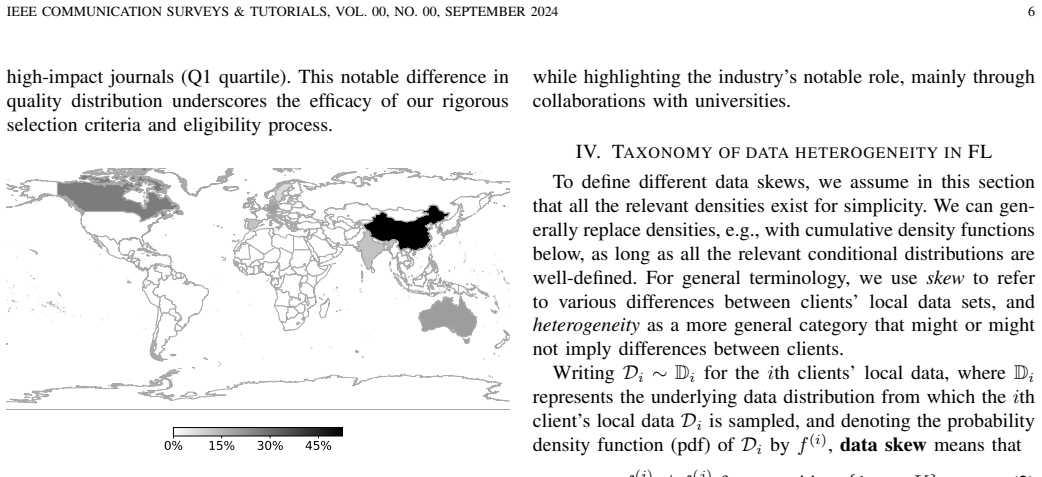
- [Section III-A, Fig. 3] The PRISMA flow is internally inconsistent, and this directly affects the denominators of every reported percentage in the meta-analysis. The text states that after duplicate removal "we compiled a collection of 5489 unique papers," while Fig. 3 reports "Remaining after duplicates removal: 5580 papers." In the eligibility stage, the text says "202 papers were marked as useful" and "36 additional papers are marked as useful," which sums to 238, but the next sentence says "we included 235 papers." Fig. 3 shows "Useful: 253 papers" and then "219 papers" from top-tier venues plus "36 papers" from unpublished/high-citation sources, totaling 255. These discrepancies change the denominator for the reported rates (e.g., 13.1% using metrics, 14.2% using frameworks, the 2% modality-skew figure, and the subtype percentages in Fig. 7). Please provide a single consistent PRISMA chart and, ideally, release the 83 search queries and the list of included papers so that the corpus can be reconstructed independently.
- [Section III-B and Section VIII] The meta-analysis percentages rest on the authors' subjective classification of each selected paper into skew subtypes, framework usage, and metric usage, but no inter-annotator agreement, second-annotator validation, or coding rubric is reported. The selection criteria themselves include subjective components (e.g., "best top-tier conferences/journals," QS top-100 university affiliation, citation-count thresholds). Without an included-paper list and a transparent coding protocol, an independent reader cannot verify that the reported prevalences (e.g., 60.3% of label-skew papers not mentioning quantity skew, 13.1% using metrics, 14.2% using frameworks) are stable or representative. This is a load-bearing issue for the paper's quantitative contribution, so please document the classification process and provide reproducibility artifacts.
- [Section I-B, I-C, and Table I] The claims of "complete coverage of all the aspects related to non-IID data" and of being "the first technical survey dedicated to organizing and synthesizing the existing knowledge regarding distribution skewness in FL" are not backed by a transparent comparison protocol. Table I assigns binary or partial checkmarks to prior surveys without specifying the rubric used to determine whether a topic is "included," "partially included," or "not included." Given the corpus inconsistencies described above, these claims are stronger than the current evidence supports. Please either provide a detailed comparison rubric and a reproducible corpus, or soften the claims to reflect coverage of the selected literature rather than complete coverage of the field.
minor comments (5)
- [Section IV, Eq. (3)] In the paragraph defining label skew, the text says "the marginal f(i)X or conditional f(i)Y|X distributions of the labels," but the equations and surrounding discussion refer to f(i)Y and f(i)Y|X; the marginal label distribution should be f(i)Y, not f(i)X. Please correct this typo in the formal definition.
- [Section II, Eq. (1)] Equation (1) defines the optimization objective as min_w l(w) := h(L_k(w)), but h is later described as an aggregation function over client objectives. As written, h is applied to a single scalar L_k(w), which is a type mismatch. Please clarify the notation, for example by writing l(w) = h(L_1(w), ..., L_K(w)).
- [Section V-B, Eq. (10)] The Client-Wise Non-IID Index formula appears garbled with OCR artifacts (e.g., the averaging sets and the normalization term are unclear). Please render the equation cleanly and verify the indices in the numerator and the definition of |C_i| versus |C_j|.
- [Section V-A] Several protocol popularity percentages (e.g., Dirichlet 27%, Sharding 20%, Percentage-of-non-IID-ness 7%) are reported without stating the denominator. Please clarify whether these are percentages of the 235 included papers or of the subset of papers that use partition protocols, and add the corresponding counts.
- [Section VI, FedDyn paragraph] The paragraph on FedDyn describes a knowledge-distillation approach with "focus distillation" and local differential privacy, but the cited reference [198] appears to be about a federated distillation method for recommender systems. Please verify that the description matches the cited work or replace the reference.
Circularity Check
Minor self-citation in the framework comparison; the central taxonomy and survey content are independent, and the PRISMA inconsistencies are reproducibility risks rather than circularity.
-
self citation load bearing
[Section VII, paragraph on FedArtML and Table II]
"Regarding non-IID metrics, FedArtML is the only framework with comprehensive support for label, attribute, and quantity skew metrics. Most frameworks have limited or no support for non-IID metrics, and no framework fully supports metrics for combined skews (label + attribute or label + attribute + quantity)."
FedArtML is cited as [128], a paper authored by the same research group (Jimenez G., Anagnostopoulos, Chatzigiannakis, Vitaletti). The superlative claim that FedArtML is 'the only framework with comprehensive support' is therefore a self-assessment by the tool's creators, and Table II's comparative rating rests on that self-citation rather than on an independent audit. This is a minor self-citation concern, but it is not load-bearing for the paper's central taxonomy or its survey conclusions, which are grounded in the broader cited literature.
full rationale
This is a survey rather than a derivation: no equations are fitted and then re-presented as predictions. The taxonomy in Section IV is built on standard definitions and is independently grounded in the cited literature, and the partition-protocol and metric taxonomies are descriptive syntheses of external work. The FedArtML self-citation in Section VII and Table II is the only notable circularity-adjacent element: the claim that FedArtML uniquely provides comprehensive non-IID metric support comes from the same authors who built the tool, making the comparison partly self-referential. However, this is a peripheral comparative claim, not the central contribution. The PRISMA meta-analysis has internal inconsistencies (5489 vs 5580 unique papers after duplicate removal; 202 + 36 = 238 vs 235 included; 219 + 36 = 255 vs 253 useful in Fig. 3), and the percentages such as '13.1%' and '14.2%' depend on that unreproducible corpus. This is a correctness and reproducibility risk, not circularity: the percentages are descriptive statistics of the selected set, not predictions that reduce to the selection criteria by construction. Overall, the central survey content is self-contained, so the circularity score is 2.
Assumptions & free parameters
assumptions (2)
- domain assumption The 235 selected papers are representative of the non-IID FL literature.
- domain assumption The manual classification of each paper into skew subtypes (label, attribute, quantity, modality, etc.) is consistent and accurate.
Cite this review
Pith. "Pith review of Non-IID data in Federated Learning: A Survey with Taxonomy, Metrics, Methods, Frameworks and Future Directions." pith.science (2026). https://pith.science/paper/T2NQAV3N
@misc{pith2026241112377,
  author       = {Pith},
  title        = {Pith review of: Non-IID data in Federated Learning: A Survey with Taxonomy, Metrics, Methods, Frameworks and Future Directions},
  year         = {2026},
  howpublished = {\url{https://pith.science/paper/T2NQAV3N}},
  note         = {Machine review of arXiv:2411.12377}
}
read the original abstract
Recent advances in machine learning have highlighted Federated Learning (FL) as a promising approach that enables multiple distributed users (so-called clients) to collectively train ML models without sharing their private data. While this privacy-preserving method shows potential, it struggles when data across clients is not independent and identically distributed (non-IID) data. The latter remains an unsolved challenge that can result in poorer model performance and slower training times. Despite the significance of non-IID data in FL, there is a lack of consensus among researchers about its classification and quantification. This technical survey aims to fill that gap by providing a detailed taxonomy for non-IID data, partition protocols, and metrics to quantify data heterogeneity. Additionally, we describe popular solutions to address non-IID data and standardized frameworks employed in FL with heterogeneous data. Based on our state-of-the-art survey, we present key lessons learned and suggest promising future research directions.
Figures


Figures from the paper (8 more)


Forward citations
Cited by 4 Pith papers
-
Privacy-Preserving Federated Averaging with Byzantine Aggregators in Asynchronous Networks
A new protocol enables differentially private federated averaging in asynchronous networks with fully Byzantine aggregators, using replicated servers, LWE masking, and verifiable cluster shuffling.
-
Model Fusion via Retrofitting
A neuron-centric fusion method that clusters intermediate activations of independently trained models into importance-weighted centroids and fits the fused network to them, outperforming baselines in zero-shot non-IID...
-
On the Effectiveness of Adaptation Strategies for VLM-Based Federated Learning in Remote Sensing
In federated remote sensing, LoRA tuning of a frozen CLIP model achieves the best accuracy-to-communication trade-off, while full fine-tuning causes severe catastrophic forgetting of pretrained knowledge.
-
PIcsC: Partitioning-Induced Covariate Shift Correction
A Fisher-information regularizer is proposed to correct partition-induced covariate shift in cross-validation and federated learning, with reported gains of 3-5 points over FedAvg-class baselines.
Reference graph
Works this paper leans on
-
[1]
Communication-efficient learning of deep networks from decentral- ized data,
B. McMahan, E. Moore, D. Ramage, S. Hampson, and B. A. y Arcas, “Communication-efficient learning of deep networks from decentral- ized data,” in Artificial intelligence and statistics . PMLR, 2017, pp. 1273–1282
2017
-
[2]
A survey for federated learning evaluations: Goals and measures,
D. Chai, L. Wang, L. Yang, J. Zhang, K. Chen, and Q. Yang, “A survey for federated learning evaluations: Goals and measures,” IEEE Transactions on Knowledge and Data Engineering , 2024
2024
-
[3]
Gdpr: Reshaping the landscape of digital transformation and business strategy,
P. Ullagaddi, “Gdpr: Reshaping the landscape of digital transformation and business strategy,” International Journal of Business Marketing and Management, vol. 9, no. 2, pp. 29–35, 2024
2024
-
[4]
Complying with hipaa and hitech,
S. Lincke, “Complying with hipaa and hitech,” in Information Security Planning: A Practical Approach . Springer, 2024, pp. 345–365
2024
-
[5]
Application of federated learning techniques for arrhythmia classification using 12-lead ecg signals,
D. M. Jimenez Gutierrez, H. M. Hassan, L. Landi, A. Vitaletti, and I. Chatzigiannakis, “Application of federated learning techniques for arrhythmia classification using 12-lead ecg signals,” in International Symposium on Algorithmic Aspects of Cloud Computing . Springer, 2023, pp. 38–65
2023
-
[6]
Transparency and privacy: the role of explainable ai and federated learning in financial fraud detection,
T. Awosika, R. M. Shukla, and B. Pranggono, “Transparency and privacy: the role of explainable ai and federated learning in financial fraud detection,” IEEE Access, 2024
2024
-
[7]
Fedasa: A personalized federated learning with adaptive model aggregation for heterogeneous mobile edge computing,
D. Deng, X. Wu, T. Zhang, X. Tang, H. Du, J. Kang, J. Liu, and D. Niyato, “Fedasa: A personalized federated learning with adaptive model aggregation for heterogeneous mobile edge computing,” IEEE Transactions on Mobile Computing , 2024
2024
-
[8]
Learning multiple layers of features from tiny images,
A. Krizhevsky, G. Hinton et al., “Learning multiple layers of features from tiny images,” 2009
2009
Show all 268 references
-
[9]
Mnist hand- written digit database,
Y . LeCun, C. Cortes, and C. Burges, “Mnist hand- written digit database,” ATT Labs [Online]. Available: http://yann.lecun.com/exdb/mnist, vol. 2, 2010
2010
-
[10]
Fashion-mnist: a novel image dataset for benchmarking machine learning algorithms,
H. Xiao, K. Rasul, and R. V ollgraf, “Fashion-mnist: a novel image dataset for benchmarking machine learning algorithms,” arXiv preprint arXiv:1708.07747, 2017
2017 arXiv
-
[11]
Enhancing generalization in federated learning with heterogeneous data: A comparative literature review,
A. Mora, A. Bujari, and P. Bellavista, “Enhancing generalization in federated learning with heterogeneous data: A comparative literature review,” Future Generation Computer Systems , 2024
2024
-
[12]
Federated learning with non-iid data: A survey,
Z. Lu, H. Pan, Y . Dai, X. Si, and Y . Zhang, “Federated learning with non-iid data: A survey,” IEEE Internet of Things Journal , 2024
2024
-
[13]
A review of federated learning methods in heterogeneous scenarios,
J. Pei, W. Liu, J. Li, L. Wang, and C. Liu, “A review of federated learning methods in heterogeneous scenarios,” IEEE Transactions on Consumer Electronics, 2024. IEEE COMMUNICATION SURVEYS & TUTORIALS, VOL. 00, NO. 00, SEPTEMBER 2024 20
2024
-
[14]
Advances in robust federated learning: Heterogeneity considerations,
C. Chen, T. Liao, X. Deng, Z. Wu, S. Huang, and Z. Zheng, “Advances in robust federated learning: Heterogeneity considerations,” arXiv preprint arXiv:2405.09839, 2024
2024 arXiv
-
[15]
Non-iid data and continual learning processes in federated learning: A long road ahead,
M. F. Criado, F. E. Casado, R. Iglesias, C. V . Regueiro, and S. Barro, “Non-iid data and continual learning processes in federated learning: A long road ahead,” Information Fusion, vol. 88, pp. 263–280, 2022
2022
-
[16]
A state-of-the-art survey on solving non-iid data in federated learning,
X. Ma, J. Zhu, Z. Lin, S. Chen, and Y . Qin, “A state-of-the-art survey on solving non-iid data in federated learning,” Future Generation Computer Systems, vol. 135, pp. 244–258, 2022
2022
-
[17]
Federated learning on non-iid data: A survey,
H. Zhu, J. Xu, S. Liu, and Y . Jin, “Federated learning on non-iid data: A survey,” Neurocomputing, vol. 465, pp. 371–390, 2021
2021
-
[18]
Decentralized federated averaging,
T. Sun, D. Li, and B. Wang, “Decentralized federated averaging,” IEEE Transactions on Pattern Analysis and Machine Intelligence , vol. 45, no. 4, pp. 4289–4301, 2022
2022
-
[19]
Federated learning: Opportunities and challenges,
P. M. Mammen, “Federated learning: Opportunities and challenges,” arXiv preprint arXiv:2101.05428 , 2021
2021 arXiv
-
[20]
Cross-silo federated learning: Challenges and opportunities,
C. Huang, J. Huang, and X. Liu, “Cross-silo federated learning: Challenges and opportunities,” arXiv preprint arXiv:2206.12949, 2022
2022 arXiv
-
[21]
Federated learning for internet of things: A comprehensive survey,
D. C. Nguyen, M. Ding, P. N. Pathirana, A. Seneviratne, J. Li, and H. V . Poor, “Federated learning for internet of things: A comprehensive survey,”IEEE Communications Surveys & Tutorials, vol. 23, no. 3, pp. 1622–1658, 2021
2021
-
[22]
Client-edge-cloud hierarchical federated learning,
L. Liu, J. Zhang, S. Song, and K. B. Letaief, “Client-edge-cloud hierarchical federated learning,” in ICC 2020-2020 IEEE international conference on communications (ICC) . IEEE, 2020, pp. 1–6
2020
-
[23]
A survey on federated learning,
C. Zhang, Y . Xie, H. Bai, B. Yu, W. Li, and Y . Gao, “A survey on federated learning,” Knowledge-Based Systems , vol. 216, p. 106775, 2021
2021
-
[24]
Federated learning review: Fundamentals, enabling technologies, and future applications,
S. Banabilah, M. Aloqaily, E. Alsayed, N. Malik, and Y . Jararweh, “Federated learning review: Fundamentals, enabling technologies, and future applications,” Information processing & management , vol. 59, no. 6, p. 103061, 2022
2022
-
[25]
Vertical federated learning: Concepts, advances, and challenges,
Y . Liu, Y . Kang, T. Zou, Y . Pu, Y . He, X. Ye, Y . Ouyang, Y .-Q. Zhang, and Q. Yang, “Vertical federated learning: Concepts, advances, and challenges,” IEEE Transactions on Knowledge and Data Engineering , 2024
2024
-
[26]
Braintorrent: A peer-to-peer environment for decentralized federated learning,
A. G. Roy, S. Siddiqui, S. P ¨olsterl, N. Navab, and C. Wachinger, “Braintorrent: A peer-to-peer environment for decentralized federated learning,” arXiv preprint arXiv:1905.06731 , 2019
1905 arXiv
-
[27]
Federated learning with non-iid data,
Y . Zhao, M. Li, L. Lai, N. Suda, D. Civin, and V . Chandra, “Federated learning with non-iid data,” arXiv preprint arXiv:1806.00582 , 2018
2018 arXiv
-
[28]
A review: Data pre- processing and data augmentation techniques,
K. Maharana, S. Mondal, and B. Nemade, “A review: Data pre- processing and data augmentation techniques,” Global Transitions Proceedings, vol. 3, no. 1, pp. 91–99, 2022
2022
-
[29]
Resampling strategies for imbalanced regression: a survey and empirical analysis,
J. G. Avelino, G. D. Cavalcanti, and R. M. Cruz, “Resampling strategies for imbalanced regression: a survey and empirical analysis,” Artificial Intelligence Review, vol. 57, no. 4, p. 82, 2024
2024
-
[30]
Evaluating machine learning models and their diagnostic value,
G. Varoquaux and O. Colliot, “Evaluating machine learning models and their diagnostic value,” Machine learning for brain disorders , pp. 601–630, 2023
2023
-
[31]
Internet of things intrusion detection: Centralized, on-device, or federated learning?
S. A. Rahman, H. Tout, C. Talhi, and A. Mourad, “Internet of things intrusion detection: Centralized, on-device, or federated learning?” IEEE Network, vol. 34, no. 6, pp. 310–317, 2020
2020
-
[32]
Fedac: A adaptive clustered federated learning framework for heterogeneous data,
Y . Zhang, H. Chen, Z. Lin, Z. Chen, and J. Zhao, “Fedac: A adaptive clustered federated learning framework for heterogeneous data,” arXiv preprint arXiv:2403.16460, 2024
2024 arXiv
-
[33]
Node selection toward faster convergence for federated learning on non-iid data,
H. Wu and P. Wang, “Node selection toward faster convergence for federated learning on non-iid data,” IEEE Transactions on Network Science and Engineering , vol. 9, no. 5, pp. 3099–3111, 2022
2022
-
[34]
Federated learning on non-iid data silos: An experimental study,
Q. Li, Y . Diao, Q. Chen, and B. He, “Federated learning on non-iid data silos: An experimental study,” in 2022 IEEE 38th international conference on data engineering (ICDE) . IEEE, 2022, pp. 965–978
2022
-
[35]
Semifed: Semi-supervised federated learning with consistency and pseudo-labeling,
H. Lin, J. Lou, L. Xiong, and C. Shahabi, “Semifed: Semi-supervised federated learning with consistency and pseudo-labeling,” arXiv preprint arXiv:2108.09412, 2021
2021 arXiv
-
[36]
Client selection in federated learning under imperfections in environment,
S. Rai, A. Kumari, and D. K. Prasad, “Client selection in federated learning under imperfections in environment,” AI, vol. 3, no. 1, pp. 124–145, 2022
2022
-
[37]
Evaluating the commu- nication efficiency in federated learning algorithms,
M. Asad, A. Moustafa, T. Ito, and M. Aslam, “Evaluating the commu- nication efficiency in federated learning algorithms,” in2021 IEEE 24th International Conference on Computer Supported Cooperative Work in Design (CSCWD). IEEE, 2021, pp. 552–557
2021
-
[38]
On safeguarding privacy and security in the framework of federated learning,
C. Ma, J. Li, M. Ding, H. H. Yang, F. Shu, T. Q. Quek, and H. V . Poor, “On safeguarding privacy and security in the framework of federated learning,” IEEE network, vol. 34, no. 4, pp. 242–248, 2020
2020
-
[39]
Poisoning attacks in federated learning: A survey,
G. Xia, J. Chen, C. Yu, and J. Ma, “Poisoning attacks in federated learning: A survey,” IEEE Access, vol. 11, pp. 10 708–10 722, 2023
2023
-
[40]
Addressing heterogeneity in federated learning with client selection via submodular optimization,
J. Zhang, J. Wang, Y . Li, F. Xin, F. Dong, J. Luo, and Z. Wu, “Addressing heterogeneity in federated learning with client selection via submodular optimization,” ACM Transactions on Sensor Networks, vol. 20, no. 2, pp. 1–32, 2024
2024
-
[41]
Wscc: A weight-similarity- based client clustering approach for non-iid federated learning,
P. Tian, W. Liao, W. Yu, and E. Blasch, “Wscc: A weight-similarity- based client clustering approach for non-iid federated learning,” IEEE Internet of Things Journal , vol. 9, no. 20, pp. 20 243–20 256, 2022
2022
-
[42]
A contribution-based device selection scheme in federated learning,
S. R. Pandey, L. D. Nguyen, and P. Popovski, “A contribution-based device selection scheme in federated learning,” IEEE Communications Letters, vol. 26, no. 9, pp. 2057–2061, 2022
2022
-
[43]
Towards federated learning: An overview of methods and applications,
P. R. Silva, J. Vinagre, and J. Gama, “Towards federated learning: An overview of methods and applications,” Wiley Interdisciplinary Reviews: Data Mining and Knowledge Discovery , vol. 13, no. 2, p. e1486, 2023
2023
-
[44]
How to do a systematic review: a best practice guide for conducting and reporting narrative reviews, meta-analyses, and meta-syntheses,
A. P. Siddaway, A. M. Wood, and L. V . Hedges, “How to do a systematic review: a best practice guide for conducting and reporting narrative reviews, meta-analyses, and meta-syntheses,” Annual review of psychology, vol. 70, pp. 747–770, 2019
2019
-
[45]
(2004) Google scholar
Google. (2004) Google scholar. Google. [Online]. Available: http: //scholar.google.com/
2004
-
[46]
(2000) Ieee xplore
IEEE. (2000) Ieee xplore. IEEE. [Online]. Available: https://ieeexplore. ieee.org/
2000
-
[47]
U. S. N. L. of Medicine. (1996) Pubmed. United States National Library of Medicine. [Online]. Available: https://pubmed.ncbi.nlm.nih. gov/
1996
-
[48]
(2004) Scopus
Elsevier. (2004) Scopus. Elsevier. [Online]. Available: https://www. sciencedirect.com/
2004
-
[49]
(1997) Web of science
Clarivate. (1997) Web of science. Clarivate. [Online]. Available: https://clarivate.com/webofsciencegroup/solutions/web-of-science
1997
-
[50]
Q. T. Universities. (1994) Qs world university rankings 2024: Top global universities. QS Quacquarelli Symonds Limited. [Online]. Available: https://www.topuniversities.com/ university-subject-rankings/engineering-technology
1994
-
[51]
Fedel: Federated ensemble learning for non-iid data,
X. Wu, J. Pei, X.-H. Han, Y .-W. Chen, J. Yao, Y . Liu, Q. Qian, and Y . Guo, “Fedel: Federated ensemble learning for non-iid data,” Expert Systems with Applications , vol. 237, p. 121390, 2024
2024
-
[52]
Aedfl: efficient asynchronous decentralized federated learning with heterogeneous devices,
J. Liu, T. Che, Y . Zhou, R. Jin, H. Dai, D. Dou, and P. Valduriez, “Aedfl: efficient asynchronous decentralized federated learning with heterogeneous devices,” in Proceedings of the 2024 SIAM International Conference on Data Mining (SDM) . SIAM, 2024, pp. 833–841
2024
-
[53]
Federated learning with a balanced heterogeneous-yoke and loose restriction,
B. Li, “Federated learning with a balanced heterogeneous-yoke and loose restriction,” Internet of Things , vol. 25, p. 101144, 2024
2024
-
[54]
Towards robust federated learning via logits calibration on non-iid data,
Y . Qiao, A. Adhikary, C. Zhang, and C. S. Hong, “Towards robust federated learning via logits calibration on non-iid data,” arXiv preprint arXiv:2403.02803, 2024
2024 arXiv
-
[55]
On the effectiveness of partial variance reduction in federated learning with heterogeneous data,
B. Li, M. N. Schmidt, T. S. Alstrøm, and S. U. Stich, “On the effectiveness of partial variance reduction in federated learning with heterogeneous data,” in Proceedings of the IEEE/CVF Conference on Computer Vision and Pattern Recognition , 2023, pp. 3964–3973
2023
-
[56]
Tackling data heterogeneity in federated learning with class prototypes,
Y . Dai, Z. Chen, J. Li, S. Heinecke, L. Sun, and R. Xu, “Tackling data heterogeneity in federated learning with class prototypes,” in Proceedings of the AAAI Conference on Artificial Intelligence , vol. 37, no. 6, 2023, pp. 7314–7322
2023
-
[57]
Label-efficient self-supervised federated learning for tackling data heterogeneity in medical imaging,
R. Yan, L. Qu, Q. Wei, S.-C. Huang, L. Shen, D. L. Rubin, L. Xing, and Y . Zhou, “Label-efficient self-supervised federated learning for tackling data heterogeneity in medical imaging,” IEEE Transactions on Medical Imaging, vol. 42, no. 7, pp. 1932–1943, 2023
1932
-
[58]
Feder- ated learning with label distribution skew via logits calibration,
J. Zhang, Z. Li, B. Li, J. Xu, S. Wu, S. Ding, and C. Wu, “Feder- ated learning with label distribution skew via logits calibration,” in International Conference on Machine Learning . PMLR, 2022, pp. 26 311–26 329
2022
-
[59]
Learning critically: Selective self-distillation in federated learning on non-iid data,
Y . He, Y . Chen, X. Yang, H. Yu, Y .-H. Huang, and Y . Gu, “Learning critically: Selective self-distillation in federated learning on non-iid data,” IEEE Transactions on Big Data , 2022
2022
-
[60]
Fedpd: A federated learning framework with adaptivity to non-iid data,
X. Zhang, M. Hong, S. Dhople, W. Yin, and Y . Liu, “Fedpd: A federated learning framework with adaptivity to non-iid data,” IEEE Transactions on Signal Processing , vol. 69, pp. 6055–6070, 2021
2021
-
[61]
Ferrari: A personalized federated learning framework for heterogeneous edge clients,
Z. Yao, J. Liu, H. Xu, L. Wang, C. Qian, and Y . Liao, “Ferrari: A personalized federated learning framework for heterogeneous edge clients,” IEEE Transactions on Mobile Computing , 2024
2024
-
[62]
Towards reliable participation in uav-enabled federated edge learning on non-iid data,
Y . Cheriguene, W. Jaafar, H. Yanikomeroglu, and C. A. Kerrache, “Towards reliable participation in uav-enabled federated edge learning on non-iid data,” IEEE Open Journal of Vehicular Technology , 2023
2023
-
[63]
Federated learning with taskonomy for non-iid data,
H. Jamali-Rad, M. Abdizadeh, and A. Singh, “Federated learning with taskonomy for non-iid data,” IEEE transactions on neural networks and learning systems , vol. 34, no. 11, pp. 8719–8730, 2022. IEEE COMMUNICATION SURVEYS & TUTORIALS, VOL. 00, NO. 00, SEPTEMBER 2024 21
2022
-
[64]
Per- sonalized cross-silo federated learning on non-iid data,
Y . Huang, L. Chu, Z. Zhou, L. Wang, J. Liu, J. Pei, and Y . Zhang, “Per- sonalized cross-silo federated learning on non-iid data,” in Proceedings of the AAAI conference on artificial intelligence , vol. 35, no. 9, 2021, pp. 7865–7873
2021
-
[65]
Exploiting label skews in federated learning with model concatenation,
Y . Diao, Q. Li, and B. He, “Exploiting label skews in federated learning with model concatenation,” in Proceedings of the AAAI Conference on Artificial Intelligence, vol. 38, no. 10, 2024, pp. 11 784–11 792
2024
-
[66]
Flgan: Gan-based unbiased federated learning under non-iid settings,
Z. Ma, Y . Liu, Y . Miao, G. Xu, X. Liu, J. Ma, and R. H. Deng, “Flgan: Gan-based unbiased federated learning under non-iid settings,” IEEE Transactions on Knowledge and Data Engineering , 2023
2023
-
[67]
Ringsfl: An adaptive split federated learning towards taming client heterogeneity,
J. Shen, N. Cheng, X. Wang, F. Lyu, W. Xu, Z. Liu, K. Aldubaikhy, and X. Shen, “Ringsfl: An adaptive split federated learning towards taming client heterogeneity,” IEEE Transactions on Mobile Computing , 2023
2023
-
[68]
Byzantine-robust variance- reduced federated learning over distributed non-iid data,
J. Peng, Z. Wu, Q. Ling, and T. Chen, “Byzantine-robust variance- reduced federated learning over distributed non-iid data,” Information Sciences, vol. 616, pp. 367–391, 2022
2022
-
[69]
Lfighter: Defending against the label-flipping attack in federated learning,
N. M. Jebreel, J. Domingo-Ferrer, D. S ´anchez, and A. Blanco-Justicia, “Lfighter: Defending against the label-flipping attack in federated learning,” Neural Networks, vol. 170, pp. 111–126, 2024
2024
-
[70]
Cross- to-merge training with class balance strategy for learning with noisy labels,
Q. Zhang, Y . Zhu, M. Yang, G. Jin, Y . Zhu, and Q. Chen, “Cross- to-merge training with class balance strategy for learning with noisy labels,” Expert Systems with Applications , vol. 249, p. 123846, 2024
2024
-
[71]
Blockchain-based fairness- enhanced federated learning scheme against label flipping attack,
S. Jin, Y . Li, X. Chen, R. Li, and Z. Shen, “Blockchain-based fairness- enhanced federated learning scheme against label flipping attack,” Journal of Information Security and Applications , vol. 77, p. 103580, 2023
2023
-
[72]
Fedcir: Client- invariant representation learning for federated non-iid features,
Z. Li, Z. Lin, J. Shao, Y . Mao, and J. Zhang, “Fedcir: Client- invariant representation learning for federated non-iid features,” IEEE Transactions on Mobile Computing , 2024
2024
-
[73]
One-shot sequential federated learning for non-iid data by enhancing local model diversity,
N. Wang, Y . Deng, W. Feng, S. Fan, J. Yin, and S.-K. Ng, “One-shot sequential federated learning for non-iid data by enhancing local model diversity,” arXiv preprint arXiv:2404.12130 , 2024
2024 arXiv
-
[74]
Fairfed: Enabling group fairness in federated learning,
Y . H. Ezzeldin, S. Yan, C. He, E. Ferrara, and A. S. Avestimehr, “Fairfed: Enabling group fairness in federated learning,” inProceedings of the AAAI Conference on Artificial Intelligence , vol. 37, 2023, pp. 7494–7502
2023
-
[75]
Fairness and accuracy in horizontal federated learning,
W. Huang, T. Li, D. Wang, S. Du, J. Zhang, and T. Huang, “Fairness and accuracy in horizontal federated learning,” Information Sciences , vol. 589, pp. 170–185, 2022
2022
-
[76]
Decentralized federated learning of deep neural networks on non-iid data,
N. Onoszko, G. Karlsson, O. Mogren, and E. L. Zec, “Decentralized federated learning of deep neural networks on non-iid data,” arXiv preprint arXiv:2107.08517, 2021
2021 arXiv
-
[77]
Robust federated learning: The case of affine distribution shifts,
A. Reisizadeh, F. Farnia, R. Pedarsani, and A. Jadbabaie, “Robust federated learning: The case of affine distribution shifts,” Advances in Neural Information Processing Systems , vol. 33, pp. 21 554–21 565, 2020
2020
-
[78]
Fairtrade: Achieving pareto-optimal trade-offs between balanced accuracy and fairness in federated learning,
M. Badar, S. Sikdar, W. Nejdl, and M. Fisichella, “Fairtrade: Achieving pareto-optimal trade-offs between balanced accuracy and fairness in federated learning,” in Proceedings of the AAAI Conference on Artifi- cial Intelligence, vol. 38, no. 10, 2024, pp. 10 962–10 970
2024
-
[79]
Fraug: Tackling federated learning with non-iid features via representation augmenta- tion,
H. Chen, A. Frikha, D. Krompass, J. Gu, and V . Tresp, “Fraug: Tackling federated learning with non-iid features via representation augmenta- tion,” in Proceedings of the IEEE/CVF International Conference on Computer Vision, 2023, pp. 4849–4859
2023
-
[80]
Clustered federated learning with adaptive local differential privacy on heterogeneous iot data,
Z. He, L. Wang, and Z. Cai, “Clustered federated learning with adaptive local differential privacy on heterogeneous iot data,” IEEE Internet of Things Journal, 2023
2023
-
[81]
Federated learning for dis- tribution skewed data using sample weights,
H. Nguyen, P. Wu, and J. M. Chang, “Federated learning for dis- tribution skewed data using sample weights,” IEEE Transactions on Artificial Intelligence, 2023
2023
-
[82]
Federated learning on non-iid graphs via structural knowledge sharing,
Y . Tan, Y . Liu, G. Long, J. Jiang, Q. Lu, and C. Zhang, “Federated learning on non-iid graphs via structural knowledge sharing,” in Pro- ceedings of the AAAI conference on artificial intelligence, vol. 37, no. 8, 2023, pp. 9953–9961
2023
-
[83]
A simple data augmentation for feature distribution skewed federated learning,
Y . Yan and L. Zhu, “A simple data augmentation for feature distribution skewed federated learning,” arXiv preprint arXiv:2306.09363 , 2023
2023 arXiv
-
[84]
Fl-enhance: A federated learning framework for balancing non-iid data with aug- mented and shared compressed samples,
D. Chiaro, E. Prezioso, M. Ianni, and F. Giampaolo, “Fl-enhance: A federated learning framework for balancing non-iid data with aug- mented and shared compressed samples,” Information Fusion, vol. 98, p. 101836, 2023
2023
-
[85]
Cross-silo federated learning for multi-tier networks with vertical and horizontal data partitioning,
A. Das, T. Castiglia, S. Wang, and S. Patterson, “Cross-silo federated learning for multi-tier networks with vertical and horizontal data partitioning,” ACM Transactions on Intelligent Systems and Technology (TIST), vol. 13, no. 6, pp. 1–27, 2022
2022
-
[86]
Federated xgboost on sample-wise non-iid data,
K. Jones, Y . J. Ong, Y . Zhou, and N. Baracaldo, “Federated xgboost on sample-wise non-iid data,” arXiv preprint arXiv:2209.01340, 2022
2022 arXiv
-
[87]
Fedmultimodal: A benchmark for multimodal federated learning,
T. Feng, D. Bose, T. Zhang, R. Hebbar, A. Ramakrishna, R. Gupta, M. Zhang, S. Avestimehr, and S. Narayanan, “Fedmultimodal: A benchmark for multimodal federated learning,” in Proceedings of the 29th ACM SIGKDD Conference on Knowledge Discovery and Data Mining, 2023, pp. 4035–4045
2023
-
[88]
Towards optimal multi-modal federated learning on non-iid data with hierarchical gradient blending,
S. Chen and B. Li, “Towards optimal multi-modal federated learning on non-iid data with hierarchical gradient blending,” in IEEE INFOCOM 2022-IEEE conference on computer communications. IEEE, 2022, pp. 1469–1478
2022
-
[89]
Multi- modal federated learning for cancer staging over non-iid datasets with unbalanced modalities,
K. Borazjani, N. Khosravan, L. Ying, and S. Hosseinalipour, “Multi- modal federated learning for cancer staging over non-iid datasets with unbalanced modalities,” arXiv preprint arXiv:2401.03609 , 2024
2024 arXiv
-
[90]
Harmony: Heterogeneous multi-modal federated learn- ing through disentangled model training,
X. Ouyang, Z. Xie, H. Fu, S. Cheng, L. Pan, N. Ling, G. Xing, J. Zhou, and J. Huang, “Harmony: Heterogeneous multi-modal federated learn- ing through disentangled model training,” in Proceedings of the 21st Annual International Conference on Mobile Systems, Applications and Se...
2023
-
[91]
Fault diagnosis based on federated learning driven by dynamic ex- pansion for model layers of imbalanced client,
F. Zhou, S. Liu, H. Fujita, X. Hu, Y . Zhang, B. Wang, and K. Wang, “Fault diagnosis based on federated learning driven by dynamic ex- pansion for model layers of imbalanced client,” Expert Systems with Applications, vol. 238, p. 121982, 2024
2024
-
[92]
Ada- ffl: Adaptive computing fairness federated learning,
Y . Cong, J. Qiu, K. Zhang, Z. Fang, C. Gao, S. Su, and Z. Tian, “Ada- ffl: Adaptive computing fairness federated learning,” CAAI Transac- tions on Intelligence Technology , vol. 9, no. 3, pp. 573–584, 2024
2024
-
[93]
Experimenting with normalization layers in federated learning on non- iid scenarios,
B. Casella, R. Esposito, A. Sciarappa, C. Cavazzoni, and M. Aldinucci, “Experimenting with normalization layers in federated learning on non- iid scenarios,” IEEE Access, 2024
2024
-
[94]
Fedproc: Prototypical contrastive federated learning on non-iid data,
X. Mu, Y . Shen, K. Cheng, X. Geng, J. Fu, T. Zhang, and Z. Zhang, “Fedproc: Prototypical contrastive federated learning on non-iid data,” Future Generation Computer Systems , vol. 143, pp. 93–104, 2023
2023
-
[95]
Distribution-regularized federated learning on non-iid data,
Y . Wang, Y . Tong, Z. Zhou, R. Zhang, S. J. Pan, L. Fan, and Q. Yang, “Distribution-regularized federated learning on non-iid data,” in 2023 IEEE 39th International Conference on Data Engineering (ICDE) . IEEE, 2023, pp. 2113–2125
2023
-
[96]
Flis: Clustered federated learning via inference similarity for non-iid data distribution,
M. Morafah, S. Vahidian, W. Wang, and B. Lin, “Flis: Clustered federated learning via inference similarity for non-iid data distribution,” IEEE Open Journal of the Computer Society, vol. 4, pp. 109–120, 2023
2023
-
[97]
Blockchain- based two-stage federated learning with non-iid data in iomt system,
Z. Lian, Q. Zeng, W. Wang, T. R. Gadekallu, and C. Su, “Blockchain- based two-stage federated learning with non-iid data in iomt system,” IEEE Transactions on Computational Social Systems , vol. 10, no. 4, pp. 1701–1710, 2022
2022
-
[98]
Mitigating data heterogeneity in federated learning with data augmentation,
A. B. de Luca, G. Zhang, X. Chen, and Y . Yu, “Mitigating data heterogeneity in federated learning with data augmentation,” arXiv preprint arXiv:2206.09979, 2022
2022 arXiv
-
[99]
Privacy threat and defense for federated learning with non-iid data in aiot,
Z. Xiong, Z. Cai, D. Takabi, and W. Li, “Privacy threat and defense for federated learning with non-iid data in aiot,” IEEE Transactions on Industrial Informatics, vol. 18, no. 2, pp. 1310–1321, 2021
2021
-
[100]
Safari: Sparsity-enabled federated learning with limited and unreliable communications,
Y . Mao, Z. Zhao, M. Yang, L. Liang, Y . Liu, W. Ding, T. Lan, and X.- P. Zhang, “Safari: Sparsity-enabled federated learning with limited and unreliable communications,” IEEE Transactions on Mobile Computing, 2023
2023
-
[101]
Adaptive channel sparsity for federated learning under system heterogeneity,
D. Liao, X. Gao, Y . Zhao, and C.-Z. Xu, “Adaptive channel sparsity for federated learning under system heterogeneity,” in Proceedings of the IEEE/CVF Conference on Computer Vision and Pattern Recognition , 2023, pp. 20 432–20 441
2023
-
[102]
Zerofl: Efficient on-device training for federated learning with local sparsity,
X. Qiu, J. Fernandez-Marques, P. P. Gusmao, Y . Gao, T. Parcollet, and N. D. Lane, “Zerofl: Efficient on-device training for federated learning with local sparsity,” arXiv preprint arXiv:2208.02507 , 2022
2022 arXiv
-
[103]
Achieving per- sonalized federated learning with sparse local models,
T. Huang, S. Liu, L. Shen, F. He, W. Lin, and D. Tao, “Achieving per- sonalized federated learning with sparse local models,” arXiv preprint arXiv:2201.11380, 2022
2022 arXiv
-
[104]
Federated nonconvex sparse learning,
Q. Tong, G. Liang, T. Zhu, and J. Bi, “Federated nonconvex sparse learning,” arXiv preprint arXiv:2101.00052 , 2020
2020 arXiv
-
[105]
Facing spatiotemporal hetero- geneity: A unified federated continual learning framework with self- challenge rehearsal for industrial monitoring tasks,
B. Li, P. Song, C. Zhao, and M. Xie, “Facing spatiotemporal hetero- geneity: A unified federated continual learning framework with self- challenge rehearsal for industrial monitoring tasks,” Knowledge-Based Systems, vol. 289, p. 111491, 2024
2024
-
[106]
Is heterogeneity notorious? taming heterogeneity to handle test-time shift in federated learning,
Y . Tan, C. Chen, W. Zhuang, X. Dong, L. Lyu, and G. Long, “Is heterogeneity notorious? taming heterogeneity to handle test-time shift in federated learning,” Advances in Neural Information Processing Systems, vol. 36, 2024
2024
-
[107]
A decentralized federated learning-based spatial–temporal model for freight traffic speed fore- casting,
X. Shen, J. Chen, S. Zhu, and R. Yan, “A decentralized federated learning-based spatial–temporal model for freight traffic speed fore- casting,” Expert Systems with Applications , vol. 238, p. 122302, 2024
2024
-
[108]
Federated continual learning via knowledge fusion: A survey,
X. Yang, H. Yu, X. Gao, H. Wang, J. Zhang, and T. Li, “Federated continual learning via knowledge fusion: A survey,” IEEE Transactions on Knowledge and Data Engineering , 2024. IEEE COMMUNICATION SURVEYS & TUTORIALS, VOL. 00, NO. 00, SEPTEMBER 2024 22
2024
-
[109]
Ensemble and continual federated learning for classification tasks,
F. E. Casado, D. Lema, R. Iglesias, C. V . Regueiro, and S. Barro, “Ensemble and continual federated learning for classification tasks,” Machine Learning, vol. 112, no. 9, pp. 3413–3453, 2023
2023
-
[110]
Fedagat: Real-time traffic flow prediction based on federated community and adaptive graph attention network,
R. Al-Huthaifi, T. Li, Z. Al-Huda, and C. Li, “Fedagat: Real-time traffic flow prediction based on federated community and adaptive graph attention network,” Information Sciences , vol. 667, p. 120482, 2024
2024
-
[111]
Train a central traffic prediction model using local data: A spatio-temporal network based on federated learning,
H. Huang, Z. Hu, Y . Wang, Z. Lu, X. Wen, and B. Fu, “Train a central traffic prediction model using local data: A spatio-temporal network based on federated learning,” Engineering Applications of Artificial Intelligence, vol. 125, p. 106612, 2023
2023
-
[112]
Spatial-temporal prompt learning for federated weather forecasting,
S. Chen, G. Long, T. Shen, T. Zhou, and J. Jiang, “Spatial-temporal prompt learning for federated weather forecasting,” arXiv preprint arXiv:2305.14244, 2023
2023 arXiv
-
[113]
Performative federated learning: A solution to model-dependent and heterogeneous distribution shifts,
K. Jin, T. Yin, Z. Chen, Z. Sun, X. Zhang, Y . Liu, and M. Liu, “Performative federated learning: A solution to model-dependent and heterogeneous distribution shifts,” in Proceedings of the AAAI Confer- ence on Artificial Intelligence, vol. 38, no. 11, 2024, pp. 12 938–12 946
2024
-
[114]
Client selection for federated learning with label noise,
M. Yang, H. Qian, X. Wang, Y . Zhou, and H. Zhu, “Client selection for federated learning with label noise,” IEEE Transactions on Vehicular Technology, vol. 71, no. 2, pp. 2193–2197, 2021
2021
-
[115]
Federated learning via meta-variational dropout,
I. Jeon, M. Hong, J. Yun, and G. Kim, “Federated learning via meta-variational dropout,” Advances in Neural Information Processing Systems, vol. 36, 2024
2024
-
[116]
Fluid: Mitigating stragglers in feder- ated learning using invariant dropout,
I. Wang, P. Nair, and D. Mahajan, “Fluid: Mitigating stragglers in feder- ated learning using invariant dropout,” Advances in Neural Information Processing Systems, vol. 36, 2024
2024
-
[117]
Feddistill: Global model distillation for local model de-biasing in non-iid federated learning,
C. Song, D. Saxena, J. Cao, and Y . Zhao, “Feddistill: Global model distillation for local model de-biasing in non-iid federated learning,” arXiv preprint arXiv:2404.09210 , 2024
2024 arXiv
-
[118]
Fedbnr: Mitigating federated learning non-iid problem by breaking the skewed task and reconstructing representation,
C. Wang, H. Xia, S. Xu, H. Chi, R. Zhang, and C. Hu, “Fedbnr: Mitigating federated learning non-iid problem by breaking the skewed task and reconstructing representation,” Future Generation Computer Systems, vol. 153, pp. 1–11, 2024
2024
-
[119]
Aligning model outputs for class imbalanced non-iid federated learning,
L. Li, D.-c. Zhan, and X.-c. Li, “Aligning model outputs for class imbalanced non-iid federated learning,” Machine Learning , vol. 113, no. 4, pp. 1861–1884, 2024
2024
-
[120]
Gofl: An accurate and efficient federated learning framework based on gradient optimization in heterogeneous iot systems,
Z. Lian, J. Cao, Z. Zhu, X. Zhou, and W. Liu, “Gofl: An accurate and efficient federated learning framework based on gradient optimization in heterogeneous iot systems,” IEEE Internet of Things Journal , 2023
2023
-
[121]
Poe: Poisoning enhancement through label smoothing in federated learning,
H. Zheng, T. Liu, R. Li, and J. Chen, “Poe: Poisoning enhancement through label smoothing in federated learning,” IEEE Transactions on Circuits and Systems II: Express Briefs , vol. 70, no. 8, pp. 3129–3133, 2023
2023
-
[122]
Reschedule gradients: Temporal non-iid resilient federated learning,
X. You, X. Liu, N. Jiang, J. Cai, and Z. Ying, “Reschedule gradients: Temporal non-iid resilient federated learning,” IEEE Internet of Things Journal, vol. 10, no. 1, pp. 747–762, 2022
2022
-
[123]
Local-global knowledge distillation in heterogeneous federated learn- ing with non-iid data,
D. Yao, W. Pan, Y . Dai, Y . Wan, X. Ding, H. Jin, Z. Xu, and L. Sun, “Local-global knowledge distillation in heterogeneous federated learn- ing with non-iid data,” arXiv preprint arXiv:2107.00051 , 2021
2021 arXiv
-
[124]
Towards federated learning on time- evolving heterogeneous data,
Y . Guo, T. Lin, and X. Tang, “Towards federated learning on time- evolving heterogeneous data,” arXiv preprint arXiv:2112.13246, 2021
2021 arXiv
-
[125]
Estimating a dirichlet distribution,
T. Minka, “Estimating a dirichlet distribution,” 2000
2000
-
[126]
On the dirichlet distribution,
J. Lin, “On the dirichlet distribution,” Department of Mathematics and Statistics, Queens University , vol. 40, 2016
2016
-
[127]
Towards efficient and stable k-asynchronous federated learning with unbounded stale gradients on non-iid data,
Z. Zhou, Y . Li, X. Ren, and S. Yang, “Towards efficient and stable k-asynchronous federated learning with unbounded stale gradients on non-iid data,” IEEE Transactions on Parallel and Distributed Systems , vol. 33, no. 12, pp. 3291–3305, 2022
2022
-
[128]
Fedartml: A tool to facilitate the generation of non-iid datasets in a controlled way to support federated learning research,
D. M. Jimenez G., A. Anagnostopoulos, I. Chatzigiannakis, and A. Vitaletti, “Fedartml: A tool to facilitate the generation of non-iid datasets in a controlled way to support federated learning research,” IEEE Access, vol. 12, pp. 81 004–81 016, 2024
2024
-
[129]
Understanding generalization of fed- erated learning via stability: Heterogeneity matters,
Z. Sun, X. Niu, and E. Wei, “Understanding generalization of fed- erated learning via stability: Heterogeneity matters,” in International Conference on Artificial Intelligence and Statistics . PMLR, 2024, pp. 676–684
2024
-
[130]
Data independent warmup scheme for non-iid federated learning,
M. Arafeh, H. Ould-Slimane, H. Otrok, A. Mourad, C. Talhi, and E. Damiani, “Data independent warmup scheme for non-iid federated learning,” Information Sciences, vol. 623, pp. 342–360, 2023
2023
-
[131]
Differentially private feder- ated learning on heterogeneous data,
M. Noble, A. Bellet, and A. Dieuleveut, “Differentially private feder- ated learning on heterogeneous data,” in International Conference on Artificial Intelligence and Statistics. PMLR, 2022, pp. 10 110–10 145
2022
-
[132]
The non-iid data quagmire of decentralized machine learning,
K. Hsieh, A. Phanishayee, O. Mutlu, and P. Gibbons, “The non-iid data quagmire of decentralized machine learning,” in International Conference on Machine Learning . PMLR, 2020, pp. 4387–4398
2020
-
[133]
Fairness-aware client selection for federated learning,
Y . Shi, Z. Liu, Z. Shi, and H. Yu, “Fairness-aware client selection for federated learning,” in 2023 IEEE International Conference on Multimedia and Expo (ICME) . IEEE, 2023, pp. 324–329
2023
-
[134]
Fedfm: Anchor-based feature matching for data heterogeneity in federated learning,
R. Ye, Z. Ni, C. Xu, J. Wang, S. Chen, and Y . C. Eldar, “Fedfm: Anchor-based feature matching for data heterogeneity in federated learning,” IEEE Transactions on Signal Processing , 2023
2023
-
[135]
Federated learning with non-iid data in wireless networks,
Z. Zhao, C. Feng, W. Hong, J. Jiang, C. Jia, T. Q. Quek, and M. Peng, “Federated learning with non-iid data in wireless networks,” IEEE Transactions on Wireless communications , vol. 21, no. 3, pp. 1927– 1942, 2021
1927
-
[136]
Fedsa: A staleness-aware asynchronous federated learning algorithm with non-iid data,
M. Chen, B. Mao, and T. Ma, “Fedsa: A staleness-aware asynchronous federated learning algorithm with non-iid data,” Future Generation Computer Systems, vol. 120, pp. 1–12, 2021
2021
-
[137]
Data resampling for federated learning with non-iid labels,
Z. Tang, Z. Hu, S. Shi, Y .-m. Cheung, Y . Jin, Z. Ren, and X. Chu, “Data resampling for federated learning with non-iid labels,” in Proceedings of the International Workshop on Federated and Transfer Learning for Data Sparsity and Confidentiality in Conjunction with IJCAI, Mo...
2021
-
[138]
Optimizing federated learning on non-iid data with reinforcement learning,
H. Wang, Z. Kaplan, D. Niu, and B. Li, “Optimizing federated learning on non-iid data with reinforcement learning,” in IEEE INFOCOM 2020-IEEE conference on computer communications . IEEE, 2020, pp. 1698–1707
2020
-
[139]
Communication-efficient federated learning with data and client heterogeneity,
H. Zakerinia, S. Talaei, G. Nadiradze, and D. Alistarh, “Communication-efficient federated learning with data and client heterogeneity,” in International Conference on Artificial Intelligence and Statistics. PMLR, 2024, pp. 3448–3456
2024
-
[140]
Feddbo: A novel federated learning approach for communication cost and data heterogeneity using dung beetle optimizer,
D. Wang, L. Chen, X. Lu, Y . Wang, Y . Shen, and J. Xu, “Feddbo: A novel federated learning approach for communication cost and data heterogeneity using dung beetle optimizer,” IEEE Access, vol. 12, pp. 43 396–43 409, 2024
2024
-
[141]
A federated learn- ing algorithm using parallel-ensemble method on non-iid datasets,
H. Yu, C. Wu, H. Yu, X. Wei, S. Liu, and Y . Zhang, “A federated learn- ing algorithm using parallel-ensemble method on non-iid datasets,” Complex & Intelligent Systems , vol. 9, no. 6, pp. 6891–6903, 2023
2023
-
[142]
Robust communication-efficient decentralized learning with heterogeneity,
X. Zhang, Y . Wang, S. Chen, C. Wang, D. Yu, and X. Cheng, “Robust communication-efficient decentralized learning with heterogeneity,” Journal of Systems Architecture , vol. 141, p. 102900, 2023
2023
-
[143]
Federated learning for non-iid data via unified feature learning and optimization objective alignment,
L. Zhang, Y . Luo, Y . Bai, B. Du, and L.-Y . Duan, “Federated learning for non-iid data via unified feature learning and optimization objective alignment,” in Proceedings of the IEEE/CVF international conference on computer vision , 2021, pp. 4420–4428
2021
-
[144]
Fair detection of poisoning attacks in federated learning,
A. K. Singh, A. Blanco-Justicia, J. Domingo-Ferrer, D. S ´anchez, and D. Rebollo-Monedero, “Fair detection of poisoning attacks in federated learning,” in 2020 IEEE 32nd international conference on tools with artificial intelligence (ICTAI) . IEEE, 2020, pp. 224–229
2020
-
[145]
Age-of-information min- imization in federated learning based networks with non-iid dataset,
K. Wang, Z. Ding, D. K. So, and Z. Ding, “Age-of-information min- imization in federated learning based networks with non-iid dataset,” IEEE Transactions on Wireless Communications , 2024
2024
-
[146]
Clustered federated multitask learning on non-iid data with enhanced privacy,
J. Shu, T. Yang, X. Liao, F. Chen, Y . Xiao, K. Yang, and X. Jia, “Clustered federated multitask learning on non-iid data with enhanced privacy,” IEEE Internet of Things Journal , vol. 10, no. 4, pp. 3453– 3467, 2022
2022
-
[147]
Decou- pled federated learning for asr with non-iid data,
H. Zhu, J. Wang, G. Cheng, P. Zhang, and Y . Yan, “Decou- pled federated learning for asr with non-iid data,” arXiv preprint arXiv:2206.09102, 2022
2022 arXiv
-
[148]
Client selection for federated learning with non-iid data in mobile edge computing,
W. Zhang, X. Wang, P. Zhou, W. Wu, and X. Zhang, “Client selection for federated learning with non-iid data in mobile edge computing,” IEEE Access, vol. 9, pp. 24 462–24 474, 2021
2021
-
[149]
Defending against data poisoning attack in feder- ated learning with non-iid data,
C. Yin and Q. Zeng, “Defending against data poisoning attack in feder- ated learning with non-iid data,” IEEE Transactions on Computational Social Systems, 2023
2023
-
[150]
Fl games: A federated learning framework for distribution shifts,
S. Gupta, K. Ahuja, M. Havaei, N. Chatterjee, and Y . Bengio, “Fl games: A federated learning framework for distribution shifts,” arXiv preprint arXiv:2205.11101, 2022
2022 arXiv
-
[151]
Personalized federated graph learning on non-iid electronic health records,
T. Tang, Z. Han, Z. Cai, S. Yu, X. Zhou, T. Oseni, and S. K. Das, “Personalized federated graph learning on non-iid electronic health records,” IEEE Transactions on Neural Networks and Learning Systems, 2024
2024
-
[152]
Federated learning under impor- tance sampling,
E. Rizk, S. Vlaski, and A. H. Sayed, “Federated learning under impor- tance sampling,” IEEE Transactions on Signal Processing, vol. 70, pp. 5381–5396, 2022
2022
-
[153]
Federated learning biases in heterogeneous edge-devices: A case-study,
K. Selialia, Y . Chandio, and F. M. Anwar, “Federated learning biases in heterogeneous edge-devices: A case-study,” in Proceedings of the 20th ACM Conference on Embedded Networked Sensor Systems , 2022, pp. 980–986
2022
-
[154]
Flower: A friendly federated learning research framework,
D. J. Beutel, T. Topal, A. Mathur, X. Qiu, J. Fernandez-Marques, Y . Gao, L. Sani, K. H. Li, T. Parcollet, P. P. B. de Gusm ˜ao et al. , IEEE COMMUNICATION SURVEYS & TUTORIALS, VOL. 00, NO. 00, SEPTEMBER 2024 23 “Flower: A friendly federated learning research framework,” arXiv...
2024 arXiv
-
[155]
Boba: Byzantine-robust federated learning with label skewness,
W. Bao, J. Wu, and J. He, “Boba: Byzantine-robust federated learning with label skewness,” in International Conference on Artificial Intelli- gence and Statistics . PMLR, 2024, pp. 892–900
2024
-
[156]
Fedbe: Making bayesian model ensemble applicable to federated learning,
H.-Y . Chen and W.-L. Chao, “Fedbe: Making bayesian model ensemble applicable to federated learning,” arXiv preprint arXiv:2009.01974 , 2020
2009 arXiv
-
[157]
Fdqm: Four-dimensional quantitative measure for statistical heterogeneity in federated learning,
Y . Guo, Q. Tang, Y . Wang, and J. Ren, “Fdqm: Four-dimensional quantitative measure for statistical heterogeneity in federated learning,” in 2022 IEEE/CIC International Conference on Communications in China (ICCC). IEEE, 2022, pp. 956–961
2022
-
[158]
Handling non-iid data in federated learning: An experimental eval- uation towards unified metrics,
M. Haller, C. Lenz, R. Nachtigall, F. M. Awayshehl, and S. Alawadi, “Handling non-iid data in federated learning: An experimental eval- uation towards unified metrics,” in 2023 IEEE Intl Conf on De- pendable, Autonomic and Secure Computing, Intl Conf on Perva- sive Intelligenc...
2023
-
[159]
Non-iid quantum federated learning with one-shot communi- cation complexity,
H. Zhao, “Non-iid quantum federated learning with one-shot communi- cation complexity,” Quantum Machine Intelligence , vol. 5, no. 1, p. 3, 2023
2023
-
[160]
An emd-based adaptive client selection algorithm for federated learning in heterogeneous data sce- narios,
A. Chen, Y . Fu, Z. Sha, and G. Lu, “An emd-based adaptive client selection algorithm for federated learning in heterogeneous data sce- narios,” Frontiers in Plant Science , vol. 13, p. 908814, 2022
2022
-
[161]
Federated visual classification with real-world data distribution,
T.-M. H. Hsu, H. Qi, and M. Brown, “Federated visual classification with real-world data distribution,” in Computer Vision–ECCV 2020: 16th European Conference, Glasgow, UK, August 23–28, 2020, Pro- ceedings, Part X 16 . Springer, 2020, pp. 76–92
2020
-
[162]
Privacy-enhanced federated learning for non-iid data,
Q. Tan, S. Wu, and Y . Tao, “Privacy-enhanced federated learning for non-iid data,” Mathematics, vol. 11, no. 19, p. 4123, 2023
2023
-
[163]
Semisupervised federated learning for temporal news hyperpatism detection,
U. Ahmed, J. C.-W. Lin, and G. Srivastava, “Semisupervised federated learning for temporal news hyperpatism detection,” IEEE Transactions on Computational Social Systems, vol. 10, no. 4, pp. 1758–1769, 2023
2023
-
[164]
Fblg: A local graph based approach for handling dual skewed non-iid data in federated learning,
Y . Xu, Y . Li, H. Luo, X. Fan, and X. Liu, “Fblg: A local graph based approach for handling dual skewed non-iid data in federated learning,” in Proceedings of the Thirty-Third International Joint Conference on Artificial Intelligence, IJCAI-24 , K. Larson, Ed. International J...
2024 doi
-
[165]
Spatial-temporal federated learn- ing for lifelong person re-identification on distributed edges,
L. Zhang, G. Gao, and H. Zhang, “Spatial-temporal federated learn- ing for lifelong person re-identification on distributed edges,” IEEE Transactions on Circuits and Systems for Video Technology , 2023
2023
-
[166]
Privacy-preserving clustering federated learning for non-iid data,
G. Luo, N. Chen, J. He, B. Jin, Z. Zhang, and Y . Li, “Privacy-preserving clustering federated learning for non-iid data,” Future Generation Computer Systems, vol. 154, pp. 384–395, 2024
2024
-
[167]
An efficient earth mover’s distance algorithm for robust histogram comparison,
H. Ling and K. Okada, “An efficient earth mover’s distance algorithm for robust histogram comparison,” IEEE transactions on pattern anal- ysis and machine intelligence , vol. 29, no. 5, pp. 840–853, 2007
2007
-
[168]
A new measure of similarity in textual analysis: Vector similarity metric versus cosine similarity metric,
R. P. Srivastava, “A new measure of similarity in textual analysis: Vector similarity metric versus cosine similarity metric,” Journal of Emerging Technologies in Accounting, vol. 20, no. 1, pp. 77–90, 2023
2023
-
[169]
Rethinking architecture design for tackling data heterogeneity in federated learning,
L. Qu, Y . Zhou, P. P. Liang, Y . Xia, F. Wang, E. Adeli, L. Fei- Fei, and D. Rubin, “Rethinking architecture design for tackling data heterogeneity in federated learning,” in Proceedings of the IEEE/CVF conference on computer vision and pattern recognition , 2022, pp. 10 061–10 071
2022
-
[170]
Curse or redemption? how data heterogeneity affects the robustness of federated learning,
S. Zawad, A. Ali, P.-Y . Chen, A. Anwar, Y . Zhou, N. Baracaldo, Y . Tian, and F. Yan, “Curse or redemption? how data heterogeneity affects the robustness of federated learning,” in Proceedings of the AAAI conference on artificial intelligence , vol. 35, no. 12, 2021, pp. 10 8...
2021
-
[171]
Fed- geo: Privacy-preserving user next location prediction with federated learning,
C. Park, T. Choi, T. Kim, M. Cho, J. Hong, M. Choi, and J. Choo, “Fed- geo: Privacy-preserving user next location prediction with federated learning,” in Proceedings of the 31st ACM International Conference on Advances in Geographic Information Systems , 2023, pp. 1–10
2023
-
[172]
Communication-efficient federated learning on non-iid data using two- step knowledge distillation,
H. Wen, Y . Wu, J. Hu, Z. Wang, H. Duan, and G. Min, “Communication-efficient federated learning on non-iid data using two- step knowledge distillation,” IEEE Internet of Things Journal , vol. 10, no. 19, pp. 17 307–17 322, 2023
2023
-
[173]
Measuring the class- imbalance extent of multi-class problems,
J. Ortigosa-Hern ´andez, I. Inza, and J. A. Lozano, “Measuring the class- imbalance extent of multi-class problems,” Pattern Recognition Letters, vol. 98, pp. 32–38, 2017
2017
-
[174]
Entropy- driven stochastic federated learning in non-iid 6g edge-ran,
B. Aamer, H. Chergui, M. Benjillali, and C. Verikoukis, “Entropy- driven stochastic federated learning in non-iid 6g edge-ran,” Frontiers in Communications and Networks , vol. 2, p. 739414, 2021
2021
-
[175]
Achieving linear speedup with partial worker participation in non-iid federated learning,
H. Yang, M. Fang, and J. Liu, “Achieving linear speedup with partial worker participation in non-iid federated learning,” arXiv preprint arXiv:2101.11203, 2021
2021 arXiv
-
[176]
Lot- teryfl: Personalized and communication-efficient federated learning with lottery ticket hypothesis on non-iid datasets,
A. Li, J. Sun, B. Wang, L. Duan, S. Li, Y . Chen, and H. Li, “Lot- teryfl: Personalized and communication-efficient federated learning with lottery ticket hypothesis on non-iid datasets,” arXiv preprint arXiv:2008.03371, 2020
2008 arXiv
-
[177]
Federated optimization in heterogeneous networks,
T. Li, A. K. Sahu, M. Zaheer, M. Sanjabi, A. Talwalkar, and V . Smith, “Federated optimization in heterogeneous networks,” Proceedings of Machine learning and systems , vol. 2, pp. 429–450, 2020
2020
-
[178]
Scaffold: Stochastic controlled averaging for federated learn- ing,
S. P. Karimireddy, S. Kale, M. Mohri, S. Reddi, S. Stich, and A. T. Suresh, “Scaffold: Stochastic controlled averaging for federated learn- ing,” in International conference on machine learning . PMLR, 2020, pp. 5132–5143
2020
-
[179]
Resource-efficient federated learning with non-iid data: An auction theoretic approach,
E. Seo, D. Niyato, and E. Elmroth, “Resource-efficient federated learning with non-iid data: An auction theoretic approach,” IEEE Internet of Things Journal , vol. 9, no. 24, pp. 25 506–25 524, 2022
2022
-
[180]
Dres-fl: Dropout-resilient secure federated learning for non-iid clients via secret data sharing,
J. Shao, Y . Sun, S. Li, and J. Zhang, “Dres-fl: Dropout-resilient secure federated learning for non-iid clients via secret data sharing,” Advances in Neural Information Processing Systems , vol. 35, pp. 10 533–10 545, 2022
2022
-
[181]
Tackling the objective inconsistency problem in heterogeneous federated optimiza- tion,
J. Wang, Q. Liu, H. Liang, G. Joshi, and H. V . Poor, “Tackling the objective inconsistency problem in heterogeneous federated optimiza- tion,” Advances in neural information processing systems , vol. 33, pp. 7611–7623, 2020
2020
-
[182]
Contrastive encoder pre-training-based clustered federated learning for heterogeneous data,
Y . L. Tun, M. N. Nguyen, C. M. Thwal, J. Choi, and C. S. Hong, “Contrastive encoder pre-training-based clustered federated learning for heterogeneous data,” Neural Networks, vol. 165, pp. 689–704, 2023
2023
-
[183]
Fedlc: Optimizing federated learning in non- iid data via label-wise clustering,
H. Lee and D. Seo, “Fedlc: Optimizing federated learning in non- iid data via label-wise clustering,” IEEE Access , vol. 11, pp. 42 082– 42 095, 2023
2023
-
[184]
Efficient feder- ated learning under non-iid conditions with attackers,
H. Zou, Y . Zhang, X. Que, Y . Liang, and J. Crowcroft, “Efficient feder- ated learning under non-iid conditions with attackers,” in Proceedings of the 1st ACM Workshop on Data Privacy and Federated Learning Technologies for Mobile Edge Network , 2022, pp. 13–18
2022
-
[185]
Model-contrastive federated learning,
Q. Li, B. He, and D. Song, “Model-contrastive federated learning,” in Proceedings of the IEEE/CVF conference on computer vision and pattern recognition, 2021, pp. 10 713–10 722
2021
-
[186]
A novel federated learning approach with knowledge transfer for credit scoring,
Z. Wang, J. Xiao, L. Wang, and J. Yao, “A novel federated learning approach with knowledge transfer for credit scoring,” Decision Support Systems, vol. 177, p. 114084, 2024
2024
-
[187]
Robust federated learning for heterogeneous model and data
H. A. Madni, R. M. Umer, and G. L. Foresti, “Robust federated learning for heterogeneous model and data.” International Journal of Neural Systems, vol. 34, no. 4, pp. 2 450 019–2 450 019, 2024
2024
-
[188]
Privacy preserving federated learning for full heterogeneity,
K. Chen, X. Zhang, X. Zhou, B. Mi, Y . Xiao, L. Zhou, Z. Wu, L. Wu, and X. Wang, “Privacy preserving federated learning for full heterogeneity,” ISA transactions, vol. 141, pp. 73–83, 2023
2023
-
[189]
Memory- adaptive depth-wise heterogenous federated learning,
K. Zhang, Y . Dai, H. Wang, E. Xing, X. Chen, and L. Sun, “Memory- adaptive depth-wise heterogenous federated learning,” arXiv preprint arXiv:2303.04887, 2023
2023 arXiv
-
[190]
Class-wise adaptive self distillation for heterogeneous federated learning,
Y . He, Y . Chen, X. Yang, Y . Zhang, and B. Zeng, “Class-wise adaptive self distillation for heterogeneous federated learning,” in Proceedings of the 36th AAAI Conference on Artificial Intelligence, Virtual , vol. 22, 2022
2022
-
[191]
Secure and decentralized federated learning framework with non-iid data based on blockchain,
F. Zhang, Y . Zhang, S. Ji, and Z. Han, “Secure and decentralized federated learning framework with non-iid data based on blockchain,” Heliyon, vol. 10, no. 5, 2024
2024
-
[192]
A new federated learning model for host intrusion detection system under non- iid data,
W. Guo, Z. Yao, Y . Liu, L. Zhang, L. Li, T. Li, and B. Wu, “A new federated learning model for host intrusion detection system under non- iid data,” in 2023 IEEE International Conference on Systems, Man, and Cybernetics (SMC). IEEE, 2023, pp. 494–500
2023
-
[193]
Ensemble federated learning with non-iid data in wireless networks,
Z. Zhao, J. Wang, W. Hong, T. Q. Quek, Z. Ding, and M. Peng, “Ensemble federated learning with non-iid data in wireless networks,” IEEE Transactions on Wireless Communications , 2023
2023
-
[194]
Federated learning with gan-based data synthesis for non-iid clients,
Z. Li, J. Shao, Y . Mao, J. H. Wang, and J. Zhang, “Federated learning with gan-based data synthesis for non-iid clients,” in International Workshop on Trustworthy Federated Learning . Springer, 2022, pp. 17–32
2022
-
[195]
Towards understanding biased client selection in federated learning,
Y . J. Cho, J. Wang, and G. Joshi, “Towards understanding biased client selection in federated learning,” in International Conference on Artificial Intelligence and Statistics. PMLR, 2022, pp. 10 351–10 375
2022
-
[196]
Adaptive federated learning on non-iid data with resource constraint,
J. Zhang, S. Guo, Z. Qu, D. Zeng, Y . Zhan, Q. Liu, and R. Akerkar, “Adaptive federated learning on non-iid data with resource constraint,” IEEE Transactions on Computers, vol. 71, no. 7, pp. 1655–1667, 2021
2021
-
[197]
Client selection in federated learning: Convergence analysis and power-of-choice selection strategies,
Y . J. Cho, J. Wang, and G. Joshi, “Client selection in federated learning: Convergence analysis and power-of-choice selection strategies,” arXiv preprint arXiv:2010.01243, 2020. IEEE COMMUNICATION SURVEYS & TUTORIALS, VOL. 00, NO. 00, SEPTEMBER 2024 24
2010 arXiv
-
[198]
Feddyn: A dynamic and efficient federated distillation approach on recommender system,
C. Jin, X. Chen, Y . Gu, and Q. Li, “Feddyn: A dynamic and efficient federated distillation approach on recommender system,” in 2022 IEEE 28th international conference on parallel and distributed systems (ICPADS). IEEE, 2023, pp. 786–793
2022
-
[199]
Towards personalized federated learning,
A. Z. Tan, H. Yu, L. Cui, and Q. Yang, “Towards personalized federated learning,” IEEE transactions on neural networks and learning systems , vol. 34, no. 12, pp. 9587–9603, 2022
2022
-
[200]
Robust multi-model personalized federated learning via model distillation,
A. Muhammad, K. Lin, J. Gao, and B. Chen, “Robust multi-model personalized federated learning via model distillation,” in International Conference on Algorithms and Architectures for Parallel Processing . Springer, 2021, pp. 432–446
2021
-
[201]
Towards personalized federated learning via heterogeneous model reassembly,
J. Wang, X. Yang, S. Cui, L. Che, L. Lyu, D. D. Xu, and F. Ma, “Towards personalized federated learning via heterogeneous model reassembly,” Advances in Neural Information Processing Systems , vol. 36, 2024
2024
-
[202]
Enhancing heterogeneous federated learning with knowledge extraction and multi- model fusion,
D. P. Nguyen, S. Yu, J. P. Mu ˜noz, and A. Jannesari, “Enhancing heterogeneous federated learning with knowledge extraction and multi- model fusion,” arXiv preprint arXiv:2208.07978 , 2022
2022 arXiv
-
[203]
Fedml: A research li- brary and benchmark for federated machine learning,
C. He, S. Li, J. So, X. Zeng, M. Zhang, H. Wang, X. Wang, P. Vepakomma, A. Singh, H. Qiu et al. , “Fedml: A research li- brary and benchmark for federated machine learning,” arXiv preprint arXiv:2007.13518, 2020
2007 arXiv
-
[204]
(2015) Tff
Google. (2015) Tff. Google. [Online]. Available: https://www. tensorflow.org/federated
2015
-
[205]
Pysyft: A library for easy federated learning,
A. Ziller, A. Trask, A. Lopardo, B. Szymkow, B. Wagner, E. Bluemke, J.-M. Nounahon, J. Passerat-Palmbach, K. Prakash, N. Rose et al. , “Pysyft: A library for easy federated learning,” Federated Learning Systems: Towards Next-Generation AI , pp. 111–139, 2021
2021
-
[206]
Openfl: the open federated learning library,
P. Foley, M. J. Sheller, B. Edwards, S. Pati, W. Riviera, M. Sharma, P. N. Moorthy, S.-h. Wang, J. Martin, P. Mirhajiet al., “Openfl: the open federated learning library,” Physics in Medicine & Biology , vol. 67, no. 21, p. 214001, 2022
2022
-
[207]
Flute: A scalable, extensible framework for high-performance federated learning simulations,
M. Hipolito Garcia, A. Manoel, D. Madrigal Diaz, F. Mireshghallah, R. Sim, and D. Dimitriadis, “Flute: A scalable, extensible framework for high-performance federated learning simulations,” arXiv e-prints , pp. arXiv–2203, 2022
2022
-
[208]
Fate: An industrial grade platform for collaborative learning with data protection,
Y . Liu, T. Fan, T. Chen, Q. Xu, and Q. Yang, “Fate: An industrial grade platform for collaborative learning with data protection,” The Journal of Machine Learning Research, vol. 22, no. 1, pp. 10 320–10 325, 2021
2021
-
[209]
Fedlab: A flexible federated learning framework,
D. Zeng, S. Liang, X. Hu, H. Wang, and Z. Xu, “Fedlab: A flexible federated learning framework,” Journal of Machine Learning Research, vol. 24, no. 100, pp. 1–7, 2023
2023
-
[210]
Leaf: A benchmark for federated settings,
S. Caldas, S. M. K. Duddu, P. Wu, T. Li, J. Kone ˇcn`y, H. B. McMahan, V . Smith, and A. Talwalkar, “Leaf: A benchmark for federated settings,” arXiv preprint arXiv:1812.01097 , 2018
2018 arXiv
-
[211]
Federated Learning on Non-IID Data Silos: An Experimental Study,
Q. Li, Y . Diao, Q. Chen, and B. He, “Federated Learning on Non-IID Data Silos: An Experimental Study,” in EEE 38th International Conference on Data Engineering (ICDE) , 2022. [Online]. Available: https://ieeexplore.ieee.org/abstract/document/9835537
2022
-
[212]
Fedmmd: A federated weighting algorithm considering non-iid and local model deviation,
K. Hu, Y . Li, S. Zhang, J. Wu, S. Gong, S. Jiang, and L. Weng, “Fedmmd: A federated weighting algorithm considering non-iid and local model deviation,” Expert Systems with Applications , vol. 237, p. 121463, 2024
2024
-
[213]
Rethinking the representation in federated unsu- pervised learning with non-iid data,
X. Liao, W. Liu, C. Chen, P. Zhou, F. Yu, H. Zhu, B. Yao, T. Wang, X. Zheng, and Y . Tan, “Rethinking the representation in federated unsu- pervised learning with non-iid data,” in Proceedings of the IEEE/CVF Conference on Computer Vision and Pattern Recognition , 2024, pp. 22...
2024
-
[214]
Fedic: Federated learning on non-iid and long-tailed data via calibrated distillation,
X. Shang, Y . Lu, Y .-m. Cheung, and H. Wang, “Fedic: Federated learning on non-iid and long-tailed data via calibrated distillation,” in 2022 IEEE International Conference on Multimedia and Expo (ICME) . IEEE, 2022, pp. 1–6
2022
-
[215]
Fast-convergent federated learning with class-weighted aggregation,
Z. Ma, M. Zhao, X. Cai, and Z. Jia, “Fast-convergent federated learning with class-weighted aggregation,” Journal of Systems Architecture, vol. 117, p. 102125, 2021
2021
-
[216]
Fed-qssl: A framework for per- sonalized federated learning under bitwidth and data heterogeneity,
Y . Chen, H. Vikalo, and C. Wang, “Fed-qssl: A framework for per- sonalized federated learning under bitwidth and data heterogeneity,” in Proceedings of the AAAI Conference on Artificial Intelligence , vol. 38, no. 10, 2024, pp. 11 443–11 452
2024
-
[217]
Delta: Diverse client sam- pling for fasting federated learning,
L. Wang, Y . Guo, T. Lin, and X. Tang, “Delta: Diverse client sam- pling for fasting federated learning,” Advances in Neural Information Processing Systems, vol. 36, 2024
2024
-
[218]
Dfrd: Data-free robustness distillation for heterogeneous federated learning,
S. Wang, Y . Fu, X. Li, Y . Lan, M. Gao et al. , “Dfrd: Data-free robustness distillation for heterogeneous federated learning,” Advances in Neural Information Processing Systems , vol. 36, 2024
2024
-
[219]
Can hierarchical client clustering mitigate the data heterogeneity effect in federated learning?
S. Lee, M. Yu, D. Yoon, and S. Oh, “Can hierarchical client clustering mitigate the data heterogeneity effect in federated learning?” in 2023 IEEE International Parallel and Distributed Processing Symposium Workshops (IPDPSW). IEEE, 2023, pp. 799–808
2023
-
[220]
Federated learning on non-iid data via local and global distillation,
X. Zheng, S. Ying, F. Zheng, J. Yin, L. Zheng, C. Chen, and F. Dong, “Federated learning on non-iid data via local and global distillation,” in 2023 IEEE International Conference on Web Services (ICWS) . IEEE, 2023, pp. 647–657
2023
-
[221]
Federated model aggregation via self-supervised priors for highly imbalanced medical image classification,
M. Elbatel, H. Wang, R. Mart, H. Fu, and X. Li, “Federated model aggregation via self-supervised priors for highly imbalanced medical image classification,” in International Conference on Medical Image Computing and Computer-Assisted Intervention . Springer, 2023, pp. 334–346
2023
-
[222]
Fedsld: Federated learning with shared label distribution for medical image classification,
J. Luo and S. Wu, “Fedsld: Federated learning with shared label distribution for medical image classification,” in 2022 IEEE 19th International Symposium on Biomedical Imaging (ISBI) . IEEE, 2022, pp. 1–5
2022
-
[223]
Spatl: Salient parameter aggregation and transfer learning for het- erogeneous federated learning,
S. Yu, P. Nguyen, W. Abebe, W. Qian, A. Anwar, and A. Jannesari, “Spatl: Salient parameter aggregation and transfer learning for het- erogeneous federated learning,” in SC22: International Conference for High Performance Computing, Networking, Storage and Analysis . IEEE, 2022...
2022
-
[224]
Towards fair federated recommendation learning: Characterizing the inter-dependence of system and data heterogeneity,
K. Maeng, H. Lu, L. Melis, J. Nguyen, M. Rabbat, and C.-J. Wu, “Towards fair federated recommendation learning: Characterizing the inter-dependence of system and data heterogeneity,” in Proceedings of the 16th ACM Conference on Recommender Systems , 2022, pp. 156– 167
2022
-
[225]
A practical recipe for federated learning under statistical heterogeneity experimental design,
M. Morafah, W. Wang, and B. Lin, “A practical recipe for federated learning under statistical heterogeneity experimental design,” IEEE Transactions on Artificial Intelligence , 2023
2023
-
[226]
Aggenhance: Aggregation enhancement by class interior points in federated learning with non-iid data,
J. Ou, Y . Shen, F. Wang, Q. Liu, X. Zhang, and H. Lv, “Aggenhance: Aggregation enhancement by class interior points in federated learning with non-iid data,” ACM Transactions on Intelligent Systems and Technology (TIST), vol. 13, no. 6, pp. 1–25, 2022
2022
-
[227]
Improving accuracy and convergence in group-based federated learning on non-iid data,
Z. He, L. Yang, W. Lin, and W. Wu, “Improving accuracy and convergence in group-based federated learning on non-iid data,” IEEE Transactions on Network Science and Engineering , vol. 10, no. 3, pp. 1389–1404, 2022
2022
-
[228]
Privacy-preserved learning from non-iid data in fog- assisted iot: A federated learning approach,
M. Abdel-Basset, H. Hawash, N. Moustafa, I. Razzak, and M. Abd Elfattah, “Privacy-preserved learning from non-iid data in fog- assisted iot: A federated learning approach,” Digital Communications and Networks, 2022
2022
-
[229]
Comparative assessment of federated and centralized machine learning,
I. A. Majeed, S. Kaushik, A. Bardhan, V . S. K. Tadi, H.-K. Min, K. Kumaraguru, and R. D. Muni, “Comparative assessment of federated and centralized machine learning,” arXiv preprint arXiv:2202.01529 , 2022
2022 arXiv
-
[230]
Semisupervised distributed learning with non-iid data for aiot service platform,
T.-C. Chiu, Y .-Y . Shih, A.-C. Pang, C.-S. Wang, W. Weng, and C.-T. Chou, “Semisupervised distributed learning with non-iid data for aiot service platform,” IEEE Internet of Things Journal , vol. 7, no. 10, pp. 9266–9277, 2020
2020
-
[231]
Communication-efficient multimodal federated learning: Joint modal- ity and client selection,
L. Yuan, D.-J. Han, S. Wang, D. Upadhyay, and C. G. Brinton, “Communication-efficient multimodal federated learning: Joint modal- ity and client selection,” arXiv preprint arXiv:2401.16685 , 2024
2024
-
[232]
Fedsea: Federated learning via selective feature alignment for non- iid multimodal data,
M. Tan, Y . Feng, L. Chu, J. Shi, R. Xiao, H. Tang, and J. Yu, “Fedsea: Federated learning via selective feature alignment for non- iid multimodal data,” IEEE Transactions on Multimedia , 2023
2023
-
[233]
A new framework of swarm learning consolidating knowledge from multi-center non-iid data for medical image segmentation,
Z. Gao, F. Wu, W. Gao, and X. Zhuang, “A new framework of swarm learning consolidating knowledge from multi-center non-iid data for medical image segmentation,” IEEE Transactions on Medical Imaging, vol. 42, no. 7, pp. 2118–2129, 2022
2022
-
[234]
Fedat: A communication-efficient federated learning method with asynchronous tiers under non-iid data,
Z. Chai, Y . Chen, L. Zhao, Y . Cheng, and H. Rangwala, “Fedat: A communication-efficient federated learning method with asynchronous tiers under non-iid data,” ArXivorg, 2020
2020
-
[235]
Analyzing the impact of personalization on fairness in federated learning for healthcare,
T. Wang, K. Zhang, J. Cai, Y . Gong, K.-K. R. Choo, and Y . Guo, “Analyzing the impact of personalization on fairness in federated learning for healthcare,” Journal of Healthcare Informatics Research , vol. 8, no. 2, pp. 181–205, 2024
2024
-
[236]
A precision-centric approach to overcoming data imbalance and non-iidness in federated learning,
A. N. Khan, A. Rizwan, R. Ahmad, Q. W. Khan, S. Lim, and D. H. Kim, “A precision-centric approach to overcoming data imbalance and non-iidness in federated learning,” Internet of Things , vol. 23, p. 100890, 2023
2023
-
[237]
Rethinking federated learning with domain shift: A prototype view. in 2023 ieee,
W. Huang, M. Ye, Z. Shi, H. Li, and B. Du, “Rethinking federated learning with domain shift: A prototype view. in 2023 ieee,” in CVF Conference on Computer Vision and Pattern Recognition (CVPR) , 2023, pp. 16 312–16 322
2023
-
[238]
A tutorial on federated learning methodology for indoor localization with non-iid fingerprint databases,
M. Jeong, S. W. Choi, and S. Kim, “A tutorial on federated learning methodology for indoor localization with non-iid fingerprint databases,” ICT express, vol. 9, no. 4, pp. 548–555, 2023. IEEE COMMUNICATION SURVEYS & TUTORIALS, VOL. 00, NO. 00, SEPTEMBER 2024 25
2023
-
[239]
Harmofl: Harmonizing local and global drifts in federated learning on heterogeneous medical images,
M. Jiang, Z. Wang, and Q. Dou, “Harmofl: Harmonizing local and global drifts in federated learning on heterogeneous medical images,” in Proceedings of the AAAI Conference on Artificial Intelligence , vol. 36, no. 1, 2022, pp. 1087–1095
2022
-
[240]
Improved generalization bounds for communication efficient federated learning,
P. Gholami and H. Seferoglu, “Improved generalization bounds for communication efficient federated learning,” arXiv preprint arXiv:2404.11754, 2024
2024 arXiv
-
[241]
Non-iid federated learning with sharper risk bound,
B. Wei, J. Li, Y . Liu, and W. Wang, “Non-iid federated learning with sharper risk bound,” IEEE Transactions on Neural Networks and Learning Systems, 2022
2022
-
[242]
Communication-efficient agnostic federated averaging,
J. Ro, M. Chen, R. Mathews, M. Mohri, and A. T. Suresh, “Communication-efficient agnostic federated averaging,”arXiv preprint arXiv:2104.02748, 2021
2021 arXiv
-
[243]
Agnostic federated learning,
M. Mohri, G. Sivek, and A. T. Suresh, “Agnostic federated learning,” in International conference on machine learning . PMLR, 2019, pp. 4615–4625
2019
-
[244]
Multimodal feder- ated learning via contrastive representation ensemble,
Q. Yu, Y . Liu, Y . Wang, K. Xu, and J. Liu, “Multimodal feder- ated learning via contrastive representation ensemble,” arXiv preprint arXiv:2302.08888, 2023
2023 arXiv
-
[245]
Evolutionary multi-model federated learning on malicious and heterogeneous data,
C. Shang, F. Gu, and J. Jiang, “Evolutionary multi-model federated learning on malicious and heterogeneous data,” in 2023 IEEE Inter- national Conference on Data Mining Workshops (ICDMW) . IEEE, 2023, pp. 386–395
2023
-
[246]
Balancefl: Addressing class imbalance in long-tail federated learning,
X. Shuai, Y . Shen, S. Jiang, Z. Zhao, Z. Yan, and G. Xing, “Balancefl: Addressing class imbalance in long-tail federated learning,” in 2022 21st ACM/IEEE International Conference on Information Processing in Sensor Networks (IPSN) . IEEE, 2022, pp. 271–284
2022
-
[247]
Perfedrlnas: One-for-all personalized federated neural architecture search,
D. Yao and B. Li, “Perfedrlnas: One-for-all personalized federated neural architecture search,” in Proceedings of the AAAI Conference on Artificial Intelligence , vol. 38, no. 15, 2024, pp. 16 398–16 406
2024
-
[248]
Peaches: Personalized federated learning with neural architecture search in edge computing,
J. Yan, J. Liu, H. Xu, Z. Wang, and C. Qiao, “Peaches: Personalized federated learning with neural architecture search in edge computing,” IEEE Transactions on Mobile Computing , 2024
2024
-
[249]
Finch: Enhancing federated learning with hierarchical neural architecture search,
J. Liu, J. Yan, H. Xu, Z. Wang, J. Huang, and Y . Xu, “Finch: Enhancing federated learning with hierarchical neural architecture search,” IEEE Transactions on Mobile Computing , 2023
2023
-
[250]
From federated learning to federated neural architecture search: a survey,
H. Zhu, H. Zhang, and Y . Jin, “From federated learning to federated neural architecture search: a survey,” Complex & Intelligent Systems , vol. 7, no. 2, pp. 639–657, 2021
2021
-
[251]
Accelerating federated learning via sequential training of grouped heterogeneous clients,
A. Silvi, A. Rizzardi, D. Caldarola, B. Caputo, and M. Ciccone, “Accelerating federated learning via sequential training of grouped heterogeneous clients,” IEEE Access, 2024
2024
-
[252]
Coalitional federated learning: Improving communication and training on non-iid data with selfish clients,
S. Arisdakessian, O. A. Wahab, A. Mourad, and H. Otrok, “Coalitional federated learning: Improving communication and training on non-iid data with selfish clients,” IEEE Transactions on Services Computing , vol. 16, no. 4, pp. 2462–2476, 2023
2023
-
[253]
Fedios: Decoupling orthogonal subspaces for personalization in feature-skew federated learning,
L. Gao, Z. Li, Y . Lu, and C. Wu, “Fedios: Decoupling orthogonal subspaces for personalization in feature-skew federated learning,”arXiv preprint arXiv:2311.18559, 2023
2023 arXiv
-
[254]
Knowledge-aware federated active learning with non-iid data,
Y .-T. Cao, Y . Shi, B. Yu, J. Wang, and D. Tao, “Knowledge-aware federated active learning with non-iid data,” in Proceedings of the IEEE/CVF International Conference on Computer Vision , 2023, pp. 22 279–22 289
2023
-
[255]
Contractible regularization for federated learning on non-iid data,
Z. Chen, Z. Wu, X. Wu, L. Zhang, J. Zhao, Y . Yan, and Y . Zheng, “Contractible regularization for federated learning on non-iid data,” in 2022 IEEE International Conference on Data Mining (ICDM) . IEEE, 2022, pp. 61–70
2022
-
[256]
Hermes: an efficient federated learning framework for heterogeneous mobile clients,
A. Li, J. Sun, P. Li, Y . Pu, H. Li, and Y . Chen, “Hermes: an efficient federated learning framework for heterogeneous mobile clients,” in Proceedings of the 27th Annual International Conference on Mobile Computing and Networking , 2021, pp. 420–437
2021
-
[257]
Asynchronous federated learn- ing on heterogeneous devices: A survey,
C. Xu, Y . Qu, Y . Xiang, and L. Gao, “Asynchronous federated learn- ing on heterogeneous devices: A survey,” Computer Science Review , vol. 50, p. 100595, 2023
2023
-
[258]
Taming heterogeneity to deal with test-time shift in federated learning,
Y . Tan, C. Chen, W. Zhuang, X. Dong, L. Lyu, and G. Long, “Taming heterogeneity to deal with test-time shift in federated learning,” in International Workshop on Federated Learning for Distributed Data Mining, 2023
2023
-
[259]
A federated learning differential privacy algo- rithm for non-gaussian heterogeneous data,
X. Yang and W. Wu, “A federated learning differential privacy algo- rithm for non-gaussian heterogeneous data,” Scientific Reports, vol. 13, no. 1, p. 5819, 2023
2023
-
[260]
Prompt federated learning for weather forecasting: Toward foundation models on meteorological data,
S. Chen, G. Long, T. Shen, and J. Jiang, “Prompt federated learning for weather forecasting: Toward foundation models on meteorological data,” arXiv preprint arXiv:2301.09152 , 2023
2023 arXiv
-
[261]
Diurnal or nocturnal? federated learning of multi-branch networks from periodically shifting distributions,
C. Zhu, Z. Xu, M. Chen, J. Kone ˇcn`y, A. Hard, and T. Goldstein, “Diurnal or nocturnal? federated learning of multi-branch networks from periodically shifting distributions,” in International Conference on Learning Representations , 2022
2022
-
[262]
Federated meta-learning for spatial-temporal prediction,
W. Li and S. Wang, “Federated meta-learning for spatial-temporal prediction,” Neural Computing and Applications , vol. 34, no. 13, pp. 10 355–10 374, 2022
2022
-
[263]
Over-the-air federated learning from heterogeneous data,
T. Sery, N. Shlezinger, K. Cohen, and Y . C. Eldar, “Over-the-air federated learning from heterogeneous data,” IEEE Transactions on Signal Processing, vol. 69, pp. 3796–3811, 2021
2021
-
[264]
Fedfed: Feature distillation against data heterogeneity in federated learning,
Z. Yang, Y . Zhang, Y . Zheng, X. Tian, H. Peng, T. Liu, and B. Han, “Fedfed: Feature distillation against data heterogeneity in federated learning,” Advances in Neural Information Processing Systems, vol. 36, 2024
2024
-
[265]
Fine-tuning global model via data-free knowledge distillation for non-iid federated learning,
L. Zhang, L. Shen, L. Ding, D. Tao, and L.-Y . Duan, “Fine-tuning global model via data-free knowledge distillation for non-iid federated learning,” in Proceedings of the IEEE/CVF conference on computer vision and pattern recognition , 2022, pp. 10 174–10 183
2022
-
[266]
Is non-iid data a threat in federated online learning to rank?
S. Wang and G. Zuccon, “Is non-iid data a threat in federated online learning to rank?” in Proceedings of the 45th International ACM SIGIR Conference on Research and Development in Information Retrieval , 2022, pp. 2801–2813
2022
-
[267]
Characterizing impacts of heterogeneity in federated learning upon large-scale smartphone data,
C. Yang, Q. Wang, M. Xu, Z. Chen, K. Bian, Y . Liu, and X. Liu, “Characterizing impacts of heterogeneity in federated learning upon large-scale smartphone data,” in Proceedings of the Web Conference 2021, 2021, pp. 935–946
2021
-
[268]
Fedrs: Federated learning with restricted softmax for label distribution non-iid data,
X.-C. Li and D.-C. Zhan, “Fedrs: Federated learning with restricted softmax for label distribution non-iid data,” in Proceedings of the 27th ACM SIGKDD conference on knowledge discovery & data mining , 2021, pp. 995–1005
2021
Reviewed August 12, 2026 · model on record in the stance chip above.
Discussion (0). Continue with ORCID to comment.