REVIEW 3 major objections 5 minor 77 references
Fermion mass splitting in the technicolor coupled scenario
T0 review · 3 major / 5 minor · reviewed 2026-08-14 · deepseek-v4-flash
Pith's one-line read This paper claims that the fermion mass hierarchy can be generated by a horizontal family symmetry acting on two strong condensates, making the ETC/GUT scale only logarithmically relevant.
desk verdict A readable but explicitly provisional model-building paper; the new electroweak splitting estimate rests on an unshown mass integral and should not be treated as a prediction. read the letter →
The pith
A machine-rendered reading of the paper's core claim, the machinery that carries it, and where it could break.
The reading
What carries the argument
The central object is the coupled Schwinger-Dyson system of QCD and technicolor (or any two strongly coupled theories), whose solution has the hard logarithmic self-energy form $\Sigma(p^2) \approx \mu[1+\delta_1\ln((p^2+\mu^2)/\mu^2)]^{-\delta_2}$. This form transfers the role of mass scale to the infrared dynamical mass $\mu$ while making the ETC/GUT mass appear only inside a logarithm, which frees the model from the usual ETC-mass hierarchy. The horizontal (family) symmetry is the second piece: it assigns quantum numbers so that the QCD condensate couples only to the first generation and the technicolor condensate only to the third, with horizontal bosons producing the mixing that yields second-generation masses. For splittings within a generation, the ratio $M_1/M_2$ is computed from the difference of ultraviolet exponents $\Delta_i(\kappa,\varepsilon)$ of the two fermion self-energies, modified by electroweak or GUT charges.
What would settle it
Compute the full mass integral for the two members of a weak doublet from the coupled equations instead of keeping only the high-momentum tail: if the low- and intermediate-momentum contributions to the two mass functions differ at a level that moves the ratio $M_1/M_2$ away from the logarithmic estimate (roughly 2.5 in the quoted example), the central claim fails. A lattice simulation of two coupled strong gauge theories with separated scales could likewise check whether the heavier fermion mass tracks the higher-scale condensate, as the paper assumes, rather than the exchanged boson mass.
Extended reading notes
Core claim
In the coupled technicolor scenario, the distinguishing claim is that the fermion mass spectrum is organized by the two strong-interaction scales rather than by ETC gauge boson masses: the third generation sees the technicolor condensate (scale near 1 TeV), the first generation sees the QCD condensate (scale near 250 MeV), and a horizontal symmetry provides the mixing that produces the second generation. Ordinary fermion masses are proportional to the dynamical mass of the strong interaction that dominates their infrared self-energy, with only logarithmic dependence on the ETC/GUT scale. The same logarithmic self-energy makes the composite scalar light, pushes pseudo-Goldstone masses high, and allows an estimate of same-generation splitting from the difference of ultraviolet exponents: with a representative $\mathrm{SU}(3)$ technicolor example, $M_1/M_2 \approx 2.5$, with larger splittings possible in the walking limit or through GUT embeddings.
Load-bearing premise
The load-bearing premise is that the dominant contribution to each ordinary fermion's mass comes from the high-momentum tail of its dynamically generated mass, and that the two members of a generation see identical low-energy physics, so their mass ratio is fixed by the difference of those tails; if low-energy physics distinguishes the two fermions, the estimate collapses.
Editorial extensions
If this is right
- ETC or GUT gauge boson masses can be pushed to very high energies—the paper quotes $10^{16}\,\mathrm{GeV}$ as an example—without destroying the fermion mass spectrum, which suppresses flavor-changing neutral currents.
- The lightest pseudo-Goldstone boson can sit near 150 GeV and most other composite scalars are heavier, so the main collider signature of the model is a light composite scalar playing the role of the Higgs.
- A minimal $\mathrm{SU}(2)$ technicolor group can be viable: the coupled dynamics reach the near-conformal regime with the smallest possible number of technifermions, and the hard self-energy eases electroweak precision constraints.
- Within one generation, electroweak interactions alone can split fermion masses by $M_1/M_2 \approx 2.5$, and the paper argues that the walking limit or GUT embeddings can produce splittings of an order of magnitude or more, such as the top-bottom difference.
Reading between the lines
- Editorial inference: if the mechanism is right, the mass hierarchy is ultimately a ratio of condensate scales, so any pair of strongly coupled gauge theories with well separated scales should reproduce the same qualitative pattern; this could be tested in lattice simulations of two coupled theories.
- Editorial inference: because the fermion masses depend only logarithmically on the horizontal symmetry breaking scale, the model predicts that the family-symmetry gauge bosons are unobservably heavy, and the only low-energy traces of the horizontal symmetry would appear in the quark and lepton mixing patterns; a precise fit of those mixings would discriminate among horizontal group choices.
- Editorial inference: assigning the first generation to the QCD condensate ties the lightest fermion masses to QCD-scale inputs, so improved determinations of the light-quark and electron mass ratios would either support or strain the assignment.
Signed reviews
Editorial analysis
A structured set of objections, weighed in public.
Referee Report
Summary. The paper proposes that in unified models where QCD and technicolor have coupled Schwinger-Dyson equations, ordinary fermion masses are generated by two strong condensates at different scales rather than by a hierarchy of ETC gauge boson masses. It argues that a horizontal (family) symmetry is required to assign the third generation to the technicolor condensate and the first generation to the QCD condensate, producing the intergenerational mass splitting; the second generation arises from mixing. Section IV contains an estimate of the electroweak mass splitting within a generation, based on the ultraviolet exponent difference of the coupled self-energies, and Section IV.B discusses GUT-induced isodoublet splittings. The paper also reviews consequences for the composite scalar and pseudo-Goldstone masses, and presents a toy two-generation spectrum in Eqs. (21)-(26).
Significance. If the central estimate were established, the mechanism would be a distinctive alternative to walking technicolor: it would trace the fermion mass hierarchy to the scale ratio of two strong condensates, raise pseudo-Goldstone masses, suppress flavor-changing neutral currents by pushing ETC scales to very high energies, and naturally produce a light composite scalar. The paper is transparent about the roughness of its numerical estimates and about the need to solve large coupled SDE systems. Its concrete two-generation construction with an explicit mass matrix is a useful illustration, and the connection between the horizontal symmetry and the two condensates is clearly presented. However, the key quantitative estimate for the electroweak splitting is not derived from a mass integral, and the intergenerational hierarchy is inserted as model input rather than generated by the dynamics. These gaps prevent the paper from being a settled derivation of the claimed mass ratios.
major comments (3)
- [Section IV.A, Eqs. (29)-(37)] The central new estimate, M1/M2 ≈ (ln(M_E^2/μ^2))^{3δγ/(bg^2)}, is written directly from the ultraviolet asymptotic form of the self-energy, but no mass integral is exhibited. A physical fermion mass is an integral of the gap kernel times the self-energy over all momenta, and the relation between the asymptotic exponent Δ and the mass ratio is not automatic. The sentence in the text stating that the IR behavior is dominated by the strong interaction and is identical for both fermions is an assertion, not a derivation; the photon diagrams (a3,b3) of Fig. 6 are charge-dependent at every scale. Unless the full mass integral is written down and evaluated, or a convincing argument is given for why it reduces to the UV logarithmic factor, Eq. (39) is an ansatz rather than a prediction.
- [Section IV.A, Eq. (32)] The prefactor A = (bg^2)^{-Δ/(bg^2)} in Eq. (32) depends on Δ and therefore does not cancel in the ratio M1/M2 once Δ1 ≠ Δ2. Equation (37) drops this factor. Including the omitted factor modifies the estimate by (bg^2)^{-3δγ/(bg^2)}, where δγ denotes the charge-dependent correction defined in Eq. (36); with the numerical values used below Eq. (37), this is a non-negligible multiplicative correction. The claim that the ratio is controlled solely by the exponent difference must be reconciled with this prefactor, which is part of the same UV asymptotic expression.
- [Section III, Eqs. (21)-(26), and Section V] The intergenerational hierarchy is inserted by hand: the numerical hierarchy mt ≈ 100 GeV and mu ≈ 0.1 GeV follows from the assumed inputs μ_TC = 1 TeV, μ_QCD = 0.2 GeV, and from the assignment, by choice of horizontal quantum numbers, of the third and first generations to the TC and QCD condensates, respectively. This is acknowledged in Section V as a construction ('by construction the first fermionic generation receives mass coupling only to QCD condensates'). Therefore the statement that the hierarchy is generated by the horizontal symmetry is an overstatement: the model parametrizes the hierarchy in terms of the two condensate scales and the horizontal charge assignments. The paper should either present a dynamical mechanism that produces the scale ratio μ_TC/μ_QCD, or explicitly frame the result as a model-building parametrization rather than a dynamical explanation.
minor comments (5)
- [Section IV.A, Eq. (34)] The displayed exponent in Eq. (34) is garbled: it appears to show Δ_E − Δ_E/(bg^2) rather than the intended difference Δ1 − Δ2 = 0. Please rewrite this equation and the preceding sentence so that the algebra is unambiguous.
- [Section IV.A, Eqs. (35)-(38)] The notation for the charge-dependent shift is not consistent: δ2γ, δγ^2, and δ2γ(κ) appear with different typographies. Define the shift once with a single symbol and use it consistently through Eqs. (35)-(38).
- [Fig. 6 caption] The caption says 'the electromagnetic interaction (3rd diagram)', but there are two electromagnetic diagrams, (a3) and (b3). Rephrase to 'the electromagnetic diagrams (a3,b3)'.
- [Throughout] There are several typographical errors, including 'proportionate' in Section II, 'at lenght' in Section III, and 'There shoud be' in Section V. These should be corrected.
- [Section II, Eq. (3)] The transition from the self-energy in Eq. (1) to the mass formula in Eq. (3) is stated without derivation. A reference to the appendix or to the specific previous paper where this integral is computed would help the reader verify the claimed logarithmic dependence.
Circularity Check
The inter-generation fermion mass hierarchy is inserted by construction through the horizontal charge assignment, so the quoted mt and mu are just the input QCD and TC scales.
-
self definitional
[Section III, Eqs. (20)-(26); Section V (Conclusions)]
"The model is a variation of the model of Ref. [3] where by construction the first fermionic generation receives mass coupling only to QCD condensates, while the third generation couples only to the TC condensate."
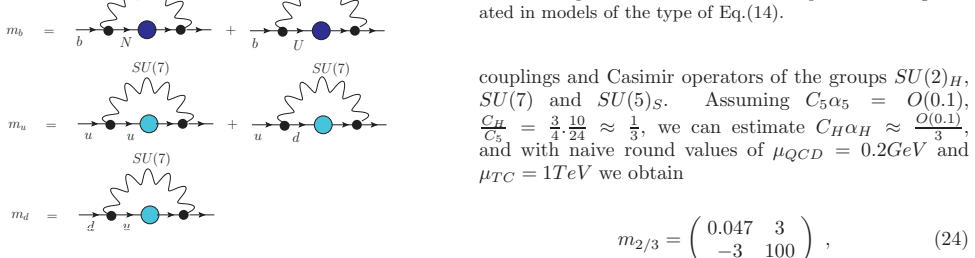
The mass matrix of Eqs. (21)-(23) is built with a ≈ µ_QCD(...) = 0.047 GeV (first generation coupled to QCD) and c ≈ µ_TC(...) = 100 GeV (third generation coupled to TC), using µ_QCD = 0.2 GeV and µ_TC = 1 TeV. Diagonalizing Eq. (24) then returns mt ≈ 100 GeV and mu ≈ 0.1 GeV, which are exactly the input scales. The paper itself admits in Section V that the first/third generation assignment is 'by construction.' Thus the central claim that the mass hierarchy is generated by the two condensates plus horizontal symmetry is not an independent prediction; the hierarchy is put in by choosing the horizontal quantum numbers and couplings that make the QCD condensate give the light generation mass and the TC condensate give the heavy generation mass.
full rationale
The paper's dynamical inputs, Eqs. (1) and (3), are taken from the authors' earlier numerical work (Refs. [46-48]); that is normal scientific continuity rather than circularity, because those prior results concern self-energy behavior and do not already contain the generation-splitting conclusion. No uniqueness theorem is imported, and the self-citations are not used to forbid alternatives. The electroweak-splitting estimate of Section IV.A is not circular in the input-output sense: it is an explicit 'naive estimate' based on the assumed UV asymptotic self-energy, and the authors concede in Section V that a full determination requires solving a large coupled SDE system before realistic masses can be claimed. That is a correctness/validation gap, not a circular reduction. The circularity resides in the inter-generation mass hierarchy: the model's horizontal quantum numbers are chosen so that the QCD condensate couples to the first generation and the TC condensate to the third, and the couplings and scales are then selected to yield mt ~ 100 GeV and mu ~ 0.1 GeV. Those masses are the input scales restated. Since the paper also contains independent content (light composite scalar, pseudo-Goldstone masses, GUT mechanisms), the appropriate score is 6: the central illustration is partially circular by construction, but the paper is not wholly a self-citation tautology.
Assumptions & free parameters
free parameters (8)
- mu_QCD =
0.2 GeV
- mu_TC =
1 TeV
- C5_alpha5 =
O(0.1)
- CH_alphaH =
O(0.1)/3
- C7_alpha7 =
not specified
- bg2 (SU(3)_TC, nf=6) =
0.44
- delta_gamma^2 =
~0.032
- M_E (ETC/GUT scale) =
10^16 GeV
assumptions (4)
- domain assumption Coupled Schwinger-Dyson equations for QCD and technicolor produce the hard self-energy form of Eq. (1) with parameters delta1, delta2.
- domain assumption Fermion masses are dominated by the UV logarithmic behavior of the self-energy (Eqs. (29)-(32)), so the mass ratio M1/M2 can be read off from the exponent difference.
- ad hoc to paper An anomaly-free horizontal symmetry can be embedded in the unified group and broken at high scale without reintroducing large flavor-changing neutral currents.
- ad hoc to paper The first and third fermion generations couple respectively to QCD and TC condensates, by choice of horizontal quantum numbers.
invented entities (1)
-
SU(2)_H horizontal gauge symmetry
Cite this review
Pith. "Pith review of Fermion mass splitting in the technicolor coupled scenario." pith.science (2026). https://pith.science/paper/TXLF7QL2
@misc{pith2026190900738,
  author       = {Pith},
  title        = {Pith review of: Fermion mass splitting in the technicolor coupled scenario},
  year         = {2026},
  howpublished = {\url{https://pith.science/paper/TXLF7QL2}},
  note         = {Machine review of arXiv:1909.00738}
}
read the original abstract
We discuss fermion mass generation in unified models where QCD and technicolor (or any two strongly interacting theories) have their Schwinger-Dyson equations coupled. In this case the technicolor (TC) and QCD self-energies are modified in comparison with the behavior observed in the isolated theories. In these models the pseudo-Goldstone boson masses are much higher than the ones obtained in different contexts, and phenomenological signals, except from a light scalar composite boson, will be quite difficult to be observed at present collider energies. The most noticeable fact of these models is how the mass splitting between the different ordinary fermions is generated. We discuss how a necessary horizontal (or family) symmetry can be implemented in order to generate the mass splitting between fermions of different generations; how the fermionic mass spectrum may be modified due to GUT interactions, as well as how the mass splitting within the same fermionic generation are generated due to electroweak and GUT interactions.
Figures


Figures from the paper (3 more)


Reference graph
Works this paper leans on
- [1]
-
[2]
= (1, 10) + (2, 5) + (1, 1),
- [3]
-
[4]
= (1, 10) + (2, ¯10) + (1, ¯ 5),
-
[5]
+ (2, 1) , (15) as in Ref. [3], but choosing the first and third ordinary fermionic representations in order to show how QCD and TC act in the generation of these fermion mass scales. We differ from Ref. [3] in the fact that the [2] representation now is (1, 10) = 0 ¯tr −¯ty tr br −¯tr 0 ¯tb ty by ¯ty −¯tb 0 tb bb −tr −ty −tb 0 ¯ τ −br −by −bb −¯τ...
-
[6]
(17) The representation [6] is the same as the one in Ref
= ¯br ¯by ¯bb τ ντ (2, ¯10) = 0 Ur −Uy ¯Ur ¯Dr −Ur 0 Ub ¯Uy ¯Dy Uy −Ub 0 ¯Ub ¯Db − ¯Ur − ¯Uy − ¯Ub 0 E − ¯Dr − ¯Dy − ¯Db −E 0 p . (17) The representation [6] is the same as the one in Ref. [3] just exchanging the second by the third fermionic family. Note the particular choice of Eqs.(16) and (17). This example is v...
-
[7]
(26) With similar mass values for the 1 /3 electrically charged quarks
10 24 ≈ 1 3 , we can estimate CHαH ≈ O(0.1) 3 , and with naive round values of µQCD = 0 .2GeV and µT C = 1TeV we obtain m2/3 = ( 0.047 3 −3 100 ) , (24) which, when diagonalized, gives mt ≈ 100GeV (25) mu ≈ 0.1GeV. (26) With similar mass values for the 1 /3 electrically charged quarks. These approximations are very rough but they provide a clear idea how ...
work page 2016
- [8]
Show all 77 references
-
[9]
Farhi and L
E. Farhi and L. Susskind, Phys. Rept. 74, 277 (1981)
1981
-
[10]
V. A. Miransky, Dynamical Symmetry Breaking in Quan- tum Field Theories, World Scientific co , (1993). 10
1993
-
[11]
C. T. Hill and E. H. Simmons, Phys. Rep. 381 (200) 235; (E) ibid. 390 (2004) 553
2004
-
[12]
N. D. Christensen and R. Shrock, Phys. Rev. D 72, 035013 (2005)
2005
-
[13]
Chen and R
N. Chen and R. Shrock, Phys. Rev. D 78,035002 (2008)
2008
-
[14]
J. R. Andersen et al. , Eur. Phys. J. Plus 126, 81 (2011)
2011
-
[15]
Sannino, J
F. Sannino, J. Phys. Conf. Ser. 259, 012003 (2010)
2010
-
[16]
Sannino, Int
F. Sannino, Int. J. Mod. Phys. A 25, 5145 (2010)
2010
-
[17]
Sannino, Acta Phys
F. Sannino, Acta Phys. Polon. B 40, 3533 (2009)
2009
-
[18]
Sannino, Int
F. Sannino, Int. J. Mod. Phys. A 20, 6133 (2005)
2005
-
[19]
R. S. Chivukula, A. G. Cohen and K. D. Lane, Nucl. Phys. B 343, 554 (1990)
1990
-
[20]
Belyaev, M
A. Belyaev, M. S. Brown, R. Foadi, and M. T. Frandsen, Phys. Rev. D 90, 035012 (2014)
2014
-
[21]
Holdom, Phys
B. Holdom, Phys. Rev. D 24, 1441 (1981)
1981
-
[22]
Appelquist and L
T. Appelquist and L. C. R. Wijewardhana, Phys. Rev. D 35, 77 (1987)
1987
-
[23]
Appelquist and L
T. Appelquist and L. C. R. Wijewardhana, Phys. Rev. D 36, 568 (1987)
1987
-
[24]
Appelquist, M
T. Appelquist, M. Einhorn, T. Takeuchi and L. C. R. Wijewardhana, Phys. Lett. B 220, 223 (1989)
1989
-
[25]
J. Jia, S. Matsuzaki and K. Yamawaki, Phys. Rev.D 87, 016006 (2013)
2013
-
[26]
Kurachi, S
M. Kurachi, S. Matsuzaki and K. Yamawaki, Phys. Rev. D 90, 095013 (2014)
2014
-
[27]
K. D. Lane and M. V. Ramana, Phys. Rev. D 44, 2678 (1991)
1991
-
[28]
T. W. Appelquist, J. Terning and L. C. R. Wijeward- hana, Phys. Rev. Lett. 79, 2767 (1997)
1997
-
[29]
Yamawaki, Prog
K. Yamawaki, Prog. Theor. Phys. Suppl. 180, 1 (2010); arXiv:hep-ph/9603293
2010 arXiv
-
[30]
Aoki et al ., Phys
Y. Aoki et al ., Phys. Rev. D 85, 074502 (2012)
2012
-
[31]
Appelquist, K
T. Appelquist, K. Lane, and U. Mahanta, Phys. Rev. Lett. 61, 1553 (1988)
1988
-
[32]
Shrock, Phys
R. Shrock, Phys. Rev. D 89, 045019 (2014)
2014
-
[33]
Kurachi and R
M. Kurachi and R. Shrock, J. High Energy Phys. 12, 034 (2006)
2006
-
[34]
V. A. Miransky and K. Yamawaki, Mod. Phys. Lett. A 4, 129 (1989)
1989
-
[35]
Kondo, H
K.-I. Kondo, H. Mino, and K. Yamawaki, Phys. Rev. D 39, 2430 (1989)
1989
-
[36]
V. A. Miransky, T. Nonoyama, and K. Yamawaki, Mod. Phys. Lett. A bf 4, 1409 (1989)
1989
-
[37]
Nonoyama, T
T. Nonoyama, T. B. Suzuki, and K. Yamawaki, Prog. Theor. Phys. 81, 1238 (1989)
1989
-
[38]
V. A. Miransky, M. Tanabashi, and K. Yamawaki, Phys. Lett. B 221, 177 (1989)
1989
-
[39]
Kondo, M
K.-I. Kondo, M. Tanabashi, and K. Yamawaki, Mod. Phys. Lett. A 8, 2859 (1993)
1993
-
[40]
Takeuchi, Phys
T. Takeuchi, Phys. Rev. D 40, 2697 (1989)
1989
-
[41]
Appelquist et al
T. Appelquist et al. , Phys. Rev. D 93, 114514 (2016)
2016
-
[42]
A. D. Gasbarro and G. T. Fleming, PoS LATTICE 2016, 242 (2017)
2017
-
[43]
Appelquist et al
T. Appelquist et al. , Phys. Rev. D 99, 014509 (2019)
2019
-
[44]
Aoki et al
Y. Aoki et al. , Phys. Rev. D 89, 111502(R) (2014)
2014
-
[45]
Aoki et al
Y. Aoki et al. , Phys. Rev. D 96, 014508 (2017)
2017
-
[46]
Fodor, K
Z. Fodor, K. Holland, J. Kuti, D. Nogradi, C. Schroeder and C. W. Wong, Phys. Lett. B 718, 657 (2012)
2012
-
[47]
Fodor, K
Z. Fodor, K. Holland, J. Kuti, S. Mondal, D. Nogradi and C. H. Wong, PoS LATTICE 2014, 244 (2015)
2015
-
[48]
Fodor, K
Z. Fodor, K. Holland, J. Kuti, S. Mondal, D. Nogradi and C. H. Wong, PoS LATTICE 2015, 219 (2016)
2016
-
[49]
Fodor, K
Z. Fodor, K. Holland, J. Kuti, D. Nogradi and C. H. Wong, EPJ Web Conf. 175, 08015 (2018)
2018
-
[50]
Fodor, K
Z. Fodor, K. Holland, J. Kuti and C. H. Wong, PoS LAT- TICE 2018, 196 (2019)
2019
-
[51]
A. C. Aguilar, A. Doff and A. A. Natale, Phys. Rev. D 97, 115035 (2018)
2018
-
[52]
Doff and A
A. Doff and A. A. Natale, Eur. Phys. J. C 78, 872 (2018)
2018
-
[53]
Doff and A
A. Doff and A. A. Natale, Phys. Rev. D 99, 055026 (2019)
2019
- [54]
-
[55]
S. J. Brodsky, G. F. de Teramond and I. A. Schmidt, Phys. Rev. Lett. 44, 557 (1980)
1980
-
[56]
E. G. S. Luna and A. A. Natale, J. Phys. G 42, 015003 (2015)
2015
-
[57]
Nambu and G
Y. Nambu and G. Jona-Lasinio, Phys. Rev. 122, 345 (1961)
1961
-
[58]
Tanabashi et al
M. Tanabashi et al . (Particle Data Group), Phys. Rev. D 98, 030001 (2018)
2018
-
[59]
Delbourgo and M
R. Delbourgo and M. D. Scadron, Phys. Rev. Lett. 48, 379 (1982)
1982
-
[60]
ATLAS Collaboration, Phys. Lett. B 716, 1 (2012)
2012
-
[61]
CMS Collaboration, Phys. Lett. B 716, 30 (2012)
2012
-
[62]
V. A. Miransky, Phys. Lett. B 165, 401 (1985)
1985
-
[63]
J. M. Cornwall and R. C. Shellard, Phys. Rev. D 18, 1216 (1978)
1978
-
[64]
Mandelstam, Proc
S. Mandelstam, Proc. R. Soc. A 233, 248 (1955)
1955
-
[65]
C. H. Llewellyn Smith, Il Nuovo Cimento A 60, 348 (1969)
1969
-
[66]
Lane, Phys
K. Lane, Phys. Rev. D 10, 2605 (1974)
1974
-
[67]
A. Doff, A. A. Natale and P. S. Rodrigues da Silva, Phys. Rev. D 80, 055005 (2009)
2009
-
[68]
A. Doff, E. G. S. Luna and A. A. Natale, Phys. Rev. D 88, 055008 (2013)
2013
-
[69]
A. Doff, A. A. Natale and P. S. Rodrigues da Silva, Phys. Rev. D 77, 075012 (2008)
2008
-
[70]
S. Raby, S. Dimopoulos and L. Susskind, Nucl. Phys. B 169, 373 (1980)
1980
-
[71]
Yamawaki, M
K. Yamawaki, M. Bando and K. Matumoto, Phys. Rev. Lett. 56, 1335 (1986)
1986
-
[72]
Appelquist, D
T. Appelquist, D. Karabali and L. C. R. Wijewardhana, Phys. Rev. Lett. 57, 957 (1986)
1986
-
[73]
Appelquist, J
T. Appelquist, J. Terning and L. C. R. Wijewardhana, Phys. Rev. Lett. 77, 1214 (1996)
1996
-
[74]
Georgi and S
H. Georgi and S. L. Glashow, Phys. Rev. Lett. 32, 438 (1974)
1974
-
[75]
Sikivie, L
P. Sikivie, L. Susskind, M. Voloshin and V. Zakharov, Nucl. Phys. B 173, 189 (1980)
1980
-
[76]
Dimopoulos, S
S. Dimopoulos, S. Raby and P. Sikivie, Nucl. Phys. B 176, 149 (1980)
1980
-
[77]
Rajpoot and P
S. Rajpoot and P. Sithikong, Phys. Rev. D 23, 1649 (1981)
1981
Reviewed August 14, 2026 · model on record in the stance chip above.
Discussion (0). Continue with ORCID to comment.