REVIEW 3 major objections 4 minor 1 cited by
Effects of quantum corrections on the criticality and efficiency of black holes surrounded by a perfect fluid
T0 review · 3 major / 4 minor · reviewed 2026-08-14 · deepseek-v4-flash
Pith's one-line read Quantum corrections alone can generate first- and second-order phase transitions in an uncharged Schwarzschild black hole surrounded by a perfect fluid, with universal critical ratio $P_c v_c/T_c = 3/8$.
desk verdict The algebra is careful, but the central metric is an unjustified ansatz that does not solve the stated field equations, so the phase transitions are properties of a formal model, not a concrete theory. read the letter →
The pith
A machine-rendered reading of the paper's core claim, the machinery that carries it, and where it could break.
The reading
What carries the argument
The load-bearing object is the metric function $A(r) = -2M/r + \sqrt{r^2-a^2}/r - c/r^{3\omega+1}$, which layers the Kazakov–Solodukhin quantum correction (a deformation of Schwarzschild by the scale $a$) onto Kiselev's perfect-fluid spacetime (a spherically symmetric fluid with density proportional to $c/r^{3(1+\omega)}$). In the extended phase space, the fluid constant $c$ is read as pressure $P=-3c/(8\pi)$, the horizon area gives entropy $S=\pi r_+^2$, and the first law forces the conjugate volume $V=(4\pi/3)r_+^{-3\omega}$. The $\sqrt{r^2-a^2}$ term is what makes the isotherms non-monotonic: when $a=0$ the system reduces to Schwarzschild-like behavior with no critical point. Imposing $\partial P/\partial r_+=0$ and $\partial^2 P/\partial r_+^2=0$ on the resulting equation of state yields the critical quantities and the golden-ratio identity.
What would settle it
Take the metric (14) and insert it into the semiclassical Einstein equations with the renormalized stress-energy tensor of a quantum scalar field together with a perfect fluid $p=\omega\rho$; if the metric is not an exact solution for $\omega\neq -1$, the predicted critical points do not exist in a self-consistent spacetime. A cheaper check: for $\omega=1/3$, the conjugate volume $V=(4\pi/3)r_+^{-1}$ shrinks as the horizon grows, so testing whether the first law $dM=T\,dS+V\,dP$ closes for this case would reveal whether the criticality is physical or a bookkeeping artifact.
Extended reading notes
Core claim
The paper's central claim is that the deformation parameter $a$ of the Kazakov–Solodukhin quantum-corrected Schwarzschild metric plays the role electric charge plays in Reissner–Nordström black holes: it creates a critical point in the pressure-volume plane. For a Kiselev perfect fluid with equation of state $p=\omega\rho$, the equation of state $P(r_+,T)$ has stationary inflection points exactly when $\omega>-1/3$, $\omega\neq 0$, and $a\neq 0$. At the critical point, $T_c = \frac{\sqrt{3}}{18\pi}\frac{(3\omega+1)}{(3\omega+2)}\frac{\sqrt{3\omega+1}}{a}$ and the dimensionless ratio satisfies $P_c v_c/T_c = 3/8$, independent of $a$ and matching the charged AdS black-hole value. For $\omega=-1$ there is no first-order critical point; instead the heat capacity diverges at a minimum temperature, which the authors identify as a second-order Hawking-Page-like transition between low-mass and high-mass black holes. These results follow from the extended-phase-space dictionary $P=-3c/(8\pi)$, $V=(4\pi/3)r_+^{-3\omega}$, and $S=\pi r_+^2$.
Load-bearing premise
The entire phase diagram rests on treating the Kiselev constant $c$ as pressure with volume $V=(4\pi/3)r_+^{-3\omega}$, an identification that is physically justified only for $\omega=-1$; if that dictionary is not valid for other fluids, the critical temperatures and the $3/8$ ratio are formal artifacts.
Editorial extensions
If this is right
- For any fluid with $\omega > -1/3$ and $\omega \neq 0$, an uncharged quantum-corrected black hole has a first-order phase transition at a temperature set by the quantum scale $a$, so measuring such a transition would fix $a$.
- The universal value $P_c v_c/T_c = 3/8$ places this system in the same criticality family as Van der Waals fluids and charged AdS black holes, even though no electric charge is present.
- At $\omega=-1$, a second-order Hawking-Page-like transition separates low-mass from high-mass black holes at a minimum temperature $t_0(p)$, where the heat capacity diverges.
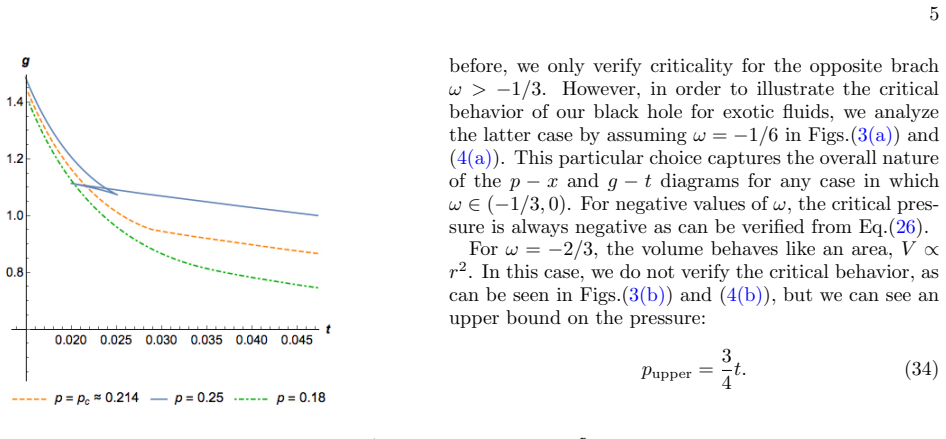
- In a Carnot cycle, quantum corrections increase the engine efficiency for all fluids studied; in a square cycle they increase efficiency for radiation but decrease it for exotic fluids.
Reading between the lines
- If this phase structure survives a full back-reaction calculation, black-hole criticality would be a generic feature of quantum-deformed horizons rather than a special effect of Maxwell charge; testing other quantum-gravity-deformed metrics for the same inflection points would be a direct extension.
- The critical pressure is negative for $\omega\in(-1/3,0)$, so those quintessence-like transitions live in a formally defined pressure region; they could be reinterpreted with a different conjugate variable (chemical potential or tension) before being declared physical.
- For the radiation case $\omega=1/3$, the volume $V\propto r_+^{-1}$ decreases as the horizon grows, so the pressure variable is better read as a charge and the volume as an electric potential; checking whether the first law closes in that reading would separate genuine thermodynamics from formal analogy.
- Computing the critical exponents of this system would test whether the $3/8$ ratio belongs to the same mean-field universality class as Van der Waals and charged AdS criticality.
Signed reviews
Editorial analysis
A structured set of objections, weighed in public.
Referee Report
Summary. The paper studies the extended phase space thermodynamics of a spherically symmetric spacetime obtained by superposing the Kazakov-Solodukhin quantum-corrected Schwarzschild metric with the Kiselev perfect-fluid term. The fluid constant c is identified with a thermodynamic pressure, the horizon area with entropy, and the mass with enthalpy. The authors derive a temperature, solve the critical-point conditions, obtain a critical temperature, radius, and pressure, and a golden relation Pc vc/Tc = 3/8. They then analyze first-order transitions for various fluid equations of state, a Hawking-Page-like second-order transition for ω = -1, the heat capacity, and the efficiency of Carnot and square cycles as heat engines. The central physical claim is that quantum corrections alone, without electric charge, can generate phase transitions in a black hole surrounded by a perfect fluid.
Significance. If the underlying metric (14) were a genuine solution of a well-defined gravitational theory, the result that quantum corrections induce phase transitions without charge would be a useful addition to black hole chemistry. The critical-point algebra is internally consistent: substituting the claimed critical temperature and radius into the first and second derivative conditions verifies the result and the golden relation. The paper also works through several fluid cases and provides explicit dimensionless formulas and figures, which is valuable. However, the physical significance is entirely conditional on the metric being a legitimate back-reacted solution and on the pressure/volume identifications being meaningful, both of which are questionable. As it stands, the paper presents a mathematically coherent analysis of a metric whose field-equation status is not established.
major comments (3)
- [Section II.B, Eq. (14)] The metric (14) is not shown to solve the Einstein equations with the energy-momentum tensor (11)-(13). For the line element ds^2 = -A(r) dt^2 + A(r)^{-1} dr^2 + r^2 dΩ^2, the tt component of the Einstein tensor is G^t_t = (A - 1 + r A')/r^2. Substituting (14) with f = sqrt(r^2 - a^2) gives G^t_t = (r/f - 1)/r^2 + 3ω c / r^{3ω+3}. The first term is nonzero for a ≠ 0 and is not present in the fluid EMT (11)-(13). The Kazakov-Solodukhin term alone is not a vacuum solution of Einstein gravity, so adding the Kiselev term is an ansatz, not a back-reacted solution. All subsequent quantities, including the mass (16), temperature (21), criticality conditions (24)-(26), and heat-engine efficiencies, are computed from this unverified metric. The authors should either provide a derivation of (14) from an explicit effective action or state clearly that it is an assumption, and should verify whether the spacetime satisfies the field equations of the theory they intend to use.
- [Section III, Eqs. (18)-(20) and Section III.A] The identification of the fluid constant c with a pressure P = -3c/(8π) and the conjugate volume V = (4π/3) r^{-3ω} follows reference [7] and is physically justified only for ω = -1. The manuscript itself acknowledges in Section III.A that for ω > 0 the volume decreases with the horizon radius and P cannot be interpreted as a physical pressure, yet the abstract and conclusions state that first-order phase transitions occur for ω > -1/3 with ω ≠ 0 without this qualification. For -1/3 < ω < 0, the critical pressure (26) is negative, so the thermodynamic interpretation of these transitions also requires discussion. The conclusions should be restricted or substantially qualified so that the claims match the acknowledged limitations of the pressure/volume identification.
- [Section IV, Eqs. (43)-(45)] The heat-engine efficiencies are computed from the same unverified metric (14) and inherit the same problem as the criticality analysis. In addition, the square-cycle efficiency formula (45) assumes the validity of the pressure identification, which is not physical for ω > 0, yet the paper reports improved efficiency for the radiation fluid ω = 1/3. The heat-engine section should either be grounded in a validated metric and pressure interpretation or clearly presented as a formal exercise in black hole chemistry with the caveats explicitly carried through.
minor comments (4)
- [Section III.C, Eq. (42)] The dimensionless pressure in the paragraph preceding Eq. (42) is written as p = P/a^{(3ω+1)/2}, which is inconsistent with the scaling p = P/a^{3ω+1} used in Eq. (29). The two definitions should be reconciled.
- [Section III.A, Eq. (33)] The phrase 'the black hole becomes electrically neutral' is confusing because the model contains no electric charge; the authors mean that the formal pressure vanishes and, under their reinterpretation, the corresponding charge parameter is zero. This should be clarified to avoid implying the black hole carries an electric charge.
- [Section V] In the concluding remarks, 'w ≠ 0' should read 'ω ≠ 0'; there are several other places where the Greek letter ω is rendered as 'w'.
- [General] The figures are often too small to distinguish individual curves, especially Figs. 8 and 9; labeling the curves directly in the figures or providing distinct symbols would improve readability.
Circularity Check
No significant circularity: all reported criticality and efficiency results follow algebraically from the assumed metric and the stated identifications of pressure, entropy, and volume.
full rationale
The derivation chain is explicit and self-contained once the metric (14) and the identifications S = pi r_+^2, P = -3c/(8 pi), and V = (4 pi/3) r_+^{-3 omega} are adopted. The critical temperature, critical radius, and critical pressure are obtained by solving the standard conditions Eq. (23) applied to Eq. (22), which is itself derived from M(S,P) in Eq. (19). No parameter is fitted to any target critical value, and the critical quantities are not used to define the inputs. The 'golden relation' P_c v_c / T_c = 3/8 is a direct algebraic consequence of Eqs. (24)-(27), not a separate fitted result. The self-citation to Ref. [12] appears only in a general list of heat-engine contexts and is not load-bearing; the heat-engine formulas used are the standard Carnot and enthalpy-work relations. The pressure/volume identification is explicitly adopted from Ref. [7], with the paper itself acknowledging that P and V are non-physical for omega > 0 and that the interpretation changes for non-cosmological-constant fluids. The paper's weakest point is that the combined metric (14) is asserted rather than derived: 'With this energy-momentum tensor, one can look for the solution of a quantum-corrected black hole surrounded by such perfect fluid. The obtained result is the Schwarzschild-like metric...' This is a missing derivation and a possible correctness problem, since the superposition of the Kazakov-Solodukhin and Kiselev terms is not shown to satisfy the Einstein equations with the stated fluid source. But that is an assumption feeding the calculation, not a case where a claimed prediction reduces by construction to its own inputs. Under the circularity criteria, there is no self-definitional step, no fitted input renamed as prediction, and no load-bearing self-citation chain.
Assumptions & free parameters
free parameters (3)
- a (quantum correction scale)
- omega (perfect fluid equation-of-state parameter) =
values plotted: 1/3, -1/6, -2/3, -1
- c (Kiselev fluid constant)
assumptions (3)
- domain assumption The Bekenstein entropy S = pi r_+^2 holds for the quantum-corrected metric.
- domain assumption The first law uses M as enthalpy with pressure P = -3c/(8 pi) and volume V = (4 pi/3) r_+^(-3 omega).
- domain assumption The combined metric (14) is a valid back-reacted solution of the Einstein equations.
Cite this review
Pith. "Pith review of Effects of quantum corrections on the criticality and efficiency of black holes surrounded by a perfect fluid." pith.science (2026). https://pith.science/paper/U3WIFW7J
@misc{pith2026190808140,
  author       = {Pith},
  title        = {Pith review of: Effects of quantum corrections on the criticality and efficiency of black holes surrounded by a perfect fluid},
  year         = {2026},
  howpublished = {\url{https://pith.science/paper/U3WIFW7J}},
  note         = {Machine review of arXiv:1908.08140}
}
read the original abstract
We study some properties of the extended phase space of a quantum-corrected Schwarzschild black hole surrounded by a perfect fluid. In particular we demonstrate that, due to the quantum correction, there exist first and second order phase transitions for a certain range of the state parameter of the perfect fluid, and we explicitly analyze some cases. Besides that, we describe the efficiency of this system as a heat engine and the effect of quantum corrections for different surrounding fluids.
Figures


Figures from the paper (7 more)


Forward citations
Cited by 1 Pith paper
-
Observational Constraints on Kazakov-Solodukhin Quantum-Deformed Black Holes from M87$^*$ and Sgr A$^*$ Shadows
EHT shadow sizes of M87* and Sgr A* constrain the Kazakov-Solodukhin deformation parameter η to O(1) ranges while the metric remains asymptotically Schwarzschild.
Reference graph
Works this paper leans on
-
[7]
Thermodynamics of quantum-corrected Schwarzschild black hole surrounded by quintessence,
M. Shahjalal, “Thermodynamics of quantum-corrected Schwarzschild black hole surrounded by quintessence,” Nucl. Phys. B 940, 63 (2019)
work page 2019
-
[1]
Black holes and entropy,
J. D. Bekenstein, “Black holes and entropy,” Phys. Rev. D 7, 2333 (1973)
1973
-
[2]
Generalized second law of thermo- dynamics in black hole physics,
J. D. Bekenstein, “Generalized second law of thermo- dynamics in black hole physics,” Phys. Rev. D 9, 3292 (1974)
work page 1974
-
[3]
Particle Creation by Black Holes,
S. W. Hawking, “Particle Creation by Black Holes,” Commun. Math. Phys. 43, 199 (1975) Erratum: [Com- mun. Math. Phys. 46, 206 (1976)]
work page 1975
-
[4]
Enthalpy and the Mechanics of AdS Black Holes,
D. Kastor, S. Ray and J. Traschen, “Enthalpy and the Mechanics of AdS Black Holes,” Class. Quant. Grav. 26, 195011 (2009) doi:10.1088/0264-9381/26/19/195011 [arXiv:0904.2765 [hep-th]]
arXiv 2009
-
[5]
P-V criticality of charged AdS black holes,
D. Kubiznak and R. B. Mann, “P-V criticality of charged AdS black holes,” JHEP 1207, 033 (2012) [arXiv:1205.0559 [hep-th]]
arXiv 2012
-
[6]
On Quantum de- formation of the Schwarzschild solution,
D. I. Kazakov and S. N. Solodukhin, “On Quantum de- formation of the Schwarzschild solution,” Nucl. Phys. B 429, 153 (1994) [hep-th/9310150]
arXiv 1994
-
[8]
V. V. Kiselev, “Quintessence and black holes,” Class. Quant. Grav. 20, 1187 (2003) [gr-qc/0210040]
arXiv 2003
Show all 53 references
-
[9]
Critical Phenomena of Born-Infeld-de Sitter Black Holes in Cavities,
F. Simovic and R. B. Mann, “Critical Phenomena of Born-Infeld-de Sitter Black Holes in Cavities,” JHEP 1905, 136 (2019) [arXiv:1904.04871 [gr-qc]]
2019 arXiv
-
[10]
Critical behavior and phase transition of dilaton black holes with nonlinear electrodynamics,
Z. Dayyani, A. Sheykhi, M. H. Dehghani and S. Ha- jkhalili, “Critical behavior and phase transition of dilaton black holes with nonlinear electrodynamics,” Eur. Phys. J. C 78, no. 2, 152 (2018) [arXiv:1709.06875 [gr-qc]]
2018 arXiv
-
[11]
Black holes with a cloud of strings in pure Lovelock gravity,
J. M. Toledo and V. B. Bezerra, “Black holes with a cloud of strings in pure Lovelock gravity,” Eur. Phys. J. C 79, no. 2, 117 (2019). J. M. Toledo and V. B. Bezerra, “Some remarks on the thermodynamics of charged AdS black holes with cloud of strings and quintessence,” Eur. P...
2019
-
[12]
Effects of a string cloud on the criti- cality and efficiency of AdS black holes as heat engines,
J. P. Morais Graa, I. P. Lobo, V. B. Bezerra and H. Moradpour, “Effects of a string cloud on the criti- cality and efficiency of AdS black holes as heat engines,” Eur. Phys. J. C 78, no. 10, 823 (2018) [arXiv:1806.02913 [gr-qc]]
2018 arXiv
-
[13]
Phase transitions and entropy force of charged de Sitter black holes with cloud of string and quintessence,
Y. Ma, Y. Zhang, R. Zhao, S. Cao, T. Liu, S. Geng, Y. Liu and Y. Huang, “Phase transitions and entropy force of charged de Sitter black holes with cloud of string and quintessence,” arXiv:1907.11870 [hep-th]
1907 arXiv
-
[14]
Critical point in the phase diagram of primordial quark-gluon matter from black hole physics,
R. Critelli, J. Noronha, J. Noronha-Hostler, I. Portillo, C. Ratti and R. Rougemont, “Critical point in the phase diagram of primordial quark-gluon matter from black hole physics,” Phys. Rev. D 96, no. 9, 096026 (2017) [arXiv:1706.00455 [nucl-th]]
2017 arXiv
-
[15]
Critical phenomena of charged Einstein?Gauss?Bonnet black holes with charged scalar hair,
Y. Brihaye and B. Hartmann, “Critical phenomena of charged Einstein?Gauss?Bonnet black holes with charged scalar hair,” Class. Quant. Grav. 35, no. 17, 175008 (2018) [arXiv:1804.10536 [gr-qc]]
2018 arXiv
-
[16]
P−v criticality of a specific black hole in f(R) gravity coupled with Yang-Mills field,
A. vgn, “P−v criticality of a specific black hole in f(R) gravity coupled with Yang-Mills field,” Adv. High Energy Phys. 2018, 8153721 (2018) [arXiv:1710.06795 [gr-qc]]
2018 arXiv
-
[17]
Peculiar P−V criticality of topological Ho?ava-Lifshitz black holes,
M. S. Ma and R. H. Wang, “Peculiar P−V criticality of topological Ho?ava-Lifshitz black holes,” Phys. Rev. D 96, no. 2, 024052 (2017) [arXiv:1707.09156 [gr-qc]]
2017 arXiv
-
[18]
P-V crit- icality of first-order entropy corrected AdS black holes in massive gravity,
S. Upadhyay, B. Pourhassan and H. Farahani, “P-V crit- icality of first-order entropy corrected AdS black holes in massive gravity,” Phys. Rev. D95, no. 10, 106014 (2017) [arXiv:1704.01016 [gr-qc]]
2017 arXiv
-
[19]
P-V criticality in AdS black holes of mas- sive gravity,
S. Fernando, “P-V criticality in AdS black holes of mas- sive gravity,” Phys. Rev. D 94, no. 12, 124049 (2016) [arXiv:1611.05329 [gr-qc]]
2016 arXiv
-
[20]
Extended phase space thermodynamics and P−V criticality of charged black holes in Brans?Dicke theory,
S. H. Hendi and Z. Armanfard, “Extended phase space thermodynamics and P−V criticality of charged black holes in Brans?Dicke theory,” Gen. Rel. Grav.47, no. 10, 125 (2015) [arXiv:1503.07070 [gr-qc]]
2015 arXiv
-
[21]
P−V criticality of charged dilatonic black holes,
M. H. Dehghani, S. Kamrani and A. Sheykhi, “ P−V criticality of charged dilatonic black holes,” Phys. Rev. D 90, no. 10, 104020 (2014) [arXiv:1505.02386 [hep-th]]
2014 arXiv
-
[22]
Ehrenfest scheme for P− V criticality of higher dimensional charged black holes, rotating black holes and Gauss-Bonnet AdS black holes,
J. X. Mo and W. B. Liu, “Ehrenfest scheme for P− V criticality of higher dimensional charged black holes, rotating black holes and Gauss-Bonnet AdS black holes,” Phys. Rev. D 89, no. 8, 084057 (2014) [arXiv:1404.3872 10 [gr-qc]]
2014 arXiv
-
[23]
P ?V criticality in the ex- tended phase?space of charged accelerating AdS black holes,
H. Liu and X. h. Meng, “ P ?V criticality in the ex- tended phase?space of charged accelerating AdS black holes,” Mod. Phys. Lett. A 31, no. 37, 1650199 (2016) [arXiv:1607.00496 [gr-qc]]
2016 arXiv
-
[24]
Critical behavior of charged black holes in Gauss-Bonnet gravity?s rainbow,
S. H. Hendi, S. Panahiyan, B. Eslam Panah, M. Faizal and M. Momennia, “Critical behavior of charged black holes in Gauss-Bonnet gravity?s rainbow,” Phys. Rev. D 94, no. 2, 024028 (2016) [arXiv:1607.06663 [gr-qc]]
2016 arXiv
-
[25]
P-V criticality of AdS black holes in a general framework,
B. R. Majhi and S. Samanta, “P-V criticality of AdS black holes in a general framework,” Phys. Lett. B 773, 203 (2017) [arXiv:1609.06224 [gr-qc]]
2017 arXiv
-
[26]
Phase transition of quantum cor- rected Schwarzschild black hole,
W. Kim and Y. Kim, “Phase transition of quantum cor- rected Schwarzschild black hole,” Phys. Lett. B 718, 687 (2012) [arXiv:1207.5318 [gr-qc]]
2012 arXiv
-
[27]
Holographic Heat Engines,
C. V. Johnson, “Holographic Heat Engines,” Class. Quant. Grav. 31, 205002 (2014) [arXiv:1404.5982 [hep- th]]
2014 arXiv
-
[28]
Non-linear black holes in 2+1 dimensions as heat engines,
L. Balart and S. Fernando, “Non-linear black holes in 2+1 dimensions as heat engines,” Phys. Lett. B 795, 638 (2019) [arXiv:1907.03051 [gr-qc]]
2019 arXiv
-
[29]
Thermodynamics of charged accelerating AdS black holes and holographic heat en- gines,
J. Zhang, Y. Li and H. Yu, “Thermodynamics of charged accelerating AdS black holes and holographic heat en- gines,” JHEP 1902, 144 (2019) [arXiv:1808.10299 [hep- th]]
2019 arXiv
-
[30]
Massive gravity with Lorentz symmetry breaking: black holes as heat engines,
S. Fernando, “Massive gravity with Lorentz symmetry breaking: black holes as heat engines,” Mod. Phys. Lett. A 33, no. 31, 1850177 (2018) [APS Physics A33, 1850177 (2018)] [arXiv:1808.08595 [gr-qc]]
2018 arXiv
-
[31]
Effects of energy dependent spacetime on geometrical thermodynamics and heat engine of black holes: gravity’s rainbow,
B. Eslam Panah, “Effects of energy dependent spacetime on geometrical thermodynamics and heat engine of black holes: gravity’s rainbow,” Phys. Lett. B 787, 45 (2018) [arXiv:1805.03014 [hep-th]]
2018 arXiv
-
[32]
Phase transition and heat en- gine efficiency of phantom AdS black holes,
J. X. Mo and S. Q. Lan, “Phase transition and heat en- gine efficiency of phantom AdS black holes,” Eur. Phys. J. C 78, no. 8, 666 (2018) [arXiv:1803.02491 [gr-qc]]
2018 arXiv
-
[33]
Holographic heat engines and static black holes: a general efficiency formula,
F. Rosso, “Holographic heat engines and static black holes: a general efficiency formula,” Int. J. Mod. Phys. D 28, no. 02, 1950030 (2018) [arXiv:1801.07425 [hep-th]]
2018 arXiv
-
[34]
Accelerating AdS black holes as the holographic heat engines in a benchmark- ing scheme,
J. Zhang, Y. Li and H. Yu, “Accelerating AdS black holes as the holographic heat engines in a benchmark- ing scheme,” Eur. Phys. J. C 78, no. 8, 645 (2018) [arXiv:1801.06811 [hep-th]]
2018 arXiv
-
[35]
Benchmarking Black Hole Heat Engines, II,
A. Chakraborty and C. V. Johnson, “Benchmarking Black Hole Heat Engines, II,” Int. J. Mod. Phys. D 27, no. 16, 1950006 (2018) [arXiv:1709.00088 [hep-th]]
2018 arXiv
-
[36]
Charged AdS black hole heat engines,
S. W. Wei and Y. X. Liu, “Charged AdS black hole heat engines,” Nucl. Phys. B , 114700 (2019) [arXiv:1708.08176 [gr-qc]]
2019 arXiv
-
[37]
Black holes in massive gravity as heat en- gines,
S. H. Hendi, B. Eslam Panah, S. Panahiyan, H. Liu and X.-H. Meng, “Black holes in massive gravity as heat en- gines,” Phys. Lett. B 781, 40 (2018) [arXiv:1707.02231 [hep-th]]
2018 arXiv
-
[38]
Black hole thermodynam- ics and heat engines in conformal gravity,
H. Xu, Y. Sun and L. Zhao, “Black hole thermodynam- ics and heat engines in conformal gravity,” Int. J. Mod. Phys. D 26, no. 13, 1750151 (2017) [arXiv:1706.06442 [gr-qc]]
2017 arXiv
-
[39]
Effects of dark energy on the efficiency of charged AdS black holes as heat engines,
H. Liu and X. H. Meng, “Effects of dark energy on the efficiency of charged AdS black holes as heat engines,” Eur. Phys. J. C 77, no. 8, 556 (2017) [arXiv:1704.04363 [hep-th]]
2017 arXiv
-
[40]
Holographic heat engines: general considerations and rotating black holes,
R. A. Hennigar, F. McCarthy, A. Ballon and R. B. Mann, “Holographic heat engines: general considerations and rotating black holes,” Class. Quant. Grav. 34, no. 17, 175005 (2017) [arXiv:1704.02314 [hep-th]]
2017 arXiv
-
[41]
Benchmarking black hole heat engines, I,
A. Chakraborty and C. V. Johnson, “Benchmarking black hole heat engines, I,” Int. J. Mod. Phys. D 27, no. 16, 1950012 (2018) [arXiv:1612.09272 [hep-th]]
2018 arXiv
-
[42]
f(R) Black Holes as Heat Engines,
M. Zhang and W. B. Liu, “f(R) Black Holes as Heat Engines,” Int. J. Theor. Phys. 55, no. 12, 5136 (2016)
2016
-
[43]
Heat engines for dilatonic Born?Infeld black holes,
B. Chandrasekhar and P. K. Yerra, “Heat engines for dilatonic Born?Infeld black holes,” Eur. Phys. J. C 77, no. 8, 534 (2017) [arXiv:1606.03223 [hep-th]]
2017 arXiv
-
[44]
Born?Infeld AdS black holes as heat engines,
C. V. Johnson, “Born?Infeld AdS black holes as heat engines,” Class. Quant. Grav. 33, no. 13, 135001 (2016) [arXiv:1512.01746 [hep-th]]
2016 arXiv
-
[45]
Gauss?Bonnet black holes and holo- graphic heat engines beyond large N,
C. V. Johnson, “Gauss?Bonnet black holes and holo- graphic heat engines beyond large N,” Class. Quant. Grav. 33, no. 21, 215009 (2016) [arXiv:1511.08782 [hep- th]]
2016 arXiv
-
[46]
Polytropic black hole as a heat engine,
M. R. Setare and H. Adami, “Polytropic black hole as a heat engine,” Gen. Rel. Grav. 47, no. 11, 133 (2015)
2015
-
[47]
Black hole chem- istry: thermodynamics with Lambda,
D. Kubiznak, R. B. Mann and M. Teo, “Black hole chem- istry: thermodynamics with Lambda,” Class. Quant. Grav. 34, no. 6, 063001 (2017) [arXiv:1608.06147 [hep- th]]
2017 arXiv
-
[48]
Thermodynamics of rotating black holes and black rings: phase transitions and thermodynamic vol- ume,
N. Altamirano, D. Kubiznak, R. B. Mann and Z. Sherkat- ghanad, “Thermodynamics of rotating black holes and black rings: phase transitions and thermodynamic vol- ume,” Galaxies 2, 89 (2014) [arXiv:1401.2586 [hep-th]]
2014 arXiv
-
[49]
Black holes in Ein- steinian cubic gravity,
R. A. Hennigar and R. B. Mann, “Black holes in Ein- steinian cubic gravity,” Phys. Rev. D 95, no. 6, 064055 (2017) [arXiv:1610.06675 [hep-th]]
2017 arXiv
-
[50]
Dark matter and dark energy,
V. Sahni, “Dark matter and dark energy,” Lect. Notes Phys. 653, 141 (2004) [astro-ph/0403324]
2004 arXiv
-
[51]
Thermodynamics of Black Holes in anti-de Sitter space,
S. W. Hawking and D. N. Page, “Thermodynamics of Black Holes in anti-de Sitter space,” Commun. Math. Phys. 87, 577 (1983)
1983
-
[52]
Thermodynamics of phase transition in higher dimensional AdS black holes,
R. Banerjee and D. Roychowdhury, “Thermodynamics of phase transition in higher dimensional AdS black holes,” JHEP 1111, 004 (2011) [arXiv:1109.2433 [gr-qc]]
2011 arXiv
-
[53]
A Modern Course in Statistical Physics
L. E. Reichl, “A Modern Course in Statistical Physics”, 2Ed., John Wiley & Sons, New York (1998)
1998
Reviewed August 14, 2026 · model on record in the stance chip above.
Discussion (0). Continue with ORCID to comment.