REVIEW 6 major objections 5 minor 51 references
Vertical Federated Unlearning via Backdoor Certification
T0 review · 6 major / 5 minor · reviewed 2026-08-11 · deepseek-v4-flash
Pith's one-line read The paper claims that a bounded gradient-ascent procedure, guided by a constrained model, can erase a single client's contribution from a vertical federated model, with a backdoor accuracy collapse serving as a certificate of erasure.
desk verdict A constrained-unlearning paper whose algorithm doesn't actually enforce the constraint, on top of a confusing VFL setup; worth a referee's time to verify the code and demand a rewrite. read the letter →
The pith
A machine-rendered reading of the paper's core claim, the machinery that carries it, and where it could break.
The reading
What carries the argument
The load-bearing object is the constrained model $W_{\mathrm{con}}$, a closed-form reweighting of the global model and the target client's local model that serves as a proxy for the ensemble of clean clients. Around it, the paper defines an $\ell^2$-norm ball of radius $R$ that acts as a leash: gradient ascent on the target client's loss pulls the model away from the target's data while the projection keeps it near the clean reference, preserving utility. An early-stopping threshold $T$ on the distance between the unlearning gradient and the target's gradient decides when the ascent has erased enough without causing collapse. The verification machinery is a backdoor trigger planted in the target party's training images; unlearning success is certified by backdoor accuracy falling to roughly zero and by membership inference attacks failing to distinguish the target's data.
What would settle it
Run the method on a VFL task where the target client's feature block is the only informative signal for one output class, then test whether perturbing or zeroing that block still changes the model's predictions after unlearning. If the predictions still move, the expensive retrained baseline and the unlearned model differ in a way that accuracy averages hide.
Extended reading notes
Core claim
The discovery is that unlearning a client in VFL can be posed as a constrained maximization that reverses the training trajectory. Given the global model $W^{(k)}$ and the target client's previous-round model $W_i^{(k-1)}$, the paper constructs a reference point $W_{\mathrm{con}} = \frac{1}{2N-1}(2N W^{(k)} - W_i^{(k-1)})$, which averages the clean clients' models under the assumption that the target client has half of its data compromised. Unlearning becomes gradient ascent on the target client's loss, projected into the ball $\{Z : \lVert Z - W_{\mathrm{con}}\rVert_2 \le R\}$, so the model forgets the target's data without drifting into a useless random state. With an early-stopping threshold on the distance to the target's gradient, this yields an unlearned model whose backdoor accuracy is zero; a few post-training FedAvg rounds excluding the target bring clean accuracy close to a full retrain (e.g., 92.11 percent versus 95.85 percent on MNIST, $N=5$) while backdoor accuracy stays near chance and membership inference recall drops to zero.
Load-bearing premise
The assumption that defines the constrained model, $W_{\mathrm{con}} = \frac{1}{2N-1}(2N W^{(k)} - W_i^{(k-1)})$, is that the target client has exactly half of its data compromised, so algebraically reweighting the global and local models yields a faithful stand-in for a model trained without that client; if that separation is not clean, the gradient ascent guidance and the early-stopping criterion lose their grounding, and the unlearned model would not really correspond to removing the client's influence.
Editorial extensions
If this is right
- If the central claim holds, a VFL platform can honor a deletion request for one client in well under a second of compute, versus the minutes required by retraining from scratch on the reported datasets.
- The backdoor-collapse test becomes an operational certificate: a backdoor accuracy near chance (around 10 percent on 10-class tasks) is evidence that the target's feature influence was removed, not merely masked.
- Membership inference recall of zero implies the unlearned model does not leak whether the target's data was in training, which is the privacy property that right-to-be-forgotten regulation targets.
- The method needs no storage of per-round parameter updates during training and no access to the full original data, only the final global model and the target client's previous local model, so it fits the data-minimization posture of federated learning.
Reading between the lines
- The procedure implicitly assumes the server or coordinator can see the target client's individual model $W_i^{(k-1)}$; in a stronger privacy regime where only encrypted aggregates are visible, the constrained model would have to be computed through secure aggregation, which may change its accuracy.
- The 'half compromised' assumption is a specific sweet spot; a natural extension is to test compromise fractions other than 50 percent and derive an adjusted $W_{\mathrm{con}}$, since real data-poisoning scenarios rarely land at exactly half.
- Backdoor accuracy is a sufficient certificate of erasure, not a necessary one: a model could in principle pass this test while still memorizing benign statistics of the target's features, so the method likely under-claims rather than over-claims forgetfulness.
- The bounded-ascent recipe could transfer to other settings where one must subtract a contributor's influence from a shared model, such as model unlearning in split learning or personalized federated learning, provided a reference model analogous to $W_{\mathrm{con}}$ can be constructed.
Editorial analysis
A structured set of objections, weighed in public.
Referee Report
Summary. The paper proposes a vertical federated unlearning method based on constrained gradient ascent, together with a backdoor-based verification mechanism. The method defines a constrained model Wcon by algebraically reweighting the global and target-client models (Eq. 7), then states a constrained maximization problem in an ℓ2-norm ball around Wcon (Eq. 8). Algorithm 2 supposedly performs gradient ascent subject to this constraint, and the paper reports experiments on MNIST, Fashion-MNIST, and CIFAR-10 showing that backdoor accuracy drops to zero and that post-training restores clean accuracy to levels comparable to retraining from scratch. The paper also reports membership-inference results and time-complexity comparisons in support of the claimed efficiency of the unlearning procedure.
Significance. If the proposed mechanism were correctly implemented and its verification were non-circular, the paper would address an important gap: vertical federated unlearning for image data with a lightweight verification method. The idea of using a reference model to bound gradient ascent is reasonable in principle, and the paper ships a public code repository, which is a practical strength. However, the central algorithmic constraint is not actually enforced in the described algorithm, and the backdoor metric is defined in a way that makes the main empirical result a near-tautology. The comparison against retraining is therefore not yet supported by the evidence as presented.
major comments (6)
- [Section IV-C, Eq. (8) and Algorithm 2] The ℓ2-ball constraint that is the central claim of the method is never enforced in Algorithm 2. Line 4 performs plain gradient ascent and only labels the update with the phrase 'subject to Wi ∈ {Z : ∥Z − Wcon∥2 ≤ R}'; there is no projection step, no feasibility check, and the radius R is never used inside the loop. The early-stopping condition in line 5 compares ∥W_i^(k) − W_i^(E−1)∥2 to T, not the distance to Wcon or the radius R. Consequently, the experiments in Tables IV, VI–IX and Figures 5–6 do not test the bounded optimization problem stated in Eq. (8). If the public repository contains an omitted projection step, that omission is a serious reproducibility gap; if it does not, the central mechanism of the paper is absent.
- [Section IV-C, Eq. (7) vs. Section V-B] The derivation of the constrained model assumes that exactly half of the target client's data is clean, but the experimental setup states that up to 80% of the target client's images are backdoored. The expression Wcon = (2N W^(k) − W_i^(k−1))/(2N−1) is derived from the 'preserve half of its model' rationale, and it is unclear how this formula represents the clean-client model when the poisoning fraction is 80%. Since Wcon is the anchor for the entire unlearning procedure, the paper needs to justify this formula under the actual poisoning rates or report results when the poisoning fraction is exactly 50%.
- [Section IV-C and Table IV] The backdoor 'certification' is largely circular. Algorithm 2 maximizes the loss L(W_i; xB_i, y_i) on exactly the target client's backdoored data, and the same backdoored data are used to compute backdoor accuracy in the evaluation. Driving the loss on those samples to a high value therefore makes the backdoor accuracy drop to zero by construction; the 0.0 entries in Table IV do not provide independent evidence that the influence of the target client has been removed. A meaningful certification would use a held-out trigger set not seen by the gradient-ascent objective, or would unlearn on clean data and then test backdoor persistence.
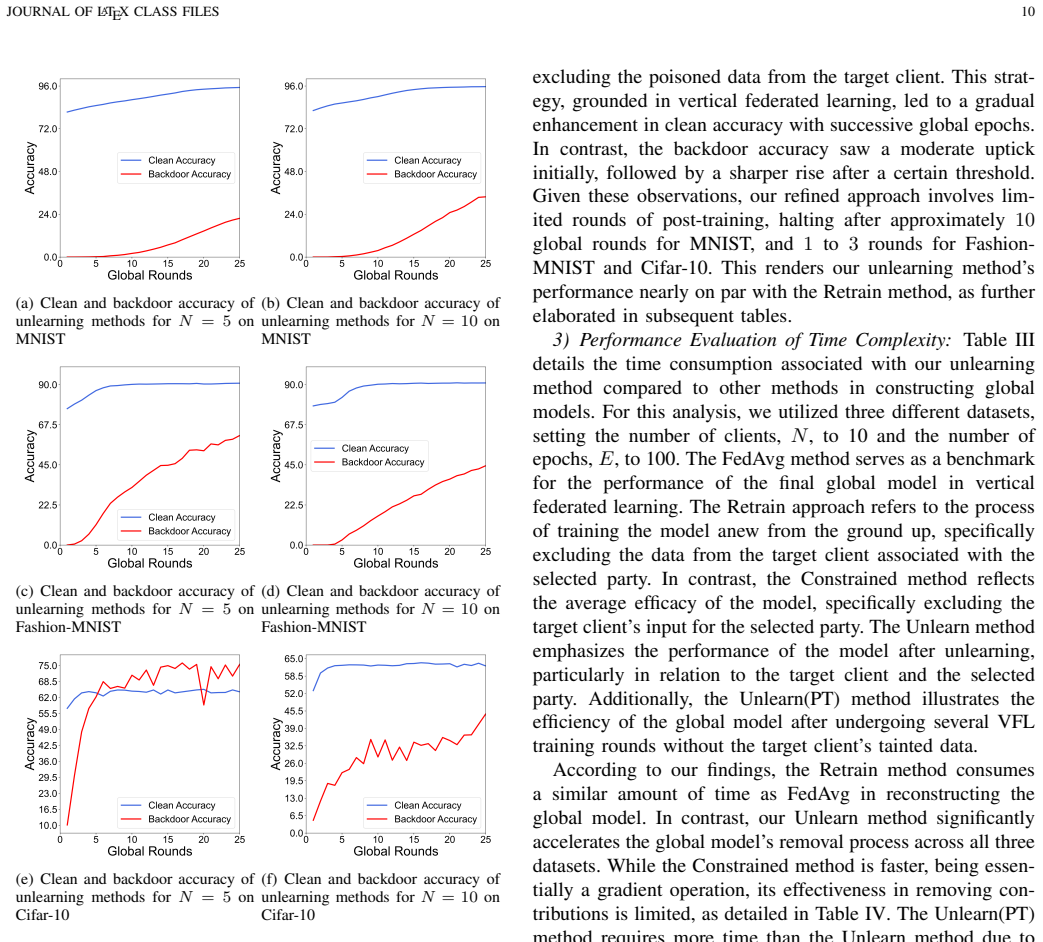
- [Section V-B, Eq. (10)] Equation (10) defines backdoor accuracy as (1/N) Σ 1(G(x_i) = y_i), where y_i is described as the 'corresponding label' of the poisoned sample. For a backdoor attack with target label '8', the success criterion should be G(x_i) = 8, not G(x_i) = y_i. As written, the formula measures ordinary classification accuracy on poisoned inputs, which is not the standard backdoor accuracy and makes the headline 'Backdoor Acc' values in Table IV and Figures 5–6 hard to interpret.
- [Sections III-C, V-A, and Algorithm 1] The manuscript conflates the number of VFL parties with the number of FedAvg clients. The VFL framework in Section III-C has two parties, A and B, but Algorithm 1 and Eq. (7) treat N clients with local models W_i^(k). The experiments split each image into two vertical halves for parties A and B, then claim N=5 and N=10 clients. The paper never specifies how the two-party SplitNN protocol interacts with the N-client FedAvg aggregation, so it is not clear that the experiments actually test a vertical federated learning system. A precise protocol with the coordinator's loss, the party-level losses, and the aggregation over N clients is needed.
- [Tables IV and V, general experimental reporting] All reported accuracies and recalls appear to come from a single run, with no error bars or multiple-seed statistics. For example, Table V reports MIA recall to 16 decimal places (e.g., 0.9899403874813711) and exactly 0 for the unlearn methods, which is not credible without variance or a detailed explanation. Without repeated runs, the claimed equivalence to Retrain is not statistically supported.
minor comments (5)
- [Section I, contribution list] The sentence 'First of all, it contains most of shadow model that' is incomplete and appears to be a typo; it should be removed or completed.
- [Section III-A and Eq. (6)] In Table I, W is described as 'the gradient of the model' but is used throughout as model parameters; Eq. (6) also writes i ∈ Di, which is a subscript error since i already denotes the client index.
- [Algorithm 1, line 15] The symbols SGDA and SGDB are used without definition; the pseudocode should state that these are stochastic gradient descent updates for party A and party B respectively.
- [Section V-C, subsection 2] There is a typo in 'Fashihon-MNIST' that should read 'Fashion-MNIST'.
- [Section V-C, subsection 6] The description of the radius R says 'Dist represents the average Euclidean distance between Wcon and a random model, calculated by averaging over 10 random models, with the early stop threshold activated.' This definition is unclear: it should specify which model the distance is measured from and how early stopping affects the distance.
Circularity Check
Backdoor 'certification' is self-referential: the gradient-ascent unlearning objective is defined on the same backdoored samples used as the verification metric, so the reported 0% backdoor accuracy is an optimization outcome, not independent evidence of unlearning; threshold T is also grid-searched to produce the claimed trade-off.
-
self definitional
[Section IV-C (Unlearning via Gradient Ascent), Eq. (9); Section V-B, Eq. (10); Table IV]
"To verify the unlearning, we introduced a backdoor-based method, which injects backdoors into the dataset of the target client associated with the selected party. The decreasing in backdoor accuracy indicates a successful unlearning of the targeted data. ... W_i^(k) ← W_i^(k−1) + ηu∇L(W_i^(k−1); x^B_i, y_i)"
The update rule in Eq. (9) performs gradient ascent on exactly the target client's backdoored selected-party samples (x^B_i, y_i), i.e., it explicitly maximizes the loss on the tampered data. The verification metric, Eq. (10), measures backdoor accuracy on those same tampered samples. Maximizing loss on a sample directly moves the model's prediction away from the assigned trigger label, so the reported 0.0 backdoor accuracy in Table IV is a mathematical consequence of the optimization objective, not evidence that the client's underlying contribution was removed. The 'certification' is therefore defined in terms of the quantity the algorithm is built to destroy.
-
fitted input called prediction
[Section V-C.6 (Performance Evaluation of Parameters), Tables VI and VII]
"To strike a balance, T must be chosen carefully—not too small and not too large. For N = 5, an optimal value of T = 15 achieves a backdoor accuracy of 0... Similarly, for N = 10, T = 11 achieves the same balance... we conduct a grid search over a reasonable interval, applying this strategy to determine T values for other datasets."
The early-stopping threshold T is grid-searched per dataset specifically so that backdoor accuracy falls to 0 and clean accuracy remains high. The resulting clean/backdoor accuracy numbers are therefore the selection criterion that produced T, not an independent prediction of unlearning quality. This makes the headline 'backdoor accuracy 0' a fitted choice rather than a measured consequence of the unlearning mechanism.
full rationale
The main circular element is the backdoor certification: Equation (9) maximizes loss on exactly the same backdoored samples whose accuracy Equation (10) then reports as the verification result, so the observed 0% backdoor accuracy is essentially an identity of the optimizer and the metric. The early-stopping threshold T is also tuned per dataset to force the reported trade-off, so part of the headline result is selected rather than predicted. The paper's self-citations in related work (e.g., [10], [22], [29]) are not load-bearing, and the missing ℓ2-radius projection in Algorithm 2 is a correctness/reproducibility gap rather than circularity. The clean-accuracy recovery after post-training is independent empirical content, which prevents the whole derivation from being a pure tautology; the circularity is partial and concentrated in the verification design. Score 6.
Assumptions & free parameters
free parameters (4)
- l2 radius R =
Dist/3 (chosen from Tables VIII-IX)
- early stopping threshold T =
e.g., 15 (Fashion-MNIST N=5), 11 (N=10), grid-searched per dataset
- post-training epochs =
10 for MNIST, 1-3 for Fashion-MNIST and CIFAR-10
- learning rates and batch sizes =
not specified in text
assumptions (3)
- ad hoc to paper The global FedAvg model W and the target client's previous local model W_i^(E-1) are sufficient to define a constrained model that approximates the clean clients' average.
- domain assumption Gradient ascent on the target client's local data, when early-stopped by a distance threshold, will remove the target's influence without destroying global utility.
- ad hoc to paper The backdoor accuracy metric is a valid proxy for the degree to which the target client's data has been forgotten.
Cite this review
Pith. "Pith review of Vertical Federated Unlearning via Backdoor Certification." pith.science (2026). https://pith.science/paper/UC6OVSZC
@misc{pith2026241211476,
  author       = {Pith},
  title        = {Pith review of: Vertical Federated Unlearning via Backdoor Certification},
  year         = {2026},
  howpublished = {\url{https://pith.science/paper/UC6OVSZC}},
  note         = {Machine review of arXiv:2412.11476}
}
read the original abstract
Vertical Federated Learning (VFL) offers a novel paradigm in machine learning, enabling distinct entities to train models cooperatively while maintaining data privacy. This method is particularly pertinent when entities possess datasets with identical sample identifiers but diverse attributes. Recent privacy regulations emphasize an individual's \emph{right to be forgotten}, which necessitates the ability for models to unlearn specific training data. The primary challenge is to develop a mechanism to eliminate the influence of a specific client from a model without erasing all relevant data from other clients. Our research investigates the removal of a single client's contribution within the VFL framework. We introduce an innovative modification to traditional VFL by employing a mechanism that inverts the typical learning trajectory with the objective of extracting specific data contributions. This approach seeks to optimize model performance using gradient ascent, guided by a pre-defined constrained model. We also introduce a backdoor mechanism to verify the effectiveness of the unlearning procedure. Our method avoids fully accessing the initial training data and avoids storing parameter updates. Empirical evidence shows that the results align closely with those achieved by retraining from scratch. Utilizing gradient ascent, our unlearning approach addresses key challenges in VFL, laying the groundwork for future advancements in this domain. All the code and implementations related to this paper are publicly available at https://github.com/mengde-han/VFL-unlearn.
Figures


Figures from the paper (2 more)

Reference graph
Works this paper leans on
-
[1]
G. Liu, X. Ma, Y . Yang, C. Wang, and J. Liu, “Federated unlearning,” arXiv preprint arXiv:2012.13891 , 2020. JOURNAL OF LATEX CLASS FILES 13
arXiv 2012
-
[2]
Forget-svgd: Particle- based bayesian federated unlearning,
J. Gong, J. Kang, O. Simeone, and R. Kassab, “Forget-svgd: Particle- based bayesian federated unlearning,” in 2022 IEEE Data Science and Learning Workshop (DSLW). IEEE, 2022, pp. 1–6
work page 2022
-
[3]
Privacy risk in machine learning: Analyzing the connection to overfitting,
S. Yeom, I. Giacomelli, M. Fredrikson, and S. Jha, “Privacy risk in machine learning: Analyzing the connection to overfitting,” in 2018 IEEE 31st computer security foundations symposium (CSF) . IEEE, 2018, pp. 268–282
2018
-
[4]
S. Hardy, W. Henecka, H. Ivey-Law, R. Nock, G. Patrini, G. Smith, and B. Thorne, “Private federated learning on vertically partitioned data via entity resolution and additively homomorphic encryption,” arXiv preprint arXiv:1711.10677, 2017
arXiv 2017
-
[5]
Federated machine learning: Concept and applications,
Q. Yang, Y . Liu, T. Chen, and Y . Tong, “Federated machine learning: Concept and applications,” ACM Transactions on Intelligent Systems and Technology (TIST), vol. 10, no. 2, pp. 1–19, 2019
2019
-
[6]
Measure contribution of partici- pants in federated learning,
G. Wang, C. X. Dang, and Z. Zhou, “Measure contribution of partici- pants in federated learning,” in 2019 IEEE international conference on big data (Big Data) . IEEE, 2019, pp. 2597–2604
work page 2019
-
[7]
Privacy preserv- ing vertical federated learning for tree-based models,
Y . Wu, S. Cai, X. Xiao, G. Chen, and B. C. Ooi, “Privacy preserv- ing vertical federated learning for tree-based models,” arXiv preprint arXiv:2008.06170, 2020
arXiv 2008
-
[8]
J. Jiang, L. Burkhalter, F. Fu, B. Ding, B. Du, A. Hithnawi, B. Li, and C. Zhang, “Vf-ps: How to select important participants in vertical feder- ated learning, efficiently and securely?” Advances in Neural Information Processing Systems, vol. 35, pp. 2088–2101, 2022
work page 2022
Show all 51 references
-
[9]
Adversarial attacks and defenses in deep learning: From a perspective of cyberse- curity,
S. Zhou, C. Liu, D. Ye, T. Zhu, W. Zhou, and P. S. Yu, “Adversarial attacks and defenses in deep learning: From a perspective of cyberse- curity,” ACM Computing Surveys , vol. 55, no. 8, pp. 1–39, 2022
2022
-
[10]
More than privacy: Applying differential privacy in key areas of artificial intelligence,
T. Zhu, D. Ye, W. Wang, W. Zhou, and S. Y . Philip, “More than privacy: Applying differential privacy in key areas of artificial intelligence,”IEEE Transactions on Knowledge and Data Engineering , vol. 34, no. 6, pp. 2824–2843, 2020
2020
-
[11]
Fairvfl: A fair vertical federated learning framework with contrastive adversarial learning,
T. Qi, F. Wu, C. Wu, L. Lyu, T. Xu, H. Liao, Z. Yang, Y . Huang, and X. Xie, “Fairvfl: A fair vertical federated learning framework with contrastive adversarial learning,” Advances in Neural Information Processing Systems, vol. 35, pp. 7852–7865, 2022
2022
-
[12]
Fedsdg- fs: Efficient and secure feature selection for vertical federated learning,
A. Li, H. Peng, L. Zhang, J. Huang, Q. Guo, H. Yu, and Y . Liu, “Fedsdg- fs: Efficient and secure feature selection for vertical federated learning,” arXiv preprint arXiv:2302.10417 , 2023
2023 arXiv
-
[13]
Towards making systems forget with machine unlearning,
Y . Cao and J. Yang, “Towards making systems forget with machine unlearning,” in 2015 IEEE symposium on security and privacy . IEEE, 2015, pp. 463–480
2015
-
[14]
Lifelong anomaly detection through unlearning,
M. Du, Z. Chen, C. Liu, R. Oak, and D. Song, “Lifelong anomaly detection through unlearning,” in Proceedings of the 2019 ACM SIGSAC conference on computer and communications security , 2019, pp. 1283– 1297
2019
-
[15]
Making ai forget you: Data deletion in machine learning,
A. Ginart, M. Guan, G. Valiant, and J. Y . Zou, “Making ai forget you: Data deletion in machine learning,” Advances in neural information processing systems, vol. 32, 2019
2019
-
[16]
Machine unlearning,
L. Bourtoule, V . Chandrasekaran, C. A. Choquette-Choo, H. Jia, A. Travers, B. Zhang, D. Lie, and N. Papernot, “Machine unlearning,” in 2021 IEEE Symposium on Security and Privacy (SP) . IEEE, 2021, pp. 141–159
2021
-
[17]
Descent-to-delete: Gradient-based methods for machine unlearning,
S. Neel, A. Roth, and S. Sharifi-Malvajerdi, “Descent-to-delete: Gradient-based methods for machine unlearning,” in Algorithmic Learn- ing Theory. PMLR, 2021, pp. 931–962
2021
-
[18]
Remember what you want to forget: Algorithms for machine unlearning,
A. Sekhari, J. Acharya, G. Kamath, and A. T. Suresh, “Remember what you want to forget: Algorithms for machine unlearning,” Advances in Neural Information Processing Systems , vol. 34, pp. 18 075–18 086, 2021
2021
-
[19]
On the necessity of auditable algorithmic definitions for machine unlearning,
A. Thudi, H. Jia, I. Shumailov, and N. Papernot, “On the necessity of auditable algorithmic definitions for machine unlearning,” in 31st USENIX Security Symposium (USENIX Security 22) , 2022, pp. 4007– 4022
2022
-
[20]
Fast yet effective machine unlearning,
A. K. Tarun, V . S. Chundawat, M. Mandal, and M. Kankanhalli, “Fast yet effective machine unlearning,” IEEE Transactions on Neural Networks and Learning Systems , 2023
2023
-
[21]
Zero- shot machine unlearning,
V . S. Chundawat, A. K. Tarun, M. Mandal, and M. Kankanhalli, “Zero- shot machine unlearning,” IEEE Transactions on Information Forensics and Security, 2023
2023
-
[22]
Machine unlearning: A survey,
H. Xu, T. Zhu, L. Zhang, W. Zhou, and P. S. Yu, “Machine unlearning: A survey,” ACM Computing Surveys , vol. 56, no. 1, pp. 1–36, 2023
2023
-
[23]
Erm-ktp: Knowledge-level machine unlearning via knowledge transfer,
S. Lin, X. Zhang, C. Chen, X. Chen, and W. Susilo, “Erm-ktp: Knowledge-level machine unlearning via knowledge transfer,” in Pro- ceedings of the IEEE/CVF Conference on Computer Vision and Pattern Recognition, 2023, pp. 20 147–20 155
2023
-
[24]
Federated unlearning with knowledge distillation,
C. Wu, S. Zhu, and P. Mitra, “Federated unlearning with knowledge distillation,” arXiv preprint arXiv:2201.09441 , 2022
2022 arXiv
-
[25]
User- level privacy-preserving federated learning: Analysis and performance optimization,
K. Wei, J. Li, M. Ding, C. Ma, H. Su, B. Zhang, and H. V . Poor, “User- level privacy-preserving federated learning: Analysis and performance optimization,” IEEE Transactions on Mobile Computing , vol. 21, no. 9, pp. 3388–3401, 2021
2021
-
[26]
Federated unlearning for on-device recommendation,
W. Yuan, H. Yin, F. Wu, S. Zhang, T. He, and H. Wang, “Federated unlearning for on-device recommendation,” in Proceedings of the Six- teenth ACM International Conference on Web Search and Data Mining , 2023, pp. 393–401
2023
-
[27]
Heterogeneous federated knowledge graph embedding learning and unlearning,
X. Zhu, G. Li, and W. Hu, “Heterogeneous federated knowledge graph embedding learning and unlearning,” in Proceedings of the ACM Web Conference 2023, 2023, pp. 2444–2454
2023
-
[28]
Asynchronous federated unlearning,
N. Su and B. Li, “Asynchronous federated unlearning,” in IEEE INFO- COM 2023-IEEE Conference on Computer Communications . IEEE, 2023, pp. 1–10
2023
-
[29]
Fedrecovery: Differentially private machine unlearning for federated learning frame- works,
L. Zhang, T. Zhu, H. Zhang, P. Xiong, and W. Zhou, “Fedrecovery: Differentially private machine unlearning for federated learning frame- works,” IEEE Transactions on Information Forensics and Security, 2023
2023
-
[30]
Vertical federated unlearning on the logistic regression model,
Z. Deng, Z. Han, C. Ma, M. Ding, L. Yuan, C. Ge, and Z. Liu, “Vertical federated unlearning on the logistic regression model,” Electronics, vol. 12, no. 14, p. 3182, 2023
2023
-
[31]
Badnets: Identifying vulnera- bilities in the machine learning model supply chain,
T. Gu, B. Dolan-Gavitt, and S. Garg, “Badnets: Identifying vulnera- bilities in the machine learning model supply chain,” arXiv preprint arXiv:1708.06733, 2017
2017 arXiv
-
[32]
Local model poisoning attacks to {Byzantine-Robust} federated learning,
M. Fang, X. Cao, J. Jia, and N. Gong, “Local model poisoning attacks to {Byzantine-Robust} federated learning,” in 29th USENIX security symposium (USENIX Security 20) , 2020, pp. 1605–1622
2020
-
[33]
Invisible backdoor attacks on deep neural networks via steganography and regularization,
S. Li, M. Xue, B. Z. H. Zhao, H. Zhu, and X. Zhang, “Invisible backdoor attacks on deep neural networks via steganography and regularization,” IEEE Transactions on Dependable and Secure Computing, vol. 18, no. 5, pp. 2088–2105, 2020
2020
-
[34]
Data poisoning attacks against federated learning systems,
V . Tolpegin, S. Truex, M. E. Gursoy, and L. Liu, “Data poisoning attacks against federated learning systems,” in Computer Security–ESORICS 2020: 25th European Symposium on Research in Computer Security, ESORICS 2020, Guildford, UK, September 14–18, 2020, Proceedings, Part I 2...
2020
-
[35]
Data and model poisoning backdoor attacks on wireless federated learning, and the defense mechanisms: A comprehensive survey,
Y . Wan, Y . Qu, W. Ni, Y . Xiang, L. Gao, and E. Hossain, “Data and model poisoning backdoor attacks on wireless federated learning, and the defense mechanisms: A comprehensive survey,” IEEE Communications Surveys & Tutorials, 2024
2024
-
[36]
Deep learning based attack detection for cyber-physical system cybersecurity: A survey,
J. Zhang, L. Pan, Q.-L. Han, C. Chen, S. Wen, and Y . Xiang, “Deep learning based attack detection for cyber-physical system cybersecurity: A survey,” IEEE/CAA Journal of Automatica Sinica , vol. 9, no. 3, pp. 377–391, 2021
2021
-
[37]
Deep model poisoning attack on federated learning,
X. Zhou, M. Xu, Y . Wu, and N. Zheng, “Deep model poisoning attack on federated learning,” Future Internet, vol. 13, no. 3, p. 73, 2021
2021
-
[38]
Detecting vulnerability on iot device firmware: A survey,
X. Feng, X. Zhu, Q.-L. Han, W. Zhou, S. Wen, and Y . Xiang, “Detecting vulnerability on iot device firmware: A survey,” IEEE/CAA Journal of Automatica Sinica, vol. 10, no. 1, pp. 25–41, 2022
2022
-
[39]
Fl- wbc: Enhancing robustness against model poisoning attacks in federated learning from a client perspective,
J. Sun, A. Li, L. DiValentin, A. Hassanzadeh, Y . Chen, and H. Li, “Fl- wbc: Enhancing robustness against model poisoning attacks in federated learning from a client perspective,” Advances in Neural Information Processing Systems, vol. 34, pp. 12 613–12 624, 2021
2021
-
[40]
Fldetector: Defending federated learning against model poisoning attacks via detecting ma- licious clients,
Z. Zhang, X. Cao, J. Jia, and N. Z. Gong, “Fldetector: Defending federated learning against model poisoning attacks via detecting ma- licious clients,” in Proceedings of the 28th ACM SIGKDD Conference on Knowledge Discovery and Data Mining , 2022, pp. 2545–2555
2022
-
[41]
Privacyeafl: Privacy- enhanced aggregation for federated learning in mobile crowdsensing,
M. Zhang, S. Chen, J. Shen, and W. Susilo, “Privacyeafl: Privacy- enhanced aggregation for federated learning in mobile crowdsensing,” IEEE Transactions on Information Forensics and Security , 2023
2023
-
[42]
A privacy-preserving and untraceable group data sharing scheme in cloud computing,
J. Shen, H. Yang, P. Vijayakumar, and N. Kumar, “A privacy-preserving and untraceable group data sharing scheme in cloud computing,” IEEE Transactions on Dependable and Secure Computing , vol. 19, no. 4, pp. 2198–2210, 2021
2021
-
[43]
The dark side of explanations: Poisoning recommender systems with counterfactual examples,
Z. Chen, F. Silvestri, J. Wang, Y . Zhang, and G. Tolomei, “The dark side of explanations: Poisoning recommender systems with counterfactual examples,” arXiv preprint arXiv:2305.00574 , 2023
2023 arXiv
-
[44]
Communication-efficient learning of deep networks from decentralized data,
B. McMahan, E. Moore, D. Ramage, S. Hampson, and B. A. y Arcas, “Communication-efficient learning of deep networks from decentralized data,” in Artificial intelligence and statistics . PMLR, 2017, pp. 1273– 1282
2017
-
[45]
Distributed learning of deep neural network over multiple agents,
O. Gupta and R. Raskar, “Distributed learning of deep neural network over multiple agents,” Journal of Network and Computer Applications , vol. 116, pp. 1–8, 2018
2018
-
[46]
Federated un- learning: How to efficiently erase a client in fl?
A. Halimi, S. Kadhe, A. Rawat, and N. Baracaldo, “Federated un- learning: How to efficiently erase a client in fl?” arXiv preprint arXiv:2207.05521, 2022. JOURNAL OF LATEX CLASS FILES 14
2022 arXiv
-
[47]
The mnist database of handwritten digits,
Y . LeCun, “The mnist database of handwritten digits,” http://yann. lecun. com/exdb/mnist/, 1998
1998
-
[48]
Fashion-mnist: a novel image dataset for benchmarking machine learning algorithms,
H. Xiao, K. Rasul, and R. V ollgraf, “Fashion-mnist: a novel image dataset for benchmarking machine learning algorithms,” arXiv preprint arXiv:1708.07747, 2017
2017 arXiv
-
[49]
Learning multiple layers of features from tiny images,
A. Krizhevsky, G. Hinton et al. , “Learning multiple layers of features from tiny images,” 2009
2009
-
[50]
Adversarial robustness toolbox v1. 0.0,
M.-I. Nicolae, M. Sinn, M. N. Tran, B. Buesser, A. Rawat, M. Wistuba, V . Zantedeschi, N. Baracaldo, B. Chen, H. Ludwig et al., “Adversarial robustness toolbox v1. 0.0,” arXiv preprint arXiv:1807.01069 , 2018. Mengde Han received the B.S. degree from Shan- dong University, Chi...
2018 arXiv
-
[2017]
degree with the University of Technology Sydney, Australia
He is currently pursuing the Ph.D. degree with the University of Technology Sydney, Australia. His research interests are federated learning, fairness and privacy preserving. Tianqing Zhu is a professor and associate dean of the Faculty of Data Science in City University of Ma...
2000
Reviewed August 11, 2026 · model on record in the stance chip above.
Discussion (0). Continue with ORCID to comment.