REVIEW 3 major objections 5 minor 17 references
Top-quark pole mass extraction at NNLO accuracy
T0 review · 3 major / 5 minor · reviewed 2026-08-10 · deepseek-v4-flash
Pith's one-line read The paper reports that NNLO QCD fits to normalized top-pair cross sections yield a top-quark pole mass of $172.15\pm0.23$ GeV with the NNPDF4.0 set, and compatible values with three other PDF sets and with PDG 2024.
desk verdict Useful proceedings summary of a solid NNLO top-mass extraction; no new numbers, but the cross-PDF comparison and released grids make it a handy reference. read the letter →
The pith
A machine-rendered reading of the paper's core claim, the machinery that carries it, and where it could break.
The reading
What carries the argument
The load-bearing machinery is a least-squares fit whose theory input is produced by MATRIX, an NNLO QCD code based on the $q_T$-subtraction infrared-singularity method, interfaced to PineAPPL so that many PDF and scale choices can be evaluated from precomputed grids. The data selection restricts to normalized cross sections, mainly as functions of the top-pair invariant mass $M(t\bar t)$ and rapidity, because normalization suppresses the PDF and $\alpha_s$ sensitivity. The fit is run at fixed pole-mass values, the three lowest $\chi^2$ points are interpolated by a parabola, and the minimum defines the extracted mass, with data, PDF, and scale uncertainties separated by repeating the fit across PDF sets and a seven-point scale variation.
What would settle it
Take the exact set of normalized $M(t\bar t)$ and double-differential bins used in the fit and compare MATRIX with an independent local-subtraction NNLO code such as STRIPPER at the same scales and mass values; if the bin-by-bin differences, when propagated through the $\chi^2$ parabola fit, shift $m_t^{\rm pole}$ by more than the quoted data uncertainty of roughly 0.2-0.3 GeV, then the power-correction assumption is falsified.
Extended reading notes
Core claim
The paper's central claim is that NNLO QCD fits to inclusive and normalized (multi-)differential $t\bar t+X$ cross sections can determine the top-quark pole mass in the on-shell scheme with an accuracy competitive with the world average, and that the result does not depend on which modern PDF set is chosen as input. The global fit with NNPDF4.0 gives $m_t^{\rm pole}=172.15\pm0.23$ GeV from data, with separate PDF and scale uncertainties of $0.08$ GeV and $^{+0.19}_{-0.49}$ GeV; the corresponding values for MSHT20, CT18, and ABMP16 are 171.79, 171.59, and 171.54 GeV, all consistent with each other and with the PDG 2024 value of $172.4\pm0.7$ GeV. The fits also show that Run 2 differential datasets dominate the constraint, that total cross-section data alone produce a mass value strongly correlated with $\alpha_s$, and that normalized cross sections suppress that correlation.
Load-bearing premise
Everything rests on the assumption that the $q_T$-subtraction power corrections left out of the MATRIX predictions are small enough to be covered by the 1% uncorrelated theory uncertainty added per bin; if they are actually larger, or correlated with the top-pair invariant mass, the extracted pole mass would shift.
Editorial extensions
If this is right
- If the claim holds, top-quark pole mass extraction from hadron-collider data no longer depends on which global PDF fit is used, provided normalized differential cross sections are the fitted observables.
- Run 2 differential data will continue to dominate the statistical power, so future precision will come from more differential measurements rather than from more inclusive total cross-section points.
- Because normalized cross sections suppress the $\alpha_s$ correlation, the extracted mass can be compared directly with the PDG average without needing a simultaneous $\alpha_s$ determination.
- Total cross-section fits alone remain unreliable for the pole mass unless PDF and $\alpha_s$ are fitted together, since the mass and coupling are strongly degenerate in that observable.
Reading between the lines
- Beyond the paper: the agreement across PDF sets is a consistency test, not a proof that the 1% per-bin theory uncertainty is correct; a dedicated propagation of the MATRIX-versus-STRIPPER differences through the fit would quantify how much of the mass shift is absorbed by the parabolic interpolation.
- Beyond the paper: as HL-LHC data shrink the statistical error, the assumed 1% uncorrelated theory uncertainty will likely become the dominant systematic, motivating a rigorous treatment of $q_T$-subtraction power corrections and possibly resummation near threshold.
- Beyond the paper: the same normalized-cross-section strategy could be applied to double-differential distributions in other mass-sensitive variables, or to single-top production, where the PDF and scale cancellation may behave differently.
Editorial analysis
A structured set of objections, weighed in public.
Referee Report
Summary. This proceedings contribution summarizes the NNLO QCD extraction of the top-quark pole mass presented in the companion paper Ref. [1]. The authors compute t-tbar cross sections with MATRIX (qT subtraction) and PineAPPL grids, fit total and normalized differential data from Tevatron and LHC, and repeat the fit with four PDF+alpha_s sets: ABMP16, CT18, MSHT20, and NNPDF4.0. The quoted global results include m_t^pole = 172.15 +/- 0.23 (data) +/- 0.08 (PDF) +0.19/-0.49 (scale) GeV for NNPDF4.0, with similar values for the other PDF sets, and the authors conclude that the extracted masses are mutually compatible and compatible with the PDG 2024 value.
Significance. If the result is correct, the paper demonstrates that normalized t-tbar cross sections at NNLO QCD provide a robust extraction of the top-quark pole mass with reduced sensitivity to PDF and alpha_s choices, and the public release of the MATRIX+PineAPPL grids is a concrete reproducibility asset. The comparison against STRIPPER is a useful cross-check, and the statistical procedure is standard rather than circular. The main significance risk is that the quoted 0.23 GeV data uncertainty may be smaller than the unquantified correlated theory bias from qT-subtraction power corrections, so the compatibility claim is not yet established at the stated precision.
major comments (3)
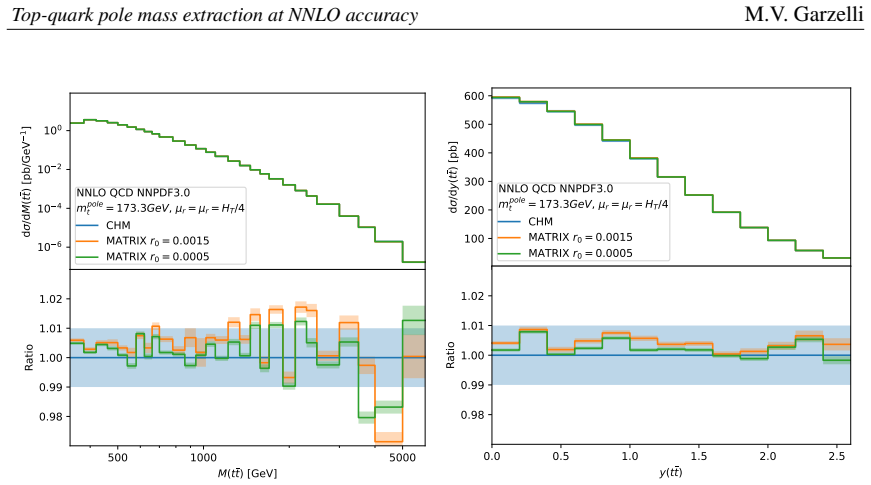
- [Sec. 2 / Fig. 1] The treatment of qT-subtraction power corrections is load-bearing for the central claim. The STRIPPER comparison is performed at a single top-quark mass (173.3 GeV), a single PDF set (NNPDF3.0), a single scale choice, and for only two distributions, whereas the actual fit combines many datasets, four PDF+alpha_s sets, and mass values near 172 GeV. The 1% uncorrelated uncertainty added to the covariance matrix inflates the diagonal errors but does not account for a correlated shift of the theory prediction; since power corrections are expected to be smooth functions of M(tt) and y, such a correlated shift would move the best-fit m_t without being flagged by the chi-square. Please provide a quantitative bound on the correlated component, for example by refitting with r0 = 0.0005 versus r0 = 0.0015 or by comparing the complete set of fitted observables to local-subtraction predictions, and state the resulting shift in m_t.
- [Sec. 2, covariance matrix] The 1% theory uncertainty is described as covering missing power corrections, Monte Carlo numerical integration error, and PineAPPL interpolation-grid error. These three sources have different correlation structures and different scalings: the integration and interpolation errors can in principle be reduced or validated directly, while the power corrections are a systematic effect. Combining them into a single uncorrelated 1% per bin obscures the dominant source and cannot constrain a correlated bias. Please separate these components, quantify each one, and explicitly identify the largest contribution to the quoted theory uncertainty.
- [Sec. 2, threshold effects] The paper states that threshold resummation and Coulomb-gluon effects are expected to be not particularly relevant because the experimental bins are wide, but no numerical test is provided. If any included bin receives non-negligible threshold corrections, the extracted mass could be biased at a level comparable to the quoted 0.23 GeV data uncertainty. Please support this assumption with a quantitative estimate, for example by comparing the effect of excluding the threshold-adjacent bins or by assigning a dedicated systematic uncertainty.
minor comments (5)
- [Throughout] The manuscript contains typographical and spacing errors (for example 'Asecondmainingredientofthefitaresuitableexperimentaldata' and 'succesfully'); a careful proofreading pass is needed.
- [Sec. 2] The sentence 'We do not include neither the effects ... nor the effect ...' contains a double negative and should be rephrased.
- [Sec. 3 / Fig. 2] The total uncertainty shown in the inset is not explicitly defined; please state whether it is the quadrature sum of the data, PDF, and scale components.
- [Sec. 3] The claim that normalized cross sections strongly reduce alpha_s sensitivity is presented qualitatively; one numerical example quantifying the cancellation would make the argument easier to assess.
- [Sec. 3] No chi-square per dataset group or global goodness-of-fit value is reported in this manuscript; since Ref. [1] contains the full analysis, a sentence explicitly referring the reader to those numbers would help the standalone readability of this summary.
Circularity Check
No significant circularity: the top-quark pole mass extraction is a standard chi-square fit to independent experimental data against independent NNLO QCD predictions.
full rationale
The paper describes a least-squares fit of the top-quark pole mass to measured inclusive and normalized differential top-pair cross sections. The fit target m_t^pole is varied as an input to independent NNLO QCD predictions (MATRIX with qT subtraction, interfaced to PineAPPL), and the minimum of the chi2 against ATLAS/CMS data determines the extracted value. Nothing in the theory predictions is constructed from the fitted mass value: the mass is scanned over fixed input values and the minimum is interpolated with a parabola. The data, PDF, and scale uncertainties are separate components of the quoted uncertainty, while the 1% uncorrelated theory uncertainty for neglected power corrections is a systematic error estimate, not a fitted parameter renamed as a prediction. Self-citations, including the companion paper [1], the MATRIX implementation [4] with a co-author, and the ABMP16 PDF set [13] containing two co-authors, are normal attributions and do not inject the PDG value or the fitted mass into the fit. The comparison to STRIPPER in Fig. 1 is an external cross-check of the qT-subtraction power corrections. The skeptical concern about correlated power corrections is a correctness and systematic-uncertainty issue, not circularity, because the paper never claims that the size of those corrections is derived from the mass extraction. Therefore no concrete reduction of a prediction to an input can be exhibited, and the derivation chain is self-contained for the purposes of this analysis.
Assumptions & free parameters
free parameters (1)
- 1% uncorrelated theory uncertainty =
0.01 (chosen)
assumptions (4)
- domain assumption qT-subtraction formalism provides exact NNLO QCD predictions in the limit r0 -> 0, and the neglected power corrections are negligible for the distributions used.
- domain assumption Effects of soft-gluon resummation and Coulomb-gluon exchange near threshold are negligible given the coarseness of the experimental binning.
- domain assumption The used PDF+alpha_s(MZ) sets (ABMP16, CT18, MSHT20, NNPDF4.0) provide reliable input and their internal correlations with the top mass do not bias the extraction.
- domain assumption The published experimental data sets and their covariance matrices are correct, and the selection criteria (normalized, parton-level unfolded, public systematic correlations, Mtt-based) do not introduce bias.
Cite this review
Pith. "Pith review of Top-quark pole mass extraction at NNLO accuracy." pith.science (2026). https://pith.science/paper/UQUUSSXW
@misc{pith2026241220259,
  author       = {Pith},
  title        = {Pith review of: Top-quark pole mass extraction at NNLO accuracy},
  year         = {2026},
  howpublished = {\url{https://pith.science/paper/UQUUSSXW}},
  note         = {Machine review of arXiv:2412.20259}
}
abstract
We describe our recent NNLO QCD extraction of the top-quark pole mass from fits to experimental data on total inclusive and normalized (multi)-differential cross sections for $t\bar{t} + X$ hadroproduction, using as input various modern PDF + $\alpha_s(M_Z)$ sets. We find top-quark mass values compatible among each other and with the PDG 2024 preferred value.
Figures

Reference graph
Works this paper leans on
-
[1]
M.V. Garzelli, J. Mazzitelli, S.O. Moch and O. Zenaiev,Top-quark pole mass extraction at NNLO accuracy, from total, single- and double-differential cross sections for𝑡𝑡 + X production at the LHC, JHEP05(2024) 321 [2311.05509]
arXiv 2024
-
[2]
M. Grazzini, S. Kallweit and M. Wiesemann,Fully differential NNLO computations with MATRIX, Eur. Phys. J. C78(2018) 537 [1711.06631]
arXiv 2018
-
[3]
S. Carrazza, E.R. Nocera, C. Schwan and M. Zaro,PineAPPL: combining EW and QCD corrections for fast evaluation of LHC processes, JHEP12(2020) 108 [2008.12789]. 4 Top-quark pole mass extraction at NNLO accuracy M.V. Garzelli 164 166 168 170 172 174 mpole t [GeV] PDG2024 mpole t = 172.4 ± 0.7 GeV NNPDF40 MSHT20 CT18 ABMP16 ATLAS+CMS Run1 differential NNPDF4...
arXiv 2020
-
[4]
S.Catani,S.Devoto,M.Grazzini,S.KallweitandJ.Mazzitelli, Top-quarkpairproductionat the LHC: Fully differential QCD predictions at NNLO, JHEP07(2019) 100 [1906.06535]
arXiv 2019
- [5]
-
[6]
Transverse-momentum resummation fo top-quark pair production at the LHC
S. Catani, M. Grazzini and H. Sargsyan,Transverse-momentum resummation for top-quark pair production at the LHC, JHEP11(2018) 061 [1806.01601]
work page Pith review arXiv 2018
-
[7]
M. Czakon and D. Heymes,Four-dimensional formulation of the sector-improved residue subtraction scheme,Nucl. Phys. B890 (2014) 152 [1408.2500]
arXiv 2014
-
[8]
M. Czakon,Double-real radiation in hadronic top quark pair production as a proof of a certain concept,Nucl. Phys. B849 (2011) 250 [1101.0642]
arXiv 2011
Show all 17 references
-
[9]
Czakon,A novel subtraction scheme for double-real radiation at NNLO,Phys
M. Czakon,A novel subtraction scheme for double-real radiation at NNLO,Phys. Lett. B693 (2010) 259 [1005.0274]
2010 arXiv
-
[10]
Czakon, D
M. Czakon, D. Heymes and A. Mitov,Dynamical scales for multi-TeV top-pair production at the LHC, JHEP04(2017) 071 [1606.03350]
2017 arXiv
-
[11]
LHC Top Physics Working Group https://twiki.cern.ch/twiki/bin/view/LHCPhysics/LHCTopWGSummaryPlots
-
[12]
Garzelli, G
M.V. Garzelli, G. Limatola, S.O. Moch, M. Steinhauser and O. Zenaiev,Updated predictions for toponium production at the LHC, 2412.16685
-
[13]
Alekhin, J
S. Alekhin, J. Blümlein, S. Moch and R. Placakyte,Parton distribution functions,𝛼𝑠, and heavy-quark masses for LHC Run II, Phys. Rev. D96 (2017) 014011 [1701.05838]
2017 arXiv
-
[14]
Hou et al.,New CTEQ global analysis of quantum chromodynamics with high-precision data from the LHC,Phys
T.-J. Hou et al.,New CTEQ global analysis of quantum chromodynamics with high-precision data from the LHC,Phys. Rev. D103(2021) 014013 [1912.10053]
2021 arXiv
-
[15]
Bailey, T
S. Bailey, T. Cridge, L.A. Harland-Lang, A.D. Martin and R.S. Thorne,Parton distributions from LHC, HERA, Tevatron and fixed target data: MSHT20 PDFs, Eur. Phys. J.C81 (2021) 341 [2012.04684]
2021 arXiv
-
[16]
NNPDFcollaboration, The path to proton structure at 1% accuracy, Eur. Phys. J. C82 (2022) 428 [2109.02653]
2022 arXiv
-
[17]
Particle Data Groupcollaboration, Review of particle physics,Phys. Rev. D110 (2024) 030001. 6
2024
Reviewed August 10, 2026 · model on record in the stance chip above.
Discussion (0). Continue with ORCID to comment.