REVIEW 3 major objections 4 minor 36 references
Towards a Utility-Scale Quantum Edge Detection for Real-World Medical Image Data
T0 review · 3 major / 4 minor · reviewed 2026-08-06 · deepseek-v4-flash
Pith's one-line read The paper claims that a two-level decomposition lets Quantum Hadamard Edge Detection run on noisy near-term quantum devices while keeping fidelity above 95%.
desk verdict A credible engineering optimization for NISQ-scale QHED, but the utility-scale claim rests on an unverified boundary-equivalence assumption. read the letter →
The pith
A machine-rendered reading of the paper's core claim, the machinery that carries it, and where it could break.
The reading
What carries the argument
The central objects are the ancilla-based decrement permutation gate and the two-level decomposition. The decrement gate is a permutation that shifts the amplitudes of the quantum state by one position; the paper's modified version uses n−2 ancillas plus CX and Toffoli gates, so the expensive multi-controlled NOT chain becomes a circuit with linear CNOT depth. Around this gate, the image-level decomposition adds two mirrored buffer pixels per sub-image boundary (red cells are discarded after processing), and the circuit-level decomposition cuts each sub-image circuit into five-qubit sub-circuits whose measurement statistics are stitched together in post-processing. These pieces together keep every executable circuit small enough for near-term hardware while preserving the edge map of the whole image.
What would settle it
Run QHED on a full known image and on its decomposed-and-stitched version under the same noisy simulator, then compare edge classifications pixel by pixel; if edges crossing subdomain boundaries are detected measurably less accurately than interior edges, the buffer-pixel equivalence assumption collapses.
Extended reading notes
Core claim
The central claim is that a two-level P×Q decomposition makes high-fidelity QHED feasible on NISQ devices: first the image is split into P augmented sub-images, each carrying two mirrored buffer pixels so that adjacent subdomains keep their boundary edges, and then each sub-image circuit is cut into Q smaller sub-circuits using circuit cutting. Combined with an ancilla-based decrement gate that uses only CX and Toffoli operations, this modified QHED circuit lowers circuit depth by over 62% and two-qubit operations by about 93% while holding fidelity above 95.6% under a realistic noise model for five-qubit data inputs. The authors present this as a route to distributed utility-scale quantum image analysis, demonstrated by processing raw k-space MRI data through an inverse quantum Fourier transform and by running the decomposed algorithm on a 1024×1024 2D brain image and a 256×256×130 3D MRI volume. They intend the reader to take the reassembled result as equivalent to what the non-decomposed QHED pipeline would produce on the full image, but at much smaller circuit sizes.
Load-bearing premise
The load-bearing premise is that adding two mirrored buffer pixels at every sub-image boundary makes the stitched edge map match what the full-image algorithm would produce, with no missing or spurious edges at the cuts; the paper does not quantitatively verify that boundary edges are detected as accurately as interior edges.
Editorial extensions
If this is right
- Large medical images can be processed one subdomain at a time, making distributed quantum edge detection over a cluster of small quantum processors possible.
- For encoding-domain sizes near five qubits, the modified circuit with circuit cutting yields a fidelity above 95.6% on a noisy simulator, a substantial improvement over the inconsistent, lower-fidelity output of the original QHED circuit.
- A 256×256×130 brain MRI volume maps to 283,990 five-qubit subdomains, a workload that is executable in parallel rather than requiring 24 entangled qubits at once.
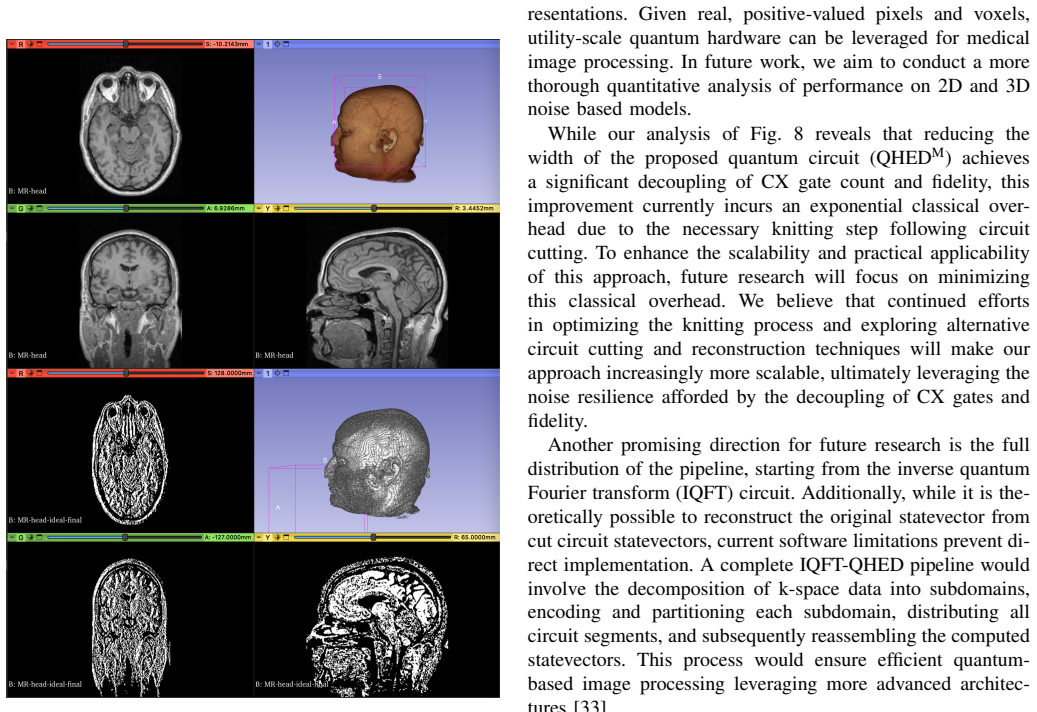
- Raw k-space MRI can enter an inverse quantum Fourier transform before edge detection, replacing the classical DFT cost of O(N^2) with O(N log N), although that part of the pipeline is demonstrated only on an ideal simulator.
- The classical knitting step that reconstructs the statevector from cut subcircuits currently incurs exponential classical overhead, so the practical speedup depends on improving that reconstruction.
Reading between the lines
- We infer that if the buffer-pixel stitching works for QHED, the same image-level decomposition should transfer to other amplitude-encoded quantum image operators, such as quantum convolution or quantum Fourier filtering, since the boundary preservation mechanism is not specific to the decrement gate.
- We predict from the reported depth curves that the fidelity advantage of the modified circuit grows as the encoding-domain size increases, because the original QHED depth scales exponentially while the modified version scales linearly; that scaling law is implicit in the figures but not explicitly fitted by the paper.
- A quantitative check we would run is a pixel-by-pixel comparison of the stitched edge map against a full-image QHED result on the same simulator; the paper provides visual evidence but no boundary-accuracy numbers, so this would settle whether the two mirrored buffer pixels are sufficient.
- We also infer that an end-to-end distributed IQFT-QHED pipeline, which the paper lists as future work, would remove the classical Fourier transform stage entirely and is the natural next test of whether the decomposition benefits survive when k-space data is itself cut and reconstructed.
Editorial analysis
A structured set of objections, weighed in public.
Referee Report
Summary. The paper proposes a two-level decomposition strategy for the Quantum Hadamard Edge Detection (QHED) algorithm to make it feasible on NISQ hardware. At the data level, an image is partitioned into P subimages, each padded with mirrored buffer pixels; at the circuit level, each subimage circuit is further cut into Q smaller subcircuits using Qiskit circuit cutting. The authors also modify the decrement permutation using ancilla qubits to reduce circuit depth and CNOT count. They report over 62% depth reduction, roughly 93% fewer CNOT gates, and fidelity above 95.6% under IBM's FakeMumbai noise model for 5-qubit input sizes, and demonstrate the approach on 2D and 3D MRI data using an HPC cluster with Dask.
Significance. If the buffer-pixel equivalence between decomposed and full-image QHED were quantitatively verified, the work would be a useful engineering contribution toward running quantum edge detection on near-term hardware. The circuit-level modifications are plausible and the experimental methodology (100 seeds, realistic noise models, a full HPC simulation pipeline) is a strength. However, the headline fidelity and circuit metrics concern an abstract 5-qubit circuit, not the end-to-end medical-image pipeline, and the central equivalence between the decomposed output and the non-decomposed QHED result is asserted without a quantitative test. The proof-of-concept IQFT pipeline is interesting but is run only on an ideal simulator. Overall, the significance of the paper depends heavily on whether the buffer-pixel assumption is validated, which is currently an open question.
major comments (3)
- [Section III-B, Fig. 5] The buffer-pixel scheme is the load-bearing assumption for the claim that the reassembled sub-image edge maps are equivalent to running QHED on the full image, yet the paper provides no quantitative verification. No experiment compares the decomposed pipeline's output with full-image QHED on the same input, and no analysis is given of whether edges at subdomain boundaries are detected with the same accuracy as interior edges. The thresholded visualizations in Figs. 10 and 11 cannot establish this equivalence. This is not a cosmetic issue: if boundary adjacencies are dropped or double-counted, the reassembled edge map would differ from full-image QHED even though all reported depth, CNOT, and fidelity numbers are unchanged. Please add a quantitative comparison, for example a small reference image processed both ways with metrics such as mean squared error, boundary precision/recall, or statevector fidelity between the reassembled and full-image outputs.
- [Section IV-B, Fig. 7] The fidelity claim of 'exceeding 95.6%' applies to an abstract 5-qubit circuit variant, not to the full medical-image processing pipeline. The circuits used in the medical-image demonstrations (Figs. 10 and 11) are either run on an ideal simulator or, in the noisy 2D case, are shown only as thresholded images; no end-to-end fidelity or error metric is reported for the decomposed pipeline. The paper should either provide end-to-end fidelity measurements on a realistic subdomain or explicitly restrict the fidelity claim to the abstract circuit level, since the current wording in the abstract and contributions implies that the medical-image results are high-fidelity.
- [Section IV-C and Section V] The 'utility-scale' and 'distributed utility-scale quantum computing' claims are overstated relative to what is demonstrated. The IQFT/QHED pipeline is run on an ideal simulator, and the authors state in Section V that circuit knitting incurs an exponential classical overhead and that current software limitations prevent full statevector reconstruction after cutting. These limitations are acknowledged, but the abstract and introduction still frame the contribution as a step toward utility-scale quantum computing. Please temper the claims to match the proof-of-concept nature of the end-to-end demonstrations.
minor comments (4)
- [Equation (7)] There is a typographical error: '|ψ3⟩ = (I2n ⊗ H)|ψ3⟩' should read '|ψ3⟩ = (I2n ⊗ H)|ψ2⟩', since the right-hand side applies the Hadamard to the previous state |ψ2⟩.
- [Equation (10)] The notation 'D22n−2' is unclear; it likely denotes a decrement gate on 2n−2 or 2^(2n−2) qubits. Please define the subscript explicitly.
- [Fig. 7 caption] The caption states that original circuits were tested over encoding domain sizes 2–8 qubits while cut circuits were evaluated from 6–12 qubits; this mismatch should be explained, as it complicates the direct comparison of the plotted metrics.
- [Throughout] Several typographical errors should be corrected: 'extention' → 'extension', 'Yao's et al.' → 'Yao et al.', 'Ulhmann' → 'Uhlmann', and the backend name 'F akeM umbai' → 'FakeMumbai'.
Circularity Check
No circularity: the depth/CNOT/fidelity improvements are direct measurements of an externally sourced ancilla-based decrement construction, and the unverified buffer-pixel equivalence is a validation gap, not a circular derivation.
full rationale
The derivation chain is self-contained. QHED_M is obtained by substituting the standard ancilla-based decrement construction (Gidney's increment-gate decomposition, cited externally) into Yao et al.'s QHED circuit; the reported depth, CNOT, and fidelity numbers are direct simulator measurements on IBM's FakeMumbai backend against the ideal statevector of the same circuit, not quantities fitted to the target claims. No parameter is fitted to a subset of data and then renamed a prediction. The P x Q decomposition resource claims are about circuit depth and two-qubit gate counts, which follow from the circuit identities and are not equivalent by construction to the target equivalence assumption. The only load-bearing assumption -- that mirrored buffer pixels make decomposed sub-image edge maps equivalent to full-image QHED -- is asserted without quantitative verification, but that is an external validation gap (correctness risk), not a circular reduction of the paper's claims to its inputs. Self-citations ([1], [2]) are background references for image-guided neurosurgery and do not support the central result. Therefore no circular step is identified.
Assumptions & free parameters
free parameters (3)
- Buffer pixel width =
2 pixels per sub-image
- Maximum sub-circuit width =
5 qubits
- Visualization thresholds =
Not reported in text
assumptions (4)
- standard math Amplitude encoding of 2^n non-negative pixel values into n qubits is valid and the normalization is achievable.
- domain assumption The QHED algorithm of Yao et al. correctly detects edges via odd-indexed output basis states.
- domain assumption FakeMumbai backend noise model is representative of real IBM hardware for NISQ fidelity estimation.
- standard math Gidney's ancilla-based decrement construction gives the stated linear scaling of CNOT gates.
Cite this review
Pith. "Pith review of Towards a Utility-Scale Quantum Edge Detection for Real-World Medical Image Data." pith.science (2026). https://pith.science/paper/URBLUJDP
@misc{pith2026250710939,
  author       = {Pith},
  title        = {Pith review of: Towards a Utility-Scale Quantum Edge Detection for Real-World Medical Image Data},
  year         = {2026},
  howpublished = {\url{https://pith.science/paper/URBLUJDP}},
  note         = {Machine review of arXiv:2507.10939}
}
abstract
We present a two-level decomposition strategy to enhance the quality and performance of Quantum Hadamard Edge Detection (QHED) for practical image analysis on Noisy Intermediate-Scale Quantum (NISQ) devices. A Data-Level Decomposition partitions an input image into P augmented sub-images, each encoded into a separate quantum circuit. Each of these circuits is then further cut via Circuit-Level Decomposition into Q smaller sub-circuits suitable for execution on near-term quantum devices. The two-level P $\times$ Q decomposition, along with optimizations we introduced, achieves over 62\% reductions in circuit depth and approximately 93\% fewer two-qubit operations, while maintaining a fidelity exceeding 95.6\% under realistic IBM noise models for 5-qubit data input sizes. These results demonstrate the feasibility of performing high-fidelity QHED on NISQ hardware and provide lessons and early evidence of distributed utility scale quantum computing, further illustrated by processing raw k-space MRI data with an Inverse Quantum Fourier Transform and a distributed simulation of the modified QHED on large 2D and 3D MRI datasets.
Figures


Figures from the paper (6 more)



Reference graph
Works this paper leans on
-
[1]
Compari- son of physics-based deformable registration methods for image-guided neurosurgery,
N. Chrisochoides, Y . Liu, F. Drakopoulos, A. Kot, P. Foteinos, C. Tso- lakis, E. Billias, O. Clatz, N. Ayache, A. Fedorov, and et al., “Compari- son of physics-based deformable registration methods for image-guided neurosurgery,” Frontiers in Digital Health , vol. 5, Dec 2023
work page 2023
-
[2]
Y . Liu, A. Kot, F. Drakopoulos, C. Yao, A. Fedorov, A. Enquobahrie, O. Clatz, and N. P. Chrisochoides, “An itk implementation of a physics- based non-rigid registration method for brain deformation in image- guided neurosurgery,” Frontiers in Neuroinformatics, vol. 8, Apr 2014
work page 2014
-
[3]
Demonstration of quantum image edge extration enhancement through improved sobel operator,
Y . Ma, H. Ma, and P. Chu, “Demonstration of quantum image edge extration enhancement through improved sobel operator,” IEEE Access, vol. 8, p. 210277–210285, 2020
work page 2020
-
[4]
P. Q. Le, F. Dong, and K. Hirota, “A flexible representation of quantum images for polynomial preparation, image compression, and processing operations,” Quantum Information Processing, vol. 10, no. 1, pp. 63–84, February 2011. [Online]. Available: https://doi.org/10.1007/s11128-010- 0177-y
-
[5]
Quantum image processing and its application to edge detection: Theory and experiment,
X.-W. Yao, H. Wang, Z. Liao, M.-C. Chen, J. Pan, J. Li, K. Zhang, X. Lin, Z. Wang, Z. Luo, W. Zheng, J. Li, M. Zhao, X. Peng, and D. Suter, “Quantum image processing and its application to edge detection: Theory and experiment,” Phys. Rev. X , vol. 7, p. 031041, Sep 2017. [Online]. Available: https://link.aps.org/doi/10.1103/PhysRevX.7.031041
-
[6]
TensorQC: Towards Scalable Distributed Quantum Computing via Tensor Networks
W. Tang and M. Martonosi, “Tensorqc: Towards scalable distributed quantum computing via tensor networks,” 2025. [Online]. Available: https://arxiv.org/abs/2502.03445
work page Pith review arXiv 2025
-
[7]
Cutqc: using small quantum computers for large quantum circuit evaluations,
W. Tang, T. Tomesh, M. Suchara, J. Larson, and M. Martonosi, “Cutqc: using small quantum computers for large quantum circuit evaluations,” in Proceedings of the 26th ACM International Conference on Architectural Support for Programming Languages and Operating Systems, ser. ASPLOS ’21. New York, NY , USA: Association for Computing Machinery, 2021, p. 473–4...
arXiv 2021
-
[8]
Optimal partitioning of quantum circuits using gate cuts and wire cuts,
S. Brandhofer, I. Polian, and K. Krsulich, “Optimal partitioning of quantum circuits using gate cuts and wire cuts,” IEEE Transactions on Quantum Engineering, vol. 5, pp. 1–10, 2024
work page 2024
Show all 36 references
-
[9]
Automated cut finding and circuit knitting on large quantum circuits,
I. Shehzad, E. Pednault, J. R. Garrison, C. Johnson, B. Fuller, and J. R. Glick, “Automated cut finding and circuit knitting on large quantum circuits,” in 2024 IEEE International Conference on Quantum Computing and Engineering (QCE) , vol. 02, 2024, pp. 406–407
2024
-
[10]
Distributed quantum computing via inte- grating quantum and classical computing,
W. Tang and M. Martonosi, “Distributed quantum computing via inte- grating quantum and classical computing,” Computer, vol. 57, no. 4, pp. 131–136, 2024
2024
-
[11]
D-nisq: A reference model for distributed noisy intermediate-scale quantum computers,
G. Acampora, F. Di Martino, A. Massa, R. Schiattarella, and A. Vitiello, “D-nisq: A reference model for distributed noisy intermediate-scale quantum computers,” Information Fusion, vol. 89, p. 16–28, 2023
2023
-
[12]
Integration of quantum accelerators with high performance computing – a review of quantum programming tools,
A. Elsharkawy, X.-T. M. To, P. Seitz, Y . Chen, Y . Stade, M. Geiger, Q. Huang, X. Guo, M. A. Ansari, C. B. Mendl, D. Kranzlm ¨uller, and M. Schulz, “Integration of quantum accelerators with high performance computing – a review of quantum programming tools,” 2023. [Online]. A...
2023
-
[13]
Arquin: Architectures for multinode superconducting quantum computers,
J. Ang, G. Carini, Y . Chen, I. Chuang, M. Demarco, S. Economou, A. Eickbusch, A. Faraon, K.-M. Fu, S. Girvin, M. Hatridge, A. Houck, P. Hilaire, K. Krsulich, A. Li, C. Liu, Y . Liu, M. Martonosi, D. McKay, J. Misewich, M. Ritter, R. Schoelkopf, S. Stein, S. Sussman, H. Tang, ...
2024
-
[14]
Review of distributed quantum computing: From single qpu to high performance quantum computing,
D. Barral, F. J. Cardama, G. D ´ıaz-Camacho, D. Fa ´ılde, I. F. Llovo, M. Mussa-Juane, J. V ´azquez-P´erez, J. Villasuso, C. Pi ˜neiro, N. Costas, J. C. Pichel, T. F. Pena, and A. G ´omez, “Review of distributed quantum computing: From single qpu to high performance quantum co...
2025
-
[15]
Integrating quantum computing resources into scientific hpc ecosystems,
T. Beck, A. Baroni, R. Bennink, G. Buchs, E. A. C. P ´erez, M. Eisenbach, R. F. da Silva, M. G. Meena, K. Gottiparthi, P. Groszkowski, T. S. Humble, R. Landfield, K. Maheshwari, S. Oral, M. A. Sandoval, A. Shehata, I.-S. Suh, and C. Zimmer, “Integrating quantum computing resou...
2024
-
[16]
A comparison of quantum and traditional fourier transform computations,
D. R. Musk, “A comparison of quantum and traditional fourier transform computations,” Computing in Science & Engineering , vol. 22, no. 6, pp. 103–110, 2020
2020
-
[17]
An improved quantum fourier transform algorithm and applications,
L. Hales and S. Hallgren, “An improved quantum fourier transform algorithm and applications,” in Proceedings 41st Annual Symposium on Foundations of Computer Science , Nov 2000, pp. 515–525
2000
-
[18]
Non-rigid alignment of pre- operative mri, fmri, and dt-mri with intra-operative mri for enhanced visualization and navigation in image-guided neurosurgery,
N. Archip, O. Clatz, S. Whalen, D. Kacher, A. Fedorov, A. Kot, N. Chrisochoides, F. Jolesz, A. Golby, P. M. Black, and S. K. Warfield, “Non-rigid alignment of pre- operative mri, fmri, and dt-mri with intra-operative mri for enhanced visualization and navigation in image-guide...
2007
-
[19]
Polynomial-time algorithms for prime factorization and discrete logarithms on a quantum computer,
P. W. Shor, “Polynomial-time algorithms for prime factorization and discrete logarithms on a quantum computer,” SIAM Review , vol. 41, no. 2, pp. 303–332, 1999. [Online]. Available: https://doi.org/10.1137/S0036144598347011
1999 doi
-
[20]
Scalable quantum neural networks for clas- sification,
J. Wu, Z. Tao, and Q. Li, “Scalable quantum neural networks for clas- sification,” 2022. [Online]. Available: https://arxiv.org/abs/2208.07719
2022 arXiv
-
[21]
Qiskit addon: circuit cutting,
A. M. Bra ´nczyk, A. Carrera Vazquez, D. J. Egger, B. Fuller, J. Gacon, J. R. Garrison, J. R. Glick, C. Johnson, S. Joshi, E. Pednault, C. D. Pemmaraju, P. Rivero, I. Shehzad, and S. Woerner, “Qiskit addon: circuit cutting,” https://github.com/Qiskit/qiskit-addon-cutting, 2024
2024
-
[22]
The ”transition probability
A. Uhlmann, “The ”transition probability” in the state space of a *- algebra,” Reports on Mathematical Physics , vol. 9, pp. 273–279, 1976
1976
-
[23]
Fidelity for mixed quantum states,
R. Jozsa, “Fidelity for mixed quantum states,” Journal of Modern Optics, vol. 41, no. 12, pp. 2315–2323, 1994. [Online]. Available: https://doi.org/10.1080/09500349414552171
1994 doi
-
[24]
A divide- and-conquer algorithm for quantum state preparation,
I. F. Araujo, D. K. Park, F. Petruccione, and A. J. da Silva, “A divide- and-conquer algorithm for quantum state preparation,”Scientific Reports, vol. 11, no. 1, 2021
2021
-
[25]
A class of efficient quantum incrementer gates for quantum circuit synthesis,
X. LI, G. Y ANG, C. M. TORRES, D. ZHENG, and K. L. W ANG, “A class of efficient quantum incrementer gates for quantum circuit synthesis,” International Journal of Modern Physics B , vol. 28, no. 01, p. 1350191, 2013
2013
-
[26]
Constructing large increment gates
C. Gidney, “Constructing large increment gates.” [Online]. Available: https://algassert.com/circuits/2015/06/12/Constructing-Large- Increment-Gates.html
2015
-
[27]
Quantum edge detection - qhed algorithm on small and large images,
T. Q. Team, “Quantum edge detection - qhed algorithm on small and large images,” Apr 2022. [Online]. Available: https://qiskit.org/textbook/ch-applications/quantum-edge-detection.html
2022
-
[28]
Cancer research data com- mons,
National Cancer Institute, “Cancer research data com- mons,” 2024, accessed: 2025-04-10. [Online]. Available: https://datacommons.cancer.gov/
2024
-
[29]
Slurm: Simple linux utility for resource management,
A. B. Yoo, M. A. Jette, and M. Grondona, “Slurm: Simple linux utility for resource management,” in Job Scheduling Strategies for Parallel Processing, D. Feitelson, L. Rudolph, and U. Schwiegelshohn, Eds. Berlin, Heidelberg: Springer Berlin Heidelberg, 2003, pp. 44–60
2003
-
[30]
Dask: Library for dynamic task scheduling,
M. Rocklin, “Dask: Library for dynamic task scheduling,” Proceedings of the 14th Python in Science Conference , pp. 130–136, 2015. [Online]. Available: https://dask.org
2015
-
[31]
Quantum computing with Qiskit,
A. Javadi-Abhari, M. Treinish, K. Krsulich, C. J. Wood, J. Lishman, J. Gacon, S. Martiel, P. D. Nation, L. S. Bishop, A. W. Cross, B. R. Johnson, and J. M. Gambetta, “Quantum computing with Qiskit,” 2024
2024
-
[32]
Abbas, S
A. Abbas, S. Andersson, A. Asfaw, A. Corcoles, L. Bello, Y . Ben-Haim, M. Bozzo-Rey, S. Bravyi, N. Bronn, L. Capelluto, A. C. Vazquez, J. Ceroni, R. Chen, A. Frisch, J. Gambetta, S. Garion, L. Gil, S. D. L. P. Gonzalez, F. Harkins, T. Imamichi, P. Jayasinha, H. Kang, A. h. Kar...
2020
-
[33]
Arquin: Architectures for multinode superconducting quantum computers,
J. Ang, G. Carini, Y . Chen, I. Chuang, M. Demarco, S. Economou, A. Eickbusch, A. Faraon, K.-M. Fu, S. Girvin, and et al., “Arquin: Architectures for multinode superconducting quantum computers,” ACM Transactions on Quantum Computing , vol. 5, no. 3, p. 1–59, Sep 2024
2024
-
[34]
The potential of quantum computing and machine learning to advance clinical research and change the practice of medicine,
D. Solenov, J. Brieler, and J. F. Scherrer, “The potential of quantum computing and machine learning to advance clinical research and change the practice of medicine,” Missouri Medicine, vol. 115, no. 5, pp. 463– 467, Sep-Oct 2018
2018
-
[35]
Nih virtual workshop: Near-term applications of quantum sensing technologies in biomedical sciences,
NIH, “Nih virtual workshop: Near-term applications of quantum sensing technologies in biomedical sciences,” Jan 2023. [Online]. Avail- able: https://datascience.nih.gov/news/nih-virtual-workshop-near-term- applications-of-quantum-sensing-technologies-in-biomedical-sciences
2023
-
[36]
McWeeney, T
S. McWeeney, T. Perciano, C. Susut, L. Chatterjee, M. Fornari, L. Biven, and C. Siwy, Quantum computing for Biomedical Computational and Data Sciences: A joint DOE-NIH roundtable , Dec 2023
2023
Reviewed August 6, 2026 · model on record in the stance chip above.
Discussion (0). Continue with ORCID to comment.