REVIEW 2 major objections 2 minor 1 cited by
Neighbor-density-weighted marked correlation functions extract additional cosmological information beyond the standard two-point correlation function.
Reviewed by Pith at T0; open to challenge. T0 means a machine referee read the full paper against a public rubric. the ladder, T0–T4 →
T0 review · grok-4.3
2026-06-30 15:05 UTC pith:US35ZQ6N
load-bearing objection The paper reports FoM gains of 1.7-2.5 from multi-mark neighbor-density weighted MCFs on Kun simulations, but the GP emulator accuracy is assumed rather than shown. the 2 major comments →
Cosmological constraints from neighbor-density-weighted marked correlation functions
The pith
A machine-rendered reading of the paper's core claim, the machinery that carries it, and where it could break.
Core claim
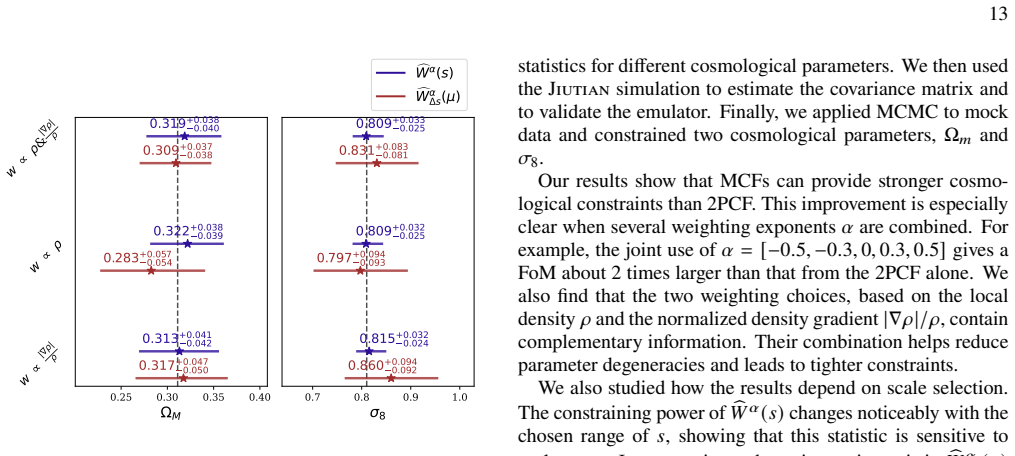
The central claim is that relative to the two-point correlation function alone, combinations of three mark parameters improve the figure of merit in the Omega_m-sigma_8 plane by factors of 1.7 to 2.5, and five-mark combinations achieve gains of 1.9 to 2.4. Density-based and gradient-based marks are nearly redundant for scale statistics but add up to 43 percent more information when combined in angular statistics. The angular marked statistic keeps extra information even when the tracer selection changes.
What carries the argument
The neighbor-density-weighted marked correlation functions, implemented through the normalized scale statistic and the angular statistic, with varying mark parameter alpha, emulated via Gaussian processes from the simulation suite.
Load-bearing premise
The Gaussian process emulators accurately reproduce the marked statistics' dependence on cosmological parameters across the relevant range.
What would settle it
Measurements from an independent simulation suite or from actual galaxy survey data that fail to show the reported improvement in the figure of merit when using the marked statistics.
Editorial analysis
A structured set of objections, weighed in public.
Referee Report
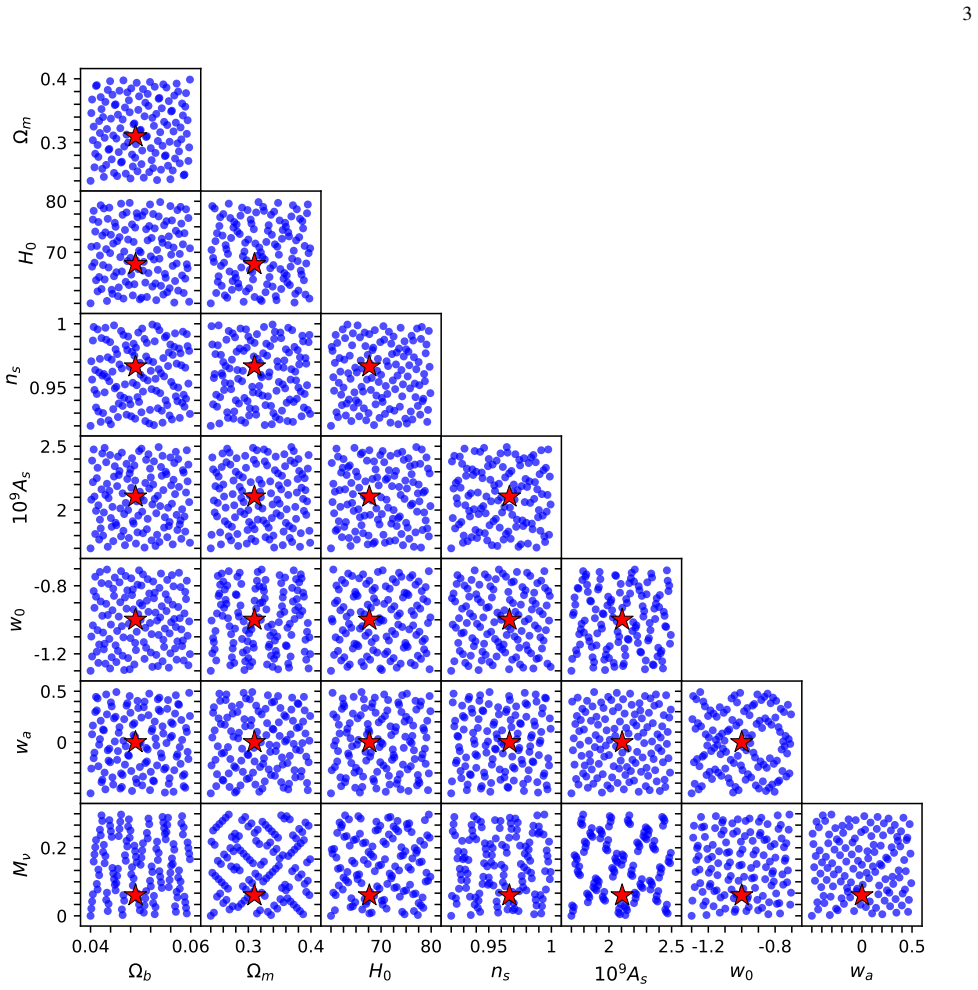
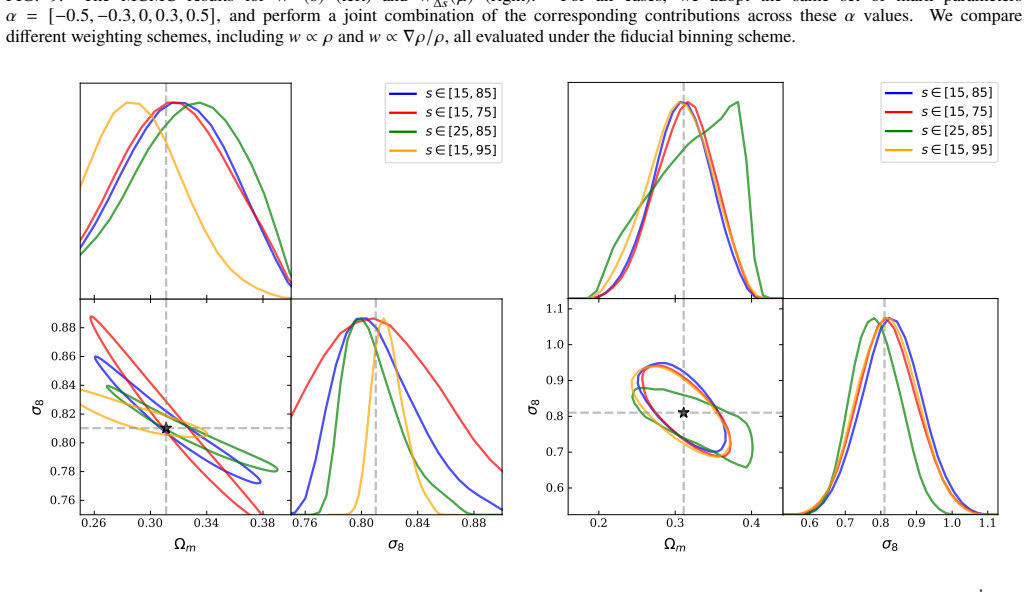
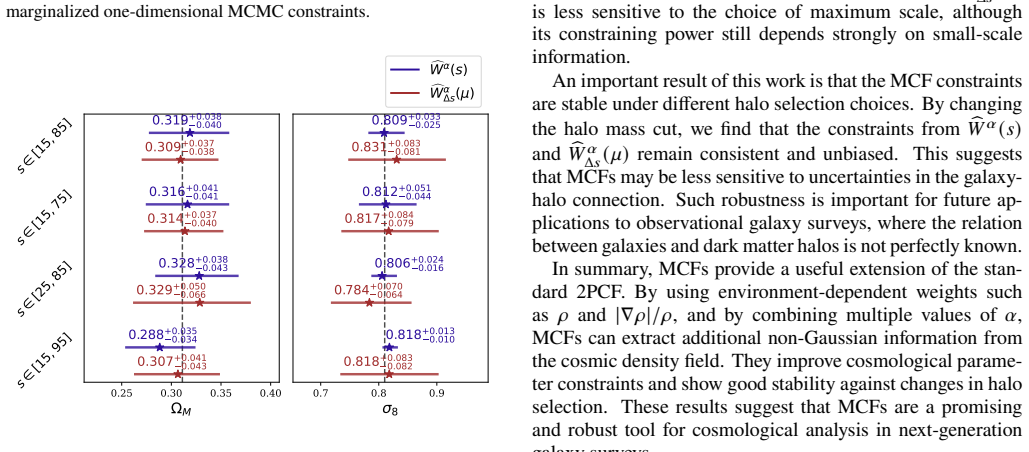
Summary. The paper claims that neighbor-density-weighted marked correlation functions (MCFs) extract additional cosmological information beyond the standard redshift-space 2PCF. Using 129 Kun-suite w0waCDM+∑mν simulations, Gaussian-process emulators are built for the normalized scale statistic Ŵ^α(s) and angular statistic Ŵ^α_Δs(μ). Joint analyses with multiple mark parameters α yield FoM gains in the Ωm–σ8 plane of 1.7–2.5 (three-mark) and 1.9–2.4 (five-mark) relative to the 2PCF, with density and normalized-gradient marks shown to be complementary for angular statistics (up to 43% FoM improvement) and the marked statistics robust to scale-range and halo-selection choices.
Significance. If the emulators are shown to be accurate, the work demonstrates that MCFs can meaningfully tighten constraints from next-generation surveys while remaining robust to analysis variations, offering a practical extension to standard 2PCF analyses.
major comments (2)
- [§3 and §4] §3 (Emulator construction) and §4 (Results): The headline FoM ratios (1.7–2.5 and 1.9–2.4) are obtained from GP predictions; however, the manuscript supplies no quantitative validation metrics such as leave-one-out cross-validation errors, maximum interpolation residuals, or tests against an independent cosmology. Without these, it is impossible to confirm that emulator modeling error is smaller than the differences driving the reported gains.
- [§4.2] §4.2 (Mark comparison): The claim that density and normalized-gradient marks are 'nearly redundant' for isotropic statistics but 'complementary' for angular statistics (43% FoM gain) rests on the emulator outputs; any systematic bias in the GP interpolation of the angular statistic would directly affect this complementarity result.
minor comments (2)
- [Abstract and §2] The abstract and §2 would benefit from a brief statement of the exact number of training simulations used per emulator and the range of α values explored.
- [§2] Notation for the normalized statistics Ŵ^α(s) and Ŵ^α_Δs(μ) is introduced without an explicit equation linking them to the underlying marked pair counts; adding this would improve readability.
Simulated Author's Rebuttal
We thank the referee for their careful reading and constructive comments. We address the two major points below regarding emulator validation and will revise the manuscript to incorporate the requested metrics.
read point-by-point responses
-
Referee: [§3 and §4] §3 (Emulator construction) and §4 (Results): The headline FoM ratios (1.7–2.5 and 1.9–2.4) are obtained from GP predictions; however, the manuscript supplies no quantitative validation metrics such as leave-one-out cross-validation errors, maximum interpolation residuals, or tests against an independent cosmology. Without these, it is impossible to confirm that emulator modeling error is smaller than the differences driving the reported gains.
Authors: We agree that quantitative validation metrics for the GP emulators are essential to support the reported FoM gains. In the revised manuscript we will add a dedicated subsection to §3 reporting leave-one-out cross-validation errors and maximum interpolation residuals for both Ŵ^α(s) and Ŵ^α_Δs(μ) across all mark parameters. We will also present results from holding out one cosmology from the 129-simulation suite as an independent test. These metrics confirm that emulator errors remain sub-dominant to the cosmological variations driving the 1.7–2.5× FoM improvements. revision: yes
-
Referee: [§4.2] §4.2 (Mark comparison): The claim that density and normalized-gradient marks are 'nearly redundant' for isotropic statistics but 'complementary' for angular statistics (43% FoM gain) rests on the emulator outputs; any systematic bias in the GP interpolation of the angular statistic would directly affect this complementarity result.
Authors: We acknowledge that the reported complementarity (and 43% FoM gain) for the angular statistic depends on emulator fidelity. The new validation subsection in revised §3 will include LOO-CV errors and residuals specifically for Ŵ^α_Δs(μ) under density and normalized-gradient marks. We will additionally show that the interpolation uncertainties do not change the relative FoM when the two marks are combined, thereby confirming that the complementarity result is robust. revision: yes
Circularity Check
No circularity; results from independent simulations and emulators
full rationale
The derivation chain relies on N-body simulations from the Kun suite and Gaussian-process emulators to compute FoM gains for marked correlation functions relative to 2PCF. No equations reduce by construction to fitted inputs, no self-definitional steps appear, and no load-bearing self-citations or imported uniqueness theorems are invoked. The reported improvement factors are obtained by direct evaluation on emulated statistics, with the central claim remaining independent of the paper's own outputs.
Axiom & Free-Parameter Ledger
free parameters (1)
- mark parameter α
axioms (1)
- domain assumption The Kun suite of 129 w0waCDM+∑m_ν simulations in 1 h⁻¹ Gpc boxes accurately represent the target cosmology for emulator training.
read the original abstract
We investigate whether neighbor-density-weighted marked correlation functions (MCFs) can extract cosmological information beyond the standard redshift-space two-point correlation function (2PCF). Using the Kun suite of 129 $w_0w_a$CDM$+\sum m_\nu$ simulations in $1~h^{-1}{\rm Gpc}$ boxes, we construct Gaussian-process emulators for the normalized scale statistic $\widehat{W}^{\alpha}(s)$ and the angular statistic $\widehat{W}^{\alpha}_{\Delta s}(\mu)$. We perform joint analyses combining multiple mark parameters $\alpha$ and quantify the information gain using the FoM in the $\Omega_m$--$\sigma_8$ plane. Relative to the 2PCF case, three-mark combinations improve the FoM by factors of $1.7$--$2.5$, while five-mark combinations increase the gain to $1.9$--$2.4$, depending on the statistic and mark definition. We further compare density and normalized-gradient marks, finding that they are nearly redundant for isotropic statistics but complementary for angular statistics, where their combination improves the FoM by up to $43\%$. Tests of scale range and halo selection show that the marked statistics remain robust under changes in analysis choices, with the angular statistic retaining additional cosmological information that is less sensitive to tracer selection. Our results demonstrate that MCFs substantially enhance cosmological constraints beyond the standard 2PCF and provide a robust probe for next-generation galaxy surveys.
Figures



Forward citations
Cited by 1 Pith paper
-
Hermes - Towards an Optimal High-Performance Algorithm for Cosmic Statistics of Large Data Sets
Hermes/PyHermes reconstructs catalogues in a scaling-function basis and unifies CIC, 2PCF, 3PCF, marked, and operator-based cosmic statistics as reusable window operations with FFT/MPI/GPU scaling.
Reference graph
Works this paper leans on
-
[1]
Choice of marks Weusetwoenvironmentalmarksinthelikelihoodanalysis. The first is the adaptive local density itself, 𝑤=𝜌 𝑛NB .(4) This mark directly upweights halos in dense environments. It is therefore sensitive to the clustering of halos in compact overdense structures. The second mark is the normalized density gradient, 𝑤= |∇𝜌 𝑛NB | 𝜌𝑛NB .(5) This quant...
-
[2]
Marked two-point statistic We now incorporate the environmental marks into a two- point statistic. For a given mark𝑤and mark power𝛼, we define the marked correlation function as 𝑊 𝛼 (r)= ⟨𝛿(x)𝑤 𝛼 (x)𝛿(x+r)𝑤 𝛼 (x+r) ⟩ .(6) Here𝛿is the tracer overdensity field, and the exponent𝛼 controls how strongly the mark affects the pair weighting. Forcomparison,theord...
-
[3]
To build a compact data vector, we compress it in two comple- mentary ways
Scale and angular compression The full two-dimensional statistic𝑊𝛼 (𝑠, 𝜇)contains both scale dependence and line-of-sight angular dependence. To build a compact data vector, we compress it in two comple- mentary ways. First, to isolate the scale dependence, we integrate over the angular range, 𝑊 𝛼 (𝑠)= ∫ 𝜇max 𝜇min 𝑊 𝛼 (𝑠, 𝜇)𝑑𝜇.(9) This statistic measures ...
-
[4]
Normalized marked correlation functions Forlikelihoodinference,wefocusontheshapeinformation rather than the overall integral of each marked statistic. We therefore define the normalized scale-dependent statistic as b𝑊 𝛼 (𝑠)= 𝑊 𝛼 (𝑠)∫ 𝑠max 𝑠min 𝑊 𝛼 (𝑠 ′)𝑑𝑠 ′ .(11) 5 FIG.2: Environmentalquantitiesina500×500(ℎ −1Mpc)2 sliceofaKunhalocatalog. Left: thelocal-d...
-
[5]
The full simulation is divided into 𝑁sub =5 3 =125subsamples, each with volume𝑉 sub = (400ℎ −1Mpc)3
Data covariance We estimate the data covariance from subvolumes of the Jiutiansimulation. The full simulation is divided into 𝑁sub =5 3 =125subsamples, each with volume𝑉 sub = (400ℎ −1Mpc)3. Lety 𝑘 be the data vector measured from the𝑘-th subvolume, and let ¯y= 1 𝑁sub 𝑁sub∑︁ 𝑘=1 y𝑘 (29) be the mean over all subvolumes. The covariance for an ob- served vol...
-
[6]
We estimate this term using the leave-one-out validation de- scribed in the previous section
Emulator covariance The emulator covariance quantifies the uncertainty intro- duced by interpolation across cosmological parameter space. We estimate this term using the leave-one-out validation de- scribed in the previous section. For the𝑗-th training cosmol- ogy, the emulator is trained on all other cosmologies and then evaluated at the omitted point. T...
-
[7]
Correction for fixed initial phases TheKuntraining simulations are generated with fixed ini- tial phases. While this suppresses sample variance and im- proves emulator training, it can introduce a systematic offset between the emulator prediction and the ensemble-averaged statistic from independent realizations. Following the ratio- based correction [84],...
-
[8]
We correct this bias using the Hartlap factor [85]
Inverse covariance correction Because the covariance matrix is estimated from a finite number of subvolumes, its inverse is biased. We correct this bias using the Hartlap factor [85]. The debiased inverse co- variance is bC−1 = 𝑁sub −𝑁 𝑑 −2 𝑁sub −1 C−1,(36) 9 31 46 62 77w 31 46 62 77 w 31 46 62 77w / 31 46 62 77 w / 0.00 0.01 0.02 0.03 0.04 W(s) 0.2 0.4 0...
work page 2021
-
[9]
M. Colless, B. A. Peterson, C. Jackson, J. A. Peacock, S. Cole, P. Norberg, I. K. Baldry, C. M. Baugh, J. Bland-Hawthorn, T. Bridges, et al., arXiv Astrophysics e-prints (2003), astro- 14 0.26 0.30 0.34 0.38 m 0.76 0.78 0.80 0.82 0.84 0.86 0.88 8 0.76 0.80 0.84 0.88 8 Mcut = 3.85 × 10¹² M Mcut = 3.15 × 10¹² M Mcut = 1.65 × 10¹² M 0.2 0.3 0.4 m 0.6 0.7 0.8...
-
[10]
The 6dF Galaxy Survey: z \approx 0 measurement of the growth rate and sigma_8
F. Beutler, C. Blake, M. Colless, D. H. Jones, L. Staveley- Smith, G. B. Poole, L. Campbell, Q. Parker, W. Saunders, and F. Watson, mnras423, 3430 (2012), 1204.4725
work page internal anchor Pith review Pith/arXiv arXiv 2012
- [14]
-
[15]
W. J. Percival, S. Cole, D. J. Eisenstein, R. C. Nichol, J. A. Peacock,A.C.Pope,andA.S.Szalay,mnras381,1053(2007), 0705.3323
work page internal anchor Pith review Pith/arXiv arXiv 2007
-
[16]
L. Anderson, E. Aubourg, S. Bailey, D. Bizyaev, M. Blanton, A. S. Bolton, J. Brinkmann, J. R. Brownstein, A. Burden, A. J. Cuesta, et al., mnras427, 3435 (2012), 1203.6594
work page internal anchor Pith review Pith/arXiv arXiv 2012
-
[17]
S.Alam,M.Ata,S.Bailey,F.Beutler,D.Bizyaev,J.A.Blazek, A.S.Bolton,J.R.Brownstein,A.Burden,C.-H.Chuang,etal., mnras470, 2617 (2017), 1607.03155
work page internal anchor Pith review Pith/arXiv arXiv 2017
-
[18]
Kaiser, Monthly Notices of the Royal Astronomical Society 227, 1 (1987)
N. Kaiser, Monthly Notices of the Royal Astronomical Society 227, 1 (1987)
work page 1987
-
[19]
W. E. Ballinger, J. A. Peacock, and A. F. Heavens, Monthly Notices of the Royal Astronomical Society282, 877 (1996), astro-ph/9605017
work page internal anchor Pith review Pith/arXiv arXiv 1996
-
[20]
D.J.EisensteinandW.Hu,TheAstrophysicalJournal496,605 (1998), astro-ph/9709112
work page internal anchor Pith review Pith/arXiv arXiv 1998
-
[21]
Probing dark energy using baryonic oscillations in the galaxy power spectrum as a cosmological ruler
C. Blake and K. Glazebrook, The Astrophysical Journal594, 665 (2003), astro-ph/0301632
work page internal anchor Pith review Pith/arXiv arXiv 2003
-
[22]
Probing Dark Energy with Baryonic Acoustic Oscillations from Future Large Galaxy Redshift Surveys
H.-J. Seo and D. J. Eisenstein, The Astrophysical Journal598, 720 (2003), astro-ph/0307460
work page internal anchor Pith review Pith/arXiv arXiv 2003
-
[23]
M. Colless, B. A. Peterson, C. Jackson, J. A. Peacock, S. Cole, P. Norberg, I. K. Baldry, C. M. Baugh, J. Bland-Hawthorn, T.Bridges,etal.,arXive-printsastro-ph/0306581(2003),astro- ph/0306581
-
[24]
F. Beutler, C. Blake, M. Colless, D. H. Jones, L. Staveley-Smith, G. B. Poole, L. Campbell, Q. Parker, W. Saunders, and F. Watson, Monthly Notices of the Royal Astronomical Society423, 3430 (2012), ISSN 0035-8711, https://academic.oup.com/mnras/article- pdf/423/4/3430/4903419/mnras0423-3430.pdf, URLhttps: //doi.org/10.1111/j.1365-2966.2012.21136.x
-
[25]
C. Blake, K. Glazebrook, T. M. Davis, S. Brough, M. Colless, C.Contreras,W.Couch,S.Croom,M.J.Drinkwater,K.Forster, et al., Monthly Notices of the Royal Astronomical Society418, 1725 (2011), 1108.2637
work page internal anchor Pith review Pith/arXiv arXiv 2011
-
[26]
The WiggleZ Dark Energy Survey: the growth rate of cosmic structure since redshift z=0.9
C. Blake, S. Brough, M. Colless, C. Contreras, W. Couch, S. Croom, T. Davis, M. J. Drinkwater, K. Forster, D. Gilbank, et al., Monthly Notices of the Royal Astronomical Society415, 2876 (2011), 1104.2948
work page internal anchor Pith review Pith/arXiv arXiv 2011
-
[27]
D. G. York, J. Adelman, J. Anderson, John E., S. F. Anderson, J.Annis,N.A.Bahcall,J.A.Bakken,R.Barkhouser,S.Bastian, E. Berman, et al., The Astronomical Journal120, 1579 (2000), astro-ph/0006396
work page internal anchor Pith review Pith/arXiv arXiv 2000
-
[28]
A.G.Sánchez,C.G.Scóccola,A.J.Ross,W.Percival,M.Man- era, F. Montesano, X. Mazzalay, A. J. Cuesta, D. J. Eisenstein, E. Kazin, et al., Monthly Notices of the Royal Astronomical Society425, 415 (2012), 1203.6616
work page internal anchor Pith review Pith/arXiv arXiv 2012
-
[29]
A. G. Sánchez, E. A. Kazin, F. Beutler, C.-H. Chuang, A. J. Cuesta,D.J.Eisenstein,M.Manera,F.Montesano,R.C.Nichol, N. Padmanabhan, et al., Monthly Notices of the Royal Astro- nomical Society433, 1202 (2013), 1303.4396. 15
work page internal anchor Pith review Pith/arXiv arXiv 2013
-
[30]
L. Anderson, É. Aubourg, S. Bailey, F. Beutler, V. Bhardwaj, M. Blanton, A. S. Bolton, J. Brinkmann, J. R. Brownstein, A. Burden, et al., Monthly Notices of the Royal Astronomical Society441, 24 (2014), 1312.4877
work page internal anchor Pith review Pith/arXiv arXiv 2014
-
[31]
L.Samushia,B.A.Reid,M.White,W.J.Percival,A.J.Cuesta, G.-B. Zhao, A. J. Ross, M. Manera, É. Aubourg, F. Beutler, et al., Monthly Notices of the Royal Astronomical Society439, 3504 (2014), 1312.4899
work page internal anchor Pith review Pith/arXiv arXiv 2014
-
[32]
A. J. Ross, L. Samushia, C. Howlett, W. J. Percival, A. Burden, and M. Manera, Monthly Notices of the Royal Astronomical Society449, 835 (2015), 1409.3242
work page internal anchor Pith review Pith/arXiv arXiv 2015
-
[33]
F. Beutler, H.-J. Seo, A. J. Ross, P. McDonald, S. Saito, A. S. Bolton, J. R. Brownstein, C.-H. Chuang, A. J. Cuesta, D. J. Eisenstein, et al., Monthly Notices of the Royal Astronomical Society464, 3409 (2017), 1607.03149
work page internal anchor Pith review Pith/arXiv arXiv 2017
-
[34]
A. G. Sánchez, J. N. Grieb, S. Salazar-Albornoz, S. Alam, F. Beutler, A. J. Ross, J. R. Brownstein, C.-H. Chuang, A. J. Cuesta, D. J. Eisenstein, et al., Monthly Notices of the Royal Astronomical Society464, 1493 (2017), 1607.03146
work page internal anchor Pith review Pith/arXiv arXiv 2017
-
[35]
C.-H.Chuang,F.-S.Kitaura,Y.Liang,A.Font-Ribera,C.Zhao, P.McDonald,andC.Tao,PhysicalReviewD95,063528(2017), 1605.05352
work page internal anchor Pith review Pith/arXiv arXiv 2017
-
[36]
The DESI Experiment Part I: Science,Targeting, and Survey Design
DESI Collaboration, A. Aghamousa, J. Aguilar, S. Ahlen, S. Alam, L. E. Allen, C. Allende Prieto, J. Annis, S. Bai- ley, C. Balland, et al., arXiv e-prints arXiv:1611.00036 (2016), 1611.00036
work page internal anchor Pith review Pith/arXiv arXiv 2016
-
[37]
LSST Science Collaboration, P. A. Abell, J. Allison, S. F. An- derson, J. R. Andrew, J. R. P. Angel, L. Armus, D. Arnett, S. J. Asztalos, T. S. Axelrod, et al., arXiv e-prints arXiv:0912.0201 (2009), 0912.0201
work page internal anchor Pith review Pith/arXiv arXiv 2009
-
[38]
Euclid Definition Study Report
R. Laureijs, J. Amiaux, S. Arduini, J. L. Auguères, J. Brinch- mann,R.Cole,M.Cropper,C.Dabin,L.Duvet,A.Ealet,etal., arXiv e-prints arXiv:1110.3193 (2011), 1110.3193
work page internal anchor Pith review Pith/arXiv arXiv 2011
- [39]
-
[40]
O.Dore,C.Hirata,Y.Wang,D.Weinberg,T.Eifler,R.J.Foley, C. H. Heinrich, E. Krause, S. Perlmutter, A. Pisani, et al., Bull. Amer. Astron. Soc.51, 341 (2019), 1904.01174
work page internal anchor Pith review Pith/arXiv arXiv 2019
-
[41]
Y. Gong, X. Liu, Y. Cao, X. Chen, Z. Fan, R. Li, X.-D. Li, Z. Li, X. Zhang, and H. Zhan, Astrophys. J.883, 203 (2019), 1901.04634
work page Pith review arXiv 2019
-
[42]
C. G. Sabiu, D. F. Mota, C. Llinares, and C. Park, Astronomy and Astrophysics592, A38 (2016), 1603.05750
work page internal anchor Pith review Pith/arXiv arXiv 2016
-
[43]
Z. Slepian, D. J. Eisenstein, J. R. Brownstein, C.-H. Chuang, H. Gil-Marín, S. Ho, F.-S. Kitaura, W. J. Percival, A. J. Ross, G. Rossi, et al., Monthly Notices of the Royal Astronomical Society469, 1738 (2017), 1607.06097
work page internal anchor Pith review Pith/arXiv arXiv 2017
-
[44]
C. G. Sabiu, B. Hoyle, J. Kim, and X.-D. Li, The Astrophysical Journals242, 29 (2019), 1901.00296
work page internal anchor Pith review Pith/arXiv arXiv 2019
- [45]
-
[46]
Precision cosmography with stacked voids
G. Lavaux and B. D. Wandelt, The Astrophysical Journal754, 109 (2012), 1110.0345
work page internal anchor Pith review Pith/arXiv arXiv 2012
-
[47]
Estimating Cosmological Parameters from the Dark Matter Distribution
S. Ravanbakhsh, J. Oliva, S. Fromenteau, L. C. Price, S. Ho, J.Schneider,andB.Poczos,arXive-prints(2017),1711.02033
work page internal anchor Pith review Pith/arXiv arXiv 2017
-
[48]
CosmoFlow: Using Deep Learning to Learn the Universe at Scale
A. Mathuriya, D. Bard, P. Mendygral, L. Meadows, J. Arne- mann, L. Shao, S. He, T. Karna, D. Moise, S. J. Pennycook, et al., arXiv e-prints (2018), 1808.04728
work page internal anchor Pith review Pith/arXiv arXiv 2018
-
[49]
S. Pan, M. Liu, J. Forero-Romero, C. G. Sabiu, Z. Li, H. Miao, and X.-D. Li, Science China Physics, Mechanics & Astronomy 63, 110412 (2020)
work page 2020
-
[50]
Luminosity- and morphology-dependent clustering of galaxies
C. Beisbart and M. Kerscher, The Astrophysical Journal545, 6 (2000), astro-ph/0003358
work page internal anchor Pith review Pith/arXiv arXiv 2000
- [51]
-
[52]
Spatial distribution of galactic halos and their merger histories
S. Gottlöber, M. Kerscher, A. V. Kravtsov, A. Faltenbacher, A. Klypin, and V. Müller, Astronomy and Astrophysics387, 778 (2002), astro-ph/0203148
work page internal anchor Pith review Pith/arXiv arXiv 2002
-
[53]
R. K. Sheth and G. Tormen, Monthly Notices of the Royal Astronomical Society350, 1385 (2004), astro-ph/0402237
work page internal anchor Pith review Pith/arXiv arXiv 2004
- [54]
- [55]
-
[56]
Breaking Halo Occupation Degeneracies with Marked Statistics
M. White and N. Padmanabhan, Monthly Notices of the Royal Astronomical Society395, 2381 (2009), 0812.4288
work page internal anchor Pith review Pith/arXiv arXiv 2009
-
[57]
A marked correlation function for constraining modified gravity models
M. White, JCAP2016, 057 (2016), 1609.08632
work page internal anchor Pith review Pith/arXiv arXiv 2016
-
[58]
S.Satpathy,R.ACCroft,S.Ho,andB.Li,MonthlyNoticesof theRoyalAstronomicalSociety484,2148(2019),1901.01447
work page internal anchor Pith review Pith/arXiv arXiv 2019
-
[59]
E. Massara, F. Villaescusa-Navarro, S. Ho, N. Dalal, and D. N. Spergel, Physical Review Letters126, 011301 (2021)
work page 2021
- [60]
- [61]
-
[62]
X. Xiao, Y. Yang, X. Luo, J. Ding, Z. Huang, X. Wang, Y. Zheng, C. G. Sabiu, J. Forero-Romero, H. Miao, et al., Monthly Notices of the Royal Astronomical Society513, 595–603 (2022), ISSN 1365-2966, URLhttp://dx.doi. org/10.1093/mnras/stac879
-
[63]
L. Lai, J. Ding, X. Luo, Y. Yang, Z. Wang, K. Liu, G. Liu, X. Wang, Y. Zheng, Z. Li, et al., Science China Physics, Me- chanics & Astronomy67(2024), ISSN 1869-1927, URL http://dx.doi.org/10.1007/s11433-023-2384-4
-
[64]
K. Heitmann, D. Higdon, M. White, S. Habib, B. J. Williams, E. Lawrence, and C. Wagner, Astrophys. J.705, 156 (2009), 0902.0429
work page internal anchor Pith review Pith/arXiv arXiv 2009
-
[65]
The Coyote Universe I: Precision Determination of the Nonlinear Matter Power Spectrum
K. Heitmann, M. White, C. Wagner, S. Habib, and D. Higdon, Astrophys. J.715, 104 (2010), 0812.1052
work page internal anchor Pith review Pith/arXiv arXiv 2010
-
[66]
E. Lawrence, K. Heitmann, M. White, D. Higdon, C. Wagner, S. Habib, and B. Williams, Astrophys. J.713, 1322 (2010), 0912.4490
work page internal anchor Pith review Pith/arXiv arXiv 2010
-
[67]
The Coyote Universe Extended: Precision Emulation of the Matter Power Spectrum
K. Heitmann, E. Lawrence, J. Kwan, S. Habib, and D. Higdon, Astrophys. J.780, 111 (2014), 1304.7849
work page internal anchor Pith review Pith/arXiv arXiv 2014
-
[68]
The Mira-Titan Universe II: Matter Power Spectrum Emulation
E. Lawrence, K. Heitmann, J. Kwan, A. Upadhye, D. Bingham, S. Habib, D. Higdon, A. Pope, H. Finkel, and N. Frontiere, Astrophys. J.847, 50 (2017), 1705.03388
work page internal anchor Pith review Pith/arXiv arXiv 2017
-
[69]
S. Bocquet, K. Heitmann, S. Habib, E. Lawrence, T. Uram, N. Frontiere, A. Pope, and H. Finkel, arXiv e-prints (2020), 2003.12116
-
[70]
J.Kwan,K.Heitmann,S.Habib,N.Padmanabhan,E.Lawrence, H.Finkel,N.Frontiere,andA.Pope,TheAstrophysicalJournal 810, 35 (2015)
work page 2015
-
[71]
B. D. Wibking, D. H. Weinberg, A. N. Salcedo, H.-Y. Wu, S. Singh, S. Rodríguez-Torres, L. H. Garrison, and D. J. Eisenstein, Monthly Notices of the Royal Astronomical So- ciety492, 2872–2896 (2019), ISSN 1365-2966, URLhttp: //dx.doi.org/10.1093/mnras/stz3423
-
[72]
J. Kwan, S. Bhattacharya, K. Heitmann, and S. Habib, The Astrophysical Journal768, 123 (2013), ISSN 1538-4357, URL http://dx.doi.org/10.1088/0004-637X/768/2/123
-
[73]
Nishimichi et al., The Astrophysical Journal884, 29 (2019), ISSN 1538-4357, URLhttp://dx.doi.org/10
T. Nishimichi et al., The Astrophysical Journal884, 29 (2019), ISSN 1538-4357, URLhttp://dx.doi.org/10. 3847/1538-4357/ab3719. 16
work page 2019
-
[74]
Y. Kobayashi, T. Nishimichi, M. Takada, R. Takahashi, and K.Osato,arXive-printsarXiv:2005.06122(2020),2005.06122
- [75]
-
[76]
K.R.Moran,K.Heitmann,E.Lawrence,S.Habib,D.Bingham, A. Upadhye, J. Kwan, D. Higdon, and R. Payne, Mon. Not. R. Astron. Soc.520, 3443 (2023), 2207.12345
-
[77]
K. Cranmer, J. Brehmer, and G. Louppe, Proceedings of the National Academy of Sciences117, 30055–30062 (2020), ISSN 1091-6490, URLhttp://dx.doi.org/10. 1073/pnas.1912789117
work page 2020
- [78]
-
[79]
V. Springel, R. Pakmor, O. Zier, and M. Reinecke, Monthly Notices of the Royal Astronomical Society506, 2871–2949 (2021), ISSN 1365-2966, URLhttp://dx.doi.org/10. 1093/mnras/stab1855
work page 2021
- [80]
- [81]
-
[82]
Planck 2018 results. VI. Cosmological parameters
Planck Collaboration, N. Aghanim, Y. Akrami, M. Ashdown, J. Aumont, C. Baccigalupi, M. Ballardini, A. J. Banday, R. B. Barreiro, N. Bartolo, et al., Astron. Astrophys.641, A6 (2020), 1807.06209
work page internal anchor Pith review Pith/arXiv arXiv 2020
-
[83]
R. E. Angulo and A. Pontzen, Mon. Not. R. Astron. Soc.462, L1 (2016), 1603.05253
work page internal anchor Pith review Pith/arXiv arXiv 2016
discussion (0)
Sign in with ORCID, Apple, or X to comment. Anyone can read and Pith papers without signing in.