REVIEW 4 major objections 6 minor 154 references
Dynamical and Cosmological Aspects of Teleparallel and Extended Teleparallel Gravity
T0 review · 4 major / 6 minor · reviewed 2026-08-10 · deepseek-v4-flash
Pith's one-line read This thesis claims that modified teleparallel gravity theories can reproduce the observed cosmic sequence—radiation, matter, and accelerating dark-energy eras—as stable critical points of a single dynamical system, with late-time…
desk verdict Competent compilation of already-published dynamical-system papers, but the central viability claim rests on freezing λ=Ḧ/H^3 to isolated power-law trajectories. read the letter →
The pith
A machine-rendered reading of the paper's core claim, the machinery that carries it, and where it could break.
The reading
What carries the argument
The engine of the analysis is the autonomous dynamical system: the Friedmann and Klein-Gordon equations of each theory are rewritten in dimensionless phase-space variables, and the fixed points of the resulting ordinary differential equations are classified by the eigenvalues of the Jacobian matrix, with center-manifold theory used for non-hyperbolic points. A constant dimensionless parameter $\lambda = \ddot{H}/H^3$ closes the system in the boundary-term chapters, and exponential and power-law potentials fix the scalar-field sector. The distinctive load-bearing objects are the teleparallel boundary term $B$ and the teleparallel Gauss-Bonnet term $T_G$, which enter the Lagrangians as new couplings and reshape the phase space; their presence is what distinguishes these models from ordinary $f(T)$ gravity and allows the de Sitter and scaling solutions the thesis highlights.
What would settle it
Compute $\lambda = \ddot{H}/H^3$ along the best-fit $H(z)$ curves the thesis reports for the $f(T,B)$ and $f(T,T_G)$ models; if $\lambda$ moves appreciably across the radiation-to-dark-energy epochs instead of holding near the values used to find the critical points, such as $8$ for radiation and $9/2$ for matter, the fixed-point analysis does not govern the models' real trajectories.
Extended reading notes
Core claim
The central claim is that, across the studied families of modified teleparallel gravity—$f(T,\phi)$, $f(T,B)$, $f(T,T_G)$, $f(T,B,T_G,B_G)$, and the general teleparallel scalar-tensor formalism—the cosmological field equations can be rewritten as autonomous dynamical systems whose fixed points reproduce radiation-, matter-, and dark-energy-dominated eras in a single phase space. The radiation and matter critical points are saddles, so the Universe can pass through them, while the dark-energy critical points are stable late-time attractors; de Sitter solutions appear as limiting cases. The thesis reports that for representative parameter choices the models yield present-day density parameters near $\Omega_m \approx 0.3$ and $\Omega_{\mathrm{DE}} \approx 0.7$, a transition from deceleration to acceleration at redshift $z \approx 0.6$, and Hubble and distance-modulus curves compatible with observational fits. If correct, this means the observed cosmic acceleration can be explained by the geometry of torsion with added boundary couplings, without a cosmological constant.
Load-bearing premise
The load-bearing premise is that the dimensionless quantity $\lambda = \ddot{H}/H^3$ stays constant along the cosmological trajectories analysed in the boundary-term chapters, so the dynamical systems are autonomous; if the real Universe's $\lambda$ varies with time, the critical points and stability classifications derived under this assumption need not describe the actual evolution.
Editorial extensions
If this is right
- If the central claim holds, modified teleparallel gravity can generate the full radiation-to-matter-to-accelerating-dark-energy sequence from a single Lagrangian, with no cosmological constant input.
- The stable dark-energy critical points mean the models converge to an accelerating late-time state from a broad set of initial conditions, making the acceleration phase an attractor rather than a fine-tuned choice.
- The boundary and Gauss-Bonnet terms alter the phase-space structure and produce de Sitter and scaling solutions, offering a dynamical route to the coincidence problem within the scope of the paper.
- The scalar-field models with exponential and power-law potentials give present-day matter and dark-energy densities, transition redshifts, and equation-of-state values close to those inferred from current observations.
- The fits to Hubble and Supernovae Ia data in the boundary-coupling chapter indicate that the nonminimal boundary coupling with several potentials can match the observed distance-modulus curve, supporting the models' observational viability.
Reading between the lines
- Inference: The viability claim is not yet tested against the full cosmological data set; a natural next step is to confront these models with CMB, baryon-acoustic-oscillation, and large-scale-structure likelihoods, which the thesis does not do.
- Inference: If the constant-$\lambda$ assumption is relaxed, the fixed-point structure of the boundary-term chapters can change qualitatively; integrating the full field equations numerically along the same trajectories would show which stability classifications survive.
- Inference: Because the $f(T,B)$ power-law models are described as useful for addressing the $H_0$ tension, the same dynamical-system machinery could be used to check whether the stable attractors shift the inferred Hubble constant, a comparison the thesis leaves implicit.
- Inference: The same phase-space method could be applied to teleparallel models with direct dark-matter and dark-energy interactions, which the thesis does not investigate.
Editorial analysis
A structured set of objections, weighed in public.
Referee Report
Summary. This PhD-thesis manuscript compiles dynamical-system analyses of several modified teleparallel gravity theories: teleparallel-Horndeski scalar-tensor models with power-law kinetic couplings (Ch. 2), f(T,φ) gravity with power-law torsion coupling and exponential/power-law potentials (Ch. 3), f(T,B) and f(T,T_G) gravity with boundary/Gauss-Bonnet terms (Ch. 4), the combined f(T,B,T_G,B_G) formalism (Ch. 5), and nonminimal boundary-coupled quintessence with observational Hubble and supernova comparisons (Ch. 6). The recurring method is to introduce dimensionless variables, form an autonomous system, locate critical points, compute eigenvalues, and identify which points can represent radiation-, matter-, and dark-energy-dominated epochs. The abstract concludes that these models provide a viable framework for early and late-time cosmic acceleration.
Significance. If the dynamical-system results were fully sound, the thesis would give a broad and useful phenomenology of teleparallel gravity modifications, with explicit stability tables, phase portraits, and some comparison to H(z) and distance-modulus data. Strengths of the manuscript include the unusually explicit algebraic presentation of the critical points and eigenvalues, the large number of models treated in a unified notation, and the inclusion of observational evolution plots in Chapter 6. However, the central viability claim is weakened by two load-bearing technical issues: the constant-λ closure in the f(T,B) and f(T,B,T_G,B_G) analyses, and the incomplete stability classification of non-hyperbolic de Sitter points. The present-day values Ω_m≈0.3 and Ω_DE≈0.7 are obtained from hand-picked initial conditions and parameter values rather than from a fit, so they are illustrative consistency checks rather than falsifiable predictions. The thesis is therefore a valuable collection of model studies, but the advertised single-framework explanation of the full radiation→matter→dark-energy sequence is not yet established.
major comments (4)
- [§4.3, Eqs. (4.10) and surrounding text] The paragraph preceding Eq. (4.10) states that λ=Ḧ/H^3 is 'treated as a constant throughout the analysis.' For a power-law scale factor a∝t^p one has λ=2/p^2, so the values λ=8 (radiation) and λ=9/2 (matter) correspond exactly to isolated power-law solutions. During a physical transition between these epochs, λ is time-dependent, and no evolution equation for λ is supplied for the f(T,B) system or for the f(T,B,T_G,B_G) system in Chapter 5 that builds on the same assumption. Consequently, the critical points and stability tables in §4.3 describe a restricted system with λ frozen, not the actual phase flow of the cosmological model. The f(T,T_G) mixed-power-law model in §4.5.1 is less affected because λ is solved from the variables in Eq. (4.28), but the summary claim treats all models as one viable framework, and for the f(T,B) and f(T,B,T_G,B_G) analyses the constant-λ closure is load-bearing.
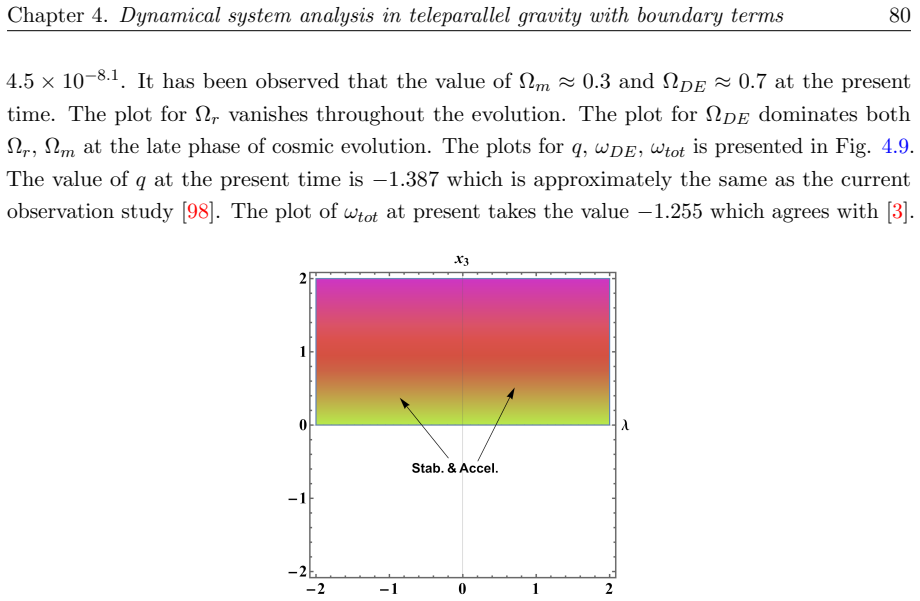
- [§4.3.1, point C4, and §4.3.2, point P4 (Tables 4.2, 4.6 and Figs. 4.3, 4.6)] The de Sitter critical points C4 and P4 have eigenvalues {0,0,0,-4}, so linear stability theory is inconclusive. The text states that the central-manifold condition is not satisfied and therefore the method is not applied, but then concludes from 2D phase portraits that the point is an attractor. A two-dimensional projection of a four-dimensional flow cannot establish asymptotic stability; at most it suggests attraction in the projected directions. Without a valid center-manifold reduction, a Lyapunov function, or a rigorous normally-hyperbolic argument, the late-time attractor status of these points is unproven, and this status is central to the claimed dark-energy epoch.
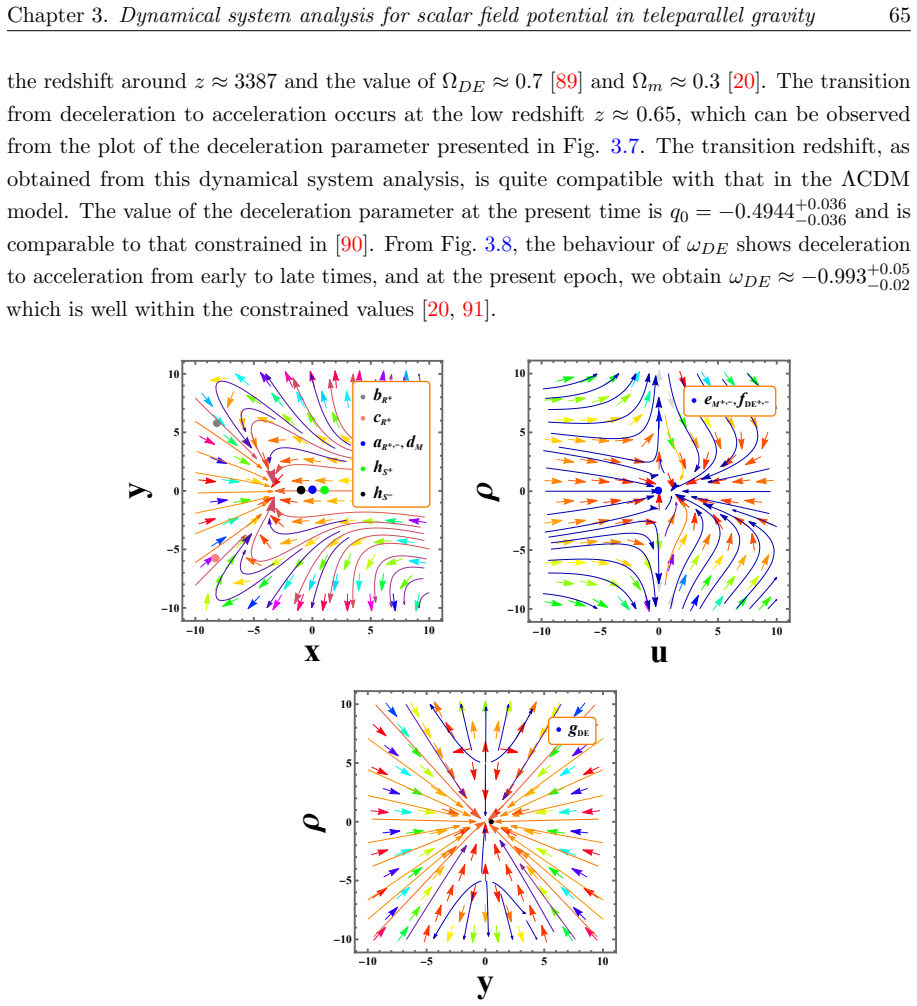
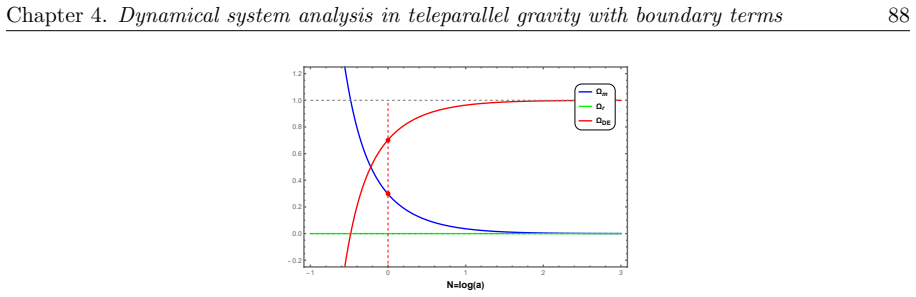
- [§3.3.1 and §3.3.2, Figs. 3.3-3.4 and 3.7-3.8] The presented present-day values Ω_m≈0.3, Ω_DE≈0.7, q0≈-0.61, and the transition redshifts are obtained by evolving the autonomous system from a specific hand-picked initial condition (e.g., x0=10^-8.89, y0=10^-2.89, u0=10^-5.96, ρ0=10^-0.9) with chosen parameters β=-0.2, σ=-0.30, λ=-0.2. No parameter estimation, likelihood, or goodness-of-fit is performed, so statements that these values 'agree with Planck' or are 'compatible with ΛCDM' are consistency checks rather than tests of the model. This does not invalidate the dynamical-system analysis, but it should be reframed in the abstract and conclusions as an illustrative compatibility exercise, not as evidence that the model is observationally preferred.
- [Chapters 2-5 (general method)] The thesis repeatedly infers a viable cosmic history from the coexistence of a stable dark-energy point and saddle radiation/matter points in the same parameter range. Strictly, one must also exhibit a trajectory (heteroclinic orbit or explicit numerical evolution) that connects the radiation saddle to the matter saddle and then to the dark-energy attractor. The 2D phase portraits and the single evolution plots from selected initial conditions do not establish this sequence for the full higher-dimensional systems. For the central claim of a single model describing radiation→matter→dark-energy in sequence, at least one representative heteroclinic chain or a full-dimension numerical trajectory with stated initial conditions is needed.
minor comments (6)
- [Abstract] The sentence 'Teleparallel gravity, is an alternative to General Relativity, explains gravitation through torsion' contains a misplaced comma; it should read 'Teleparallel gravity, an alternative to General Relativity, explains gravitation through torsion.'
- [Eq. (1.15)] The tetrad for flat FLRW spacetime is written as (1,a(t),a(t),a(t)), which is ambiguous; it should be written as the diagonal tetrad diag(1,a(t),a(t),a(t)) to avoid confusion with a four-vector.
- [§2.3.1 and §2.3.2] There are missing closing parentheses in references to 'action equation Eq. (2.11' and similar; please proofread the equation cross-references.
- [Throughout] The cosmological model name is written inconsistently as FLRW, FLRW, and 'FLR W'; one standard form should be used throughout.
- [§4.3.2 heading] The subsection heading 'Radiaiton-dominated Critical points' contains a typo: it should be 'Radiation-dominated Critical points.'
- [Figure captions, Chapter 2] Some phase-portrait captions list parameter values such as τ, ζ, δ without defining them in the caption or immediately preceding text; please clarify each symbol when it first appears in a figure.
Circularity Check
The claimed radiation/matter/de-Sitter epoch sequence is put in by hand through the constant-λ closure, and the quoted present-day density parameters are fixed by chosen initial conditions rather than predicted.
-
fitted input called prediction
[Chapter 4, §4.3, before Eq. (4.10); Tables 4.1–4.4 (f(T,B)) and Tables 4.5–4.8 (power-law model)]
"To express the autonomous dynamical system, we define the parameter λ = Ḧ/H^3 [39,93] and is treated as a constant throughout the analysis. To note the value of the parameter λ = 8, 9/2, connects with the radiation, matter dominated phase, respectively, whereas for DE, it depends on the dynamical variables X and Y."
For a power-law scale factor a(t) ∝ t^p one has λ = Ḧ/H^3 = 2/p^2. The values quoted are exactly the power-law epochs: radiation p = 1/2 gives λ = 8, matter p = 2/3 gives λ = 9/2, and de Sitter gives λ = 0. The critical points C1/P1, C2/P2 and C4/P4 are then required to exist precisely at λ = 8, λ = 9/2 and λ = 0, so the 'radiation-dominated', 'matter-dominated' and 'de Sitter' epochs are not derived from the field equations; they are inserted as the assumed constant value of λ. No evolution equation for λ is supplied, so the claimed sequence from radiation to matter to dark energy is a property of the closure assumption, not of the full f(T,B) dynamics. The same constant-λ construction is carried into the f(T,B,T_G,B_G) analysis of Chapter 5.
-
fitted input called prediction
[Chapter 3, §3.3.1 and §3.3.2, text around Figs. 3.3 and 3.7]
"From the evolution plots of standard density parameters, we observe that at present, Ωm ≈ 0.3, which agrees with the Planck observation results [20]. The dominant presence of DE at the present epoch is quite visible from the derived value of the DE density parameter ΩDE ≈ 0.7 [89]. ... for the initial conditions x0 = 10^-8.89, y0 = 10^-2.89, u0 = 10^-5.96, ρ0 = 10^-0.9 for model 3.3.1."
The autonomous system for (x,y,u,ρ) is deterministic: the entire trajectory, and hence the present-day values Ωm ≈ 0.3 and ΩDE ≈ 0.7, is fixed once the initial conditions are chosen. The thesis presents these values as a successful outcome ('derived value') but they are, on inspection, outputs of the stated initial condition vector, not predictions of the modified-gravity model. Matching ΛCDM/Planck values is therefore a tuning of initial data rather than an independent test. The same applies to the transition redshift values quoted from the same integrations.
full rationale
The thesis contains a large amount of standard dynamical-system work: deriving autonomous systems from the Friedmann and Klein-Gordon equations, computing critical points, and classifying stability by eigenvalues. That core analysis is self-contained and not circular. The circularity is concentrated in the interpretive layer. First, the f(T,B) analysis (Chapter 4) closes the system by declaring λ = Ḧ/H^3 constant, and then identifies radiation, matter and de Sitter critical points by imposing λ = 8, λ = 9/2 and λ = 0 respectively. Since these numbers are exactly the values of λ for the corresponding power-law solutions, the 'epochs' are equivalent to the input assumption rather than emergent from the dynamics. The f(T,T_G) mixed-power-law model partially improves on this by solving λ from the phase-space variables in Eq. (4.28), and the paper notes the singular k = 0,1 limits honestly, so the f(T,T_G) part is less exposed. Second, the present-day cosmological parameters quoted as successful outcomes are fixed by chosen initial conditions in the numerical integrations; no independent, parameter-free prediction of Ωm and ΩDE is demonstrated. The thesis also makes normal use of the author's own prior publications for the λ variable and for model forms; I do not treat that as load-bearing circularity beyond the constant-λ issue. The acknowledged non-hyperbolic stability gaps and the failed central-manifold conditions are limitations rather than circular steps. Overall, the central viability claim is partially circular: the epoch sequence is built into the constant-λ closure, and the quoted present-day agreement is fitted through initial conditions. A score of 6 reflects this partial reduction without claiming that every result in the thesis is definitionally true.
Assumptions & free parameters
free parameters (6)
- α (power-law index in kinetic couplings X^α T and X^α I2) =
general α, plus α=1,2 chosen by hand
- λ (potential slope in V=V0 e^{-κτφ}) =
chosen as λ=√(2/9) etc. in phase portraits
- σ (coupling slope in F=F0 e^{-ηκφ}) =
-0.30 in Chapter 3 plots
- β (power in G(T)=α(-T)^β) =
-0.2 or 1.1 in different models
- ξ, α, ζ, p, m, k (boundary-term and Gauss-Bonnet coupling constants) =
e.g., ξ=-2.4, ζ=1.0001, p=-1, k=0.029, m=0.5
- initial conditions for evolution plots =
e.g., x0=10^-8.89, y0=10^-2.89, u0=10^-5.96, ρ0=10^-0.9
assumptions (5)
- domain assumption FLRW metric and perfect-fluid energy-momentum tensor with matter EoS ω_m=0 and radiation EoS ω_r=1/3
- domain assumption Weitzenböck gauge with vanishing spin connection for the tetrad
- ad hoc to paper λ=Ḧ/H^3 is treated as a constant in the autonomous systems
- ad hoc to paper The chosen Lagrangian functions (logarithmic boundary term, power-law models, exponential/power-law potentials) are representative of the viable parameter space
- standard math The equivalence between f(R) and f(T,B) when f(T,B)=f(-T+B) is accepted
Cite this review
Pith. "Pith review of Dynamical and Cosmological Aspects of Teleparallel and Extended Teleparallel Gravity." pith.science (2026). https://pith.science/paper/UZMKAZEN
@misc{pith2026250111048,
  author       = {Pith},
  title        = {Pith review of: Dynamical and Cosmological Aspects of Teleparallel and Extended Teleparallel Gravity},
  year         = {2026},
  howpublished = {\url{https://pith.science/paper/UZMKAZEN}},
  note         = {Machine review of arXiv:2501.11048}
}
abstract
This thesis investigates modified teleparallel gravity models with a scalar field and teleparallel boundary terms, focusing on their cosmological implications for late-time cosmic acceleration. Teleparallel gravity, is an alternative to General Relativity, explains gravitation through torsion. The study presents the teleparallel analog of the Horndeski theory and its dynamical system approach, analyzing the newly developed $f(T,\phi)$ gravity model with two potential functions. It examines the phase space, conditions for different cosmological epochs, and the transition from early to late-time cosmic evolution. The inclusion of boundary terms, such as the teleparallel boundary term $B$ and the Gauss-Bonnet term $T_G$, enhances gravitational interactions. The modified teleparallel gravity models, such as $f(T, B)$, $f(T, T_G)$, and $f(T, B, T_G, B_G)$, are explored in terms of their stability and cosmological scenarios, successfully describing the accelerated expansion and late-time attractors. The thesis assesses the impact of a non-canonical scalar field coupled to the boundary term $B$ on the Universe's evolution, comparing findings from Hubble data and Supernovae Ia data. Overall, the analysis suggests that modified teleparallel gravity models effectively explain early to late-time cosmic acceleration, revealing the strong dynamical foundation and offering a versatile framework for addressing challenges in cosmic evolution.
Figures


Figures from the paper (48 more)








Reference graph
Works this paper leans on
-
[1]
A. G. Riess et al., Observational evidence from supernovae for an accelerating universe and a cosmological constant , Astron. J. 116 (1998) 1009
1998
-
[2]
Perlmutter et al., Measurements of Ω and Λ from 42 high redshift supernovae, Astrophys
S. Perlmutter et al., Measurements of Ω and Λ from 42 high redshift supernovae, Astrophys. J. 517 (1999) 565
1999
-
[3]
Hinshaw et al., Nine-year Wilkinson Microwave Anisotropy Probe (WMAP) observations: cosmological paramrter results, Astro
G. Hinshaw et al., Nine-year Wilkinson Microwave Anisotropy Probe (WMAP) observations: cosmological paramrter results, Astro. J. Supp. Ser. 208 (2013) 19
2013
-
[4]
Di Valentino, A
E. Di Valentino, A. Melchiorri and J. Silk, Reconciling Planck with the local value of H0 in extended parameter space, Phys. Lett. B 761 (2016) 242
2016
-
[5]
Misner, K
C. Misner, K. Thorne and J. Wheeler, Gravitation, W. H. Freeman, (1973)
1973
-
[6]
Capozziello and M
S. Capozziello and M. De Laurentis, Extended theories of gravity , Phys. Rep. 509 (2011) 167
2011
-
[7]
Faraoni, f(R) gravity: Successes and challenges , in 18th SIGRA V Conference, (2008)
V. Faraoni, f(R) gravity: Successes and challenges , in 18th SIGRA V Conference, (2008)
2008
-
[8]
Sahni and A
V. Sahni and A. Starobinsky, The case for a positive cosmological Λ-term, Int. J. Mod. Phys. D 9 (2000) 373
2000
Show all 154 references
-
[9]
Arbey and F
A. Arbey and F. Mahmoudi, Dark matter and the early Universe: A review , Prog. Part. Nucl. Phys. 119 (2021) 103865
2021
-
[10]
Weitzenb¨ oock,‘Invariantentheorie’, Noordhoff, Gronningen (1923)
R. Weitzenb¨ oock,‘Invariantentheorie’, Noordhoff, Gronningen (1923)
1923
-
[11]
Bahamonde et al., Teleparallel gravity: from theory to cosmology , Rep
S. Bahamonde et al., Teleparallel gravity: from theory to cosmology , Rep. Prog. Phys. 86 (2023) 207
2023
-
[12]
A. H. Guth, Inflationary universe: A possible solution to the horizon and flatness problems , Phys. Rev. D 23 (1981) 347
1981
-
[13]
J. D. Barrow and M. S. Turner, Inflation in the Universe , Nature 292 (1981) 35
1981
-
[14]
Linde, A new inflationary universe scenario: A possible solution of the horizon, flatness, homogeneity, isotropy and primordial monopole problems , Phys
A. Linde, A new inflationary universe scenario: A possible solution of the horizon, flatness, homogeneity, isotropy and primordial monopole problems , Phys. Lett. B 108 (1982) 389. 132 References 133
1982
-
[15]
D. W. Sciama, The impact of the cmb discovery on theoretical cosmology , in The Cosmic Microwave Background: 25 Years Later , N. Mandolesi and N. Vittorio, eds., Astrophysics and Space Science Library, (Dordrecht), Springer Netherlands 164 (1990) 1
1990
-
[16]
Bellini and L
M. Bellini and L. S. Ridao, Gravitational waves from the birth of the universe with extended general relativity, Phys. Lett. B 826 (2022) 136901
2022
-
[17]
Ryden, Introduction to Cosmology, Cambridge University press (2017)
B. Ryden, Introduction to Cosmology, Cambridge University press (2017)
2017
-
[18]
Silk, The big bang: The creation and evolution of the universe , Astronomy & Geophysics (1980)
J. Silk, The big bang: The creation and evolution of the universe , Astronomy & Geophysics (1980)
1980
-
[19]
P. J. E. Peebles, The large-scale structure of the universe , Princeton University Press (1980)
1980
-
[20]
Aghanim, et al., Planck 2018 results
N. Aghanim, et al., Planck 2018 results. VI. Cosmological parameters , Astron. Astrophys. 641 (2020) A6
2020
-
[21]
Colin et al., Evidence for anisotropy of cosmic acceleration , Astron
J. Colin et al., Evidence for anisotropy of cosmic acceleration , Astron. Astrophys. 631 (2019) L13
2019
-
[22]
C. M. Lin, K. W. Ng and K. Cheung, Chaotic inflation on the brane and the Swampland Criteria, Phys. Rev. D 100 (2019) 023545
2019
-
[23]
Y. F. Cai et al., f(T) teleparallel gravity and cosmology , Rep. Prog. Phys. 79 (2016) 106901
2016
-
[24]
Bamba et al., Dark energy cosmology: the equivalent description via different theoretical models and cosmography tests , Astrophys
K. Bamba et al., Dark energy cosmology: the equivalent description via different theoretical models and cosmography tests , Astrophys. Space Sci. 342 (2012) 155
2012
-
[25]
Clifton et al., Modified gravity and Cosmology , Phys
T. Clifton et al., Modified gravity and Cosmology , Phys. Rep. 513 (2012) 1
2012
-
[26]
R. C. Bernardo et al., Well-tempered teleparallel Horndeski cosmology: a teleparallel variation to the cosmological constant problem , J. Cosmol. Astropart. Phys. 10 (2021) 078
2021
-
[27]
Henneaux and C
M. Henneaux and C. Teitelboim, The Cosmological constant and general covariance , Phys. Lett. B 222 (1989) 195
1989
-
[28]
Lombriser, On the cosmological constant problem , Phys
L. Lombriser, On the cosmological constant problem , Phys. Lett. B 797 (2019) 134804
2019
-
[29]
Nojiri, S
S. Nojiri, S. D. Odintsov and V. K. Oikonomou, Modified gravity theories on a nutshell: inflation, bounce and late-time evolution , Phys. Rep. 692 (2017) 1
2017
-
[30]
A. Einstein, Riemann-geometrie mit aufrechterhaltung des begriffes des fernparallelismus , Albert Einstein: Akademie-Vortr¨ age: Sitzungsberichte der Preußischen Akademie der Wissenschaften 1914–1932 (2005) 316
2005
-
[31]
Aldrovandi and J
R. Aldrovandi and J. G. Pereira, Teleparallel gravity: an introduction , Springer (2013)
2013
-
[32]
Krˇ sˇ s´ ak and E
M. Krˇ sˇ s´ ak and E. N. Saridakis,The covariant formulation of f(T) gravity , Class. Quant. Grav. 33 (2016) 115009. References 134
2016
-
[33]
Carroll, Spacetime and Geometry: An Introduction to General Relativity , Cambridge University Press (2019)
S. Carroll, Spacetime and Geometry: An Introduction to General Relativity , Cambridge University Press (2019)
2019
-
[34]
Hilbert, Die Grundlagen der Physik
D. Hilbert, Die Grundlagen der Physik. 1. , Gott. Nachr. 27 (1915) 395
1915
-
[35]
Ferraro and F
R. Ferraro and F. Fiorini, Modified teleparallel gravity: inflation without inflaton , Phys. Rev. D 75 (2007) 084031
2007
-
[36]
B. Li, T. P. Sotiriou and J. D. Barrow, f (T ) gravity and local Lorentz invariance, Phys. Rev. D 83 (2011) 064035
2011
-
[37]
Bahamonde, C
S. Bahamonde, C. G. B¨ ohmer and M. Wright, Modified teleparallel theories of gravity , Phys. Rev. D 92 (2015) 104042
2015
-
[38]
G. A. Rave-Franco, C. Escamilla-Rivera and J. L. Said, Dynamical complexity of the teleparallel gravity cosmology, Phys. Rev. D 103 (2021) 084017
2021
-
[39]
G. A. R. Franco, C. Escamilla-Rivera and J. L. Said, Stability analysis for cosmological models in f (T, B) gravity, Eur. Phys. J. C 80 (2020) 677
2020
-
[40]
De Felice and S
A. De Felice and S. Tsujikawa, f(R) theories, Living Rev. Relativity 13 (2010) 3
2010
-
[41]
Lovelock, The Einstein tensor and its generalizations , J
D. Lovelock, The Einstein tensor and its generalizations , J. Math. Phys. 12 (1971) 498
1971
-
[42]
De Felice and S
A. De Felice and S. Tsujikawa, Construction of cosmologically viable f (G) gravity models, Phys. Lett. B 675 (2009) 1
2009
-
[43]
Cognola et al., Dark energy in modified gauss-bonnet gravity: late-time acceleration and the hierarchy problem, Phys
G. Cognola et al., Dark energy in modified gauss-bonnet gravity: late-time acceleration and the hierarchy problem, Phys. Rev. D 73 (2006) 084007
2006
-
[44]
Kofinas and E
G. Kofinas and E. N. Saridakis, Teleparallel equivalent of Gauss-Bonnet gravity and its modifications, Phys. Rev. D 90 (2014) 084044
2014
-
[45]
Bahamonde and C
S. Bahamonde and C. G. B¨ ohmer,Modified teleparallel theories of gravity: Gauss–Bonnet and trace extensions , Eur. Phys. J. C 76 (2016) 578
2016
-
[46]
Kofinas and E
G. Kofinas and E. N. Saridakis, Cosmological applications of f (T, TG) gravity, Phys. Rev. D 90 (2014) 084045
2014
-
[47]
S. A. Kadam, B. Mishra and J. L. Said, Noether symmetries in f (T, TG) cosmology, Phys. Scr. 98 (2023) 045017
2023
-
[48]
Kofinas, G
G. Kofinas, G. Leon and E. N. Saridakis, Dynamical behavior in f (T, TG) cosmology, Class. Quant. Grav. 31 (2014) 175011
2014
-
[49]
Bogdanos et al., Massive, massless and ghost modes of gravitational waves from higher- order gravity, Astropart
C. Bogdanos et al., Massive, massless and ghost modes of gravitational waves from higher- order gravity, Astropart. Phys. 34 (2010) 236
2010
-
[50]
Bahamonde, U
S. Bahamonde, U. Camci and S. Capozziello, Noether symmetries and boundary terms in extended teleparallel gravity cosmology, Class. Quant. Grav. 36 (2019) 065013. References 135
2019
-
[51]
Bahamonde et al., Dynamical systems applied to cosmology: dark energy and modified gravity, Phys
S. Bahamonde et al., Dynamical systems applied to cosmology: dark energy and modified gravity, Phys. Rep. 775-777 (2018) 1
2018
-
[53]
C. Q. Geng, C. C. Lee and E. N. Saridakis, Observational constraints on teleparallel dark energy, J. Cosmol. Astropart. Phys. 2012 (2012) 002
2012
-
[54]
Ferraro and F
R. Ferraro and F. Fiorini, On Born-infeld gravity in Weitzenbock spacetime , Phys. Rev. D 78 (2008) 124019
2008
-
[55]
E. V. Linder, Einstein ’s Other gravity and the acceleration of the Universe , Phys. Rev. D 81 (2010) 127301
2010
-
[56]
J. P. Uzan, Cosmological scaling solutions of nonminimally coupled scalar fields , Phys. Rev. D 59 (1999) 123510
1999
-
[57]
Amendola, Scaling solutions in general nonminimal coupling theories , Phys
L. Amendola, Scaling solutions in general nonminimal coupling theories , Phys. Rev. D 60 (1999) 043501
1999
-
[58]
Gonzalez-Espinoza, G
M. Gonzalez-Espinoza, G. Otalora and J. Saavedra, Stability of scalar perturbations in scalar-torsion f (T, ϕ) gravity theories in the presence of a matter fluid, J. Cosmol. Astropart. Phys. 10 (2021) 007
2021
-
[59]
Gonzalez-Espinoza et al., Reconstructing inflation in scalar-torsion f (T, ϕ) gravity, Eur
M. Gonzalez-Espinoza et al., Reconstructing inflation in scalar-torsion f (T, ϕ) gravity, Eur. Phys. J. C 81 (2021) 731
2021
-
[60]
Gonzalez-Espinoza and G
M. Gonzalez-Espinoza and G. Otalora, Cosmological dynamics of dark energy in scalar- torsion f (T, ϕ) gravity, Eur. Phys. J. C 81 (2021) 480
2021
-
[61]
Hayashi and T
K. Hayashi and T. Shirafuji, New General Relativity , Phys. Rev. D 19 (1979) 3524
1979
-
[62]
Bahamonde, C
S. Bahamonde, C. G. B¨ ohmer and M. Krˇ sˇ s´ ak,New classes of modified teleparallel gravity models, Phys. Lett. B 775 (2017) 37
2017
-
[63]
Bahamonde, K
S. Bahamonde, K. F. Dialektopoulos and J. L. Said, Can Horndeski theory be recast using teleparallel gravity?, Phys. Rev. D 100 (2019) 064018
2019
-
[64]
Bahamonde et al., Reviving Horndeski theory using teleparallel gravity after GW170817 , Phys
S. Bahamonde et al., Reviving Horndeski theory using teleparallel gravity after GW170817 , Phys. Rev. D 101 (2020) 084060
2020
-
[65]
Bahamonde et al., Post-Newtonian limit of teleparallel Horndeski gravity , Class
S. Bahamonde et al., Post-Newtonian limit of teleparallel Horndeski gravity , Class. Quant. Grav. 38 (2020) 025006
2020
-
[66]
K. F. Dialektopoulos, J. L. Said and Z. Oikonomopoulou, Classification of teleparallel Horndeski cosmology via Noether symmetries , Eur. Phys. J. C 82 (2022) 259
2022
-
[67]
Bahamonde et al., Gravitational-wave propagation and polarizations in the teleparallel analog of Horndeski gravity , Phys
S. Bahamonde et al., Gravitational-wave propagation and polarizations in the teleparallel analog of Horndeski gravity , Phys. Rev. D 104 (2021) 084082. References 136
2021
-
[68]
R. C. Bernardo et al., Well-tempered Minkowski solutions in teleparallel Horndeski theory , Class. Quant. Grav. 39 (2022) 015013
2022
-
[69]
P. A. Gonzalez and Y. Vasquez, Teleparallel equivalent of Lovelock gravity, Phys. Rev. D 92 (2015) 124023
2015
-
[70]
P. A. Gonz´ alez, S. Reyes and Y. V´ asquez,Teleparallel equivalent of Lovelock gravity, generalizations and cosmological applications, J. Cosmol. Astropart. Phys. 07 (2019) 040
2019
-
[71]
G. W. Horndeski, Second-order scalar-tensor field equations in a four-dimensional space , Int. J. Theor. Phys. 10 (1974) 363
1974
-
[72]
C. G. B¨ ohmer and N. Chan,Dynamical systems in cosmology , in Dynamical and Complex Systems, World Scientific (Europe) (2016) 121
2016
-
[73]
Wiggins, Introduction to applied nonlinear dynamical systems and chaos , Texts in Applied Mathematics, Springer New York (2003)
S. Wiggins, Introduction to applied nonlinear dynamical systems and chaos , Texts in Applied Mathematics, Springer New York (2003)
2003
-
[74]
Carr, Applications of centre manifold theory , Applied mathematical sciences, Springer New York (2012)
J. Carr, Applications of centre manifold theory , Applied mathematical sciences, Springer New York (2012)
2012
-
[75]
A. A. Coley, Dynamical systems and cosmology , 291, Springer Science & Business Media (2003)
2003
-
[76]
Paliathanasis, Dynamics in interacting scalar-torsion Cosmology , Universe 7 (2021) 244
A. Paliathanasis, Dynamics in interacting scalar-torsion Cosmology , Universe 7 (2021) 244
2021
-
[77]
Leon et al., Unified dark sectors in scalar-torsion theories of gravity , Phys
G. Leon et al., Unified dark sectors in scalar-torsion theories of gravity , Phys. Rev. D 106 (2022) 024055
2022
-
[78]
E. J. Copeland, A. R. Liddle and D. Wands, Exponential potentials and cosmological scaling solutions, Phys. Rev. D 57 (1998) 4686
1998
-
[79]
Hohmann, L
M. Hohmann, L. J¨ arv and U. Ualikhanova,Covariant formulation of scalar-torsion gravity , Phys. Rev. D 97 (2018) 104011
2018
-
[80]
Wu and H
P. Wu and H. W. Yu, The dynamical behavior of f (T ) theory, Phys. Lett. B 692 (2010) 176
2010
-
[81]
Mirza and F
B. Mirza and F. Oboudiat, Constraining f (T ) gravity by dynamical system analysis , J. Cosmol. Astropart. Phys. 2017 (2017) 011
2017
-
[82]
Briffa et al., Constraints on f (T ) cosmology with Pantheon+, Mon
R. Briffa et al., Constraints on f (T ) cosmology with Pantheon+, Mon. Not. R. Astron. Soc. 522 (2023) 6024
2023
-
[83]
G. R. Bengochea and R. Ferraro, Dark torsion as the cosmic speed-up , Phys. Rev. D 79 (2009) 124019
2009
-
[84]
Otalora, Cosmological dynamics of tachyonic teleparallel dark energy , Phys
G. Otalora, Cosmological dynamics of tachyonic teleparallel dark energy , Phys. Rev. D 88 (2013) 063505. References 137
2013
-
[85]
Otalora, Scaling attractors in interacting teleparallel dark energy , J
G. Otalora, Scaling attractors in interacting teleparallel dark energy , J. Cosmol. Astropart. Phys. 07 (2013) 044
2013
-
[86]
Samaddar and S
A. Samaddar and S. S. Singh, Qualitative stability analysis of cosmological models in f (T, ϕ) gravity, Gen. Relat. Grav. 55 (2023) 111
2023
-
[87]
L. K. Duchaniya et al., Dynamical systems analysis in f (T, ϕ) gravity, Eur. Phys. J. C 83 (2023) 27
2023
-
[89]
Kowalski et al., Improved Cosmological constraints from new, old, and combined supernova data sets , The Astrophys
M. Kowalski et al., Improved Cosmological constraints from new, old, and combined supernova data sets , The Astrophys. J. 686 (2008) 749
2008
-
[90]
Capozziello, R
S. Capozziello, R. D’Agostino and O. Luongo,High-redshift cosmography: auxiliary variables versus Pad´ e polynomials, Mon. Not. R. Astron. Soc. 494 (2020) 2576
2020
-
[91]
P. A. R. Ade, et al., Planck 2015 results. XIV. Dark energy and modified gravity , Astron. Astrophys. 594 (2016) A14
2016
-
[92]
C. G. B¨ ohmer and N. Chan,Dynamical systems in cosmology , in Dynamical and Complex Systems, World Scientific (2017), 121
2017
-
[93]
S. D. Odintsov and V. K. Oikonomou, Dynamical systems perspective of cosmological finite-time singularities in f (R) gravity and interacting multifluid cosmology , Phys. Rev. D 98 (2018) 024013
2018
-
[94]
Escamilla-Rivera and J
C. Escamilla-Rivera and J. L. Said, Cosmological viable models in f (T, B) theory as solutions to the H0 tension, Class. Quant. Grav. 37 (2020) 165002
2020
-
[95]
Bamba et al., Equation of state for dark energy in f (T ) gravity, J
K. Bamba et al., Equation of state for dark energy in f (T ) gravity, J. Cosmol. Astropart. Phys. 2011 (2011) 021
2011
-
[96]
Capozziello, M
S. Capozziello, M. De Laurentis and K. F. Dialektopoulos, Noether symmetries in Gauss–Bonnet-teleparallel cosmology, Eur. Phys. J. C 76 (2016) 629
2016
-
[97]
Paliathanasis and G
A. Paliathanasis and G. Leon, Cosmological evolution in f (T, B) gravity, Eur. Phys. J. Plus 136 (2021) 1
2021
-
[98]
S. M. Feeney, D. J. Mortlock and N. Dalmasso, Clarifying the Hubble constant tension with a Bayesian hierarchical model of the local distance ladder , Mon. Not. R. Astron. Soc. 476 (2018) 3861
2018
-
[99]
Briffa et al., f (T, B) Gravity in the late Universe in the context of local measurements , Phys
R. Briffa et al., f (T, B) Gravity in the late Universe in the context of local measurements , Phys. Dark Uni. 39 (2023) 101153
2023
-
[100]
Gruber and O
C. Gruber and O. Luongo, Cosmographic analysis of the equation of state of the universe through pad´ e approximations, Phys. Rev. D 89 (2014) 103506. References 138
2014
-
[101]
Odintsov and V
S. Odintsov and V. Oikonomou, Autonomous dynamical system approach for f (R) gravity, Phys. Rev. D 96 (2017) 104049
2017
-
[102]
Bahamonde and S
S. Bahamonde and S. Capozziello, Noether Symmetry Approach in f (T, B) teleparallel cosmology, Eur. Phys. J. C 77 (2017) 107
2017
-
[103]
S. A. Kadam, S. V. Lohakare and B. Mishra, Dynamical complexity in teleparallel gauss–bonnet gravity, Ann. Phys. 460 (2024) 169563
2024
-
[104]
Wetterich, Cosmology and the fate of dilatation symmetry , Nuclear Phys
C. Wetterich, Cosmology and the fate of dilatation symmetry , Nuclear Phys. B 302 (1988) 668
1988
-
[105]
Ratra and P
B. Ratra and P. Peebles, Cosmological consequences of a rolling homogeneous scalar field , Phys. Rev. D 37 (1988) 3406
1988
-
[106]
E. J. Copeland, M. Sami and S. Tsujikawa, Dynamics of dark energy , Int. J. Mod. Phys. D 15 (2006) 1753
2006
-
[107]
Wei, Dynamics of teleparallel dark energy , Phys
H. Wei, Dynamics of teleparallel dark energy , Phys. Lett. B 712 (2012) 430
2012
-
[108]
C. Q. Geng et al., Teleparallel dark energy, Phys. Lett. B 704 (2011) 384
2011
-
[109]
Bahamonde and M
S. Bahamonde and M. Wright, Teleparallel quintessence with a nonminimal coupling to a boundary term, Phys. Rev. D 92 (2015) 084034
2015
-
[110]
Zubair, S
M. Zubair, S. Bahamonde and M. Jamil, Generalized second law of thermodynamic in modified teleparallel theory, Eur. Phys. J. C 77 (2017) 472
2017
-
[111]
Gecim and Y
G. Gecim and Y. Kucukakca, Scalar–tensor teleparallel gravity with boundary term by noether symmetries, Int. J. Geom. Meth. Mod. Phys. 15 (2018) 1850151
2018
-
[112]
Bahamonde, M
S. Bahamonde, M. Marciu and J. L. Said, Generalized tachyonic teleparallel cosmology, Eur. Phys. J. C 79 (2019) 324
2019
-
[113]
Bahamonde et al., Scalar-tensor teleparallel wormholes by noether symmetries , Phys
S. Bahamonde et al., Scalar-tensor teleparallel wormholes by noether symmetries , Phys. Rev. D 94 (2016) 084042
2016
-
[114]
Gonzalez-Espinoza and G
M. Gonzalez-Espinoza and G. Otalora, Generating primordial fluctuations from modified teleparallel gravity with local lorentz-symmetry breaking , Phys. Lett. B 809 (2020) 135696
2020
-
[115]
Zlatev, L
I. Zlatev, L. Wang and P. J. Steinhardt, Quintessence, cosmic coincidence, and the cosmological constant, Phys. Rev. Lett. 82 (1999) 896
1999
-
[116]
Roy and N
N. Roy and N. Bhadra, Dynamical systems analysis of phantom dark energy models , J. Cosmol. Astropart. Phys. 2018 (2018) 002
2018
-
[117]
Sahni and L
V. Sahni and L. Wang, New cosmological model of quintessence and dark matter , Phys. Rev. D 62 (2000) 103517. References 139
2000
-
[118]
Sahani and A
V. Sahani and A. Starobinsky, The case for a positive Cosmological Λ-term, Int. J. Mod. Phys. D 09 (2000) 373
2000
-
[119]
C. Xu, E. N. Saridakis and G. Leon, Phase-space analysis of teleparallel dark energy , J. Cosmol. Astropart. Phys. 2012 (2012) 002
2012
-
[120]
P. H. Chavanis, Cosmology with a stiff matter era , Phys. Rev. D 92 (2015) 103004
2015
-
[121]
Moresco, et al., Unveiling the universe with emerging cosmological probes , Living Rev
M. Moresco, et al., Unveiling the universe with emerging cosmological probes , Living Rev. Relativity 25 (2022) 6
2022
-
[122]
Capozziello et al., Cosmographic bounds on the cosmological deceleration-acceleration transition redshift in f (R) gravity, Phys
S. Capozziello et al., Cosmographic bounds on the cosmological deceleration-acceleration transition redshift in f (R) gravity, Phys. Rev. D 90 (2014) 044016
2014
-
[123]
Camarena and V
D. Camarena and V. Marra, Local determination of the hubble constant and the deceleration parameter, Phys. Rev. Res. 2 (2020) 013028
2020
-
[124]
D. M. Scolnic et al., The complete light-curve sample of spectroscopically confirmed SNe Ia from Pan-STARRS1 and Cosmological constraints from the combined Pantheon sample , Astrophys. J. 859 (2018) 101
2018
-
[125]
3 q 3 2 αξ , 3(2α−ξ) 2αξ , 1, 0, 0 #T , [0, 0, 0, 1, 0]T ,
A. de la Cruz-Dombriz et al., Cosmological reconstructed solutions in extended teleparallel gravity theories with a teleparallel Gauss–Bonnet term , Class. Quant. Grav. 34 (2017) 235011. Appendices Datasets Hubble data H(z) In this work, we have taken 31 data points [ 121] to ...
2017
-
[126]
Teleparallel Scalar-Tensor Gravity Through Cosmological Dynamical Systems
S. A. Kadam , B. Mishra, and J. L. Said, “Teleparallel Scalar-Tensor Gravity Through Cosmological Dynamical Systems”, European Physical Journal C , 82, 680 (2022)
2022
-
[127]
Dynamical system analysis for scalar field potential in teleparallel gravity
S. A. Kadam , Ananya Sahu, S. K. Tripathy, B. Mishra, “Dynamical system analysis for scalar field potential in teleparallel gravity”, European Physical Journal C, 84, 1088 (2024)
2024
-
[128]
Dynamical System Analysis in Teleparallel Gravity with Boundary Term
S. A. Kadam , Ninaad P. Thakkar and B. Mishra, “Dynamical System Analysis in Teleparallel Gravity with Boundary Term”, European Physical Journal C , 83, 809 (2023)
2023
-
[129]
Dynamical Complexity in Teleparallel Gauss-Bonnet Gravity
S. A. Kadam, Santosh V. Lohakare and B. Mishra, “Dynamical Complexity in Teleparallel Gauss-Bonnet Gravity”, Annals of Physics , 460, 169563 (2024)
2024
-
[130]
Constraining f (T, B, TG, BG) gravity by dynamical system analysis
S. A. Kadam and B. Mishra, “Constraining f (T, B, TG, BG) gravity by dynamical system analysis”, Physics of the Dark Universe , 46, 101693 (2024)
2024
-
[131]
Teleparallel Gravity and Quintessence: The Role of Nonminimal Boundary Couplings
S. A. Kadam , L. K. Duchaniya, B. Mishra, “Teleparallel Gravity and Quintessence: The Role of Nonminimal Boundary Couplings”, Annals of Physics , 470, 169808 (2024). Other Publications
2024
-
[132]
Dynamical Features of f (T, B) Gravity
S. A. Kadam , B. Mishra, and S. K. Tripathy, “Dynamical Features of f (T, B) Gravity”, Modern Physical Letter A , 32, 2250104 (2022)
2022
-
[133]
Rip Cosmological Models in Extended Symmetric Teleparallel Gravity
Laxmipriya Pati, S.A. Kadam, S. K. Tripathy and B. Mishra, “Rip Cosmological Models in Extended Symmetric Teleparallel Gravity”, Physics of the Dark Universe , 35, 100925 (2022)
2022
-
[134]
Accelerating Cosmological Models in f (T, B) Gravitational Theory
S. A. Kadam , J. L. Said, and B. Mishra, “Accelerating Cosmological Models in f (T, B) Gravitational Theory”, International Journal of Geometric Methods in Modern Physics , 20, 2350083 (2023)
2023
-
[135]
Dynamical Systems Analysis in f (T, ϕ) Gravity
L. K. Duchaniya, S. A. Kadam , J. L. Said, and B. Mishra, “Dynamical Systems Analysis in f (T, ϕ) Gravity”, European Physical Journal C , 83, 27 (2023). 147 List of publications and presentations 148
2023
-
[136]
Noether Symmetries in f (T, TG) Cosmology
S. A. Kadam , B. Mishra and J. L. Said, “Noether Symmetries in f (T, TG) Cosmology”, Physica Scripta, 98, 045017 (2023)
2023
-
[137]
Scalar Field Induced Evolution in Teleparallel Gravity
B. Mishra, S. A. Kadam , and S. K. Tripathy, “Scalar Field Induced Evolution in Teleparallel Gravity”, Physics Letter B , 857, 138968 (2024). Conferences and talks
2024
-
[138]
Late-time Cosmic Acceleration Model In f (T, B) Gravity
Attend Cosmology from Home 2021, held from July 5 –16, 2021, and present a talk entitled “Late-time Cosmic Acceleration Model In f (T, B) Gravity.”
2021
-
[139]
Advances in Relativity and Cosmology (PARC-2021)
Attend the conference “Advances in Relativity and Cosmology (PARC-2021)” (October 26-28, 2021) Organized by the Department of Mathematics, BITS-Pilani, Hyderabad Campus, and present a talk entitled “Late-time cosmic acceleration model in extended theory of gravity.”
2021
-
[140]
Late-time Cosmic Acceleration Model In f (T, B) Gravity
Participated in Physical Interpretations of Relativity Theory (PIRT) – 2021 conference, organized by Bauman Moscow State Technical University during the period Monday 5 July – Friday 9 July 2021, and presented a talk entitled “Late-time Cosmic Acceleration Model In f (T, B) Gravity”
2021
-
[141]
Delivered an invited talk in the International Webinar on Recent Advances in Science and Technology (RAST-2021) held at Indira Gandhi Institute of Technology, Sarang, Odisha, INDIA on the topic
2021
-
[142]
Participated in Recent Developments in Modified Gravity and Cosmology organized by the Department of Mathematics, Birla Institute of Technology and Science – Pilani, Hyderabad Campus, Hyderabad, India, from March 09-11, 2021
2021
-
[143]
Organized by the University of KwaZulu Natal, Durban, Republic of South Africa
Attended the GRA VITEX international conference on Gravity: Theory and Experiment on 9-12 August 2021 and delivered a talk. Organized by the University of KwaZulu Natal, Durban, Republic of South Africa
2021
-
[144]
Workshop on Tensions in Cosmology
Attended the “Workshop on Tensions in Cosmology”, held in Corfu, Greece, from the 7th to the 12th of September 2022
2022
-
[145]
Attended the Cosmology from Home 2022 conference, held from July 4-15, 2022, and contributed a talk on Dynamical features of f (T, B) Cosmology
2022
-
[146]
Dynamical behavior of f (T, B) Cosmology
Attended the 23rd International Conference on General Relativity and Gravitation 2022 annual meeting of the Division of Gravitation and Relativistic Astrophysics and gave a talk entitled “Dynamical behavior of f (T, B) Cosmology.”
2022
-
[147]
Teleparallel Scalar-tensor gravity through cosmological dynamical systems
Participated in the 32nd meeting of the Indian Association for General Relativity and Gravitation (IAGRG32) from 19-21 December 2022 at ISSER Kolkata and presented a poster entitled “Teleparallel Scalar-tensor gravity through cosmological dynamical systems.” List of publicatio...
2022
-
[148]
International Conference on Mathematical Sciences & its Applications (ICMSA - 2022)
Participated in “International Conference on Mathematical Sciences & its Applications (ICMSA - 2022)” organized by the School of Mathematical Sciences, Swami Ramanand Teerth Marathwada University, Nanded, Maharashtra, India, and has presented a paper entitled “ Energy Conditio...
2022
-
[149]
Rip Cosmological Models in Extended Symmetric Teleparallel Gravity
Participated in Prof. P. C. Vaidya’s National Conference on Mathematical Sciences held from 14-15 March 2022 and presented a paper entitled “Rip Cosmological Models in Extended Symmetric Teleparallel Gravity”. Organized by the Department of Mathematics, Sardar Patel University...
2022
-
[150]
XXIII International Scientific Conference “Physical Interpretations of Relativity Theory PIRT – 2023
Participated in “XXIII International Scientific Conference “Physical Interpretations of Relativity Theory PIRT – 2023”, organized by Bauman Moscow State Technical University during the period Monday 3 July – Thursday 6 July 2023. Delivered the talk on “Teleparallel scalar-tens...
2023
-
[151]
Dynamical features of f (T, B) Cosmology
Participated in Metric Affine Framework for Gravity 2022 and presented a paper entitled “Dynamical features of f (T, B) Cosmology.” Organized by the Institute of Physics, University of Tartu, Estonia, from 27 June to 1 July 2022
2022
-
[152]
Noether Symmetries in Extended Teleparallel Gauss-Bonnet Cosmology
Attend Cosmology from Home 2023, held from July 3 –14, 2023, and present a talk entitled “Noether Symmetries in Extended Teleparallel Gauss-Bonnet Cosmology.”
2023
-
[153]
Teacher’s Enrichment Workshop
Participated in “Teacher’s Enrichment Workshop” at BITS-Pilani Hyderabad Campus” (From 09.01.2023 to 14.01.2023)
2023
-
[154]
Dynamical System Analysis in Teleparallel Gravity with Boundary Term
Participated in 89th Annual Conference of Indian Mathematical Society An International Meet BITS Pilani - Hyderabad Campus, Hyderabad, December 22 – 25, 2023, and presented a talk entitled “Dynamical System Analysis in Teleparallel Gravity with Boundary Term.” Research visit/ ...
2023
-
[155]
A research visit to the Inter-University Centre for Astronomy and Astrophysics (IUCAA) Pune from June 16 – 23, 2024
2024
-
[156]
Dynamical system analysis in teleparallel scalar-tensor gravity
Attended the International Conference on Beyond Standard Model: From Theory to Experiment BSM-2023 Conference in Hurghada, Egypt, and presented a talk entitled “Dynamical system analysis in teleparallel scalar-tensor gravity.” This visit is funded by the Science and Engineerin...
2023
Reviewed August 10, 2026 · model on record in the stance chip above.
Discussion (0). Continue with ORCID to comment.