REVIEW 3 major objections 5 minor 44 references
Data-driven analysis of the $\gamma\gamma^*\rightarrow\pi^0$ system using mathematical models and the role of feedback-loop dynamics
T0 review · 3 major / 5 minor · reviewed 2026-08-11 · deepseek-v4-flash
Pith's one-line read The paper claims that a two-parameter curve's half-saturation point fixes the pion-photon transition form factor's asymptotic QCD value, improving Belle-data fits.
desk verdict A correct but nearly tautological note whose only practical claim—an improved fit—is supported by handpicked parameters and no fit statistic. read the letter →
The pith
A machine-rendered reading of the paper's core claim, the machinery that carries it, and where it could break.
The reading
What carries the argument
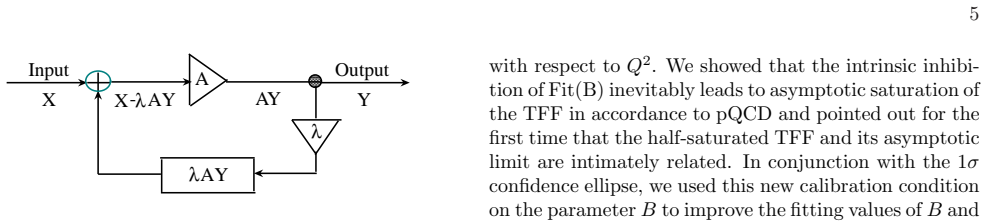
The central machine is the two-parameter rational function $F(Q^2)=BQ^2/(C+Q^2)$, a Michaelis-Menten-like growth curve whose parameter $C$ is the momentum at which the TFF reaches half its maximum $B$. At that point the slope is maximal and the exact identity $F(Q^2=C)=B/2$ holds; this is the calibration pivot of the whole analysis. The second piece is the one-$\sigma$ $(B,C)$ confidence ellipse of a previous fit, used to locate improved parameters. The third is the feedback-loop reading of the same formula: the curve is written as a mapping operator $Q^2/(1+Q^2/C)$ acting on $B/C$, so that it behaves like a negative-feedback control system that damps growth and drives the TFF to the constant $B$ asymptotically.
What would settle it
Measure the pion TFF at $Q^2$ near the fitted $C^*=1.3$ GeV$^2$ with high precision: the paper's half-saturation relation predicts $Q^2F(Q^2) = B^*/2 = 0.096$ GeV there, and the curve should show its maximum slope at that point. A value significantly different from $B^*/2$, or a slope that is not maximal, would falsify the Fit(B) ansatz; likewise, if high-$Q^2$ data above $10$ GeV$^2$ continue to rise instead of saturating toward $0.187$ GeV, the inhibition premise collapses.
Extended reading notes
Core claim
The central claim is that the half-saturated value of the transition form factor is exactly half the asymptotic value, $F(Q^2=C)=B/2$, a relation called novel and fundamental. For the Belle-fitted curve this anchors $B$ to a finite momentum point via the maximum slope, so that $B$ no longer needs to be estimated at $Q^2\to\infty$. Combined with the one-$\sigma$ confidence ellipse from an earlier fit, this selects improved parameters $B^*=0.192$ GeV and $C^*=1.3$ GeV$^2$, and the resulting curve moves closer to low-energy CELLO and BESIII measurements below Belle's kinematic coverage. The author further claims that this inhibited behavior is analogous to a feedback-loop controlled mechanical system: a mapping operator keeps the curve returning to a stable saturated state, and without such inhibition the TFF would not reach the pQCD asymptotic limit.
Load-bearing premise
The load-bearing premise is that the hand-chosen curve $F(Q^2)=BQ^2/(C+Q^2)$ genuinely describes the transition form factor over the full momentum range, so that the half-saturation point $Q^2=C$ really encodes the physics; otherwise the relation $F(Q^2=C)=B/2$ is pure algebra, and the improved fit rests on an unproven functional shape plus assumed compatibility of below-range third-party data.
Editorial extensions
If this is right
- If $F(Q^2=C)=B/2$ holds, the asymptotic parameter $B$ can be calibrated from measurements at the finite point $Q^2=C$, removing the need to fit the $Q^2\to\infty$ value directly.
- The refined parameters $B^*=0.192$ GeV and $C^*=1.3$ GeV$^2$, chosen inside the one-sigma ellipse, put the half-saturation point at $0.096$ GeV, close to CELLO and BESIII data below Belle's coverage, improving the low-$Q^2$ compatibility of the Belle-based fit.
- The conformity protocol gives a checklist of QCD-based criteria—calibration crossing, inhibition, saturation, pQCD limit, slope behavior, feedback loop—against which future TFF data or model fits can be judged uniformly.
- An uninhibited power-law fit, Fit(A), cannot reach the pQCD asymptotic limit because its slope never turns over; this distinguishes BaBar-like rising data from Belle-like saturation behavior.
- The feedback-loop interpretation predicts that the TFF curve should be self-stabilizing: perturbations from measurements pull the curve back to the fitted saturated state.
Reading between the lines
- Because relation (7) is exact for any curve of the form (4), the relation itself cannot be falsified; what can be tested is whether the chosen curve is the right representation of the TFF, so future work should treat the functional ansatz as the real hypothesis.
- The improved fit is asserted without a reported quantitative goodness-of-fit comparison; a re-analysis that combines Belle with CELLO and BESIII points and reports chi-squared would settle whether the new parameters are actually better.
- The feedback-loop language opens a modeling direction: one could require TFF parametrizations to satisfy a control-theoretic stability condition, such as boundedness and return to steady state under perturbations, rather than picking a saturating function ad hoc.
Editorial analysis
A structured set of objections, weighed in public.
Referee Report
Summary. The manuscript proposes a data-driven description of the pion-photon transition form factor using the two-parameter function Fit(B) = B Q^2/(C+Q^2). It notes that this function saturates to B at large Q^2, identifies Q^2=C as the half-saturation point, and promotes the identity F(C)=B/2 as a 'novel fundamental relation.' Using this relation together with the 1σ confidence ellipse from Ref. [11], the author selects B* = 0.192 GeV and C* = 1.3 GeV^2 and claims an improved fit to Belle data that accounts for third-party data below Belle's kinematic coverage. The paper also rewrites Fit(B) as a feedback-loop system and proposes a conformity protocol for comparing TFF fit models to QCD-based criteria.
Significance. If Eq. (7) were a genuine constraint, the paper would offer a simple way to anchor the asymptotic normalization of the TFF to low-Q^2 data. The author is explicit about the analytic properties of the Michaelis-Menten form and correctly notes that its saturation value can be compared with the pQCD asymptotic limit. However, the central relation is an algebraic identity, and the claimed improved fit is not quantified by any goodness-of-fit measure. As a research contribution, the paper currently provides a reparametrization and an analogy rather than a new quantitative result or a falsifiable prediction.
major comments (3)
- [Halfway-saturated TFF, Eq. (7)] The claimed 'novel fundamental relation' F_{1/2}(Q^2=C)=B/2 is not novel and does not constrain Fit(B): substituting Q^2=C into Eq. (4) gives F(C)=B C/(C+C)=B/2 for any values of B and C. It simply restates the defining property of C as the half-saturation scale of the chosen functional form. Since Eq. (4) is selected by hand and not derived from QCD, Eq. (7) carries no independent physical content. The abstract's statement that this relation 'avoids the determination of the location of the TFF at infinite momentum' is therefore misleading; the asymptotic value B is already part of the fitted functional form.
- [Synthetic fitting procedure, Eq. (8)] The central practical claim of an 'improved fit to the Belle data' is not substantiated. The values B* = 0.192 GeV and C* = 1.3 GeV^2 are selected by hand from the near-end region of the 1σ(B,C) ellipse; no chi-squared value is computed for these parameters, no uncertainty intervals are propagated, no comparison is made with the Belle fit's chi^2/ndf = 7.07/13, and no residual analysis is provided. The only supporting evidence is the visual proximity of the half-saturation point to one CELLO point and one BESIII point. Without a quantitative fit, the statement that this choice 'provides a better measure for the long trend of the data' is unsupported. Additionally, B* is close to the pQCD asymptotic value 0.187 GeV, so the advertised agreement with pQCD is partly built into the parameter selection rather than derived from the data.
- [Origin of inhibition, Eqs. (10)-(11)] The feedback-loop interpretation is an algebraic rearrangement of Eq. (4), not an independent mechanism. The operator R = Q^2/(1+Q^2/C) equals C F(Q^2)/B, so it contains no information beyond the original fitting function. Similarly, the asymptotic saturation of Fit(B) is built into the functional form by construction: lim_{Q^2→∞} F(Q^2)=B regardless of any 'inhibition.' The analogy with Wiener's negative-feedback systems may be pedagogically useful, but it does not explain the TFF data or provide a dynamical constraint.
minor comments (5)
- [Belle vs exogenous data] The text refers to 'the Belle best-fit parameters given in (7),' but Eq. (7) is the half-saturation relation, not the parameter values; the parameters are given in Eq. (5).
- [Synthetic fitting procedure] The statement that B* and C* 'agree well with the lower limits of the corresponding Belle estimates' is inaccurate for C*: the Belle value C = 2.2 ± 0.8 GeV^2 has a lower limit of 1.4 GeV^2, while C* = 1.3 GeV^2 lies below that limit.
- [Eq. (10)] The notation 'Q^2F(Q^2)' is dimensionally inconsistent with the definitions of F in Eqs. (1) and (4); the formula should be written with an explicit multiplication, and the meaning of the plotted quantity should be clarified.
- [Table II] The row labeled 'Best fit chi^2' is marked with X for both Fit(A) and Fit(B), but the text elsewhere quotes a chi^2 for the Belle Fit(B); the entries in this row need a clear explanation.
- [Fig. 3, left panel] The statement that the maximum slope corresponds to a tangent angle of 30 degrees depends on the arbitrary scaling of the axes in a semi-logarithmic plot; this is not a coordinate-invariant statement and should be removed or qualified.
Circularity Check
Eq. (7) is an algebraic identity of the model, and the 'improved fit' is a handpicked parameter choice; the central claims reduce to the model's definition.
-
self definitional
[Halfway-saturated TFF, Eq. (7)]
"C is the amount of the TFF needed to reach half of Fmax. This is actually the defining feature of C and is reached when the momentum Q2 becomes numerically equal to the parameter C. Then, the growth curve of the TFF reaches its maximum slope... As a result, one obtains the following exact relation F1/2(Q2 = C) = B/2. (7) This novel bridging relation between the low-Q2 domain of the TFF and its asymptotic regime provides a stringent constraint on Fit(B)."
Substituting Q2=C into the model (4), F(Q2)=B Q2/(C+Q2), gives F(C)=B C/(C+C)=B/2 identically for every B and C. The paper itself states that reaching half of Fmax at Q2=C 'is actually the defining feature of C.' Calling this algebraic identity a 'novel fundamental relation' and using it as a 'stringent constraint' presents the definition of the fitted function as a derived physical prediction, so the claimed derivation reduces to the model's definition by construction.
-
fitted input called prediction
[Synthetic fitting procedure, Eqs. (8)]
"we select best-choice B, C values in the near-end region of the major axis of the 1σ(B,C) confidence ellipse [11] ... Using the central values of these rather prudent intervals, we obtain with Eq. (7) B*=0.192 GeV, C*=1.3 GeV2. ... the half-saturated TFF has the value B*/2=0.096 GeV at C*=1.3 GeV2 which is close to the CELLO event ... Also the data point 0.116±0.009 GeV of BESIII at Q2=1.226 GeV2 appears to be in the neighborhood of the improved B parameter. This optimized Fit(B) curve ... provides a better measure for the long trend of the data compared to the original Fit(B)."
The 'improved' parameters are not determined by any new fit to Belle data; they are chosen from the near-end region of a pre-existing confidence ellipse specifically so that the half-saturation point lands close to a CELLO event and near a BESIII point. The agreement with those third-party events is therefore the selection criterion, not a prediction. No chi-square or goodness-of-fit comparison with the Belle data is reported, so the claim of an 'improved fit' is asserted after handpicking parameters that match the desired points.
1 more flagged steps
-
renaming known result
[Origin of inhibition, Eqs. (10)-(11)]
"Performing a simple rearrangement of expression (4), we show that it can be expressed as a backward mapping of the fitted asymptotic parameter B to any earlier value of the TFF to give Q2F(Q2) = Q2/(1+Q2/C) B/C, (10) where the mapping operator R is produced by the feedback mechanism: R = Q2/(1+Q2/C). (11)"
Equation (10) is obtained by multiplying Eq. (4) by Q2: F=B Q2/(C+Q2) implies Q2F=(Q2/(1+Q2/C))(B/C). The 'feedback operator' R is therefore the same algebraic factor Q2/(C+Q2), relabeled with control-theory vocabulary (lambda=1/C, X=B/C). The paper explicitly calls this a 'simple rearrangement'; presenting it as 'feedback-loop dynamics' renames the Michaelis-Menten functional form without adding any new content or independent derivation.
full rationale
The paper's central claimed derivation is Eq. (7), F_{1/2}(Q^2=C)=B/2, advertised as 'a novel fundamental relation' that 'provides a stringent constraint on Fit(B)'. Algebraically this is an identity: inserting Q^2=C into the defining model F(Q^2)=B Q^2/(C+Q^2) gives F(C)=B/2 for every B and C. The paper itself notes that reaching half of F_max at Q^2=C 'is actually the defining feature of C', so the headline theoretical result is self-definitional rather than a derived constraint. The practical improvement claim is likewise not backed by any quantitative fit: the 'improved' parameters B*=0.192 GeV and C*=1.3 GeV^2 are selected by hand from the near-end of the 1-sigma ellipse of Ref. [11] (a prior work whose authors include the present author) so that the half-saturation point lies near a CELLO event and near a BESIII point; the agreement with those points is the selection criterion, and no chi-square comparison to the Belle data is given. The feedback-loop interpretation is an acknowledged algebraic rearrangement of Eq. (4) relabeled in control-theory language. Because the central relation reduces to the definition of the fitted function and the improved fit is an unquantified handpicked choice, the paper earns a high circularity score; the underlying Belle fit [7] and the 1-sigma ellipse [11] are themselves legitimate published empirical results, but they do not rescue the new claims from being definitional or asserted.
Assumptions & free parameters
free parameters (4)
- B (Belle fit) =
0.209 ± 0.016 GeV
- C (Belle fit) =
2.2 ± 0.8 GeV^2
- B* (improved) =
0.192 GeV
- C* (improved) =
1.3 GeV^2
assumptions (4)
- domain assumption The pion-photon TFF data are described by the functional form F(Q^2)=B Q^2/(C+Q^2) over the full Q^2 range.
- standard math The asymptotic pQCD limit is F_∞ = sqrt(2) f_π ≈ 0.187 GeV.
- domain assumption The 1σ confidence ellipse for (B,C) from Ref. [11] is valid and can be used to constrain improved parameters.
- domain assumption Third-party events below Belle's kinematic coverage (CELLO, BESIII) are compatible with the improved fit curve.
Cite this review
Pith. "Pith review of Data-driven analysis of the $\gamma\gamma^*\rightarrow\pi^0$ system using mathematical models and the role of feedback-loop dynamics." pith.science (2026). https://pith.science/paper/UZX2GUMN
@misc{pith2026241203403,
  author       = {Pith},
  title        = {Pith review of: Data-driven analysis of the $\gamma\gamma^*\rightarrow\pi^0$ system using mathematical models and the role of feedback-loop dynamics},
  year         = {2026},
  howpublished = {\url{https://pith.science/paper/UZX2GUMN}},
  note         = {Machine review of arXiv:2412.03403}
}
abstract
The data behavior of the pion-photon transition form factor (TFF) is discussed using a nonlinear mathematical model with two parameters $B$ and $C$. Analysis shows that the model's inherent inhibition provides a precondition for the asymptotic saturation of the TFF in agreement with perturbative QCD. Integral to this derivation is the use of a novel fundamental relation between the half-saturated TFF and its asymptotic limit given by $B$. This helps avoid the determination of the location of the TFF at infinite momentum by estimating instead the maximum slope of the curve at $Q^2=C$. In conjunction with the $1\sigma(B,C)$ confidence ellipse, this framework provides an improved fit to the Belle data by setting stronger constraints on the fitting parameters and taking into account the sensitivity to third-party events below Belle's kinematic coverage. Without inhibition, the slope of the TFF curve would continue to grow so that saturation towards the asymptotic QCD limit would not be achieved. In order to compare the key features of TFF fit models to upcoming high-precision data in a standardized way, a conformity protocol in terms of QCD-based criteria is worked out. Adopting a broader perspective, we show that the asymptotic saturation of an inhibited TFF fit curve is analogous to a mechanical system driven by a feedback-loop mechanism in control theory.
Figures


Figures from the paper (1 more)
Reference graph
Works this paper leans on
- [11]
-
[1]
G. P. Lepage and S. J. Brodsky, Phys. Rev. D22, 2157 (1980)
1980
-
[2]
S. J. Brodsky and G. P. Lepage, Phys. Rev. D24, 1808 (1981)
1981
-
[3]
(7), and is characterized by the maximum slope at an angle of 30 ± shown in the left panel
It shows the end of the initial linearly growing phase of the TFF at the half-saturation point, see Eq. (7), and is characterized by the maximum slope at an angle of 30 ± shown in the left panel. It reflects the first-order ( n = 1) behavior of the TFF in segment S1. In S2 the TFF shows a mixed-order metastable behav- ior, which is controlled by the nonline...
-
[4]
H. J. Behrend et al. (CELLO), Z. Phys. C49, 401 (1991)
1991
-
[5]
P. A. Zyla et al. (Particle Data Group), PTEP 2020, 083C01 (2020)
2020
- [6]
- [7]
Show all 44 references
-
[8]
C. F. Redmer (BESIII), in 13th Conference on the Inter- sections of Particle and Nuclear Physics (CIPANP 2018) Palm Springs, California, USA, May 29-June 3, 2018 (2018), 1810.00654
2018 arXiv
- [9]
-
[10]
N. G. Stefanis, Phys. Rev. D 102, 034022 (2020), 2006.10576
2020 arXiv
-
[12]
which provides asymptotic saturation amounting to a constant. Finally, we worked out a conformity proto- col which fares Fit(A) and Fit(B) against selected QCD- based criteria to set key benchmarks on the data-driven exploration of TFF predictions by improving the qual- ity mo...
-
[13]
N. G. Stefanis, A. P. Bakulev, S. V. Mikhailov, and A. V. Pimikov, Phys. Rev. D87, 094025 (2013), 1202.1781
2013 arXiv
-
[14]
Wiener, Cybernetics; or, Control and communication in the animal and the machine (M.I.T
N. Wiener, Cybernetics; or, Control and communication in the animal and the machine (M.I.T. Press, New York, 1961), ISBN 9780262730099
1961
-
[15]
V. M. Braun, A. N. Manashov, S. Moch, and J. Schoen- leber, Phys. Rev. D 104, 094007 (2021), 2106.01437
2021 arXiv
-
[16]
J. Gao, T. Huber, Y. Ji, and Y.-M. Wang, Phys. Rev. Lett. 128, 062003 (2022), 2106.01390
2022 arXiv
-
[17]
G. P. Lepage and S. J. Brodsky, Phys. Lett. B87, 359 (1979)
1979
-
[18]
Michaelis and M
L. Michaelis and M. L. Menten, Biochemische Zeitschrift 49, 339 (1913)
1913
-
[19]
Michaelis and M
L. Michaelis and M. M. L. Menten, FEBS Letters 587, 2712 (2013)
2013
-
[20]
S. J. Brodsky, F.-G. Cao, and G. F. de T´ eramond, Phys. Rev. D84, 033001 (2011), 1104.3364
2011 arXiv
-
[21]
A. P. Bakulev, S. V. Mikhailov, A. V. Pimikov, and N. G. Stefanis, Phys. Rev. D86, 031501(R) (2012), 1205.3770
2012 arXiv
-
[22]
S. V. Mikhailov, A. V. Pimikov, and N. G. Stefanis, Phys. Rev. D 103, 096003 (2021), 2101.12661
2021 arXiv
-
[23]
A. V. Efremov and A. V. Radyushkin, Theor. Math. Phys. 42, 97 (1980)
1980
-
[24]
V. L. Chernyak and A. R. Zhitnitsky, Phys. Rept. 112, 173 (1984)
1984
-
[25]
A. P. Bakulev, S. V. Mikhailov, and N. G. Stefanis, Phys. Lett. B508, 279 (2001), [Erratum: Phys. Lett. B590, 309 (2004)], hep-ph/0103119
2001 arXiv
-
[26]
S. S. Agaev, V. M. Braun, N. Offen, and F. A. Porkert, Phys. Rev. D83, 054020 (2011), 1012.4671
2011 arXiv
-
[27]
N. G. Stefanis, Phys. Lett. B738, 483 (2014), 1405.0959
2014 arXiv
-
[28]
G. S. Bali, V. M. Braun, S. B¨ urger, M. G¨ ockeler, M. Gru- ber, F. Hutzler, P. Korcyl, A. Sch¨ afer, A. Sternbeck, and P. Wein (RQCD), JHEP 08, 065 (2019), [Addendum: JHEP 11, 037 (2020)], 1903.08038
2019 arXiv
-
[29]
Hua et al
J. Hua et al. (Lattice Parton), Phys. Rev. Lett. 129, 132001 (2022), 2201.09173
2022 arXiv
-
[30]
X. Gao, A. D. Hanlon, N. Karthik, S. Mukherjee, P. Pe- treczky, P. Scior, S. Syritsyn, and Y. Zhao, Phys. Rev. D 106, 074505 (2022), 2206.04084
2022 arXiv
-
[31]
Chang, I
L. Chang, I. C. Cloet, J. J. Cobos-Martinez, C. D. Roberts, S. M. Schmidt, and P. C. Tandy, Phys. Rev. Lett. 110, 132001 (2013), 1301.0324
2013 arXiv
-
[32]
V. M. Braun, A. N. Manashov, S. Moch, and M. Strohmaier, JHEP 06, 037 (2017), 1703.09532
2017 arXiv
-
[33]
Altmannshofer et al
W. Altmannshofer et al. (Belle-II), PTEP 2019, 123C01 (2019), [Erratum: PTEP 2020, 029201 (2020)], 1808.10567
2019
-
[34]
N. G. Stefanis and A. V. Pimikov, Nucl. Phys. A945, 248 (2016), 1506.01302
2016 arXiv
-
[35]
V. M. Braun and I. E. Filyanov, Z. Phys. C44, 157 (1989), [Yad. Fiz. 50, 818 (1989)]
1989
-
[36]
N. G. Stefanis, S. V. Mikhailov, and A. V. Pimikov, Few Body Syst. 56, 295 (2015), 1411.0528
2015 arXiv
-
[37]
Meli´ c, D
B. Meli´ c, D. M¨ uller, and K. Passek-Kumeriˇ cki, Phys. Rev. D68, 014013 (2003), hep-ph/0212346
2003 arXiv
-
[38]
S. V. Mikhailov, A. V. Pimikov, and N. G. Stefanis, Phys. Rev. D93, 114018 (2016), 1604.06391
2016 arXiv
-
[39]
I. I. Balitsky, V. M. Braun, and A. V. Kolesnichenko, Nucl. Phys. B312, 509 (1989)
1989
-
[40]
Khodjamirian, Eur
A. Khodjamirian, Eur. Phys. J. C6, 477 (1999), hep- ph/9712451
1999
-
[41]
Ayala, S
C. Ayala, S. V. Mikhailov, and N. G. Stefanis, Phys. Rev. D 98, 096017 (2018), [Erratum: Phys. Rev. D 101, 059901 (2020)], 1806.07790
2018 arXiv
-
[42]
Mikhailov, A
S. Mikhailov, A. Pimikov, and N. G. Stefanis, EPJ Web Conf. 258, 03003 (2022), 2111.12469
2022 arXiv
-
[43]
Rohatgi, Webplotdigitizer: Version 4.4 (2020), URL https://automeris.io/WebPlotDigitizer
A. Rohatgi, Webplotdigitizer: Version 4.4 (2020), URL https://automeris.io/WebPlotDigitizer. SUPPLEMENT AL MA TERIAL A. QCD theoretical background Here we present a short exposition of the current sta- tus of the QCD calculations related to the perturbative (Subsection A) and ...
2020
-
[44]
The blocks containing the data of the BESIII experiment [8] are shown separately in red color to indicate their preliminary status
BABAR [6], and Belle [7]. The blocks containing the data of the BESIII experiment [8] are shown separately in red color to indicate their preliminary status. Note that data points at the intersection of two bins are counted as usual in the next higher bin. One observes that th...
Reviewed August 11, 2026 · model on record in the stance chip above.
Discussion (0). Continue with ORCID to comment.