REVIEW 4 major objections 5 minor 45 references
Forward and Inverse Simulation of Pseudo-Two-Dimensional Model of Lithium-Ion Batteries Using Neural Networks
T0 review · 4 major / 5 minor · reviewed 2026-08-12 · deepseek-v4-flash
Pith's one-line read The paper reports the first physics-informed neural network for the lithium-ion P2D model that keeps the fully nonlinear Butler-Volmer term, reaching forward errors of 0.5–7 percent and inverse length estimates within 9 percent.
desk verdict A genuinely useful PINN stabilization trick for the P2D battery model, but the quantitative claims need a reproducible reference solver before they can be trusted. read the letter →
The pith
A machine-rendered reading of the paper's core claim, the machinery that carries it, and where it could break.
The reading
What carries the argument
The central object is the Butler-Volmer reaction flux $j_i = 2k\,(c_{s,\max}-c_{s,\mathrm{surf}})^{0.5}c_{s,\mathrm{surf}}^{0.5}c_i^{0.5}\sinh(19.5\,\eta_i)$, the algebraic coupling through which all the P2D equations exchange information. Two devices carry the argument. The first is the bypassing term: a dedicated neural network $\beta_\theta$ replaces the argument of the hyperbolic sine, with a penalty $L_\beta = \int(\beta_\theta - 19.5\,\eta)^2\,dx$ tying it to the true overpotential, which removes the exponential sensitivity and collapses the Hessian spectrum. The second is the secondary conservation law: the integral identities $(L_p a_p F/I_{\mathrm{app}})\int_0^{L_p} j_p\,dx = 1$ and $(L_n a_n F/I_{\mathrm{app}})\int_{L_p+L_s}^{1} j_n\,dx = -1$, derived by integrating the solid-potential equation, fix the total ionic flux and rule out shifted-potential impostors that the residual alone accepts. Around these sit the scaffolding of non-dimensionalization, hard-constrained initial conditions, and domain decomposition with soft interface penalties.
What would settle it
Recompute the P2D reference solution with an independent, grid-converged finite-volume or finite-difference solver using the same physical parameters, and re-run both the forward comparisons and the inverse estimation of $L$, $L_p$, and $L_n$ against that new reference; if the relative $L^2$ errors leave the reported ranges, or if removing the secondary conservation law lets a constant-shifted solid potential $\psi_p + C$ pass the PINN residual test, the paper's central claims would fail.
Extended reading notes
Core claim
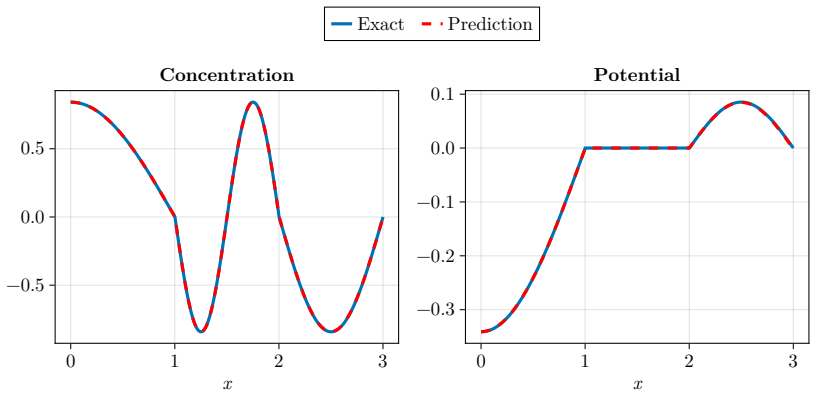
On its own terms, the paper's central claim is that the P2D model becomes trainable by PINNs without discarding the nonlinear Butler-Volmer kinetics, and that this is the first successful PINN simulation of a lithium-ion battery with the fully nonlinear Butler-Volmer equation. The two ingredients are a bypassing network $\beta_\theta$ that absorbs the argument $19.5\,\eta$ inside the hyperbolic sine, isolating the stiffest nonlinearity and dropping the Hessian condition number from about $2\times10^{108}$ to about $5\times10^9$, and secondary conservation laws that fix the integrated ionic flux in each electrode, eliminating the family of constant-shifted solid-potential solutions that the PDE residual alone cannot distinguish. With both ingredients, the trained network reproduces the reference solid concentration, liquid concentration, solid potential, and liquid potential at 1C, 0.5C, and 2C discharge, and the same representation supports inverse estimation of the total battery length and the electrode-to-separator length ratio, with relative errors below 9 percent even under 5 percent observational noise. The ablation study shows that each ingredient is necessary: the bypassing term alone yields a tiny loss but inaccurate solutions, while the conservation law alone does not even stabilize training.
Load-bearing premise
Everything reported is measured against a reference solution that the paper computes with time step 1 and 50 spatial points but does not describe further—no solver details, no parameter table, no grid-convergence study, and no experimental comparison—so if that reference is biased or wrong, the forward errors and inverse parameter estimates do not establish that the method works.
Editorial extensions
If this is right
- The full P2D model with nonlinear Butler-Volmer kinetics becomes solvable by PINNs in a single training pass, without the single-particle approximation, linearized kinetics, or two-step pretraining used in earlier work.
- The reported error levels hold across discharge rates from 0.5C to 2C; the worst case is the liquid potential at 2C at about $7\times10^{-2}$ relative $L^2$ error, and most variables sit near $10^{-3}$–$10^{-2}$.
- The same framework estimates battery geometry—total length, and the ratio of electrode and separator lengths—with relative errors under 9 percent, and the estimates remain in that range when the observational data carry 5 percent Gaussian noise.
- The Hessian analysis gives a quantitative explanation of why vanilla PINNs fail here: without bypassing, the condition number is on the order of $10^{108}$ and the initial loss reaches $10^{75}$, while with bypassing the condition number falls to about $10^9$.
- The ablation study shows the two ingredients are complementary: the bypassing term restores trainability, the conservation law restores accuracy, and neither alone suffices.
Reading between the lines
- The bypassing recipe is generic: any stiff or near-singular algebraic coupling inside a PDE system could be isolated with its own network plus a consistency penalty, so the method likely transfers to other electrochemical, combustion, or reaction-diffusion models.
- Because the reference solution used for validation and inverse data is described only by its time step and grid size, with no solver specified and no grid-convergence or experimental check, the quantitative error claims are best read as upper bounds until an independent converged reference is used; the qualitative two-failure-mode diagnosis does not depend on that reference.
- The stability of the estimates under 5 percent noise suggests the architecture could be pointed at real cell measurements—voltage and current traces—to track capacity fade or parameter drift over aging, an application the authors mention as future work but do not test.
- The condition-number drop offers a practical selection rule for when bypassing is needed: if the Hessian spectrum of a PINN residual spans more than about nine orders of magnitude, isolating the stiffest term is a reasonable first move.
Editorial analysis
A structured set of objections, weighed in public.
Referee Report
Summary. The paper proposes two modifications to physics-informed neural network (PINN) training for the pseudo-two-dimensional (P2D) lithium-ion battery model with the fully nonlinear Butler–Volmer (BV) equation. First, a bypassing neural network βθ approximates the scaled overpotential inside the sinh term of the BV flux, which is shown to reduce the Hessian condition number of the loss. Second, a secondary conservation law for the solid-phase potential is added to the loss to prevent convergence to incorrect solutions that yield small residuals. The authors report forward relative L2 errors of 4.8e-3 to 7.2e-2 for various state variables at 0.5C, 1C, and 2C discharge rates, and inverse estimates of battery length and section lengths with relative errors below 9% even with 5% noise. They claim this is the first successful PINN simulation of a Li-ion battery incorporating the fully nonlinear BV equation.
Significance. If the reported accuracy is trustworthy, the work addresses two genuine obstacles in applying PINNs to battery models: the ill-conditioning caused by the exponential sinh term and the loss-accuracy mismatch caused by small reaction-rate coefficients. The ablation study (Table 2) cleanly shows that neither the bypassing term nor the secondary conservation law is redundant, and the toy problems in Sections 4 and 5 provide useful insight into the failure modes. The inverse results are internally consistent and show robustness to added noise. However, the significance is currently limited by the lack of external validation: all quantitative claims are measured against an undocumented reference solver, and the inverse experiments use synthetic data from that same solver. The novelty claim also needs careful qualification relative to prior work by Hassanaly et al. [25]. With additional reproducibility details and independent validation, the contribution would be valuable to the computational physics and battery modeling communities.
major comments (4)
- [Section 6] The reference solution is described only as 'For reference solution, we used Δt = 1 for time-stepping up to the final time τ = 3500, and Nx = 50 for spatial discretization.' No discretization scheme, physical parameter table, open-circuit potential functions, radial mesh details, or convergence study are provided. Because Table 2 and Table A.6 report relative L2 errors against this reference, and Tables 3–5 use it to generate the inverse-problem data, an inaccurate or biased reference would invalidate all quantitative conclusions. The authors should supply the full parameter set, the numerical scheme, and a grid-convergence study (or a comparison with an established solver such as PyBaMM or LIONSIMBA) demonstrating that the reference is converged to an accuracy well below the reported errors.
- [Section 6.2] The inverse problems are tested exclusively with synthetic data generated by the same reference solver used to validate the forward problem ('using the reference solution as our data'). This demonstrates self-consistency but not the ability to estimate parameters from real or independent data. Since the reference solver is also undocumented, the inverse errors in Tables 3–5 may partly reflect the solver's own discretization bias. The authors should add at least one test using data from an independent solver or a finer-grid reference, or an experimental dataset, and discuss how model mismatch would affect the parameter estimates.
- [Section 6.1 and Introduction] The claim that this is 'the first successful PINN simulation of a Li-ion battery incorporating the fully nonlinear BV equation (1)' needs qualification. The manuscript itself discusses Hassanaly et al. [25], who addressed the nonlinear BV equation in the P2D model with an additional division step, and Remark 1 acknowledges similar work for the single-particle model. As written, the claim is too broad and potentially misleading. It should be qualified, for example, as 'first single-step end-to-end PINN training without linearization or multi-stage initialization,' and the differences in accuracy, robustness, and computational cost relative to [25] should be quantified.
- [Section 5.1 and Figure 6] The Hessian conditioning analysis is performed on a smaller network than the one used for the full P2D model, as the paper acknowledges ('memory constraints required us to perform this analysis with a smaller neural network compared to the one used for the full P2D model in Section 6.1'). Without specifying the reduced architecture, the included loss terms, and the collocation data, the reported condition numbers (2.017×10^108 without vs. 4.599×10^9 with bypassing) cannot be directly taken as evidence for the full model. Since the ablation study in Table 2 already demonstrates the necessity of the bypassing term, this issue is not fatal, but the analysis should be clearly labeled as illustrative or repeated on the actual model.
minor comments (5)
- [Section 3.2 and Section 5] The loss weights λ_BC, λ_Inter, λ_Lβ, λ_SC, and λ_data are never given numerical values. For reproducibility, the authors should provide the values used in the reported experiments.
- [Section 5.2, Eq. (12)] The derivation of the secondary conservation laws is stated to follow from integrating the solid-potential equation, but the relevant equation is not numbered (the text refers to '(3.1)'). Adding an explicit derivation with the boundary conditions would make the sign conventions and normalization clear.
- [Appendix A, Table A.6] The 2C results show relative errors up to 7.15e-2 for φ and 4.69e-2 for cs; the text says the method 'accurately' predicts behavior, but a 7% error may warrant more careful wording.
- [Throughout] There are several typos and formatting issues: 'can appears' in Section 3, 'instable' in Section 5.1, 'V anilla' and 'O urs' in Figure 9 labels, and the sentence 'inverse problems that might not be infeasible' in the conclusion. These should be corrected.
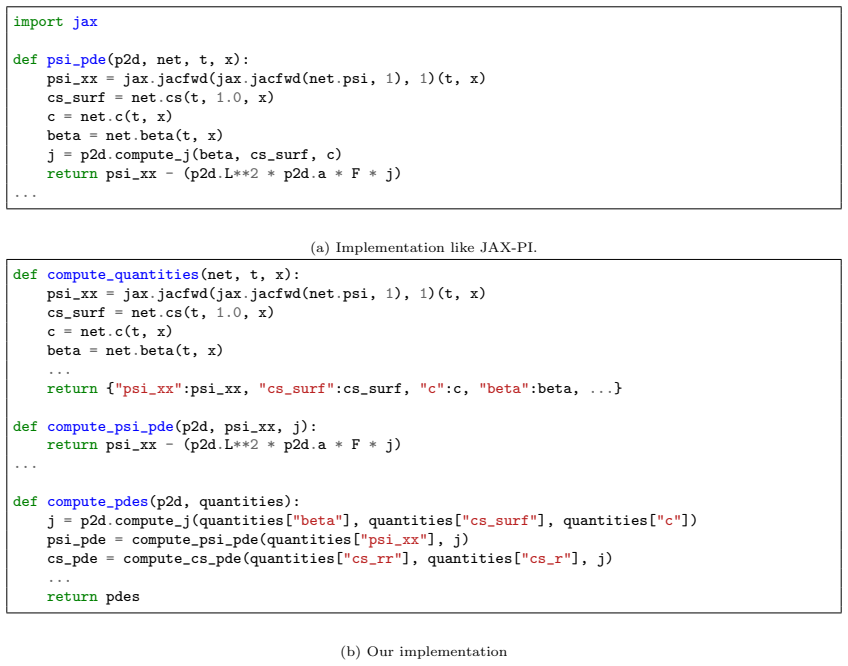
- [Section 6.3] The implementation note is useful, but the claimed speedup (14 vs. 9 iterations per second) is modest and would benefit from a benchmark with wall-clock time and hardware details beyond what is stated.
Circularity Check
No significant circularity: forward solves are validated against an external reference, the added conservation law is derived from the model, and inverse tests are standard self-consistency parameter estimation.
full rationale
The paper's derivation chain is self-contained and does not reduce to its own inputs. The bypassing term (Eqs. 10-11) is a reparameterization: the loss L_beta forces beta_theta to match (F/2RT)eta, so at convergence the flux (10) becomes the original Butler-Volmer equation (1); it does not fit a separate quantity and then relabel it as a prediction. The secondary conservation law (Eq. 12) is explicitly derived by integrating the solid-potential PDE, as stated in Section 5.2, so it is a necessary condition on any true solution rather than an independently imposed ansatz. Forward errors in Tables 2 and A.6 are measured against a reference solution produced by classical time-stepping (Section 6: 'For reference solution, we used Delta t = 1 for time-stepping up to the final time tau = 3500, and Nx = 50 for spatial discretization'), and this reference is not used in training the forward PINN, so the reported accuracy is not forced by construction. The inverse problems (Tables 3-5) use the reference solution as observational data and treat L, rho_p, and rho_n as learnable parameters; this is a standard self-consistency test for an inverse solver and is not circular because the data are nontrivial nonlinear functions of the parameters. The cited PINN application examples from the authors' own prior work ([21], [22]) appear only in the introduction and are not load-bearing for any derivation. The inadequate documentation of the reference solver is a reproducibility and correctness concern, but it does not constitute circularity.
Assumptions & free parameters
free parameters (3)
- Loss weights lambda (boundary, interface, conservation, data) =
not reported
- Bypass network initialization scale =
O(1)
- Non-dimensionalization references cref, phiref, psiref =
cref=10^3, phiref=psiref=1
assumptions (4)
- domain assumption P2D model equations (Doyle-Fuller-Newman) are an accurate description of Li-ion cell dynamics
- domain assumption Reference solution from a classical numerical solver is ground truth
- ad hoc to paper Non-dimensionalization scales (cref=10^3, phiref=psiref=1) keep rescaled variables O(1)
- standard math The secondary conservation law (12) is a valid necessary condition derived by integrating the solid-potential PDE
invented entities (1)
-
Bypassing neural network beta_theta
Cite this review
Pith. "Pith review of Forward and Inverse Simulation of Pseudo-Two-Dimensional Model of Lithium-Ion Batteries Using Neural Networks." pith.science (2026). https://pith.science/paper/V2XKQ6U7
@misc{pith2026241213200,
  author       = {Pith},
  title        = {Pith review of: Forward and Inverse Simulation of Pseudo-Two-Dimensional Model of Lithium-Ion Batteries Using Neural Networks},
  year         = {2026},
  howpublished = {\url{https://pith.science/paper/V2XKQ6U7}},
  note         = {Machine review of arXiv:2412.13200}
}
abstract
In this work, we address the challenges posed by the high nonlinearity of the Butler-Volmer (BV) equation in forward and inverse simulations of the pseudo-two-dimensional (P2D) model using the physics-informed neural network (PINN) framework. The BV equation presents significant challenges for PINNs, primarily due to the hyperbolic sine term, which renders the Hessian of the PINN loss function highly ill-conditioned. To address this issue, we introduce a bypassing term that improves numerical stability by substantially reducing the condition number of the Hessian matrix. Furthermore, the small magnitude of the ionic flux \( j \) often leads to a common failure mode where PINNs converge to incorrect solutions. We demonstrate that incorporating a secondary conservation law for the solid-phase potential \( \psi \) effectively prevents such convergence issues and ensures solution accuracy. The proposed methods prove effective for solving both forward and inverse problems involving the BV equation. Specifically, we achieve precise parameter estimation in inverse scenarios and reliable solution predictions for forward simulations.
Figures


Figures from the paper (9 more)


Reference graph
Works this paper leans on
-
[25]
M. Hassanaly, P. J. Weddle, R. N. King, S. De, A. Doostan, C. R. Randall, E. J. Dufek, A. M. Colclasure, K. Smith, Pinn surrogate of li-ion battery models for parameter inference. part ii: Regularization and application of the pseudo-2d model, arXiv preprint arXiv:2312.17336 (2023)
work page Pith review arXiv 2023
-
[1]
G. Zubi, R. Dufo-L´ opez, M. Carvalho, G. Pasaoglu, The lithium-ion battery: State of the art and future perspectives, Renewable and sustainable energy reviews 89 (2018) 292–308
work page 2018
-
[2]
T. M. Bandhauer, S. Garimella, T. F. Fuller, A critical review of thermal issues in lithium-ion batteries, Journal of the electrochemical society 158 (3) (2011) R1
2011
-
[3]
V. Etacheri, R. Marom, R. Elazari, G. Salitra, D. Aurbach, Challenges in the development of advanced li-ion batteries: a review, Energy & Environmental Science 4 (9) (2011) 3243–3262
work page 2011
-
[4]
C. M. Costa, J. C. Barbosa, R. Gon¸ calves, H. Castro, F. Del Campo, S. Lanceros-M´ endez, Recycling and environmental issues of lithium-ion batteries: Advances, challenges and op- portunities, Energy Storage Materials 37 (2021) 433–465
work page 2021
- [5]
-
[6]
Y. Wang, J. Tian, Z. Sun, L. Wang, R. Xu, M. Li, Z. Chen, A comprehensive review of battery modeling and state estimation approaches for advanced battery management systems, Renewable and Sustainable Energy Reviews 131 (2020) 110015. 25
work page 2020
-
[7]
M. Nikdel, et al., Various battery models for various simulation studies and applications, Renewable and Sustainable Energy Reviews 32 (2014) 477–485
work page 2014
Show all 45 references
-
[8]
G. L. Plett, Extended kalman filtering for battery management systems of lipb-based hev battery packs: Part 3. state and parameter estimation, Journal of Power sources 134 (2) (2004) 277–292
2004
-
[9]
W. Li, M. Rentemeister, J. Badeda, D. J¨ ost, D. Schulte, D. U. Sauer, Digital twin for battery systems: Cloud battery management system with online state-of-charge and state-of-health estimation, Journal of energy storage 30 (2020) 101557
2020
-
[10]
Doyle, T
M. Doyle, T. F. Fuller, J. Newman, Modeling of galvanostatic charge and discharge of the lithium/polymer/insertion cell, Journal of the Electrochemical society 140 (6) (1993) 1526
1993
-
[11]
Doyle, J
M. Doyle, J. Newman, A. S. Gozdz, C. N. Schmutz, J.-M. Tarascon, Comparison of modeling predictions with experimental data from plastic lithium ion cells, Journal of the Electrochem- ical Society 143 (6) (1996) 1890
1996
-
[12]
Kumaresan, G
K. Kumaresan, G. Sikha, R. E. White, Thermal model for a li-ion cell, Journal of the Electrochemical Society 155 (2) (2007) A164
2007
-
[13]
L. Cai, R. E. White, Mathematical modeling of a lithium ion battery with thermal effects in comsol inc. multiphysics (mp) software, Journal of Power Sources 196 (14) (2011) 5985–5989
2011
-
[14]
R. Han, C. Macdonald, B. Wetton, A fast solver for the pseudo-two-dimensional model of lithium-ion batteries, arXiv preprint arXiv:2111.09251 (2021)
2021 arXiv
-
[15]
Mora-Paz, High-order transient multidimensional simulation of a thermo-electro-chemo- mechanical model for lithium-ion batteries, arXiv preprint arXiv:2403.16928 (2024)
J. Mora-Paz, High-order transient multidimensional simulation of a thermo-electro-chemo- mechanical model for lithium-ion batteries, arXiv preprint arXiv:2403.16928 (2024)
2024 arXiv
-
[16]
Torchio, L
M. Torchio, L. Magni, R. B. Gopaluni, R. D. Braatz, D. M. Raimondo, Lionsimba: a matlab framework based on a finite volume model suitable for li-ion battery design, simulation, and control, Journal of The Electrochemical Society 163 (7) (2016) A1192
2016
-
[17]
Sulzer, S
V. Sulzer, S. G. Marquis, R. Timms, M. Robinson, S. J. Chapman, Python battery mathe- matical modelling (pybamm), Journal of Open Research Software 9 (1) (2021)
2021
-
[18]
M. D. Berliner, D. A. Cogswell, M. Z. Bazant, R. D. Braatz, Methods—PETLION: Open- source software for millisecond-scale porous electrode theory-based lithium-ion battery sim- ulations, Journal of The Electrochemical Society 168 (9) (2021) 090504
2021
-
[19]
Raissi, P
M. Raissi, P. Perdikaris, G. E. Karniadakis, Physics-informed neural networks: A deep learning framework for solving forward and inverse problems involving nonlinear partial differential equations, Journal of Computational physics 378 (2019) 686–707
2019
-
[20]
Q. He, D. Barajas-Solano, G. Tartakovsky, A. M. Tartakovsky, Physics-informed neural net- works for multiphysics data assimilation with application to subsurface transport, Advances in Water Resources 141 (2020) 103610
2020
-
[21]
H. Jo, H. Hong, H. J. Hwang, W. Chang, J. K. Kim, Density physics-informed neural networks reveal sources of cell heterogeneity in signal transduction, Patterns 5 (2) (2024)
2024
-
[22]
H. Son, M. Lee, A pinn approach for identifying governing parameters of noisy thermoa- coustic systems, Journal of Fluid Mechanics 984 (2024) A21. 26
2024
-
[23]
Ostanek, M
J. Ostanek, M. Parhizi, J. Jeevarajan, A novel method for alleviating numerical stiffness in li-ion thermal abuse models, Journal of Power Sources Advances 23 (2023) 100123
2023
-
[24]
C. Xue, B. Jiang, J. Zhu, X. Wei, H. Dai, An enhanced single-particle model using a physics- informed neural network considering electrolyte dynamics for lithium-ion batteries, Batteries 9 (10) (2023) 511
2023
-
[26]
Zubov, Z
K. Zubov, Z. McCarthy, Y. Ma, F. Calisto, V. Pagliarino, S. Azeglio, L. Bottero, E. Luj´ an, V. Sulzer, A. Bharambe, et al., Neuralpde: Automating physics-informed neural networks (pinns) with error approximations, arXiv preprint arXiv:2107.09443 (2021)
2021 arXiv
-
[27]
W. Chen, Y. Fu, P. Stinis, Physics-informed machine learning of redox flow battery based on a two-dimensional unit cell model, Journal of Power Sources 584 (2023) 233548
2023
-
[28]
J. I. D ´ ıaz, D. G´ omez-Castro, A. M. Ramos, On the well-posedness of a multiscale mathemat- ical model for lithium-ion batteries, Advances in Nonlinear Analysis 8 (1) (2018) 1132–1157
2018
-
[29]
L. N. Trefethen, J. Weideman, The exponentially convergent trapezoidal rule, SIAM review 56 (3) (2014) 385–458
2014
-
[30]
G. H. Golub, J. H. Welsch, Calculation of gauss quadrature rules, Mathematics of compu- tation 23 (106) (1969) 221–230
1969
-
[31]
I. M. Sobol’, On the distribution of points in a cube and the approximate evaluation of integrals, Zhurnal Vychislitel’noi Matematiki i Matematicheskoi Fiziki 7 (4) (1967) 784–802
1967
-
[32]
Krishnapriyan, A
A. Krishnapriyan, A. Gholami, S. Zhe, R. Kirby, M. W. Mahoney, Characterizing possible failure modes in physics-informed neural networks, Advances in neural information process- ing systems 34 (2021) 26548–26560
2021
-
[33]
J. C. Wong, C. C. Ooi, A. Gupta, Y.-S. Ong, Learning in sinusoidal spaces with physics- informed neural networks, IEEE Transactions on Artificial Intelligence 5 (3) (2022) 985–1000
2022
-
[34]
L. Lu, R. Pestourie, W. Yao, Z. Wang, F. Verdugo, S. G. Johnson, Physics-informed neural networks with hard constraints for inverse design, SIAM Journal on Scientific Computing 43 (6) (2021) B1105–B1132. doi:10.1137/21M1397908
2021 doi
-
[35]
C. Wang, S. Li, D. He, L. Wang, Is l2 physics informed loss always suitable for training physics informed neural network?, Advances in Neural Information Processing Systems 35 (2022) 8278–8290
2022
-
[36]
Hassanaly, P
M. Hassanaly, P. J. Weddle, R. N. King, S. De, A. Doostan, C. R. Randall, E. J. Dufek, A. M. Colclasure, K. Smith, Pinn surrogate of li-ion battery models for parameter inference. part i: Implementation and multi-fidelity hierarchies for the single-particle model, arXiv prepri...
2023 arXiv
-
[37]
S. Wang, Y. Teng, P. Perdikaris, Understanding and mitigating gradient flow pathologies in physics-informed neural networks, SIAM Journal on Scientific Computing 43 (5) (2021) A3055–A3081. 27
2021
-
[38]
D. P. Kingma, J. Ba, Adam: A method for stochastic optimization, arXiv preprint arXiv:1412.6980 (2014)
2014 arXiv
-
[39]
D. C. Liu, J. Nocedal, On the limited memory bfgs method for large scale optimization, Mathematical programming 45 (1) (1989) 503–528
1989
-
[40]
Babuschkin, K
DeepMind, I. Babuschkin, K. Baumli, A. Bell, S. Bhupatiraju, J. Bruce, P. Buchlovsky, D. Budden, T. Cai, A. Clark, I. Danihelka, A. Dedieu, C. Fantacci, J. Godwin, C. Jones, R. Hemsley, T. Hennigan, M. Hessel, S. Hou, S. Kapturowski, T. Keck, I. Kemaev, M. King, M. Kunesch, L....
2020
-
[41]
Blondel, Q
M. Blondel, Q. Berthet, M. Cuturi, R. Frostig, S. Hoyer, F. Llinares-L´ opez, F. Pedregosa, J.-P. Vert, Efficient and modular implicit differentiation, arXiv preprint arXiv:2105.15183 (2021)
2021 arXiv
-
[42]
Sitzmann, J
V. Sitzmann, J. Martel, A. Bergman, D. Lindell, G. Wetzstein, Implicit neural representa- tions with periodic activation functions, Advances in neural information processing systems 33 (2020) 7462–7473
2020
-
[43]
Bradbury, R
J. Bradbury, R. Frostig, P. Hawkins, M. J. Johnson, C. Leary, D. Maclaurin, G. Necula, A. Paszke, J. VanderPlas, S. Wanderman-Milne, Q. Zhang, JAX: composable transforma- tions of Python+NumPy programs (2018). URL http://github.com/google/jax
2018
-
[44]
Danisch, J
S. Danisch, J. Krumbiegel, Makie.jl: Flexible high-performance data visualization for Julia, Journal of Open Source Software 6 (65) (2021) 3349. doi:10.21105/joss.03349. URL https://doi.org/10.21105/joss.03349
2021 doi
-
[45]
J. Kang, Y. Jia, G. Zhu, J. V. Wang, B. Huang, Y. Fan, How electrode thicknesses influence performance of cylindrical lithium-ion batteries, Journal of Energy Storage 46 (2022) 103827. Appendix A. Additional experiments In addition to the original 1C discharge rate which corre...
2022
Reviewed August 12, 2026 · model on record in the stance chip above.
Discussion (0). Continue with ORCID to comment.