REVIEW 1 major objections 4 minor 28 references
An Energy Efficient Design of Hybrid NOMA Based on Hybrid SIC with Power Adaptation
T0 review · 1 major / 4 minor · reviewed 2026-08-06 · deepseek-v4-flash
Pith's one-line read Power-adaptive hybrid NOMA beats OMA in rate and energy at high SNR
desk verdict Sign error in Lemma 1 undermines the exact derivation, but the core idea is sound and the conclusion may survive after a corrected proof. read the letter →
The pith
A machine-rendered reading of the paper's core claim, the machinery that carries it, and where it could break.
The reading
What carries the argument
The load-bearing mechanism is the power-adaptation coefficient $\gamma$ used in Type II, Case 2 of the NOMA slot. When the opportunistic user's un-adapted received power exceeds the interference threshold $\tau_m = \max\{0, \rho_m |h_m|^2/(2^{R_m}-1)-1\}$, the receiver chooses $\gamma$ so that $\gamma \beta \rho_n |h_n|^2 = \tau_m$. This places the signal exactly at the maximum interference the legacy user can tolerate, allowing the opportunistic user to be decoded at the second SIC stage at rate $\log(1+\tau_m)$ rather than suffering the first-stage interference-limited rate $\log\bigl(1 + \beta\rho_n|h_n|^2/(\rho_m|h_m|^2+1)\bigr)$. The equality converts a bad channel draw into a deterministic rate that depends only on the legacy user's target rate, which is what removes the error floor of the earlier HSIC-NPA scheme.
What would settle it
Simulate the uplink with a fixed channel-estimation error variance $\sigma_e^2>0$ and sweep the SNR; if the measured $\hat P_n$ stops decaying and flattens above zero instead of falling like $1/\rho^n$, the exact-equality assumption is doing the work and the high-SNR dominance claim fails under imperfect CSI.
Extended reading notes
Core claim
The central claim, stated as Theorems 1 and 2 of the paper, is that for the proposed HSIC-PA aided H-NOMA uplink, the probability $\hat P_n$ that the achievable rate over the NOMA and OMA slots combined is no larger than the pure-OMA rate tends to $0$ as $\rho_n,\rho_m \to \infty$ with $\rho_n/\rho_m = \eta$ fixed, for any $0<\beta<1/2$, any target rate $R_m$, and any power ratio. Equivalently, at high SNR the scheme outperforms OMA in rate while using less energy with probability tending to one. The paper also derives exact closed-form expressions for $\hat P_n$ in both pairing orders $m<n$ and $m>n$, and shows asymptotically that $\hat P_n$ decays like $1/\rho^n$, so the opportunistic user's channel-gain order $n$ dominates the decay. The restrictive conditions required by the earlier HSIC-NPA scheme disappear because the power-adaptation branch can force the opportunistic user's received power down to the legacy user's interference threshold.
Load-bearing premise
The result rests on perfect instantaneous channel knowledge at both transmitter and receiver and on the power adaptation coefficient $\gamma$ being set so that $\gamma \beta \rho_n |h_n|^2 = \tau_m$ exactly; if channel estimation is imperfect or $\gamma$ is quantized, the claimed rate $\log(1+\tau_m)$ and the asymptotic $\hat P_n \to 0$ are not established.
Editorial extensions
If this is right
- At high SNR, any user paired under the scheme can be served at a higher rate than pure OMA with less energy, with probability tending to one, for every $0<\beta<1/2$ and every target rate $R_m$.
- The error floors that appear in fixed-SIC and HSIC-NPA H-NOMA under specific target-rate and power-ratio conditions are eliminated by the power-adaptation branch.
- The failure probability $\hat P_n$ decays exponentially at rate $n$, the channel-gain order of the opportunistic user, so system performance depends more on the opportunistic user than on its legacy partner.
- Because the dominance holds for every power ratio $\eta$ and every $R_m$, user pairing and power allocation become simpler at high SNR: no restrictive condition needs to be enforced.
Reading between the lines
- Inference: A practical implementation would need to quantize $\gamma$ and tolerate imperfect CSI; the analysis implies the loss appears as an error floor rather than just a slower decay, because the exact equality is what unlocks the clean second-stage rate.
- Inference: The same scale-down-to-threshold trick should carry over to downlink H-NOMA or relay-aided NOMA wherever the receiver can compute $\tau_m$ and feed it back; the proof structure needs only the exact equality to be reachable.
- Inference: The scheme only reduces the opportunistic user's power; allowing $\gamma>1$ when the legacy channel is weak could extend the gain to lower SNR, but that would require re-deriving the interference-threshold analysis.
Editorial analysis
A structured set of objections, weighed in public.
Referee Report
Summary. The manuscript proposes an uplink hybrid NOMA (H-NOMA) scheme that combines hybrid successive interference cancellation (HSIC) with power adaptation (PA), and claims that the probability \hat P_n of the total achievable rate over the NOMA and OMA slots being no larger than the pure-OMA rate tends to zero as the signal-to-noise ratios grow, for any \beta<1/2, any target rate, and any power ratio. The theoretical part derives closed-form-looking expressions for \hat P_n in the two user-ordering cases m<n and m>n, and asymptotic approximations showing \hat P_n \to 0. The paper builds its derivation on Lemma 1, which decomposes the Type II probability into two terms using thresholds \Phi, \Omega, \Theta, and \Psi. Numerical simulations are presented as verifying the analysis.
Significance. If the asymptotic claim were rigorously established, it would be a meaningful advance: it would show that the proposed HSIC-PA H-NOMA scheme achieves a higher rate than OMA with probability approaching one at high SNR while consuming less energy, without the restrictive conditions that cause error floors in earlier H-NOMA designs (e.g., [25]). The paper provides a substantial set of analytical expressions, piecewise tables, and simulation curves, and the system model is clearly described. However, the central derivation rests on a lemma that contains an algebraic sign error, so the claimed exact expression for \hat P_n is not the probability defined in Eq. (13), and the asymptotic proof is not supported as written. The qualitative conclusion may still be correct, but the supplied analysis does not establish it.
major comments (1)
- [Lemma 1, Eq. (17), and Appendix A] The rearrangement of the rate inequality in the Type II, Case 2 branch is incorrect for \tau_m > (1-\beta)/\beta. Starting from (1+\tau_m)(1+\beta\rho_n y) \le 1+\rho_n y, where y=|h_n|^2, we obtain \tau_m \le \rho_n y (1-\beta-\beta\tau_m). If \tau_m < (1-\beta)/\beta, this gives y \ge \tau_m/[\rho_n(1-\beta-\beta\tau_m)] = \Theta. If \tau_m > (1-\beta)/\beta, the right-hand side is negative, so the inequality has no solution for y>0; the correct condition is an empty set, not y \ge \Theta with a negative \Theta. Equation (17) keeps the region |h_n|^2 > \Theta, |h_n|^2 < \Omega, |h_n|^2 > \Phi, |h_m|^2 > \alpha_m, which for \tau_m > (1-\beta)/\beta includes a positive-probability set that does not satisfy the failure condition. Since at high SNR \tau_m = \rho_m |h_m|^2/\varepsilon_m - 1 tends to infinity for typical nonzero |h_m|^2, the erroneous regime is the dominant one rather than a corner case. Consequently, the exact expression for \hat P_n in Theorems 1 and 2 is not the probability defined in Eq. (13), and the asymptotic claim \hat P_n \to 0 is not established by the supplied derivation. This is a load-bearing error that requires a full re-derivation of Lemma 1 and all subsequent results that depend on it.
minor comments (4)
- [Eq. (22) and Eq. (49)] The definitions of c_p and \hat c_p contain a typo: the binomial coefficient uses l where it should use p. For example, Eq. (22) writes c_p = \binom{n-m-1}{l}(-1)^{n-m-1-p}, but the summation index is p, so it should be \binom{n-m-1}{p}(-1)^{n-m-1-p}.
- [Abstract and Section III] The paper repeatedly calls the derived expressions "closed-form", but several key terms (S2, S3, S5, V5, V7, etc.) rely on Gauss-Chebyshev quadrature with the parameter n_c, which is a numerical integration approximation, not a closed form. The language should be adjusted to "semi-analytical" or "numerically evaluated" where quadrature is used.
- [Conclusion] The conclusion contains a sentence fragment: "particularly in achieving \hat P_n \to 0 in the high SNR regime under all conditions. guaranteed performance superiority." The second phrase should be integrated into a complete sentence.
- [General] The paper relies heavily on results from [25] for P1 and P2,2 without re-deriving them; the manuscript would be easier to verify if those expressions were summarized or briefly re-derived in an appendix, or if the exact statements from [25] were stated explicitly.
Circularity Check
No material circularity: the HSIC-PA probability is derived from the model equations; the only self-citation is the baseline [25] terms, which are independent prior results rather than the target claim.
full rationale
The derivation chain is largely self-contained algebra on the stated model. The probability \hat P_n in Eq. (13) is not defined as the desired answer; it is computed from the event {T \hat R_n^NOMA + T R_n^OMA ≤ T R_n} by first splitting on βρ_n|h_n|^2 ≤ τ_m (Eq. 14) and then evaluating P_I and P_II with the explicit rates in Eqs. (5)-(10). The asymptotic PT→0 claims follow from Taylor expansions of the Rayleigh order-statistic densities in Appendices C and E, not from assuming the conclusion. No parameters are fitted to data: γ is chosen per channel realization to satisfy γβρ_n|h_n|^2 = τ_m, so the fitted-input-called-prediction pattern does not apply. The one load-bearing import is P1 and P2,2 from the authors' prior [25]; these are published baseline HSIC-NPA terms, the assumptions of [25] do not include the HSIC-PA result, and the present conclusion is not equivalent to them. That is legitimate prior-work support, not circularity under the hard rules. The skeptical point that Appendix A's reduction of Eq. (83) to Eq. (17) omits the sign condition on 1−β|h_m|^2/α_m, and the Section V acknowledgment of perfect-CSI assumptions, are correctness and scope limitations rather than circular-dependency issues. The score of 2 reflects only the mild self-citation burden from [25]; there is no circularity in the central derivation.
Assumptions & free parameters
assumptions (4)
- domain assumption User channels |h_i|^2 are i.i.d. exponential (Rayleigh fading) and are perfectly ordered; the joint order-statistic PDF has the product form used in Appendices B and D.
- domain assumption Perfect CSI and slow time-varying channels allow the BS to know |h_m|^2 and |h_n|^2 and to set \gamma so that \gamma\beta\rho_n|h_n|^2 = \tau_m exactly.
- domain assumption Ideal SIC with no error propagation; a user decoded at the second SIC stage achieves log(1 plus its received SNR).
- standard math Standard order-statistics, multinomial, binomial, Taylor expansion, and Gauss-Chebyshev quadrature tools are applied correctly.
Cite this review
Pith. "Pith review of An Energy Efficient Design of Hybrid NOMA Based on Hybrid SIC with Power Adaptation." pith.science (2026). https://pith.science/paper/V4ALV7BJ
@misc{pith2026250709458,
  author       = {Pith},
  title        = {Pith review of: An Energy Efficient Design of Hybrid NOMA Based on Hybrid SIC with Power Adaptation},
  year         = {2026},
  howpublished = {\url{https://pith.science/paper/V4ALV7BJ}},
  note         = {Machine review of arXiv:2507.09458}
}
read the original abstract
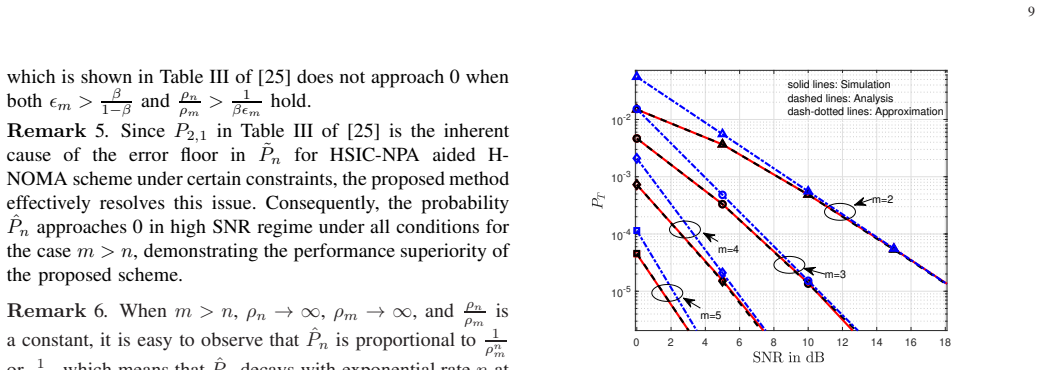
Recently, hybrid non-orthogonal multiple access (H-NOMA) technology, which effectively utilizes both NOMA and orthogonal multiple access (OMA) technologies through flexible resource allocation in a single transmission, has demonstrated immense potential for enhancing the performance of wireless communication systems. To further release the potential of HNOMA, this paper proposes a novel design of H-NOMA which jointly incorporates hybrid successive interference cancellation (HSIC) and power adaptation (PA) in the NOMA transmission phase. To reveal the potential of the proposed HSIC-PA aided H-NOMA scheme, closed-form expression for the probability of the event that H-NOMA can achieve a higher data rate than pure OMA by consuming less energy is rigorously derived. Furthermore, the asymptotic analysis demonstrates that the probability of the proposed H-NOMA scheme approaches 1 in the high signal-to-noise ratio (SNR) regime without any constraints on either users' target rates or transmit power ratios. This represents a significant improvement over conventional H-NOMA schemes, which require specific restrictive conditions to achieve probability 1 at high SNRs as shown in existing work. The above observation indicates that with less energy consumption, the proposed HSIC-PA aided H-NOMA can achieve a higher data rate than pure OMA with probability 1 at high SNRs, and hence a higher energy efficiency. Finally, numerical results are provided to verify the accuracy of the analysis and also demonstrate the superior performance of the proposed H-NOMA scheme.
Figures


Reference graph
Works this paper leans on
-
[25]
Hybrid sic- aided hybrid noma: A new approach for improving energy efficiency,
Y . Sun, W. Cao, N. Wang, M. Zhou, and Z. Ding, “Hybrid sic- aided hybrid noma: A new approach for improving energy efficiency, ” IEEE Transactions on Wireless Communications , vol. 24, no. 3, pp. 2007– 2021, 2025
work page 2007
-
[28]
——, “Hybrid successive interference cancellation and power adapta- tion: a win-win strategy for robust uplink NOMA transmissio n,” IEEE Trans. Commun., vol. 72, no. 2, pp. 771–785, Feb. 2024
work page 2024
-
[1]
A s urvey of non-orthogonal multiple access for 5G,
L. Dai, B. Wang, Z. Ding, Z. Wang, S. Chen, and L. Hanzo, “A s urvey of non-orthogonal multiple access for 5G,” IEEE Commun. Surveys Tuts. , vol. 20, no. 3, pp. 2294–2323, May 2018
work page 2018
-
[2]
A su rvey of NOMA: Current status and open research challenges,
B. Makki, K. Chitti, A. Behravan, and M.-S. Alouini, “A su rvey of NOMA: Current status and open research challenges,” IEEE Open Journal of the Commun. Society , vol. 1, pp. 179–189, 2020
work page 2020
-
[3]
Towards 6G wireless communication networks: Vision, enabling technologies, and new paradigm shifts,
X. Y ou, C.-X. Wang, J. Huang, X. Gao, Z. Zhang, M. Wang, Y . H uang, C. Zhang, Y . Jiang, J. Wang et al., “Towards 6G wireless communication networks: Vision, enabling technologies, and new paradigm shifts,” Sci. China Inf. Sci. , vol. 64, pp. 1–74, Feb. 2021
work page 2021
-
[4]
L. Sun, Z. Zhao, S. Wang, Z. Ding, and M. Peng, “On the study of non-orthogonal multiple access (noma)-assisted integrat ed sensing and communication (isac),” IEEE Transactions on Communications , vol. 72, no. 11, pp. 7278–7293, 2024
work page 2024
-
[5]
Q. Li, M. El-Hajjar, Y . Sun, I. Hemadeh, A. Shojaeifard, Y . Liu, and L. Hanzo, “Achievable rate analysis of the STAR-RIS-aided N OMA uplink in the face of imperfect CSI and hardware impairments ,” IEEE Transactions on Communications , vol. 71, no. 10, pp. 6100–6114, Oct. 2023
work page 2023
-
[6]
Power ef ficient irs- assisted noma,
J. Zhu, Y . Huang, J. Wang, K. Navaie, and Z. Ding, “Power ef ficient irs- assisted noma,” IEEE Transactions on Communications , vol. 69, no. 2, pp. 900–913, Feb. 2020
work page 2020
Show all 28 references
-
[7]
Exploiting semantic communication for non- orthogonal multiple access,
X. Mu and Y . Liu, “Exploiting semantic communication for non- orthogonal multiple access,” IEEE J. Select. Areas Commun. , vol. 41, no. 8, pp. 2563–2576, Aug. 2023
2023
-
[8]
Flexible-ante nna systems: A pinching-antenna perspective,
Z. Ding, R. Schober, and H. Vincent Poor, “Flexible-ante nna systems: A pinching-antenna perspective,” IEEE Transactions on Communications , 2025, early access: doi=10.1109/TCOMM.2025.3555866
2025
-
[9]
Pinching antennas: Principle s, applications and challenges,
Z. Y ang, N. Wang, Y . Sun, Z. Ding, R. Schober, G. K. Karagia nnidis, V . W. S. Wong, and O. A. Dobre, “Pinching antennas: Principle s, applications and challenges,” (submitted), arXiv:2501.10753
-
[10]
Pinc hing- antenna systems (pass): Architecture designs, opportunit ies, and out- look,
Y . Liu, Z. Wang, X. Mu, C. Ouyang, X. Xu, and Z. Ding, “Pinc hing- antenna systems (pass): Architecture designs, opportunit ies, and out- look,” (submitted), arXiv:2501.18409
-
[11]
Impact of non-orthogona l multiple access on the offloading of mobile edge computing,
Z. Ding, P . Fan, and H. V . Poor, “Impact of non-orthogona l multiple access on the offloading of mobile edge computing,” IEEE Trans. Commun., vol. 67, no. 1, pp. 375–390, Jan. 2019
2019
-
[12]
Latency optimizat ion for computation offloading with hybrid NOMA–OMA transmission,
L. Liu, B. Sun, Y . Wu, and D. H. Tsang, “Latency optimizat ion for computation offloading with hybrid NOMA–OMA transmission, ” IEEE Internet of Things J. , vol. 8, no. 8, pp. 6677–6691, Aug. 2021
2021
-
[13]
Energy efficiency maximization for hybrid TDMA-NOMA syste m with opportunistic time assignment,
X. Wei, H. Al-Obiedollah, K. Cumanan, Z. Ding, and O. A. D obre, “Energy efficiency maximization for hybrid TDMA-NOMA syste m with opportunistic time assignment,” IEEE Trans. V eh. Technol. , vol. 71, no. 8, pp. 8561–8573, Aug. 2022
2022
-
[14]
A study on the optimality of downlink hybrid no ma,
Z. Ding, “A study on the optimality of downlink hybrid no ma,” IEEE Signal Processing Letters , vol. 32, pp. 511–515, 2025
2025
-
[15]
Rethinking power minimiza tion in a downlink hybrid noma network,
X. Xie, F. Fang, and X. Wang, “Rethinking power minimiza tion in a downlink hybrid noma network,” IEEE Communications Letters, vol. 29, no. 5, pp. 953–957, 2025
2025
-
[16]
Non-orthogonal access wi th random beamforming and intra-beam SIC for cellular MIMO downlink,
K. Higuchi and Y . Kishiyama, “Non-orthogonal access wi th random beamforming and intra-beam SIC for cellular MIMO downlink, ” in IEEE V eh. Tech. Conf.,, Las V egas, NV , US, Sep. 2013, pp. 1–5
2013
-
[17]
Theo retical analysis of the dynamic decode ordering sic receiver for upl ink noma systems,
Y . Gao, B. Xia, K. Xiao, Z. Chen, X. Li, and S. Zhang, “Theo retical analysis of the dynamic decode ordering sic receiver for upl ink noma systems,” IEEE Commun. Lett. , vol. 21, no. 10, pp. 2246–2249, Jun. 2017
2017
-
[18]
Outage Performance Analysis for the Advanced SIC Receiver in Wirel ess NOMA Systems,
B. Xia, J. Wang, K. Xiao, Y . Gao, Y . Y ao, and S. Ma, “Outage Performance Analysis for the Advanced SIC Receiver in Wirel ess NOMA Systems,” IEEE Trans. V eh. Technol., vol. 67, no. 7, pp. 6711– 6715, Mar. 2018
2018
-
[19]
State of the art, taxonomy, and open issues on cognitive radio netw orks with NOMA,
F. Zhou, Y . Wu, Y .-C. Liang, Z. Li, Y . Wang, and K.-K. Wong , “State of the art, taxonomy, and open issues on cognitive radio netw orks with NOMA,” IEEE Wireless Commun. , vol. 25, no. 2, pp. 100–108, 2018
2018
-
[20]
NOMA With Guara nteed Weak User QoS: Design and Analysis,
S. Dhakal, P . A. Martin, and P . J. Smith, “NOMA With Guara nteed Weak User QoS: Design and Analysis,” IEEE Access, vol. 7, pp. 32 884– 32 896, Mar. 2019
2019
-
[21]
A new QoS-guarantee strategy for NOMA assisted semi-grant-free transmission,
Z. Ding, R. Schober, and H. V . Poor, “A new QoS-guarantee strategy for NOMA assisted semi-grant-free transmission,” IEEE Trans. Commun. , vol. 69, no. 11, pp. 7489–7503, Jul. 2021
2021
-
[22]
Unveiling the importance of sic in noma systems—pa rt 1: State of the art and recent findings,
——, “Unveiling the importance of sic in noma systems—pa rt 1: State of the art and recent findings,” IEEE Communications Letters , vol. 24, no. 11, pp. 2373–2377, 2020
2020
-
[23]
Unveiling the importance of sic in noma systems—pa rt ii: New results and future directions,
——, “Unveiling the importance of sic in noma systems—pa rt ii: New results and future directions,” IEEE Communications Letters , vol. 24, no. 11, pp. 2378–2382, 2020
2020
-
[24]
A novel hybrid successive interference cancellation for uplink wi reless power transfer noma in internet of things,
Z. Y ang, J. A. Hussein, P . Xu, G. Chen, Y . Wu, and Z. Ding, “ A novel hybrid successive interference cancellation for uplink wi reless power transfer noma in internet of things,” IEEE Transactions on V ehicular Technology, vol. 72, no. 5, pp. 6090–6102, 2023
2023
-
[26]
A new design of hybrid SIC for improving transmission robustness in uplink NOMA,
Y . Sun, Z. Ding, and X. Dai, “A new design of hybrid SIC for improving transmission robustness in uplink NOMA,” IEEE Trans. V eh. Technol., vol. 70, no. 5, pp. 5083–5087, Mar. 2021
2021
-
[27]
New designs of robus t uplink NOMA in cognitive radio inspired communications,
Y . Sun, W. Cao, M. Zhou, and Z. Ding, “New designs of robus t uplink NOMA in cognitive radio inspired communications,” in 2023 IEEE Globecom W orkshops, 2023, pp. 1207–1212
2023
Reviewed August 6, 2026 · model on record in the stance chip above.
Discussion (0). Continue with ORCID to comment.