REVIEW 3 major objections 6 minor 98 references
Generative AI can be engineered into a trusted, personalized signal-processing textbook.
Reviewed by Pith at T0; open to challenge. T0 means a machine referee read the full paper against a public rubric. the ladder, T0–T4 →
T0 review · deepseek-v4-flash
2026-08-04 19:55 UTC pith:V5VNGFK5
load-bearing objection A competent survey wrapped around an unvalidated smart-textbook proof of concept; the authors are honest about the missing evidence, but the 'reliable' framing overreaches. the 3 major comments →
Deploying AI for Signal Processing education: Selected challenges and intriguing opportunities
The pith
A machine-rendered reading of the paper's core claim, the machinery that carries it, and where it could break.
Core claim
The central discovery is a reusable workflow, not a single algorithm: separate a course into a curated learning graph of concepts and dependencies, use that graph to anchor LLM prompts, decompose content generation into small verifiable steps, and verify the output by having separate LLMs cross-check each other against established software like SciPy, MATLAB, and GNU Radio. Because signal-processing concepts are mathematical and testable, the paper argues, this workflow confers a credibility unavailable to open-ended AI uses: every claim can, in principle, be checked against derivations or reference implementations. The proof-of-concept site demonstrates that even non-experts can generate in
What carries the argument
The central object is the 'smart textbook' architecture built from three interlocking parts: (1) a directed learning graph whose nodes are concepts and edges are dependencies, which serves as the ground truth for what to teach and in what order; (2) LLM-based content generation controlled by prompt engineering (decomposition, domain context, LaTeX conventions, educational theory) and optimized by Bayesian optimization over soft prompts; and (3) a verification layer where generated text and code are cross-checked by other LLMs and benchmarked against reference implementations. The learning graph does the heaviest lifting: it anchors the LLM's output, makes personalization a graph traversal, a
Load-bearing premise
The argument stands on the assumption that LLM-generated content, after being cross-checked by other LLMs and compared with standard software packages, is factually reliable enough for classroom use—something the paper asserts in Section V.C without empirical validation.
What would settle it
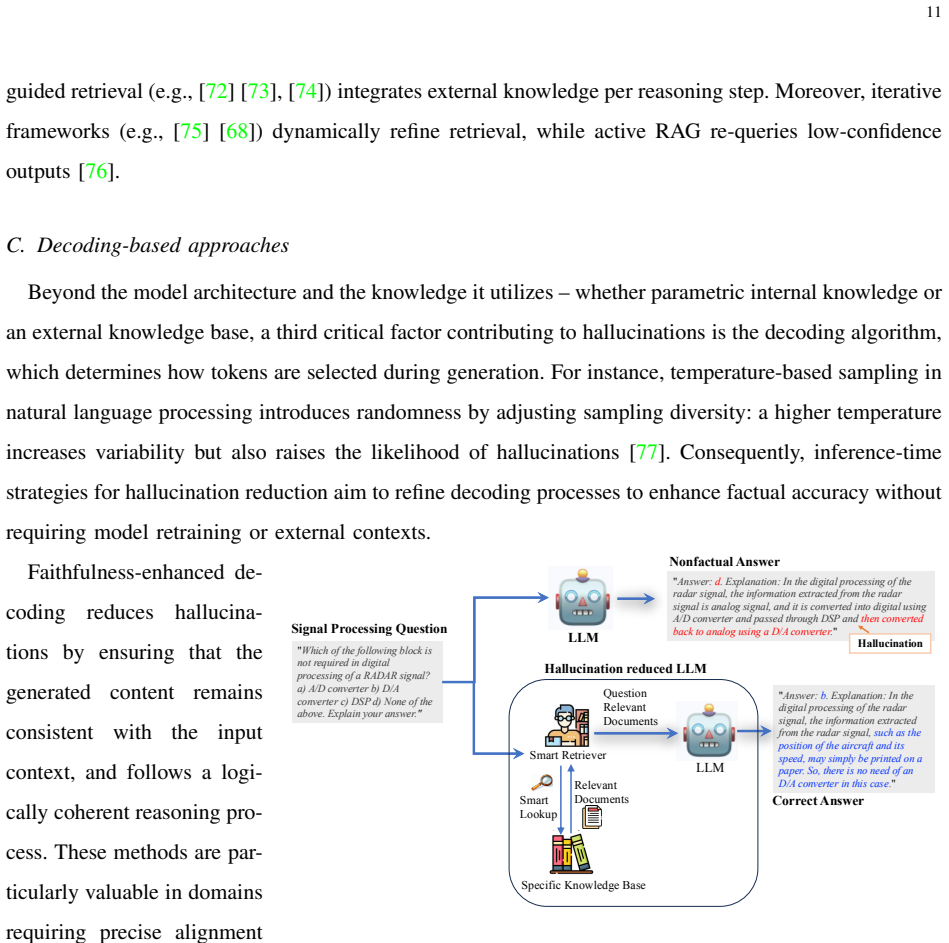
A randomized experiment: students learn from the proof-of-concept smart textbook versus a conventional SP textbook, with pre/post concept-inventory tests designed to catch typical LLM errors (e.g., the radar D/A-conversion question shown in the paper). If the AI-textbook group underperforms or the generated content exhibits uncorrected factual errors, the claim that cross-checking makes AI content trustworthy would be falsified.
If this is right
- Educators without programming or prompt-engineering expertise can produce interactive, browser-based SP simulations (MicroSims) from text descriptions, lowering the barrier to custom course materials.
- Content reliability can be improved at the workflow level—learning graphs, context, cross-checking—so individual instructors can mitigate hallucinations without retraining large models.
- Bayesian optimization can tune prompts and other course-design parameters with a small number of black-box LLM queries, keeping the cost of building such a textbook manageable.
- Fairness-aware AI techniques plus interest-driven matching can counteract historical biases in course and career recommendations, potentially improving representation in engineering fields.
- The verification strategy of combining LLM cross-checking with reference implementations (SciPy, MATLAB, GNU Radio) yields a practical quality bar for SP-specific content that goes beyond generic factuality checks.
Where Pith is reading between the lines
- The same learning-graph-plus-verification workflow would likely transfer to other quantitative disciplines whose content is provable and dependency-structured, such as statistics, control theory, or circuit analysis—a generalization the paper does not claim.
- The paper's trust argument primarily covers computational and definitional content; for narrative or historical material (e.g., the graphic-novel history of SP), cross-checking against software packages has no analogue, leaving those parts less protected.
- A direct, untested consequence is that the completeness of the human-curated learning graph becomes the true bottleneck: a missing or wrongly-ordered concept would propagate errors through all downstream generation, so the quality of the graph, not the LLM, likely determines the quality of the textbook.
- LLM cross-checking may be circular if the checking model shares the same training distribution and blind spots; an independent audit against a held-out corpus of SP problems would provide a stronger guarantee than the paper currently establishes.
Editorial analysis
A structured set of objections, weighed in public.
Referee Report
Summary. The paper is a perspective/case-study article on using generative AI for signal processing (SP) education. It surveys three technical challenge areas: fairness-aware AI (Section II), hallucination mitigation in LLMs (Section III), and query-efficient design via Bayesian optimization (Section IV). It then describes a proof-of-concept 'intelligent SP textbook' (Section V) built from curated learning graphs, LLM-generated content, prompt-engineering workflows, and interactive JavaScript MicroSims, with validation primarily based on LLM cross-checking and reference implementations. The stated goal is to show that current AI tools can help create a 'trusted, personalized, immersive, and reliable' SP educational resource.
Significance. If the central claim were established, the proposed workflow would be a useful template for educators and could lower the barrier to creating interactive, personalized SP learning materials. The paper does provide a genuinely useful primer on fairness metrics, hallucination taxonomies and mitigation strategies, and Bayesian optimization for prompt design; it also makes the proof-of-concept artifact and its generation prompts publicly available, which is a strength. However, the paper's headline claim—that the resulting smart textbook is 'reliable'—is not supported by any empirical evaluation. There is no user study, no learning-outcome data, no factual-accuracy audit of the generated prose, and no assessment of the companion website. The article itself concedes this gap in Section V.C. The value of the paper is therefore mainly as a discussion document and a workflow proposal, not as a validated demonstration of trustworthy AI-generated SP education.
major comments (3)
- [Abstract and §V.C] The word 'reliable' is load-bearing in the abstract and throughout Section V, but no evaluation is provided that would substantiate it. Section V.C explicitly states 'there are still no guarantees that generated educational content will be more effective than a well-written static paper textbook.' No data on factual accuracy, hallucination rate, expert review, or learning outcomes is reported, and the companion site [96] is not assessed. Either provide such evidence (e.g., a sampled comparison of generated definitions/derivations against a standard SP textbook, or a small user study) or substantially soften the claim—e.g., describe the artifact as a 'proof of concept with verification strategies under development' rather than 'reliable.'
- [§V.C] The verification strategy has an independence problem. Having one LLM cross-check another LLM's output cannot establish ground truth, because LLMs can share correlated training data and correlated false beliefs; the paper gives no guard against that failure mode. Reference implementations (MATLAB/SciPy/GNU Radio) can validate numerical examples and code, but not the prose definitions, derivations, and pedagogical explanations that constitute most of the textbook. A concrete fix would be to test the cross-checking protocol on a held-out set of SP facts with known ground truth, measuring how often the verifier catches injected errors. Without such a test, the 'trustworthiness' premise remains asserted rather than demonstrated.
- [§I.A and §V] The introduction states the objective is to 'assess the efficacy of current AI tools in creating ... content in a purely automated and trustable way' (end of Section I.A). However, Section V is a workflow description, not an efficacy assessment. No quantitative or controlled comparison is made between LLM-generated content and existing high-quality static textbooks, and no student-facing evaluation is reported. This mismatch between stated objective and delivered evidence should be reconciled: either the claim should be restricted to 'feasibility' or the missing assessment should be added.
minor comments (6)
- [§III.D] The summary paragraph refers to 'encoding-based approach' when the section title and content describe decoding-based approaches. Please correct.
- [References [35] and [36]] References [35] and [36] appear to be the same paper ('Fast & fair: Training acceleration and bias mitigation for GNNs') with different years (2022 and 2023) and different venues. Please verify and merge or clarify.
- [§II.B] Typo: 'Notwithstanging' should be 'Notwithstanding.'
- [§III] Typo: 'tayloring' should be 'tailoring.'
- [§V.B.6] 'pj.js editing tool' should be 'p5.js editing tool.'
- [§IV.B] Typo: 'aplication programming interface' should be 'application programming interface.'
Circularity Check
No significant circularity: the paper is a review plus proof-of-concept demonstration, not a derivation; its main weakness is unvalidated trustworthiness, which is an evidence gap rather than a circular reduction.
full rationale
The paper does not derive a prediction or first-principles result from fitted inputs. Section V is a workflow description for generating a smart textbook with LLMs, MicroSims, and learning graphs; Section IV presents Bayesian optimization as a primer and cites InstructZero [90] and related work, but the proof-of-concept does not reduce to those methods. The self-citations to Kose/Shen, Lu/Giannakis, Chen et al., and McCreary are normal citations to prior work and are not load-bearing: none is invoked as a uniqueness theorem or as the source of a derived quantity. The closest candidate is V.C, where LLM cross-checking is proposed to improve veracity; this is not an independent oracle, and the paper itself concedes 'there are still no guarantees that generated educational content will be more effective than a well-written static paper textbook.' That is an unsupported empirical assumption about validation, not a self-definitional reduction or a fitted parameter renamed as a prediction. No equation in the paper is shown to equal its own input, and no benchmark result is claimed from fitted data. Hence no circularity; the trustworthiness gap belongs in correctness/evidence risk.
Axiom & Free-Parameter Ledger
axioms (4)
- domain assumption Cognitive load theory implies personalized learning reduces cognitive overload and improves learning
- standard math The kernel-based GP posterior specified in Section IV.A is valid for the black-box objective
- standard math The random projection R preserves distances so BO in the reduced space is consistent
- domain assumption LLMs can be made sufficiently accurate for SP education via RAG, fine-tuning, or decoding methods
Cite this review
Pith. "Pith review of Deploying AI for Signal Processing education: Selected challenges and intriguing opportunities." pith.science (2026). https://pith.science/paper/V5VNGFK5
@misc{pith2026250908950,
  author       = {Pith},
  title        = {Pith review of: Deploying AI for Signal Processing education: Selected challenges and intriguing opportunities},
  year         = {2026},
  howpublished = {\url{https://pith.science/paper/V5VNGFK5}},
  note         = {Machine review of arXiv:2509.08950}
}
read the original abstract
Powerful artificial intelligence (AI) tools that have emerged in recent years -- including large language models, automated coding assistants, and advanced image and speech generation technologies -- are the result of monumental human achievements. These breakthroughs reflect mastery across multiple technical disciplines and the resolution of significant technological challenges. However, some of the most profound challenges may still lie ahead. These challenges are not purely technical but pertain to the fair and responsible use of AI in ways that genuinely improve the global human condition. This article explores one promising application aligned with that vision: the use of AI tools to facilitate and enhance education, with a specific focus on signal processing (SP). It presents two interrelated perspectives: identifying and addressing technical limitations, and applying AI tools in practice to improve educational experiences. Primers are provided on several core technical issues that arise when using AI in educational settings, including how to ensure fairness and inclusivity, handle hallucinated outputs, and achieve efficient use of resources. These and other considerations -- such as transparency, explainability, and trustworthiness -- are illustrated through the development of an immersive, structured, and reliable "smart textbook." The article serves as a resource for researchers and educators seeking to advance AI's role in engineering education.
Figures


Reference graph
Works this paper leans on
-
[1]
The role of learning in returns to college major: evidence from 2.8 million reviews of 150,000 professors,
V . Novik, “The role of learning in returns to college major: evidence from 2.8 million reviews of 150,000 professors,” Available at SSRN 4275668, 2022. 2
2022
-
[2]
J. L. Plass, R. Moreno, and R. Br ¨unken,Cognitive load theory. Cambridge University Press, 2010. 2
2010
-
[3]
Cognitive load theory, educational research, and instructional design: Some food for thought,
T. D. Jong, “Cognitive load theory, educational research, and instructional design: Some food for thought,”Instructional Science, vol. 38, no. 2, pp. 105–134, 2010. 2
2010
-
[4]
The flipped classroom: A review of its advantages and challenges,
G. Akc ¸ayır and M. Akc ¸ayır, “The flipped classroom: A review of its advantages and challenges,”Computers & Education, vol. 126, pp. 334–345, 2018. 2
2018
-
[5]
The flipped classroom: A survey of the research,
J. Bishop and M. A. Verleger, “The flipped classroom: A survey of the research,” in2013 ASEE Annual Conference & Exposition, 2013, pp. 23–1200. 3
2013
-
[6]
The flipped classroom in engineering education: A survey of the research,
B. Kerr, “The flipped classroom in engineering education: A survey of the research,” in2015 International Conference on Interactive Collaborative Learning (ICL). IEEE, 2015, pp. 815–818. 3
2015
-
[7]
Flipping signal-processing instruction [sp education],
B. V . Veen, “Flipping signal-processing instruction [sp education],”IEEE Signal Processing Magazine, vol. 30, no. 6, pp. 145–150, 2013. 3
2013
-
[8]
GPT-4 — Wikipedia, the free encyclopedia,
Wikipedia, “GPT-4 — Wikipedia, the free encyclopedia,” http://en.wikipedia.org/w/index.php?title=GPT-4, 2025, [Online; accessed 28-January-2025]. 3 September 22, 2025 DRAFT 24
2025
-
[9]
A. Wanjala. (2024) AI tools are making films: Here are 5 sites where you can watch. [Online]. Available: https://www.makeuseof.com/sites-where-you-can-watch-ai-films/ 3
2024
-
[10]
Scientific discovery in the age of artificial intelligence,
H. Wanget al., “Scientific discovery in the age of artificial intelligence,”Nature, vol. 620, no. 7972, pp. 47–60, 2023. 3
2023
-
[11]
Leandojo: Theorem proving with retrieval-augmented language models,
K. Yanget al., “Leandojo: Theorem proving with retrieval-augmented language models,”Advances in Neural Information Processing Systems, vol. 36, 2024. 3
2024
-
[12]
Highly accurate protein structure prediction with AlphaFold,
J. Jumperet al., “Highly accurate protein structure prediction with AlphaFold,”nature, vol. 596, no. 7873, pp. 583–589,
-
[13]
Artificial intelligence in drug discovery and development,
K.-K. Mak, Y .-H. Wong, and M. R. Pichika, “Artificial intelligence in drug discovery and development,”Drug discovery and evaluation: Safety and pharmacokinetic assays, pp. 1461–1498, 2024. 3
2024
-
[14]
6g wireless communication systems: Applications, requirements, technologies, challenges, and research directions,
M. Z. Chowdhury, M. Shahjalal, S. Ahmed, and Y . M. Jang, “6g wireless communication systems: Applications, requirements, technologies, challenges, and research directions,”IEEE Open Journal of the Communications Society, vol. 1, pp. 957–975, 2020. 3
2020
-
[15]
Trust in artificial intelligence: A global study,
N. Gillespie, S. Lockey, C. Curtis, J. Pool, and A. Akbari, “Trust in artificial intelligence: A global study,”The University of Queensland and KPMG Australia, vol. 10, 2023. 4
2023
-
[16]
Systematic review of research on artificial intelligence applications in higher education,
O. Zawacki-Richter, V . I. Mar ´ın, M. Bond, and F. Gouverneur, “Systematic review of research on artificial intelligence applications in higher education,”International Journal of Educational Technology in Higher Education, vol. 16, no. 1, p. 39, 2019. 5
2019
-
[17]
Luckin,Machine learning and human intelligence: The future of education for the 21st century
R. Luckin,Machine learning and human intelligence: The future of education for the 21st century. UCL Institute of Education Press, 2018. 5, 7
2018
-
[18]
Holmes, M
W. Holmes, M. Bialik, and C. Fadel,Artificial intelligence in education: Promises and implications for teaching and learning. Center for Curriculum Redesign, 2020. 5
2020
-
[19]
The impact of intelligent tutoring systems on student learning,
K. R. Koedinger and A. T. Corbett, “The impact of intelligent tutoring systems on student learning,”Educational Psychologist, vol. 41, no. 3, pp. 183–206, 2019. 6
2019
-
[20]
How effective is online learning? evidence from a large-scale study of k-12 students,
J. F. Pane, E. D. Steiner, M. D. Baird, and L. S. Hamilton, “How effective is online learning? evidence from a large-scale study of k-12 students,” RAND Corporation, Tech. Rep., 2017. 6
2017
-
[21]
R. S. Baker and P. S. Inventado,Educational data mining and learning analytics. Springer, 2014. 6
2014
-
[22]
How artificial intelligence is transforming the future of education,
D. M. West, M. Rhoads, and J. Choi, “How artificial intelligence is transforming the future of education,”Brookings Institution, 2019. 6
2019
-
[23]
Counterfactual fairness,
M. J. Kusner, J. Loftus, C. Russell, and R. Silva, “Counterfactual fairness,”Advances in neural information processing systems, vol. 30, 2017. 6
2017
-
[24]
Fairness through awareness,
C. Dwork, M. Hardt, T. Pitassi, O. Reingold, and R. Zemel, “Fairness through awareness,” inProceedings of the 3rd innovations in theoretical computer science conference, 2012, pp. 214–226. 6
2012
-
[25]
Equality of opportunity in supervised learning,
M. Hardt, E. Price, and N. Srebro, “Equality of opportunity in supervised learning,”Advances in neural information processing systems, vol. 29, 2016. 6
2016
-
[26]
Selwyn,Education and technology: Key issues and debates
N. Selwyn,Education and technology: Key issues and debates. Bloomsbury Publishing, 2020. 7
2020
-
[27]
Graph machine learning in the era of large language models (LLMs),
W. Fanet al., “Graph machine learning in the era of large language models (LLMs),”arXiv preprint arXiv:2404.14928,
-
[28]
Graph learning in the era of llms: A survey from the perspective of data, models, and tasks,
X. Liet al., “Graph learning in the era of llms: A survey from the perspective of data, models, and tasks,”arXiv preprint arXiv:2412.12456, 2024. 7
Pith/arXiv arXiv 2024
-
[29]
A comprehensive survey on graph neural networks,
Z. Wu, S. Pan, F. Chen, G. Long, C. Zhang, and P. S. Yu, “A comprehensive survey on graph neural networks,”IEEE Transactions on Neural Networks and Learning Systems, vol. 32, no. 1, pp. 4–24, 2020. 7 September 22, 2025 DRAFT 25
2020
-
[30]
Semi-supervised classification with graph convolutional networks,
T. N. Kipf and M. Welling, “Semi-supervised classification with graph convolutional networks,”International Conference on Learning Representations (ICLR), 2017. 7
2017
-
[31]
Graph neural networks: A review of methods and applications,
J. Zhou, G. Cui, Z. Zhang, C. Yang, Z. Liu, L. Wang, C. Li, and M. Sun, “Graph neural networks: A review of methods and applications,”AI Open, vol. 1, pp. 57–81, 2020. 7
2020
-
[32]
Gnnexplainer: Generating explanations for graph neural networks,
Z. Ying, D. Bourgeois, J. You, M. Zitnik, and J. Leskovec, “Gnnexplainer: Generating explanations for graph neural networks,”Advances in neural information processing systems, vol. 32, 2019. 7
2019
-
[33]
Demystifying and mitigating bias for node representation learning,
O. D. Kose and Y . Shen, “Demystifying and mitigating bias for node representation learning,”IEEE Transactions on Neural Networks and Learning Systems, 2023. 7
2023
-
[34]
Fair contrastive learning on graphs,
——, “Fair contrastive learning on graphs,”IEEE Transactions on Signal and Processing over Networks, vol. 8, pp. 475–488, 2022. 7
2022
-
[35]
Fast&fair: Training acceleration and bias mitigation for GNNs,
——, “Fast&fair: Training acceleration and bias mitigation for GNNs,”Transactions on Machine Learning Research, 2023. 7
2023
-
[36]
Fast&fair: Training acceleration and bias mitigation for gnns,
——, “Fast&fair: Training acceleration and bias mitigation for gnns,”Transactions on Machine Learning Research, 2022. 7
2022
-
[37]
FairGAT: Fairness-aware graph attention networks,
——, “FairGAT: Fairness-aware graph attention networks,”ACM Transactions on Knowledge Discovery from Data, vol. 18, no. 7, pp. 1–20, 2024. 7
2024
-
[38]
Fairness-aware graph filter design,
O. D. Kose, Y . Shen, and G. Mateos, “Fairness-aware graph filter design,”arXiv preprint arXiv:2303.11459, 2023. 7
Pith/arXiv arXiv 2023
-
[39]
Fairwire: Fair graph generation,
O. D. Kose and Y . Shen, “Fairwire: Fair graph generation,”Advances in neural information processing systems, 2024. 7
2024
-
[40]
DP-FT: A differential privacy graph generation with field theory for social network data release,
H. Zhu, X. Zuo, and M. Xie, “DP-FT: A differential privacy graph generation with field theory for social network data release,”IEEE access, vol. 7, pp. 164 304–164 319, 2019. 7
2019
-
[41]
Generative pretrained autoregressive transformer graph neural network applied to the analysis and discovery of novel proteins,
M. J. Buehler, “Generative pretrained autoregressive transformer graph neural network applied to the analysis and discovery of novel proteins,”Journal of Applied Physics, vol. 134, no. 8, 2023. 7
2023
-
[42]
Graph generation with prescribed feature constraints,
X. Ying and X. Wu, “Graph generation with prescribed feature constraints,” inProc. International Conference on Data Mining (SIAM), 2009, pp. 966–977. 7
2009
-
[43]
Graphgpt: Graph learning with generative pre-trained transformers,
Q. Zhao, W. Ren, T. Li, X. Xu, and H. Liu, “Graphgpt: Graph learning with generative pre-trained transformers,”arXiv preprint arXiv:2401.00529, 2023. 7
Pith/arXiv arXiv 2023
-
[44]
The challenge of using llms to simulate human behavior: A causal inference perspective,
G. Gui and O. Toubia, “The challenge of using llms to simulate human behavior: A causal inference perspective,”arXiv preprint arXiv:2312.15524, 2023. 8
arXiv 2023
-
[45]
Causal inference with large language model: A survey,
J. Ma, “Causal inference with large language model: A survey,”arXiv preprint arXiv:2409.09822, 2024. 8
Pith/arXiv arXiv 2024
-
[46]
Large language models and causal inference in collaboration: A comprehensive survey,
X. Liuet al., “Large language models and causal inference in collaboration: A comprehensive survey,”arXiv preprint arXiv:2403.09606, 2024. 8
Pith/arXiv arXiv 2024
-
[47]
Pearl,Causality: Models, reasoning, and inference
J. Pearl,Causality: Models, reasoning, and inference. Cambridge University Press, 2009. 8
2009
-
[48]
G. W. Imbens and D. B. Rubin,Causal inference in statistics, social, and biomedical sciences. Cambridge University Press, 2015. 8
2015
-
[49]
Topology identification and learning over graphs: Accounting for nonlinearities and dynamics,
G. B. Giannakis, Y . Shen, and G. V . Karanikolas, “Topology identification and learning over graphs: Accounting for nonlinearities and dynamics,”Proceedings of the IEEE, vol. 106, no. 5, pp. 787–807, 2018. 8
2018
-
[50]
Kernel-based structural equation models for topology identification of directed networks,
Y . Shen, B. Baingana, and G. B. Giannakis, “Kernel-based structural equation models for topology identification of directed networks,”IEEE Transactions on Signal Processing, vol. 65, no. 10, pp. 2503–2516, 2017. 8
2017
-
[51]
Simulating classroom education with llm-empowered agents,
Z. Zhanget al., “Simulating classroom education with llm-empowered agents,”arXiv preprint arXiv:2406.19226, 2024. 8
Pith/arXiv arXiv 2024
-
[52]
Large language models for education: A survey,
H. Xu, W. Gan, Z. Qi, J. Wu, and P. S. Yu, “Large language models for education: A survey,”arXiv preprint arXiv:2405.13001, 2024. 8 September 22, 2025 DRAFT 26
Pith/arXiv arXiv 2024
-
[53]
On faithfulness and factuality in abstractive summarization,
J. Maynez, S. Narayan, B. Bohnet, and R. McDonald, “On faithfulness and factuality in abstractive summarization,” in Proceedings of the 58th Annual Meeting of the Association for Computational Linguistics. Online: Association for Computational Linguistics, Jul. 2020, pp. 1906–1919. 8, 9
2020
-
[54]
Hallucinations in llms: Understanding and addressing challenges,
G. Perkovi ´c, A. Drobnjak, and I. Boti ˇcki, “Hallucinations in llms: Understanding and addressing challenges,” in2024 47th MIPRO ICT and Electronics Convention (MIPRO). IEEE, 2024, pp. 2084–2088. 8
2024
-
[55]
Prioritizing safeguarding over autonomy: Risks of llm agents for science,
X. Tanget al., “Prioritizing safeguarding over autonomy: Risks of llm agents for science,”arXiv preprint arXiv:2402.04247,
-
[56]
The problems of llm-generated data in social science research,
L. Rossi, K. Harrison, and I. Shklovski, “The problems of llm-generated data in social science research,”Sociologica, vol. 18, no. 2, pp. 145–168, 2024. 8
2024
-
[57]
What future do we want with artificial intelligence?
Y . Dong, “What future do we want with artificial intelligence?” 2023, accessed: 2025-02-10. [Online]. Available: https://www.youtube.com/watch?v=w5fmMcrwk I 8
2023
-
[58]
Unlocking the power of chatgpt: A framework for applying generative ai in education,
J. Su and W. Yang, “Unlocking the power of chatgpt: A framework for applying generative ai in education,”ECNU Review of Education, vol. 6, no. 3, pp. 355–366, 2023. 8
2023
-
[59]
Ai in education: The problem with hallucinations,
eSpark Learning, “Ai in education: The problem with hallucinations,” 2023, accessed: 2024-11-06. [Online]. Available: https://www.esparklearning.com/blog/ai-in-education-the-problem-with-hallucinations/ 8
2023
-
[60]
Controlled hallucinations: Learning to generate faithfully from noisy data,
K. Filippova, “Controlled hallucinations: Learning to generate faithfully from noisy data,” inFindings of the Association for Computational Linguistics: EMNLP 2020. Online: Association for Computational Linguistics, Nov. 2020, pp. 864–870. 9
2020
-
[61]
Hallucinated but factual! inspecting the factuality of hallucinations in abstractive summarization,
M. Cao, Y . Dong, and J. C. K. Cheung, “Hallucinated but factual! inspecting the factuality of hallucinations in abstractive summarization,”arXiv preprint arXiv:2109.09784, 2021. 9
Pith/arXiv arXiv 2021
-
[62]
Entity-based knowledge conflicts in question answering,
S. Longpre, K. Perisetla, A. Chen, N. Ramesh, C. DuBois, and S. Singh, “Entity-based knowledge conflicts in question answering,” inProceedings of the 2021 Conference on Empirical Methods in Natural Language Processing, 2021. 9
2021
-
[63]
Survey of hallucination in natural language generation,
Z. Jiet al., “Survey of hallucination in natural language generation,”ACM Comput. Surv., vol. 55, no. 12, Mar. 2023. 9
2023
-
[64]
A survey on hallucination in large language models: Principles, taxonomy, challenges, and open questions,
L. Huanget al., “A survey on hallucination in large language models: Principles, taxonomy, challenges, and open questions,” ACM Trans. Inf. Syst., vol. 43, no. 2, Jan. 2025. 9
2025
-
[65]
Batgpt: A bidirectional autoregessive talker from generative pre-trained transformer,
Z. Li, S. Zhang, H. Zhao, Y . Yang, and D. Yang, “Batgpt: A bidirectional autoregessive talker from generative pre-trained transformer,” 2023. [Online]. Available: https://arxiv.org/abs/2307.00360 10
Pith/arXiv arXiv 2023
-
[66]
Lost in the middle: How language models use long contexts,
N. F. Liuet al., “Lost in the middle: How language models use long contexts,”Transactions of the Association for Computational Linguistics, vol. 12, pp. 157–173, 2024. 10
2024
-
[67]
In-context pretraining: Language modeling beyond document boundaries,
W. Shiet al., “In-context pretraining: Language modeling beyond document boundaries,” inThe Twelfth International Conference on Learning Representations, 2024. [Online]. Available: https://openreview.net/forum?id=LXVswInHOo 10
2024
-
[68]
Simple synthetic data reduces sycophancy in large language models,
J. Wei, D. Huang, Y . Lu, D. Zhou, and Q. V . Le, “Simple synthetic data reduces sycophancy in large language models,”
-
[69]
In-context retrieval-augmented language models,
O. Ramet al., “In-context retrieval-augmented language models,”Transactions of the Association for Computational Linguistics, vol. 11, pp. 1316–1331, 2023. 10
2023
-
[70]
Knowledge-augmented language model prompting for zero-shot knowledge graph question answering,
J. Baek, A. F. Aji, and A. Saffari, “Knowledge-augmented language model prompting for zero-shot knowledge graph question answering,” inProceedings of the 1st Workshop on Natural Language Reasoning and Structured Explanations (NLRSE). Toronto, Canada: Association for Computational Linguistics, Jun. 2023, pp. 78–106. 10
2023
-
[71]
MindMap: Knowledge graph prompting sparks graph of thoughts in large language models,
Y . Wen, Z. Wang, and J. Sun, “MindMap: Knowledge graph prompting sparks graph of thoughts in large language models,” inProceedings of the 62nd Annual Meeting of the Association for Computational Linguistics (Volume 1: Long Papers). Bangkok, Thailand: Association for Computational Linguistics, Aug. 2024, pp. 10 370–10 388. 10 September 22, 2025 DRAFT 27
2024
-
[72]
Rethinking with retrieval: Faithful large language model inference,
H. He, H. Zhang, and D. Roth, “Rethinking with retrieval: Faithful large language model inference,” 2022. [Online]. Available: https://arxiv.org/abs/2301.00303 11
Pith/arXiv arXiv 2022
-
[73]
Interleaving retrieval with chain-of-thought reasoning for knowledge-intensive multi-step questions,
H. Trivedi, N. Balasubramanian, T. Khot, and A. Sabharwal, “Interleaving retrieval with chain-of-thought reasoning for knowledge-intensive multi-step questions,” inProceedings of the 61st Annual Meeting of the Association for Computational Linguistics (Volume 1: Long Papers). Toronto, Canada: Association for Computational Linguistics, Jul. 2023, pp. 10 01...
2023
-
[74]
React: Synergizing reasoning and acting in language models,
S. Yaoet al., “React: Synergizing reasoning and acting in language models,”arXiv preprint arXiv:2210.03629, 2022. 11
Pith/arXiv arXiv 2022
-
[75]
Enhancing retrieval-augmented large language models with iterative retrieval-generation synergy,
Z. Shaoet al., “Enhancing retrieval-augmented large language models with iterative retrieval-generation synergy,” in Findings of the Association for Computational Linguistics: EMNLP 2023. Singapore: Association for Computational Linguistics, Dec. 2023, pp. 9248–9274. 11
2023
-
[76]
Active retrieval augmented generation,
Z. Jianget al., “Active retrieval augmented generation,” inProceedings of the 2023 Conference on Empirical Methods in Natural Language Processing. Singapore: Association for Computational Linguistics, Dec. 2023, pp. 7969–7992. 11
2023
-
[77]
LLMs will always hallucinate, and we need to live with this,
S. Banerjee, A. Agarwal, and S. Singla, “LLMs will always hallucinate, and we need to live with this,” 2024. [Online]. Available: https://arxiv.org/abs/2409.05746 11
Pith/arXiv arXiv 2024
-
[78]
Trusting your evidence: Hallucinate less with context-aware decoding,
W. Shi, X. Han, M. Lewis, Y . Tsvetkov, L. Zettlemoyer, and W.-T. Yih, “Trusting your evidence: Hallucinate less with context-aware decoding,” inProceedings of the 2024 Conf. NAACL: Human Language Technologies (Volume 2: Short Papers). Mexico City, Mexico: Association for Computational Linguistics, Jun. 2024, pp. 783–791. 11
2024
-
[79]
RARR: Researching and revising what language models say, using language models,
L. Gaoet al., “RARR: Researching and revising what language models say, using language models,” inProceedings of the 61st Annual Meeting of the Association for Computational Linguistics (Volume 1: Long Papers). Toronto, Canada: Association for Computational Linguistics, Jul. 2023, pp. 16 477–16 508. 11
2023
-
[80]
Chain of natural language inference for reducing large language model ungrounded hallucinations,
D. Leiet al., “Chain of natural language inference for reducing large language model ungrounded hallucinations,” 2023. [Online]. Available: https://arxiv.org/abs/2310.03951 11
Pith/arXiv arXiv 2023
discussion (0)
Sign in with ORCID, Apple, or X to comment. Anyone can read and Pith papers without signing in.