REVIEW 5 major objections 6 minor 1 cited by
Sculpting Quantum Landscapes: Fubini-Study Metric Conditioning for Geometry Aware Learning in Parameterized Quantum Circuits
T0 review · 5 major / 6 minor · reviewed 2026-08-06 · deepseek-v4-flash
Pith's one-line read A classical meta-model learns to flatten the Fubini–Study metric of parameterized quantum circuits, and scaling that conditioning lifts diabetes classification accuracy from about 0.68 to above 0.78.
desk verdict Plausible new meta-learning objective for PQC initialization, but the headline log-κ reduction is computed on an unvalidated block-diagonal proxy; worth sending to review, expecting major revision. read the letter →
The pith
A machine-rendered reading of the paper's core claim, the machinery that carries it, and where it could break.
The reading
What carries the argument
The load-bearing object is the Fubini–Study metric tensor $G_{ij}(\boldsymbol{\theta}) = \frac{1}{4}\mathrm{Cov}_{\psi}(H_i,H_j)$, which measures how infinitesimal parameter shifts change the quantum state; its logarithmic condition number $\log\kappa(G) = \log(\lambda_{\max}/\lambda_{\min})$ quantifies anisotropy in parameter sensitivity. The paper's mechanism is a composite parameterization $\boldsymbol{\theta}(x) = \boldsymbol{\theta}_{\mathrm{task}} + \lambda\boldsymbol{\theta}_{\mathrm{meta}}(x)$, where a classical meta-model outputs $\boldsymbol{\theta}_{\mathrm{meta}}(x)$ and is trained to minimize the average $\log\kappa$ of the metric at those initializations, estimated on a block-diagonal approximation of $G$ using the parameter-shift rule. That quantity is the target of meta-training and the proposed explanation for better convergence and generalization downstream.
What would settle it
Measure the variance of the cost gradient for the same meta-learning objective on circuits with 8, 16, and 32 qubits while keeping $\log\kappa$ near 0.6; if gradient variance still decays exponentially with qubit count, then conditioning the local Fubini-Study metric is not the mechanism that removes barren plateaus.
Extended reading notes
Core claim
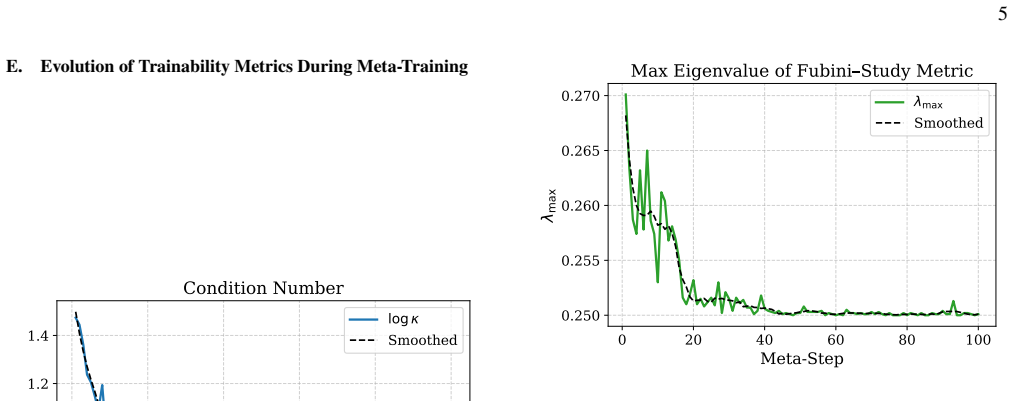
The paper's central claim is that conditioning the Fubini–Study metric of a PQC—specifically minimizing $\log\kappa = \log(\lambda_{\max}/\lambda_{\min})$ locally at the initialization point—is a geometric regularizer that improves optimization and generalization. The authors derive that this conditioning flattens the eigenvalue spectrum, increases the effective dimension, accelerates natural-gradient-style optimization, and tightens a PAC-Bayes generalization surrogate. Empirically, the meta-learner reduces $\log\kappa$ from approximately 1.4737 to 0.6375 over 100 meta-steps, with the minimum eigenvalue rising from 0.0635 to 0.1328 while the maximum eigenvalue falls from 0.2701 to 0.2501. The learned conditioning transfers to unseen inputs, and in the downstream classifier the meta-scaling coefficient $\lambda$ controls the trade-off: larger $\lambda$ yields faster convergence, smaller final gradient norms, and test accuracy that rises from about 0.68 to over 0.78.
Load-bearing premise
The argument assumes that the logarithmic condition number of the local Fubini-Study metric is the key control parameter for trainability, optimization speed, and generalization, so improvements measured on one 8-qubit, 3-layer circuit are taken to indicate general barren-plateau mitigation.
Editorial extensions
If this is right
- Well-conditioned initializations should make gradient-based optimizers converge in fewer epochs, since the quadratic convergence factor $\left(\frac{\kappa-1}{\kappa+1}\right)^2$ shrinks as $\kappa$ approaches 1.
- The generalization surrogate predicts that minimizing $\log\kappa$ reduces the effective complexity term $\mathrm{Tr}(G)/\lambda_{\min}$, so models trained from these initializations should generalize better on held-out data.
- Because the meta-model outputs are data-dependent, the same trained generator can supply initializations for new input instances without retraining, which the paper demonstrates on unseen test inputs.
- Scaling $\lambda$ toward 1 should produce faster convergence, lower final gradient norms, and higher test accuracy, matching the reported diabetes-classification results.
Reading between the lines
- Beyond the paper's own demonstration, if $\log\kappa$ is causal then the same meta-objective should suppress gradient decay on deeper and wider circuits; running the training at 16 and 32 qubits would test that directly.
- The paper measures conditioning at initialization; a natural extension would track $\log\kappa$ along the optimization trajectory, since a well-conditioned starting metric does not by itself guarantee the landscape stays flat during training.
- A control experiment that matches random initializations to the same small $\log\kappa$ would separate the effect of spectral conditioning from the meta-model's data-dependent parameter structure, which could be acting as an input-dependent regularizer in its own right.
Editorial analysis
A structured set of objections, weighed in public.
Referee Report
Summary. The paper proposes Sculpture, a classical meta-learning framework that generates data-dependent initializations for parameterized quantum circuits (PQCs) by explicitly minimizing the logarithmic condition number log kappa of the local Fubini-Study metric. The authors report that meta-training on an 8-qubit, 3-layer hardware-efficient ansatz reduces log kappa from approximately 1.47 to 0.64, that this conditioning transfers to unseen test inputs, and that in a downstream hybrid quantum-classical classification task on the Kaggle diabetes dataset, increasing the meta-scaling coefficient lambda improves convergence, lowers gradient norms, and raises test accuracy from about 0.68 to over 0.78. The paper also presents a theoretical framework linking log kappa to natural-gradient convergence and PAC-Bayes generalization, with a composite parameterization theta(x) = theta_task + lambda * theta_meta(x).
Significance. If the empirical claims survive scrutiny, the paper would make a useful contribution by introducing a differentiable, geometry-aware meta-objective for PQC initialization and by connecting spectral conditioning of the Fubini-Study metric to downstream optimization and generalization. The explicit composite parameterization and the fully differentiable meta-objective are clear strengths, and the paper states a falsifiable prediction about lambda scaling. However, the current validation has several load-bearing gaps: the reported log kappa values are computed on a block-diagonal proxy with an unreported eigenvalue cutoff, the reduction in log kappa is a restatement of the training objective, the downstream accuracy curves lack error bars and seed analysis, and the attribution of the accuracy gain to conditioning is confounded by the input-dependent parameter shift. The theoretical contribution is also weakened by the appendix's explicit statement that the PAC-Bayes expression is only a spectral surrogate, not a formal bound.
major comments (5)
- [Section IVB/IVC and Figures 1-3] The headline reduction in log kappa from approximately 1.47 to 0.64 is computed from a block-diagonal approximation of the Fubini-Study metric, and Section IVB states that eigenvalues below an unreported threshold epsilon are discarded. Since log kappa = log(lambda_max/lambda_min), discarding small eigenvalues directly replaces the true lambda_min by the smallest retained eigenvalue, and the meta-objective can be minimized by driving eigenvalues below epsilon rather than by genuinely flattening the spectrum. The paper never reports epsilon, the number or fraction of discarded eigenvalues, or a validation of the block-diagonal proxy against the full 72x72 metric (or a sensitivity analysis). This is load-bearing because the central empirical claim depends on the fidelity of this estimator; please provide these details and show that the proxy reproduces the full-metric condition number, or quantify the bias introduced by the truncation.
- [Section IVB step 3 and Section IVE] The meta-loss L_meta is defined as log kappa(Gbar) and the meta-model is trained to minimize it; Section IVE then reports that log kappa decreases from 1.47 to 0.64. This is a restatement of the training objective rather than an independent confirmation that the learned initialization is well conditioned in a meaningful sense. To support the trainability claims, please report out-of-sample log kappa at fixed meta-model checkpoints on the same metric used for evaluation, compare against random initializations under the same metric, and include an ablation with a different objective (for example, spectral entropy or a fixed random perturbation) to establish that the specific choice of log kappa matters and that the effect is not an artifact of the truncation rule.
- [Section V, Figures 7-12] The downstream claim that increasing lambda raises test accuracy from about 0.68 to over 0.78 is presented without error bars, number of random seeds, or statistical significance tests. The curves show substantial fluctuations (for example, Figure 11 around lambda near 0.15), the diabetes dataset is small, and the manuscript does not state whether each lambda is trained once or multiple times. Single-run results cannot support the generalization claim. Please provide mean and standard deviation over at least 5-10 independent seeds, report the number of runs, and include confidence intervals or a paired significance test for the lambda dependence.
- [Section VI and Eq. (A20)/Algorithm 2] The improvement in downstream test accuracy is attributed to improved Fubini-Study conditioning, but increasing lambda also changes the actual PQC parameters by introducing the input-dependent term lambda * theta_meta(x). Section VI itself concedes that a monotonic decrease in the global log kappa(G) at a fixed epoch is not consistently observed across lambda values. Therefore the observed accuracy gain could be caused by the data-dependent initialization itself rather than by conditioning of the FS metric. Please add a control experiment that compares against an input-dependent perturbation of the same magnitude but with random or untrained directions, and also report the local log kappa of the composed circuit at fixed checkpoints during downstream training to establish a direct link between conditioning and performance.
- [Section III.a and Appendix A6.e] Section III.a claims that PAC-Bayes generalization bounds are controlled by Tr(G)/lambda_min(G) and that minimizing the log condition number tightens these bounds, but Appendix A6.e explicitly states that Eq. (A28) is 'not a formally derived PAC-Bayes bound, but a spectral surrogate.' This is a direct contradiction between the main text and the appendix. Please correct the main text to clearly label the result as a heuristic surrogate, or provide a formal derivation with the required assumptions stated precisely. This matters because the theoretical framing is used to justify the choice of the meta-objective.
minor comments (6)
- [Section IVB] The output scale pi in the meta-model definition is never specified, and no sensitivity analysis is provided for this hyperparameter; please report its value and any tuning procedure.
- [Section IVC] The meta-training procedure does not specify the batch size B, the number of meta-steps T, the learning rate, the optimizer hyperparameters, or how the representative input x_rep is sampled; these details are necessary for reproducibility.
- [Section IVE, Figure 4] The y-axis label 'log Gradient Norm' is ambiguous because the plotted values appear to be raw Euclidean norms (e.g., 5.12 and 0.21); please clarify whether the quantity is logged and, if so, with which base.
- [Section IVF, Figure 5] The text states that random initializations yield broader, less favorable log kappa distributions, but no random-initialization baseline is shown in Figure 5; please include it or remove the comparison.
- [Figures 7-12] Several figure captions in the provided manuscript appear as corrupted glyph sequences rather than readable text (for example, the captions of Figures 7-12); this formatting issue must be fixed before publication.
- [References] Reference [16] appears to have an inconsistent author list ('Shouvanik Liu, Yu Li, Yingli Guo, and Yian Huang'); please check the actual authors of that arXiv preprint and correct it.
Circularity Check
The reported log-κ reduction is the meta-training loss itself, and the PAC-Bayes link is a self-defined spectral surrogate; the downstream λ-accuracy result is external, leaving only partial circularity.
-
fitted input called prediction
[Section IVC, Algorithm 1 (Meta-Training of Sculpture via FS Metric Conditioning), steps (f)-(g); Section IVE]
"Compute loss: L ← log κ(Ḡ) = log( λmax(Ḡ)/λmin(Ḡ) ) ... Update φ ← φ − η∇φ L via AdamW. ... At Meta-Step 1, the logarithmic condition number log κ is approximately 1.4737 ... reaches 0.6375 by Meta-Step 100. This substantial reduction demonstrates that Sculpture effectively learns to produce PQC parameters residing in better-conditioned regions of the parameter landscape."
The meta-model is trained by gradient descent on L = log κ of the FS metric, so the reported 1.47 → 0.64 decrease is the training-loss trajectory of the optimization objective, not an independent consequence of a theory. Presenting this decrease as empirical support for the 'theoretical prediction' that minimizing log κ reduces log κ is a restatement of the algorithm's update rule: minimizing a function and then reporting that the function decreased is forced by construction. The evaluation is also performed on the same block-diagonal, eigenvalue-thresholded proxy used as the training objective, making the headline numbers properties of the fitted objective rather than of the true FS metric.
-
self definitional
[Appendix A6 d-e (Eqs. A27-A28) and Section III a (Theoretical Predictions)]
"Plugging this estimate into the PAC-Bayes inequality gives ... R(θ) ≤ R̂_N(θ) + sqrt( C/N · Tr(G)/λmin(G) · log 1/δ ). ... This expression is not a formally derived PAC-Bayes bound, but a spectral surrogate that links generalization to the curvature of the quantum model's geometry. ... Thus, minimizing the log condition number directly tightens these bounds."
The 'generalization bound' is constructed in the appendix as a surrogate whose complexity term is Tr(G)/λmin(G), which Section III then bounds above by d·κ(G). Because the surrogate was defined to contain λmin(G) in the denominator, showing that improved conditioning tightens it is an identity, not a derivation. The paper explicitly disclaims that it is a formal PAC-Bayes bound, so invoking it as a theoretical prediction that log κ governs generalization imports the target conclusion into the premise.
full rationale
The paper contains two load-bearing circular steps. First, the central empirical claim that meta-training reduces log κ from about 1.47 to 0.64 is the direct result of optimizing L_meta = log κ(Ḡ) (Algorithm 1). A training curve of the optimized quantity cannot independently validate the theory that log κ is the critical geometric control; it is the objective by construction. Second, the theoretical link from log κ to generalization rests on a PAC-Bayes expression that the paper itself labels a 'spectral surrogate' and defines in terms of Tr(G)/λmin(G), bounded by d·κ(G). Tightening a self-defined surrogate by reducing κ is not an independent derivation. The downstream diabetes classification result with varying λ is genuinely external to the log-κ objective and provides non-circular evidence that the meta-learned initialization helps optimization and generalization; however, Section VI concedes that global log κ does not consistently decrease with λ, so the causal claim that conditioning drives the accuracy gain is unsupported rather than circular. There is no load-bearing self-citation or imported uniqueness theorem. Overall, partial circularity: some predictions reduce by construction, but the paper retains independent downstream evidence, yielding score 6.
Assumptions & free parameters
free parameters (3)
- lambda (meta-scaling coefficient) =
swept over [0,1]
- epsilon (eigenvalue cutoff) =
unreported
- pi (output scale of meta-model) =
unreported
assumptions (5)
- standard math The FS metric is a positive semidefinite symmetric matrix, so its eigenvalues are real and nonnegative.
- domain assumption Gradient descent convergence in the PQC loss landscape is governed by the FS metric as the relevant Hessian.
- ad hoc to paper Posterior covariance Sigma_Q is proportional to G^{-1}.
- domain assumption The block-diagonal approximation of the FS metric is accurate enough for the reported log kappa values.
- domain assumption Lower log kappa corresponds to mitigation of barren plateaus.
Cite this review
Pith. "Pith review of Sculpting Quantum Landscapes: Fubini-Study Metric Conditioning for Geometry Aware Learning in Parameterized Quantum Circuits." pith.science (2026). https://pith.science/paper/VC4L6KWV
@misc{pith2026250621940,
  author       = {Pith},
  title        = {Pith review of: Sculpting Quantum Landscapes: Fubini-Study Metric Conditioning for Geometry Aware Learning in Parameterized Quantum Circuits},
  year         = {2026},
  howpublished = {\url{https://pith.science/paper/VC4L6KWV}},
  note         = {Machine review of arXiv:2506.21940}
}
read the original abstract
We present a novel meta learning framework called Sculpture that explicitly conditions the Fubini Study metric tensor of parameterized quantum circuits to mitigate barren plateaus in variational quantum algorithms. Our theoretical analysis identifies the logarithmic condition number of the Fubini Study metric as a critical geometric quantity governing trainability, optimization dynamics, and generalization. Sculpture uses a classical meta model trained to generate data dependent quantum circuit initializations that minimize the logarithmic condition number, thereby promoting an isotropic and well conditioned parameter space. Empirical results show that meta training reduces the logarithmic condition number from approximately 1.47 to 0.64 by significantly increasing the minimum eigenvalue and slightly decreasing the maximum eigenvalue of the metric, effectively alleviating barren plateaus. This improved conditioning generalizes well to unseen data, consistently producing well conditioned quantum circuit initializations. In a downstream hybrid quantum classical classification task on the Kaggle diabetes dataset, increasing the meta scaling coefficient accelerates convergence, reduces training loss and gradient norms, and crucially improves generalization, with test accuracy increasing from about 0.68 to over 0.78. These findings demonstrate that sculpting the quantum landscape via meta learning serves as a principled geometric regularizer, substantially enhancing trainability, optimization, and generalization of parameterized quantum circuits and enabling more robust and efficient variational quantum algorithms.
Figures


Figures from the paper (8 more)


Forward citations
Cited by 1 Pith paper
-
From Qubits to Couplings: A Hybrid Quantum Machine Learning Framework for LHC Physics
A hybrid quantum-classical classifier on simulated HH→bbγγ events claims 95% CL limits of 1.9–2.1×SM, but the gain over XGBoost is 21–29%, not the advertised factor of two.
Reference graph
Works this paper leans on
-
[1]
Sample a representative input𝑥rep and generate𝜽(𝑥rep) using the meta-model
-
[2]
Evaluate the average FS metric¯𝐺 over a batch{𝑥𝑗}𝐵 𝑗=1 of inputs with PQCs initialized at𝜽(𝑥rep)
-
[3]
Computethemeta-loss Lmeta= log𝜅( ¯𝐺) fromtheeigen- values of ¯𝐺 and backpropagate through the meta-model
-
[4]
The FS metric is estimated via a block-diagonal approxima- tion
Update meta-model parameters using the AdamW opti- mizer. The FS metric is estimated via a block-diagonal approxima- tion. To maintain numerical stability, eigenvalues below a threshold𝜀 are discarded. Training is monitored for degenera- cies that may signal barren plateaus. This fully differentiable meta-objective enables the meta-model to learn paramete...
-
[5]
Initialize model parameters𝜙∼N( 0,𝜎 2), set learning rate𝜂
-
[6]
foreach meta-training step𝑡= 1,...,𝑇 do (a) Sample a representative input𝑥rep∼D (b) Generate PQC parameters:𝜽rep←M 𝜙(𝑥rep) (c) Sample a batch{𝑥𝑗}𝐵 𝑗=1⊂D for estimating FS metric (d) For each𝑥𝑗, construct circuit𝑈𝜽rep(𝑥𝑗) and compute block-diagonal FS metric𝐺(𝑥𝑗) (e) Average FS metric over batch:¯𝐺← 1 𝐵 Í𝐵 𝑗=1𝐺(𝑥𝑗) (f) Compute loss:L← log𝜅( ¯𝐺)= log 𝜆max( ...
-
[7]
end for Themeta-modelisoptimizedusingbackpropagationthrough a differentiable estimator oflog𝜅(𝐺). The metric tensor is computed with PennyLane using the parameter-shift rule and averaged across a mini-batch of circuits initialized with shared parameters but evaluated on diverse inputs. To detect barren plateaus, we also monitor the eigenvalue spectrum of𝐺...
-
[8]
Expressivepowerofparameterized quantum circuits.Physical Review Research, 3(3):033053, 2021
Yuxuan Du, Mingkai Hsieh, Zhikuan Zhao, Junde Wang, Daoyi Xu,HuiLi,andJinchuanLiu. Expressivepowerofparameterized quantum circuits.Physical Review Research, 3(3):033053, 2021. doi:10.1103/PhysRevResearch.3.033053. URLhttps://doi. org/10.1103/PhysRevResearch.3.033053
Show all 49 references
-
[9]
Computing nonvacuous generalization bounds for deep (stochastic) neural networks with many more parameters than training data.arXiv preprint arXiv:1703.11008, 2017
Gintare Karolina Dziugaite and Daniel M Roy. Computing nonvacuous generalization bounds for deep (stochastic) neural networks with many more parameters than training data.arXiv preprint arXiv:1703.11008, 2017
2017 arXiv
-
[10]
Abbas et al
A. Abbas et al. The power of quantum neural net- works. Nature Communications, 12(1):1–9, 2021. doi: 10.1038/s41467-021-23861-9. URL https://doi.org/10. 1038/s41467-021-23861-9
2021 doi
-
[11]
Comparative performance analysis of quan- tummachinelearningarchitecturesforcreditcardfrauddetection,
Mansour El Alami, Nouhaila Innan, Muhammad Shafique, and Mohamed Bennai. Comparative performance analysis of quan- tummachinelearningarchitecturesforcreditcardfrauddetection,
-
[12]
Hqcm-ebtc: A hybrid quantum-classical model for explainable brain tumor classification, 2025
Marwan Ait Haddou and Mohamed Bennai. Hqcm-ebtc: A hybrid quantum-classical model for explainable brain tumor classification, 2025. URL https://arxiv.org/abs/2506. 21937
2025
-
[13]
Natural gradient works efficiently in learning
Shun-ichi Amari. Natural gradient works efficiently in learning. Neural Computation, 10(2):251–276, 1998. doi: 10.1162/089976698300017746
1998 doi
-
[14]
Information geometry and its applications
Shun-ichi Amari. Information geometry and its applications. Springer Japan, 2016. doi:10.1007/978-4-431-55979-1
2016 doi
-
[15]
Quantum fisher information and the uncertainty relations
Samuel L Braunstein and Carlton M Caves. Quantum fisher information and the uncertainty relations. Physical Review Letters, 72(22):3439, 1994
1994
-
[16]
Cerezo, Andrew Arrasmith, Ryan Babbush, Patrick J
M. Cerezo, Andrew Arrasmith, Ryan Babbush, Patrick J. Coles, Lukasz Cincio, K. Fernandez-Fenollosa, Josh Izaac, Z. Kishore, M. Larocca, Xiao Li, et al. Variational quantum algorithms. Nature Reviews Physics, 3(9):625–644, 2021
2021
-
[17]
Cost function dependent barren plateaus in shallow quantum neural networks.npj Quantum Information, 7(1):1–11, 2021
M Cerezo, Andrew Arrasmith, Patrick J Coles, and Lukasz Cincio. Cost function dependent barren plateaus in shallow quantum neural networks.npj Quantum Information, 7(1):1–11, 2021
2021
-
[18]
Pac-bayesianmodelaveraging
DavidA.McAllester. Pac-bayesianmodelaveraging. In Proceed- ings of the 12th Annual Conference on Computational Learning Theory, pages 164–170. ACM, 1999
1999
-
[19]
Barrenplateausinquantumneural networks
Jarrod R McClean, Sergio Boixo, Vadim N Smelyanskiy, Ryan Babbush,andHartmutNeven. Barrenplateausinquantumneural networks. Nature Communications, 9(1):2913, 2018
2018
-
[20]
is not consistently observed across all𝜆 values, the overall effect of increasing𝜆 is to facilitate a more efficient and stable optimization trajectory. This is evidenced by the consistent reduction in training loss, improved test accuracy, and no- tably, the decrease in final...
-
[21]
A survey of methods for mitigating barren plateaus for parameterized quantum circuits.arXiv preprint arXiv:2406.14285, 2024
Michelle Gelman. A survey of methods for mitigating barren plateaus for parameterized quantum circuits.arXiv preprint arXiv:2406.14285, 2024
2024 arXiv
-
[22]
An initialization strategy for addressing barren plateaus in variational quantum algorithms.Quantum, 3: 214, 2019
EdwardGrant,LeonardWossnig,MarcelloBenedetti,LiangCao, and Simone Severini. An initialization strategy for addressing barren plateaus in variational quantum algorithms.Quantum, 3: 214, 2019
2019
-
[23]
Estimation of quantum fisher information via stein’sidentityinvariationalquantumalgorithms
Mourad Halla. Estimation of quantum fisher information via stein’sidentityinvariationalquantumalgorithms. arXivpreprint arXiv:2502.17231, 2025
2025 arXiv
-
[24]
Quantum natural gradient with geodesic correc- tions for small shallow quantum circuits.Physica Scripta, 100 (5):055121, 2025
Mourad Halla. Quantum natural gradient with geodesic correc- tions for small shallow quantum circuits.Physica Scripta, 100 (5):055121, 2025
2025
-
[25]
Meta-learning in neural networks: A survey
Timothy Hospedales, Antreas Antoniou, Paul Micaelli, and Amos Storkey. Meta-learning in neural networks: A survey. IEEETransactionsonPatternAnalysisandMachineIntelligence , 44(9):5149–5169, 2020
2020
-
[26]
Meta- learning for quantum neural networks
Shouvanik Liu, Yu Li, Yingli Guo, and Yian Huang. Meta- learning for quantum neural networks. arXiv preprint 11 arXiv:2104.09506, 2021
2021 arXiv
-
[27]
Qfal: Quantum federated adversarial learning, 2025
Walid El Maouaki, Nouhaila Innan, Alberto Marchisio, Taoufik Said, Mohamed Bennai, and Muhammad Shafique. Qfal: Quantum federated adversarial learning, 2025. URLhttps: //arxiv.org/abs/2502.21171
2025 arXiv
-
[30]
Quantum circuit learning
Kosuke Mitarai, Makoto Negoro, Masahiro Kitagawa, and Keisuke Fujii. Quantum circuit learning. Physical Review A,98(3):032309,2018. doi:10.1103/PhysRevA.98.032309. URL https://doi.org/10.1103/PhysRevA.98.032309
2018 doi
-
[31]
Circuit-centric quantum classifiers
Maria Schuld and Nathan Killoran. Circuit-centric quantum classifiers. Physical Review A, 101(2):022305, 2020
2020
-
[32]
Quantum natural gradient for variational quantum eigensolver
IsaacGStokes,JoshIzaac,NathanKilloran,andGiuseppeCarleo. Quantum natural gradient for variational quantum eigensolver. Quantum, 4:269, 2020
2020
-
[33]
Noise-induced barren plateaus in variational quantum algorithms.Nature Communica- tions, 12(1):6961, 2021
SamsonWang,EnricoFontana,MCerezo,KunalSharma, Akira Sone, Lukasz Cincio, and Patrick J Coles. Noise-induced barren plateaus in variational quantum algorithms.Nature Communica- tions, 12(1):6961, 2021
2021
-
[34]
Towards understanding the geometry of quantum neural networks
Jiang Wu et al. Towards understanding the geometry of quantum neural networks. Quantum, 5:486, 2021. doi: 10.22331/q-2021-08-05-486. URL https://doi.org/10. 22331/q-2021-08-05-486
2021 doi
-
[35]
Natural gradientdescentforquantumimmunerecognition
Takashi Yamamoto, Kosuke Mitarai, and Keisuke Fujii. Natural gradientdescentforquantumimmunerecognition. arXivpreprint arXiv:1905.07469, 2019
1905 arXiv
-
[36]
Generalization bounds for quantum neural networks
Zhaokai Zhao et al. Generalization bounds for quantum neural networks. arXiv preprint arXiv:2203.15680, 2022. URLhttps: //arxiv.org/abs/2203.15680. 12 Appendix A: Fubini–Study Metric Conditioning in Parameterized Quantum Circuits
2022 arXiv
-
[37]
Understanding this metric is crucial for analyzing the trainability, convergence, and generalization of variational quantum algorithms (VQAs)
Introduction TheFubini–Study(FS)metrictensor characterizestheintrinsicgeometryofquantumstatemanifoldsinducedbyparameterized quantum circuits (PQCs). Understanding this metric is crucial for analyzing the trainability, convergence, and generalization of variational quantum algo...
-
[38]
The Fubini–Study Metric Tensor: Definitions and Derivations Let|𝜓(𝜽)⟩=𝑈(𝜽)|𝜓0⟩ represent a smooth family of normalized pure states generated by a parameterized unitary PQC, where 𝜽∈ R𝑑 is the vector of parameters. a. IntrinsicGeometryandtheFubini–StudyMetric TheFubini–Study(FS...
-
[39]
Spectral Properties and Conditioning Let the eigenvalues of the FS metric tensor𝐺(𝜽) be𝜆1≥···≥ 𝜆𝑑 > 0. a. Condition number: The condition number𝜅(𝐺) is a standard measure of the numerical stability of amatrix and is defined as the ratio of its largest to its smallest eigenvalu...
-
[40]
Standard gradient descent updates parameters as: 𝜽𝑘+1= 𝜽𝑘−𝜂∇𝑓(𝜽𝑘)
Optimization and Natural Gradient Flow Consider a general objective function𝑓(𝜽). Standard gradient descent updates parameters as: 𝜽𝑘+1= 𝜽𝑘−𝜂∇𝑓(𝜽𝑘). (A16) a. Natural gradient: The natural gradient is derived from performing the steepest descent in the Riemannian manifold defin...
-
[41]
The FS metric for this parameterized circuit is then 𝐺𝜆(𝑥) :=𝐺(𝜽task+𝜆𝜽meta(𝑥), 𝑥)
Meta-Learning and Conditioning via𝜆-Scaling Our approach employs a composite parameterization: 𝜽(𝑥)= 𝜽task+𝜆· 𝜽meta(𝑥), (A20) where 𝜽meta(𝑥) are data-dependent parameters generated by a meta-model trained to minimizelog𝜅(𝐺). The FS metric for this parameterized circuit is then...
-
[42]
Surrogate PAC-Bayes Generalization Bound We derive a PAC-Bayes–inspired generalization bound tailored to parameterized quantum circuits (PQCs), where the geometry of the quantum state manifold is characterized by the Fubini–Study (FS) metric tensor𝐺(𝜽). Our objective is to sho...
-
[43]
Summary: FS Conditioning as Geometric Regularization Minimizing log𝜅(𝐺):
-
[44]
Promotes isotropy in parameter sensitivity
-
[45]
Maximizes spectral entropyH(𝐺)→ log𝑑
-
[46]
Maximizes effective rank𝑑eff→𝑑
-
[47]
Reduces optimization anisotropy and accelerates convergence
-
[48]
Tightens PAC-Bayes generalization bounds
-
[49]
Conditioning it, especially minimizing its log condition number, yields faster convergence, more uniform parameter sensitivity, and improved generalization
Conclusion The Fubini–Study metric encapsulates essential geometry for variational quantum algorithms. Conditioning it, especially minimizing its log condition number, yields faster convergence, more uniform parameter sensitivity, and improved generalization. Meta-learning arc...
-
[81]
The plateauing of log𝜅towardtheendindicatesconvergenceofthemeta-learning process
This substantial reduction demonstrates thatSculpture effectivelylearnstoproducePQCparametersresidinginbetter- conditioned regions of the parameter landscape, mitigating barren plateaus and enhancing trainability. The plateauing of log𝜅towardtheendindicatesconvergenceofthemeta...
-
[2025]
URL https://arxiv.org/abs/2412.19441
Reviewed August 6, 2026 · model on record in the stance chip above.
Discussion (0). Sign in to comment.