REVIEW 4 major objections 5 minor 42 references
An Improved Quantum Algorithm of the Multislice Method
T0 review · 4 major / 5 minor · reviewed 2026-08-12 · deepseek-v4-flash
Pith's one-line read This paper shows that phase-shifting circuits in the quantum multislice algorithm can be rebuilt with only one- and two-qubit gates, and that truncating small Walsh terms cuts the gate count by over an order of magnitude at about 1…
desk verdict Solid modest result: a 2D Walsh-based phase-shifting circuit for the multislice method that removes multi-controlled gates and demonstrably works in simulation; truncation scaling claims are empirical and over-reaching. read the letter →
The pith
A machine-rendered reading of the paper's core claim, the machinery that carries it, and where it could break.
The reading
What carries the argument
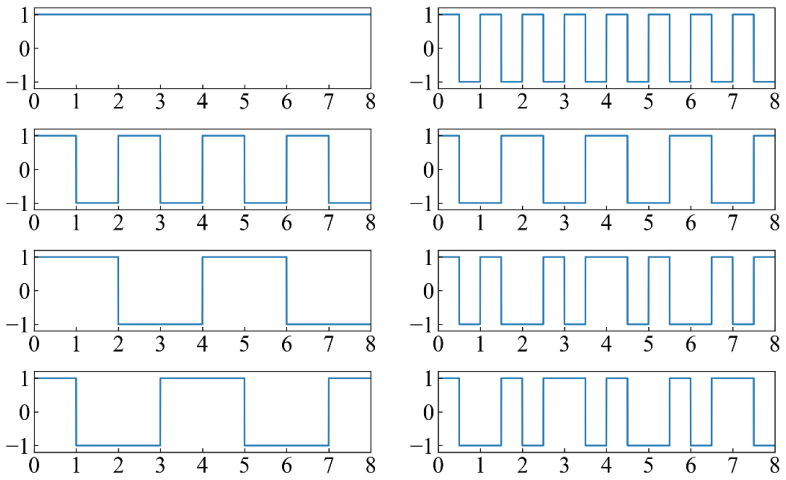
The central object is the phase-shifting quantum circuit built from the Walsh-Hadamard expansion of a diagonal phase operator $U = e^{if(x)}$. Each retained Walsh basis term is implemented by one phase-shifting gate, and the CNOT gates connecting neighboring terms are ordered by Gray code so that successive Walsh indices differ by one bit. The authors extend the one-dimensional construction of [34] to two dimensions by reshaping the $N\times N$ potential matrix into a vector of length $N^2$, which matches the qubit encoding with $n$ qubits per coordinate. A relative truncation threshold $\tau$ removes Walsh coefficients below $\tau$ times the maximum coefficient, and the empirical formula (17) sets the potential threshold as a function of $n$ while the kinetic threshold is fixed to keep all non-zero terms. This machinery is what converts a circuit with many multi-controlled gates into a comparable-size circuit of one- and two-qubit gates and then shrinks it further at controlled cost.
What would settle it
Run the truncated circuit for a 20- or 24-qubit simulation of the same gold specimen, or for another material such as silicon or an oxide, using the threshold formula (17); the claim fails if the remaining-term percentage stops decreasing with qubit count or if the average relative error of the electron density exceeds about 1 percent.
Extended reading notes
Core claim
The paper's central claim is that the phase-shifting part of the quantum multislice algorithm can be rebuilt exactly using the Walsh-Hadamard expansion of the diagonal phase operator, so that no multi-controlled gates are needed. Each Walsh basis term corresponds to a single phase-shifting gate, and the CNOT gates between them follow Gray-code ordering, giving a circuit whose one- and two-qubit gate count is comparable to the old multi-controlled circuit. The paper further claims that truncating Walsh coefficients below a threshold reduces the total gate count by more than an order of magnitude while holding the average relative error around 1 percent, with the remaining-term percentage falling as the qubit number grows. It supports these claims with classical simulations of 12-, 14-, and 16-qubit circuits for 100 keV electrons in a gold specimen, comparing the exact and truncated circuits against the classical multislice result.
Load-bearing premise
The gate-count reduction depends on the potential's Walsh expansion remaining sparse as the simulation grows and for materials other than the single gold specimen at 100 keV, since the paper's threshold formula is fitted to only three qubit counts (12, 14, and 16).
Editorial extensions
If this is right
- The phase-shifting circuit is now implementable with only one- and two-qubit gates, removing the multi-controlled-gate compilation overhead that threatened the earlier algorithm's advantage on real hardware.
- Using the paper's threshold formula, the total gate count is reduced by more than one order of magnitude while the average relative error stays around 1 percent.
- The retained fraction of Walsh terms decreases as the qubit count grows from 12 to 16, so the truncation benefit is expected to strengthen, not weaken, for larger simulations.
- The classical preprocessing step, the fast Walsh-Hadamard transform, costs only $O(N \log N)$ additions and is reusable across slices and input states, so it does not become a new bottleneck.
Reading between the lines
- Reader extension: the threshold formula is fitted to 12-, 14-, and 16-qubit runs for gold at 100 keV; testing other crystals, temperatures, and energies would show whether Walsh-coefficient sparsity is a general property of projected atomic potentials or particular to this specimen.
- Reader extension: the kinetic operator's Walsh spectrum is described as having almost all coefficients zero, which suggests an analytic description of its support; deriving one could replace the empirical threshold fit with a rigorous gate-count bound as the qubit number grows.
- Reader extension: because truncation acts on the operators rather than on the wave function, the same Walsh-truncation idea transfers to any diagonal-unitary simulation whose generator is sparse in the Walsh basis, such as other scattering or spectral-phase problems.
Editorial analysis
A structured set of objections, weighed in public.
Referee Report
Summary. The manuscript presents an improved quantum algorithm for the multislice method used in transmission electron microscopy simulations. The authors replace the multi-controlled phase-shifting gates of their previous quantum circuit by a Walsh-Hadamard decomposition, so that the phase-shifting operator is implemented with single-qubit phase gates and CNOT gates only. They then propose a truncation of small Walsh coefficients to reduce the gate count at the cost of a controlled approximation error. The improved exact circuit is verified against the previous quantum algorithm and the classical multislice algorithm for a 100 keV electron beam on a Au specimen with 12 qubits. Truncation thresholds are tested at 12, 14, and 16 qubits, leading to an empirical formula, Eq. (17), intended to keep an average relative error near 1% while reducing the number of gates by more than an order of magnitude. The authors conclude that the speedup from truncation improves as the number of qubits increases.
Significance. If the central claims hold, this is a meaningful step toward making the quantum multislice algorithm more hardware-friendly: the replacement of multi-controlled gates by one- and two-qubit gates is a concrete improvement, and the exact version of the improved circuit is a clean application of the known diagonal-unitary construction by Welch et al. The truncation idea is interesting and the paper provides simulation evidence, including a direct comparison with the classical multislice result. However, the claimed size-improving truncation speedup rests on an empirical fit to three system sizes and a single specimen, and the error metric used for the 1% claim is a full-state average rather than an observable-specific error; these points limit the generality of the conclusions. The paper is therefore of moderate significance pending a strengthening of the scaling evidence.
major comments (4)
- [Sec. 4, Eq. (17), Figs. 12-13] The threshold formula and the conclusion that the truncation speedup improves with qubit number rest on three simulated sizes (12, 14, and 16 qubits) and a single Au specimen at 100 keV. The paper offers no physical argument that the Walsh coefficient tail remains sparse as N grows or for other materials; if the tail fills in at larger N, the remaining-term percentage could increase and the order-of-magnitude gate reduction would disappear. This is a load-bearing extrapolation for the central claim, so it needs either a theoretical bound on the coefficient decay or validation on additional system sizes and materials.
- [Sec. 4, Eq. (16)] The 1% error claim refers to the average relative error over the full wave function defined in Eq. (16), not to errors in the extracted electron diffraction pattern or other observables. The truncation threshold is tuned to this particular metric, and the paper asserts rather than justifies that this metric is the right proxy for the application. The statement that the error is 'controllable' should be specified with respect to the metric actually controlled.
- [Sec. 4, Sec. 5] The complexity statements ('complexity advantage', 'speedup effect may increase') are not accompanied by a formal accounting that includes state preparation, measurement repetitions, and compilation of the improved circuit to hardware-native gates. Figure 15 reports raw gate counts from the simulation; without the omitted overheads, the asymptotic comparison is not quantified and the quantum-advantage claim is not fully supported.
- [Sec. 4, Figs. 13 and 15] The reported 'original' term numbers (65,010; 261,057; 1,046,709 for 12, 14, and 16 qubits) appear to count Walsh terms across all 16 potential slices, whereas a single multislice iteration uses only one potential operator. The relationship between these term counts, the per-iteration gate count, and the total simulation gate count is not made explicit, which makes the reported reduction factor ambiguous.
minor comments (5)
- [Equations (4), (6), (14), (17)] Several equations contain garbled mathematical expressions (for example, Eq. (17) is printed as '3128 102 V nτ −=×'); the manuscript needs a careful proofreading pass so that all formulas are readable.
- [Abstract, Sec. 3] There are typos such as 'multisilce' in the abstract and 'It can be proven' in Sec. 3; these should be corrected to 'multislice' and 'proved'.
- [Fig. 13] The caption lists several numbers without a clear legend; a small table giving the original term count, remaining term count, truncation threshold, and error for each qubit count would improve readability.
- [Sec. 2] The discussion of initial state preparation cites Ref. [35] for O(N) state preparation and Ref. [36] for sparse states, but these costs are not included in the later complexity comparison; please clarify their role in the overall algorithm.
- [Sec. 3] The statement that a phase-shifting gate without control qubits 'will result in a phase shift for half of the basis states' is imprecise: it applies to a single-qubit rotation on one register qubit, and the correspondence to a Walsh function should be stated explicitly.
Circularity Check
The truncation scaling claim rests on Eq. (17), an empirical fit to the same 12/14/16-qubit simulations used to report the 1% error and improving speedup; the circuit reconstruction itself is independently verified.
-
fitted input called prediction
[Sec. 4 (Eq. (17), Figs. 12-13) and Sec. 5 Conclusion]
"Here we provide an empirical formula by the three sample points closest to the dashed line in Fig. 12 to maintain approximately a 1% average relative error: ... Although the truncation threshold is lowered and we keep more terms when the qubit number increases, the percentage of the remaining terms actually decreases. This indicates that the aforementioned problem does not exist; instead, the speedup effect of the truncation will improve as we use more qubits."
Eq. (17) is fit to the same three simulated sizes (12, 14, 16 qubits) whose truncation errors and remaining-term counts appear in Fig. 12. Fig. 13 and the conclusion then apply Eq. (17) at those identical sizes to report roughly 1% error and a decreasing remaining percentage. The 'speedup improves with qubit number' trend is therefore a restatement of the calibration points, not an independent prediction; the ~1% error is achieved by construction because the threshold was chosen to land near the 1% contour of those same runs.
full rationale
Apart from the fitted threshold formula, the paper's core derivation is self-contained: the Walsh-expansion phase-shifting circuit is an exact rewrite, following Welch et al., of the diagonal unitary, and its correctness is verified by comparing no-truncation results with the previous quantum circuit and the classical multislice algorithm. The authors' earlier work is cited for background and for the original phase-shifting circuit, but the new circuit's validity does not depend on an unverified self-citation. The gate-count reduction from truncation is also arithmetically immediate once terms are discarded, though the quantitative claim of 'more than an order of magnitude' is just the measured remaining-term count. The only genuinely circular element is Eq. (17): it is fit to the 12/14/16-qubit data and then used to assert that those same data show ~1% error and an improving speedup with size. That is post-hoc calibration presented as a scalable parameter-setting scheme, which warrants a mild circularity finding but does not undermine the independently verified circuit construction.
Assumptions & free parameters
free parameters (3)
- Potential truncation threshold tau_V =
0.002 (12 qubits), 0.001 (14 qubits), 0.0005 (16 qubits)
- Kinetic truncation threshold tau_P =
1e-10
- Selection of three sample points for empirical fit =
12, 14, 16 qubit datasets
assumptions (5)
- domain assumption Multislice iteration formula (Eq. 1) is the correct high-energy approximation for electron propagation through thin slices.
- standard math Walsh-Hadamard transform provides a complete orthonormal basis for discrete functions on an N by N grid, and the Welch et al. construction correctly implements each Walsh term as phase gates and CNOT gates.
- domain assumption The potential and kinetic phase operators are diagonal in coordinate and momentum representations respectively.
- ad hoc to paper The average relative error metric (Eq. 16), computed over the full wave function, is an appropriate proxy for the error in extracted diffraction patterns.
- domain assumption Classical simulation of the quantum circuit with pyqpanda faithfully represents the gate-level behavior of the algorithm on real hardware.
Cite this review
Pith. "Pith review of An Improved Quantum Algorithm of the Multislice Method." pith.science (2026). https://pith.science/paper/VI2CVW4Q
@misc{pith2026241117482,
  author       = {Pith},
  title        = {Pith review of: An Improved Quantum Algorithm of the Multislice Method},
  year         = {2026},
  howpublished = {\url{https://pith.science/paper/VI2CVW4Q}},
  note         = {Machine review of arXiv:2411.17482}
}
read the original abstract
The multisilce method is an important algorithm for electron diffraction and image simulations in transmission electron microscopy. We have proposed a quantum algorithm of the multislice method based on quantum circuit model previously. In this work we have developed an improved quantum algorithm. We reconstruct the phase-shifting quantum circuit without using the multi-controlled quantum gates, thereby significantly improve the computation efficiency. The new quantum circuit also allows further gate count reduction at the cost of a controllable error. We have simulated the quantum circuit on a classical supercomputer and analyzed the result to prove the feasibility and correctness of the improved quantum algorithm. We also provide proper parameter settings through testing, allowing the minimization of the necessary number of quantum gates while limiting the relative error within 1%. This work demonstrates the potential of applying quantum computing to electron diffraction simulations and achieving quantum advantages.
Figures


Figures from the paper (4 more)


Reference graph
Works this paper leans on
-
[1]
F. Arute, K. Arya, R. Babbush, D. Bacon, J. C. Bardin, R. Barends, R. Biswas, S. Boixo, F. Brandao, D. A. Buell, B. Burkett, Y . Chen, Z. Chen, B. Chiaro, R. Collins, W. Courtney, A. Dunsworth, E. Farhi, B. Foxen, A. Fowler, C. Gidney, M. Giustina, R. Graff, K. Guerin, S. Habegger, M. P. Harrigan, M. J. Hartmann, A. Ho, M. Hoffmann, T. Huang, T. S. Humble...
work page 2019
-
[2]
Y . L. Wu, W. S. Bao, S. R. Cao, F. S. Chen, M. C. Chen, X. W. Chen, T. H. Chung, H. Deng, Y . J. Du, D. J. Fan, M. Gong, C. Guo, C. Guo, S. J. Guo, L. C. Han, L. Y . Hong, H. L. Huang, Y . H. Huo, L. P. Li, N. Li, S. W. Li, Y . Li, F. T. Liang, C. Lin, J. Lin, H. R. Qian, D. Qiao, H. Rong, H. Su, L. H. Sun, L. Y . Wang, S. Y . Wang, D. C. Wu, Y . Xu, K. ...
work page 2021
-
[3]
H. S. Zhong, Y . H. Deng, J. Qin, H. Wang, M. C. Chen, L. C. Peng, Y . H. Luo, D. Wu, S. Q. Gong, H. Su, Y . Hu, P. Hu, X. Y . Yang, W. J. Zhang, H. Li, Y . Li, X. Jiang, L. Gan, G. Yang, L. You, Z. Wang, L. Li, N. L. Liu, J. J. Renema, C. Y . Lu, and J. W. Pan, Phys. Rev. Lett. 127, 180502 (2021)
work page 2021
-
[4]
P. W. Shor, in: 35th Annual Symposium on Foundations of Computer Science (Santa Fe, 1994), pp. 124
work page 1994
-
[5]
L. K. Grover, in: Proceedings of 1996 ACM Symposium on Theory of Computing (Philadelphia, 1996), pp. 212
work page 1996
-
[6]
I. M. Georgescu, S. Ashhab, and F. Nori, Rev. Mod. Phys. 86, 153 (2014)
2014
-
[7]
R. P. Feynman, Inter. J. Theor. Phys. 21, 467 (1982)
work page 1982
-
[8]
R. P. Feynman, Found. Phys. 16, 507 (1986)
work page 1986
Show all 42 references
-
[9]
Y . C. Wang, Y . Sun, and Z. J. Ding, Results Phys. 62, 107834 (2024)
2024
-
[10]
J. M. Cowley and A. F. Moodie, Acta Crystal. 10, 609 (1957)
1957
-
[11]
J. M. Cowley and A. F. Moodie, Acta Crystal. 12, 353 (1959)
1959
-
[12]
J. M. Cowley and A. F. Moodie, Acta Crystal. 12, 360 (1959)
1959
-
[13]
Goodman and A
P. Goodman and A. F. Moodie, Acta Crystal. A 30, 289 (1974). 26
1974
-
[14]
Ishizuka and N
K. Ishizuka and N. Uyeda, Acta Crystal. A 33, 740 (1977)
1977
-
[15]
van Dyck, Phys
D. van Dyck, Phys. Status Solidi a 52, 283 (1979)
1979
-
[16]
Van Dyck, J
D. Van Dyck, J. Microsc. 119, 141 (1980)
1980
-
[17]
Ishizuka, Acta Crystal
K. Ishizuka, Acta Crystal. A 38, 773 (1982)
1982
-
[18]
Kilaas, M
R. Kilaas, M. A. O'Keefe, and K. M. Krishnan, Ultramicrosc. 21, 47 (1987)
1987
-
[19]
Van Dyck, Adv
D. Van Dyck, Adv. Imag. Elect. Phys. 65, 295 (1985)
1985
-
[20]
M. A. O'Keefe and R. Kilaas, Users guide to NCEMSS. Version 2.0 (1994)
1994
-
[21]
Ishizuka, J
K. Ishizuka, J. Elect. Microsc. 50, 291 (2001)
2001
-
[22]
Ishizuka, Ultramicrosc
K. Ishizuka, Ultramicrosc. 90, 71 (2002)
2002
-
[23]
S. Kim, Y . Oshima, H. Sawada, T. Kaneyama, Y . Kondo, M. Takeguchi, Y . Nakayama, Y . Tanishiro, and K. Takayanagi, J. Elect. Microsc. 60, 109 (2011)
2011
-
[24]
Zhang, Y
M. Zhang, Y . Ming, R. G. Zeng, and Z. J. Ding, J. Microsc. 260, 200 (2015). [25]Z. Ruan, R. G. Zeng, Y . Ming, M. Zhang, B. Da, S. F. Mao, and Z. J. Ding, Phys. Chem. Chem. Phys. 17, 17628 (2015)
2015
-
[26]
Dwyer and J
C. Dwyer and J. Etheridge, Ultramicrosc. 96, 343 (2003)
2003
-
[27]
Dwyer, Ultramicrosc
C. Dwyer, Ultramicrosc. 104, 141 (2005)
2005
-
[28]
Bethe, Ann
H. Bethe, Ann. Phys. 392, 55 (1928)
1928
-
[29]
J. M. Cowley, Diffraction physics (Elsevier, Amsterdam, 1995)
1995
-
[30]
E. O. Brigham and R. E. Morrow, IEEE Spectrum 4, 63 (1967)
1967
-
[31]
Coppersmith, arXiv:quant-ph/0201067v1 (1994)
D. Coppersmith, arXiv:quant-ph/0201067v1 (1994)
1994 arXiv
-
[32]
M. A. Nielsen and I. L. Chuang, Quantum computation and quantum information (Cambridge university press, Cambridge, 2010)
2010
- [33]
-
[34]
Welch, D
J. Welch, D. Greenbaum, S. Mostame, and A. Aspuru-Guzik, New J. Phys. 16, 033040 (2014)
2014
-
[35]
I. F. Araujo, D. K. Park, T. B. Ludermir, W. R. Oliveira, F. Petruccione, and A. J. da Silva, Quantum Inf. Process. 22, 123 (2023)
2023
-
[36]
Gleinig and T
N. Gleinig and T. Hoefler, in: 58th ACM/IEEE Design Automation Conference (DAC) (San Francisco, CA, 2021), pp. 433
2021
-
[37]
O'Donnell and J
R. O'Donnell and J. Wright, in: Proceedings of the forty-eighth annual ACM symposium on Theory of Computing (Cambridge, MA, 2016), pp. 899. 27
2016
-
[38]
J. L. Walsh, Am. J. Math. 45, 5 (1923)
1923
-
[39]
E. N. Gilbert, Bell Syst. Tech. J. 37, 815 (1958)
1958
-
[40]
R. W. Hamming, Bell Syst. Tech. J. 29, 147 (1950)
1950
-
[41]
M. Dou, T. Zou, Y . Fang, J. Wang, D. Zhao, L. Yu, B. Chen, W. Guo, Y . Li, Z. Chen, and G. Guo, arXiv preprint arXiv:2212.14201 (2022)
2022 arXiv
-
[42]
Z. Y . Chen and G. P. Guo, arXiv:1901.08340 [quant-ph] (2019)
2019 arXiv
-
[43]
L. M. Peng, Micron 30, 625 (1999)
1999
Reviewed August 12, 2026 · model on record in the stance chip above.
Discussion (0). Continue with ORCID to comment.