REVIEW 3 major objections 3 minor 19 references
Edge modes in chiral electron double layers
T0 review · 3 major / 3 minor · reviewed 2026-08-11 · deepseek-v4-flash
Pith's one-line read In chiral electron double layers, quasiparticle modes split into edge and bulk spectra linked by an analytic continuation.
desk verdict A sign error in the lower Dirac block flips which layer's edge current is controlled; the boundary-condition omission is real but secondary. read the letter →
The pith
A machine-rendered reading of the paper's core claim, the machinery that carries it, and where it could break.
The reading
What carries the argument
The central object is the Bogoliubov–de Gennes Hamiltonian $H_{\rm EEDL}(\Delta)$ of the chiral electron double layer, which a unitary transformation $W$ maps to a block-diagonal pair of massive Dirac Hamiltonians $h_D(\pm|\Delta|)$. The eigenfunctions of each Dirac layer in a circular geometry are built from modified Bessel functions $K_n(cr)$ for edge modes; the analytic continuation $c\to \pm ik$ converts them via the identity $K_n(-iz)=\frac{\pi i}{2}e^{i\pi(n+1)/2}[J_n(z)+iY_n(z)]$ into Bessel combinations describing bulk modes. The boundary phase $\psi$ between the layer amplitudes $A_n$ and $A'_n=e^{i\psi}A_n$ is the control parameter that fixes the separate edge currents in the two layers.
What would settle it
Solving the full Bogoliubov–de Gennes equations in a disk with a hole and an explicit boundary condition (e.g., $\Psi(r_0)=0$) would show whether a continuum of in-gap edge modes exists; if the spectrum is discrete or empty, the claimed transition at $E=\pm|\Delta|$ and the analytic-continuation bulk-edge correspondence would not hold in that geometry.
Extended reading notes
Core claim
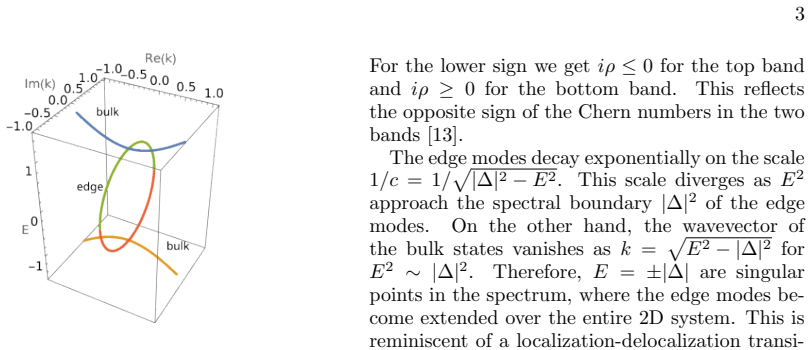
The central claim is that the quasiparticle spectrum of the chiral double layer separates into in-gap edge modes with energies $|E|<|\Delta|$, described by modified Bessel functions $K_n(cr)$ with $c=\sqrt{|\Delta|^2-E^2}$, and bulk modes with $|E|>|\Delta|$ obtained by the analytic continuation $c\to \pm ik$. The paper presents this continuation as a bulk-edge correspondence: the same eigenfunctions interpolate between exponentially localized and extended behavior as $E$ crosses $\pm|\Delta|$, which it likens to a localization-delocalization transition. The phase $\psi$ entering through $A'_n=e^{i\psi}A_n$ determines the relative weight of the two Dirac sectors in the double-layer wavefunction, and through it the magnitude, direction, and phase of the edge currents in the two layers. In particular, $\psi=0$ suppresses the zero mode in the top layer and $\psi=\pi$ suppresses it in the bottom layer. The edge quasiparticle currents are balanced by supercurrents, so they can be maintained without external sources.
Load-bearing premise
The paper assumes that the in-gap edge-mode eigenfunction $K_n(cr)$ is valid for every $c$ in $(0,|\Delta|)$ without imposing a boundary condition at the hole radius, so the edge spectrum is taken as given rather than derived from boundary data.
Editorial extensions
If this is right
- If the bulk-edge correspondence holds, edge modes and bulk bands are connected through $c\to \pm ik$, with $E=\pm|\Delta|$ as the critical energies where the localization length diverges.
- The boundary phase $\psi$ can independently suppress the zero mode in either layer, implying that edge channels can be switched layer-selectively.
- The edge currents in the two layers flow in opposite directions, and their magnitude depends on $\psi$, so the phase can tune the current.
- Charge conservation requires the quasiparticle edge currents to be balanced by supercurrents, so the edge modes are sustained rather than radiated away.
- The transition at $E=\pm|\Delta|$ is reminiscent of a localization-delocalization transition, suggesting that varying the energy drives the quasiparticles from edge-localized to bulk-extended states.
Reading between the lines
- If one imposes a concrete boundary condition at the hole radius (for instance, vanishing of the wavefunction at $r_0$), the in-gap energies would become discrete; whether the analytic-continuation transition survives this is a direct test of the paper's edge-mode picture.
- The mapping to two Dirac Hamiltonians suggests the same edge-mode structure should appear in any paired double-layer system dual to the electron–hole bilayer, so the predictions could be checked in dipolar exciton bilayers.
- Because the boundary phase $\psi$ controls the currents, a gated edge could be used as a switch for the edge-channel conductance in a single layer; this is an experimentally testable consequence the paper does not develop.
- The analytic continuation $c\to \pm ik$ is formal; a lattice simulation of the tight-binding BdG equations in a disk would clarify whether the bulk-edge correspondence persists beyond the Dirac continuum approximation.
Editorial analysis
A structured set of objections, weighed in public.
Referee Report
Summary. The manuscript studies quasiparticle excitations of a chiral electron double layer with interlayer pairing, using a unitary mapping (App. A) from the BdG Hamiltonian H_EEDL to a block-diagonal massive Dirac Hamiltonian H_Dirac. In a circular geometry with a hole, the authors write edge-mode eigenfunctions in terms of modified Bessel functions K_n(cr) with in-gap energies E = ±sqrt(|Δ|^2 - c^2), then pass to bulk modes by the formal replacement c → ±ik and identify E = ±|Δ| as a localization-delocalization transition. They also compute layer-resolved edge currents and claim that the relative boundary-condition phase ψ controls the two layers' edge currents separately, allowing individual switching off of zero modes. The paper's central claims are the edge/bulk dichotomy, the analytic-continuation bulk-edge correspondence, and the ψ-controlled layer currents.
Significance. If the claims were established, the paper would offer a useful duality-based route to edge-state wavefunctions and currents in a paired chiral double layer, with a concrete experimental handle (boundary-condition phase ψ) for controlling layer-resolved currents. The strengths include an explicit unitary transformation in App. A, a clean separation-of-variables calculation, and a clear formal connection between the edge-mode functions K_n and the bulk functions J_n,Y_n through analytic continuation. However, two load-bearing issues prevent acceptance in the present form: a sign error in the lower Dirac block that changes the physical predictions for layer currents, and the absence of an imposed boundary condition at the hole, which leaves the in-gap spectrum underdetermined. The claimed transition at E = ±|Δ| is also not established as a genuine transition. These issues are local in the sense that the calculational framework is promising, but the printed results and the headline physical conclusions require substantial correction.
major comments (3)
- [Appendix B, Eq. (B6); Eq. (10)] The lower-block spinor in Eq. (B6) is not an eigenfunction of h_D(-|Δ|). Substituting (A'K_n, A'iρ^{-1}K_{n+1}e^{iα}) into the first radial Dirac equation for mass -|Δ| gives cρ^{-1} = E + |Δ|, whereas the upper-block relation cρ = E - |Δ| combined with c^2 = |Δ|^2 - E^2 implies cρ^{-1} = -(E + |Δ|); the printed expression is therefore only consistent at E = -|Δ| in the c → 0 limit. The correct lower-block coefficient is -iρ^{-1}. Repeating the W† construction with the correct sign interchanges the middle two components of Eq. (10): the terms i(ρ + e^{iψ}ρ^{-1}) and i(ρ - e^{iψ}ρ^{-1}) appear in the opposite order. This changes the physical predictions already within the family of K_n solutions, e.g., at E = 0, ψ = 0 the suppressed zero mode switches from one layer to the other, and the ψ-dependence of C↑ and C↓ in Eqs. (14)-(15) is exchanged. Since the central claim of independent layer control rests on these formulas, this sign error is load-bearing and must be corrected.
- [§2, Eqs. (5)-(7) and text after Eq. (11)] The edge-mode problem is underdetermined because no boundary condition at the circular hole r = r0 is imposed. Equation (5) is a decaying solution of the radial Dirac equation for any c in (0, |Δ|); without specifying the self-adjoint boundary condition at r0 (or the matching condition for a finite disk), the in-gap spectrum is not discrete and every c is admissible. The text acknowledges this indirectly when it says that 'the actual values of the boundary conditions are determined by the coupling of the double layer to its environment', but that statement does not replace the missing derivation. As a result, the paper's 'edge-mode spectrum' and the precise edge/bulk distinction are not yet established.
- [§3 and Conclusion, text after Eqs. (8)-(9)] The claims of a 'bulk-edge correspondence' and of a 'transition' at E = ±|Δ| are stronger than what is demonstrated. The replacement c → ±ik is a formal analytic continuation that turns the modified Bessel functions K_n into combinations of J_n and Y_n; it does not, by itself, identify which bulk modes satisfy the same boundary condition as a given edge mode, and no scattering problem is solved. The divergence of the decay length 1/c as E^2 → |Δ|^2 shows that the edge modes become extended at the spectral boundary, but this is a continuum limit rather than evidence of a thermodynamic or spectral phase transition. The authors should either prove a precise statement of the correspondence (e.g., a bijection between edge eigenstates and bulk scattering states with the same boundary condition) or substantially soften the transition language.
minor comments (3)
- [§1, after Eq. (1)] The four-component wavefunction is written as Ψ(r) = (ψ↑1(r), ψ↑2(r), ψ↓1(r)ψ↓2(r))^T; a comma is missing between ψ↓1(r) and ψ↓2(r).
- [§2, paragraph after Eq. (7)] For the full disk the text says to replace K_n by I_n, but no boundary condition is given that would select the allowed values of c (or the analog for I_n). Please clarify which geometry (infinite plane with a hole versus finite disk) is used in each formula and where the boundary condition enters.
- [Eq. (8)] The asymptotic expansion of K_n(-iz) is used to motivate the identification of bulk modes; it would be helpful to cite a uniform identity such as the DLMF relation between modified and ordinary Bessel functions, since the asymptotic form shown is not valid uniformly for all n and z.
Circularity Check
No significant circularity: edge modes are derived by direct solution of the mapped Dirac Hamiltonian; self-citations are background, not load-bearing.
full rationale
The central derivation is self-contained: the mapping HEEDL = W^dagger HDirac W is derived explicitly in App. A, not imported as a black box, and the Dirac eigenfunctions in Eq. (5) are obtained from the eigenvalue equation using the Bessel recurrence relations (B3)-(B5). The 'bulk-edge correspondence' is an explicit analytic continuation c -> +/- ik carried out with the standard Bessel identity (8), so it is a mathematical continuation of the same solution family rather than a fitted input or a renamed empirical result. The phase psi entering Eq. (10) is an unconstrained boundary-condition parameter, and the current formulas (13)-(15) are algebraic consequences of the stated eigenfunction, not definitions of the predicted effect. Self-citations [7,8,11] motivate the existence of geometric pairing and the duality, but the actual calculation does not rely on an unverified claim from those papers; the duality is rederived in the appendix, and Delta is an input order parameter. One algebraic inconsistency in the printed lower-block coefficient of Eq. (B6) (the correct coefficient for h_D(-|Delta|) is -i rho^{-1} K_{n+1}, not i rho^{-1} K_{n+1}) is a correctness issue that would change the layer assignment in Eq. (10), but it is not a circularity because it does not make any output equivalent to an input. The score is set to 1 only to acknowledge that several background citations are by the authors; none of them is load-bearing for the edge-mode derivation.
Assumptions & free parameters
free parameters (1)
- psi (relative phase of boundary conditions)
assumptions (5)
- domain assumption Continuum limit h1,2 -> i d1,2, h3 -> 0 near a single Dirac node.
- domain assumption Uniform pairing order parameter Delta, taken as a constant solution of the self-consistent equation.
- domain assumption No interlayer hopping; charge neutrality maintained by a gate.
- ad hoc to paper Boundary condition amplitudes satisfy |A'_n| = |A_n| and A'_n = e^{i psi} A_n.
- domain assumption Analytic continuation c -> +/- ik maps edge to bulk modes.
Cite this review
Pith. "Pith review of Edge modes in chiral electron double layers." pith.science (2026). https://pith.science/paper/VIZQPUQF
@misc{pith2026241216760,
  author       = {Pith},
  title        = {Pith review of: Edge modes in chiral electron double layers},
  year         = {2026},
  howpublished = {\url{https://pith.science/paper/VIZQPUQF}},
  note         = {Machine review of arXiv:2412.16760}
}
read the original abstract
We study the quasiparticles in chiral double layers with electron pairing within the framework of the Bogoliubov de Gennes equation. In the presence of an edge it is demonstrated that the quasiparticle modes can be distinguished as edge modes and bulk modes, which appear at different energies. The bulk-edge correspondence is obtained by an analytic continuation from the in-gap edge modes to the bands of bulk modes. By varying the energy we find a transition from localized edge modes to delocalized bulk modes. We calculate the quasiparticle currents, discuss briefly how these currents couple to external currents, and predict how this can be used to control the quasiparticle modes.
Figures


Figures from the paper (1 more)

Reference graph
Works this paper leans on
-
[1]
Yu. E. Lozovik and V. I. Yudson. A new mech- anism for superconductivity: pairing between spatially separated electrons and holes. Soviet Journal of Experimental and Theoretical Physics, 44:389, 1976
work page 1976
-
[2]
few-electron–single spa- tially separated hole
V. I. Yudson. Charged “few-electron–single spa- tially separated hole” complexes in a double quan- tum well near a metal plate. Phys. Rev. Lett., 77:1564–1567, 1996
work page 1996
-
[3]
A. V. Balatsky, Y. N. Joglekar, and P. B. Little- wood. Dipolar superfluidity in electron-hole bi- layer systems. Phys. Rev. Lett., 93:266801, 2004
work page 2004
-
[4]
D. K. Efimkin, Yu. E. Lozovik, and A. A. Soko- lik. Electron-hole pairing in a topological insulator thin film. Phys. Rev. B, 86:115436, 2012
work page 2012
-
[5]
Z. Wang, D. A. Rhodes, K. Watanabe, T. Taniguchi, J. C. Hone, J. Shan, and K. F. Mak. Evidence of high-temperature exciton condensa- tion in two-dimensional atomic double layers. Na- ture, 574(7776):76–80, 2019
work page 2019
-
[6]
M. Zimmerman, R. Rapaport, and S. Gazit. Col- lective interlayer pairing and pair superfluidity in vertically stacked layers of dipolar excitons. Proceedings of the National Academy of Sciences, 119(30):e2205845119, 2022
work page 2022
-
[7]
A. Sinner, Yu. E. Lozovik, and K. Ziegler. Pair- ing transition in a double layer with interlayer Coulomb repulsion. Physical Review Research, 2(3):033085, 2020
work page 2020
-
[8]
K. Ziegler, A. Sinner, and Yu. E. Lozovik. Anoma- lous josephson effect of s-wave pairing states in chiral double layers. Phys. Rev. Lett., 128:157001, 2022
work page 2022
Show all 19 references
-
[9]
G. M. Graf and M. Porta. Bulk-edge corre- spondence for two-dimensional topological insula- tors. Communications in Mathematical Physics, 324(3):851–895, 2013
2013
-
[10]
J. Shapiro. The bulk-edge correspondence in three simple cases. Reviews in Mathematical Physics, 32(03):2030003, 2020
2020
-
[11]
K. Ziegler. Chiral josephson effect in double layers: The role of particle–hole duality. Contributions to Plasma Physics, 63(9-10):e202300014, 2023
2023
-
[12]
Read and Green
N. Read and Green. Paired states of fermions in two dimensions with breaking of parity and time- reversal symmetries and the fractional quantum Hall effect. Phys. Rev. B 61(15): 10267–10297, 1993
1993
-
[13]
E. Fradkin. Field Theories of Condensed Mat- ter Physics. Field Theories of Condensed Matter Physics. Cambridge University Press, 2013
2013
-
[14]
F. D. M. Haldane. Model for a quantum hall effect without landau levels: Condensed-matter realiza- tion of the ”parity anomaly”. Phys. Rev. Lett., 61:2015–2018, 1988
2015
-
[15]
A. Hill, A. Sinner, and K. Ziegler. Valley symme- try breaking and gap tuning in graphene by spin doping. New Journal of Physics, 13(3):035023, 2011
2011
-
[16]
Abramowitz and I
M. Abramowitz and I. A. Stegun. Handbook of Mathematical Functions with Formulas, Graphs, and Mathematical Tables. Dover Publications, Inc., New York, 1964
1964
-
[17]
G. E. Blonder, M. Tinkham, and T. M. Klapwijk. Transition from metallic to tunneling regimes in superconducting microconstrictions: Excess cur- rent, charge imbalance, and supercurrent conver- sion. Phys. Rev. B, 25:4515–4532, 1982
1982
-
[18]
Spuntarelli, P
A. Spuntarelli, P. Pieri, and G.C. Strinati. Solu- tion of the bogoliubov–de gennes equations at zero temperature throughout the bcs–bec crossover: Josephson and related effects. Physics Reports, 488(4):111–167, 2010
2010
-
[19]
Pascucci, S
F. Pascucci, S. Conti, D. Neilson, J. Tempere, and A. Perali. Josephson effect as a signa- ture of electron-hole superfluidity in bilayers of van der waals heterostructures. Phys. Rev. B, 106:L220503, 2022. Appendix A: Mapping of theHEEDL Hamiltonian First, we consider the map...
2022
Reviewed August 11, 2026 · model on record in the stance chip above.
Discussion (0). Continue with ORCID to comment.