REVIEW 3 major objections 5 minor 82 references
Electric dipole moments from the perspective of a scalar triplet and singlet extension of the MSSM: A study of neutrons, electrons, mercury, and b and c quarks
T0 review · 3 major / 5 minor · reviewed 2026-08-10 · deepseek-v4-flash
Pith's one-line read The TNMSSM's new CP-violating couplings drive observable EDMs, with the neutron bound the tightest constraint.
desk verdict A workmanlike TNMSSM EDM calculation with a four-order-of-magnitude internal inconsistency between the quoted d_b and d_c predictions that needs to be resolved before the headline numbers can be trusted. read the letter →
The pith
A machine-rendered reading of the paper's core claim, the machinery that carries it, and where it could break.
The reading
What carries the argument
The analysis is organized by a five-operator effective Lagrangian: the quark EDM operator, the quark CEDM operator, and the purely gluonic Weinberg operator, with renormalization-group running from the matching scale down to the quark mass scale. The new couplings $\chi_d$ and $\chi_t$ enter the superpotential through $\chi_d H_d \cdot T H_d$ and $\chi_u H_u \cdot \bar{T} H_u$, shift the squark and neutralino/chargino mass matrices, and supply the CP-violating phases that feed the loop amplitudes. Two-loop Barr-Zee diagrams, two-loop gluino self-energy diagrams, and the Weinberg operator are all needed to match the measured observables, and the neutron and mercury EDMs are then assembled from quark EDMs and CEDMs through hadronic relations.
What would settle it
Recompute the bounds on $\chi_d$ and $\chi_t$ and the maxima of $d_b$ and $d_c$ using the full $\pm0.5$ and $\pm10\,\text{MeV}$ uncertainty band of Eq. (2) instead of the fixed central values the paper adopts; the claimed $10^{-22}\,\text{e}\!\cdot\!\text{cm}$ reach for $d_b$ survives only if it changes by less than an order of magnitude under that propagation.
Extended reading notes
Core claim
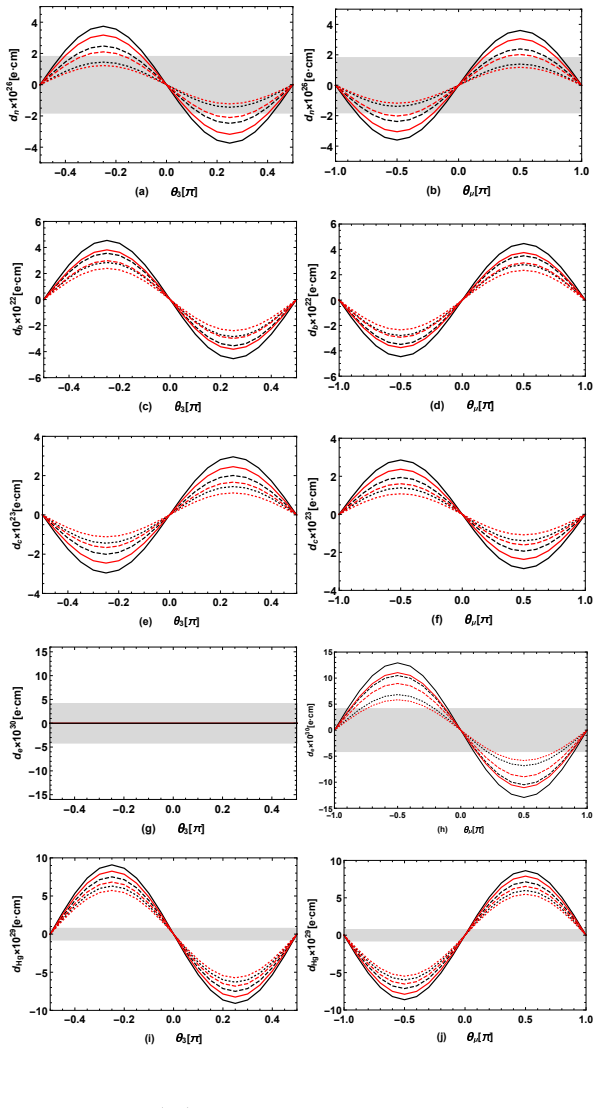
The central claim is that the TNMSSM's own CP-violating couplings, $\chi_d$ and $\chi_t$, produce electric and chromoelectric dipole moments that are not merely present but experimentally relevant. Through one-loop diagrams, two-loop gluino and Barr-Zee diagrams, and the Weinberg operator, the authors compute $d_n$, $d_e$, $d_{\text{Hg}}$, $d_b$, and $d_c$ and compare them with current bounds. They find that $\chi_t$, enhanced by $\tan\beta$ and acting through up-type squarks, dominates the EDMs; the neutron upper bound then sharply restricts $\chi_d$ and $\chi_t$, while $d_b$ and $d_c$ can still be as large as about $10^{-22}\,\text{e}\!\cdot\!\text{cm}$ and $10^{-23}\,\text{e}\!\cdot\!\text{cm}$, respectively. In the same parameter region the TNMSSM predictions are larger than the MSSM ones, making the model distinguishable through EDM measurements.
Load-bearing premise
The entire constraint analysis rests on one hadronic formula, Eq. (2), that turns quark electric and chromoelectric dipole moments into the neutron's EDM; the paper fixes that formula's coefficients at their central values (0.5 and 12 MeV) and does not propagate the $\pm0.5$ and $\pm10\,\text{MeV}$ uncertainties, so a change in this hadronic input would shift the bounds on the new CP phases and the predicted heavy-quark EDMs.
Editorial extensions
If this is right
- The neutron EDM bound excludes most of the $\chi_t$ parameter space, leaving only $|\chi_t| \lesssim 0.2$ when other phases are fixed, so neutron EDM experiments act as a direct filter on the TNMSSM's new CPV sources.
- Because $\chi_t$ is enhanced by $\tan\beta$ and enters through up-type squark and chargino/neutralino loops, the TNMSSM predictions for all five EDMs exceed the MSSM predictions in the same parameter region.
- Within current constraints, $d_b$ reaches about $10^{-22}\,\text{e}\!\cdot\!\text{cm}$ and $d_c$ reaches about $10^{-23}\,\text{e}\!\cdot\!\text{cm}$, values that future heavy-quark EDM searches could probe.
- The electron and mercury EDMs constrain the phase of $\mu$ more strongly than the neutron EDM does, so combining all four observables gives a tighter test of the model than any single bound.
Reading between the lines
- The paper stops at quoting reachable values; a natural next step is to map the same parameter space onto CP asymmetries in $b \to s\gamma$ or $B$-meson decays, which would give an independent handle on $d_b$ without a dedicated EDM measurement.
- If a future EDM experiment sees a signal, the correlation structure among $d_n$, $d_e$, $d_{\text{Hg}}$, $d_b$, and $d_c$—all driven by $\chi_t$ and the $\mu$ phase—would help disentangle the TNMSSM phases from MSSM phases, something the paper does not explicitly work out.
- The large $\mu$ phase preferred for electroweak baryogenesis is the same phase most tightly bounded by $d_e$ and $d_{\text{Hg}}$; the paper notes cancellations can hide it, but does not quantify how much fine-tuning that requires, leaving the model's baryogenesis viability as an open question.
Editorial analysis
A structured set of objections, weighed in public.
Referee Report
Summary. This paper computes electric dipole moments of the neutron, electron, mercury, b quark, and c quark in the TNMSSM, including one-loop diagrams, two-loop gluino corrections, Barr-Zee-type diagrams, and the Weinberg operator. It studies the dependence of these EDMs on the gluino phase θ3, the μ phase θμ, and the TNMSSM-specific CPV sources χd and χt, and it compares the results with MSSM predictions. The central claims are that the neutron EDM upper bound imposes strict constraints on χd and χt and that the b and c quark EDMs can reach about 10^-22 e·cm and 10^-23 e·cm respectively, making them potentially observable in future experiments.
Significance. If the numerical results are correct, the paper provides a useful phenomenological study of CPV in a well-motivated SUSY extension and gives concrete, falsifiable predictions for b and c quark EDMs. The analytic expressions and the explicit TNMSSM-versus-MSSM comparison are strengths, and I see no circularity: the EDM predictions are computed from the model Lagrangian and then compared with experimental bounds. However, the headline numbers contain a four-order-of-magnitude internal inconsistency, and the hadronic uncertainty in the neutron-EDM relation is not propagated; both issues directly affect the claimed constraints and the quoted reach of d_b and d_c.
major comments (3)
- [Sec. IV (after Fig. 7); Abstract; Sec. V] The text after Fig. 7 states that d_b and d_c can reach 10^-26 e·cm and 10^-27 e·cm respectively from the new CPV sources alone, but Fig. 8(c)-(f) has axes labeled db×10^22 and dc×10^23 with order-unity values, and both the Abstract and Sec. V quote 10^-22 e·cm and 10^-23 e·cm. This is a four-order-of-magnitude discrepancy in the central quantitative claim of the paper. Please correct the statement or clearly distinguish the scenarios that produce the two sets of numbers.
- [Sec. III.B, Eq. (2)] Equation (2) contains the hadronic uncertainties (1±0.5) and (22±10) MeV, but the text states that the coefficients are fixed to 0.5 and 12 MeV, and the numerical analysis never propagates these uncertainties. Because the paper's headline result—that |d_n| imposes strict constraints on χ_d and χ_t, and hence sets the allowed d_b and d_c ceiling—passes through this relation, the order-100% uncertainty on the hadronic coefficients should be reflected in the constraints. Please provide the resulting uncertainty band or justify why fixing the central values is sufficient.
- [Sec. I, Eqs. (1)-(3); Sec. IV] The paper derives or adopts bounds on d_b and d_c from a mapping through |dg_c| and dg_b, citing Ref. [22], but it does not show the intermediate steps connecting the neutron bound to these quark-level bounds. Since the claimed reach of d_b ~ 10^-22 e·cm and d_c ~ 10^-23 e·cm depends on this chain, please display the explicit mapping or provide the numerical inputs so the reader can verify the quoted limits.
minor comments (5)
- [Sec. IV] The text says 'the fact can be seed explicitly'; this should read 'seen'. Similar typos appear elsewhere, such as 'in in Fig. 6'.
- [Fig. 7 caption] The caption of Fig. 7 does not specify the units of the plotted quantities; please add the axis labels and units so that the numbers quoted in the text can be checked against the figures.
- [References] Ref. [64] is incomplete ('B. Yan, S. M. Zhao, and T. F. Feng et al. [Authors]'), and Ref. [76] contains a stray bibliographic entry ('975 (2022) 115671, doi: ...').
- [Eq. (27)] The mercury EDM formula involves dg_s, but no strange-quark CEDM expression is given in Sec. III; please state how dg_s is obtained.
- [Eq. (10)] The argument of ℑ and the H function in Eq. (10) are not cleanly delimited by parentheses; please fix the notation for readability.
Circularity Check
No significant circularity: the EDM predictions are computed from the TNMSSM Lagrangian and compared against external experimental bounds, not fitted to them.
full rationale
The derivation chain runs model-to-observable: the TNMSSM superpotential (Eq. 6) and soft terms (Eq. 7) introduce the CPV parameters chi_d and chi_t; the mass matrices in Appendix A and SARAH-generated couplings feed into the explicit one-loop (Eqs. 24, 31) and two-loop/Barr-Zee (Eqs. 25, 26) amplitudes; Eq. (9) combines d_gamma, d_g, and C5 into quark EDMs; and Eq. (2) converts the quark-level dipoles into d_n, whose computed value is then compared with the experimental upper bound. No equation defines chi_d or chi_t in terms of d_n, d_e, or d_Hg, and the scan over chi_d and chi_t in Eq. (33) is an independent Lagrangian-level parameter scan rather than a fit to the EDM outputs. The reported maxima for d_b and d_c are ordinary predictions evaluated after imposing the experimental constraints, not quantities forced by construction. The self-citations to earlier Feng-group papers (e.g., Refs. [62], [64], [66], [67], [78]) supply standard EDM formulas or parameter conventions, not the target result; the hadronic bridge in Eq. (2) is an external input from Pospelov-Ritz and Sala, and fixing its coefficients to 0.5 and 12 MeV is a robustness or uncertainty-propagation concern, not a circular step. No load-bearing equation reduces to its own input by construction.
Assumptions & free parameters
free parameters (6)
- χ_d and χ_t =
χ_d = χ_t = 0.1 in Eq. (32); scanned over (-1, 1) in Eq. (33)
- tan β and tan β' =
tan β = 5, tan β' = 1.3
- M3 and μ =
M3 = 4.0-4.5 TeV in Fig. 6, M3 = 5 TeV in Fig. 8; μ = 0.8-1.2 TeV
- T_χd and T_χt =
T_χt = -0.8 TeV, T_χd = -0.5 TeV
- m_squark M_Q =
M_Q > 1.5 TeV, treated as universal
- Triplet and singlet sector parameters =
λ_T = -0.22, κ = 0.8, T_λ = T_λT = -0.1 TeV, v_T^2 + v_Tbar^2 = 1 GeV^2
assumptions (5)
- domain assumption TNMSSM superpotential and soft terms in Eqs. (6)-(7)
- domain assumption EDM effective-operator basis, including dimension-five photon and gluon operators and the Weinberg operator
- domain assumption Neutron EDM hadronic relation in Eq. (2)
- ad hoc to paper Only θ3, θμ, θ_d, and θ_t are non-negligible CPV phases
- domain assumption SARAH-generated couplings and mass matrices are correct
Cite this review
Pith. "Pith review of Electric dipole moments from the perspective of a scalar triplet and singlet extension of the MSSM: A study of neutrons, electrons, mercury, and b and c quarks." pith.science (2026). https://pith.science/paper/VQ6APCWM
@misc{pith2026250102217,
  author       = {Pith},
  title        = {Pith review of: Electric dipole moments from the perspective of a scalar triplet and singlet extension of the MSSM: A study of neutrons, electrons, mercury, and b and c quarks},
  year         = {2026},
  howpublished = {\url{https://pith.science/paper/VQ6APCWM}},
  note         = {Machine review of arXiv:2501.02217}
}
abstract
In the framework of the minimal supersymmetric model extension with new scalar triplets and singlet (TNMSSM), we analyze the electric dipole moment (EDM) of neutron ($d_n$), electron EDM($d_e$), the mercury EDM($d_{Hg}$), $b$ quark ($d_b$) and $c$ quark ($d_c$) by considering the contributions from the one-loop diagrams, some two-loop diagrams and the Weinberg operators. The effects of TNMSSM specific CPV sources $\chi_d,\;\chi_t$ on $d_n$, $d_e$, $d_{Hg}$, $d_b$, $d_c$ are specialized, it is found that they have significant contributions to these EDMs, and the current upper bounds on $d_n$ impose strict constraints on $\chi_d,\;\chi_t$. The theoretical predictions on $d_b$, $d_c$ can reach about $10^{-22}$ e$\cdot$cm and $10^{-23}$ e$\cdot$cm respectively by taking the upper bounds on $d_n$, $d_e$, $d_{Hg}$ into account, which have great potential to be observed in future.
Figures


Figures from the paper (6 more)




Reference graph
Works this paper leans on
- [22]
-
[1]
Abe et al
K. Abe et al. [Belle Collaboration], Phys. Rev. Lett. 87, 091802 (2001)
2001
-
[2]
Modak and E
T. Modak and E. Senaha, Phys. Lett. B 822 (2021), 136695
2021
-
[3]
B. Aubert et al. [BaBar Collaboration], Phys. Rev. Lett. 89, 201802 (2002)
work page 2002
- [4]
- [5]
- [6]
-
[7]
J. L. Yang, T. F. Feng, S. K. Cui, C. X. Liu, W. Li and H. B. Zhang,JHEP 04, 013 (2020)
work page 2020
Show all 82 references
-
[8]
J. R. Ellis, S. Ferrara and D. V. Nanopoulos, Phys. Lett. 114B, 231 (1982)
1982
-
[9]
Polchinski and M
J. Polchinski and M. B. Wise, Phys. Lett. 125B, 393 (1983)
1983
-
[10]
Nath, Phys
P. Nath, Phys. Rev. Lett. 66, 2565 (1991)
1991
-
[11]
Kizukuri and N
Y. Kizukuri and N. Oshimo, Phys. Rev. D 46, 3025 (1992)
1992
-
[12]
Kizukuri and N
Y. Kizukuri and N. Oshimo, Phys. Rev. D 45, 1806 (1992)
1992
-
[13]
Bandyopadhyay, K
P. Bandyopadhyay, K. Huitu and A. Sabanci, JHEP 1310 (2013) 091 [arXiv:1306.4530 [hep- ph]]
2013 arXiv
-
[14]
Bandyopadhyay, S
P. Bandyopadhyay, S. Di Chiara, K. Huitu and A. S. Keceli, JHEP 1411 (2014) 062
2014
-
[15]
S. F. King, M. Muhlleitner, R. Nevzorov and K. Walz, Nucl. Phys. B 901 (2015), 526-555
2015
-
[16]
Particle Data Group, Review of Particle Physics, 83C, 1 (2023)
2023
-
[17]
Baron et al, (ACME Collaboration), Science 343, 269 (2014)
J. Baron et al, (ACME Collaboration), Science 343, 269 (2014)
2014
-
[18]
Andreev et al, (ACME Collaboration), Nature 562, 355-360 (2018)
V. Andreev et al, (ACME Collaboration), Nature 562, 355-360 (2018)
2018
-
[19]
A. E. Blinov and A. S. Rudenko, Nucl. Phys. Proc. Suppl. 189, 257 (2009)
2009
-
[20]
Navas et al
S. Navas et al. (Particle Data Group), Phys. Rev. D 110, 030001 (2024)
2024
-
[21]
Graner, Y
B. Graner, Y. Chen, E. G. Lindahl and B. R. Heckel, Phys. Rev. Lett. 116, no.16, 161601 (2016) [erratum: Phys. Rev. Lett. 119, no.11, 119901 (2017)]
2016
-
[23]
Pospelov and A
M. Pospelov and A. Ritz, Phys. Rev. D 63, 073015 (2001)
2001
-
[24]
Braaten, C
E. Braaten, C. S. Li and T. C. Yuan, Phys. Rev. Lett. 64, 1709 (1990)
1990
-
[25]
Degrassi, E
G. Degrassi, E. Franco, S. Marchetti and L. Silvestrini, JHEP 0511, 044 (2005)
2005
- [26]
-
[27]
Chang, W
D. Chang, W. Y. Keung, C. S. Li and T. C. Yuan, Phys. Lett. B 241, 589 (1990)
1990
-
[28]
J. R. Espinosa and M. Quiros,Phys. Lett. B 302 (1993), 51-58
1993
-
[29]
J. R. Espinosa and M. Quiros,Phys. Rev. Lett. 81 (1998), 516-519
1998
-
[30]
Agashe, A
K. Agashe, A. Azatov, A. Katz and D. Kim, Phys. Rev. D, 84, 115024 (2011)
2011
-
[31]
Ellwanger, C
U. Ellwanger, C. Hugonie, and A. M. Teixeira, Phys. Rep. 496, 1 (2010). 25
2010
-
[32]
Chang, R
S. Chang, R. Dermisek, J. F. Gunion, and N. Weiner, Annu. Rev. Nucl. Part. Sci. 58, 75 (2008)
2008
-
[33]
J. R. Espinosa,PoS TOP2015 (2016), 043
2016
-
[34]
J. R. Espinosa, T. Konstandin and F. Riva,Nucl. Phys. B 854 (2012), 592-630
2012
-
[35]
Elias-Miro, J
J. Elias-Miro, J. R. Espinosa, G. F. Giudice, G. Isidori, A. Riotto and A. Strumia,Phys. Lett. B 709 (2012),222-228
2012
-
[36]
Falk and K
T. Falk and K. A. Olive, Phys. Lett. B 375, 196 (1996)
1996
-
[37]
Falk and K
T. Falk and K. A. Olive, Phys. Lett. B 439, 71 (1998)
1998
-
[38]
Brhlik, G
M. Brhlik, G. J. Good and G. L. Kane, Phys. Rev. D 59, 115004 (1999)
1999
-
[39]
Bartl, T
A. Bartl, T. Gajdosik, W. Porod, P. Stockinger and H. Stremnitzer, Phys. Rev. D 60, 073003 (1999)
1999
-
[40]
S. Abel, S. Khalil and O. Lebedev, Nucl. Phys. B 606, 151 (2001) [hep-ph/0103320]
2001 arXiv
-
[41]
V. D. Barger, T. Falk, T. Han, J. Jiang, T. Li and T. Plehn, Phys. Rev. D 64, 056007 (2001) [hep-ph/0101106]
2001 arXiv
-
[42]
K. A. Olive, M. Pospelov, A. Ritz and Y. Santoso, Phys. Rev. D 72, 075001 (2005) [hep- ph/0506106]
2005
-
[43]
Cirigliano, S
V. Cirigliano, S. Profumo and M. J. Ramsey-Musolf, JHEP 0607, 002 (2006) [hep- ph/0603246]
2006
-
[44]
S. Y. Ayazi and Y. Farzan, Phys. Rev. D 74, 055008 (2006)
2006
-
[45]
Barger, P
V. Barger, P. Fileviez Perez and S. Spinner, Phys. Rev. Lett 102, 181802 (2009) [arXiv:0812.3661 [hep-ph]]
2009 arXiv
-
[46]
Fileviez Perez and S
P. Fileviez Perez and S. Spinner, Phys. Lett. B 673, 251 (2009) [arXiv:0811.3424 [hep-ph]]
2009 arXiv
-
[47]
H. X. Chen, S. K. Cui, N. Y. Zhu, Z. Y. Zhang and H. C. Hu,Chin. Phys. C 48 (2024) no.5, 053104
2024
-
[48]
H. c. Hu, Z. Y. Zhang, N. Y. Zhu and H. X. Chen,Chin. Phys. C 48 (2024) no.9, 093101
2024
-
[49]
Z. Y. Zhang, J. L. Yang, H. B. Zhang and T. F. Feng,Phys. Rev. D 110 (2024) no.1, 015035
2024
-
[50]
J. Dai, H. Dykstra, R. G. Leigh, S. Paban and D. Dicus,Phys. Lett. B
-
[51]
D. A. Dicus,Phys. Rev. D 41, 999 (1990)
1990
-
[52]
T. F. Feng, X. Q. Li, J. Maalampi and X. M. Zhang,Phys. Rev. D 71, 056005 (2005)[arXiv: 26 0412147]
2005
-
[53]
J. Cao, D. Li, L. Shang, P. Wu and Y. Zhang,’JHEP 12 (2014), 026
2014
-
[54]
Ibrahim and P
T. Ibrahim and P. Nath,Phys. Rev. D 71 (2005), 055007
2005
-
[55]
R. L. Arnowitt, J. L. Lopez and D. V. Nanopoulos,Phys. Rev. D 42, 2423-2426 (1990)
1990
-
[56]
R. L. Arnowitt, M. J. Duff and K. S. Stelle,Phys. Rev. D 43, 3085-3088 (1991)
1991
- [57]
-
[58]
Staub, Comput.Phys.Commun
F. Staub, Comput.Phys.Commun. 181 1077-1086 (2010) [arXiv:0909.2863]
2010 arXiv
-
[59]
Staub, Comput.Phys.Commun
F. Staub, Comput.Phys.Commun. 182 808-833 (2011) [arXiv:1002.0840]
2011 arXiv
-
[60]
Staub, Comput.Phys.Commun
F. Staub, Comput.Phys.Commun. 184 1792-1809 (2013) [arXiv:1207.0906]
2013 arXiv
-
[61]
Staub, Comput.Phys.Commun
F. Staub, Comput.Phys.Commun. 185 1773-1790 (2014) [arXiv:1309.7223]
2014 arXiv
-
[62]
T. F. Feng, X. Q. Li, J. Maalampi and X. M. Zhang, Phys. Rev. D 71, 056005 (2005)
2005
-
[63]
G. F. Giudice and A. Romanino, Phys. Lett. B 634, 307 (2006)
2006
-
[64]
B. Yan, S. M. Zhao, and T. F. Feng et al. [Authors],Nucl. Phys. B
-
[65]
C. Lee, V. Cirigliano and M. J. Ramsey-Musolf, Phys. Rev. D 71, 075010 (2005)
2005
-
[66]
H. B. Zhang, T. F. Feng, S. M. Zhao and T. J. Gao, Nucl. Phys. B 873, 300 (2013) [Erratum: Nucl. Phys. B 879, 235 (2014)]
2013
-
[67]
H. B. Zhang, T. F. Feng, G. H. Luo, Z. F. Ge and S. M. Zhao, JHEP 1307, 069 (2013) [Erratum: JHEP 1310, 173 (2013)]
2013
-
[68]
R. L. Workman et al. (PDG), Prog. Theor. Exp. Phys. 2022, 083C01 (2022)
2022
-
[69]
CMS Collab., Phys. Lett. B, 716, 30 (2012)
2012
-
[70]
ATLAS Collab., Phys. Lett. B, 716, 1 (2012)
2012
-
[71]
Han, T.T
P.Cox, C.C. Han, T.T. Yanagida, Phys. Rev. D 104 075035 (2021)
2021
-
[72]
M. V. Beekveld, W. Beenakker, M. Schutten, et al., SciPost Phys. 11 3 (2021) [arXiv:2104.03245 [hep-ph]]
2021 arXiv
-
[73]
Chakraborti, L
M. Chakraborti, L. Roszkowski, S. Trojanowski, JHEP 05 252 (2021) [arXiv:2104.04458 [hep- ph]]
2021 arXiv
-
[74]
F. Wang, L. Wu, Y. Xiao, et al., Nucl. Phys. B970, 115486 (2021) [arXiv:2104.03262 [hep-ph]]
2021 arXiv
-
[75]
Chakraborti, S
M. Chakraborti, S. Heinemeyer, I. Saha, Eur. Phys. J. C 81 12 (2021) [arXiv:2104.03287 [hep-ph]]. 27
2021 arXiv
-
[76]
M. Endo, K. Hamaguchi, S. Iwamoto, et al., JHEP 07 075 (2021) [arXiv:2104.03217 [hep-ph]]. 975 (2022) 115671,doi: 10.1016/j.nuclphysb.2022.115671,[arXiv:2011.0853 [hep-ph]]
2021 arXiv
-
[77]
Agashe, A
K. Agashe, A. Azatov, A. Katz and D. Kim,Phys. Rev. D 84 (2011),115024
2011
-
[78]
Z. J. Yang, J. L. Yang, S. M. Zhao, X. G. Wu and T. F. Feng, [arXiv:2410.13659 [hep-ph]]
- [79]
-
[80]
C. S. Un and O. Ozdal, Phys. Rev. D 93, 055024 (2016)
2016
-
[81]
Cheung, T
K. Cheung, T. J. Hou, J. S. Lee and E. Senaha,Phys. Rev. D 84 (2011), 015002
2011
- [82]
Reviewed August 10, 2026 · model on record in the stance chip above.
Discussion (0). Continue with ORCID to comment.