REVIEW 5 minor 116 references
Bragg Interferometry of Moir\'e Superlattices: From Geometric Phase Principles to Atomic Reconstruction
T0 review · 0 major / 5 minor · reviewed 2026-07-14 · grok-4.5
Pith's one-line read Bragg interferometry maps sub-angstrom atomic reconstruction across micron-scale moiré superlattices by fitting dark-field Bragg-disk interference.
desk verdict Solid methodological review that cleanly situates Bragg interferometry among geometric-phase and dark-field methods; useful for the subfield, no new data or claims that over-reach. read the letter →
The pith
A machine-rendered reading of the paper's core claim, the machinery that carries it, and where it could break.
The reading
What carries the argument
The overlap-intensity formula (Eq. 9) that relates measured Bragg-disk intensity I_j(r) to the local interlayer displacement u(r) through cosine and sine terms of the projected geometric phase π g_j · u(r); fitting this expression at multiple reflections yields the full displacement map.
What would settle it
A controlled comparison on a known-thickness, heavy-atom bilayer in which multislice dynamical simulations predict intensity patterns that cannot be fit by the simple cosine form of Eq. 9, while a full ptychographic or CBED-holography reconstruction recovers a different displacement field.
Extended reading notes
Core claim
Bragg interferometry recovers interlayer displacement fields and the resulting strain tensors in moiré materials by fitting the intensity of overlapping Bragg disks recorded in 4D-STEM dark-field patterns to analytical expressions that depend only on the relative in-plane displacement between layers, thereby enabling large-area maps of atomic reconstruction even inside encapsulated heterostructures.
Load-bearing premise
The intensities can be treated as arising from independent, weakly scattering layers whose free-space propagation can be ignored; if multiple scattering or strong specimen tilt dominate, the fitted displacement no longer equals the true atomic offset.
Editorial analysis
A structured set of objections, weighed in public.
Referee Report
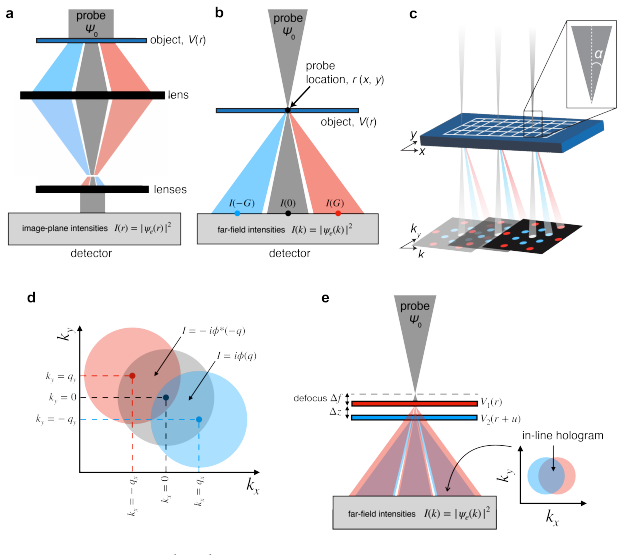
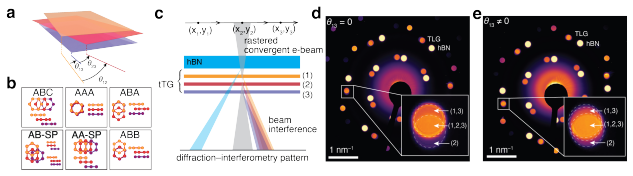
Summary. This review surveys geometric-phase methods for mapping atomic reconstruction in moiré superlattices, with primary emphasis on Bragg interferometry (BI). BI is presented as a constrained dark-field approach that fits the intensity of overlapping Bragg disks in 4D-STEM CBED patterns to analytical forms of the interlayer displacement field u(r) (Eqs. 8–9), thereby extracting reconstruction-induced strain and stacking over large fields of view. The manuscript situates BI relative to geometric phase analysis, CBED holography, single-sideband and dark-field X-ray ptychography, and full electron ptychography, then illustrates its utility through published case studies of twisted bilayer graphene, twisted TMD bilayers/heterobilayers, and twisted trilayer graphene. Special attention is given to advantages for buried/encapsulated interfaces and to limitations arising from incomplete phase information, the weak-phase approximation, dynamical scattering, and specimen tilt.
Significance. If the comparative framing and the physical assumptions hold, the review supplies a timely, pedagogically useful synthesis for the rapidly expanding moiré community. It correctly identifies a practical gap—sub-ångström reconstruction mapping over micron-scale fields of view in encapsulated devices—and shows how BI addresses that gap more efficiently than full ptychography while retaining dark-field selectivity unavailable to bright-field GPA. The case studies (reconstruction regimes near the magic angle, encapsulation-dependent dilational pathways, second-neighbor coupling in trilayers) are drawn from independent experimental 4D-STEM datasets already in the literature; the present text does not invent new entities or circularly redefine fitted parameters as predictions. Explicit discussion of free parameters (origin offset Δγ, average lattice constant) and of the weak-phase/independent-scattering approximation further strengthens the contribution as a balanced methods review rather than an uncritical advocacy piece.
minor comments (5)
- Equation numbering is inconsistent: the text refers to “equation 1.10” when discussing the small impact of Δz, yet the displayed equations are numbered (1)–(9). Align the cross-references.
- Figure 2 caption and surrounding text use both “aberration-free” and “aberation-free”; standardize spelling.
- In the TMD section the text states “BI determined local rotational reconstruction … and and to separate”; remove the duplicated “and”.
- A short forward-looking sentence on how BI-derived strain maps could be quantitatively cross-validated against multislice-simulated CBED libraries would strengthen the Future Directions section without altering the central claim.
- The abstract and introduction correctly emphasize “incomplete phase information,” yet the main text could more explicitly flag that only the absolute value of the geometric phase is recovered (necessitating unwrapping), to match the clarity of the Limitations section.
Circularity Check
Methodological review; self-cited experimental case studies illustrate BI utility but do not force the intensity-to-u(r) mapping by construction or uniqueness theorem.
-
self citation load bearing
[Case studies sections (Twisted bilayer graphene; Twisted transition metal dichalcogenides; Twisted trilayer graphene) and associated figures]
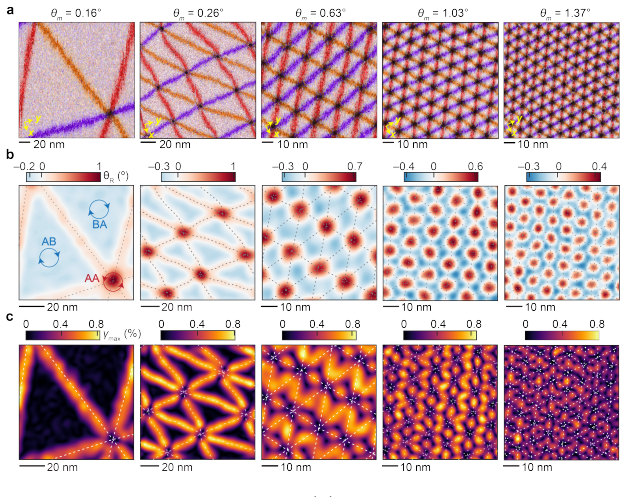
"We demonstrate the utility of Bragg interferometry through case studies of twisted bilayer and trilayer graphene as well as transition metal dichalcogenide moiré systems. … By fitting the overlap intensities associated with multiple graphene Bragg reflections, BI was used to obtain the local displacement field u(r) throughout the moiré lattice (Figure 4a)."
The concrete claims of reconstruction regimes, dilational strain, encapsulation effects and trilayer stacking preferences rest exclusively on the authors’ own prior experimental papers. The citations are experimental (independent 4D-STEM data) rather than an unverified uniqueness theorem, so the circularity is minor and non-load-bearing for the methodological derivation itself.
full rationale
The paper is a review that derives the Bragg-interferometry intensity model from the weak-phase-object approximation (Eqs. 1–2, 8–9) and standard bilayer scattering, then fits experimental dark-field overlap intensities I_j(r) to extract interlayer displacement u(r). That extraction is an ordinary inverse problem under stated approximations; nothing is redefined in terms of the fitted u and then re-presented as an independent prediction. Comparative discussion of GPA, SSB ptychography, dark-field X-ray ptychography and CBED holography rests on the broader literature. The three case-study sections necessarily cite the authors’ own prior experimental papers ([36], [63], [64]) that contain independent 4D-STEM datasets; those citations supply illustrations of utility rather than a load-bearing uniqueness claim or an unverified premise. The Limitations section explicitly flags the weak-phase and tilt assumptions. No self-definitional loop, fitted-input-as-prediction, or ansatz-smuggled-via-citation is present. Score 1 reflects only the ordinary self-citation of the experimental demonstrations.
Assumptions & free parameters
free parameters (2)
- origin offset Δγ (or equivalent choice of stacking reference)
- average lattice constant used for absolute strain
assumptions (4)
- domain assumption Weak-phase-object approximation: exit wave ≈ (1 + iσV)ψ0, multiple scattering neglected
- domain assumption Deformation is equally partitioned between the two (or more) layers when converting relative phase to absolute displacement/strain
- domain assumption Out-of-plane separation Δz contributes negligibly to the observed fringe offset under the imaging conditions used
- standard math Standard Fourier relationship between geometric phase PG and displacement: PG = 2πG·u
Cite this review
Pith. "Pith review of Bragg Interferometry of Moir\'e Superlattices: From Geometric Phase Principles to Atomic Reconstruction." pith.science (2026). https://pith.science/paper/VTSORWU2
@misc{pith2026260709901,
  author       = {Pith},
  title        = {Pith review of: Bragg Interferometry of Moir\'e Superlattices: From Geometric Phase Principles to Atomic Reconstruction},
  year         = {2026},
  howpublished = {\url{https://pith.science/paper/VTSORWU2}},
  note         = {Machine review of arXiv:2607.09901}
}
read the original abstract
The emergence of moir\'e superlattices formed by twisting and stacking two-dimensional materials has created a need for characterization techniques capable of mapping sub-angstrom atomic reconstruction across micron-scale fields of view. This review surveys a suite of methodologies developed to extract geometric phases in electron microscopy and X-ray spectroscopy, with a primary focus on the interference of overlapping Bragg reflections in the dark field. We provide a comparative analysis of some established techniques, including geometric phase analysis, converged beam electron diffraction holography, and various ptychographic paradigms, culminating in a discussion of Bragg interferometry for measuring interlayer displacement fields and strain in moir\'e materials. We demonstrate the utility of Bragg interferometry through case studies of twisted bilayer and trilayer graphene as well as transition metal dichalcogenide moir\'e systems. Special attention is given to the unique advantages of this dark-field interferometric method for probing buried interfaces and encapsulated heterostructures, as well as the inherent challenges of interpreting incomplete phase information in the presence of dynamical scattering. By examining the physical principles underlying these approaches, this review highlights the conceptual similarities and practical trade-offs involved in high-resolution structural mapping of materials in which the interplay between structural relaxation and electronic behavior defines a scientific frontier at the nexus of modern condensed matter physics, nanomaterials engineering, and interfacial chemistry.
Figures


Figures from the paper (5 more)



Reference graph
Works this paper leans on
-
[1]
D., Vargas, P., Pacheco, M
Su´ arez Morell, E., Correa, J. D., Vargas, P., Pacheco, M. & Barticevic, Z. Flat bands in slightly twisted bilayer graphene: Tight-binding calculations.Phys. Rev. B82, 121407(R) (2010)
2010
-
[2]
Moir´ e bands in twisted double-layer graphene.Proceedings of the National Academy of Sciences108,12233–12237 (2011)
Bistritzer & MacDonald. Moir´ e bands in twisted double-layer graphene.Proceedings of the National Academy of Sciences108,12233–12237 (2011)
2011
-
[3]
Cao, Y.et al.Correlated insulator behaviour at half-filling in magic-angle graphene superlattices.Nature556,80–84 (2018). 30
2018
-
[4]
Nature556,43–50 (2018)
Cao, Y.et al.Unconventional superconductivity in magic-angle graphene superlattices. Nature556,43–50 (2018)
2018
-
[5]
Chen, G.et al.Signatures of tunable superconductivity in a trilayer graphene moir´ e superlattice.Nature572,215–219 (2019)
2019
-
[6]
Tran, K.et al.Evidence for moir´ e excitons in van der Waals heterostructures.Nature 567,71–75 (2019)
2019
-
[7]
L.et al.Signatures of moir´ e-trapped valley excitons in MoSe 2/WSe2 heter- obilayers.Nature567,66–70 (2019)
Seyler, K. L.et al.Signatures of moir´ e-trapped valley excitons in MoSe 2/WSe2 heter- obilayers.Nature567,66–70 (2019)
2019
-
[8]
M.et al.Resonantly hybridized excitons in moir´ e superlattices in van der Waals heterostructures.Nature567,81–86 (2019)
Alexeev, E. M.et al.Resonantly hybridized excitons in moir´ e superlattices in van der Waals heterostructures.Nature567,81–86 (2019)
2019
Show all 116 references
-
[9]
Nature567,76–80 (2019)
Jin, C.et al.Observation of moir´ e excitons in WSe2/WS2 heterostructure superlattices. Nature567,76–80 (2019)
2019
-
[10]
Hao, Z.et al.Electric field–tunable superconductivity in alternating-twist magic-angle trilayer graphene.Science371,1133–1138 (2021)
2021
-
[11]
Mater.19,1068–1073 (2020)
Bai, Y.et al.Excitons in strain-induced one-dimensional moir´ e potentials at transition metal dichalcogenide heterojunctions.Nat. Mater.19,1068–1073 (2020)
2020
-
[12]
Huang, D., Choi, J., Shih, C.-K. & Li, X. Excitons in semiconductor moir´ e superlat- tices.Nature Nanotechnology17,227–238 (2022)
2022
-
[13]
Mak, K. F. & Shan, J. Semiconductor moir´ e materials.Nature Nanotechnology17, 686–696 (2022)
2022
-
[14]
H.et al.Intralayer charge-transfer moir´ e excitons in van der Waals super- lattices.Nature609,52–57 (2022)
Naik, M. H.et al.Intralayer charge-transfer moir´ e excitons in van der Waals super- lattices.Nature609,52–57 (2022)
2022
-
[15]
Susarla, S.et al.Hyperspectral imaging of exciton confinement within a moir´ e unit cell with a subnanometer electron probe.Science378,1235–1239 (2022)
2022
-
[16]
Nature628,522–526 (2024)
Kang, K.et al.Evidence of the fractional quantum spin Hall effect in moir´ e MoTe 2. Nature628,522–526 (2024)
2024
-
[17]
Yu, Y.et al.Tunable angle-dependent electrochemistry at twisted bilayer graphene with moir´ e flat bands.Nature Chemistry14,267–273 (2022). 31
2022
-
[18]
& Bediako, D
Yu, Y., Van Winkle, M. & Bediako, D. K. Tuning interfacial chemistry with twistron- ics.Trends in Chemistry4,857–859 (2022)
2022
-
[19]
Zhang, K.et al.Anomalous Interfacial Electron-Transfer Kinetics in Twisted Trilayer Graphene Caused by Layer-Specific Localization.ACS Central Science9,1119–1128 (2023)
2023
-
[20]
& Bediako, D
Van Winkle, M., Zhang, K. & Bediako, D. K. Nanoscale Structure and Interfacial Electrochemical Reactivity of Moir´ e-Engineered Atomic Layers.Accounts of Chemical Research58,415–427 (Feb. 2025)
2025
-
[21]
Nature579,353–358 (2020)
Tang, Y.et al.Simulation of Hubbard model physics in WSe 2/WS2 moir´ e superlattices. Nature579,353–358 (2020)
2020
-
[22]
R., Efetov, D
Balents, L., Dean, C. R., Efetov, D. K. & Young, A. F. Superconductivity and strong correlations in moir´ e flat bands.Nature Physics16,725–733 (2020)
2020
-
[23]
Xu, Y.et al.A tunable bilayer Hubbard model in twisted WSe2.Nature Nanotech- nology17,934–939 (2022)
2022
-
[24]
& Limmer, D
Coello Escalante, L. & Limmer, D. T. Microscopic Origin of Twist-Dependent Electron Transfer Rate in Bilayer Graphene.Nano Letters24,14868–14874 (2024)
2024
-
[25]
Maroo, S.et al.Electronic origin of reorganization energy in interfacial electron trans- fer.Nature653,98–103 (2026)
2026
-
[26]
A., Ohuchi, F
Parkinson, B. A., Ohuchi, F. S., Ueno, K. & Koma, A. Periodic lattice distortions as a result of lattice mismatch in epitaxial films of two-dimensional materials.Applied Physics Letters58,472–474 (1991)
1991
-
[27]
S.et al.Strain solitons and topological defects in bilayer graphene.Proceed- ings of the National Academy of Sciences110,11256–11260 (2013)
Alden, J. S.et al.Strain solitons and topological defects in bilayer graphene.Proceed- ings of the National Academy of Sciences110,11256–11260 (2013)
2013
-
[28]
R.et al.Commensurate–incommensurate transition in graphene on hexag- onal boron nitride.Nature Physics10,451–456 (2014)
Woods, C. R.et al.Commensurate–incommensurate transition in graphene on hexag- onal boron nitride.Nature Physics10,451–456 (2014)
2014
-
[29]
Wijk, M. M. v., Schuring, A., Katsnelson, M. I. & Fasolino, A. Relaxation of moir´ epatterns for slightly misaligned identical lattices: graphene on graphite.2,034010 (2015)
2015
-
[30]
& Srolovitz, D
Dai, S., Xiang, Y. & Srolovitz, D. J. Twisted bilayer graphene: Moir´ e with a twist. Nano Lett.16,5923–5927 (2016). 32
2016
-
[31]
Nam, N. N. T. & Koshino, M. Lattice relaxation and energy band modulation in twisted bilayer graphene.Physical Review B96,075311– (Aug. 2017)
2017
-
[32]
& Tadmor, E
Zhang, K. & Tadmor, E. B. Structural and electron diffraction scaling of twisted graphene bilayers.Journal of the Mechanics and Physics of Solids112,225–238 (2018)
2018
-
[33]
Carr, S.et al.Relaxation and domain formation in incommensurate two-dimensional heterostructures.Phys. Rev. B98,224102 (22 2018)
2018
-
[34]
Mater.18,448–453 (2019)
Yoo, H.et al.Atomic and electronic reconstruction at the van der Waals interface in twisted bilayer graphene.Nat. Mater.18,448–453 (2019)
2019
-
[35]
Nanotechnol.15,592–597 (2020)
Weston, A.et al.Atomic reconstruction in twisted bilayers of transition metal dichalco- genides.Nat. Nanotechnol.15,592–597 (2020)
2020
-
[36]
P.et al.Strain fields in twisted bilayer graphene.Nature materials 20,956–963 (2021)
Kazmierczak, N. P.et al.Strain fields in twisted bilayer graphene.Nature materials 20,956–963 (2021)
2021
-
[37]
& Koshino, M
Nakatsuji, N., Kawakami, T. & Koshino, M. Multi-scale lattice relaxation in chiral twisted trilayer graphenes.arXiv preprint arXiv:2305.13155(2023)
2023 arXiv
-
[38]
Uri, A.et al.Mapping the twist-angle disorder and Landau levels in magic-angle graphene.Nature581,47–52 (2020)
2020
-
[39]
H., Fu, Y., Das Sarma, S
Wilson, J. H., Fu, Y., Das Sarma, S. & Pixley, J. H. Disorder in twisted bilayer graphene.Physical Review Research2,023325– (June 2020)
2020
-
[40]
N., Bockrath, M
Lau, C. N., Bockrath, M. W., Mak, K. F. & Zhang, F. Reproducibility in the fabrica- tion and physics of moir´ e materials.Nature602,41–50 (2022)
2022
-
[41]
Physical Review Letters120,156405– (Apr
Huder, L.et al.Electronic Spectrum of Twisted Graphene Layers under Heterostrain. Physical Review Letters120,156405– (Apr. 2018)
2018
-
[42]
Bi, Z., Yuan, N. F. Q. & Fu, L. Designing flat bands by strain.Physical Review B 100,035448– (July 2019)
2019
-
[43]
Kerelsky, A.et al.Maximized electron interactions at the magic angle in twisted bilayer graphene.Nature572,95–100 (2019)
2019
-
[44]
O.et al.High-resolution three-dimensional structural microscopy by single-angle Bragg ptychography.Nature materials16,244–251 (2017)
Hruszkewycz, S. O.et al.High-resolution three-dimensional structural microscopy by single-angle Bragg ptychography.Nature materials16,244–251 (2017). 33
2017
-
[45]
X-ray ptychography.Nature Photonics12,9–17 (2018)
Pfeiffer, F. X-ray ptychography.Nature Photonics12,9–17 (2018)
2018
-
[46]
Kim, C.et al.Three-dimensional imaging of phase ordering in an Fe-Al alloy by Bragg ptychography.Physical Review Letters121,256101 (2018)
2018
-
[47]
Takahashi, Y.et al.Bragg x-ray ptychography of a silicon crystal: Visualization of the dislocation strain field and the production of a vortex beam.Physical Review B—Condensed Matter and Materials Physics87,121201 (2013)
2013
-
[48]
& Ciston, J
Ophus, C., Ercius, P., Sarahan, M., Czarnik, C. & Ciston, J. Recording and using 4D- STEM datasets in materials science.Microscopy and Microanalysis20,62–63 (2014)
2014
-
[49]
Four-dimensional scanning transmission electron microscopy (4D-STEM): From scanning nanodiffraction to ptychography and beyond.Microscopy and Micro- analysis25,563–582 (2019)
Ophus, C. Four-dimensional scanning transmission electron microscopy (4D-STEM): From scanning nanodiffraction to ptychography and beyond.Microscopy and Micro- analysis25,563–582 (2019)
2019
-
[50]
& Rodenburg, J
Humphry, M., Kraus, B., Hurst, A., Maiden, A. & Rodenburg, J. Ptychographic elec- tron microscopy using high-angle dark-field scattering for sub-nanometre resolution imaging.Nature communications3,730 (2012)
2012
-
[51]
J.et al.Efficient phase contrast imaging in STEM using a pixelated detector
Pennycook, T. J.et al.Efficient phase contrast imaging in STEM using a pixelated detector. Part 1: Experimental demonstration at atomic resolution.Ultramicroscopy 151,160–167 (2015)
2015
-
[52]
Gao, S.et al.Electron ptychographic microscopy for three-dimensional imaging.Na- ture Communications8,163 (2017)
2017
-
[53]
Jiang, Y.et al.Electron ptychography of 2D materials to deep sub-˚ angstr¨ om resolu- tion.Nature559,343–349 (2018)
2018
-
[54]
Chen, Z.et al.Mixed-state electron ptychography enables sub-angstrom resolution imaging with picometer precision at low dose.Nature communications11,2994 (2020)
2020
-
[55]
Yang, W., Sha, H., Cui, J., Mao, L. & Yu, R. Local-orbital ptychography for ultrahigh- resolution imaging.Nature Nanotechnology,1–6 (2024)
2024
-
[56]
M., Qiu, W
Pelz, P. M., Qiu, W. X., B¨ ucker, R., Kassier, G. & Miller, R. D. Low-dose cryo electron ptychography via non-convex Bayesian optimization.Scientific reports7,9883 (2017)
2017
-
[57]
Chen, Z.et al.Electron ptychography achieves atomic-resolution limits set by lattice vibrations.Science372,826–831 (2026/07/04 2021). 34
2026
-
[58]
& Kilaas, R
H¨ ytch, M., Snoeck, E. & Kilaas, R. Quantitative measurement of displacement and strain fields from HREM micrographs.Ultramicroscopy74,131–146 (1998)
1998
-
[59]
P´ asztor, ´A.et al.Holographic imaging of the complex charge density wave order parameter.Physical Review Research1,033114– (Nov. 2019)
2019
-
[60]
P´ asztor, ´A.et al.Multiband charge density wave exposed in a transition metal dichalco- genide.Nature Communications12,6037 (2021)
2021
-
[61]
& Renner, C
P´ asztor, ´A., Pushkarna, I. & Renner, C. Delusive chirality and periodic strain pattern in moir´ esystems.11,035017 (2024)
2024
-
[62]
Ke, X., Zhang, M., Zhao, K. & Su, D. Moir´ eFringe Method via Scanning Transmission Electron Microscopy.Small Methods6,2101040 (2026/07/04 2022)
2026
-
[63]
Van Winkle, M.et al.Rotational and dilational reconstruction in transition metal dichalcogenide moir´ e bilayers.Nature communications14,2989 (2023)
2023
-
[64]
M.et al.Local atomic stacking and symmetry in twisted graphene trilayers
Craig, I. M.et al.Local atomic stacking and symmetry in twisted graphene trilayers. Nature Materials,1–8 (2024)
2024
-
[65]
M., Van Winkle, M., Ophus, C
Craig, I. M., Van Winkle, M., Ophus, C. & Bediako, D. K. Considerations for extract- ing moir´ e-level strain from dark field intensities in transmission electron microscopy. Journal of Applied Physics136,074301 (2024)
2024
-
[66]
& Knoll, M
Ruska, E. & Knoll, M. Die magnetische Sammelspule f¨ ur schnelle Elektronenstrahlen. The magnetic concentrating coil for fast electron beams.) Z. techn. Physik12,389–400 (1931)
1931
-
[67]
¨Uber einige Fehler von Elektronenlinsen.Zeitschrift f¨ ur Physik101,593– 603 (1936)
Scherzer, O. ¨Uber einige Fehler von Elektronenlinsen.Zeitschrift f¨ ur Physik101,593– 603 (1936)
1936
-
[68]
The theoretical resolution limit of the electron microscope.Journal of Applied Physics20,20–29 (1949)
Scherzer, O. The theoretical resolution limit of the electron microscope.Journal of Applied Physics20,20–29 (1949)
1949
-
[69]
Faruqi, A. R. & McMullan, G. Electronic detectors for electron microscopy.44,357– 390 (2011)
2011
-
[70]
Levin, B. D. A. Direct detectors and their applications in electron microscopy for materials science.4,042005 (2021). 35
2021
-
[71]
& Maiden, A
Rodenburg, J. & Maiden, A. inSpringer Handbook of Microscopy(eds Hawkes, P. W. & Spence, J. C. H.) 819–904 (Springer International Publishing, Cham, 2019).isbn: 978-3-030-00069-1.https://doi.org/10.1007/978-3-030-00069-1_17
2019 doi
-
[72]
& Yang, C
Zheng, G., Shen, C., Jiang, S., Song, P. & Yang, C. Concept, implementations and applications of Fourier ptychography.Nature Reviews Physics3,207–223 (2021)
2021
-
[73]
Ptychography: A brief introduction.Journal of Microscopy300,153– 155 (2026/07/04 2025)
Rodenburg, J. Ptychography: A brief introduction.Journal of Microscopy300,153– 155 (2026/07/04 2025)
2026
-
[74]
& Nellist, P
Clark, L. & Nellist, P. D.Electron Ptychography2025. arXiv:2503.10917 [physics.optics]. https://arxiv.org/abs/2503.10917
-
[75]
Computational microscopy with coherent diffractive imaging and ptychogra- phy.Nature637,281–295 (2025)
Miao, J. Computational microscopy with coherent diffractive imaging and ptychogra- phy.Nature637,281–295 (2025)
2025
-
[76]
Wang, T.et al.Optical ptychography for biomedical imaging: recent progress and future directions [Invited].Biomedical Optics Express14,489–532 (2023)
2023
-
[77]
Beugung im inhomogenen Prim¨ arstrahlwellenfeld
Hoppe, W. Beugung im inhomogenen Prim¨ arstrahlwellenfeld. I. Prinzip einer Phasen- messung von Elektronenbeungungsinterferenzen.Acta Crystallographica Section A25, 495–501 (July 1969)
1969
-
[78]
& Hoppe, W
Hegerl, R. & Hoppe, W. Dynamische theorie der kristallstrukturanalyse durch elektro- nenbeugung im inhomogenen prim¨ arstrahlwellenfeld.Berichte der Bunsengesellschaft f¨ ur physikalische Chemie74,1148–1154 (1970)
1970
-
[79]
& Nellist, P
Rodenburg, J., McCallum, B. & Nellist, P. Experimental tests on double-resolution coherent imaging via STEM.Ultramicroscopy48,304–314 (1993)
1993
-
[80]
& Takahashi, Y
Suzuki, A., Shimomura, K., Hirose, M., Burdet, N. & Takahashi, Y. Dark-field X- ray ptychography: Towards high-resolution imaging of thick and unstained biological specimens.Scientific reports6,35060 (2016)
2016
-
[81]
W.et al.High dynamic range pixel array detector for scanning transmission electron microscopy.Microscopy and Microanalysis22,237–249 (2016)
Tate, M. W.et al.High dynamic range pixel array detector for scanning transmission electron microscopy.Microscopy and Microanalysis22,237–249 (2016)
2016
-
[82]
Latychevskaia, T.et al.Convergent beam electron holography for analysis of van der Waals heterostructures.Proc. Natl. Acad. Sci.115,7473–7478 (2018). 36
2018
-
[83]
A.et al.Imaging moir´ e deformation and dynamics in twisted bilayer graphene.Nature Communications13,70 (2022)
De Jong, T. A.et al.Imaging moir´ e deformation and dynamics in twisted bilayer graphene.Nature Communications13,70 (2022)
2022
-
[84]
A New Microscopic Principle.Nature161,777–778 (1948)
Gabor, D. A New Microscopic Principle.Nature161,777–778 (1948)
1948
-
[85]
J.et al.Interferometric 4D-STEM for lattice distortion and interlayer spacing measurements of bilayer and trilayer 2D materials.Small17,2100388 (2021)
Zachman, M. J.et al.Interferometric 4D-STEM for lattice distortion and interlayer spacing measurements of bilayer and trilayer 2D materials.Small17,2100388 (2021)
2021
-
[86]
K., Juriˇ ci´ c, V
Jain, S. K., Juriˇ ci´ c, V. & Barkema, G. T. Structure of twisted and buckled bilayer graphene.4,015018 (2017)
2017
-
[87]
& Bernevig, B
T¨ orm¨ a, P., Peotta, S. & Bernevig, B. A. Superconductivity, superfluidity and quantum geometry in twisted multilayer systems.Nature Reviews Physics4,528–542 (2022)
2022
-
[88]
R.et al.Twist angle-dependent atomic reconstruction and moir´ e patterns in transition metal dichalcogenide heterostructures.ACS Nano14,4550– 4558 (2020)
Rosenberger, M. R.et al.Twist angle-dependent atomic reconstruction and moir´ e patterns in transition metal dichalcogenide heterostructures.ACS Nano14,4550– 4558 (2020)
2020
-
[89]
Mater.20,945–950 (2021)
Li, H.et al.Imaging moir´ e flat bands in three-dimensional reconstructed WSe 2/WS2 superlattices.Nat. Mater.20,945–950 (2021)
2021
-
[90]
H.et al.Torsional Periodic Lattice Distortions and Diffraction of Twisted 2D Materials.arXiv preprint arXiv:2203.06510(2022)
Sung, S. H.et al.Torsional Periodic Lattice Distortions and Diffraction of Twisted 2D Materials.arXiv preprint arXiv:2203.06510(2022)
2022 arXiv
-
[91]
Phys.17,720–725 (2021)
Shabani, S.et al.Deep moir´ e potentials in twisted transition metal dichalcogenide bilayers.Nat. Phys.17,720–725 (2021)
2021
-
[92]
Commun.12,1–7 (2021)
Li, E.et al.Lattice reconstruction induced multiple ultra-flat bands in twisted bilayer WSe2.Nat. Commun.12,1–7 (2021)
2021
-
[93]
H., Kundu, S., Maity, I
Naik, M. H., Kundu, S., Maity, I. & Jain, M. Origin and evolution of ultraflat bands in twisted bilayer transition metal dichalcogenides: Realization of triangular quantum dots.Phys. Rev. B102,075413 (2020)
2020
-
[94]
Naik, M. H. & Jain, M. Ultraflatbands and shear solitons in moir´ e patterns of twisted bilayer transition metal dichalcogenides.Phys. Rev. Lett.121,266401 (2018)
2018
-
[95]
& Fal’ko, V
Enaldiev, V., Z´ olyomi, V., Yelgel, C., Magorrian, S. & Fal’ko, V. Stacking domains and dislocation networks in marginally twisted bilayers of transition metal dichalcogenides. Phys. Rev. Lett.124,206101 (2020). 37
2020
-
[96]
& Fal’ko, V
Ferreira, F., Magorrian, S., Enaldiev, V., Ruiz-Tijerina, D. & Fal’ko, V. Band energy landscapes in twisted homobilayers of transition metal dichalcogenides.Appl. Phys. Lett.118,241602 (2021)
2021
-
[97]
Jinet al.Probing moir´ e excitons in van der Waals heterostructures.Nature567,76– 80 (2019)
2019
-
[98]
Zhang, Mao, Cao,et al.Moir´ e excitons in van der Waals heterostructures.Nature Communications11,5888 (2020)
2020
-
[99]
Zhang, N.et al.Moir´ e intralayer excitons in a MoSe 2/MoS2 heterostructure.Nano Letters18,7651–7657 (2018)
2018
-
[100]
Tranet al.Signature of moir´ e excitons in van der Waals heterostructures.Nature567, 71–75 (2019)
2019
-
[101]
Topological exciton bands in moir´ e heterojunctions.Phys- ical Review Letters118,147401 (2017)
Wu, Lovorn & MacDonald. Topological exciton bands in moir´ e heterojunctions.Phys- ical Review Letters118,147401 (2017)
2017
-
[102]
Dandu, M.et al.Electrically tunable localized versus delocalized intralayer moir´ e excitons and trions in a twisted MoS 2 bilayer.ACS Nano16,8983–8992 (2022)
2022
-
[103]
Nature606,494–500 (2022)
Kim, H.et al.Evidence for unconventional superconductivity in twisted trilayer graphene. Nature606,494–500 (2022)
2022
-
[104]
M., Cao, Y., Watanabe, K., Taniguchi, T
Park, J. M., Cao, Y., Watanabe, K., Taniguchi, T. & Jarillo-Herrero, P. Tunable strongly coupled superconductivity in magic-angle twisted trilayer graphene.Nature 590,249–255 (2021)
2021
-
[105]
& Kaxiras, E
Zhu, Z., Carr, S., Massatt, D., Luskin, M. & Kaxiras, E. Twisted trilayer graphene: A precisely tunable platform for correlated electrons.Physical review letters125,116404 (2020)
2020
-
[106]
C˘ alug˘ aru, D.et al.Twisted symmetric trilayer graphene: Single-particle and many- body Hamiltonians and hidden nonlocal symmetries of trilayer moir´ e systems with and without displacement field.Physical Review B103,195411 (2021)
2021
-
[107]
S., Pacheco, M., Chico, L
Morell, E. S., Pacheco, M., Chico, L. & Brey, L. Electronic properties of twisted trilayer graphene.Physical Review B87,125414 (2013). 38
2013
-
[108]
Turkel, S.et al.Orderly disorder in magic-angle twisted trilayer graphene.Science 376,193–199 (2022)
2022
-
[109]
T., Pantale´ on, P
Phong, V. T., Pantale´ on, P. A., Cea, T. & Guinea, F. Band structure and supercon- ductivity in twisted trilayer graphene.Physical Review B104,L121116 (2021)
2021
-
[110]
Nature620,762–767 (2023)
Uri, A.et al.Superconductivity and strong interactions in a tunable moir´ equasicrystal. Nature620,762–767 (2023)
2023
-
[111]
& Yang, B.-J
Ahn, J., Park, S. & Yang, B.-J. Failure of Nielsen-Ninomiya theorem and fragile topol- ogy in two-dimensional systems with space-time inversion symmetry: application to twisted bilayer graphene at magic angle.Physical Review X9,021013 (2019)
2019
-
[112]
Song, Z.et al.All magic angles in twisted bilayer graphene are topological.Physical review letters123,036401 (2019)
2019
-
[113]
& Bernevig, B
Mora, C., Regnault, N. & Bernevig, B. A. Flatbands and perfect metal in trilayer moir´ e graphene.Physical review letters123,026402 (2019)
2019
-
[114]
M.et al.Robust superconductivity in magic-angle multilayer graphene family
Park, J. M.et al.Robust superconductivity in magic-angle multilayer graphene family. Nature Materials21,877–883 (2022)
2022
-
[115]
& Ledwith, P.Four Moir´ e materials at One Magic Angle in Helical Quadrilayer Graphene2025
Fujimoto, M., Nakatsuji, N., Vishwanath, A. & Ledwith, P.Four Moir´ e materials at One Magic Angle in Helical Quadrilayer Graphene2025. arXiv:2510.02444 [cond-mat.str-el]
-
[116]
Han, T.et al.Correlated insulator and Chern insulators in pentalayer rhombohedral- stacked graphene.Nature Nanotechnology19,181–187 (2024). 39
2024
Reviewed July 14, 2026 · model on record in the stance chip above.
Discussion (0). Sign in to comment.