REVIEW 4 major objections 5 minor 51 references
Investigation of $\Lambda_c$ States and $(\bar{D}N)$ Molecules Production at EicC and EIC
T0 review · 4 major / 5 minor · reviewed 2026-08-11 · deepseek-v4-flash
Pith's one-line read The paper shows that yields of excited charm baryons at EicC and EIC reach 10^6 to 10^7 events, while Lambda_c(2940) production rates alone cannot distinguish a molecular from a three-quark structure.
desk verdict A useful feasibility estimate with one robust central claim, but the t-channel-only approximation and an ambiguous coupling-constant value need referee attention before the yield numbers can be taken at face value. read the letter →
The pith
A machine-rendered reading of the paper's core claim, the machinery that carries it, and where it could break.
The reading
What carries the argument
The carrier of the calculation is the t-channel Feynman amplitude for $\gamma p \to \bar{D}^0 \Lambda_c^{(*)}$, built from effective Lagrangians with nucleon, $D$, and $D^*$ exchange (Fig. 1). The couplings that enter are not all known empirically, so two model schemes supply them: the hadronic-molecule picture, in which $\Lambda_c(2940)$ and the $(\bar{D}N)$ states are $S$-wave bound states whose couplings are fixed by the compositeness condition $Z=1-\Sigma'(m^2)=0$, and the $3P_0$ quark-pair-creation model, which gives the couplings for the three-quark assignments. A monopole form factor with cutoff $\Lambda_2=2.5$ GeV regulates the off-shell vertices, and the Weizsäcker-Williams equivalent-photon approximation converts the real-photon cross sections into electron-proton yields at the EicC and EIC energies.
What would settle it
A measurement of the $\gamma p\to \bar{D}^0\Lambda_c(2940)$ cross section at a center-of-mass energy around 10 GeV would settle the central estimate: the paper's t-channel model places it in a specific band (the $\Lambda_2=2.5$ GeV curve in Fig. 7), so a measured value an order of magnitude above or below that band would falsify the yield prediction.
Extended reading notes
Core claim
On the paper's own terms, the central discovery is a quantitative yield comparison. For the t-channel process $\gamma p\to \bar{D}^0\Lambda_c^{(*)}$, treating $\Lambda_c(2940)$ either as a $D^*N$ molecular state or as the three-quark $\Lambda_c(1/2^-,2P)$ state changes the photoproduction cross section by less than an order of magnitude over the $5$--$20$ GeV range, with the molecular assumption giving a modest enhancement (Figs. 6 and 7). Converting to electroproduction by the Weizsäcker-Williams method and folding in the integrated luminosities of EicC and EIC, the paper yields $10^6$--$10^7$ events for $\Lambda_c(2595)$ and $\Lambda_c(2940)$, and $10^5$ events for the predicted $(\bar{D}N)$ molecules with isospin $I=0$ and $I=1$. These numbers are presented as evidence that both facilities can meaningfully study charm baryons, while the near-degeneracy of the two $\Lambda_c(2940)$ models is presented as evidence that photoproduction rates alone are not decisive for its structure.
Load-bearing premise
The load-bearing assumption is that the t-channel meson exchange alone controls the photoproduction cross section, with no s-channel, u-channel, or contact contributions of comparable size; if any of these channels contributes significantly near threshold, the predicted yields for the excited states would shift by an unknown amount.
Editorial extensions
If this is right
- $\Lambda_c(2940)$ production alone will not settle its structure: the molecule and quark-model cross sections stay within the same order of magnitude, so distinguishing them requires other observables such as angular distributions or decay patterns.
- After integrated luminosity, EicC and EIC should collect $10^6$--$10^7$ $\Lambda_c(2595)$ and $\Lambda_c(2940)$ events, giving large samples for spectroscopy and decay studies.
- The $(\bar{D}N)$ molecules with $I=0$ and $I=1$ should be produced at the $10^5$ level and are within reach of both facilities.
- The yield hierarchy is controlled by whether $D$ or $D^*$ exchange dominates: for $\Lambda_c(2940)$ the $D^*$ exchange pushes production to higher energies, whereas for $(\bar{D}N)$ the $D$ exchange keeps it at lower energies, explaining the different EicC-vs-EIC ratios.
Reading between the lines
- A natural next step, not taken in the paper, is to compute s- and u-channel contributions in the same effective-Lagrangian framework; the near-threshold region ($W$ between 5 and 10 GeV) is where the t-channel approximation is most vulnerable, and an explicit check would show whether the same-order-of-magnitude conclusion survives.
- Because the $3P0$ model coupling constants for the excited states were evaluated with the meson off-shell ($p_C^2=0$) and one free parameter $\gamma$ fixed elsewhere, the quark-model branch of the comparison carries an uncertainty that could be tested against future lattice QCD determinations of the $\Lambda_c(2940)\to \bar{D}N$ coupling.
- The same recipe could be applied to bottom counterparts like $\Lambda_b$ states and $(\bar{B}N)$ molecules, where the heavier quark mass changes the kinematics and could make the molecular vs quark-model discrimination more visible.
Editorial analysis
A structured set of objections, weighed in public.
Referee Report
Summary. The paper estimates photoproduction and electroproduction yields for ground and excited Lambda_c states and predicted (Dbar N) hadronic molecules at the proposed EicC and EIC facilities. It uses t-channel D and D* exchange effective Lagrangians for gamma p -> Dbar0 Lambda_c^(*) and gamma p -> (Dbar N) D+, with couplings determined from SU(4) symmetry, the compositeness condition for molecular states, and the 3P0 model for quark-model states. The equivalent photon approximation converts photoproduction cross sections into electroproduction yields. The central quantitative claims are that Lambda_c(2940) production is of the same order of magnitude whether it is treated as a hadronic molecule or a three-quark state, and that with integrated luminosity the yields reach 10^6-10^7 for Lambda_c excited states and 10^5 for (Dbar N) molecular states, making them likely detectable.
Significance. If the calculation were robust, the paper would provide useful first estimates for charm-baryon searches at EicC and EIC, and its conclusion that photoproduction alone may not discriminate the structure of Lambda_c(2940) would be a valuable caution. The paper has concrete strengths: the ratio between channels is shown to be fairly stable under variation of the form-factor cutoff in Fig. 6; the compositeness condition and 3P0 model are implemented with explicit formulas; and the final yield tables are straightforward to use for experimental planning. However, the absolute yields, on which the detectability claim rests, inherit several unquantified model uncertainties, and the manuscript itself acknowledges the t-channel-only approximation and the use of the experimental mass for a quark-model state whose predicted mass is higher. The significance is therefore conditional on a quantitative assessment of these omitted and ambiguous contributions.
major comments (4)
- [II.B and III.A; Fig. 7; Tables II and IV] The central yield claims depend on the t-channel-only approximation, but the approximation is weakest exactly in the photon-energy region that dominates the yield integrals. Section II.B states 'we only consider t-channel particle exchange here,' and Section III.A justifies this by saying the center-of-mass energy is much higher than the nucleon mass. The equivalent photon spectrum in Eq. (5) has a 1/omega weight, so the yields in Tables II and IV receive substantial contributions from photon energies just above threshold, w ~ 5-10 GeV. At these energies, s-channel nucleon-resonance diagrams, u-channel contributions, and the contact terms required by electromagnetic gauge invariance for charged D/D* exchange are not obviously negligible. No estimate of these omitted contributions is given. Because the molecule-versus-three-quark comparison enters through different N Lambda_c D* couplings (1.63 vs 0.75), an order-of-magnitude shift in the t-channel contribution could change the central 'same order of magnitude' conclusion. I would ask the authors to provide at least a quantitative estimate of the omitted channels, or to phrase the claims explicitly as lower-bound estimates under a stated dominance assumption.
- [II.B and II.C.1] There is an unresolved ambiguity in the coupling constant that enters the molecular Lambda_c(2940) amplitude. Section II.B states that 'the excited states coupling constants g_{ND Lambda*_c} = -0.54 and g_{ND* Lambda*_c} = 6.64 are used in Refs. [24,31].' Section II.C.1 instead derives g_{Lambda_c(2940) D*N} = 1.63 from the compositeness condition, Eq. (22). The manuscript never explicitly states which value is used in Eq. (9) for the molecular Lambda_c(2940) curve in Fig. 7 and the corresponding yields in Table II. If the value 6.64 is used, the molecular cross section scales by (6.64/1.63)^2 ~ 16.6 relative to the compositeness-based value, which would invalidate the claimed 'same order of magnitude' ratio with the 3P0 result (g = 0.75). This is a load-bearing numerical ambiguity and must be resolved in the text.
- [III.A] The 3P0-model prediction for Lambda_c(2940) uses the experimental mass while the quark model predicts the Lambda_c(1/2-, 2P) state to be roughly 40-60 MeV heavier, and this difference is acknowledged in the introduction. The mass enters the threshold and phase space of the t-channel amplitude, and the cross section of a near-threshold state is very sensitive to that input. Section III.A states 'we use this assignment along with the experimental mass [1] in our 3P0 model calculations,' but no sensitivity study is given. The same-order-of-magnitude comparison between the 3P0 and molecular models could change if the predicted mass were used instead. A simple check with the quark-model mass, or an estimate of the resulting shift in Table II, is needed before the comparison can be considered robust.
- [Tables II and IV; Fig. 6] The yield ranges quoted in Tables II and IV reflect only the variation of collision energy and integrated luminosity between EicC and EIC, not the model uncertainties in the input couplings, the form-factor cutoff Lambda_2, or the molecular size parameter Lambda. Section III.A calibrates Lambda_2 = 2.5 GeV by 'comparing the charm production results [12-14,22]' but does not state the uncertainty of that calibration. Figure 6 shows that the ratios to the ground state are stable under Lambda_2 variation at w = 10 GeV, but ratios do not constrain the absolute normalization that determines the 'yields reach 10^5-10^7' claim. I request a propagated uncertainty estimate, or at least an explicit statement that the quoted yields are central values without model-systematic errors.
minor comments (5)
- [II.C.2] There are typos: 'descrping' should be 'describing', 'wav function' should be 'wave function', and 'repectively' should be 'respectively'.
- [IV] The summary repeats the typo 'yeilds' for 'yields'.
- [III.A] The sentence beginning 'We use Lambda_c and Lambda_c(2940) molecular state as examples' is grammatically incomplete; it likely should read 'We use the Lambda_c and Lambda_c(2940) molecular state as examples.'
- [III.A] The sentence 'even after taking into account reconstruction efficiency, the yields remain considerable large' would be clearer with a stated efficiency value or a more precise phrasing such as 'assuming a plausible reconstruction efficiency.'
- [References] References [4] and [45] are the same paper (Capstick and Isgur, Phys. Rev. D 34, 2809 (1986)); this duplication should be removed.
Circularity Check
No significant circularity: the molecule-versus-quark comparison rests on independently derived couplings and cutoff-stable ratios.
full rationale
The derivation chain is self-contained in the relevant sense. The molecular coupling g_{Λc(2940)D*N} = 1.63 is obtained from the compositeness condition Z = 1 − Σ′(m²) = 0 (Eq. 22), not from the photoproduction cross sections being predicted. The quark-model coupling g^{QPC}_{Λc(2940)D*p} = 0.75 is obtained from the 3P0 model with the pair-creation strength γ = 9.83 fixed by the independent Σc(2520)^{++} → Λcπ⁺ decay (Refs. [47,48]). The cutoff Λ₂ = 2.5 GeV is calibrated to existing charm photoproduction data, but the paper explicitly shows that the excited-to-ground ratios are stable over Λ₂ = 2.4–3.0 GeV (Fig. 6 and surrounding text), so the central 'same order of magnitude' conclusion is not forced by the calibration. The equivalent-photon approximation (Eqs. 1–5) is a standard external formalism. The self-citations to Refs. [34,35,39] (form factors and compositeness review) are not load-bearing in a circular way: the compositeness condition is a general field-theoretic result, and the form factors are conventional regulators whose parameters are not adjusted to force the Λc(2940) conclusion. A numerical ambiguity exists—the excited-state coupling g_{ND*Λ*} = 6.64 quoted from Refs. [24,31] is not explicitly reconciled with the molecular compositeness value 1.63—but this is a correctness/consistency risk, not a circular reduction, because neither number is defined in terms of the predicted yields. No step was found in which an input is renamed as a prediction or in which the conclusion is equivalent by construction to its assumptions.
Assumptions & free parameters
free parameters (4)
- Form factor cutoff Lambda_2 =
2.5 GeV
- Molecular size parameter Lambda =
1 GeV
- 3P0 quark-pair creation strength gamma =
9.83
- SHO parameters (alpha_rho, quark masses, meson radii) =
alpha_rho = 0.4 GeV; mu = md = 220 MeV, ms = 419 MeV, mc = 1628 MeV; R = 2.5, 1.67, 1.94 GeV^-1
assumptions (6)
- domain assumption t-channel exchange dominates photoproduction for all considered states and energies.
- domain assumption Weizsacker-Williams equivalent photon approximation with Lambda_gamma ~ m_rho is valid for electroproduction at EicC and EIC.
- ad hoc to paper Lambda_c(2940) can be assigned the quark-model quantum numbers Lambda_c(1/2-, 2P) with the experimental mass, despite the quark model predicting a mass 40 to 60 MeV higher.
- domain assumption Compositeness condition Z = 1 - Sigma'(m^2) = 0 determines the molecular couplings, with a Gaussian correlation function with scale Lambda = 1 GeV.
- domain assumption D-bar-N bound states with masses 2804.8 and 2800.2 MeV and I = 0 and 1 exist as predicted in Ref [28].
- domain assumption SU(4) flavor symmetry provides g_NDLambda_c = -13.72 and g_ND*Lambda_c = -5.20.
Cite this review
Pith. "Pith review of Investigation of $\Lambda_c$ States and $(\bar{D}N)$ Molecules Production at EicC and EIC." pith.science (2026). https://pith.science/paper/VZTXX6NL
@misc{pith2026241203216,
  author       = {Pith},
  title        = {Pith review of: Investigation of $\Lambda_c$ States and $(\barDN)$ Molecules Production at EicC and EIC},
  year         = {2026},
  howpublished = {\url{https://pith.science/paper/VZTXX6NL}},
  note         = {Machine review of arXiv:2412.03216}
}
abstract
We explore various $\Lambda_c$ states, including $\Lambda_c$, $\Lambda_c(2595)$, $\Lambda_c(2940)$, and the predicted $(\bar{D}N)$ hadronic molecular states, in photoproduction and electroproduction to estimate their yields at EicC and EIC. Assuming $\Lambda_c(2940)$ as either a hadronic molecular state or a three-quark state, our analysis demonstrates that its production rates are of the same order of magnitude, posing challenges in identifying its underlying structure. After considering the integral luminosity, the yields of $\Lambda_c$ excited states reach $10^6$ to $10^7$ at EicC and EIC. The $(\bar{D}N)$ molecular states with both isospin $I = 0$ and $I = 1$ are also studied, with yields reaching $10^5$, making them likely to be detectable at these facilities.
Figures


Figures from the paper (4 more)


Reference graph
Works this paper leans on
-
[1]
Hadronic molecular structure In this work, we consider both Λc(2940) and ¯DN state as S-wave molecular states with J P = 1 /2− quantum numbers. The effective Lagrangian describing the molec- ular state and its components, using Λ c(2940) as an ex- ample, is, LΛ∗c (x) =gΛ∗c ¯Λ∗ c (x)γ5γµ Z d4yΦ(y2)N (x + wD∗N y) × D∗µ(x − wN D∗ y) + H.c. (18) The definitio...
-
[2]
Symmetries and the Emergence of Structure in QCD
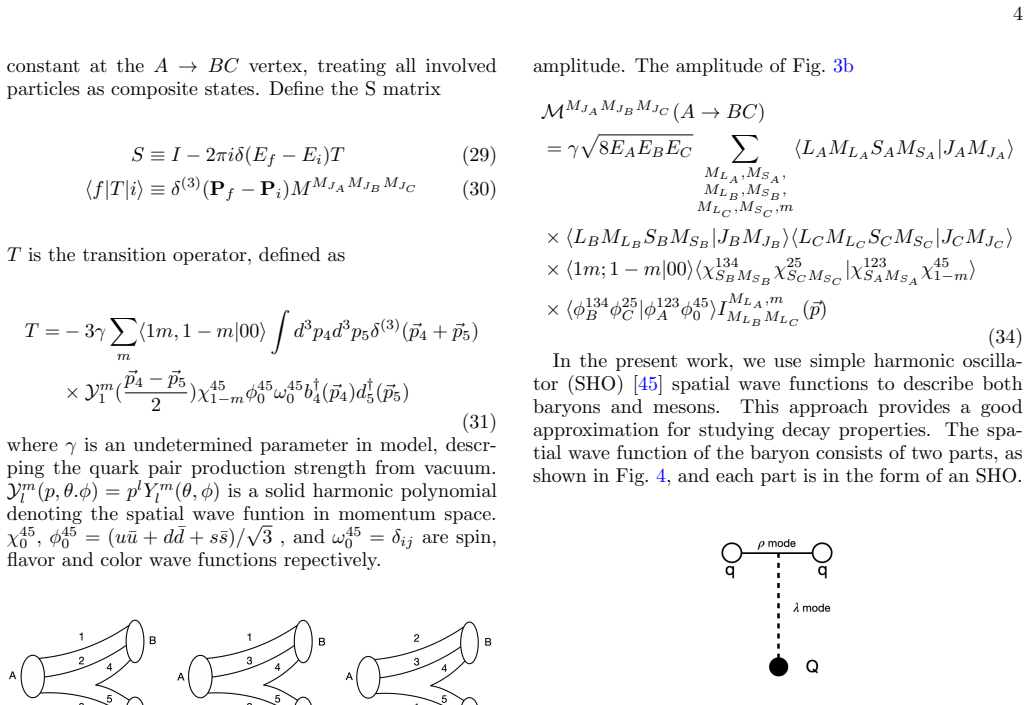
3P0 model The 3P0 model, also referred to as the quark pair cre- ation model [41–43], is utilized here to study the coupling 4 constant at the A → BC vertex, treating all involved particles as composite states. Define the S matrix S ≡ I − 2πiδ(Ef − Ei)T (29) ⟨f |T |i⟩ ≡δ(3)(Pf − Pi)M MJA MJB MJC (30) T is the transition operator, defined as T = − 3γ X m ⟨...
- [3]
- [4]
-
[5]
Y. Dong, A. Faessler, T. Gutsche, and V. E. Lyubovitskij, Phys. Rev. D 81, 014006 (2010)
work page 2010
- [7]
-
[8]
B. Chen, K.-W. Wei, X. Liu, and T. Matsuki, Eur. Phys. J. C 77, 154 (2017), 1609.07967
arXiv 2017
-
[9]
S.-Q. Luo, B. Chen, Z.-W. Liu, and X. Liu, Eur. Phys. J. C 80, 301 (2020), 1910.14545
arXiv 2020
Show all 51 references
-
[10]
Xie, Y.-B
J.-J. Xie, Y.-B. Dong, and X. Cao, Phys. Rev. D 92, 034029 (2015)
2015
-
[11]
K. Abe, T. C. Bacon, H. H. Bingham, J. E. Brau, K. Braune, D. Brick, W. M. Bugg, J. M. Butler, W. Cameron, H. O. Cohn, et al., Phys. Rev. D 30, 694 (1984)
1984
-
[12]
K. Abe, R. Armenteros, T. C. Bacon, J. Ballam, H. H. Bingham, J. E. Brau, K. Braune, D. Brick, W. M. Bugg, J. M. Butler, et al., Phys. Rev. D 33, 1 (1986)
1986
-
[13]
S. R. Amendotia, G. Bagliesi, G. Batignani, G. A. Beck, E. H. Bellamy, G. Bellini, E. BertolucciZ, D. Bettoni, A. Bizzeti, G. Bologna, et al. (1987). 8
1987
-
[14]
M. I. Adamovich, Y. A. Alexandrov, J. M. Bolta, L. Bravo, A. M. Cartacci, V. Castillo, M. M. Chernyavsky, A. Conti, M. G. Dagliana, M. Dameri, et al., Physics Letters B 187, 437 (1987)
1987
-
[15]
Alvarez, R
M. Alvarez, R. Barate, D. Bloch, P. Bonamy, P. Borgeaud, M. Burchell, H. Burmeister, J. Brunet, F. Calvino, M. Cattaneo, et al., Physics Letters B 246, 256 (1990)
1990
-
[16]
NA14/2 Collaboration, M. P. Alvarez, R. Barate, D. Bloch, P. Bonamy, P. Borgeaud, M. Burchell, H. Burmeister, J. M. Brunet, F. Calvino, et al., Z. Phys. C - Particles and Fields 60, 53 (1993)
1993
-
[17]
P. L. Frabetti, H. W. K. Cheung, J. P. Cumalat, C. Dal- lapiccola, J. F. Ginkel, S. V. Greene, W. E. Johns, M. S. Nehring, J. N. Butler, S. Cihangir, et al., Phys. Rev. Lett. 70, 1755 (1993)
1993
-
[18]
P. L. Frabetti, H. W. K. Cheung, J. P. Cumalat, C. Dal- lapiccola, J. F. Ginkel, S. V. Greene, W. E. Johns, M. S. Nehring, J. N. Butler, S. Cihangir, et al., Phys. Rev. Lett. 72, 961 (1994)
1994
-
[19]
Collaboration, Eur
Z. Collaboration, Eur. Phys. J. C 44, 351 (2005), hep- ex/0508019
2005
-
[20]
Collaboration, Measurement of charm fragmentation fractions in photoproduction at hera(2013), 1306.4862
Z. Collaboration, Measurement of charm fragmentation fractions in photoproduction at hera(2013), 1306.4862
2013 arXiv
-
[21]
M. P. Rekalo and E. Tomasi-Gustafsson, Physics Letters B 500, 53 (2001)
2001
-
[22]
W. Liu, S. H. Lee, and C. M. Ko, Nuclear Physics A 724, 375 (2003), nucl-th/0302024
2003 arXiv
-
[23]
Tomasi-Gustafsson and M
E. Tomasi-Gustafsson and M. P. Rekalo, Eur. Phys. J. A 21, 469 (2004), hep-ph/0401156
2004 arXiv
-
[24]
Tomasi-Gustafsson, Czech J Phys 55, A179 (2005)
E. Tomasi-Gustafsson, Czech J Phys 55, A179 (2005)
2005
-
[25]
Huang, J.-J
Y. Huang, J.-J. Xie, J. He, X. Chen, and H.-F. Zhang, Chinese Phys. C 40, 124104 (2016), 1604.05969
2016 arXiv
-
[26]
X.-Y. Wang, A. Guskov, and X.-R. Chen, Phys. Rev. D 92, 094032 (2015)
2015
-
[27]
D. P. Anderle, V. Bertone, X. Cao, L. Chang, N. Chang, G. Chen, X. Chen, Z. Chen, Z. Cui, L. Dai, et al., Front. Phys. 16, 64701 (2021)
2021
-
[28]
R. A. Khalek, A. Accardi, J. Adam, D. Adamiak, W. Ak- ers, M. Albaladejo, A. Al-bataineh, M. G. Alexeev, F. Ameli, P. Antonioli, et al., Nuclear Physics A 1026, 122447 (2022), 2103.05419
2022 arXiv
-
[29]
F.-Z. Peng, M. S´ anchez S´ anchez, M.-J. Yan, and M. Pavon Valderrama, Phys. Rev. D105, 034028 (2022)
2022
-
[30]
Yamaguchi, S
Y. Yamaguchi, S. Yasui, and A. Hosaka, Phys. Rev. D 106, 094001 (2022)
2022
-
[31]
Yan, F.-Z
M.-J. Yan, F.-Z. Peng, and M. Pavon Valderrama, Phys. Rev. D 109, 014023 (2024)
2024
-
[32]
Budnev, I
V. Budnev, I. Ginzburg, G. Meledin, and V. Serbo, Physics Reports 15, 181 (1975)
1975
-
[33]
Y. Dong, A. Faessler, T. Gutsche, and V. E. Lyubovitskij, Phys. Rev. D 90, 094001 (2014)
2014
-
[34]
Y. Dong, A. Faessler, T. Gutsche, and V. E. Lyubovitskij, Phys. Rev. D 77, 094013 (2008), 0802.3610
2008 arXiv
-
[35]
R. L. Workman, V. D. Burkert, V. Crede, E. Klempt, U. Thoma, L. Tiator, K. Agashe, G. Aielli, B. C. Al- lanach, C. Amsler, et al., Progress of Theoretical and Experimental Physics 2022, 083C01 (2022)
2022
-
[36]
Lin, C.-W
Y.-H. Lin, C.-W. Shen, F.-K. Guo, and B.-S. Zou, Phys. Rev. D 95, 114017 (2017)
2017
-
[37]
Gao, J.-J
P. Gao, J.-J. Wu, and B. S. Zou, Phys. Rev. C81, 055203 (2010)
2010
-
[38]
Faessler, T
A. Faessler, T. Gutsche, S. Kovalenko, and V. E. Lyubovitskij, Phys. Rev. D 76, 014003 (2007)
2007
-
[39]
Faessler, T
A. Faessler, T. Gutsche, V. E. Lyubovitskij, and Y.-L. Ma, Phys. Rev. D 76, 014005 (2007)
2007
-
[40]
Faessler, T
A. Faessler, T. Gutsche, V. E. Lyubovitskij, and Y.-L. Ma, Phys. Rev. D 77, 114013 (2008)
2008
-
[41]
F.-K. Guo, C. Hanhart, U.-G. Meißner, Q. Wang, Q. Zhao, and B.-S. Zou, Rev. Mod. Phys. 90, 015004 (2018), [Erratum: Rev.Mod.Phys. 94, 029901 (2022)], 1705.00141
2018 arXiv
-
[42]
Yue, Q.-Y
Z.-L. Yue, Q.-Y. Guo, and D.-Y. Chen, Phys. Rev. D 109, 094049 (2024), 2402.10594
2024 arXiv
-
[43]
Roberts and B
W. Roberts and B. Silvestre-Brac, Few Body Syst. 11, 171 (1992)
1992
-
[44]
H. G. Blundell, Meson properties in the quark model: A look at some outstanding problems (1996), hep- ph/9608473
1996
-
[45]
Chen, X.-L
C. Chen, X.-L. Chen, X. Liu, W.-Z. Deng, and S.-L. Zhu, Phys. Rev. D 75, 094017 (2007), 0704.0075
2007 arXiv
-
[46]
Hayne and N
C. Hayne and N. Isgur, Phys. Rev. D 25, 1944 (1982)
1982
-
[47]
Capstick and N
S. Capstick and N. Isgur, Phys. Rev. D 34, 2809 (1986)
1986
-
[48]
G.-L. Yu, Y. Meng, Z.-Y. Li, Z.-G. Wang, and L. Jie, Int. J. Mod. Phys. A 38, 2350082 (2023), 2302.11758
2023 arXiv
-
[49]
L¨ u, L.-Y
Q.-F. L¨ u, L.-Y. Xiao, Z.-Y. Wang, and X.-H. Zhong, Eur. Phys. J. C 78, 599 (2018)
2018
-
[50]
L¨ u and X.-H
Q.-F. L¨ u and X.-H. Zhong, Phys. Rev. D 101, 014017 (2020)
2020
-
[51]
Godfrey and K
S. Godfrey and K. Moats, Phys. Rev. D 93, 034035 (2016)
2016
-
[52]
Xiao, Q.-F
L.-Y. Xiao, Q.-F. L¨ u, and S.-L. Zhu, Phys. Rev. D 97, 074005 (2018)
2018
Reviewed August 11, 2026 · model on record in the stance chip above.
Discussion (0). Continue with ORCID to comment.