REVIEW 2 major objections 5 minor 134 references
Predictions of the LSST Solar System Yield: Near-Earth Objects, Main Belt Asteroids, Jupiter Trojans, and Trans-Neptunian Objects
T0 review · 2 major / 5 minor · reviewed 2026-08-07 · deepseek-v4-flash
Pith's one-line read A high-fidelity simulation predicts that LSST will link 5,356,423 small solar system bodies from 1.145 billion detections over ten years, multiplying known populations of near-Earth objects, main-belt asteroids, Jupiter Trojans, and…
desk verdict A transparent, reproducible full-scale simulation of LSST's small-body yield; the headline numbers are model forecasts with honest caveats, but the missing sensitivity analysis on linking efficiency is the main soft spot. read the letter →
The pith
A machine-rendered reading of the paper's core claim, the machinery that carries it, and where it could break.
The reading
What carries the argument
The carrying mechanism is Sorcha, an open-source, catalog-level survey simulator. It integrates each body's orbit, places it on the LSST camera footprint for every visit, assigns a detection with a logistic probability function (50% chance at the exposure's limiting magnitude, bright detections above mag 16 removed as saturated), and applies the survey's design linking rule: an object seen at least twice in one night on at least three nights within 14 days is discovered with 95% probability, with independent chances for each qualifying window. The input populations come from debiased models—NEOMOD3 for NEOs, an 80%-scaled Pan-STARRS S3M for MBAs, a recent model for Jupiter Trojans, and CFEPS-L7 with OSSOS-style magnitude distributions for nine TNO subpopulations—and per-object colors are drawn from five spectral classes. This pipeline translates intrinsic population models into concrete predictions of discovery counts, completeness curves, arcs, colors, and lightcurves.
What would settle it
Compare the number of linked objects in the first LSST data release (roughly the first two years) with the simulation's discovery curve for each population, split by brightness; a measured linking efficiency well below 95%, or a shortfall concentrated in faint objects with few detections, would lower the predicted total catalog. The authors note that the real pipeline's efficiency has not yet been measured.
Extended reading notes
Core claim
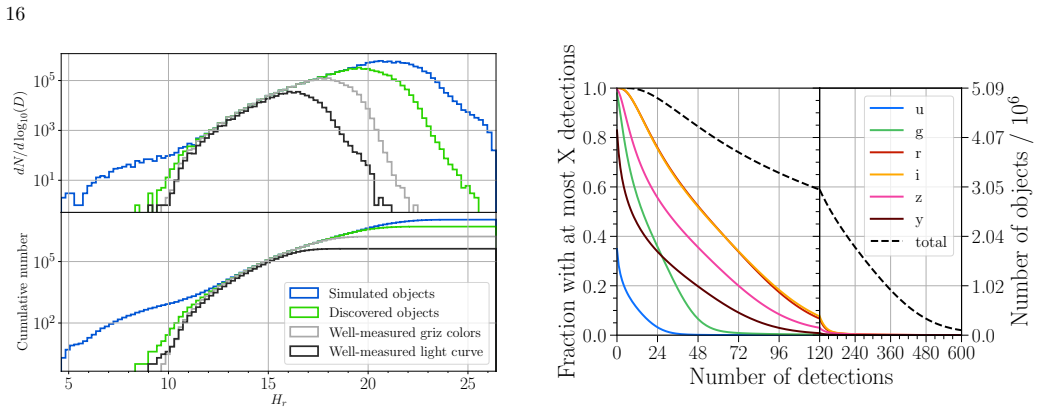
The central claim is that LSST will generate a catalog of 5,356,423 linked small bodies from 1.145 billion $5\sigma$ detections, with 1.27E5 near-Earth objects, 5.09E6 main-belt asteroids, 1.09E5 Jupiter Trojans, and 3.70E4 trans-Neptunian objects, assuming none were known beforehand. Since roughly 1.4 million small bodies are already cataloged, the survey would add about 3.9 million new discoveries, a 3.6-fold increase. The simulation also predicts 91% discovery completeness for NEOs with $d>1$ km, 72.7% for potentially hazardous asteroids with $d>140$ m, and long observation arcs—medians near 9.0 years for MBAs and Trojans and 9.5 years for TNOs—so most discovered objects end the survey with well-determined orbits. The authors describe this as the first full-scale simulation to combine recent debiased population models, the near-final v3.4 cadence, as-built camera response, and a modeled linking pipeline.
Load-bearing premise
The load-bearing premise is that the real LSST linking software will behave like its design requirement—finding 95% of objects detected twice in one night on at least three nights within 14 days—and that all prior detections of a linked object are then recovered with perfect completeness.
Editorial extensions
If this is right
- The known near-Earth object census would grow from about 37,900 to 127,000, with 91% completeness for $d>1$ km objects and 72.7% for $d>140$ m potentially hazardous asteroids, advancing the planetary-defense goal.
- Main-belt science would shift from discovery to characterization: about 1.67 million MBAs (32.8%) would have high-quality $griz$ colors and about 421,000 (8.3%) would be suited for lightcurve inversion.
- Distant populations would be largely discovered early: 72% of TNOs, 68% of Jupiter Trojans, and 69% of MBAs would be found by the two-year data release, enabling early population estimates.
- The survey would log 1.145 billion detections, more than twice the number listed in all historical observations, and would link about 96% of the moving-object detections it records.
- The public simulated catalog lets researchers test discovery, orbit-fitting, and characterization methods on a representative full-scale LSST dataset before the survey begins.
Reading between the lines
- If the flat 95% linking probability turns out to depend on tracklet length or sky density, early LSST data can be used to measure a per-object efficiency curve; applying that curve could shift yields by more than a linear factor because faint, few-detection objects dominate the uncertain tail.
- The early-discovery result implies follow-up networks and orbit-computation resources will face a concentrated burst of new objects in survey years 1–2; the paper notes the need for rapid follow-up of small NEOs but does not quantify the operational load.
- Because Sorcha and the input catalogs are public, the same machinery can be rerun with future cadence versions (the paper notes v4.0 already exists) to test how observing-strategy changes alter the predicted yields, especially for NEOs.
- The color and lightcurve metrics are intentionally conservative, so the eventual catalogs of well-measured physical properties are likely to be larger than the paper's headline numbers; statistical studies can tolerate noisier data than the chosen thresholds.
Editorial analysis
A structured set of objections, weighed in public.
Referee Report
Summary. Using the Sorcha survey simulator, the authors simulate ten years of LSST observations under the near-final v3.4 baseline cadence for four small-body populations: NEOs, main-belt asteroids, Jupiter Trojans, and TNOs. Input populations are drawn from recent debiased models (NEOMOD3, S3M at 80% scale, Vokrouhlický et al. 2024, CFEPS-L7 with updated magnitude distributions). The simulation yields 1.145 billion detections and 5,356,423 linked discoveries, comprising 127,040 NEOs, 5,087,541 MBAs, 109,367 Jupiter Trojans, and 37,002 TNOs. The authors find that roughly 70% of main-belt and distant objects are discovered in the first two years, estimate the subsets with high-quality colors and lightcurves, and make the simulated detection catalog publicly available. The methodology is documented in detail, with input models, code, and data products referenced.
Significance. If accurate, these predictions establish that LSST will multiply the known small-body inventory by factors of roughly 3–7, deliver well-constrained orbits for most discovered objects, and enable large statistical samples for physical characterization. The paper's strengths include the use of an open-source simulator, a near-final observing cadence, public release of the simulated catalog and input populations, and explicit documentation of assumptions and limitations. The central numerical claims are falsifiable predictions of an upcoming survey. The main caveat is that the headline yields are conditional on unverified assumptions about the linking pipeline and on input population models whose systematics are not propagated into the quoted uncertainties; the paper acknowledges these limitations but does not quantify their impact.
major comments (2)
- [Section 2.4, Table 5] The central yield predictions are directly conditional on the assumed flat 95% linking efficiency per discovery chance, which the authors explicitly identify as a design requirement rather than a measured pipeline performance. Because the simulated catalog is dominated by faint main-belt objects near the detection limit, where linking is most difficult, a sensitivity analysis over a plausible range of linking efficiencies (e.g., 0.80–0.99) is needed to establish how much the headline totals (5,356,423 objects; 127,040 NEOs; 5,087,541 MBAs; 109,367 Trojans; 37,002 TNOs) would change. Without such an analysis, the abstract and Table 5 should explicitly state that all yields are conditional on the 95% assumption.
- [Section 2.2 and Table 5] The quoted uncertainties are only Poisson sample uncertainties, and the table's stated rule appears internally inconsistent. For example, sqrt(127,040) ≈ 356, not 557, and sqrt(5,087,541) ≈ 2255, not 1661. The model systematics—S3M 80% scale factor, TNO magnitude-distribution slopes and normalizations, NEO 1–10 m upsampling factor, detection logistic parameters, and linking efficiency—are not propagated. The paper should either propagate these systematics or provide a per-population qualitative discussion of their impact on the yields, and the table's error values should be corrected or explained.
minor comments (5)
- [Abstract vs Section 5] The abstract states that LSST will raise the number of known objects by '4–9x', but the ratios from Table 5 are approximately 3.4 for NEOs, 3.7 for MBAs, 7.2 for Trojans, and 7.1 for TNOs; Section 5 correctly says '3–7 times more', so the abstract should be corrected for consistency.
- [Section 2.2.4, Table 2, Section 3.5.1] The text in Section 2.2.4 lists the '5:3' mean-motion resonance with Neptune, but Table 2 and Section 3.5.1 refer to the '5:2' resonance; the labels should be made consistent (likely 5:2 is intended, given the standard nomenclature).
- [Section 3.1] The sentence 'Applying Rubin software's linking and discovery criteria' overstates what was done: the paper applies an analytic model of the linking criteria (Section 2.4), not the actual Rubin pipeline software; rephrasing would avoid implying an end-to-end measured evaluation.
- [Section 2.5 and Table 4] The TNO color metric is described in the text as requiring 'a primary band with 30 detections and 3 other bands with 20', but Table 4 reports thresholds of 100 SNR sum in griz with a primary band of 150 SNR sum; these two descriptions should be harmonized.
- [Section 2.4] The assumption of perfect precovery of all prior detections for linked objects is stated as reasonable because most objects have long arcs, but the median NEO arc is only 96 days (Table 5); a brief justification or caveat for short-arc populations would strengthen the claim.
Circularity Check
No circularity: the predicted LSST yields are outputs of the Sorcha simulator applied to externally calibrated population models, with no parameter fitted to the predicted catalog.
full rationale
The derivation chain is: (1) adopt externally calibrated input population models (NEOMOD3 for NEOs, S3M as rescaled by Wagg et al. 2024 for MBAs, Vokrouhlicky et al. 2024 for Trojans, and CFEPS-L7/OSSOS-based models for TNOs); (2) propagate these populations through the Sorcha survey simulator with the v3.4 cadence and a logistic detection model; (3) apply the stated linking criterion of 95% per discovery chance for objects meeting the two-nights-in-one-night and three-nights-in-14-days pattern; (4) count linked objects. None of the headline numbers (1.27E5 NEOs, 5.09E6 MBAs, 1.09E5 Trojans, 3.70E4 TNOs, 1.145 billion detections) is used to fit or define any input parameter, so the outputs do not reduce to their inputs by construction. The flat 95% linking efficiency in Section 2.4 is an explicit, transparent assumption rather than a fitted quantity; varying it would change the outputs but does not make the outputs equivalent to the inputs. Self-citations (Merritt et al. In Press for Sorcha, Holman et al. Submitted, Kurlander et al. 2025, Murtagh et al. Submitted) describe tools and companion analyses rather than supplying the numerical claims, and the simulator is made reproducible with public configuration and input catalogs. The MBA 80% rescaling is an external calibration to current m~20 detection counts, not to the deeper LSST yield being predicted. The paper's stated limitations (unmeasured real pipeline efficiency and the absence of a sensitivity analysis) are uncertainties in an otherwise self-contained simulation study, not circularity.
Assumptions & free parameters
free parameters (10)
- NEO 1-10 m upsampling factor =
4.42
- MBA S3M population scale =
0.8
- Detection logistic function parameters =
50% at limiting magnitude; width 0.1 mag
- Linking efficiency per discovery chance =
95%
- Bright saturation limit =
m_r = 16.0
- Tracklet minimum length =
0.5 arcsec (2.5 pixels)
- Phase slope G =
0.15
- TNO subpopulation normalizations =
cold 11,000; hot 20,000; detached 36,000; scattering 90,000; resonances 1,000-8,000 for H_r<8.3-8.66
- Scattering TNO magnitude distribution parameters =
alpha_b=0.9, alpha_f=0.3, H_B=8.3, c=3.2
- Jupiter Trojan faint-end slope extension =
extrapolated to H_V~19 using L4 small-end slope
assumptions (6)
- domain assumption The LSST v3.4 baseline cadence simulation is representative of the actual survey.
- domain assumption The Sorcha catalog-level simulator correctly propagates orbits and models the camera footprint.
- domain assumption Input population models (NEOMOD3, S3M, Vokrouhlicky et al., CFEPS-L7 plus updates) represent the true intrinsic populations, including extrapolation to fainter sizes.
- domain assumption LSST's solar system linking pipeline achieves its design requirement of 95% linking efficiency for objects meeting the tracklet criteria.
- domain assumption Small bodies in the input models have no cometary activity, no variability, and follow an HG phase curve with G=0.15 (or no phase curve for TNOs).
- domain assumption Once an object is linked, all of its prior detections are recovered perfectly.
Cite this review
Pith. "Pith review of Predictions of the LSST Solar System Yield: Near-Earth Objects, Main Belt Asteroids, Jupiter Trojans, and Trans-Neptunian Objects." pith.science (2026). https://pith.science/paper/W5YQKIYF
@misc{pith2026250602487,
  author       = {Pith},
  title        = {Pith review of: Predictions of the LSST Solar System Yield: Near-Earth Objects, Main Belt Asteroids, Jupiter Trojans, and Trans-Neptunian Objects},
  year         = {2026},
  howpublished = {\url{https://pith.science/paper/W5YQKIYF}},
  note         = {Machine review of arXiv:2506.02487}
}
read the original abstract
The NSF-DOE Vera C. Rubin Observatory is a new 8m-class survey facility presently being commissioned in Chile, expected to begin the 10yr-long Legacy Survey of Space and Time (LSST) by the end of 2025. Using the purpose-built Sorcha survey simulator (Merritt et al. In Press), and near-final observing cadence, we perform the first high-fidelity simulation of LSST's solar system catalog for key small body populations. We show that the final LSST catalog will deliver over 1.1 billion observations of small bodies and raise the number of known objects to 1.27E5 near-Earth objects, 5.09E6 main belt asteroids, 1.09E5 Jupiter Trojans, and 3.70E4 trans-Neptunian objects. These represent 4-9x more objects than are presently known in each class, making LSST the largest source of data for small body science in this and the following decade. We characterize the measurements available for these populations, including orbits, griz colors, and lightcurves, and point out science opportunities they open. Importantly, we show that ~70% of the main asteroid belt and more distant populations will be discovered in the first two years of the survey, making high-impact solar system science possible from very early on. We make our simulated LSST catalog publicly available, allowing researchers to test their methods on an up-to-date, representative, full-scale simulation of LSST data.
Figures


Figures from the paper (7 more)




Reference graph
Works this paper leans on
-
[1]
thebibliography [1] 20pt to REFERENCES 6pt =0pt -12pt 10pt plus 3pt =0pt =0pt =1pt plus 1pt =0pt =0pt -12pt =13pt plus 1pt =20pt =13pt plus 1pt \@M =10000 =-1.0em =0pt =0pt 0pt =0pt =1.0em @enumiv\@empty 10000 10000 `\.\@m \@noitemerr \@latex@warning Empty `thebibliography' environment \@ifnextchar \@reference \@latexerr Missing key on reference command E...
-
[2]
2018, Planetary and Space Science, 150, 9
Acton, C., Bachman, N., Semenov, B., & Wright, E. 2018, Planetary and Space Science, 150, 9
2018
-
[3]
Acton Jr, C. H. 1996, Planetary and Space Science, 44, 65
1996
-
[4]
R., Gulbis, A., Elliot, J., et al
Adams, E. R., Gulbis, A., Elliot, J., et al. 2014, The Astronomical Journal, 148, 55
2014
-
[5]
W., Alvarez, W., Asaro, F., & Michel, H
Alvarez, L. W., Alvarez, W., Asaro, F., & Michel, H. V. 1980, Science, 208, 1095
1980
-
[6]
Astropy Collaboration , Robitaille , T. P., Tollerud , E. J., et al. 2013, , 558, A33, 10.1051/0004-6361/201322068
-
[7]
Astropy Collaboration , Price-Whelan , A. M., Sip o cz , B. M., et al. 2018, , 156, 123, 10.3847/1538-3881/aabc4f
-
[8]
Astropy Collaboration , Price-Whelan , A. M., Lim , P. L., et al. 2022, , 935, 167, 10.3847/1538-4357/ac7c74
Show all 134 references
-
[9]
T., Kavelaars , J
Bannister , M. T., Kavelaars , J. J., Petit , J.-M., et al. 2016, , 152, 70, 10.3847/0004-6256/152/3/70
2016 doi
-
[10]
T., Gladman , B
Bannister , M. T., Gladman , B. J., Kavelaars , J. J., et al. 2018, , 236, 18, 10.3847/1538-4365/aab77a
2018 doi
-
[11]
Batygin, K., & Brown, M. E. 2016, The Astronomical Journal, 151, 22, 10.3847/0004-6256/151/2/22
2016 doi
-
[12]
2023, The Planetary Science Journal, 4, 145, 10.3847/PSJ/ace88d
Beaudoin, M., Gladman, B., Huang, Y., et al. 2023, The Planetary Science Journal, 4, 145, 10.3847/PSJ/ace88d
2023 doi
-
[13]
H., Bernstein, G
Bernardinelli, P. H., Bernstein, G. M., Sako, M., et al. 2020, The Planetary Science Journal, 1, 28, 10.3847/PSJ/ab9d80
2020 doi
-
[14]
2022, The Astrophysical Journal Supplement Series, 258, 41
---. 2022, The Astrophysical Journal Supplement Series, 258, 41
2022
-
[15]
H., Bernstein, G
Bernardinelli, P. H., Bernstein, G. M., Jindal, N., et al. 2023, The Astrophysical Journal Supplement Series, 269, 18, 10.3847/1538-4365/acf6bf
2023 doi
-
[16]
H., Bernstein, G
Bernardinelli, P. H., Bernstein, G. M., Abbott, T., et al. 2025, arXiv preprint arXiv:2501.01551
2025 arXiv
-
[17]
2000, The Astronomical Journal, 120, 3323
Bernstein, G., & Khushalani, B. 2000, The Astronomical Journal, 120, 3323
2000
-
[18]
B., Ivezi \'c , Z ., Jones , R
Bianco , F. B., Ivezi \'c , Z ., Jones , R. L., et al. 2022, , 258, 1, 10.3847/1538-4365/ac3e72
2022 doi
-
[19]
A., Belskaya, I., et al
Birlan, M., Barucci, M. A., Belskaya, I., et al. 2024, Astronomy & Astrophysics, 689, A334, 10.1051/0004-6361/202450495
2024 doi
-
[20]
1989, in Asteroids II , ed
Bowell, E., Hapke, B., Domingue, D., et al. 1989, in Asteroids II , ed. R. P. Binzel, T. Gehrels, & M. S. Matthews ( University of Arizona Press ), 524 -- 556
1989
-
[21]
2002, Asteroids III, 1, 27
Bowell, E., Virtanen, J., Muinonen, K., & Boattini, A. 2002, Asteroids III, 1, 27
2002
- [22]
-
[23]
J., & Binzel, R
Bus, S. J., & Binzel, R. P. 2002, Icarus, 158, 106, 10.1006/icar.2002.6857
2002
-
[24]
L., Rivkin, A
Chabot, N. L., Rivkin, A. S., Cheng, A. F., et al. 2024, The Planetary Science Journal, 5, 49
2024
-
[26]
C., Magnier, E., Metcalfe, N., et al
Chambers, K. C., Magnier, E., Metcalfe, N., et al. 2016, arXiv preprint arXiv:1612.05560
2016 arXiv
-
[27]
2012, in European Planetary Science Congress, Vol
Cheng, A., Michel, P., Reed, C., et al. 2012, in European Planetary Science Congress, Vol. 7, 23--28
2012
-
[28]
Chow, I., & Brown, P. G. 2025, Icarus, 429, 116444, https://doi.org/10.1016/j.icarus.2024.116444
2025
-
[29]
2012, in AAS/Division for Planetary Sciences Meeting Abstracts\# 44, Vol
Christensen, E., Larson, S., Boattini, A., et al. 2012, in AAS/Division for Planetary Sciences Meeting Abstracts\# 44, Vol. 44, 210--13
2012
-
[30]
E., Barucci , M
DeMeo , F. E., Barucci , M. A., Merlin , F., et al. 2010, , 521, A35, 10.1051/0004-6361/201014042
2010 doi
-
[31]
E., & Carry, B
DeMeo, F. E., & Carry, B. 2014, Nature, 505, 629
2014
-
[32]
M., Schwamb, M
Dobson, M. M., Schwamb, M. E., Benecchi, S. D., et al. 2023, The Planetary Science Journal, 4, 75
2023
-
[33]
1909, Popular Astronomy, vol
Doolittle, E. 1909, Popular Astronomy, vol. 17, pp. 292-303, 17, 292
1909
-
[34]
2019, LSST Asteroid Discovery Rates, Tech
Eggl, S., Jones, L., & Jurić, M. 2019, LSST Asteroid Discovery Rates, Tech. rep., LSST. https://dmtn-109.lsst.io/DMTN-109.pdf
2019
-
[35]
2022, Frontiers in Astronomy and Space Sciences, 9, 796004
Fern \'a ndez-Valenzuela, E. 2022, Frontiers in Astronomy and Space Sciences, 9, 796004
2022
-
[36]
1994, in Symposium-International Astronomical Union, Vol
Ferraz-Mello, S. 1994, in Symposium-International Astronomical Union, Vol. 160, Cambridge University Press, 175--188
1994
-
[37]
C., & Brown, M
Fraser, W. C., & Brown, M. E. 2012, Astrophysical Journal, 749, 33, 10.1088/0004-637X/749/1/33
2012 doi
-
[38]
C., Bannister, M
Fraser, W. C., Bannister, M. T., Pike, R. E., et al. 2017, Nature Astronomy, 1, 0088
2017
-
[39]
C., Pike, R
Fraser, W. C., Pike, R. E., Marsset, M., et al. 2023, The Planetary Science Journal, 4, 80, 10.3847/PSJ/acc844
2023 doi
-
[40]
D., Yeomans , D
Giorgini , J. D., Yeomans , D. K., Chamberlin , A. B., et al. 1996, in AAS/Division for Planetary Sciences Meeting Abstracts, Vol. 28, AAS/Division for Planetary Sciences Meeting Abstracts \#28, 25.04
1996
-
[41]
G., & Vanlaerhoven, C
Gladman, B., Marsden, B. G., & Vanlaerhoven, C. 2008, in The Solar System Beyond Neptune, ed. M. A. Barucci , H. Boehnhardt , D. P. Cruikshank , A. Morbidelli , & R. Dotson , 43--57
2008
-
[42]
2021, scipy/scipy: SciPy 1.7.3, v1.7.3, Zenodo, 10.5281/zenodo.5725464
Gommers, R., Virtanen, P., Burovski, E., et al. 2021, scipy/scipy: SciPy 1.7.3, v1.7.3, Zenodo, 10.5281/zenodo.5725464
2021 doi
-
[43]
M., Hivon , E., Banday , A
G \'o rski , K. M., Hivon , E., Banday , A. J., et al. 2005, , 622, 759, 10.1086/427976
2005 doi
-
[44]
1982, Science, 216, 1405
Gradie, J., & Tedesco, E. 1982, Science, 216, 1405
1982
-
[45]
2016, Nature, 530, 303, 10.1038/nature16934
Granvik, M., Morbidelli, A., Jedicke, R., et al. 2016, Nature, 530, 303, 10.1038/nature16934
2016 doi
-
[46]
2011, Publications of the Astronomical Society of the Pacific, 123, 423, 10.1086/659833
Grav, T., Jedicke, R., Denneau, L., et al. 2011, Publications of the Astronomical Society of the Pacific, 123, 423, 10.1086/659833
2011 doi
-
[47]
K., & Spahr , T
Grav , T., Mainzer , A. K., & Spahr , T. 2016, , 151, 172, 10.3847/0004-6256/151/6/172
2016 doi
-
[48]
P., Bechtol, K., Bellm, E., et al
Guy, L. P., Bechtol, K., Bellm, E., et al. 2021, Rubin Observatory Plans for an Early Science Program
2021
-
[49]
2023, , 679, A56, 10.1051/0004-6361/202346022
Hanu s , J., Vokrouhlick \'y , D., Nesvorn \'y , D., et al. 2023, , 679, A56, 10.1051/0004-6361/202346022
2023 doi
-
[50]
R., Millman, K
Harris, C. R., Millman, K. J., van der Walt, S. J., et al. 2020, Nature, 585, 357, 10.1038/s41586-020-2649-2
2020 doi
-
[51]
J., Bernardinelli, P
Holman, M. J., Bernardinelli, P. H., Schwamb, M. E., & Others, M. Submitted
-
[52]
2024, The Astrophysical Journal Letters, 962, L33, 10.3847/2041-8213/ad2686
Huang, Y., & Gladman, B. 2024, The Astrophysical Journal Letters, 962, L33, 10.3847/2041-8213/ad2686
2024 doi
-
[53]
J., Farnocchia, D., & Spoto, F
Hung, D., Tholen, D. J., Farnocchia, D., & Spoto, F. 2023, The Planetary Science Journal, 4, 215, 10.3847/PSJ/ad0226
2023 doi
-
[54]
Hunter, J. D. 2007, Computing in Science & Engineering, 9, 90, 10.1109/MCSE.2007.55
2007 doi
-
[55]
2000, The Astrophysical Journal, 534, 428
Ida, S., Bryden, G., Lin, D., & Tanaka, H. 2000, The Astrophysical Journal, 534, 428
2000
-
[56]
A., Juri \'c , M., et al
Ivezi \'c , Z ., Tyson , J. A., Juri \'c , M., et al. 2007, in IAU Symposium, Vol. 236, Near Earth Objects, our Celestial Neighbors: Opportunity and Risk, ed. G. B. Valsecchi , D. Vokrouhlick \'y , & A. Milani , 353--362, 10.1017/S1743921307003420
2007 doi
-
[57]
M., Tyson, J
Ivezi \'c , Z ., Kahn, S. M., Tyson, J. A., et al. 2019, The Astrophysical Journal, 873, 111, 10.3847/1538-4357/ab042c
2019 doi
-
[58]
2016, Icarus, 266, 173, 10.1016/J.ICARUS.2015.10.021
Jedicke, R., Bolin, B., Granvik, M., & Beshore, E. 2016, Icarus, 266, 173, 10.1016/J.ICARUS.2015.10.021
2016 doi
-
[59]
2006, Icarus, 185, 508, 10.1016/J.ICARUS.2006.07.024
Jones, R., Gladman, B., Petit, J.-M., et al. 2006, Icarus, 185, 508, 10.1016/J.ICARUS.2006.07.024
2006 doi
-
[60]
L., Jurić, M., & Ivezi \'c , Z
Jones, R. L., Jurić, M., & Ivezi \'c , Z . 2015, Proceedings of the International Astronomical Union, 10, 282–292, 10.1017/S1743921315008510
2015 doi
-
[61]
L., Yoachim, P., Ivezic, Z., Neilsen, E., & Ribeiro, T
Jones, R. L., Yoachim, P., Ivezic, Z., Neilsen, E., & Ribeiro, T. 2021, Survey Strategy and Cadence Choices for the Vera C. Rubin Observatory Legacy Survey of Space and Time (LSST). https://pstn-051.lsst.io/
2021
-
[62]
L., Yoachim, P., Chandrasekharan, S., et al
Jones, R. L., Yoachim, P., Chandrasekharan, S., et al. 2014, in Observatory Operations: Strategies, Processes, and Systems V, ed. A. B. Peck, C. R. Benn, & R. L. Seaman, Vol. 9149, International Society for Optics and Photonics (SPIE), 91490B, 10.1117/12.2056835
2014 doi
-
[63]
L., Slater, C
Jones, R. L., Slater, C. T., Moeyens, J., et al. 2018, Icarus, 303, 181, https://doi.org/10.1016/j.icarus.2017.11.033
2018 doi
-
[64]
J., Petit, J.-M., Gladman, B., et al
Kavelaars, J. J., Petit, J.-M., Gladman, B., et al. 2021, The Astrophysical Journal Letters, 920, L28, 10.3847/2041-8213/ac2c72
2021 doi
-
[65]
C., Lin, H
Khain, T., Becker, J. C., Lin, H. W., et al. 2020, The Astronomical Journal, 159, 133, 10.3847/1538-3881/ab7002
2020 doi
-
[66]
2016, in ELPUB, 87--90
Kluyver, T., Ragan-Kelley, B., P \'e rez, F., et al. 2016, in ELPUB, 87--90
2016
-
[67]
A., Holman, M
Kurlander, J. A., Holman, M. J., Bernardinelli, P. H., et al. 2025, The Astronomical Journal, 169, 73
2025
-
[68]
Kurucz , R. L. 2005, Memorie della Societa Astronomica Italiana Supplementi, 8, 189
2005
-
[69]
M., Shankman, C., Kavelaars, J
Lawler, S. M., Shankman, C., Kavelaars, J. J., et al. 2018, The Astronomical Journal, 155, 197, 10.3847/1538-3881/aab8ff
2018 doi
- [70]
-
[71]
R., Abell, P
Mainzer, A., Masiero, J. R., Abell, P. A., et al. 2023, The Planetary Science Journal, 4, 224
2023
-
[72]
1993, Nature, 365, 819
Malhotra, R. 1993, Nature, 365, 819
1993
-
[73]
R., Fedorets, G., Schwamb, M
Merritt, S. R., Fedorets, G., Schwamb, M. E., et al. In Press, The Astrophysical Journal
-
[74]
E., & Bottke, W
Michel, P., DeMeo, F. E., & Bottke, W. F. 2015, Asteroids IV, 1, 1
2015
-
[75]
2002, The Astronomical Journal, 123, 2083
Millis, R., Buie, M., Wasserman, L., et al. 2002, The Astronomical Journal, 123, 2083
2002
-
[76]
A., & Malhotra, R
Minton, D. A., & Malhotra, R. 2009, Nature, 457, 1109
2009
-
[77]
F., & Tsiganis, K
Morbidelli, A., Brasser, R., Gomes, R., Levison, H. F., & Tsiganis, K. 2010, The Astronomical Journal, 140, 1391
2010
-
[78]
2020, Icarus, 340, 113631, https://doi.org/10.1016/j.icarus.2020.113631
Morbidelli, A., Delbo, M., Granvik, M., et al. 2020, Icarus, 340, 113631, https://doi.org/10.1016/j.icarus.2020.113631
2020
-
[79]
J., O'Brien , D
Morbidelli , A., Walsh , K. J., O'Brien , D. P., Minton , D. A., & Bottke , W. F. 2015, in Asteroids IV, ed. P. Michel , F. E. DeMeo , & W. F. Bottke , 493--507, 10.2458/azu_uapress_9780816532131-ch026
2015 doi
-
[80]
E., Merritt, S
Murtagh, J., Schwamb, M. E., Merritt, S. R., et al. Submitted
-
[81]
J., Connolly , A
Naghib , E., Yoachim , P., Vanderbei , R. J., Connolly , A. J., & Jones , R. L. 2019, , 157, 151, 10.3847/1538-3881/aafece
2019 doi
-
[82]
J., Gerdes, D
Napier, K. J., Gerdes, D. W., Lin, H. W., et al. 2021, The Planetary Science Journal, 2, 59, 10.3847/psj/abe53e
2021 doi
-
[83]
2024b, , 274, 25, 10.3847/1538-4365/ad675c
Nesvorn \'y , D., Roig , F., Vokrouhlick \'y , D., & Bro z , M. 2024b, , 274, 25, 10.3847/1538-4365/ad675c
-
[84]
2016, The Astrophysical Journal, 825, 94
Nesvorn \'y , D., & Vokrouhlick \'y , D. 2016, The Astrophysical Journal, 825, 94
2016
-
[85]
2024a, Icarus, 417, 116110, https://doi.org/10.1016/j.icarus.2024.116110
Nesvorný, D., Vokrouhlický, D., Shelly, F., et al. 2024a, Icarus, 417, 116110, https://doi.org/10.1016/j.icarus.2024.116110
2024
-
[86]
W., Gerdes, D
Pan, J., Lin, H. W., Gerdes, D. W., et al. 2022, The Planetary Science Journal, 3, 269, 10.3847/PSJ/aca4d1
2022 doi
-
[87]
2015, Astronomy and Astrophysics, 577, A35, 10.1051/0004-6361/201425436
Peixinho, N., Delsanti, A., & Doressoundiram, A. 2015, Astronomy and Astrophysics, 577, A35, 10.1051/0004-6361/201425436
2015 doi
-
[88]
Perez , F., & Granger , B. E. 2007, Computing in Science and Engineering, 9, 21, 10.1109/MCSE.2007.53
2007 doi
-
[89]
2013, The Astronomy and Astrophysics Review, 21, 1
Perna, D., Barucci, M., & Fulchignoni, M. 2013, The Astronomy and Astrophysics Review, 21, 1
2013
-
[90]
2017, The Astronomical Journal, 153, 236
Petit, J., Kavelaars, J., Gladman, B., et al. 2017, The Astronomical Journal, 153, 236
2017
-
[91]
J., et al
Petit, J.-M., Gladman, B., Kavelaars, J. J., et al. 2023, The Astrophysical Journal Letters, 947, L4, 10.3847/2041-8213/acc525
2023 doi
-
[92]
M., Kavelaars, J
Petit, J. M., Kavelaars, J. J., Gladman, B. J., et al. 2011, Astronomical Journal, 142, 10.1088/0004-6256/142/4/131
2011 doi
-
[93]
2024, Nature Astronomy, 8, 1380
Pfalzner, S., Govind, A., & Portegies Zwart, S. 2024, Nature Astronomy, 8, 1380
2024
-
[94]
E., Fraser, W
Pike, R. E., Fraser, W. C., Volk, K., et al. 2023, The Planetary Science Journal, 4, 200, 10.3847/PSJ/ace2c2
2023 doi
-
[95]
P., Jenniskens, P., Emel’yanenko, V., et al
Popova, O. P., Jenniskens, P., Emel’yanenko, V., et al. 2013, Science, 342, 1069
2013
-
[96]
2022, pandas-dev/pandas: Pandas 1.4.3, v1.4.3, Zenodo, 10.5281/zenodo.6702671
Reback, J., jbrockmendel, McKinney, W., et al. 2022, pandas-dev/pandas: Pandas 1.4.3, v1.4.3, Zenodo, 10.5281/zenodo.6702671
2022 doi
-
[97]
2012, Astronomy & Astrophysics, 537, A128, 10.1051/0004-6361/201118085
Rein, H., & Liu, S.-F. 2012, Astronomy & Astrophysics, 537, A128, 10.1051/0004-6361/201118085
2012 doi
-
[98]
Rein, H., & Spiegel, D. S. 2015, Monthly Notices of the Royal Astronomical Society, 446, 1424
2015
-
[99]
E., Schwamb, M
Robinson, J. E., Schwamb, M. E., Jones, R. L., et al. 2024, Tuning the Legacy Survey of Space and Time (LSST) Observing Strategy for Solar System Science: Incremental Templates in Year 1. 2411.19796
2024 arXiv
-
[100]
2023, Survey Cadence Optimization Committee’s Phase 2 Recommendations , Vera C
Rubin Observatory Survey Cadence Optimization Committee . 2023, Survey Cadence Optimization Committee’s Phase 2 Recommendations , Vera C. Rubin Observatory. https://PSTN-055.lsst.io
2023
-
[101]
Schemel, M., & Brown, M. E. 2021, The Planetary Science Journal, 2, 40, 10.3847/PSJ/abc752
2021 doi
-
[102]
E., Jones, R
Schwamb, M. E., Jones, R. L., Chesley, S. R., et al. 2018, Large Synoptic Survey Telescope Solar System Science Roadmap. 1802.01783
2018 arXiv
-
[103]
E., Fraser, W
Schwamb, M. E., Fraser, W. C., Bannister, M. T., et al. 2019, The Astrophysical Journal Supplement Series, 243, 12, 10.3847/1538-4365/ab2194
2019 doi
-
[104]
E., Jones, R
Schwamb, M. E., Jones, R. L., Yoachim, P., et al. 2023, The Astrophysical Journal Supplement Series, 266, 22, 10.3847/1538-4365/acc173
2023 doi
-
[105]
C., Puzia, T
Seccull, T., Fraser, W. C., Puzia, T. H., Brown, M. E., & Schönebeck, F. 2018, The Astrophysical Journal Letters, 855, L26, 10.3847/2041-8213/aab3dc
2018 doi
-
[106]
V., & Carry, B
Sergeyev, A. V., & Carry, B. 2021, Astronomy & Astrophysics, 652, A59
2021
-
[107]
J., Bannister, M
Shankman, C., Kavelaars, J. J., Bannister, M. T., et al. 2017, The Astronomical Journal, 154, 50, 10.3847/1538-3881/aa7aed
2017 doi
-
[108]
W., Luis, O
Sicardy , B., Braga-Ribas , F., Buie , M. W., Luis, O. J., & Roques , F. 2024. 2411.07026v1
2024 arXiv
-
[109]
B., Blum, J., Birnstiel, T., & Nesvorn \`y , D
Simon, J. B., Blum, J., Birnstiel, T., & Nesvorn \`y , D. 2024, Comets III, 63
2024
-
[110]
F., & Tremaine , S
Siraj , A., Chyba , C. F., & Tremaine , S. 2025, , 978, 139, 10.3847/1538-4357/ad98f6
2025 doi
-
[111]
J., Kalmbach, J
Smotherman, H., Connolly, A. J., Kalmbach, J. B., et al. 2021, The Astronomical Journal, 162, 245, 10.3847/1538-3881/ac22ff
2021 doi
-
[112]
H., Portillo, S
Smotherman, H., Bernardinelli, P. H., Portillo, S. K. N., et al. 2024, The Astronomical Journal, 167, 136, 10.3847/1538-3881/ad1524
2024 doi
-
[113]
E., et al
Strauss, R., McNeill, A., Trilling, D. E., et al. 2024, The Astronomical Journal, 168, 184, 10.3847/1538-3881/ad7366
2024 doi
-
[114]
Tsiganis, K., Gomes, R., Morbidelli, A., & Levison, H. F. 2005, Nature, 435, 459
2005
-
[115]
Congress
U.S. Congress . 2005, 42 U.S.C. § 16691 Subtitle C—George E. Brown, Jr. Near-Earth Object Survey, Sec. 321
2005
-
[116]
Van Rossum, G., & Drake, F. L. 2009, Python 3 Reference Manual (Scotts Valley, CA: CreateSpace)
2009
-
[117]
2023, , 675, A24, 10.1051/0004-6361/202345889
D urech , J., & Hanu s , J. 2023, , 675, A24, 10.1051/0004-6361/202345889
2023 doi
-
[118]
Vere s , P., & Chesley, S. R. 2017, The Astronomical Journal, 154, 12
2017
-
[119]
E., et al
Virtanen, P., Gommers, R., Oliphant, T. E., et al. 2020, Nature Methods, 17, 261, 10.1038/s41592-019-0686-2
2020 doi
-
[120]
F., Chesley , S
Vokrouhlick\'y , D., Bottke , W. F., Chesley , S. R., Scheeres , D. J., & Statler , T. S. 2015, in Asteroids IV, ed. P. Michel , F. E. DeMeo , & W. F. Bottke , 509--531
2015
-
[121]
2024, The Astronomical Journal, 167, 138
Vokrouhlick \'y , D., Nesvorn \'y , D., Bro z , M., et al. 2024, The Astronomical Journal, 167, 138
2024
-
[122]
2024, Research Notes of the AAS, 8, 36
Volk, K., & Van Laerhoven, C. 2024, Research Notes of the AAS, 8, 36
2024
-
[123]
2016, The Astronomical Journal, 152, 23, 10.3847/0004-6256/152/1/23
Volk, K., Murray-Clay, R., Gladman, B., et al. 2016, The Astronomical Journal, 152, 23, 10.3847/0004-6256/152/1/23
2016 doi
- [124]
-
[125]
J., Morbidelli, A., Raymond, S
Walsh, K. J., Morbidelli, A., Raymond, S. N., O’brien, D., & Mandell, A. 2012, Meteoritics & Planetary Science, 47, 1941
2012
-
[126]
D., Harris, A
Warner, B. D., Harris, A. W., & Pravec, P. 2009, Icarus, 202, 134, 10.1016/j.icarus.2009.02.003
2009 doi
-
[127]
2010, in P roceedings of the 9th P ython in S cience C onference, ed
W es M c K inney. 2010, in P roceedings of the 9th P ython in S cience C onference, ed. S t\'efan van der W alt & J arrod M illman, 56 -- 61, 10.25080/Majora-92bf1922-00a
2010 doi
-
[128]
Wong, I., & Brown, M. E. 2015, The Astronomical Journal, 150, 174
2015
-
[129]
Yoachim, P., Bianca, F., & Becker, M. R. 2024 a , V3.4 Simulations, 10.5281/zenodo.10126361
2024 doi
-
[130]
Neilsen, J., et al
Yoachim, P., Jones, L., Eric H. Neilsen, J., et al. 2024 b , lsst/rubin\_scheduler: v3.4.0, v3.4.0, Zenodo, 10.5281/zenodo.14232232
2024 doi
-
[131]
Neilsen , J., et al
Yoachim , P., Jones , L., Eric H. Neilsen , J., et al. 2023, lsst/rubin\_sim: v2.0.0 , v2.0.0, Zenodo, 10.5281/zenodo.10215451
2023 doi
-
[132]
N., & Goodman, J
Youdin, A. N., & Goodman, J. 2005, The Astrophysical Journal, 620, 459
2005
-
[133]
2019, Journal of Open Source Software, 4, 1298, 10.21105/joss.01298
Zonca, A., Singer, L., Lenz, D., et al. 2019, Journal of Open Source Software, 4, 1298, 10.21105/joss.01298
2019 doi
-
[134]
2021, healpy/healpy: 1.15.0, 1.15.0, Zenodo, 10.5281/zenodo.5012376
Zonca, A., crosset, Singer, L., et al. 2021, healpy/healpy: 1.15.0, 1.15.0, Zenodo, 10.5281/zenodo.5012376
2021 doi
-
[135]
2020, Astronomy & Astrophysics, 643, A59, 10.1051/0004-6361/202037729
Ďurech, J., Tonry, J., Erasmus, N., et al. 2020, Astronomy & Astrophysics, 643, A59, 10.1051/0004-6361/202037729
2020 doi
Reviewed August 7, 2026 · model on record in the stance chip above.
Discussion (0). Continue with ORCID to comment.