REVIEW 3 major objections 6 minor 7 references
Quantum simulation of thermal field theories
T0 review · 3 major / 6 minor · reviewed 2026-08-12 · deepseek-v4-flash
Pith's one-line read This paper shows that the quantum imaginary time evolution (QITE) algorithm can prepare the thermal (Gibbs) states of 1+1 dimensional fermionic and scalar field theories on a small digital quantum simulator, with measured momentum-space…
desk verdict A credible QITE demonstration for free fields, but the interacting-fermion section is under-specified and needs either a derivation or a clear pointer to the full paper. read the letter →
The pith
A machine-rendered reading of the paper's core claim, the machinery that carries it, and where it could break.
The reading
What carries the argument
The engine of the calculation is the QITE algorithm, which approximates the non-unitary operator $e^{-\beta H}$ by a sequence of unitary gates chosen from local expectation values, so no auxiliary qubits are required. The fermion part of the argument rests on a staggered-lattice discretisation followed by the Jordan-Wigner transformation, which maps $N$ Majorana modes to Pauli operators on $N$ qubits. The scalar part rests on a digitisation scheme: each lattice site gets a finite Hilbert space spanned by field eigenvalues $\varphi_\alpha=\Delta\varphi(\alpha-(N_\varphi-1)/2)$, and the conjugate momentum operator is defined through a discrete Fourier transform, $\Pi_n=\bar m\,\mathcal{F}_n\Phi_n\mathcal{F}_n^{-1}$. These encodings matter because they determine exactly what state the simulator prepares and how the measured momentum-space occupancies are extracted from coordinate-space operators.
What would settle it
Run an exact diagonalisation of the interacting Majorana-plus-background Hamiltonian at the same parameters used for Fig. 2 and compute $\langle a_p^{\dagger}a_p\rangle_\beta$ and $\langle a_p^{\prime\dagger} a_p^\prime\rangle_\beta$ directly from the full thermal state; if the exact occupancies deviate from the paper's two-sector formulas with $\tilde m=E_0-E_\Omega$ determined from the spectrum, the central agreement claim is refuted.
Extended reading notes
Core claim
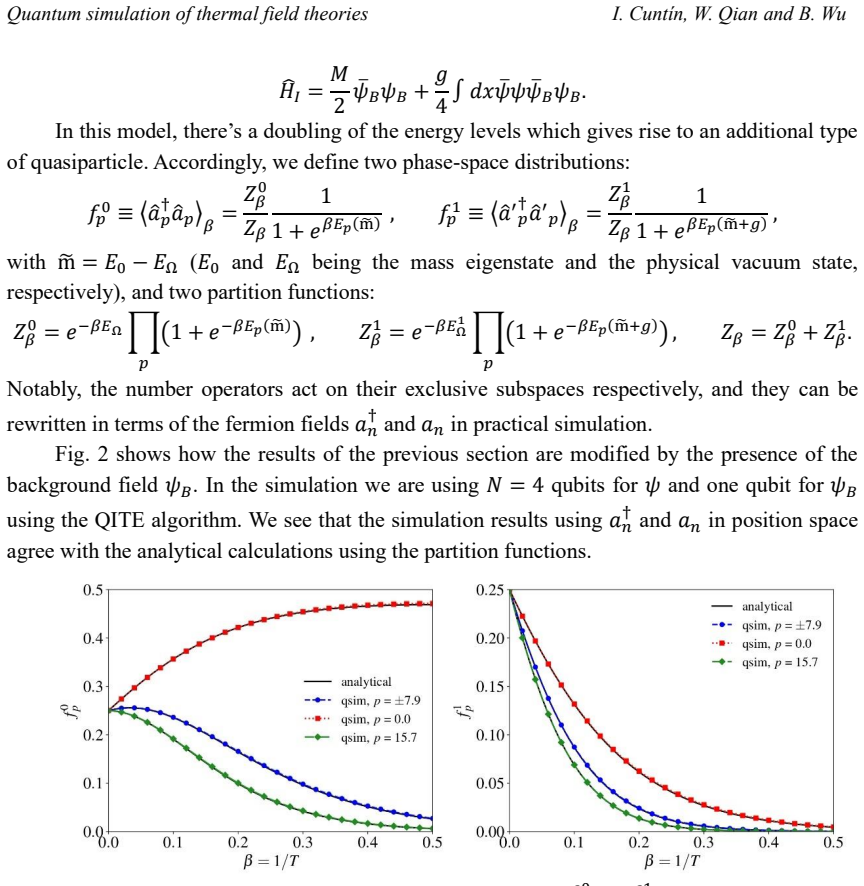
The central claim is that quantum imaginary time evolution (QITE) prepares the Gibbs state $e^{-\beta H}/Z_\beta$ of a lattice-discretised quantum field theory, and that observables read from the prepared state reproduce the exact thermal field theory. In the free Majorana case the measured $f_p$ follow Fermi-Dirac curves for both $T\gg m$ and $m\gg T$. In the interacting case, the four-fermion interaction is implemented with a homogeneous spectator Majorana field $\psi_B$, and the paper defines two partition functions $Z_\beta^0$, $Z_\beta^1$ and two occupation functions $f_p^0$, $f_p^1$; the simulation, run on four qubits for $\psi$ and one for $\psi_B$, agrees with those analytic forms. For the scalar theory, continuous fields are replaced by finite-dimensional operators on a local Hilbert space of dimension $N_\varphi=2^{n_Q}$, with conjugate momentum built from a discrete Fourier transform; the simulated thermal occupancies converge toward Bose-Einstein as $n_Q$ increases. The paper takes this as evidence that qubit-based simulators can access equilibrium properties of interacting field theories, and as the groundwork for real-time thermalisation studies.
Load-bearing premise
For the interacting fermion model, the analytical comparison assumes that the thermal state factorises into two independent sectors described by $Z_\beta^0$ and $Z_\beta^1$ with an effective mass $\tilde m=E_0-E_\Omega$; the paper does not derive this factorization or specify how $E_0$ and $E_\Omega$ are computed, so if that assumption is wrong the agreement in Fig. 2 would be an artifact of the analytic curves.
Editorial extensions
If this is right
- If the QITE preparation works as demonstrated, finite-temperature observables in small lattice field theories can be obtained on digital quantum hardware without constructing the full Gibbs state classically.
- Because the simulations run in coordinate space while the comparison is made in momentum space, the same preparation can be used for interacting theories whose interaction terms are non-local in momentum.
- The interacting Majorana model predicts a doubled quasiparticle thermal spectrum, with occupation branches controlled by $\tilde m$ and $\tilde m+g$; this is a concrete signature of four-fermion interactions at finite temperature.
- For scalar fields, thermal-state accuracy is controlled by the local register size $n_Q$: increasing it drives the prepared state toward the Bose-Einstein limit, giving a controlled digitisation error.
- The successful preparation of equilibrium states is the paper's announced precondition for simulating real-time thermalisation and thermal fixed points in quantum field theory.
Reading between the lines
- If the two-sector effective-mass ansatz is correct, the same factorization should survive at stronger coupling and on larger lattices, with $\tilde m=E_0-E_\Omega$ computable from the single-particle spectrum; those runs would either confirm or break the ansatz.
- The QITE-prepared thermal state could be used as an initial condition for a subsequent real-time evolution on the same qubits, turning the equilibrium preparation directly into a thermalisation simulation.
- The scalar digitisation results suggest a resource estimate the paper does not provide: the number of qubits per site and the circuit depth should scale polynomially with $N_\varphi$ and $\beta$, which could be checked numerically before hardware deployment.
Editorial analysis
A structured set of objections, weighed in public.
Referee Report
Summary. The paper is an ICHEP2024 proceedings contribution reporting quantum simulations of thermal states for 1+1-dimensional field theories on a small digital quantum simulator. The authors describe qubit encodings for Majorana fermions and a discretised scalar field, and they apply the quantum imaginary time evolution (QITE) algorithm to prepare approximate thermal states. They compare the momentum-space occupancies f_p with analytical Fermi-Dirac (free and interacting Majorana fermions) and Bose-Einstein (scalar) distributions in Figs. 1-3, and they claim strong agreement, including with exact diagonalisation methods.
Significance. If the central claim holds, the paper provides a useful small-scale demonstration that QITE can prepare thermal states of lattice field theories, with the free-fermion and scalar comparisons serving as independent benchmarks. The qubit mappings and the QITE implementation are concrete and reproducible in principle, and the free-field checks are not circular because the analytical distributions are externally derived. The main value is as a stepping stone toward studying thermalisation and thermal fixed points in real-time quantum simulation, as the authors state in the abstract and outlook. The significance is limited by the proceedings format: several technical steps, especially the interacting-fermion analytical expressions, are stated without derivation, and the claimed exact-diagonalisation comparison is not shown.
major comments (3)
- [Sec. 3, Eqs. defining f_p^0, f_p^1, Z_beta^0, Z_beta^1] The analytical distributions for the interacting Majorana fermion model are stated without derivation: f_p^0 and f_p^1 are expressed in terms of sector partition functions Z_beta^0 and Z_beta^1 and an effective mass m̃ = E_0 - E_Omega, but the paper does not derive the factorization Z_beta = Z_beta^0 + Z_beta^1, does not define how E_0 and E_Omega are computed from the Hamiltonian, and does not state the bare parameters (m_0, M, g, beta, a, N) used in the simulation. If m̃ is adjusted to match the numerical data, the agreement in Fig. 2 would not be an independent test of QITE. The authors should provide the derivation or an explicit reference, define all quantities, and state the parameter values; they should also show the claimed exact diagonalisation data for this model, since Fig. 2 contains only the simulation and the analytical curves.
- [Secs. 1-2, QITE protocol] The manuscript defines the thermal expectation value as a Gibbs trace, but it does not specify how the trace is implemented with QITE. QITE as cited prepares the pure state e^{-beta H/2}|psi> (up to normalisation), so the reported f_p values require a specification of the initial state |psi> and the procedure for averaging over a complete basis or for using a purification. Without this protocol, the numerical results in Figs. 1-3 are not reproducible from the manuscript alone, and the comparison to a thermal ensemble is not fully justified.
- [Figs. 1-3 and Sec. 4] The paper states in the summary that the results are compared with 'exact diagonalisation methods', but no exact diagonalisation data or error bars appear in any figure. Moreover, the simulations in Figs. 1-3 lack a complete list of input parameters (lattice spacing a, number of sites N, bare masses, coupling g or lambda, temperature beta, boson cutoff N_b, and number of qubits per site n_Q). For the scalar case, the approach to the Bose-Einstein distribution with increasing n_Q is presented without stating the truncation parameters or the finite-volume corrections, so it is unclear whether the agreement reflects convergence to the continuum distribution or merely to the digitised approximation. The authors should add a parameter table, show the exact diagonalisation results or remove the claim, and discuss truncation errors in the scalar-field digitisation.
minor comments (6)
- [Sec. 2, free-fermion Hamiltonian] The displayed free-fermion Hamiltonian has a summation structure that is hard to parse, with a sum over n appearing both outside and inside the second line; please rewrite it with clear parentheses and a single summation convention.
- [Fig. 1 caption] The caption states '4 qubits' and mentions two thermal limits, but it does not give the values of beta, the lattice spacing, or the number of momentum modes; please add these so that the reader can reproduce the curves.
- [Fig. 2 caption] The caption refers to 'both quasiparticles' but does not label which markers correspond to f_p^0 and f_p^1; please add a legend or explicitly identify the curves.
- [Sec. 4, digitisation] The text introduces N_b as a boson number cutoff but then uses N_phi = 2^{n_Q} as the local Hilbert space dimension and never specifies how N_b is chosen or how it relates to N_phi; please clarify this truncation procedure.
- [References] Reference [5] is listed as 'work in progress'; if the scalar-field results rely on this work, please provide a preprint identifier or report the results directly in the present paper.
- [Sec. 2, Wilson term] The Wilson parameter r is introduced but its value in the simulations is never stated; please give the value used in Figs. 1 and 2.
Circularity Check
No significant circularity: free-fermion and scalar benchmarks are external Fermi-Dirac/Bose-Einstein distributions; the interacting-fermion analytical comparison is underived and under-specified but is not shown to be fitted to the QITE data.
full rationale
The central numerical claims are QITE simulations of lattice Hamiltonians compared with analytic distributions. For the free Majorana fermion (Fig. 1) the comparison is to the standard Fermi-Dirac distribution with stated regimes T >> m and m >> T; the scalar case (Fig. 3) is compared to the standard Bose-Einstein distribution and the agreement improves with the qubit register size n_Q. These benchmarks are independent of the QITE output, so no circularity arises there. The interacting-fermion section (Sec. 3) introduces f_p0 and f_p1 with sector partition functions Z_beta^0, Z_beta^1 and an effective mass m_tilde = E_0 - E_Omega; these expressions are stated without derivation, and the bare parameters (m_0, M, g, beta, a, N) and the E_0/E_Omega computation are not given. This is a significant exposition gap: if m_tilde or the sector weights were adjusted to the simulation, the Fig. 2 agreement would be by construction. However, the text presents m_tilde as a physical mass-eigenstate/vacuum-energy input and the sector decomposition as an analytical property of the model, not as a fit to the QITE data; absent evidence of fitting, this is a missing-derivation/verifiability problem rather than demonstrated circularity. The summary's claim of agreement with 'exact diagonalisation methods' is not backed by ED data in the figures, but that is an unsubstantiated assertion, not a circular reduction. Self-citations [4] and [5] are normal in a proceedings summarizing the authors' program and are not used as uniqueness theorems or as the sole justification of the external benchmarks; QITE itself is cited to Motta et al. Therefore no step in the derivation chain reduces to its own input by construction, and the appropriate finding is a low score reflecting minor self-citation and under-specified analytical inputs.
Assumptions & free parameters
free parameters (3)
- m̃ (interacting fermion effective mass) =
not specified
- N_b (boson number cutoff per site) =
not specified
- n_Q (qubits per scalar lattice site) =
not specified (N_φ = 2^{n_Q})
assumptions (5)
- domain assumption The thermal state of the discretized lattice Hamiltonian is the Gibbs state ρ = e^{-βH}/Z
- domain assumption The QITE algorithm converges to the thermal state for the studied systems
- ad hoc to paper Four-fermion interactions among identical Majorana fields vanish, requiring an auxiliary homogeneous field ψ_B
- ad hoc to paper The interacting partition function factorizes as Z_β = Z_β^0 + Z_β^1 with independent Fermi-Dirac sectors
- domain assumption The truncated scalar digitization preserves canonical commutation relations up to small O(ε) corrections
invented entities (1)
-
ψ_B homogeneous background Majorana field
Cite this review
Pith. "Pith review of Quantum simulation of thermal field theories." pith.science (2026). https://pith.science/paper/WAEZBLOE
@misc{pith2026241119601,
  author       = {Pith},
  title        = {Pith review of: Quantum simulation of thermal field theories},
  year         = {2026},
  howpublished = {\url{https://pith.science/paper/WAEZBLOE}},
  note         = {Machine review of arXiv:2411.19601}
}
read the original abstract
We present our recent studies on thermal field theories using quantum algorithms. We first delve into the representation of quantum fields via qubits on general digital quantum computers alongside the quantum algorithms employed to evaluate thermal properties of generic quantum field theories. Then, we show our numerical results of thermal field theories in 1+1 dimensions using quantum simulators. Both fermion and scalar fields will be discussed. These studies aim to understand thermal fixed points for our forthcoming work on studying thermalisation in quantum field theories in real time quantum simulation.
Figures

Reference graph
Works this paper leans on
- [4]
-
[1]
Preskill, Quantum 2 (2018) 79 [quant-ph/1801.00862]
J. Preskill, Quantum 2 (2018) 79 [quant-ph/1801.00862]
arXiv 2018
-
[2]
Lloyd, Science 273 (1996) 5278 [DOI:10.1126/science.273.5278.1073]
S. Lloyd, Science 273 (1996) 5278 [DOI:10.1126/science.273.5278.1073]
arXiv 1996
-
[3]
M. Motta et al., Nature Phys. 16 (2020) 205 [quant-ph/1901.07653]
arXiv 2020
- [5]
- [6]
-
[7]
S.P. Jordan, K.S.M. Lee and J. Preskill, Science 336 (2012) 1130 [quant-ph/1111.3633]
arXiv 2012
Reviewed August 12, 2026 · model on record in the stance chip above.
Discussion (0). Continue with ORCID to comment.