REVIEW 3 major objections 5 minor 76 references
Experimental preparation of $W$ states through frustration on a programmable quantum simulator
T0 review · 3 major / 5 minor · reviewed 2026-08-04 · deepseek-v4-flash
Pith's one-line read Odd-numbered antiferromagnetic rings produce W states; a Rydberg simulator realizes them with fidelity 0.77.
desk verdict Frustrated-ring W-state preparation on 11 Rydberg atoms is credible, but the 'certified' fidelity is a model-conditioned estimate, not a rigorous lower bound. read the letter →
The pith
A machine-rendered reading of the paper's core claim, the machinery that carries it, and where it could break.
The reading
What carries the argument
Topological ring frustration: placing an odd number of spins on a ring with antiferromagnetic nearest-neighbor interactions forces a single ferromagnetic domain wall (a kink); quantum fluctuations delocalize that kink, producing the superposition |KS⟩ = (1/√L) Σₖ |k⟩_AFM, which approximates the W state. This mechanism bypasses the no-go result that no local gapped Hamiltonian has a W state as its unique ground state, because the frustrated ring is gapless in the thermodynamic limit. The certification relies on the fidelity estimator F_e = (1/L)(Σₖ pₖ + Tr(ρ_exp P_x)), where P_x sums x-correlators over even contiguous segments, and on a Bayesian weighting w_j ∝ ∏_α exp(−N^(α) D_KL(f^(α)||t^(α
What would settle it
Run the same Bayesian two-basis estimation on a small system (L=3 or 5) where full quantum state tomography is feasible, and check whether the inferred fidelity matches the tomography result within uncertainty; alternatively, measure the x-basis correlators directly using a gate-based rotation (where interactions can be turned off) and compare with the Bayesian-inferred values.
Extended reading notes
Core claim
We show that an odd-sized antiferromagnetic ring, whose ground state is a gapless superposition of kink states due to topological frustration, hosts a state equivalent to a W state, and we prepare it adiabatically on a Rydberg atom simulator. We certify the entanglement with a fidelity estimator that uses only z-basis populations and x-basis correlators, with the off-diagonal part inferred through a Bayesian update conditioned on classical simulations that match experimental bit-string statistics. For a ring of 11 atoms we obtain a certified lower-bound fidelity of 0.774, well above the separable threshold of 1/L, and numerical simulations indicate the protocol scales to tens of atoms with n
Load-bearing premise
The inferred fidelity depends on the classical simulation with its noise model (dephasing rate, atom motion, readout errors) accurately reproducing the real imperfect rotation sequence; if that model is wrong, the claimed lower bound could be biased.
Editorial extensions
If this is right
- W states can be generated deterministically (not probabilistically) on neutral-atom platforms, with measured fidelity around 0.77 for 11 atoms and the potential to scale to tens of atoms as plate sizes and coherence improve.
- W states with an even number of atoms become accessible by preparing an odd ring and converting via a Clifford circuit or an ancilla qubit, as detailed in the supplementary material.
- Certification of W fidelity requires only two measurement bases and a number of state preparations that grows linearly with qubit count, avoiding the exponential cost of full state tomography.
- The Bayesian inference method can certify observables that are not directly measurable on analog quantum simulators whenever a trustworthy classical noisy model exists, extending beyond W states to other correlated many-body states.
- Because the reported fidelity is a lower bound—the rotation sequence introduces additional errors—the true state quality is higher, strengthening its usefulness for quantum communication protocols such as teleportation and secret sharing.
Reading between the lines
- The fidelity lower bound is only as trustworthy as the classical noise model (dephasing rate, atom motion, readout errors); a systematic misspecification could bias the inferred coherence, so a model-agnostic cross-check would make the certification more robust.
- The kink state |KS⟩ differs from an exact W state at finite size; while the paper argues most algorithms tolerate this, protocols that require the precise W amplitudes (e.g., certain secret-sharing schemes) would need the explicit conversion step.
- The frustration mechanism might generalize to prepare other families of delocalized-excitation states by tuning interaction ranges or adding next-nearest-neighbor couplings, potentially yielding weighted superpositions beyond the uniform W state.
- As hardware fidelity improves, the bottleneck shifts from state preparation to certification; the reliance on simulation priors could be relaxed in hybrid devices that allow gate-based rotations, offering an independent validation of the reported fidelities.
Editorial analysis
A structured set of objections, weighed in public.
Referee Report
Summary. The paper proposes and experimentally implements a protocol to prepare W-type states in a Rydberg atom array using topological ring frustration: an odd-numbered ring with antiferromagnetic interactions has a degenerate manifold of kink states whose equal superposition is related to a W state. The authors report z-basis populations for L=5,7,9,11 atoms on the Aquila device, and use a Bayesian inference scheme, based on classical simulations with noise parameters, to estimate the off-diagonal coherence and hence a fidelity F_e ≈ 0.774 for L=11. They also claim that the required number of measurements is linear in system size, and that numerical simulations indicate scalability to larger systems.
Significance. If the protocol and the fidelity estimate hold, this is a valuable step toward deterministic preparation of multipartite entangled W states in a scalable neutral-atom platform, and the proposed two-basis estimator plus simulation-assisted Bayesian tomography is a useful addition to the certification toolbox. The paper is commendable for making the data public, using bootstrap error bars, and being transparent in the Fig. 4 caption that the fidelity is conditioned on theoretical simulations. However, the headline 'certified lower bound' is not actually certified: the off-diagonal term is inferred through a classical noise model rather than directly measured, and the same model is used to construct the prior. The strength of the experimental claim therefore depends on model validity, which is not quantitatively assessed.
major comments (3)
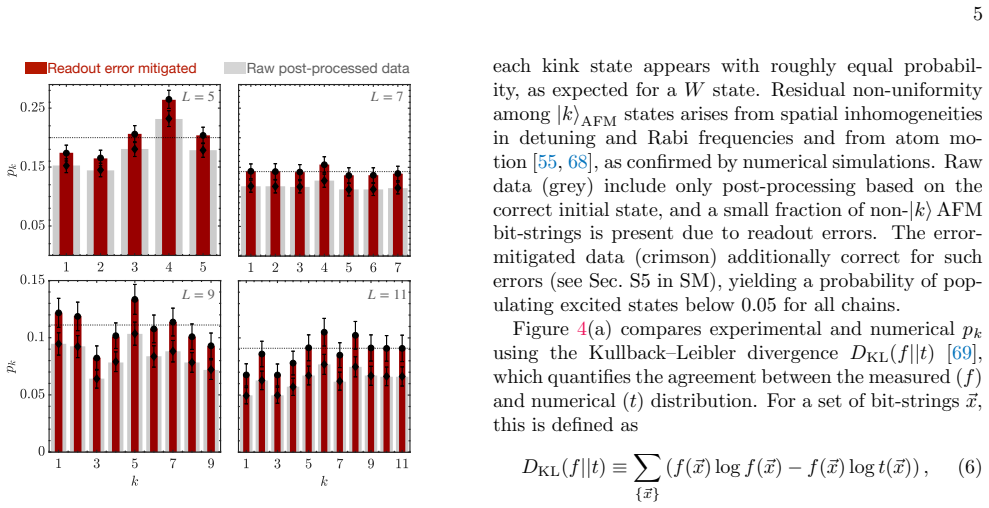
- [State validation and Bayesian inference, Eqs. (7)-(8), Fig. 4] The headline fidelity for L=11 (F_e=0.774) is not directly measured. Because the GRAPE rotation has operator fidelity below 0.3, Tr(ρ_exp P_x) is inferred from a posterior over Q=100 simulated density matrices whose weights w_j are built from KL divergences between measured and simulated post-rotation bit-string distributions. The likelihood uses a specific noise model (Lindblad dephasing in Eq. (10), Gaussian atom displacements, readout confusion); if the true noise contains processes outside this family—correlated laser noise, non-Markovian dephasing, calibration drift—the posterior can be biased. No sensitivity analysis or posterior predictive check is presented, and the figure caption itself says 'conditioned on the theoretical simulations.' The abstract and conclusion call the fidelities 'certified lower bounds,' which is too strong. Please add posterior predictive checks and vary t
- [Prior calibration and circularity, Fig. 4(a)-(b)] The prior is selected using z-basis experimental populations (the Fig. 4 caption states that the shaded 'prior distribution... is created using just the diagonal (z-basis) experimental data'), and the same classical simulations are then used to predict the off-diagonal term. The rotated-basis data reweight the simulated states but do not provide an independent check of the model's ability to predict coherence. This does not invalidate the method, but it should be acknowledged explicitly; an independent measurement (e.g., a different rotation angle or a direct coherence witness) is needed to support the 'certified lower bound' language.
- [Eqs. (3)-(4) and target state definition] The prepared state |KS> in Eq. (3) is a superposition of kink states with (L-1)/2 Rydberg excitations, not the single-excitation W state of Eq. (1). The text asserts equivalence via Clifford circuits or an ancilla, but the mapping is not shown in the main text. Yet Eq. (4) is said to give 'fidelity relative to a perfect W state.' A reader cannot verify that Fe in Eq. (4) equals the fidelity to a W state (or to |KS> after the mapping). Please derive Eq. (4) explicitly or clarify that the quoted fidelities are to |KS>, and state what this implies for the W-state claim in the abstract.
minor comments (5)
- [Abstract and Conclusion] The abstract and conclusion refer to 'W states' and 'certified lower bounds' without qualification. Since the prepared state is |KS> and the fidelity is simulation-conditioned, please use 'W-type' or add the appropriate caveats in the abstract.
- [Eq. (6)] The KL divergence D_KL(f||t) uses empirical frequencies f; bins with zero counts will make the expression undefined unless regularized. Describe how zero-count outcomes are handled in the numerical implementation.
- [Fig. 2 caption] Typo: 'Infidelity (that it, 1−F_th)' should read '(that is, 1−F_th)'.
- [Methods] The sentence 'the optimization landscape does not scale with the dimension of the physical Hilbert space, but rather with the number of parameters employed' is misleading: the underlying tensor-network simulation still has a bond dimension that must grow with system size. Clarify that the Bayesian update is low-dimensional, not the simulation itself.
- [Table I] The entry 'Ωrot = 7.97±0.5,1' is ambiguous. Please specify the three experimental values and the error convention separately.
Circularity Check
No circular derivation: the fidelity estimate is model-based Bayesian inference with independent rotated-basis data; model dependence is a caveat, not circularity.
full rationale
The derivation is not circular. Eq. (4) combines measured z-basis populations p_k with an off-diagonal term Tr(rho_exp P_x). Because interactions cannot be turned off during the rotation, the paper does not claim to measure this term directly; instead Eqs. (5)-(8) define Bayesian weights from rotated-basis experimental data: w_j ∝ exp(-N D_KL(f||t(rho_j))), using Q=100 simulated density matrices as prior support. The target fidelity is not an input to the prior, and the posterior is updated with an independent dataset; Fig. 4(b) shows the posterior narrows the prior spread, so the result is not forced by the z-basis fit alone. The main limitation is model dependence, as the caption states 'Measured W state fidelity conditioned on the theoretical simulations.' If the noise model (local dephasing Eq. (10), atom motion, readout errors) is misspecified, the inferred coherence and the lower-bound claim could be biased. That is a correctness/robustness risk, not circularity. Self-citations on frustration and the kink-to-W mapping are not load-bearing: the protocol is supported by the paper's own numerical simulations, the external no-go theorem Ref. [32], and by the described Clifford/ancilla mapping. No equation reduces to its inputs by construction.
Assumptions & free parameters
free parameters (5)
- Dephasing rate γ (Lindblad equation) =
not stated in main text
- Atom position spread δx=δy =
0.15 µm
- Readout error confusion matrix =
not stated
- Rabi frequency / detuning fluctuation parameters =
from calibration
- Gap scaling exponent α =
1.87 ± 0.11
assumptions (4)
- ad hoc to paper The state |KS> is equivalent to a W state via Clifford circuits or an ancilla qubit (SM)
- domain assumption Only kink strings |k>_AFM appear in the z-basis support
- domain assumption The Lindblad master equation with dephasing (Eq. 10) captures the dominant decoherence
- domain assumption Tensor network simulations with χ=64 are converged for the noisy L=11 dynamics
Cite this review
Pith. "Pith review of Experimental preparation of $W$ states through frustration on a programmable quantum simulator." pith.science (2026). https://pith.science/paper/WH3BYQF2
@misc{pith2026251017974,
  author       = {Pith},
  title        = {Pith review of: Experimental preparation of $W$ states through frustration on a programmable quantum simulator},
  year         = {2026},
  howpublished = {\url{https://pith.science/paper/WH3BYQF2}},
  note         = {Machine review of arXiv:2510.17974}
}
abstract
$W$ states are a central class of multipartite entangled states with applications in quantum information processing, yet their scalable and deterministic preparation remains challenging. Here we propose a protocol based on {\it topological ring frustration}, where an antiferromagnetic ring with an odd number of sites hosts a delocalized excitation corresponding to a $W$ state. We implement this protocol on a Rydberg atom array -- a programmable quantum simulator -- generating $W$ states of up to 11 atoms. Our results demonstrate a fidelity of $\mathcal{F} \approx 0.77$, and numerical simulations indicate scalability to larger system sizes accessible with near-term hardware improvements. To enable certification of these many-body entangled states, we introduce a novel and efficient Bayesian tomography method that, leveraging on classical simulations, enables their certification with a cost that avoids the exponential scaling of full tomography. These results establish topological frustration as a practical mechanism for engineering multipartite entanglement and provide a scalable route toward the certification of correlated quantum many-body states in quantum simulators.
Figures


Figures from the paper (1 more)

Reference graph
Works this paper leans on
-
[1]
Chitambar, E. & Gour, G. Quantum resource theories. Rev. Mod. Phys.91, 025001 (2019). URLhttps://link. aps.org/doi/10.1103/RevModPhys.91.025001
-
[2]
Plbnio, M. B. & Virmani, S. An introduction to en- tanglement measures.Quantum Info. Comput.7, 1–51 (2007)
2007
-
[3]
Horodecki, R., Horodecki, P., Horodecki, M. & Horodecki, K. Quantum entanglement.Rev. Mod. Phys. 81, 865–942 (2009). URLhttps://link.aps.org/doi/ 10.1103/RevModPhys.81.865
-
[4]
Ollivier, H. & Zurek, W. H. Quantum discord: A mea- sure of the quantumness of correlations.Phys. Rev. Lett. 88, 017901 (2001). URLhttps://link.aps.org/doi/ 10.1103/PhysRevLett.88.017901
-
[5]
Modi, K., Brodutch, A., Cable, H., Paterek, T. & Ve- dral, V. The classical-quantum boundary for correla- tions: Discord and related measures.Rev. Mod. Phys. 84, 1655–1707 (2012). URLhttps://link.aps.org/ doi/10.1103/RevModPhys.84.1655
-
[6]
& Plenio, M
Baumgratz, T., Cramer, M. & Plenio, M. B. Quan- tifying coherence.Phys. Rev. Lett.113, 140401 (2014). URLhttps://link.aps.org/doi/10.1103/ PhysRevLett.113.140401
2014
-
[7]
& Plenio, M
Streltsov, A., Adesso, G. & Plenio, M. B. Colloquium: Quantum coherence as a resource.Rev. Mod. Phys.89, 041003 (2017). URLhttps://link.aps.org/doi/10. 1103/RevModPhys.89.041003
2017
-
[8]
& Campbell, E
Howard, M. & Campbell, E. Application of a re- source theory for magic states to fault-tolerant quan- tum computing.Phys. Rev. Lett.118, 090501 (2017). URLhttps://link.aps.org/doi/10.1103/ PhysRevLett.118.090501
2017
Show all 76 references
-
[9]
Leone, L., Oliviero, S. F. E. & Hamma, A. Sta- bilizer r´ enyi entropy.Phys. Rev. Lett.128, 050402 (2022). URLhttps://link.aps.org/doi/10.1103/ PhysRevLett.128.050402
2022
-
[10]
& Cirac, J
D¨ ur, W., Vidal, G. & Cirac, J. I. Three qubits can be en- tangled in two inequivalent ways.Physical Review A62 (2000). URLhttp://dx.doi.org/10.1103/PhysRevA. 62.062314
2000 doi
-
[11]
M., Horne, M
Greenberger, D. M., Horne, M. A. & Zeilinger, A.Go- ing Beyond Bell’s Theorem, 69–72 (Springer Nether- lands, Dordrecht, 1989). URLhttps://doi.org/10. 1007/978-94-017-0849-4_10
1989
-
[13]
& Chao-Jing, T
Jian, W., Quan, Z. & Chao-Jing, T. Quantum secure communication scheme with w state.Communications in Theoretical Physics48, 637 (2007). URLhttps:// dx.doi.org/10.1088/0253-6102/48/4/013
2007 doi
-
[14]
URLhttp: //dx.doi.org/10.1142/S0219749908004195
Chen, X.-B.et al.Controlled quantum secure direct communication with w state.International Journal of Quantum Information06, 899–906 (2008). URLhttp: //dx.doi.org/10.1142/S0219749908004195
2008 doi
-
[15]
URLhttp://dx.doi.org/10.1038/nphoton.2014.204
Gr¨ afe, M.et al.On-chip generation of high-order single- photon w-states.Nature Photonics8, 791–795 (2014). URLhttp://dx.doi.org/10.1038/nphoton.2014.204
2014 doi
-
[16]
& Kurizki, G
Da˘ g, C., Niedenzu, W., M¨ ustecaplıo˘ glu, O. & Kurizki, G. Multiatom quantum coherences in micromasers as fuel for thermal and nonthermal machines.Entropy18, 244 (2016). URLhttp://dx.doi.org/10.3390/e18070244
2016 doi
-
[17]
& Saffman, M
Ebert, M., Kwon, M., Walker, T. & Saffman, M. Coher- ence and rydberg blockade of atomic ensemble qubits. Physical Review Letters115(2015). URLhttp://dx. doi.org/10.1103/PhysRevLett.115.093601
2015 doi
-
[18]
K., Lund, A
Vijayan, M. K., Lund, A. P. & Rohde, P. P. A ro- bust W-state encoding for linear quantum optics.Quan- tum4, 303 (2020). URLhttps://doi.org/10.22331/ q-2020-08-03-303
2020
-
[19]
Grover, L. K. Quantum mechanics helps in searching for a needle in a haystack.Phys. Rev. Lett.79, 325– 328 (1997). URLhttps://link.aps.org/doi/10.1103/ PhysRevLett.79.325
1997
-
[20]
& Kenigsberg, D
Biham, E. & Kenigsberg, D. Grover’s quantum search algorithm for an arbitrary initial mixed state.Phys. Rev. 10 A66, 062301 (2002). URLhttps://link.aps.org/doi/ 10.1103/PhysRevA.66.062301
2002 doi
-
[21]
& Biham, O
Shapira, D., Shimoni, Y. & Biham, O. Algebraic analysis of quantum search with pure and mixed states.Phys. Rev. A71, 042320 (2005). URLhttps://link.aps.org/ doi/10.1103/PhysRevA.71.042320
2005 doi
-
[22]
F.et al.Control and measurement of three- qubit entangled states.Science304, 1478–1480 (2004)
Roos, C. F.et al.Control and measurement of three- qubit entangled states.Science304, 1478–1480 (2004). URLhttp://dx.doi.org/10.1126/science.1097522
2004 doi
-
[23]
URLhttp: //dx.doi.org/10.1038/nature04279
H¨ affner, H.et al.Scalable multiparticle entanglement of trapped ions.Nature438, 643–646 (2005). URLhttp: //dx.doi.org/10.1038/nature04279
2005 doi
-
[24]
URLhttp://dx.doi.org/10.1038/nature09071
Kim, K.et al.Quantum simulation of frustrated ising spins with trapped ions.Nature465, 590–593 (2010). URLhttp://dx.doi.org/10.1038/nature09071
2010 doi
-
[25]
& Weinfurter, H
Eibl, M., Kiesel, N., Bourennane, M., Kurtsiefer, C. & Weinfurter, H. Experimental realization of a three-qubit entangledwstate.Phys. Rev. Lett.92, 077901 (2004). URLhttps://link.aps.org/doi/10. 1103/PhysRevLett.92.077901
2004
-
[26]
URL http://dx.doi.org/10.1002/qute.201900015
Cruz, D.et al.Efficient quantum algorithms for ghz and w states, and implementation on the ibm quantum com- puter.Advanced Quantum Technologies2(2019). URL http://dx.doi.org/10.1002/qute.201900015
2019 doi
-
[27]
& Neumann, N
Buhrman, H., Folkertsma, M., Loff, B. & Neumann, N. M. P. State preparation by shallow circuits using feed forward.Quantum8, 1552 (2024). URLhttps://doi. org/10.22331/q-2024-12-09-1552
2024 doi
-
[28]
& Cirac, J
Piroli, L., Styliaris, G. & Cirac, J. I. Approximat- ing many-body quantum states with quantum circuits and measurements.Phys. Rev. Lett.133, 230401 (2024). URLhttps://link.aps.org/doi/10.1103/ PhysRevLett.133.230401
2024
-
[29]
C., Zemlevskiy, N
Farrell, R. C., Zemlevskiy, N. A., Illa, M. & Preskill, J. Digital quantum simulations of scattering in quan- tum field theories using w states (2025). URLhttps: //arxiv.org/abs/2505.03111. 2505.03111
2025
-
[30]
Saffman, M., Walker, T. G. & Mølmer, K. Quantum information with rydberg atoms.Rev. Mod. Phys.82, 2313–2363 (2010). URLhttps://link.aps.org/doi/ 10.1103/RevModPhys.82.2313
2010 doi
-
[31]
URLhttp://dx.doi.org/ 10.1126/science.aax9743
Omran, A.et al.Generation and manipulation of schr¨ odinger cat states in rydberg atom arrays.Sci- ence365, 570–574 (2019). URLhttp://dx.doi.org/ 10.1126/science.aax9743
2019 doi
-
[32]
& Thorngren, R.wstate is not the unique ground state of any local hamiltonian (2023)
Gioia, L. & Thorngren, R.wstate is not the unique ground state of any local hamiltonian (2023). URL https://arxiv.org/abs/2310.10716
2023 arXiv
-
[33]
URLhttps://arxiv.org/ abs/2306.11727
Wurtz, J.et al.Aquila: Quera’s 256-qubit neutral-atom quantum computer (2023). URLhttps://arxiv.org/ abs/2306.11727
2023 arXiv
-
[34]
& Chen, Q.-H
Dong, J.-J., Li, P. & Chen, Q.-H. The a-cycle prob- lem for transverse ising ring.Journal of Statisti- cal Mechanics: Theory and Experiment2016, 113102 (2016). URLhttp://dx.doi.org/10.1088/1742-5468/ 2016/11/113102
2016 doi
-
[35]
M., Kui´ c, D
Mari´ c, V., Giampaolo, S. M., Kui´ c, D. & Franchini, F. The frustration of being odd: how boundary con- ditions can destroy local order.New Journal of Physics 22, 083024 (2020). URLhttp://dx.doi.org/10.1088/ 1367-2630/aba064
2020
-
[36]
Mari´ c, V., Giampaolo, S. M. & Franchini, F. Quan- tum phase transition induced by topological frustra- tion.Communications Physics3(2020). URLhttp: //dx.doi.org/10.1038/s42005-020-00486-z
2020 doi
-
[37]
G., Giampaolo, S
Catalano, A. G., Giampaolo, S. M., Morsch, O., Giovan- netti, V. & Franchini, F. Frustrating quantum batteries. PRX Quantum5(2024). URLhttp://dx.doi.org/10. 1103/PRXQuantum.5.030319
2024
-
[38]
URL http://dx.doi.org/10.1142/9789812799371_0009
Toulouse, G.Theory of the frustration effect in spin glasses: I, 99–103 (WORLD SCIENTIFIC, 1986). URL http://dx.doi.org/10.1142/9789812799371_0009
1986 doi
-
[39]
& Vicari, E
Campostrini, M., Pelissetto, A. & Vicari, E. Quantum transitions driven by one-bond defects in quantum ising rings.Phys. Rev. E91, 042123 (2015). URLhttps: //link.aps.org/doi/10.1103/PhysRevE.91.042123
2015 doi
-
[40]
M., Ramos, F
Giampaolo, S. M., Ramos, F. B. & Franchini, F. The frustration of being odd: universal area law violation in local systems.Journal of Physics Communications 3, 081001 (2019). URLhttp://dx.doi.org/10.1088/ 2399-6528/ab3ab3
2019
-
[41]
URLhttp://dx.doi.org/10.21468/ SciPostPhys.15.4.131
Odavi´ c, J.et al.Complexity of frustration: A new source of non-local non-stabilizerness.SciPost Physics15(2023). URLhttp://dx.doi.org/10.21468/ SciPostPhys.15.4.131
2023
-
[42]
G.et al.Magic phase transition and non- local complexity in generalizedwstate (2024)
Catalano, A. G.et al.Magic phase transition and non- local complexity in generalizedwstate (2024). URL https://arxiv.org/abs/2406.19457. 2406.19457
2024
-
[43]
W., Ji, Z., Wu, X
Haah, J., Harrow, A. W., Ji, Z., Wu, X. & Yu, N. Sample- optimal tomography of quantum states. InProceedings of the Forty-Eighth Annual ACM Symposium on Theory of Computing, STOC ’16, 913–925 (Association for Com- puting Machinery, New York, NY, USA, 2016). URL https://doi.org...
2016
-
[44]
URLhttps://arxiv.org/abs/2507.02849
Talath, H.et al.Three-qubit w state tomography via full and marginal state reconstructions on ibm osaka (2025). URLhttps://arxiv.org/abs/2507.02849
2025
-
[45]
& Preskill, J
Huang, H.-Y., Kueng, R. & Preskill, J. Predicting many properties of a quantum system from very few measure- ments.Nature Physics16, 1050–1057 (2020). URL https://doi.org/10.1038/s41567-020-0932-7
2020 doi
-
[46]
Nature Reviews Physics5, 9–24 (2023)
Elben, A.et al.The randomized measurement toolbox. Nature Reviews Physics5, 9–24 (2023). URLhttps: //doi.org/10.1038/s42254-022-00535-2
2023 doi
-
[47]
URLhttps://www.sciencedirect.com/ science/article/pii/S0370157324003326
Cie´ sli´ nski, P.et al.Analysing quantum systems with randomised measurements.Physics Reports1095, 1– 48 (2024). URLhttps://www.sciencedirect.com/ science/article/pii/S0370157324003326. Analysing quantum systems with randomised measurements
2024
-
[48]
Bertoni, C.et al.Shallow shadows: Expectation estima- tion using low-depth random clifford circuits.Phys. Rev. Lett.133, 020602 (2024). URLhttps://link.aps.org/ doi/10.1103/PhysRevLett.133.020602
2024 doi
-
[49]
URLhttps://doi
Hu, H.-Y.et al.Demonstration of robust and efficient quantum property learning with shallow shadows.Nature Communications16, 2943 (2025). URLhttps://doi. org/10.1038/s41467-025-57349-w
2025 doi
-
[50]
& Piroli, L
Cioli, R., Ercolessi, E., Ippoliti, M., Turkeshi, X. & Piroli, L. Approximate inverse measurement channel for shallow shadows.Quantum9, 1698 (2025). URLhttps://doi. org/10.22331/q-2025-04-08-1698
2025 doi
-
[51]
Nature534, 667–670 (2016)
Labuhn, H.et al.Tunable two-dimensional arrays of sin- gle rydberg atoms for realizing quantum ising models. Nature534, 667–670 (2016). URLhttp://dx.doi.org/ 10.1038/nature18274
2016 doi
-
[52]
URLhttp://dx.doi.org/10.1038/nature24622
Bernien, H.et al.Probing many-body dynamics on a 51- atom quantum simulator.Nature551, 579–584 (2017). URLhttp://dx.doi.org/10.1038/nature24622. 11
2017 doi
-
[53]
& Ahn, J
Kim, H., Park, Y., Kim, K., Sim, H.-S. & Ahn, J. Detailed balance of thermalization dynamics in rydberg-atom quantum simulators.Phys. Rev. Lett.120, 180502 (2018). URLhttps://link.aps.org/doi/10. 1103/PhysRevLett.120.180502
2018
-
[54]
& Hazzard, K
Zhang, Z., Yuan, M., Sundar, B. & Hazzard, K. R. A. Motional decoherence in ultracold-rydberg-atom quan- tum simulators of spin models.Phys. Rev. A110, 053321 (2024). URLhttps://link.aps.org/doi/10. 1103/PhysRevA.110.053321
2024
-
[55]
B., Ma, H., Eugenio, P
Dag, C. B., Ma, H., Eugenio, P. M., Fang, F. & Yelin, S. F. Emergent disorder and sub-ballistic dynamics in quantum simulations of the ising model using ryd- berg atom arrays (2024). URLhttps://arxiv.org/abs/ 2411.13643. 2411.13643
2024
-
[56]
URLhttps://www.nature
Ga¨ etan, A.et al.Observation of collective excitation of two individual atoms in the rydberg blockade regime.Na- ture Physics5, 115 (2009). URLhttps://www.nature. com/articles/nphys1183
2009
-
[57]
Catalano, A. G. Numerically efficient unitary evolution for hamiltonians beyond nearest-neighbors (2024). URL https://arxiv.org/abs/2402.05198
2024
-
[58]
& Montangero, S
Doria, P., Calarco, T. & Montangero, S. Optimal control technique for many-body quantum dynamics.Phys. Rev. Lett.106, 190501 (2011). URLhttps://link.aps.org/ doi/10.1103/PhysRevLett.106.190501
2011 doi
-
[59]
& Glaser, S
Khaneja, N., Reiss, T., Kehlet, C., Schulte-Herbr¨ uggen, T. & Glaser, S. J. Optimal control of coupled spin dy- namics: design of nmr pulse sequences by gradient as- cent algorithms.Journal of Magnetic Resonance172, 296–305 (2005). URLhttp://dx.doi.org/10.1016/j. jmr.2004.11.004
2005 doi
-
[60]
MacKay, D. J. C.Information theory, inference and learning algorithms(Cambridge University Press, Cam- bridge, England, 2003)
2003
-
[61]
Schack, R., Brun, T. A. & Caves, C. M. Quantum bayes rule.Physical Review A64(2001). URLhttp://dx. doi.org/10.1103/PhysRevA.64.014305
2001 doi
-
[64]
M., Law, K
Lukens, J. M., Law, K. J. H., Jasra, A. & Lougovski, P. A practical and efficient approach for bayesian quantum state estimation.New Journal of Physics22, 063038 (2020). URLhttp://dx.doi.org/10.1088/1367-2630/ ab8efa
2020 doi
-
[65]
Bravyi, S., Sheldon, S., Kandala, A., Mckay, D. C. & Gambetta, J. M. Mitigating measurement er- rors in multiqubit experiments.Phys. Rev. A103, 042605 (2021). URLhttps://link.aps.org/doi/10. 1103/PhysRevA.103.042605
2021
-
[66]
Bootstrap methods: Another look at the jack- knife.The Annals of Statistics7, 1–26 (1979)
Efron, B. Bootstrap methods: Another look at the jack- knife.The Annals of Statistics7, 1–26 (1979)
1979
-
[67]
& Tibshirani, R
Efron, B. & Tibshirani, R. J.An Introduction to the Bootstrap(Chapman and Hall/CRC, New York, 1994)
1994
-
[68]
Marcuzzi, M.et al.Facilitation dynamics and localization phenomena in rydberg lattice gases with position disor- der.Phys. Rev. Lett.118, 063606 (2017). URLhttps:// link.aps.org/doi/10.1103/PhysRevLett.118.063606
2017 doi
-
[69]
Cover, T. M. & Thomas, J. A.Elements of Information Theory(Wiley-Interscience, Hoboken, NJ, USA, 2006), 2 edn
2006
-
[70]
URLhttps://arxiv.org/abs/ 2405.21019
Lukin, A.et al.Quantum quench dynamics as a shortcut to adiabaticity (2024). URLhttps://arxiv.org/abs/ 2405.21019
2024 arXiv
-
[71]
& Montangero, S
Lloyd, S. & Montangero, S. Information theoretical anal- ysis of quantum optimal control.Phys. Rev. Lett.113, 010502 (2014). URLhttps://link.aps.org/doi/10. 1103/PhysRevLett.113.010502
2014
-
[72]
URLhttp://dx.doi.org/10
Bluvstein, D.et al.A quantum processor based on coherent transport of entangled atom arrays.Nature 604, 451–456 (2022). URLhttp://dx.doi.org/10. 1038/s41586-022-04592-6
2022
-
[73]
Levine, H.et al.Parallel implementation of high-fidelity multiqubit gates with neutral atoms.Phys. Rev. Lett. 123, 170503 (2019)
2019
-
[74]
URLhttps: //arxiv.org/abs/2402.15376
Fang, F.et al.Probing critical phenomena in open quan- tum systems using atom arrays (2024). URLhttps: //arxiv.org/abs/2402.15376. 2402.15376
2024
-
[75]
& Lahaye, T
de L´ es´ eleuc, S., Barredo, D., Lienhard, V., Browaeys, A. & Lahaye, T. Analysis of imperfections in the coherent optical excitation of single atoms to rydberg states.Phys. Rev. A97, 053803 (2018). URLhttps://link.aps.org/ doi/10.1103/PhysRevA.97.053803
2018 doi
-
[76]
Kozlej, T., Pelegri, G., Pritchard, J. D. & Daley, A. J. Adiabatic state preparation and thermalization of simu- lated phase noise in a rydberg spin hamiltonian (2025). URLhttps://arxiv.org/abs/2505.04595. 2505.04595
2025
-
[77]
& Santini, A
Collura, M., Lami, G., Ranabhat, N. & Santini, A. Tensor Network Techniques for Quantum Computation (SISSA Medialab s.r.l., 2024). URLhttp://dx.doi.org/ 10.22323/9788898587049
2024 doi
-
[78]
URLhttp://dx.doi.org/10.1016/j.aop.2019.167998
Paeckel, S.et al.Time-evolution methods for matrix- product states.Annals of Physics411, 167998 (2019). URLhttp://dx.doi.org/10.1016/j.aop.2019.167998
2019
-
[79]
& Murray, S.Elements of Quantum Optics (Springer Berlin, Heidelberg, 2007)
Meystre, P. & Murray, S.Elements of Quantum Optics (Springer Berlin, Heidelberg, 2007)
2007
Reviewed August 4, 2026 · model on record in the stance chip above.
Discussion (0). Continue with ORCID to comment.