REVIEW 3 minor 1 cited by
Four-fermion left-handed operators best describe b to s data in SMEFT while U(3)^5 and U(2)^5 symmetries align s to d predictions with kaon bounds.
Reviewed by Pith at T0; open to challenge. T0 means a machine referee read the full paper against a public rubric. the ladder, T0–T4 →
T0 review · grok-4.3
2026-05-25 03:52 UTC pith:WNEDXAFW
load-bearing objection This is a standard SMEFT global fit to b to s data that uses U(3)^5 or U(2)^5 to restore CKM suppression for kaon modes, done cleanly but without major new physics insight.
Correlated b to s and s to d Rare Semileptonic Transitions in the Standard Model Effective Field Theory
The pith
A machine-rendered reading of the paper's core claim, the machinery that carries it, and where it could break.
Core claim
Within SMEFT the present b to s semileptonic data favors four-fermion operators built from left-handed quark and lepton doublets, while the electroweak operator that modifies Z couplings contributes meaningfully to the global fit. Flavor-symmetric frameworks based on U(3)^5 and U(2)^5 automatically restore the CKM hierarchies required for s to d transitions, so that the same operators remain compatible with current experimental limits on rare kaon decays.
What carries the argument
Dimension-six SMEFT four-fermion operators involving left-handed doublets together with the electroweak operator, supplemented by U(3)^5 and U(2)^5 flavor symmetries.
Load-bearing premise
The b to s anomalies are produced by new physics captured entirely by a global fit of dimension-six SMEFT operators that can be applied unchanged to s to d transitions once one of the two flavor symmetries is imposed.
What would settle it
A high-precision measurement of the K to pi nu nu branching ratio that lies well outside the range predicted by the U(3)^5 or U(2)^5 symmetric operators while the b to s fit remains unchanged would falsify the correlated description.
If this is right
- Flavor-universal SMEFT couplings produce kaon branching ratios that exceed present experimental bounds, requiring minimal flavor violation.
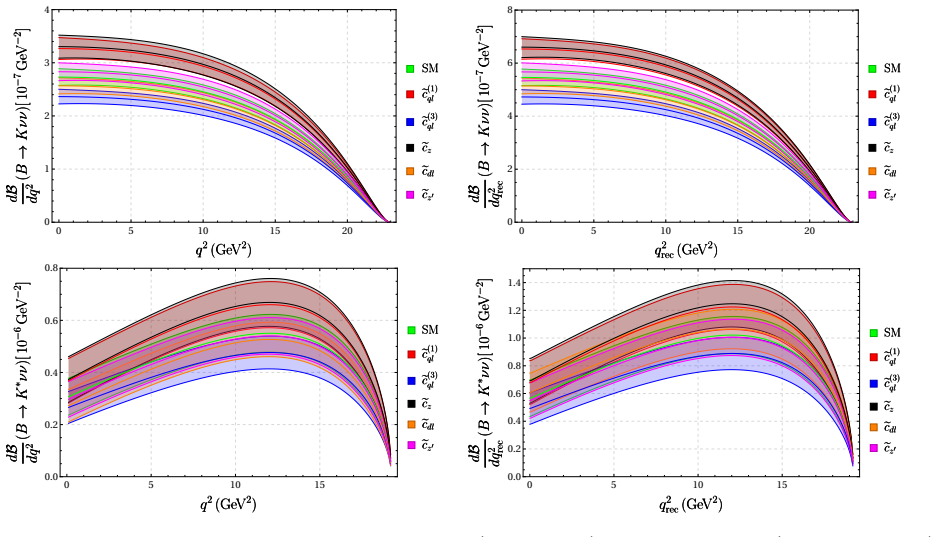
- Differential distributions in B to K(*) nu nu decays as functions of q2 and q2_rec distinguish among the different new-physics operators.
- Complex Wilson coefficients generate percent-level CP asymmetries in specific q2 regions of B to K(*) mu mu decays.
- The same operators fitted to b to s data can be used for s to d processes once the flavor symmetries are imposed.
Where Pith is reading between the lines
- Future kaon experiments with higher precision could directly test whether the same operator coefficients explain both sectors.
- If the pattern holds, analogous correlations might appear in other down-type quark transitions such as those involving charm quarks.
- Extending the global fit to include additional observables from both b and s sectors would further tighten the allowed coefficient ranges.
Editorial analysis
A structured set of objections, weighed in public.
Referee Report
Summary. The paper performs a global SMEFT fit to current b→s (μ⁺μ⁻, νν̄) data allowing complex dimension-six Wilson coefficients, finds a preference for left-handed four-fermion operators involving quark and lepton doublets together with the electroweak operator, shows that flavor-universal coefficients over-enhance rare kaon decays in conflict with data, and demonstrates that imposing U(3)⁵ or U(2)⁵ flavor symmetry restores the necessary CKM suppression so that the same coefficients yield kaon rates consistent with experiment. It additionally studies q² and q²_rec distributions in B→K(*)νν̄ and CP asymmetries in B→K(*)μμ.
Significance. If the fit results and symmetry implementation hold, the work supplies an explicit, reproducible illustration of how minimal flavor violation in SMEFT correlates b→s anomalies with s→d constraints, automatically satisfying kaon bounds once the symmetry is imposed. The differential-distribution and CP-asymmetry analyses provide concrete experimental handles. The approach follows standard MFV logic but makes the correlation between sectors quantitatively explicit.
minor comments (3)
- The abstract and introduction state that the fit prefers left-handed four-fermion operators plus the electroweak operator, but the manuscript should tabulate the Δχ² improvement and best-fit values (with uncertainties) for these coefficients relative to the SM-only hypothesis to substantiate the preference claim.
- Notation for the Wilson coefficients (e.g., C_{ℓq}^{(1,3)} versus C_{ϕℓ}) should be defined once in a dedicated table or equation block early in the text, as the same symbols appear in both the b→s fit and the kaon predictions.
- Figure captions for the q² distributions should explicitly state which operator combinations are shown in each panel and whether the bands include only statistical or also theoretical uncertainties from the fit.
Simulated Author's Rebuttal
We thank the referee for their positive summary of our work and the recommendation for minor revision. The referee's description accurately reflects the scope of the SMEFT global fit, the preference for left-handed operators, and the demonstration that U(3)^5 or U(2)^5 symmetry restores consistency with kaon data.
Circularity Check
No significant circularity identified
full rationale
The paper performs a fit of dimension-six SMEFT Wilson coefficients to b→s data and then imposes U(3)^5 or U(2)^5 flavor symmetries to relate the same coefficients to s→d transitions. The resulting kaon predictions follow from the symmetry-imposed CKM suppression factors applied to the fitted values; this is a standard MFV construction that generates independent constraints from separate observables rather than reducing outputs to inputs by definition. No self-definitional equations, fitted parameters renamed as predictions, or load-bearing self-citations appear in the derivation chain.
Axiom & Free-Parameter Ledger
free parameters (1)
- Wilson coefficients of dimension-six operators
axioms (2)
- domain assumption Dimension-six SMEFT operators capture all relevant new physics effects below the cutoff scale
- domain assumption The observed discrepancies in b to s decays are due to new physics rather than experimental or SM uncertainties
read the original abstract
The persistent anomalies observed in $b \to s\,(\ell^+\ell^-,\,\nu\bar{\nu})$ transitions continue to provide strong motivation for exploring possible extensions of the Standard Model (SM). Motivated by these discrepancies, we present a comprehensive analysis of semileptonic flavor changing neutral current processes within the Standard Model Effective Field Theory (SMEFT), encompassing both $b \to s\,(\mu^+\mu^-,\,\nu\bar{\nu})$ and $s \to d\,(\mu^+\mu^-,\,\nu\bar{\nu})$ transitions. We perform a combined fit to $b \to s\,(\mu^+\mu^-,\,\nu\bar{\nu})$ observables, allowing the relevant dimension-six Wilson coefficients to be complex. We find that the four-fermion operators involving left-handed quark and lepton doublets provide the preferred description of the current $b \to s$ data, while the electroweak operator modifying the $Z$-boson couplings also plays an important role in improving the fit. We show that flavor-universal SMEFT couplings lead to strongly enhanced rare semileptonic kaon decay branching ratios, in conflict with current experimental bounds and thus motivating the implementation of Minimal Flavor Violation. In particular, we demonstrate that flavor-symmetric frameworks based on $U(3)^5$ and $U(2)^5$ naturally restore the required CKM hierarchies and bring the predicted kaon observables into agreement with present data. We further analyze the differential distributions with respect to the dineutrino invariant mass squared $q^2$, as well as the reconstructed variable $q^2_{\mathrm{rec}}$, in $B \to K^{(*)}\nu\bar{\nu}$ decays, demonstrating their sensitivity to different new physics operators. In addition, we investigate the impact of complex Wilson coefficients on $\mathcal{CP}$ asymmetries in $B \to K^{(*)}\mu^+\mu^-$ decays and find that percent-level effects can arise in specific $q^2$ regions.
Figures

Lean theorems connected to this paper
-
IndisputableMonolith/Cost/FunctionalEquation.leanwashburn_uniqueness_aczel unclear?
unclearRelation between the paper passage and the cited Recognition theorem.
We perform a combined fit to b→s(μ+μ−,νν¯) observables... flavor-symmetric frameworks based on U(3)5 and U(2)5 naturally restore the required CKM hierarchies
-
IndisputableMonolith/Foundation/RealityFromDistinction.leanreality_from_one_distinction unclear?
unclearRelation between the paper passage and the cited Recognition theorem.
the four-fermion operators involving left-handed quark and lepton doublets provide the preferred description
What do these tags mean?
- matches
- The paper's claim is directly supported by a theorem in the formal canon.
- supports
- The theorem supports part of the paper's argument, but the paper may add assumptions or extra steps.
- extends
- The paper goes beyond the formal theorem; the theorem is a base layer rather than the whole result.
- uses
- The paper appears to rely on the theorem as machinery.
- contradicts
- The paper's claim conflicts with a theorem or certificate in the canon.
- unclear
- Pith found a possible connection, but the passage is too broad, indirect, or ambiguous to say the theorem truly supports the claim.
Forward citations
Cited by 1 Pith paper
-
Implications of $K\to\pi\nu\bar\nu$ for new physics in $B$ decays
Updated NA62 K+→π+νν̄ data tighten modified-Z and U(2)^5 semileptonic fits and predict KL→π0νν̄ enhanced relative to K+ in the preferred U(2) lobe.
Reference graph
Works this paper leans on
-
[1]
Differential branching fractions and isospin asymmetries of $B \to K^{(*)}\mu^{+}\mu^{-}$ decays
LHCb Collaboration, R. Aaijet al., Differential branching fractions and isospin asymme- tries of B → K(∗)µ+µ− decays, JHEP 06 (2014) 133, arXiv:1403.8044 [hep-ex]
work page internal anchor Pith review Pith/arXiv arXiv 2014
-
[2]
LHCb Collaboration, R. Aaij et al., Measurements of the S-wave fraction in B0 → K+π−µ+µ− decays and the B0 → K ∗(892)0µ+µ− differential branching fraction, JHEP 11 (2016) 047, arXiv:1606.04731 [hep-ex] . [Erratum: JHEP 04, 142 (2017)]
work page internal anchor Pith review Pith/arXiv arXiv 2016
-
[3]
LHCb Collaboration, R. Aaij et al., Measurement of lepton universality parameters in B+ → K+ℓ+ℓ− and B0 → K ∗0ℓ+ℓ− decays, Phys. Rev. D 108 no. 3, (2023) 032002, arXiv:2212.09153 [hep-ex]
-
[4]
CMS Collaboration, A. Hayrapetyan et al., Test of lepton flavor universality in B±→ K±µ+µ− and B ±→ K±e+e− decays in proton-proton collisions at √s = 13 TeV , arXiv:2401.07090 [hep-ex] . 31
-
[5]
Aaijet al., Measurement ofCP-Averaged Observables in theB0 → K ∗0µ+µ− Decay, Phys
LHCbCollaboration, R. Aaijet al., Measurement ofCP-Averaged Observables in theB0 → K ∗0µ+µ− Decay, Phys. Rev. Lett.125 no. 1, (2020) 011802,arXiv:2003.04831 [hep-ex]
-
[6]
CMS Collaboration, A. Hayrapetyanet al., Angular analysis of theB0 → K ∗(892)0µ+µ− decay in proton-proton collisions at √s = 13 TeV, Phys. Lett. B 864 (2025) 139406, arXiv:2411.11820 [hep-ex]
-
[7]
Adachiet al.(Belle-II), Evidence forB +→K+ν¯νdecays, Phys
Belle-II Collaboration, I. Adachiet al., Evidence for B+ → K+ν¯ν decays, Phys. Rev. D 109 no. 11, (2024) 112006,arXiv:2311.14647 [hep-ex]
-
[8]
A. J. Buras, F. Schwab, and S. Uhlig,Waiting for precise measurements ofK+ → π+ν¯ν and KL → π0ν¯ν, Rev. Mod. Phys.80 (2008) 965–1007,arXiv:hep-ph/0405132
work page internal anchor Pith review Pith/arXiv arXiv 2008
-
[9]
Insights from the Interplay of K -> pi nu anti-nu and epsilon_K on the New Physics Flavour Structure
M. Blanke, Insights from the interplay of K → πν ¯ν and εK on the new-physics flavour structure, Acta Phys. Polon. B41 (2010) 127, arXiv:0904.2528 [hep-ph]
work page internal anchor Pith review Pith/arXiv arXiv 2010
-
[10]
NA62 Collaboration, E. Cortina Gilet al., Measurement of the very rare K+→π+νν decay, JHEP 06 (2021) 093, arXiv:2103.15389 [hep-ex]
-
[11]
KOTO Collaboration, J. K. Ahn et al., Search for the KL → π0νν and KL → π0X0 decays at the J-PARC KOTO experiment, Phys. Rev. Lett. 122 no. 2, (2019) 021802, arXiv:1810.09655 [hep-ex]
work page internal anchor Pith review Pith/arXiv arXiv 2019
- [12]
-
[13]
A new measurement of the properties of the rare decay K -> pi+ e+ e-
E865 Collaboration, R. Appelet al., A New measurement of the properties of the rare decay K+ → π+e+e−, Phys. Rev. Lett.83 (1999) 4482–4485,arXiv:hep-ex/9907045
work page internal anchor Pith review Pith/arXiv arXiv 1999
-
[14]
NA48/2 Collaboration, J. R. Batley et al., Precise measurement of theK+ → π+e+e− decay, Phys. Lett. B677 (2009) 246–254,arXiv:0903.3130 [hep-ex]
work page internal anchor Pith review Pith/arXiv arXiv 2009
-
[15]
NA48/2 Collaboration, J. R. Batleyet al., New measurement of theK+ → π+µ−µ+ decay, Phys. Lett. B697 (2011) 107–115,arXiv:1011.4817 [hep-ex]
work page internal anchor Pith review Pith/arXiv arXiv 2011
-
[16]
NA62 Collaboration, E. Cortina Gilet al., A measurement of theK+ → π+µ+µ− decay, JHEP 11 (2022) 011, arXiv:2209.05076 [hep-ex] . [Addendum: JHEP 06, 040 (2023)]
-
[17]
Search for the Rare Decay KL --> pi0 ee
KTeV Collaboration, A. Alavi-Harati et al., Search for the Rare DecayKL → π0e+e−, Phys. Rev. Lett.93 (2004) 021805, arXiv:hep-ex/0309072
work page internal anchor Pith review Pith/arXiv arXiv 2004
-
[18]
Search for the Decay $K_L \to \pi^0 \mu^+ \mu^-$
KTEV Collaboration, A. Alavi-Haratiet al., Search for the DecayKL → π0µ+µ−, Phys. Rev. Lett.84 (2000) 5279–5282,arXiv:hep-ex/0001006
work page internal anchor Pith review Pith/arXiv arXiv 2000
-
[19]
J. A. Baileyet al., B → Kl+l− Decay Form Factors from Three-Flavor Lattice QCD, Phys. Rev. D 93 no. 2, (2016) 025026,arXiv:1509.06235 [hep-lat]
work page internal anchor Pith review Pith/arXiv arXiv 2016
- [20]
-
[21]
A. J. Buras, J. Girrbach-Noe, C. Niehoff, and D. M. Straub,B → K(∗)νν decays in the Standard Model and beyond, JHEP 02 (2015) 184, arXiv:1409.4557 [hep-ph]
work page internal anchor Pith review Pith/arXiv arXiv 2015
-
[22]
$B\to V\ell^+\ell^-$ in the Standard Model from Light-Cone Sum Rules
A. Bharucha, D. M. Straub, and R. Zwicky, B → V ℓ+ℓ− in the Standard Model from light-cone sum rules, JHEP 08 (2016) 098, arXiv:1503.05534 [hep-ph]
work page internal anchor Pith review Pith/arXiv arXiv 2016
-
[23]
Charm-loop effect in $B \to K^{(*)} \ell^{+} \ell^{-}$ and $B\to K^*\gamma$
A. Khodjamirian, T. Mannel, A. A. Pivovarov, and Y. M. Wang,Charm-loop effect in B → K(∗)ℓ+ℓ− and B → K ∗γ, JHEP 09 (2010) 089, arXiv:1006.4945 [hep-ph]
work page internal anchor Pith review Pith/arXiv arXiv 2010
-
[24]
N. Gubernari, D. van Dyk, and J. Virto,Non-local matrix elements inB(s) → {K(∗), ϕ}ℓ+ℓ−, JHEP 02 (2021) 088, arXiv:2011.09813 [hep-ph]
- [25]
-
[26]
The Decays $K \to \pi \ell^+ \ell^-$ beyond Leading Order in the Chiral Expansion
G. D’Ambrosio, G. Ecker, G. Isidori, and J. Portoles,The decaysK → πℓ+ℓ− beyond leading order in the chiral expansion, JHEP 08 (1998) 004, arXiv:hep-ph/9808289
work page internal anchor Pith review Pith/arXiv arXiv 1998
-
[27]
C.-H. Chen, C. Q. Geng, and I.-L. Ho,Forward-backward asymmetry inK+ → π+ℓ+ℓ−, Phys. Rev. D67 (2003) 074029, arXiv:hep-ph/0302207
work page internal anchor Pith review Pith/arXiv arXiv 2003
-
[28]
Kaon Decays in the Standard Model
V. Cirigliano, G. Ecker, H. Neufeld, A. Pich, and J. Portoles,Kaon Decays in the Standard Model, Rev. Mod. Phys.84 (2012) 399, arXiv:1107.6001 [hep-ph]
work page internal anchor Pith review Pith/arXiv arXiv 2012
- [29]
-
[30]
Abudinén et al., Search for B+ → K+ν¯ν decays using an inclusive tagging method at Belle II , Phys
Belle-II Collaboration, F. Abudinén et al., Search for B+ → K+ν¯ν decays using an inclusive tagging method at Belle II , Phys. Rev. Lett. 127 no. 18, (2021) 181802, arXiv:2104.12624 [hep-ex]
- [31]
-
[32]
A Global Likelihood for Precision Constraints and Flavour Anomalies
J. Aebischer, J. Kumar, P. Stangl, and D. M. Straub,A Global Likelihood for Precision Con- straints and Flavour Anomalies, Eur. Phys. J. C79 no. 6, (2019) 509,arXiv:1810.07698 [hep-ph]
work page internal anchor Pith review Pith/arXiv arXiv 2019
-
[33]
R. Mandal and A. Pich,Constraints on scalar leptoquarks from lepton and kaon physics, JHEP 12 (2019) 089, arXiv:1908.11155 [hep-ph]
-
[34]
Dimension-Six Terms in the Standard Model Lagrangian
B. Grzadkowski, M. Iskrzynski, M. Misiak, and J. Rosiek,Dimension-Six Terms in the Standard Model Lagrangian, JHEP 10 (2010) 085, arXiv:1008.4884 [hep-ph]
work page internal anchor Pith review Pith/arXiv arXiv 2010
-
[35]
W. Altmannshofer, A. J. Buras, D. M. Straub, and M. Wick, New strategies for New Physics search in B → K ∗ν¯ν, B → Kν ¯ν and B → Xsν¯ν decays, JHEP 04 (2009) 022, arXiv:0902.0160 [hep-ph] . 33
work page internal anchor Pith review Pith/arXiv arXiv 2009
-
[36]
C. Bobeth and A. J. Buras,Leptoquarks meetε′/ε and rare Kaon processes, JHEP 02 (2018) 101, arXiv:1712.01295 [hep-ph]
-
[37]
S. Neshatpour, T. Hurth, F. Mahmoudi, and D. Martinez Santos,Neutral Current B-Decay Anomalies, Springer Proc. Phys.292 (2023) 11–21,arXiv:2210.07221 [hep-ph]
-
[38]
G.Buchalla, A.J.Buras, andM.E.Lautenbacher, Weak Decays beyond Leading Logarithms, Rev. Mod. Phys.68 (1996) 1125–1144,arXiv:hep-ph/9512380
work page internal anchor Pith review Pith/arXiv arXiv 1996
-
[39]
J. Brod, M. Gorbahn, and E. Stamou,Two-Loop Electroweak Corrections for theK → πν ¯ν Decays, Phys. Rev. D83 (2011) 034030, arXiv:1009.0947 [hep-ph]
work page internal anchor Pith review Pith/arXiv arXiv 2011
-
[40]
Light-quark Loops in K->pi nu nu
G. Isidori, F. Mescia, and C. Smith,Light-quark loops in K → πν ¯ν, Nucl. Phys. B 718 (2005) 319–338,arXiv:hep-ph/0503107
work page internal anchor Pith review Pith/arXiv arXiv 2005
-
[41]
Electroweak Corrections to the Charm Quark Contribution to K+ -> pi+ nu nu-bar
J. Brod and M. Gorbahn,Electroweak corrections to the charm-quark contribution toK+ → π+ν¯ν, Phys. Rev. D78 (2008) 034006, arXiv:0805.4119 [hep-ph]
work page internal anchor Pith review Pith/arXiv arXiv 2008
-
[42]
Search for $\boldsymbol{B\to h\nu\bar{\nu}}$ decays with semileptonic tagging at Belle
Belle Collaboration, J. Grygieret al., Search for B → hν ¯ν decays with semileptonic tag- ging at Belle, Phys. Rev. D 96 no. 9, (2017) 091101, arXiv:1702.03224 [hep-ex] . [Ad- dendum: Phys.Rev.D 97, 099902 (2018)]
work page internal anchor Pith review Pith/arXiv arXiv 2017
- [43]
- [44]
-
[45]
A. Berezhnoy, W. Lucha, and D. Melikhov,Analysis of qrec2-distribution for B→KMX and B→K*MX decays in a scalar-mediator dark-matter scenario, Phys. Rev. D111no. 7, (2025) 075035, arXiv:2502.14313 [hep-ph]
-
[46]
A. J. Buras, Minimal flavor violation , Acta Phys. Polon. B 34 (2003) 5615–5668, arXiv:hep-ph/0310208
work page internal anchor Pith review Pith/arXiv arXiv 2003
-
[47]
A. J. Buras, M. Gorbahn, U. Haisch, and U. Nierste,The rare decayK+ → π+ν¯ν at next-to- next-to-leading order in QCD, Phys. Rev. Lett.95 (2005) 261805, arXiv:hep-ph/0508165
work page internal anchor Pith review Pith/arXiv arXiv 2005
-
[48]
Minimal Flavour Violation and Beyond
G. Isidori and D. M. Straub,Minimal Flavour Violation and Beyond, Eur. Phys. J. C72 (2012) 2103, arXiv:1202.0464 [hep-ph]
work page internal anchor Pith review Pith/arXiv arXiv 2012
-
[49]
Minimal Flavour Violation: an effective field theory approach
G. D’Ambrosio, G. F. Giudice, G. Isidori, and A. Strumia,Minimal flavor violation: An Effective field theory approach, Nucl. Phys. B645 (2002) 155–187,arXiv:hep-ph/0207036
work page internal anchor Pith review Pith/arXiv arXiv 2002
- [50]
-
[51]
Belle Collaboration, J. T. Weiet al., Measurement of the Differential Branching Fraction and Forward-Backward Asymmetry forB → K(∗)ℓ+ℓ−, Phys. Rev. Lett.103 (2009) 171801, arXiv:0904.0770 [hep-ex] . 34
work page internal anchor Pith review Pith/arXiv arXiv 2009
-
[52]
BaBar Collaboration, J. P. Lees et al., Measurement of Branching Fractions and Rate Asymmetries in the Rare Decays B → K(∗)l+l−, Phys. Rev. D 86 (2012) 032012, arXiv:1204.3933 [hep-ex]
work page internal anchor Pith review Pith/arXiv arXiv 2012
-
[53]
LHCb Collaboration, R. Aaijet al., Measurement ofC Pasymmetries in the decaysB0 → K ∗0µ+µ− and B+ → K+µ+µ−, JHEP 09 (2014) 177, arXiv:1408.0978 [hep-ex]
work page internal anchor Pith review Pith/arXiv arXiv 2014
-
[54]
Angular Distributions of B -> K ll Decays
C. Bobeth, G. Hiller, and G. Piranishvili,Angular distributions of ¯B → ¯Kℓ+ℓ− decays, JHEP 12 (2007) 040, arXiv:0709.4174 [hep-ph]
work page internal anchor Pith review Pith/arXiv arXiv 2007
-
[55]
Symmetries and Asymmetries of B -> K* mu+ mu- Decays in the Standard Model and Beyond
W. Altmannshofer, P. Ball, A. Bharucha, A. J. Buras, D. M. Straub, and M. Wick,Symme- tries and Asymmetries ofB → K ∗µ+µ− Decays in the Standard Model and Beyond, JHEP 01 (2009) 019, arXiv:0811.1214 [hep-ph]
work page internal anchor Pith review Pith/arXiv arXiv 2009
-
[56]
Systematic approach to exclusive B ->V l^+l^-, V gamma decays
M. Beneke, T. Feldmann, and D. Seidel,Systematic approach to exclusiveB → V l+l−, V γ decays, Nucl. Phys. B612 (2001) 25–58,arXiv:hep-ph/0106067
work page internal anchor Pith review Pith/arXiv arXiv 2001
-
[57]
F. Mahmoudi and Y. Monceaux,Overview of B → K(∗)ℓℓ Theoretical Calculations and Uncertainties, Symmetry 16 no. 8, (2024) 1006,arXiv:2408.03235 [hep-ph]
- [58]
-
[59]
Bician, New measurement of the K+ → π+µ+µ− decay at NA62, PoS ICHEP2020 (2021) 364
L. Bician, New measurement of the K+ → π+µ+µ− decay at NA62, PoS ICHEP2020 (2021) 364
work page 2021
-
[60]
Precision tests of the Standard Model with leptonic and semileptonic kaon decays
FlaviaNet Working Group on Kaon Decays Collaboration, M. Antonelliet al., Pre- cision tests of the Standard Model with leptonic and semileptonic kaon decays, in 5th In- ternational Workshop on e+ e- Collisions from Phi to Psi. 1, 2008. arXiv:0801.1817 [hep-ph]
work page internal anchor Pith review Pith/arXiv arXiv 2008
-
[61]
P. D. Group,Review of particle physics, Prog. Theor. Exp. Phys.2024 (2024) 083C01
work page 2024
-
[62]
Navas et al., Review of particle physics, Phys
Particle Data Group Collaboration, S. Navas et al., Review of particle physics, Phys. Rev. D 110 no. 3, (2024) 030001. 35
work page 2024
discussion (0)
Sign in with ORCID, Apple, or X to comment. Anyone can read and Pith papers without signing in.