REVIEW 4 major objections 5 minor 72 references
A physics-assisted deep neural network-based closure framework for velocity gradient dynamics in compressible flows with vibrational non-equilibrium
T0 review · 4 major / 5 minor · reviewed 2026-08-01 · deepseek-v4-flash
Pith's one-line read This paper claims that a hybrid model combining phenomenological closures with neural-network closures can reproduce DNS statistics of velocity-gradient dynamics in compressible flows with vibrational non-equilibrium, across a range of turb
desk verdict Genuinely new dynamical closure for velocity-gradient evolution with neural networks, but the vibrational-equilibrium limit has a real bug and part of the validation is on the training distribution. read the letter →
The pith
A machine-rendered reading of the paper's core claim, the machinery that carries it, and where it could break.
The reading
What carries the argument
The central object is a tensor-basis neural network (TBNN) closure for the non-dimensional inviscid baroclinic mechanism, together with a separate network for the tensor magnitude. The paper derives eight tensor bases for an asymmetric second-order tensor with nonzero trace, built from a symmetric tensor and an antisymmetric tensor, and six scalar invariants that vanish in the incompressible limit. A second network predicts the scalar magnitude of the mechanism. These closures, joined with a previously developed invariants-based vibrational non-equilibrium closure, form the 34-ODE H-EHEE system, whose integration yields the predicted velocity-gradient statistics.
What would settle it
Compute, for random symmetric matrices M and antisymmetric matrices N, whether a general polynomial such as M^2 N M^2 lies in the linear span of the eight basis tensors with coefficients that are functions of the listed invariants; if any asymmetric nonzero-trace polynomial falls outside that span, the basis is incomplete. Alternatively, run DNS at turbulent Mach number above 1.2 and check if the H-EHEE antisymmetric thermodynamic-gradient predictions diverge from the simulation, indicating extrapolation failure.
Extended reading notes
Core claim
The central claim is that the unclosed inviscid mechanism generating the baroclinic tensor can be represented by a tensor-basis neural network built from a novel set of eight tensor bases for an asymmetric, nonzero-trace second-order tensor, using a symmetric input tensor (the normalized modified pressure Hessian) and an antisymmetric input tensor (the normalized rotation rate). Scalar invariants are constructed to vanish in the incompressible limit, forcing the baroclinic term to vanish where it should. When this closure and a separate neural closure for vibrational non-equilibrium are embedded into the evolution equations for the velocity gradient, the pressure Hessian, and the baroclinic
Load-bearing premise
The argument rests on the claim that any asymmetric second-order tensor built from a symmetric and an antisymmetric tensor can be written as a linear combination of eight fixed products of those tensors, with coefficients that are functions of four scalar invariants; the paper takes this from a classical representational theorem without proving it for the specific asymmetric case. If that basis is incomplete, the neural closure cannot represent the true baroclinic mechanism a
Editorial extensions
If this is right
- The H-EHEE system provides a closed Lagrangian ODE model for velocity-gradient dynamics, offering a computationally cheap alternative to direct numerical simulation for studying small-scale turbulence structure.
- The framework can serve as a closure in Lagrangian probability density function methods for compressible turbulence.
- The new tensor basis extends neural-network closures to asymmetric tensors, potentially useful for other non-symmetric closures in turbulence modeling.
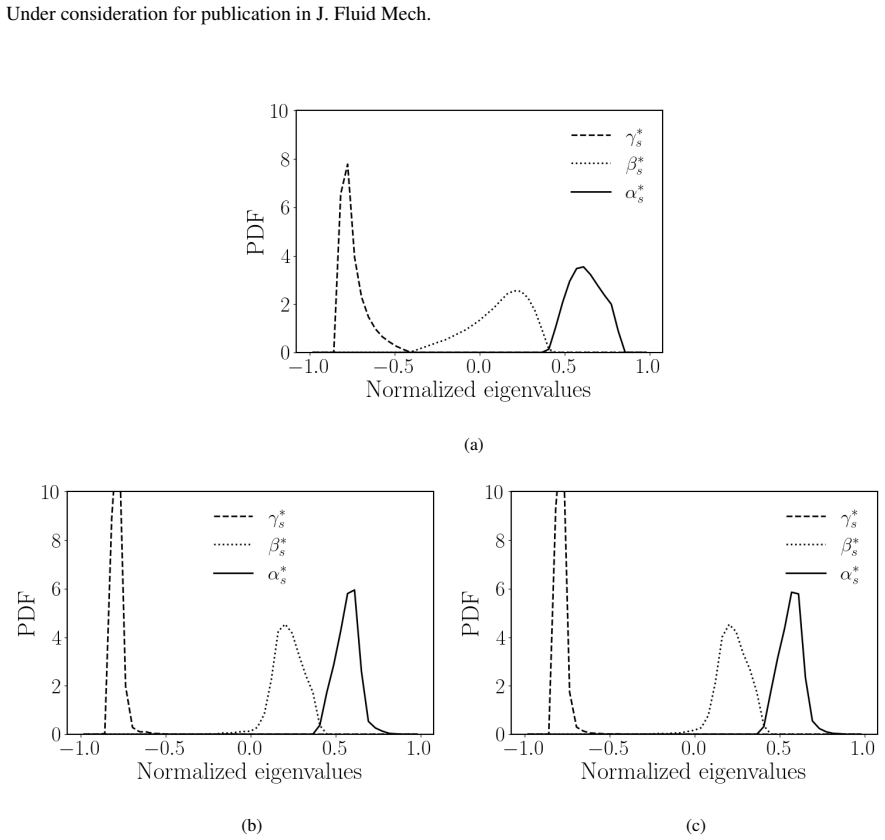
- At high turbulent Mach numbers, the model predicts the antisymmetric part of the thermodynamic gradient field more accurately than the prior model, indicating better representation of shock-dominated flow regions.
- The modular hybrid structure suggests that separate neural closures can be targeted at distinct physical mechanisms within a single dynamical system, improving interpretability and robustness.
Reading between the lines
- If the eight-basis representation is indeed complete for asymmetric nonzero-trace tensors, the same bases could be applied to other asymmetric closure problems where only a symmetric and an antisymmetric input tensor are available.
- The model's success at Mt=1.2 despite training on data at or below Mt=1.0 suggests the invariant-based map may generalize across Mach numbers; a direct test would be to train at Mt=1.2 and check whether the improvement at Mt=1.2 grows.
- The paper deliberately omits the antisymmetric component of vibrational non-equilibrium mechanisms; extending the framework to include it, especially at higher Mach numbers or stronger non-equilibrium, is a natural next step the authors leave for future work.
- A concrete testable extension would be evaluating the H-EHEE model against DNS at Mach numbers above 1.2 or at significantly different Reynolds numbers to explore the extrapolation limits of the neural closures.
Editorial analysis
A structured set of objections, weighed in public.
Referee Report
Summary. The paper proposes a closed ODE system, denoted H-EHEE, for the Lagrangian evolution of the velocity-gradient tensor in compressible turbulence with vibrational non-equilibrium. The model extends the N-EHEE framework by splitting the thermodynamic gradient field into its symmetric pressure-Hessian part H and asymmetric baroclinic part B, and by supplying closures for (i) the vibrational non-equilibrium contribution to the H-evolution equation and (ii) the inviscid baroclinic-generation mechanism V_ij in the B-evolution equation. The latter closure, called IBBM, uses a tensor-basis neural network with a newly claimed complete set of eight asymmetric tensor bases built from a symmetric and an antisymmetric input tensor. The former closure, IBVM, is taken from the authors' previous work and embedded dynamically via an auxiliary non-equilibrium index xi_m. The complete system (71)-(77) is a 34-ODE set. The authors evaluate the model in the incompressible limit, at intermediate Mach numbers with and without vibrational non-equilibrium, and at Mt=1.2, reporting improved agreement with DNS for the antisymmetric part of the TGF tensor compared with N-EHEE.
Significance. If the central claims hold, this would be one of the first fully dynamical velocity-gradient models in which neural-network closures are integrated into the evolution equations rather than evaluated a priori. The modular decomposition of the closure problem — separate networks for the baroclinic mechanism and for vibrational non-equilibrium — is methodologically appealing, and the explicit recovery of the incompressible limit in Section 9.1 is a useful sanity check. The claimed extension of tensor-basis neural networks to asymmetric, nonzero-trace second-order tensors would also be a methodological contribution beyond this specific application. However, the demonstrated evaluation is currently weaker than the abstract suggests: the a-priori test of IBBM is performed on the same DNS case and snapshot used for training, the independent C2/C3 validation is asserted but not displayed, and the vibrational closure does not vanish at local equilibrium for non-equilibrium initial conditions. These issues affect load-bearing parts of the paper, but they are fixable with additional derivations and experiments.
major comments (4)
- [§6.2.1, Eqs. (47)/(60)] The completeness of the eight-term tensor basis is asserted, not shown. The paper cites Spencer & Rivlin (1958) and states that all products with total degree <=5 and extension <=3 were considered and non-symmetric, nonzero-trace elements retained, but it does not reproduce the reduction or demonstrate that these eight generators span the full module of asymmetric tensor polynomials in a symmetric M and antisymmetric N. Without this proof, the TBNN output (63) may be confined to a proper subspace, which would make the B-evolution equation (70) structurally deficient regardless of good a-priori statistics. Please give either a self-contained derivation using the Cayley-Hamilton theorem and the Spencer-Rivlin generator list, or an explicit theorem stating exactly which generators are discarded and why.
- [§6.4 and §6.2] The a-priori evaluation of IBBM is not independent. Training and validation samples are randomly drawn from a fixed time snapshot of case C1, and the a-priori evaluation in Section 6.4 also uses case C1 at the same flow condition, only at different spatial points. This is an in-distribution test and cannot support the claimed universality across C1-C3. The text says C2 and C3 results are similar and therefore omitted; for a validation claim they should be shown, at least in supplementary material. This is a central gap because the paper advertises C2 and C3 as independent test platforms.
- [§5, Eq. (36)] The vibrational closure does not relax to equilibrium unless the initial state is already equilibrium. For xi_m0=0.5, the prefactor (1-xi_m0)/(1+xi_m) tends to 0.25 when xi_m->1, so M_vib remains non-zero in the local vibrational-equilibrium limit xi_m=1. This contradicts Eq. (34) and the Landau-Teller motivation, and it affects the vibrational non-equilibrium results in Section 9.2.2. The prefactor should depend on xi_m-1, or otherwise vanish at xi_m=1, and the model should be recalibrated accordingly.
- [§9.3 and §8.1] The headline high-Mach-number result is based on one DNS dataset at Mt=1.2, which is outside the training range Mt<=1.0, and the model-to-DNS parameter mapping (Mm to Mt, Rem to Re_lambda) is only qualitative. More evidence is needed that the improvement in the Theta_ij PDFs is robust: for example, sensitivity of the results to the mapping, comparison with DNS at Mt=1.0, or inclusion of the promised C2/C3 a-priori results. As written, the central claim of 'significant improvement at Mt=1.2' rests on a single extrapolated comparison.
minor comments (5)
- [Table 1] The table entries are difficult to parse: 'C1 1 250512 3' and 'C3 1 60256 3' appear to concatenate Mt, Re_lambda, N and N^3. Please format clearly.
- [§8, Eq. (85)] Notation is inconsistent: the text uses tau_v in some places and tau_nu in Eq. (77); the non-dimensional parameter D_m is written in a confusing way. Please unify.
- [§5, Eq. (37)] The evolution equation for xi_m is a pure relaxation law with a single timescale tau_vib; its connection to the local thermodynamic state used by IBVM inputs is not explained. Clarify whether xi_m is a surrogate for the ratio of vibrational to translational energy and how Eq. (37) is initialized consistently with the DNS cases.
- [§9.2.2] The model Damkohler numbers D_m in Table 2 (2, 4, 8) are not compared quantitatively with the DNS Damkohler numbers D (0.25-4). A statement of the mapping, or at least a sensitivity discussion, is needed to interpret the comparison.
- [Appendix/References] The paper would benefit from a data/code availability statement. Also, 'and and' typo in Section 1 and several 'the the' instances should be corrected.
Circularity Check
Partial circularity: the IBBM a-priori validation is a training-fit re-description on the same C1 snapshot, the incompressible-limit check is engineered into the invariants, and the vibrational closure is a self-cited model validated with Dm values chosen to show the DNS trend; the Mt=1.2 dynamical improvement is, however, an independent extrapolation against external DNS.
-
fitted input called prediction
[§6.2.2 (training) and §6.4 (a-priori evaluation)]
"Both training and validation sets are randomly sampled from a fixed time snapshot of the DNS simulation case C1 ... The IBBM model is trained using DNS data from simulation C1 (Mt = 1.0). Therefore, at this stage, we evaluate the model within the same flow configuration but at spatial locations different from those used in the training and validation of the neural networks."
The a-priori evaluation compares PDFs of cosΞ, cosθ, cosη, cosϕ and Ψ, which are exactly the targets minimized by the loss functions J1 (64) and J2 (67). The evaluation uses 3,000,000 points from the same C1 snapshot from which the training/validation points were randomly sampled; random sampling from one fixed snapshot does not produce an independent test set. The reported agreement is therefore a re-description of the fitted function, not an independent prediction.
-
self definitional
[§6.2.1 (invariants, Eq. 62) and §9.1 (incompressible limit)]
"In incompressible flow regions, aii = 0, ˆH′ii = 0 and δ = 0, which consequently brings all invariants to zero, leads to bς→0 which in turns leads to Bij→0. ... The recovery of N-EHEE-like behavior indicates that, within the H-EHEE framework, the B tensor is effectively suppressed."
The vanishing of the IBBM closure in the incompressible limit is explicitly engineered into the model: the invariants λ1, λ3, λ4, λ5, λ6 are constructed to contain Tr(a) and δ, so every invariant is forced to zero when aii = δ = 0, making bς and hence Bij vanish by construction. Section 9.1 then presents this built-in property as a successful validation. The check is self-definitional rather than an emergent prediction.
1 more flagged steps
-
self citation load bearing
[§5 (M^vib closure) and §9.2.2 (vibrational non-equilibrium evaluation)]
"The reader is referred to the original paper by Shikha et al. [2024] for further details of the tensor bases and invariants employed in this model. ... Because an explicit quantitative relationship between the DNS-based Damköhler number (D) and the model parameter (Dm) cannot be established, we select values of Dm such that the trend of the influence of varying Dm is clearly observable."
The vibrational closure in the H-EHEE model is imported from the authors' prior paper without independent derivation or verification here. The dynamical validation is qualitative: Dm values (2, 4, 8) are chosen specifically to make the DNS trend observable, and no mapping between Dm and the DNS Damköhler number D is given. The reported agreement with vibrational DNS therefore reduces to a self-cited fitted closure plus a parameter selection that guarantees the qualitative trend, rather than a parameter-free prediction.
full rationale
The paper's headline Mt=1.2 improvement over N-EHEE is supported by a genuine external benchmark (Kumar et al. 2013 DNS), and the H-EHEE system is integrated dynamically so the tensor inputs evolve from the model rather than being read from DNS; this keeps the central claim partially independent and prevents a high circularity score. However, the visible a-priori IBBM evaluation is circular: the network is trained and tested on random samples from the same fixed C1 snapshot, and the reported PDFs are the same quantities minimized in the loss. The incompressible-limit recovery is also built into the invariant design, so presenting it as a successful model check is self-definitional. The vibrational component relies on a self-cited prior neural closure, and the comparison with DNS uses model Damköhler numbers deliberately selected to exhibit the trend, making that part of the validation weaker than claimed. The asserted completeness of the eight tensor bases via Spencer and Rivlin is an unverified external citation/omitted derivation; that is a correctness risk rather than a circularity, so it is not counted as a circular step. Overall, the circular and self-cited elements are substantial but not total, yielding a score of 5.
Assumptions & free parameters
free parameters (5)
- τp (pressure relaxation time) =
not given; set implicitly via Prandtl number and model Reynolds number
- τv (viscous relaxation time) =
not given; set via desired Rem
- Initial L0 (characteristic length scale) =
set to unity
- ξm0 (initial model non-equilibrium index) =
1.0 or 0.5 in different cases
- Neural-network hyperparameters (batch size, learning rate, epochs) =
e.g., 1e5 and 1e-2 for TBNN; 5e4 and 1e-3 for magnitude network; 650/150 epochs
assumptions (4)
- standard math Cayley-Hamilton theorem and Spencer-Rivlin polynomial representation apply to the asymmetric trace-nonzero tensor ς
- domain assumption The V mechanism is the only inviscid contributor to baroclinic-tensor generation, and other mechanisms (e.g., VII, viscous heating) are neglected
- domain assumption The H-tensor closure from N-EHEE remains valid in the new framework
- ad hoc to paper The invented ξm state evolves according to the Landau-Teller form (37), and the closure (36) correctly scales vibrational non-equilibrium
invented entities (1)
-
ξm (model vibrational non-equilibrium index)
Cite this review
Pith. "Pith review of A physics-assisted deep neural network-based closure framework for velocity gradient dynamics in compressible flows with vibrational non-equilibrium." pith.science (2026). https://pith.science/paper/WSMQIKDF
@misc{pith2026260721152,
  author       = {Pith},
  title        = {Pith review of: A physics-assisted deep neural network-based closure framework for velocity gradient dynamics in compressible flows with vibrational non-equilibrium},
  year         = {2026},
  howpublished = {\url{https://pith.science/paper/WSMQIKDF}},
  note         = {Machine review of arXiv:2607.21152}
}
abstract
In this study, we propose a dynamical model for the evolution of velocity gradients in compressible turbulent flows with vibrational non-equilibrium effects, using physics-assisted deep neural networks. Such models provide a powerful framework for understanding the nonlinear physics associated with small-scale structures. In compressible flows, the influence of thermodynamic fields on velocity-gradient dynamics is represented through thermodynamic gradient field (TGF) tensor. The TGF tensor is one of the primary unclosed terms in velocity-gradient evolution equations. The TGF tensor comprises contributions from the pressure-Hessian tensor, $\rho\boldsymbol{H}$, and the baroclinic tensor, $\boldsymbol{B}$. Accordingly, the proposed framework incorporates closures for both $\boldsymbol{H}$ and $\boldsymbol{B}$ tensor dynamics. Building upon existing phenomenological closures for the $\boldsymbol{H}$ tensor governing mechanisms, we develop a neural-network-based closure for the inviscid mechanism responsible for generating the $\boldsymbol{B}$ tensor. Unlike the other recently used tensor bases, the presented work employs a novel tensor basis allowing for the inclusion of non-symmetric features in the model. The framework also incorporates a data-driven closure for vibrational non-equilibrium effects.The resulting framework combines phenomenological and data-driven representations of various $\boldsymbol{H}$ and $\boldsymbol{B}$ tensors governing mechanisms, termed as the \textit{hybrid enhanced homogenized Euler equation} (H-EHEE) model. Model predictions are evaluated across a range of turbulent Mach numbers and compared against direct numerical simulation (DNS) data and existing compressible velocity-gradient models. The H-EHEE model exhibits close agreement with DNS statistics and provides significant improvements over existing models, particularly in highly compressible flow regimes.
Figures


Figures from the paper (19 more)




Reference graph
Works this paper leans on
-
[1]
Annual Review of Fluid Mechanics , volume=
Lagrangian dynamics and models of the velocity gradient tensor in turbulent flows , author=. Annual Review of Fluid Mechanics , volume=. 2011 , publisher=
2011
-
[2]
Journal of Fluid Mechanics , volume=
Dynamical model for velocity-gradient evolution in compressible turbulence , author=. Journal of Fluid Mechanics , volume=. 2011 , publisher=
2011
-
[3]
Physical Review Letters , volume=
Origin of non-Gaussian statistics in hydrodynamic turbulence , author=. Physical Review Letters , volume=. 2005 , publisher=
2005
-
[4]
Journal of Fluid Mechanics , volume=
Intermittency trends and Lagrangian evolution of non-Gaussian statistics in turbulent flow and scalar transport , author=. Journal of Fluid Mechanics , volume=. 2006 , publisher=
2006
-
[5]
Physics of Fluids , volume=
A numerical study of the mixing of a passive scalar in three dimensions in the presence of a mean gradient , author=. Physics of Fluids , volume=. 1994 , publisher=
1994
-
[6]
Fluid Dynamics Research , volume=
The relationship between the topological structures in turbulent flow and the distribution of a passive scalar with an imposed mean gradient , author=. Fluid Dynamics Research , volume=. 2005 , publisher=
2005
-
[7]
Physical Review E , volume=
Influence of compressibility on the Lagrangian statistics of vorticity--strain-rate interactions , author=. Physical Review E , volume=. 2016 , publisher=
2016
-
[8]
Proceedings of the Royal Society of London
The effect of homogeneous turbulence on material lines and surfaces , author=. Proceedings of the Royal Society of London. Series A. Mathematical and Physical Sciences , volume=. 1952 , publisher=
1952
Show all 72 references
-
[9]
Journal of Fluid Mechanics , volume=
Material-element deformation in isotropic turbulence , author=. Journal of Fluid Mechanics , volume=. 1990 , publisher=
1990
-
[10]
Journal of Fluid Mechanics , volume=
Lagrangian investigations of velocity gradients in compressible turbulence: lifetime of flow-field topologies , author=. Journal of Fluid Mechanics , volume=. 2019 , publisher=
2019
-
[11]
Physics of Fluids , volume=
A direct numerical simulation-based investigation and modeling of pressure Hessian effects on compressible velocity gradient dynamics , author=. Physics of Fluids , volume=. 2014 , publisher=
2014
-
[12]
Nature Physics , volume=
The pirouette effect in turbulent flows , author=. Nature Physics , volume=. 2011 , publisher=
2011
-
[13]
Journal de Physique , volume=
Local interaction between vorticity and shear in a perfect incompressible fluid , author=. Journal de Physique , volume=. 1982 , publisher=
1982
-
[14]
Physics of Fluids A: Fluid Dynamics , volume=
Exact solution of a restricted Euler equation for the velocity gradient tensor , author=. Physics of Fluids A: Fluid Dynamics , volume=. 1992 , publisher=
1992
-
[15]
Physics of Fluids , volume=
The inverse diffusion time scale of velocity gradients in homogeneous isotropic turbulence , author=. Physics of Fluids , volume=. 1997 , publisher=
1997
-
[16]
Theoretical and Computational Fluid Dynamics , volume=
Velocity-gradient dynamics in turbulence: effect of viscosity and forcing , author=. Theoretical and Computational Fluid Dynamics , volume=. 2003 , publisher=
2003
-
[17]
Physical Review Letters , volume=
Lagrangian dynamics and statistical geometric structure of turbulence , author=. Physical Review Letters , volume=. 2006 , publisher=
2006
-
[18]
Physics of Fluids , volume=
Modeling the pressure Hessian and viscous Laplacian in turbulence: comparisons with direct numerical simulation and implications on velocity gradient dynamics , author=. Physics of Fluids , volume=. 2008 , publisher=
2008
-
[19]
Journal of Fluid Mechanics , volume=
Homogenized Euler equation: a model for compressible velocity gradient dynamics , author=. Journal of Fluid Mechanics , volume=. 2009 , publisher=
2009
-
[20]
Progress in Energy and Combustion Science , volume=
PDF methods for turbulent reactive flows , author=. Progress in Energy and Combustion Science , volume=. 1985 , publisher=
1985
-
[21]
Journal of Fluid Mechanics , volume=
Reynolds averaged turbulence modelling using deep neural networks with embedded invariance , author=. Journal of Fluid Mechanics , volume=. 2016 , publisher=
2016
-
[22]
Physics of Fluids A: Fluid Dynamics , volume=
A general classification of three-dimensional flow fields , author=. Physics of Fluids A: Fluid Dynamics , volume=. 1990 , publisher=
1990
-
[23]
Physical Review Fluids , volume=
Modeling the pressure-Hessian tensor using deep neural networks , author=. Physical Review Fluids , volume=. 2020 , publisher=
2020
-
[24]
Journal of Fluid Mechanics , volume=
A more general effective-viscosity hypothesis , author=. Journal of Fluid Mechanics , volume=. 1975 , publisher=
1975
-
[25]
Journal of Fluid Mechanics , volume=
Lagrangian statistics from direct numerical simulations of isotropic turbulence , author=. Journal of Fluid Mechanics , volume=. 1989 , publisher=
1989
-
[26]
Physics of Fluids A: Fluid Dynamics , volume=
Eigenvalue problems in three-dimensional Euler flows , author=. Physics of Fluids A: Fluid Dynamics , volume=. 1993 , publisher=
1993
-
[27]
Physics of fluids , volume=
Alignment of vorticity and scalar gradient with strain rate in simulated Navier--Stokes turbulence , author=. Physics of fluids , volume=. 1987 , publisher=
1987
-
[28]
Physics of Fluids , volume=
Nonlocal nature of vortex stretching in an inviscid fluid , author=. Physics of Fluids , volume=. 1995 , publisher=
1995
-
[29]
arXiv preprint arXiv:1905.11075 , year=
Machine learning for fluid mechanics , author=. arXiv preprint arXiv:1905.11075 , year=
1905 arXiv
-
[30]
Physical Review Fluids , volume=
Physics-informed machine learning of the Lagrangian dynamics of velocity gradient tensor , author=. Physical Review Fluids , volume=. 2021 , publisher=
2021
-
[31]
Journal of Fluid Mechanics , volume=
Subgrid modelling for two-dimensional turbulence using neural networks , author=. Journal of Fluid Mechanics , volume=. 2019 , publisher=
2019
-
[32]
Proceedings of the 2007 ACM/IEEE Conference on Supercomputing , pages=
Data exploration of turbulence simulations using a database cluster , author=. Proceedings of the 2007 ACM/IEEE Conference on Supercomputing , pages=
2007
-
[33]
Journal of Turbulence , volume=
A public turbulence database cluster and applications to study Lagrangian evolution of velocity increments in turbulence , author=. Journal of Turbulence , volume=. 2008 , publisher=
2008
-
[34]
Journal of Turbulence , volume=
A web services accessible database of turbulent channel flow and its use for testing a new integral wall model for LES , author=. Journal of Turbulence , volume=. 2016 , publisher=
2016
-
[35]
Science , volume=
The turbulent cascade in five dimensions , author=. Science , volume=. 2017 , publisher=
2017
-
[36]
Physica D: Nonlinear Phenomena , volume=
Recent fluid deformation closure for velocity gradient tensor dynamics in turbulence: timescale effects and expansions , author=. Physica D: Nonlinear Phenomena , volume=. 2010 , publisher=
2010
-
[37]
2016 , publisher=
Deep learning , author=. 2016 , publisher=
2016
-
[38]
2000 , pages=
Turbulent flows , author=. 2000 , pages=
2000
-
[39]
Physical Review E , volume=
Statistics of pressure fluctuations in decaying isotropic turbulence , author=. Physical Review E , volume=. 2006 , publisher=
2006
-
[40]
Journal of Turbulence , volume=
Velocity gradient invariants and local flow-field topology in compressible turbulence , author=. Journal of Turbulence , volume=. 2010 , publisher=
2010
-
[41]
1995 , publisher=
Elementary theory of angular momentum , author=. 1995 , publisher=
1995
-
[42]
Physics of Fluids , volume=
Velocity gradient dynamics in compressible turbulence: Characterization of pressure-Hessian tensor , author=. Physics of Fluids , volume=. 2013 , publisher=
2013
-
[43]
Journal of Computational Physics , volume=
Machine learning strategies for systems with invariance properties , author=. Journal of Computational Physics , volume=. 2016 , publisher=
2016
-
[44]
The Journal of Machine Learning Research , volume=
Dropout: a simple way to prevent neural networks from overfitting , author=. The Journal of Machine Learning Research , volume=. 2014 , publisher=
2014
-
[45]
Journal of Computational Physics , volume=
WENO-enhanced gas-kinetic scheme for direct simulations of compressible transition and turbulence , author=. Journal of Computational Physics , volume=. 2013 , publisher=
2013
-
[46]
Advances in Neural Information Processing Systems , volume=
Practical bayesian optimization of machine learning algorithms , author=. Advances in Neural Information Processing Systems , volume=
-
[47]
Physics of Fluids , volume=
A study of the fine-scale motions of incompressible time-developing mixing layers , author=. Physics of Fluids , volume=. 1994 , publisher=
1994
-
[48]
Physics of Fluids , volume=
On the local topology evolution of a high-symmetry flow , author=. Physics of Fluids , volume=. 1995 , publisher=
1995
-
[49]
Experimental Thermal and Fluid Science , volume=
Study of turbulent boundary layer structure using the invariants of the velocity gradient tensor , author=. Experimental Thermal and Fluid Science , volume=. 1996 , publisher=
1996
-
[50]
Journal of Fluid Mechanics , volume=
Topology of fine-scale motions in turbulent channel flow , author=. Journal of Fluid Mechanics , volume=. 1996 , publisher=
1996
-
[51]
Annual Review of Fluid Mechanics , volume=
Turbulence modeling in the age of data , author=. Annual Review of Fluid Mechanics , volume=. 2019 , publisher=
2019
-
[52]
Journal of Computational Physics , volume=
NSFnets (Navier-Stokes flow nets): Physics-informed neural networks for the incompressible Navier-Stokes equations , author=. Journal of Computational Physics , volume=. 2021 , publisher=
2021
-
[53]
Physics Reports , volume=
Turbulence theories and statistical closure approaches , author=. Physics Reports , volume=. 2021 , publisher=
2021
-
[54]
Physics of Life Reviews , volume=
The multidimensional brain , author=. Physics of Life Reviews , volume=. 2019 , publisher=
2019
-
[55]
Physics of Fluids , volume=
Deep learning methods for super-resolution reconstruction of turbulent flows , author=. Physics of Fluids , volume=. 2020 , publisher=
2020
-
[56]
Physics of Fluids , volume=
Modeling of vibrational nonequilibrium effects on pressure Hessian tensor using physics-assisted deep neural networks , author=. Physics of Fluids , volume=. 2024 , publisher=
2024
-
[57]
Physics of Fluids , volume=
An augmented invariant-based model of the pressure Hessian tensor using a combination of physics-assisted neural networks , author=. Physics of Fluids , volume=. 2023 , publisher=
2023
-
[58]
Physics of Fluids , volume=
Direct numerical simulation of decaying compressible turbulence and shocklet statistics , author=. Physics of Fluids , volume=. 2001 , publisher=
2001
-
[59]
Physics of Fluids , volume=
Data-driven turbulence modeling for fluid flow and heat transfer in peripheral subchannels of a rod bundle , author=. Physics of Fluids , volume=. 2024 , publisher=
2024
-
[60]
Journal of Fluid Mechanics , volume=
The analysis and modelling of dilatational terms in compressible turbulence , author=. Journal of Fluid Mechanics , volume=. 1991 , publisher=
1991
-
[61]
Theoretical and Computational Fluid Dynamics , volume=
Direct simulation of compressible turbulence in a shear flow , author=. Theoretical and Computational Fluid Dynamics , volume=. 1991 , publisher=
1991
-
[62]
Journal of Fluid Mechanics , volume=
Direct numerical simulation of a hypersonic transitional boundary layer at suborbital enthalpies , author=. Journal of Fluid Mechanics , volume=. 2021 , publisher=
2021
-
[63]
AIAA Journal , volume=
Direct Numerical Simulation of Nonequilibrium Effects on Decaying Isotropic Turbulence , author=. AIAA Journal , volume=. 2024 , publisher=
2024
-
[64]
Archive for rational mechanics and analysis , volume=
The theory of matrix polynomials and its application to the mechanics of isotropic continua , author=. Archive for rational mechanics and analysis , volume=. 1958 , publisher=
1958
-
[65]
Journal of Fluid Mechanics , volume=
On the Reynolds number dependence of velocity-gradient structure and dynamics , author=. Journal of Fluid Mechanics , volume=. 2019 , publisher=
2019
-
[66]
Journal of Fluid Mechanics , volume=
Influence of vibrational non-equilibrium on the dynamics of velocity gradients in compressible flows , author=. Journal of Fluid Mechanics , volume=. 2024 , publisher=
2024
-
[67]
1966 , publisher=
Introduction to physical gas dynamics , author=. 1966 , publisher=
1966
-
[68]
Journal of Fluid Mechanics , volume=
Compressibility effects on the growth and structure of homogeneous turbulent shear flow , author=. Journal of Fluid Mechanics , volume=. 1993 , publisher=
1993
-
[69]
Physics of Fluids , volume=
Decaying compressible turbulence with thermal non-equilibrium , author=. Physics of Fluids , volume=. 2019 , publisher=
2019
-
[70]
Physics of Fluids A: Fluid Dynamics , volume=
Eddy shocklets in decaying compressible turbulence , author=. Physics of Fluids A: Fluid Dynamics , volume=. 1991 , publisher=
1991
-
[71]
Physical Review Fluids , volume=
Two neural network Unet architecture for subfilter stress modeling , author=. Physical Review Fluids , volume=. 2025 , publisher=
2025
-
[72]
Annual Review of Fluid Mechanics , volume=
Multiscale velocity gradients in turbulence , author=. Annual Review of Fluid Mechanics , volume=. 2024 , publisher=
2024
Reviewed August 1, 2026 · model on record in the stance chip above.
Discussion (0). Continue with ORCID to comment.