REVIEW 3 major objections 2 minor 61 references
Functional QCD computes the pion distribution amplitude, finding its second moment to be 0.267.
Reviewed by Pith at T0; open to challenge. T0 means a machine referee read the full paper against a public rubric. the ladder, T0–T4 →
T0 review · deepseek-v4-flash
2026-08-02 08:32 UTC pith:WUWLD2VM
load-bearing objection The first fRG LaMET computation of the pion DA, with genuine internal convergence checks; the quoted 0.267 is plausible but the no-matching argument in S.4 is asserted, so I'd ask for major revision, not rejection. the 3 major comments →
Pion Distribution Amplitudes from Functional QCD
The pith
A machine-rendered reading of the paper's core claim, the machinery that carries it, and where it could break.
Core claim
The authors show that the pion quasi-DA, constructed from fRG-computed quark propagators and the pion Bethe-Salpeter amplitude, becomes independent of P_z for P_z ≳ 3.5 GeV, allowing a controlled 1/P_z² extrapolation to the light cone. The resulting light-front DA is broad, concave, and unimodal, with no double-humped structure, and its second, fourth, and sixth moments are 0.267, 0.139, and 0.088, respectively. They interpret the smaller second moment compared with lattice LaMET as evidence that their higher P_z access incorporates more complete QCD dynamics, specifically the effect of dynamical chiral symmetry breaking, which produces a narrower DA.
What carries the argument
The computation rests on three pieces: (i) the quasi-LFWF defined in Eq. (7), built from the unamputated Bethe-Salpeter amplitude (quark propagators times the BS amplitude extracted from the four-quark vertex dressing's pole residue); (ii) a deformed integration contour in p0 plus a fourth-order Taylor expansion of the quark mass, wave function, and BS amplitude in the complex plane, which extends the accessible P_z to 4.5 GeV; and (iii) the LaMET extrapolation of Eq. (71), which assumes only 1/P_z² higher-twist corrections with no perturbative matching kernel, justified by the ultraviolet finiteness of the quasi-DA integral and the cancellation of scheme factors upon normalization.
Load-bearing premise
The quasi-DA computed from Landau-gauge correlation functions without a Wilson line is assumed to be the LaMET quasi-DA up to higher-twist corrections, so its P_z→∞ extrapolation equals the light-cone DA; if this identification fails, 0.267 is not the physical second moment.
What would settle it
Compute the same quasi-DA in a different gauge, or with an explicit Wilson line, using the same fRG inputs and check whether the P_z→∞ extrapolated ⟨ξ²⟩_π stays at 0.267. Alternatively, a lattice LaMET simulation reaching P_z = 4.5 GeV would directly test saturation and the moment value.
If this is right
- Predictions for exclusive pion processes, such as the pion-photon transition form factor and the pion electromagnetic form factor, will shift toward the narrower-DA outcomes.
- The observed saturation of the quasi-DA by P_z ≈ 3.5 GeV implies that the lattice-LaMET discrepancy stems from insufficiently large P_z rather than from higher-twist contamination.
- The same functional-QCD machinery can be applied without phenomenological parameters to other mesons and, potentially, to baryon parton distributions.
- The matching relation without a perturbative kernel is a specific, testable prediction: the P_z dependence of the quasi-DA should be fully captured by 1/P_z² terms in this framework.
Where Pith is reading between the lines
- If the equality between the fRG quasi-DA and the LaMET quasi-DA holds, the same contour-deformation and Taylor-expansion technique could be adapted to quasi-PDFs, where the Wilson line is more involved; the Wilson-line-free construction used here is either a simplification or an untested assumption.
- The gauge dependence of the result is untested. A repeat of the quasi-DA computation in a different gauge, or with an explicit Wilson line, would either confirm or falsify the 0.267 value.
- The fourth-order truncation in p0 sets the P_z ceiling at 4.5 GeV; testing with fifth-order expansions or Padé approximations would reveal whether the observed plateau is an artifact of that truncation.
- The endpoint extrapolation uses the phenomenological form x^a(1-x)^b; although the paper reports insensitivity of ⟨ξ²⟩_π, the higher moments (e.g., ⟨ξ⁶⟩) may be more sensitive, so a model-independent endpoint treatment would be a stronger test.
Editorial analysis
A structured set of objections, weighed in public.
Referee Report
Summary. The paper presents the first functional QCD calculation of the pion distribution amplitude (PDA) using large-momentum effective theory (LaMET) within the functional renormalisation group (fRG). Starting from 2+1-flavour fRG correlation functions, the authors construct a quasi-light-front wave function/DA (Eqs. 7-8), extend the computation to P_z=4.5 GeV using a deformed integration contour and Taylor expansions in p0, and extrapolate to the light cone with only a 1/P_z^2 correction (Eq. 71). The resulting light-cone DA is broad and unimodal, with <ξ²>_π=0.267, which they compare with lattice LaMET, lattice OPE, sum rules, and DSE results.
Significance. If the Wilson-line-free quasi-DA is a valid LaMET object, the result is significant: it is the first functional calculation of a parton distribution in this framework, reaches twice the P_z of current lattice calculations, and the extracted moment is consistent with DSE/sum rules rather than lattice LaMET. The underlying fRG correlation functions are benchmarked against lattice data (Figs. 3, 7, 9), and the paper contains useful convergence checks (Taylor-order dependence, 1/P_z^2 linearity, endpoint-fit insensitivity). The result is not circular: the inputs m_l, m_s, α_s are tuned to meson masses and fπ, not to the PDA. However, the central comparison and the physical interpretation of 0.267 depend on the unproven matching relation, and no uncertainty is assigned.
major comments (3)
- [S.4, Eq. (71)] The central identification of the Wilson-line-free quasi-DA is asserted, not demonstrated. Eq. (55) is built from Landau-gauge fRG correlation functions with no Wilson line, whereas the standard LaMET quasi-DA is defined through a nonlocal operator with a Wilson line and requires a perturbative matching kernel. The two arguments in S.4 — UV finiteness of the integral and cancellation of multiplicative scheme factors after normalization — do not imply that the finite large-P_z physics equals the light-cone DA up to 1/P_z^2. Gauge dependence is not discussed. As this identification is the only route from Eq. (55) to <ξ²>=0.267, the quoted moment cannot be taken as the physical second moment until the matching relation is either derived or numerically validated against a standard quasi-DA.
- [Abstract and Table I] The headline value <ξ²>=0.267 is given without any uncertainty. The statement in the abstract that extrapolation errors are 'negligible' is not backed by an error budget. Sources to be propagated include the Taylor-order truncation (Fig. 10), the 1/P_z^2 fit (Fig. 11), the endpoint fit (Table II), and the fRG truncation of [3]. Without an error, the claim that this is 'significantly smaller' than the lattice-LaMET value 0.300(41) is not supported: the difference is 0.033 compared to a quoted lattice error of 0.041. A quantitative comparison is required.
- [S.3, Eq. (67)] The extension to P_z=4.5 GeV rests entirely on the fourth-order Taylor expansion of the quark mass function, wave function, and BS amplitude in the complex p0 plane (Eqs. 67-68). The only validation reported is agreement between second- and fourth-order results (Fig. 10); the zeroth-order result deviates sizably. This is not a substitute for a direct check of the analytic continuation (e.g., through Padé approximants or a direct contour computation at selected kinematics). A quantitative estimate of the truncation error is needed because the saturation plateau, and hence the extrapolation (71), is observed only after this expansion.
minor comments (2)
- [Fig. 6] The caption says 'PDA obtained with only the extrapolation of P_z→∞' and 'PDA with both extrapolations...', but the legend uses φπ(x, Pz) for the quasi-PDA and φπ(x) for the PDA. Please unify the notation to avoid confusion between quasi-DA and light-cone DA.
- [Eq. (55)] The function hπ(p,cosθ) appears in the integrand before the momentum arguments are defined; Eq. (57) and the preceding line introduce p and cosθ only later. Consider moving these definitions before Eq. (55) for readability.
Circularity Check
No significant circularity: the reported ⟨ξ²⟩_π = 0.267 is a genuine output; heavy self-citation is offset by external benchmarks.
full rationale
The central derivation chain is not circular. The authors fix only the strong coupling and current quark masses to the physical ratios m_π/f_π and m_K/f_π (Eqs. 51–52), and the pion quark mass function, gluon dressing, and Bethe–Salpeter inputs are benchmarked against independent lattice results (Figs. 3, 7, 9). The quasi-DA in Eq. (55) is built from the quark propagator and pion BS amplitude, and the light-cone DA is obtained by the P_z → ∞ extrapolation of Eq. (71); no equation defines ⟨ξ²⟩_π through the fitted inputs, and the quoted second moment is not imposed by any fit. The heavy reliance on the authors' earlier fRG framework [1–3,53,54] is a legitimate use of prior work that has been externally tested, so it does not become circular under the standards of this review. The S.4 assertion that no perturbative matching kernel is needed in the functional quasi-DA framework is an important, load-bearing assumption and a genuine correctness risk, but it is an unproven physical approximation rather than a circular reduction: it does not make Eq. (71) equivalent to the target result by construction. Endpoint extrapolation uses a phenomenological fitting form (Eq. 73), but the paper shows the resulting ⟨ξ²⟩_π is insensitive to the endpoint fit window, so this also does not force the central number. Overall, the analysis is self-contained against external benchmarks and contains no demonstrated circular step.
Axiom & Free-Parameter Ledger
free parameters (5)
- light current quark mass m_l =
2.1 MeV
- strange current quark mass m_s =
55.9 MeV
- UV strong coupling α_{s,Λ} =
0.179 at Λ = 35.7 GeV
- endpoint shape parameters a, b, c =
x_EP=0.05: (0.047, -5.694, 0.500); x_EP=0.1: (0.113, -3.547, 0.680); x_EP=0.15: (0.184, -2.040, 0.921)
- c₂(x), the 1/P_z² extrapolation coefficient =
≈ 0.2-0.3 GeV²
axioms (5)
- domain assumption The fRG truncation of [3] — three sectors, symmetric-point vertex approximations, Fierz-complete four-quark basis restricted to {σ, π, κ, K} channels, α_{A3} = α_{A4}, gauge-consistent AA¯qq approximation (Eq. 39) — captures the QCD dynamics relevant for DCSB and the pion bound state.
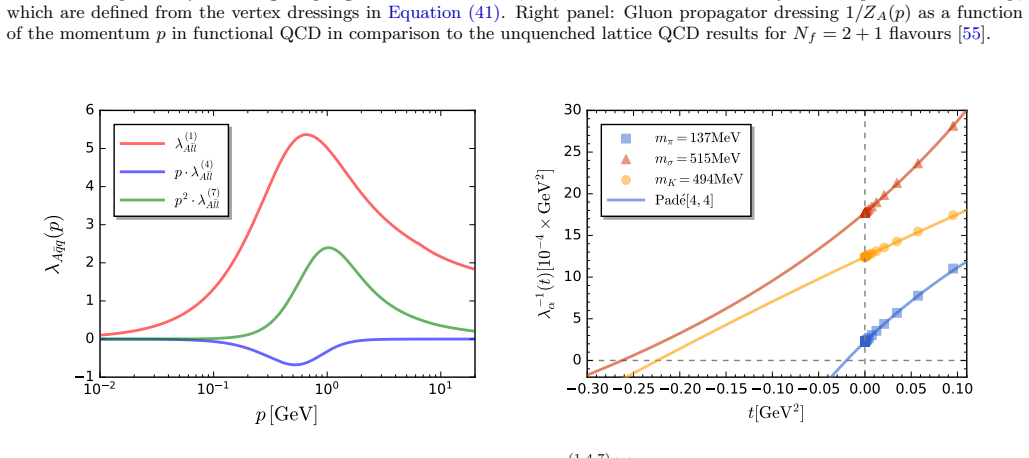
- domain assumption Padé [4,4] continuation of the Euclidean four-quark dressing λ_π(t) to the Minkowski pole t = -m_π² yields the true pion pole and Bethe-Salpeter amplitude (Eqs. 49-50).
- domain assumption The Euclidean quark mass function, wave function, and BS amplitude admit a fourth-order Taylor expansion in p₀ over the shifted contour that faithfully represents their complex-plane structure (Eqs. 67-68).
- domain assumption The quasi-DA of Eq. (55) — a Landau-gauge, Wilson-line-free definition — equals the light-cone PDA up to O(1/P_z²) corrections with no perturbative matching kernel (Eq. 71 and Section S.4).
- domain assumption Bound-state stability condition M_l(p) > m_π/2 (Eq. 63) and the pole kinematics of Eqs. (58)-(59) govern the quasi-DA's analytic structure and justify the contour shift.
read the original abstract
We present the first functional QCD calculation of the pion distribution amplitude (DA) using the large-momentum effective theory within the functional renormalisation group (fRG) approach. With only the strong coupling and current quark masses as inputs, we compute the quasi-DA from first-principles QCD correlation functions. By pushing the pion momentum up to $P_z = 4.5\ \mathrm{GeV}$, the quasi-DA becomes fully saturated, rendering the extrapolation errors to the light-cone limit negligible. The resulting second-order moment $\langle \xi^2 \rangle_\pi = 0.267$ is significantly smaller than existing lattice-LaMET determinations and lies in a range consistent with other nonperturbative approaches.
Figures




Reference graph
Works this paper leans on
-
[1]
W.-j. Fu, C. Huang, J. M. Pawlowski, and Y.-y. Tan, SciPost Phys.14, 069 (2023), arXiv:2209.13120 [hep-ph]
Pith/arXiv arXiv 2023
-
[2]
W.-j. Fu, C. Huang, J. M. Pawlowski, and Y.-y. Tan, SciPost Phys.17, 148 (2024), arXiv:2401.07638 [hep-ph]
Pith/arXiv arXiv 2024
-
[3]
W.-j. Fu, C. Huang, J. M. Pawlowski, Y.-y. Tan, and L.-j. Zhou, Phys. Rev. D112, 054047 (2025), arXiv:2502.14388 [hep-ph]
Pith/arXiv arXiv 2025
- [4]
-
[5]
X. Ji, Y.-S. Liu, Y. Liu, J.-H. Zhang, and Y. Zhao, Rev. Mod. Phys.93, 035005 (2021), arXiv:2004.03543 [hep- ph]
Pith/arXiv arXiv 2021
-
[6]
X. Ji, J.-H. Zhang, and Y. Zhao, Nucl. Phys. B924, 366 (2017), arXiv:1706.07416 [hep-ph]
Pith/arXiv arXiv 2017
-
[7]
J.-H. Zhang, J.-W. Chen, X. Ji, L. Jin, and H.-W. Lin, Phys. Rev. D95, 094514 (2017), arXiv:1702.00008 [hep- lat]
Pith/arXiv arXiv 2017
-
[8]
Huaet al.(Lattice Parton), Phys
J. Huaet al.(Lattice Parton), Phys. Rev. Lett.129, 132001 (2022), arXiv:2201.09173 [hep-lat]
Pith/arXiv arXiv 2022
-
[9]
R. Arthur, P. A. Boyle, D. Brommel, M. A. Donnellan, J. M. Flynn, A. Juttner, T. D. Rae, and C. T. C. Sachra- jda, Phys. Rev. D83, 074505 (2011), arXiv:1011.5906 [hep-lat]
Pith/arXiv arXiv 2011
-
[10]
G. S. Bali, V. M. Braun, S. B¨ urger, M. G¨ ockeler, M. Gru- ber, F. Hutzler, P. Korcyl, A. Sch¨ afer, A. Sternbeck, and P. Wein (RQCD), JHEP08, 065 (2019), [Addendum: JHEP 11, 037 (2020)], arXiv:1903.08038 [hep-lat]
Pith/arXiv arXiv 2019
-
[11]
P. Ball, V. M. Braun, and A. Lenz, JHEP08, 090 (2007), arXiv:0707.1201 [hep-ph]
Pith/arXiv arXiv 2007
-
[12]
T. Zhong, Z.-H. Zhu, H.-B. Fu, X.-G. Wu, and T. Huang, Phys. Rev. D104, 016021 (2021), arXiv:2102.03989 [hep- ph]
Pith/arXiv arXiv 2021
-
[13]
L. Chang, I. C. Cloet, J. J. Cobos-Martinez, C. D. Roberts, S. M. Schmidt, and P. C. Tandy, Phys. Rev. Lett.110, 132001 (2013), arXiv:1301.0324 [nucl-th]
Pith/arXiv arXiv 2013
-
[14]
C. D. Roberts, D. G. Richards, T. Horn, and L. Chang, Prog. Part. Nucl. Phys.120, 103883 (2021), arXiv:2102.01765 [hep-ph]. 6
Pith/arXiv arXiv 2021
-
[15]
V. M. Braun, S. Collins, M. G¨ ockeler, P. P´ erez-Rubio, A. Sch¨ afer, R. W. Schiel, and A. Sternbeck, Phys. Rev. D92, 014504 (2015), arXiv:1503.03656 [hep-lat]
Pith/arXiv arXiv 2015
-
[16]
G. S. Bali, V. M. Braun, M. G¨ ockeler, M. Gruber, F. Hut- zler, P. Korcyl, B. Lang, and A. Sch¨ afer (RQCD), Phys. Lett. B774, 91 (2017), arXiv:1705.10236 [hep-lat]
Pith/arXiv arXiv 2017
-
[17]
M. L¨ offler, P. Wein, T. Wurm, S. Weish¨ aupl, D. Jenkins, R. R¨ odl, A. Sch¨ afer, and L. Walter (RQCD), Phys. Rev. D105, 014505 (2022), arXiv:2108.07544 [hep-lat]
Pith/arXiv arXiv 2022
-
[18]
C. Shi and I. C. Clo¨ et, Phys. Rev. Lett.122, 082301 (2019), arXiv:1806.04799 [nucl-th]
Pith/arXiv arXiv 2019
-
[19]
Z.-F. Cui, M. Ding, F. Gao, K. Raya, D. Binosi, L. Chang, C. D. Roberts, J. Rodr ´ ıguez-Quintero, and S. M. Schmidt, Eur. Phys. J. C80, 1064 (2020)
2020
-
[20]
K. Raya, Z.-F. Cui, L. Chang, J.-M. Morgado, C. D. Roberts, and J. Rodriguez-Quintero, Chin. Phys. C46, 013105 (2022), arXiv:2109.11686 [hep-ph]
Pith/arXiv arXiv 2022
- [21]
-
[22]
L. Chang, Y.-B. Liu, K. Raya, and M. A. Sultan, Phys. Rev. D112, 114050 (2025), arXiv:2504.07372 [hep-ph]
Pith/arXiv arXiv 2025
-
[23]
M. Mitter, J. M. Pawlowski, and N. Strodthoff, Phys. Rev.D91, 054035 (2015), arXiv:1411.7978 [hep-ph]
Pith/arXiv arXiv 2015
-
[24]
J. Braun, L. Fister, J. M. Pawlowski, and F. Rennecke, Phys. Rev.D94, 034016 (2016), arXiv:1412.1045 [hep- ph]
Pith/arXiv arXiv 2016
-
[25]
F. Rennecke, Phys. Rev.D92, 076012 (2015), arXiv:1504.03585 [hep-ph]
Pith/arXiv arXiv 2015
-
[26]
A. K. Cyrol, L. Fister, M. Mitter, J. M. Pawlowski, and N. Strodthoff, Phys. Rev.D94, 054005 (2016), arXiv:1605.01856 [hep-ph]
Pith/arXiv arXiv 2016
-
[27]
A. K. Cyrol, M. Mitter, J. M. Pawlowski, and N. Strodthoff, Phys. Rev.D97, 054006 (2018), arXiv:1706.06326 [hep-ph]
Pith/arXiv arXiv 2018
-
[28]
L. Corell, A. K. Cyrol, M. Mitter, J. M. Pawlowski, and N. Strodthoff, SciPost Phys.5, 066 (2018), arXiv:1803.10092 [hep-ph]
Pith/arXiv arXiv 2018
-
[29]
W.-j. Fu, J. M. Pawlowski, and F. Rennecke, Phys. Rev. D101, 054032 (2020), arXiv:1909.02991 [hep-ph]
Pith/arXiv arXiv 2020
-
[30]
F. Ihssen, J. M. Pawlowski, F. R. Sattler, and N. Wink, (2024), arXiv:2408.08413 [hep-ph]
Pith/arXiv arXiv 2024
-
[31]
J. M. Pawlowski, F. Rennecke, and F. R. Sattler, (2025), arXiv:2512.20510 [hep-ph]
arXiv 2025
-
[32]
W.-j. Fu, C. Huang, J. M. Pawlowski, F. Rennecke, R. Wen, and S. Yin, (2026), arXiv:2603.13455 [hep-ph]
arXiv 2026
-
[33]
Braun, Y.-r
J. Braun, Y.-r. Chen, W.-j. Fu, F. Gao, C. Huang, F. Ihssen, K. Kockler, Y. Lu, J. M. Pawlowski, F. Ren- necke, F. R. Sattler, J. Stoll, Y.-y. Tan, Z.-n. Wang, R. Wen, J. Wessely, S. Yin, H.-w. Zheng, and N. Zor- bach, (2026)
2026
-
[34]
N. Dupuis, L. Canet, A. Eichhorn, W. Metzner, J. M. Pawlowski, M. Tissier, and N. Wschebor, Phys. Rept. 910, 1 (2021), arXiv:2006.04853 [cond-mat.stat-mech]
Pith/arXiv arXiv 2021
-
[35]
W.-j. Fu, Commun. Theor. Phys.74, 097304 (2022), arXiv:2205.00468 [hep-ph]
Pith/arXiv arXiv 2022
-
[36]
F. Rennecke, in31st International Conference on Ultra-relativistic Nucleus-Nucleus Collisions(2025) arXiv:2510.11270 [hep-ph]
arXiv 2025
-
[37]
C. S. Fischer and J. M. Pawlowski, (2026), arXiv:2603.11135 [hep-ph]
arXiv 2026
-
[38]
C. S. Fischer and J. M. Pawlowski, (2026), arXiv:2606.03703 [hep-ph]
Pith/arXiv arXiv 2026
-
[39]
F. Gao, A. S. Miramontes, J. Papavassiliou, and J. M. Pawlowski, Phys. Lett. B863, 139384 (2025), arXiv:2411.19680 [hep-ph]
arXiv 2025
-
[40]
A. S. Miramontes, J. M. Morgado Chavez, J. Papavas- siliou, and J. M. Pawlowski, Eur. Phys. J. C85, 1055 (2025), arXiv:2507.15646 [hep-ph]
arXiv 2025
-
[41]
M. N. Ferreira, A. S. Miramontes, J. M. Morgado, J. Pa- pavassiliou, and J. M. Pawlowski, Eur. Phys. J. C86, 325 (2026), arXiv:2512.04853 [hep-ph]
arXiv 2026
-
[42]
A. S. Miramontes, J. M. Morgado, and J. Papavassiliou, (2026), arXiv:2604.00959 [hep-ph]
Pith/arXiv arXiv 2026
-
[43]
M. N. Ferreira, A. S. Miramontes, J. M. Morgado, and J. Papavassiliou, (2026), arXiv:2604.07221 [hep-ph]
Pith/arXiv arXiv 2026
-
[44]
J. Braun, A. Geißel, J. M. Pawlowski, F. R. Sat- tler, and N. Wink, Annals Phys.484, 170250 (2026), arXiv:2503.05580 [hep-th]
Pith/arXiv arXiv 2026
-
[45]
Eichmann, (2026), arXiv:2603.00804 [hep-ph]
G. Eichmann, (2026), arXiv:2603.00804 [hep-ph]
Pith/arXiv arXiv 2026
-
[46]
(cyan points) and [47] (purple points). fort=−m 2 π with the pole massm π of the pion, the pseudoscalar channel diverges and simply reduces to the product of the Bethe-Salpeter (BS) wave function, its conjugate and the pion on-shell propagator 1/(t+m 2 π). Finally, for the computation of Eq. (7) we choose the symmetric configuration, p=−p ′ =|p|(cosθ,sinθ...
-
[47]
L. Chang, Y.-B. Liu, K. Raya, J. Rodr ´ ıguez-Quintero, and Y.-B. Yang, Phys. Rev. D104, 094509 (2021), arXiv:2105.06596 [hep-lat]
Pith/arXiv arXiv 2021
-
[48]
P. O. Bowman, U. M. Heller, D. B. Leinweber, M. B. Parappilly, A. G. Williams, and J.-b. Zhang, Phys. Rev. D71, 054507 (2005), arXiv:hep-lat/0501019
Pith/arXiv arXiv 2005
-
[49]
R. Williams, Eur. Phys. J. A51, 57 (2015), arXiv:1404.2545 [hep-ph]
Pith/arXiv arXiv 2015
-
[50]
R. Williams, C. S. Fischer, and W. Heupel, Phys. Rev. D93, 034026 (2016), arXiv:1512.00455 [hep-ph]
Pith/arXiv arXiv 2016
-
[51]
A. C. Aguilar, J. C. Cardona, M. N. Ferreira, and J. Papavassiliou, Phys. Rev. D96, 014029 (2017), arXiv:1610.06158 [hep-ph]
Pith/arXiv arXiv 2017
-
[52]
F. Gao, J. Papavassiliou, and J. M. Pawlowski, Phys. Rev. D103, 094013 (2021), arXiv:2102.13053 [hep-ph]
Pith/arXiv arXiv 2021
-
[53]
A. C. Aguilar, M. N. Ferreira, B. M. Oliveira, J. Pa- pavassiliou, and G. T. Linhares, Eur. Phys. J. C84, 1231 (2024), arXiv:2408.15370 [hep-ph]
Pith/arXiv arXiv 2024
-
[54]
D.-y. Zhang, C. Huang, and W.-j. Fu, Phys. Rev. D112, 074001 (2025), arXiv:2502.15384 [hep-ph]
Pith/arXiv arXiv 2025
-
[55]
W. Cui, D.-y. Zhang, C. Huang, and W.-j. Fu, (2026), arXiv:2604.23739 [hep-ph]
Pith/arXiv arXiv 2026
-
[56]
G. Eichmann, E. Ferreira, and A. Stadler, Phys. Rev. D 105, 034009 (2022), arXiv:2112.04858 [hep-ph]
Pith/arXiv arXiv 2022
-
[57]
W. de Paula, E. Ydrefors, J. H. Nogueira Alvarenga, T. Frederico, and G. Salm` e, Phys. Rev. D105, L071505 (2022), arXiv:2203.07106 [hep-ph]
arXiv 2022
-
[58]
P. Boucaud, F. De Soto, K. Raya, J. Rodr ´ ıguez-Quintero, and S. Zafeiropoulos, Phys. Rev.D98, 114515 (2018), arXiv:1809.05776 [hep-ph]
Pith/arXiv arXiv 2018
-
[59]
A. C. Aguilar, D. Ibanez, V. Mathieu, and J. Papavas- siliou, Phys. Rev.D85, 014018 (2012), arXiv:1110.2633 [hep-ph]
Pith/arXiv arXiv 2012
-
[60]
M. N. Ferreira and J. Papavassiliou, Prog. Part. Nucl. Phys.144, 104186 (2025), arXiv:2501.01080 [hep-ph]
Pith/arXiv arXiv 2025
-
[61]
X. Ji, A. Sch¨ afer, X. Xiong, and J.-H. Zhang, Phys. Rev. D92, 014039 (2015), arXiv:1506.00248 [hep-ph]. 7 Supplemental Material We provide supplemental material about the fRG approach to QCD, Section S.1, the contour deformation used for the computation of the quasi-PDA, Section S.2, the Taylor expansion of the BSE-amplitude and the quark mass, Section ...
Pith/arXiv arXiv 2015
discussion (0)
Sign in with ORCID, Apple, or X to comment. Anyone can read and Pith papers without signing in.