REVIEW 4 major objections 6 minor 32 references
From non-equilibrium Green's functions to Lattice Wigner: A toy model for quantum nanofluidics simulations
T0 review · 4 major / 6 minor · reviewed 2026-08-10 · deepseek-v4-flash
Pith's one-line read A lattice Boltzmann model derived from the Wigner equation shows that quantum interference acts mainly on the odd kinetic moments of a nanofluid—current and energy flux—while even moments are shielded by thermal fluctuations.
desk verdict A suggestive but incomplete toy model; the odd/even asymmetry is likely a normalization artifact and the exciting regime violates the model's own validity condition. read the letter →
The pith
A machine-rendered reading of the paper's core claim, the machinery that carries it, and where it could break.
The reading
What carries the argument
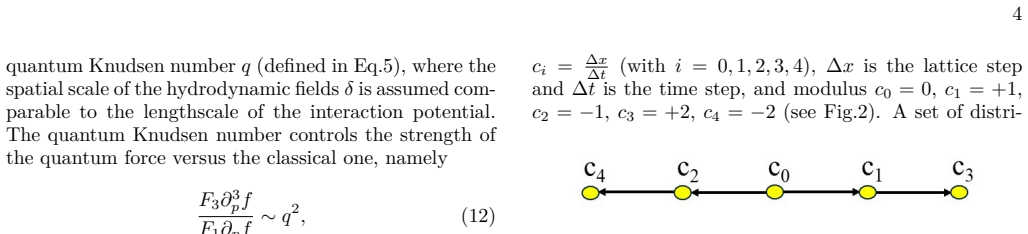
The central mechanism is the hierarchy of kinetic moments in the D1Q5 model with the truncated Wigner quantum operator. The power moments $P_k=\sum_i f_i c_i^k$ have exact equilibrium expressions in which even moments retain thermal offsets ($\theta_2^{\rm eq}=c_s^2$ for the energy, $\theta_4^{\rm eq}=3c_s^4$ for the flatness) while odd moments vanish, so quantum forcing has no thermal noise to hide behind for the odd ones. The quantum force $F_3$ enters explicitly only the equations for the third and fourth kinetic moments and then propagates to lower moments through spatial gradients, which explains why the effect is visible in $P_1$ and $P_3$ even though the force does not act directly on them. The control parameter is the quantum Knudsen number $q=\lambda_F/\delta$, with the ratio of quantum to classical force scaling as $q^2$.
What would settle it
Increase the wavenumber stepwise and check whether the odd-moment deviations $\Delta_1$ and $\Delta_3$ follow the predicted $q^2$ scaling of Eq. (12); then add the next-order quantum force $F_5=-\partial_x^5 U$ to the D1Q5 scheme and see whether the reported 13% and 30% deviations survive. If the deviations vanish when $F_5$ is included, the effect is a truncation artifact rather than a robust quantum signature.
Extended reading notes
Core claim
The discovery is a simulation-level asymmetry in how quantum interference affects the kinetic moments of a nanofluid. Using a D1Q5 lattice Boltzmann scheme with a BGK collision term and a forcing given by the classical potential force $F_1=-\partial_x U$ plus the truncated quantum force $F_3=-\partial_x^3 U$, the paper shows that for a periodic potential with wavenumber $n_w=32$ (quantum Knudsen number $q=\lambda_F/\delta\simeq 1.25$), the odd power moments $P_1$ and $P_3$ depart from their classical values by roughly 13% and 30%, while the even power moments $P_0$, $P_2$, $P_4$ move by less than 1%. At the lower wavenumber $n_w=8$ ($q\simeq 0.3$), quantum effects are essentially invisible. The explanation offered is that odd moments vanish at equilibrium, so they have no thermal buffer against the quantum force, whereas even moments contain the nonzero thermal correlators $\theta_2^{\rm eq}=c_s^2$ and $\theta_4^{\rm eq}=3c_s^4$, which protect them from quantum fluctuations.
Load-bearing premise
The Boltzmann-like equation is derived assuming the quantum Knudsen number is small ($q\ll 1$), but the simulations that display the central odd-moment effect run at $q\simeq 1.25$, outside that validity window.
Editorial extensions
If this is right
- At low wavenumbers, where $q\lesssim 0.3$, density, current, and energy are effectively immune to quantum interference, so semiclassical lattice Boltzmann remains a safe tool in that regime.
- At $q\simeq 1.25$, the quantum force changes the amplitude of the spatial oscillations of all moments, but the odd moments respond far more strongly than the even ones.
- The even moments stay within 1% of the classical solution even at high wavenumber, confirming that thermal fluctuations dominate quantum fluctuations for those observables.
- Since the quantum force enters only the third and fourth moment equations, its influence on current and density is indirect, arriving through spatial gradients of the higher moments.
Reading between the lines
- A practical consequence, if this mechanism holds, is that experiments on negative quantum friction should look at current and energy-flux measurements rather than density profiles, because the odd-moment response is where the quantum signature is amplified.
- The third-order truncation is a testable limitation: including $F_5=-\partial_x^5 U$ in the same D1Q5 scheme could either stabilize or erase the reported 13% and 30% deviations, so a direct comparison would settle how much of the effect is genuine.
- Because the high-wavenumber runs operate at $q\simeq 1.25$, outside the $q\ll 1$ regime where the Boltzmann equation was derived, a cross-check against a full Wigner solver or a higher-order lattice would be the cleanest way to verify that the odd-moment effect is not an artifact of the model extension.
- The same odd/even asymmetry argument could be transferred to two-dimensional nanochannels with screened Coulomb potentials, where the odd moments would again be the natural diagnostic for quantum friction.
Editorial analysis
A structured set of objections, weighed in public.
Referee Report
Summary. This paper proposes a semi-classical lattice Boltzmann model derived from the Wigner equation, truncated at third-order quantum force terms, and applies it to a one-dimensional nanofluid in a periodic potential. The numerical study reports that at high wavenumber (quantum Knudsen number q > 1), quantum fluctuations produce large relative deviations in odd power moments P1 and P3, while even moments P0, P2, P4 deviate by less than 1%, which the authors interpret as thermal protection of even moments. A constant-force test reproduces Ohm's law. The authors argue the model may be a useful tool for quantum nanofluidics simulations.
Significance. If the central claim were established, the paper would provide a computationally efficient mesoscale route from NEGF to lattice kinetic simulations, with a concrete prediction about which kinetic moments are affected by quantum interference. The authors are appropriately cautious about the toy-model nature. However, the headline result rests on a relative-error metric that is systematically biased against odd moments, and the simulations that show the effect are run outside the model's stated validity regime. The paper is a promising proof-of-concept, but the specific physical conclusion needs stronger support.
major comments (4)
- [Sec. VII.D, definition of Δk] The central claim that quantum fluctuations are 'mostly felt on the odd kinetic moments' is inferred from the relative errors Δk = 100|P_cl − P_q|/P_cl. Because the odd power moments P1 and P3 are near zero at late times while the even moments carry large thermal offsets (P0 ≈ 1, P2 ≈ 1, P4 ≈ 3), the same absolute quantum-driven change produces a much larger percentage error in odd moments. For instance, Δ1 ≈ 13% of P1 ≈ 10^-3 corresponds to an absolute deviation of about 1.3 × 10^-4, whereas Δ4 < 1% of P4 ≈ 3 corresponds to an absolute deviation of order 10^-2, roughly two orders of magnitude larger. The statement that even moments are 'nearly unaffected' is therefore not established by the quoted numbers. Please report absolute deviations or normalize by a thermal scale (e.g., ρ c_s^k), and re-examine the conclusion.
- [Sec. VII.B with Eq. (6)] The Boltzmann-like equation is derived under the weak-heterogeneity condition q = λ_F/δ ≪ 1 (Eq. 6), yet the high-wavenumber simulations use nw = 32, for which the authors themselves give q ≈ 1.25. This is outside the validity regime of the derivation, so the observed odd-moment effects at nw = 32 may be an artifact of applying the model where it is not expected to hold. Please either restrict the physical conclusions to the regime q < 1, provide a justification for extrapolating the model to q > 1, or benchmark against a full Wigner-equation solution in this regime.
- [Sec. IV, Eq. (4)] The model keeps only the F3 term in the Wigner quantum operator, neglecting F5, F7, and higher terms. The ratio of the F5 term to the F3 term scales as q^2 (one factor of q^2 from the two extra derivatives), so at q ≈ 1.25 the neglected F5 contribution is of the same order as the retained F3 contribution. The truncation is therefore uncontrolled precisely in the regime where the paper reports the strongest quantum effects. Please estimate the magnitude of the neglected terms or include the F5 term to show that the results are converged.
- [Sec. VI.A, power moments] The expressions for P3 and P4 are algebraically incomplete. The exact binomial expansions around the mean velocity u are P3 = ρ(u^3 + 3u^2 θ1 + 3u θ2 + θ3) and P4 = ρ(u^4 + 4u^3 θ1 + 6u^2 θ2 + 4u θ3 + θ4). The paper omits the terms proportional to θ1 and θ3, which do not vanish away from equilibrium. Since the subsequent qualitative argument about odd moments lacking thermal protection cites these formulas, the identities should be corrected.
minor comments (6)
- [Eq. (31)] The first equality has a sign error; with S_cl = −F1 ∂_p f, the moment is −F1 ∫ H_k ∂_p f dp, not +F1 ∫ H_k ∂_p f dp. The final moment values quoted after integration by parts are correct.
- [Fig. 6 caption] The caption refers to panels (d), (e), and (f), but the figure contains only panels (a)–(d). Please correct the caption.
- [Section I] The word 'screend' in the introduction should be 'screened'.
- [Section VIII] The word 'lenghtscale' in the conclusions should be 'lengthscale'.
- [Section VII.A] The symbol q is used for the particle charge in Section VII.A while it denotes the quantum Knudsen number elsewhere; this is a potential source of confusion, although the usage is stated.
- [Sections II and III] The derivation from NEGF to the Wigner-Boltzmann equation is very condensed; for a paper that advertises this route, a few more intermediate steps or references would help reproducibility.
Circularity Check
Odd-moment asymmetry is built into the Δk normalization; 'even moments protected' restates equilibrium moment offsets, so the headline claim is partially circular.
-
self definitional
[Sec. VI A (Pk formulas); Sec. VII C-D (Δk definition and reported Δ1≈13%, Δ3≈30%, Δ0,2,4<1%); Abstract (conclusion)]
"Deviations from the classical distribution can be approximately quantified in terms of the percentage error Δk = 100× |Pcl_k − Pq_k| / Pcl_k ... one can easily prove that P0 = ρ, P1 = ρ(u+θ1), P2 = ρ(u^2+θ2), P3 = ρ(u^3+uθ2+θ3) and P4 = ρ(u^4+6u^2θ2+θ4) ... the odd correlators θ1 and θ3 vanish at equilibrium, while the even correlators do not, since they carry the contribution of thermal fluctuations."
The ranking noted in the paper is forced by the definition of Δk together with the paper's own moment identities. Because Δk divides by Pcl_k, and because P0=ρ≈1, P2≈ρ(u²+c_s²)≈1, P4≈ρ(3c_s⁴)≈3 carry O(1) thermal offsets while P1≈ρu and P3≈ρu(u²+c_s²) are O(10⁻³) at late times (Fig.4: 'fluctuating around 10^-3'), any comparable absolute quantum change yields percentage errors orders of magnitude larger in the odd moments. The claim that even moments are 'protected by thermal fluctuations' is therefore a restatement of the relative-error normalization and of the equilibrium correlator offsets, not an independently measured selection rule. The paper's moment expansions also omit 3u²θ1 and 4u³θ1+4uθ3 away from equilibrium, so the odd/even split is not exact.
full rationale
No fit-labeled-as-prediction, no load-bearing self-citation chain, and no uniqueness theorem smuggled from the authors' prior work were found; the simulation is self-contained against the model it defines. The central claim that quantum fluctuations 'are mostly felt on the odd kinetic moments' while even moments are 'protected by thermal fluctuations' does, however, reduce by construction to the definition of the diagnostic Δk and to the equilibrium moment structure stated in Sec. VI A: since Δk normalizes by Pcl_k and the paper itself notes the odd correlators vanish at equilibrium while even correlators carry thermal offsets, the reported hierarchy of percentage errors (and the qualitative conclusion drawn from it) is a consequence of the normalization, not an independent numerical discovery. This is partial circularity of the 'self-definitional' kind. Other concerns—simulations at nw=32 having q≈1.25 outside the stated q≪1 validity condition (Eq. 6), and truncation of the Moyal operator at F3—are validity/correctness issues, not circularity, and are excluded from the score.
Assumptions & free parameters
free parameters (7)
- wavenumber nw = 32 (high-frequency regime) =
32
- quantum length scale lambda_F =
5 lattice units (approx. 5 nm)
- potential amplitude U0 =
10^-3 (lattice units)
- electric field E =
10^-6 (lattice units)
- friction coefficient gamma =
10^-3 (lattice units)
- relaxation frequency omega =
1.0 and 0.5
- initial Gaussian width sigma =
4 lattice units
assumptions (5)
- domain assumption Weak heterogeneity: q = lambda_F/delta << 1 (Eq. 6)
- domain assumption Weak interactions and single-valued dispersion relation E = E(p), giving the in-shell representation (Eq. 8)
- ad hoc to paper Truncation of the Wigner quantum operator (Eq. 4) at the third-order derivative F3, neglecting F5, F7 and higher
- domain assumption BGK single-relaxation-time collision operator (Eq. 10) adequately represents scattering between quasiparticles
- domain assumption Thermal fluctuations on even moments are captured by the D1Q5 equilibrium values theta2 = c_s^2 and theta4 = 3 c_s^4
Cite this review
Pith. "Pith review of From non-equilibrium Green's functions to Lattice Wigner: A toy model for quantum nanofluidics simulations." pith.science (2026). https://pith.science/paper/WW5FWHCF
@misc{pith2026250118634,
  author       = {Pith},
  title        = {Pith review of: From non-equilibrium Green's functions to Lattice Wigner: A toy model for quantum nanofluidics simulations},
  year         = {2026},
  howpublished = {\url{https://pith.science/paper/WW5FWHCF}},
  note         = {Machine review of arXiv:2501.18634}
}
read the original abstract
Recent experiments of fluid transport in nano-channels have shown evidence of a coupling between charge-fluctuations in polar fluids and electronic excitations in graphene solids, which may lead to a significant reduction of friction a phenomenon dubbed "negative quantum friction". In this paper, we present a semi-classical mesoscale Boltzmann-Wigner lattice kinetic model of quantum-nanoscale transport and perform a numerical study of the effects of the quantum interactions on the evolution of a one-dimensional nano-fluid subject to a periodic external potential. It is shown that the effects of quantum fluctuations become visible once the quantum length scale (Fermi wavelength) of the quasiparticles becomes comparable to the lengthscale of the external potential. Under such conditions, quantum fluctuations are mostly felt on the odd kinetic moments, while the even ones remain nearly unaffected because they are "protected" by thermal fluctuations. It is hoped that the present Boltzmann-Wigner lattice model and extensions thereof may offer a useful tool for the computer simulation of quantum-nanofluidic transport phenomena at scales of engineering relevance.
Figures


Figures from the paper (4 more)


Reference graph
Works this paper leans on
-
[1]
S. Succi, The lattice Boltzmann equation: for complex states of flowing matter (Oxford University Press, 2018)
work page 2018
-
[2]
The lattice Boltz- mann equation: theory and applications,
R. Benzi, S. Succi, and M. Vergassola, “The lattice Boltz- mann equation: theory and applications,” Phys. Rep. 222, 145–197 (1992)
work page 1992
-
[3]
Lattice Boltzmann equation for quantum mechanics,
S. Succi and R. Benzi, “Lattice Boltzmann equation for quantum mechanics,” Physica D: Nonlinear Phenomena 69, 327–332 (1993)
work page 1993
-
[4]
Relativistic lattice Boltzmann methods: Theory and ap- plications,
A. Gabbana, D. Simeoni, S. Succi, and R. Tripiccione, “Relativistic lattice Boltzmann methods: Theory and ap- plications,” Phys. Rep. 863, 1–63 (2020)
work page 2020
-
[5]
Lattice Boltzmann simu- lations for soft flowing matter,
A. Tiribocchi, M. Durve, M. Lauricella, A. Montessori, J. M. Tucny, and S. Succi, “Lattice Boltzmann simu- lations for soft flowing matter,” Phys. Rep. 1105, 1–52 (2025). 10
work page 2025
-
[6]
Nanofluidics in two-dimensional layered materials: inspirations from nature,
J. Gao, Y. Feng, W. Guo, and L. Jiang, “Nanofluidics in two-dimensional layered materials: inspirations from nature,” Chem. Soc. Rev. 46, 5400–5424 (2017)
work page 2017
-
[7]
Electron cooling in graphene enhanced by plasmon-hydron reso- nance,
X. Yu, A. Principi, and K. J. et al. Tielrooij, “Electron cooling in graphene enhanced by plasmon-hydron reso- nance,” Nat. Nanotechnol. 18, 898–904 (2023)
work page 2023
-
[8]
Strong electronic winds blowing under liquid flows on carbon surfaces,
M. Liz´ ee, A. Marcotte, B. Coquinot, N. Kavokine, K. Sobnath, C. Barraud, A. Bhardwaj, B. Radha, A. Nigu` es, L. Bocquet, and A. Siria, “Strong electronic winds blowing under liquid flows on carbon surfaces,” Phys. Rev. X 13, 011020 (2023)
work page 2023
Show all 32 references
-
[9]
Anoma- lous friction of supercooled glycerol on mica,
M. Liz´ ee, B. Coquinot, and G. et al. Mariette, “Anoma- lous friction of supercooled glycerol on mica,” Nat. Com- mun. 15, 6129 (2024)
2024
-
[10]
Classical quantum friction at water-carbon inter- faces,
A. T. Bui, F. L. Thiemann, A. Michaelides, and S. J. Cox, “Classical quantum friction at water-carbon inter- faces,” Nano Lett. 23, 580–587 (2023)
2023
-
[11]
Fluctuation-induced quantum friction in nanoscale wa- ter flows,
N. Kavokine, M. L. Bocquet, and L. Bocquet, “Fluctuation-induced quantum friction in nanoscale wa- ter flows,” Nature 602, 84–90 (2022)
2022
-
[12]
Quantum feedback at the solid-liquid interface: Flow-induced elec- tronic current and its negative contribution to friction,
B. Coquinot, L. Bocquet, and N. Kavokine, “Quantum feedback at the solid-liquid interface: Flow-induced elec- tronic current and its negative contribution to friction,” Phys. Rev. X 13, 011019 (2023)
2023
-
[13]
Hydroelec- tric energy conversion of waste flows through hydroelec- tronic drag,
B. Coquinot, L. Bocquet, and N. Kavokine, “Hydroelec- tric energy conversion of waste flows through hydroelec- tronic drag,” Proceedings of the National Academy of Sciences 121, e2411613121 (2024)
2024
-
[14]
Molecular dynam- ics with quantum heat baths: Application to nanoribbons and nanotubes,
J.-S. Wang, X. Ni, and J.-W. Jiang, “Molecular dynam- ics with quantum heat baths: Application to nanoribbons and nanotubes,” Phys. Rev. B 80, 224302 (2009)
2009
-
[15]
Entropy and Galilean invariance of lattice Boltzmann theories,
S. S. Chikatamarla and I. V. Karlin, “Entropy and Galilean invariance of lattice Boltzmann theories,” Phys. Rev. Lett. 97, 190601 (2006)
2006
-
[16]
Generalized lattice Boltz- mann method with multirange pseudopotential,
M. Sbragaglia, R. Benzi, L. Biferale, S. Succi, K. Sugiyama, and F. Toschi, “Generalized lattice Boltz- mann method with multirange pseudopotential,” Phys. Rev. E 75, 026702 (2007)
2007
-
[17]
Lattices for the lattice Boltzmann method,
S. S. Chikatamarla and I. V. Karlin, “Lattices for the lattice Boltzmann method,” Phys. Rev. E 79, 046701 (2009)
2009
-
[18]
Crystal- lographic lattice Boltzmann method,
M. Namburi, S. Krithivasan, and S Ansumali, “Crystal- lographic lattice Boltzmann method,” Sci. Rep. 6, 27172 (2016)
2016
-
[19]
Frenkel and B
D. Frenkel and B. Smit, Understanding Molecular Sim- ulation: From Algorithms to Applications (Academic Press, 2001, 2001)
2001
-
[20]
L. P. Kadanoff and G. Baym, Quantum Statistical Me- chanics: Green’s Function Methods in Equilibrium and Nonequilibrium Problems (W.A. Benjamin, 1962)
1962
-
[21]
Rammer, Quantum Field Theory of Non-Equilibrium States (Cambridge University Press, 2007)
J. Rammer, Quantum Field Theory of Non-Equilibrium States (Cambridge University Press, 2007)
2007
-
[22]
Distribution functions in physics: Fundamen- tals,
M. Hillery, R. F. O’Connell, M. O. Scully, and E. P. Wigner, “Distribution functions in physics: Fundamen- tals,” Physics Reports 106, 121–167 (1984)
1984
-
[23]
Lattice Wigner equation,
S. Sol´ orzano, M. Mendoza, S. Succi, and H. J. Her- rmann, “Lattice Wigner equation,” Phys. Rev. E 97, 013308 (2018)
2018
-
[24]
A model for collision processes in gases. i. Small amplitude pro- cesses in charged and neutral one-component systems,
P. L. Bhatnagar, E. P. Gross, and M. Krook, “A model for collision processes in gases. i. Small amplitude pro- cesses in charged and neutral one-component systems,” Phys. Rev. 94, 511–525 (1954)
1954
-
[25]
Lattice Boltzmann method for bosons and fermions and the fourth-order hermite polynomial expan- sion,
R.C.V. Coelho, A. Ilha, M. M. Doria, R.M. Pereira, and V. Y. Aibe, “Lattice Boltzmann method for bosons and fermions and the fourth-order hermite polynomial expan- sion,” Phys. Rev. E 89, 043302 (2014)
2014
-
[26]
Generalized lattice boltz- mann method with multirange pseudopotential,
M. Sbragaglia, R. Benzi, L. Biferale, S. Succi, K. Sugiyama, and F. Toschi, “Generalized lattice boltz- mann method with multirange pseudopotential,” Phys. Rev. E 75, 026702 (2007)
2007
-
[27]
Lattice wigner equation,
S. Solorzano, M. Mendoza, S. Succi, and H. J. Herrmann, “Lattice wigner equation,” Physical Review E 97, 013308 (2018)
2018
-
[28]
Lattice boltzmann simulations of a strongly interacting two-dimensional fermi gas,
J. Brewer, M. Mendoza, R. E. Young, and P. Ro- matschke, “Lattice boltzmann simulations of a strongly interacting two-dimensional fermi gas,” Physical Review A 93, 013618 (2016)
2016
-
[29]
Keldysh-lattice Boltz- mann approach to quantum nanofluidics,
S. Succi and A. Montessori, “Keldysh-lattice Boltz- mann approach to quantum nanofluidics,” arXiv preprint arXiv:2403.15768 (2024)
2024 arXiv
-
[30]
Viscosity in strongly interacting quantum field theories from black hole physics,
P. K. Kovtun, D. T. Son, and A. O. Starinets, “Viscosity in strongly interacting quantum field theories from black hole physics,” Phys. Rev. Lett. 94, 111601 (2005)
2005
-
[31]
Minimal quantum viscosity from fundamental physical constants,
K. Trachenko and V. V. Brazhkin, “Minimal quantum viscosity from fundamental physical constants,” Science Advances 6, eaba3747 (2020)
2020
-
[32]
Kr¨ uger, H
T. Kr¨ uger, H. Kusumaatmaja, A. Kuzmin, O. Shardt, G. Silva, and E. M. Viggen, The Lattice Boltzmann Method: Principles and Practice (Springer International Publishing, 2017)
2017
Reviewed August 10, 2026 · model on record in the stance chip above.
Discussion (0). Continue with ORCID to comment.