REVIEW 1 major objections 7 minor 43 references
Semantic Feature Division Multiple Access for Digital Semantic Broadcast Channels
T0 review · 1 major / 7 minor · reviewed 2026-08-09 · deepseek-v4-flash
Pith's one-line read Orthogonal semantic codes let many users share one channel while keeping each user's data private.
desk verdict SFDMA is a plausible extension of multi-user semantic communication with genuine empirical evidence of near-orthogonality, but the central claims rest on an unenforced and under-analyzed assumption. read the letter →
The pith
A machine-rendered reading of the paper's core claim, the machinery that carries it, and where it could break.
The reading
What carries the argument
The load-bearing mechanism is the learned approximate orthogonality of encoded semantic features, stated as $x_i^H x_j/(\|x_i\|\|x_j\|) \to 0$ for $i\neq j$ (Eq. (8)). In the proposed SFDMA networks, a semantic encoder maps each source to a continuous feature, a sign binarizer quantizes it to $\pm 1$ using the straight-through estimator, and BPSK modulation normalizes power; the whole encoder is trained jointly across users so that interference between users is minimized. For inference tasks, the robust information bottleneck (RIB) objective, approximated by a variational upper bound on mutual information terms, trades off inference accuracy, compression, and interference. For image reconstruction, a Swin Transformer encoder-decoder with MSE loss plays the same role, and the ABG function $\phi_i = \alpha_i - \gamma_i/(1+(\beta_i \mathrm{SINR}_i)^{\tau_i})$ links task performance to SINR for power allocation.
What would settle it
Take a trained two-user SFDMA encoder and feed it images from a held-out class or a channel fading profile not used in training, then compute the normalized inner product of the two encoded feature vectors. If it rises above roughly 0.1, or if cross-decoding accuracy moves well above chance (for MNIST, above about 15% on 10 classes), the claimed emergent orthogonality has not generalized and the interference and privacy guarantees fail for those conditions.
Extended reading notes
Core claim
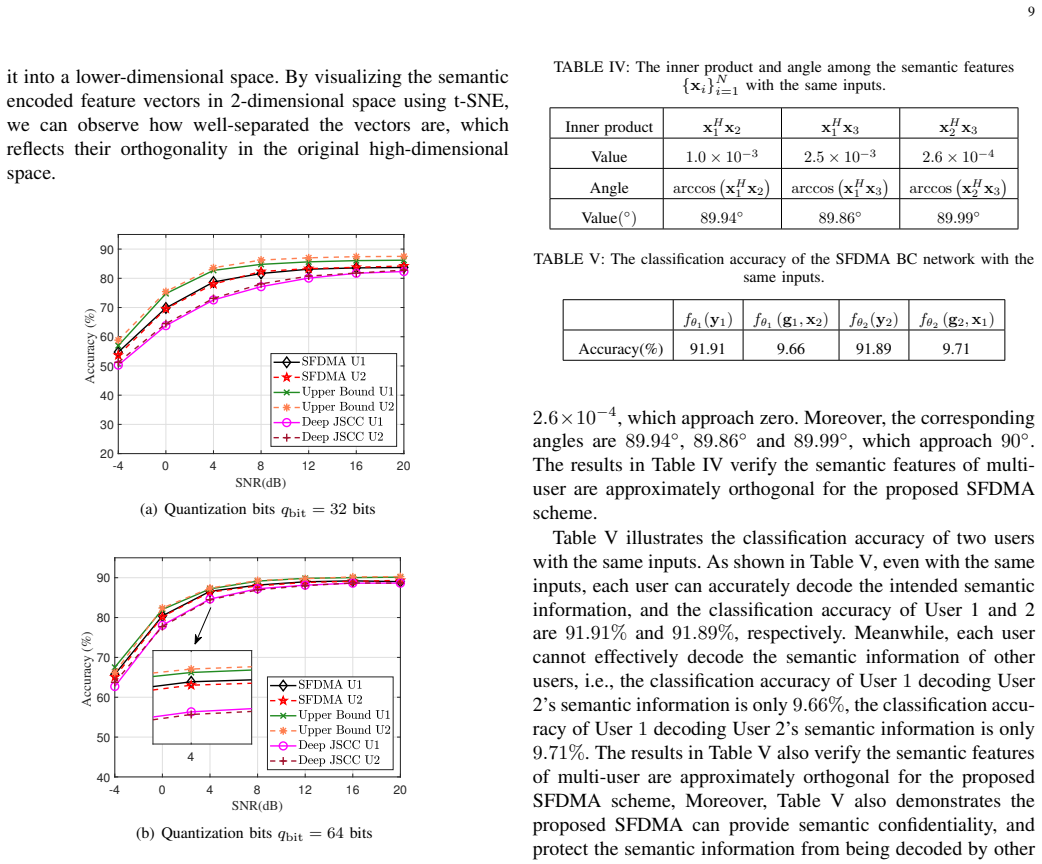
The central discovery is that multi-user interference in a semantic broadcast channel can be handled in the feature domain rather than the signal-processing domain. With user-specific encoders trained jointly, the quantized BPSK-modulated semantic features of different users become approximately orthogonal, with normalized inner products around $10^{-3}$ and angles near $90^\circ$, even when the inputs are identical. This makes it possible to superpose all users' signals in the same time-frequency resource; each decoder recovers its own semantic information while decoding another user's signal yields near-chance accuracy or, for images, very low PSNR and MS-SSIM. The orthogonality is not imposed by a loss term: it is described as emerging spontaneously because minimizing reconstruction error rewards well-separated signals.
Load-bearing premise
The load-bearing premise is that joint training alone will push different users' encoded signals to be nearly orthogonal in practice; if that emergent separation fails for new data, channels, or more users, the interference mitigation and privacy claims collapse.
Editorial extensions
If this is right
- Users' signals can share the same time-frequency resource without successive interference cancellation, so receiver complexity no longer limits the number of superposed users to two.
- Semantic privacy becomes a side effect of the coding: a receiver that tries to decode another user's feature gets near-chance results, so user data is not exposed to other users in the broadcast.
- The ABG performance-SINR curve turns semantic quality-of-service constraints into a linear power-allocation problem, enabling adaptive power control in fading channels.
- Because the transmitted features are binary and BPSK-modulated, the scheme is compatible with digital modulation chains rather than requiring analog transmission of continuous features.
- With more users or new data domains, the encoders would need retraining to re-establish the near-orthogonality that the current experiments show for two and three users.
Reading between the lines
- If the emergent orthogonality is the only thing separating users, then out-of-distribution inputs or channel conditions not seen during training could break the separation; a targeted stress test on unseen classes or fading statistics would show how much margin exists.
- The near-chance cross-decoding results suggest statistical separation, not cryptographic secrecy; the scheme should be described as providing confidentiality against casual receivers, not as a secure physical-layer privacy mechanism.
- The ABG fit is empirical and dataset-specific, so the power-allocation guarantee likely carries only as far as the fitted parameters; refitting on another dataset or channel model would be needed before deployment.
- The same feature-domain division idea could be applied to other multi-user settings, such as uplink semantic access or over-the-air federated learning, though the paper does not explore those cases.
Editorial analysis
A structured set of objections, weighed in public.
Referee Report
Summary. The paper proposes SFDMA (semantic feature division multiple access) for multi-user digital semantic broadcast networks. The transmitter encodes each user's source into a discrete approximately orthogonal BPSK feature vector, and all users' vectors are broadcast simultaneously in the same time-frequency resource; each receiver is expected to decode only its own semantic information. For inference tasks the authors design a robust information bottleneck (RIB) objective, and for image reconstruction they use a Swin Transformer with an MSE loss. The paper further fits an Alpha-Beta-Gamma (ABG) curve relating task performance to SINR and uses it to formulate a linear power allocation problem. Experiments on MNIST and CelebA compare the proposed SFDMA with Deep JSCC and an upper bound, with t-SNE plots and inner-product/angle tables for orthogonality, along with CDFs for the power allocation scheme.
Significance. If validated, the SFDMA mechanism would be a useful contribution to semantic broadcast: it addresses multi-user interference without SIC and offers a form of semantic privacy, and the ABG-based power allocation would give a practical QoS control tool. The paper's strengths are its clear system model, the use of quantitative orthogonality metrics (inner products, angles), and the comparison against JSCC baselines and an upper bound. However, the central design assumption of spontaneous orthogonality is not enforced or analyzed, the privacy test does not match the actual received signal, and the ABG 'optimal' power allocation is fitted to simulation data from the same system on which it is evaluated. These gaps currently limit the claims to a specific simulation setup and prevent the paper from supporting its stated generalizations.
major comments (1)
- [Section V-B/V-C, Tables V and VII] The privacy claim 'each receiver can only decode its own semantic information' is not supported by the reported experiments. In Tables V and VII the cross-decoding inputs are the clean codewords x2 or x1, but the actual received signal y_i in Eq. (5) is a superposition of x_i, the interfering x_j, and noise. A decoder that performs poorly on an isolated interfering codeword can nevertheless extract information about user j from y_i, where x_j is present as interference mixed with the intended signal. To support the privacy claim, the authors should evaluate cross-decoding from the actual equalized received signal y_i (or a noise-free version of it), or quantify leakage via mutual information between y_i and s_j/u_j.
minor comments (7)
- [Index Terms] 'Sematic broadcast network' should be 'Semantic broadcast network'.
- [Eq. (4)] The notation gi ⊙ xi is unclear if gi is a scalar channel gain; please define whether gi is a scalar or vector and specify how the equalizer in Eq. (5) depends on gi, including the treatment of noise when dividing by gi.
- [Eq. (17)] Eq. (17) is missing a closing parenthesis and the summation over c is written inconsistently with the indexing of x_{c,j}; the sentence describing f_epsilon as a combination of Bernoulli and Cauchy distributions is not precise enough to reproduce the computation.
- [Table II] Table II lists a parameter ζ that does not appear in Eq. (30), and only one set of ABG parameters is given although Eq. (30) is written per user; please clarify whether the parameters are shared by all users and what ζ represents.
- [Fig. 10] The Fig. 10 caption says training SNR = 5 dB for both panels, but the text says Fig. 10(a) uses training SNR = 0 dB; please reconcile this inconsistency.
- [Section V-B/V-C, text around Tables V and VII] In the paragraph after Table V, the sentence 'the classification accuracy of User 1 decoding User 2's semantic information is only 9.71%' should read 'User 2 decoding User 1's semantic information'; similarly, the sentence after Table VII that refers to 'Table V' should refer to 'Table VII'.
- [Fig. 6(b)] Fig. 6(b) contains a stray '4' on the vertical axis and the axis label is incomplete; please correct the figure.
Circularity Check
No significant circularity: the SFDMA orthogonality claim is directly measured, the RIB objective is derived via a variational bound, and the ABG power-allocation model is an explicit empirical fit rather than a disguised prediction.
full rationale
The paper's central SFDMA claim (Eq. (8)) is a design target, not a derived result that reduces to its own input: the approximate orthogonality is verified by direct measurements of inner products and angles in Tables IV and VI (values near 1e-3 and 90 degrees) and by t-SNE separation, so the verification is independent of the claim's definition. The RIB objective is obtained by a variational upper-bound derivation from the mutual-information problem in Eq. (9), and no fitted parameter is used to force the orthogonality or the inference results. The ABG relationship in Eq. (30) is explicitly presented as a fit ('can be fitted by ABG function', 'parameters ... can be obtained through testing'), so the subsequent power-allocation optimization is model-based optimization using an empirical surrogate, not a claim that a first-principles prediction is being made from the same data. The validation CDFs in Figs. 12 and 13 are reported as classification accuracy and MS-SSIM outcomes, not as evaluations of the fitted ABG curve itself, so no reduction of the validation to the fitted input is exhibited. Self-citations such as [14] and [19] appear as background or prior RIB work, and the paper re-derives the variational bound rather than importing a load-bearing uniqueness or ansatz result from those citations. The privacy and orthogonality tests have validity limitations, but those are correctness concerns, not circularity.
Assumptions & free parameters
free parameters (2)
- ABG parameters (alpha, beta, gamma, tau) =
alpha=95, beta=15.7, gamma=82.93, tau=1.427 (for inference), plus unexplained zeta=0.6338
- RIB weight omega_i =
not specified
assumptions (3)
- ad hoc to paper Approximate orthogonality of multi-user semantic features emerges implicitly from joint training without an explicit orthogonality constraint.
- ad hoc to paper The Alpha-Beta-Gamma function accurately models the relationship between task performance and SINR over the operating range.
- domain assumption Variational distributions q_theta_i(u_i|y_i) provide a tight approximation to the true posterior p_psi_i(u_i|y_i) so the KL divergence can be dropped in the RIB upper bound.
Cite this review
Pith. "Pith review of Semantic Feature Division Multiple Access for Digital Semantic Broadcast Channels." pith.science (2026). https://pith.science/paper/X2OXEWXJ
@misc{pith2026250203949,
  author       = {Pith},
  title        = {Pith review of: Semantic Feature Division Multiple Access for Digital Semantic Broadcast Channels},
  year         = {2026},
  howpublished = {\url{https://pith.science/paper/X2OXEWXJ}},
  note         = {Machine review of arXiv:2502.03949}
}
read the original abstract
In this paper, we propose a digital semantic feature division multiple access (SFDMA) paradigm in multi-user broadcast (BC) networks for the inference and the image reconstruction tasks. In this SFDMA scheme, the multi-user semantic information is encoded into discrete approximately orthogonal representations, and the encoded semantic features of multiple users can be simultaneously transmitted in the same time-frequency resource. Specifically, for inference tasks, we design a SFDMA digital BC network based on robust information bottleneck (RIB), which can achieve a tradeoff between inference performance, data compression and multi-user interference. Moreover, for image reconstruction tasks, we develop a SFDMA digital BC network by utilizing a Swin Transformer, which significantly reduces multi-user interference. More importantly, SFDMA can protect the privacy of users' semantic information, in which each receiver can only decode its own semantic information. Furthermore, we establish a relationship between performance and signal to interference plus noise ratio (SINR), which is fitted by an Alpha-Beta-Gamma (ABG) function. Furthermore, an optimal power allocation method is developed for the inference and reconstruction tasks. Extensive simulations verify the effectiveness and superiority of our proposed SFDMA scheme.
Figures


Figures from the paper (9 more)




Reference graph
Works this paper leans on
-
[1]
Near-space communications: The last piece of 6g space–air–ground–sea integrated network puzzle,
H. Liu, T. Qin, Z. Gao, T. Mao, K. Ying, Z. Wan, L. Qiao, R. Na, Z. Li, C. Hu et al. , “Near-space communications: The last piece of 6g space–air–ground–sea integrated network puzzle,” Space: Science & Technology, vol. 4, p. 0176, 2024
work page 2024
-
[2]
Deep joint semantic coding and beamforming for near-space airship- borne massive mimo network,
M. Wu, Z. Gao, Z. Wang, D. Niyato, G. K. Karagiannidis, and S. Chen, “Deep joint semantic coding and beamforming for near-space airship- borne massive mimo network,” arXiv preprint arXiv:2405.19889, 2024
arXiv 2024
-
[3]
Metaverse: Challenges for extended reality and holographic-type communication in the next decade,
I. F. Akyildiz, “Metaverse: Challenges for extended reality and holographic-type communication in the next decade,” in 2022 ITU Kaleidoscope-Extended reality–How to boost quality of experience and interoperability. IEEE, 2022, pp. 1–2
work page 2022
-
[4]
E. Calvanese Strinati, S. Barbarossa, J. L. Gonzalez-Jimenez, D. Ktenas, N. Cassiau, L. Maret, and C. Dehos, “6G: The next frontier: From holographic messaging to artificial intelligence using subterahertz and visible light communication,” IEEE Veh. Technol. Mag., vol. 14, no. 3, pp. 42–50, Sep. 2019
work page 2019
-
[5]
Ofdm-guided deep joint source chan- nel coding for wireless multipath fading channels,
M. Yang, C. Bian, and H.-S. Kim, “Ofdm-guided deep joint source chan- nel coding for wireless multipath fading channels,” IEEE Trans.Cognit. Commun. Netw, vol. 8, no. 2, pp. 584–599, Jun 2022
work page 2022
-
[6]
On the capacity of channels with additive non-gaussian noise,
S. Ihara, “On the capacity of channels with additive non-gaussian noise,” Information and Control , vol. 37, no. 1, pp. 34–39, 1978
work page 1978
-
[7]
Rate splitting for mimo wireless networks: A promising phy-layer strategy for lte evolution,
B. Clerckx, H. Joudeh, C. Hao, M. Dai, and B. Rassouli, “Rate splitting for mimo wireless networks: A promising phy-layer strategy for lte evolution,” IEEE Commun. Mag., vol. 54, no. 5, pp. 98–105, May 2016
work page 2016
-
[8]
Y . Mao and B. Clerckx, Multiple Access Techniques. Cham: Springer International Publishing, 2021, pp. 63–100. [Online]. Available: https://doi.org/10.1007/978-3-030-58197-8 3
Show all 43 references
-
[9]
Is noma efficient in multi-antenna networks? a critical look at next generation multiple access techniques,
B. Clerckx, Y . Mao, R. Schober, E. A. Jorswieck, D. J. Love, J. Yuan, L. Hanzo, G. Y . Li, E. G. Larsson, and G. Caire, “Is noma efficient in multi-antenna networks? a critical look at next generation multiple access techniques,” IEEE Open J. Commun. Soc., vol. 2, pp. 1310–1343, 2021
2021
-
[10]
A vision of 6G wireless systems: Applications, trends, technologies, and open research problems,
W. Saad, M. Bennis, and M. Chen, “A vision of 6G wireless systems: Applications, trends, technologies, and open research problems,” IEEE Netw., vol. 34, no. 3, pp. 134–142, Oct. 2020
2020
-
[11]
Toward wisdom-evolutionary and primitive-concise 6g: A new paradigm of semantic communication networks,
P. Zhang, W. Xu, H. Gao, K. Niu, X. Xu, X. Qin, C. Yuan, Z. Qin, H. Zhao, J. Wei, and F. Zhang, “Toward wisdom-evolutionary and primitive-concise 6g: A new paradigm of semantic communication networks,” Engineering, vol. 8, pp. 60–73, Jan. 2022
2022
-
[12]
Deep learning enabled semantic communication systems,
H. Xie, Z. Qin, L. Geoffrey, Ye, and B.-H. Juang, “Deep learning enabled semantic communication systems,” IEEE Trans. Signal Process., vol. 69, pp. 2663–2675, Apr. 2021
2021
-
[13]
Semantic communication systems for speech transmission,
Z. Weng and Z. Qin, “Semantic communication systems for speech transmission,” IEEE J. Sel. Areas Commun , vol. 39, no. 8, pp. 2434– 2444, Jun. 2021
2021
-
[14]
Task-oriented explainable semantic communications,
S. Ma, W. Qiao, Y . Wu, H. Li, G. Shi, D. Gao, Y . Shi, S. Li, and N. Al-Dhahir, “Task-oriented explainable semantic communications,” IEEE Trans. Wireless Commun. , vol. 22, no. 12, pp. 9248–9262, Dec. 2023
2023
-
[15]
Deep learning- constructed joint transmission-recognition for internet of things,
C.-H. Lee, J.-W. Lin, P.-H. Chen, and Y .-C. Chang, “Deep learning- constructed joint transmission-recognition for internet of things,” IEEE Access, vol. 7, pp. 76 547–76 561, 2019
2019
-
[16]
Toward semantic communications: Deep learning-based image semantic coding,
D. Huang, F. Gao, X. Tao, Q. Du, and J. Lu, “Toward semantic communications: Deep learning-based image semantic coding,” IEEE J. Sel. Areas Commun. , vol. 41, no. 1, pp. 55–71, 2022
2022
-
[17]
Robust semantic communications with masked vq-vae enabled codebook,
Q. Hu, G. Zhang, Z. Qin, Y . Cai, G. Yu, and G. Y . Li, “Robust semantic communications with masked vq-vae enabled codebook,” IEEE Trans. Wireless Commun., vol. 22, no. 12, pp. 8707–8722, Dec. 2023
2023
-
[18]
Learning task-oriented communication for edge inference: An information bottleneck approach,
Y . M. J. Shao and J. Zhang, “Learning task-oriented communication for edge inference: An information bottleneck approach,” IEEE J. Sel. Areas. Commun., vol. 40, no. 1, pp. 197–211, Jan. 2022
2022
-
[19]
Robust information bottleneck for task-oriented communication with digital modulation,
S. Xie, S. Ma, M. Ding, Y . Shi, M. Tang, and Y . Wu, “Robust information bottleneck for task-oriented communication with digital modulation,” IEEE J. Sel. Areas Commun., vol. 41, no. 8, pp. 2577–2591, Aug. 2023
2023
-
[20]
The information bottleneck method,
N. Tishby, F. C. Pereira, and W. Bialek, “The information bottleneck method,” 2000
2000
-
[21]
Deep learning for joint source- channel coding of text,
N. Farsad, M. Rao, and A. Goldsmith, “Deep learning for joint source- channel coding of text,” in Proc. IEEE Int. Conf. Acoust., Speech Signal Process. (ICASSP), 2018, pp. 2326–2330
2018
-
[22]
A lite distributed semantic communication system for internet of things,
H. Xie and Z. Qin, “A lite distributed semantic communication system for internet of things,” IEEE J. Sel. Areas Commun. , vol. 39, no. 1, pp. 142–153, Jan 2020
2020
-
[23]
Reinforcement learning-powered semantic communication via semantic similarity,
K. Lu, R. Li, X. Chen, Z. Zhao, and H. Zhang, “Reinforcement learning-powered semantic communication via semantic similarity,” arXiv preprint arXiv:2108.12121 , 2021
2021 arXiv
-
[24]
Wireless image transmission using deep source channel coding with attention modules,
J. Xu, B. Ai, W. Chen, A. Yang, P. Sun, and M. Rodrigues, “Wireless image transmission using deep source channel coding with attention modules,” IEEE Trans. Circuits Syst. Video Technol., vol. 32, no. 4, pp. 2315–2328, 2022
2022
-
[25]
Bandwidth-agile image transmission with deep joint source-channel coding,
D. B. Kurka and D. G ¨und¨uz, “Bandwidth-agile image transmission with deep joint source-channel coding,” IEEE Trans. Wirel. Commun., vol. 20, no. 12, pp. 8081–8095, Jun. 2021
2021
-
[26]
Deep joint source- channel coding for wireless image transmission,
E. Bourtsoulatze, D. B. Kurka, and D. G ¨und¨uz, “Deep joint source- channel coding for wireless image transmission,” IEEE Trans. Cog- nit.Commun. Netw., vol. 5, no. 3, pp. 567–579, May. 2019
2019
-
[27]
Deepwive: Deep-learning-aided wireless video transmission,
T.-Y . Tung and D. G ¨und¨uz, “Deepwive: Deep-learning-aided wireless video transmission,” IEEE J. Sel. Areas Commun. , vol. 40, no. 9, pp. 2570–2583, Sep. 2022
2022
-
[28]
Global mobile data traffic forecast update, 2016–2021 white paper,
C. V . N. Index, “Global mobile data traffic forecast update, 2016–2021 white paper,” Cisco: San Jose, CA, USA , vol. 7, p. 180, 2017
2016
-
[29]
Wireless semantic commu- nications for video conferencing,
P. Jiang, C.-K. Wen, S. Jin, and G. Y . Li, “Wireless semantic commu- nications for video conferencing,” IEEE Journal on Selected Areas in Communications, vol. 41, no. 1, pp. 230–244, 2022
2022
-
[30]
One-to-many semantic communication systems: Design, implementation, performance evaluation,
H. Hu, X. Zhu, F. Zhou, W. Wu, R. Q. Hu, and H. Zhu, “One-to-many semantic communication systems: Design, implementation, performance evaluation,” IEEE Commun. Lett. , vol. 26, no. 12, pp. 2959–2963, Dec. 2022
2022
-
[31]
Task-oriented multi-user semantic communications for VQA,
H. Xie, Z. Qin, and G. Y . Li, “Task-oriented multi-user semantic communications for VQA,” IEEE Wireless Commun. Lett., vol. 11, no. 3, pp. 553–557, Mar. 2022. 14
2022
-
[32]
Multi-user semantic com- munications for cooperative object identification,
Y . Zhang, W. Xu, H. Gao, and F. Wang, “Multi-user semantic com- munications for cooperative object identification,” in IEEE Int. Conf. Commun. Workshops (ICC Workshops), 2022, pp. 157–162
2022
-
[33]
Model division multiple access for semantic communications,
P. Zhang, X. Xu, C. Dong, K. Niu, H. Liang, Z. Liang, X. Qin, M. Sun, H. Chen, N. Ma et al. , “Model division multiple access for semantic communications,” Frontiers of Information Technology & Electronic Engineering, vol. 24, no. 6, pp. 801–812, 2023
2023
-
[34]
Multi-modal and multi-user semantic communications for channel-level information fusion,
X. Luo, R. Gao, H.-H. Chen, S. Chen, Q. Guo, and P. N. Suganthan, “Multi-modal and multi-user semantic communications for channel-level information fusion,” IEEE Wireless Commun., pp. 1–18, 2022
2022
-
[35]
DeepMA: End-to-end deep multiple access for wireless image transmission in semantic communication,
W. Zhang, K. Bai, S. Zeadally, H. Zhang, H. Shao, H. Ma, and V . C. M. Leung, “DeepMA: End-to-end deep multiple access for wireless image transmission in semantic communication,” IEEE Trans. Cogn. Commun. Netw., pp. 1 – 1, 2023
2023
-
[36]
Swin transformer: Hierarchical vision transformer using shifted windows,
Z. Liu, Y . Lin, Y . Cao, H. Hu, Y . Wei, Z. Zhang, S. Lin, and B. Guo, “Swin transformer: Hierarchical vision transformer using shifted windows,” in Proc. IEEE/CVF Conf. Comput. Vis. Pattern Recognit. (CVPR), 2021, pp. 10 012–10 022
2021
-
[37]
Binarized neural networks: Training deep neural networks with weights and activations constrained to+ 1 or-1,
M. Courbariaux, I. Hubara, D. Soudry, R. El-Yaniv, and Y . Ben- gio, “Binarized neural networks: Training deep neural networks with weights and activations constrained to+ 1 or-1,” arXiv preprint arXiv:1602.02830, 2016
2016 arXiv
-
[38]
Deep variational information bottleneck,
A. A. Alemi, I. Fischer, J. V . Dillon, and K. Murphy, “Deep variational information bottleneck,” arXiv preprint arXiv:1612.00410 , 2016
2016 arXiv
-
[39]
Distributed adaptive power allocation for wireless relay networks,
Y . Li, B. Vucetic, Z. Zhou, and M. Dohler, “Distributed adaptive power allocation for wireless relay networks,” IEEE Trans. Wireless Commun., vol. 6, no. 3, pp. 948–958, 2007
2007
-
[40]
Deep learning enabled semantic communication systems,
H. Xie, Z. Qin, G. Y . Li, and B.-H. Juang, “Deep learning enabled semantic communication systems,” IEEE Transactions on Signal Pro- cessing, vol. 69, pp. 2663–2675, 2021
2021
-
[41]
The mnist database of handwritten digit images for machine learning research [best of the web],
L. Deng, “The mnist database of handwritten digit images for machine learning research [best of the web],” IEEE signal processing magazine , vol. 29, no. 6, pp. 141–142, 2012
2012
-
[42]
Deep learning face attributes in the wild,
Z. Liu, P. Luo, X. Wang, and X. Tang, “Deep learning face attributes in the wild,” in Proceedings of International Conference on Computer Vision (ICCV), December 2015
2015
-
[43]
Visualizing data using t-SNE
L. Van der Maaten and G. Hinton, “Visualizing data using t-SNE.” J. Mach. Learn. Res. , vol. 9, no. 11, 2008
2008
Reviewed August 9, 2026 · model on record in the stance chip above.
Discussion (0). Continue with ORCID to comment.