REVIEW 3 major objections 6 minor 26 references
Quantized Rank Reduction: A Communications-Efficient Federated Learning Scheme for Network-Critical Applications
T0 review · 3 major / 6 minor · reviewed 2026-08-06 · deepseek-v4-flash
Pith's one-line read A federated learning scheme compresses each client's gradient update by truncated SVD or Tucker decomposition and quantization, reporting near-baseline accuracy at a small fraction of the bandwidth.
desk verdict A straightforward low-rank-plus-quantization combination with honest bit accounting, but the 'minimal impact' accuracy claim is contradicted by the paper's own CIFAR-10 result and the experiments are too thin. read the letter →
The pith
A machine-rendered reading of the paper's core claim, the machinery that carries it, and where it could break.
The reading
What carries the argument
The load-bearing mechanism is the pair of operators $(C, Q)$: compression $C$ maps the gradient matrix or tensor to a truncated SVD or Tucker decomposition controlled by one fraction $p$, and quantization $Q$ maps each resulting factor onto a $\beta$-bit grid whose radius is the $\ell^\infty$ distance from the previous quantized factor. The central identity is the reconstruction on the server, $\hat{g} = Q(U)Q(\Sigma)Q(V)^\top$ for SVD and the equivalent mode-product formula for Tucker, so the argument reduces to counting transmitted bits: only $\nu(D_{\mathrm{out}}+D_{\mathrm{in}}+1)$ scalars instead of $D_{\mathrm{out}}D_{\mathrm{in}}$, and the analogous count for Tucker. The parameter $p<0.5$ balances reconstruction error against bit savings.
What would settle it
Compute the cumulative energy $\sum_{j=1}^{\nu}\sigma_j^2 / \sum_{j=1}^{r}\sigma_j^2$ of actual gradients from a model such as a transformer or ResNet on ImageNet for $\nu = \lceil 0.1\cdot r\rceil$; if the ratio is well below the value needed to keep training stable, then QRR's premise fails for that setting. Alternatively, run QRR with $p=0.1$ on such a model and check whether the accuracy gap to SGD exceeds roughly the 1-9 points seen on MNIST and CIFAR-10.
Extended reading notes
Core claim
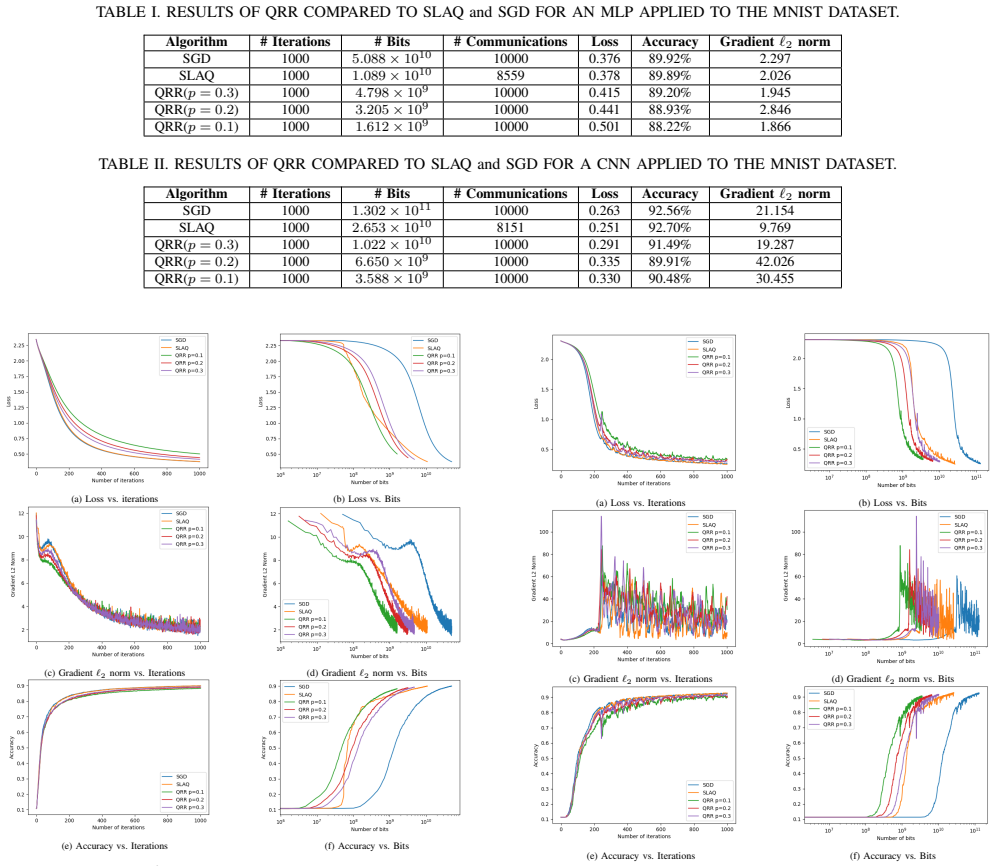
On its own terms, the paper establishes that the communication bottleneck of federated learning can be attacked by treating each client's gradient update as a low-rank object. For fully connected layers the update matrix is factored as $A \approx U_\nu \Sigma_\nu V_\nu^\top$ retaining the $\nu = \lceil p\cdot \min(D_{\mathrm{out}}, D_{\mathrm{in}})\rceil$ largest singular values, and for convolutional layers the update tensor is factored by Tucker decomposition with per-mode ranks $r_i = \lceil p\cdot I_i\rceil$. The factor matrices and core tensor are then quantized with a $\beta$-bit lazily aggregated quantizer, transmitted, and reconstructed on the server. The reported result is that QRR keeps accuracy within 1-3 points on MNIST and within about 9 points on CIFAR-10 of SGD or SLAQ while transmitting 3.34-9.43% of the bits of SGD and 13.52-44.05% of the bits of SLAQ.
Load-bearing premise
The whole scheme rests on the assumption that neural network gradient matrices and tensors are low-rank enough that keeping a fraction $p<0.5$ of the singular values still carries most of the training signal; if real gradients have a flat singular-value spectrum, the compressed updates lose too much information and the bandwidth-accuracy trade-off collapses.
Editorial extensions
If this is right
- With QRR, a federated client can cut its per-iteration upload by one to two orders of magnitude compared with sending raw gradients, at a cost of 1-9 accuracy points depending on dataset and $p$.
- On the MNIST experiments, QRR reaches a given accuracy faster than SGD and SLAQ when progress is measured per transmitted bit, meaning bandwidth, not iterations, can be the scarce resource.
- On CIFAR-10, the 8-9 point gap suggests QRR is suitable for getting a deployable model quickly on constrained links rather than for final accuracy.
- The measured client-side overhead is modest: about 1.2 times the memory and 3.8 times the computation time of SGD, versus 13 times the memory for SLAQ.
Reading between the lines
- A natural extension is an adaptive $p$ chosen per layer, per client, or per round, since the paper only tests fixed or evenly spaced client-level values; an adaptive scheme would likely improve the accuracy-bandwidth frontier.
- If the low-rank assumption weakens for models like large transformers, QRR's accuracy loss is expected to grow; a useful comparison would be the singular-value spectra of attention and MLP gradients to identify which layers tolerate aggressive truncation.
- The paper does not give a convergence bound for the compressed-quantized update, so a formal analysis of when the $p$ parameter preserves convergence is the natural next step.
Editorial analysis
A structured set of objections, weighed in public.
Referee Report
Summary. The paper proposes Quantized Rank Reduction (QRR), a federated-learning compression scheme that combines low-rank matrix/tensor factorization (truncated SVD for fully-connected layers, Tucker decomposition for convolutional layers) with the LAQ quantized-gradient framework. Each client compresses its gradient update, quantizes the factor components with β bits, and transmits the quantized factors; the server reconstructs an approximate gradient and performs distributed gradient descent. The authors derive bit-count comparisons from the factor sizes, report experiments on an MLP and a CNN for MNIST and a VGG-like CNN for CIFAR-10, and compare QRR against SGD and SLAQ. The headline claim is that QRR transmits a small fraction of the bits of SGD or SLAQ while maintaining, on MNIST, accuracy within 1–3 percentage points of the baselines; on CIFAR-10 the accuracy drop is about 9 percentage points.
Significance. If the underlying low-rank premise holds broadly, the bit-accounting part of the paper is sound and directly useful: the reported bit counts follow from the rank-retention formula and the quantization width, and the code is made available, which aids reproducibility. The combination of rank reduction with lazily aggregated quantization is a reasonable design, and the comparison against SLAQ is appropriate. However, the paper's evidence for the load-bearing premise is thin, and its own CIFAR-10 result contradicts the abstract's 'minimal impact on accuracy' wording. As it stands, the paper establishes a bandwidth-accuracy tradeoff on MNIST-like tasks, but not a general method with minimal accuracy impact. The central idea may be salvageable with additional measurements and more careful claims, so a major revision is warranted rather than rejection.
major comments (3)
- [Section II.A, Eq. (7), Figure 1] The paper's central premise is that neural-network gradient matrices and tensors 'are generally low-rank and have a few dominant singular values,' but the only supporting evidence is one unlabeled singular-value plot of a single fully-connected layer gradient and a citation to [14]. No quantitative measurement of the retained Frobenius energy, as defined in Eq. (7), or of a Tucker analogue is reported for any layer, iteration, or dataset. This is load-bearing because if the gradients are not sufficiently low-rank, truncating to p<0.5 discards signal and the bandwidth-accuracy tradeoff collapses. Please add measurements of the form ||A−A_ν||_F^2 / ||A||_F^2 for the SVD case and the corresponding Tucker reconstruction error for each layer type and each p value, across iterations, for all three experiments.
- [Table III and Section IV] The conclusion states that QRR has 'slightly lower accuracy' than Federated Averaging or SLAQ, and the abstract promises 'minimal impact on the model's accuracy.' Table III does not support this: on CIFAR-10 QRR reaches 47.57% accuracy versus 56.72% for SGD and 55.73% for SLAQ, a drop of about 8–9 percentage points, with a correspondingly worse loss (1.441 versus 1.213 and 1.242). The text in Section III.B acknowledges the reduced accuracy on the more complex dataset, but the global claims in the abstract and conclusions are too broad. Please either temper the claims to reflect the dataset-dependent nature of the accuracy loss or add a mechanism, such as energy-based per-layer rank selection, that keeps the accuracy drop small on harder tasks.
- [Section III.B, Tables I–III] All experiments appear to be single runs: no random seeds, no repeated trials, and no variance estimates are reported. With 10 clients and stochastic batches, the 1–2 percentage point differences on MNIST may be within run-to-run noise, and the claimed 'faster convergence in terms of bits' could depend on initialization. Please report mean and standard deviation over at least several seeds, or clearly state that the tables are illustrative single runs and avoid over-interpreting small accuracy gaps.
minor comments (6)
- [Section II.A, Figure 1] Figure 1 lacks axis labels and a description of which layer, dataset, and iteration produced the gradient; please add these details and state whether the singular values are normalized.
- [Section II.A, Eq. (7)] The notation 'rX' in the summation is a typo; it should read a summation over j from ν+1 to r, i.e., \sum_{j=\nu+1}^{r} \sigma_j^2.
- [Section III.A, Eq. (19)] The relationship between the QRR_c operator defined in Eq. (19) and the later description of compression followed by quantization is not fully explicit; a short pseudocode or algorithm box would clarify the order of operations and the client-side state that must be stored.
- [Section III.B] The SLAQ parameters 'D = 10, ξ1,...,ξD = 1/D' are introduced without defining D and ξ; please define these symbols or cite the specific definition from [22].
- [Table III] For the CIFAR-10 experiment, the paper says that each client is assigned a p value evenly spaced in [0.1, 0.3], but the table does not list those p values or an average retention ratio; please report them so the bit count can be checked.
- [Figures 2–4] The vertical axis label in Figure 4 is simply 'Gradient'; for consistency with Figures 2 and 3 it should read 'Gradient ℓ2 norm'.
Circularity Check
No significant circularity: QRR's accuracy and bit-reduction claims are empirical results predicated on an external low-rank-gradient assumption, not on fitting parameters to the headline quantities.
full rationale
The central claim—that QRR transmits a small fraction of SGD/SLAQ bits at a modest accuracy cost—is supported by the experimental tables (Tables I–III), which report measured loss, accuracy, and bit counts computed from the explicit SVD/Tucker and quantization formulas. The compression parameter p and quantization bits β are fixed before the runs, and no fitted parameter is later renamed as a prediction; Eq. (19) is a definition of the scheme, not a derivation of the experimental outcomes. The only load-bearing premise, that gradient matrices/tensors are low-rank, is imported from an external reference [14] and a supporting Figure 1; it is a data-dependent assumption and a correctness/generalization risk (especially given the CIFAR-10 9-point accuracy drop), not a circular step. The paper contains no load-bearing self-citation chain: the authors' own repository link [12] is incidental, and the cited low-rank and quantization results [14,22] are independent external work. Because the empirical accuracy-versus-bits comparison is testable and is not constructed by fitting p or β to the reported accuracies, no reduction of the claimed result to its own inputs is present.
Assumptions & free parameters
free parameters (2)
- rank retention ratio p =
0.1, 0.2, 0.3; per-client values in [0.1, 0.3] for CIFAR-10
- quantization bit width beta =
8 bits
assumptions (4)
- domain assumption Gradient matrices and tensors of neural network layers are approximately low-rank, with a few dominant singular values.
- standard math Eckart-Young theorem: the rank-nu truncated SVD minimizes Frobenius error, with error equal to the sum of squared truncated singular values.
- standard math Tucker decomposition represents a 4-mode tensor with a small core and factor matrices, with reconstruction given by the mode-n product.
- standard math LAQ quantization with grid radius R and step 2*tau*R has sup-norm error at most tau*R.
Cite this review
Pith. "Pith review of Quantized Rank Reduction: A Communications-Efficient Federated Learning Scheme for Network-Critical Applications." pith.science (2026). https://pith.science/paper/X3N55KN2
@misc{pith2026250711183,
  author       = {Pith},
  title        = {Pith review of: Quantized Rank Reduction: A Communications-Efficient Federated Learning Scheme for Network-Critical Applications},
  year         = {2026},
  howpublished = {\url{https://pith.science/paper/X3N55KN2}},
  note         = {Machine review of arXiv:2507.11183}
}
read the original abstract
Federated learning is a machine learning approach that enables multiple devices (i.e., agents) to train a shared model cooperatively without exchanging raw data. This technique keeps data localized on user devices, ensuring privacy and security, while each agent trains the model on their own data and only shares model updates. The communication overhead is a significant challenge due to the frequent exchange of model updates between the agents and the central server. In this paper, we propose a communication-efficient federated learning scheme that utilizes low-rank approximation of neural network gradients and quantization to significantly reduce the network load of the decentralized learning process with minimal impact on the model's accuracy.
Figures


Reference graph
Works this paper leans on
-
[14]
Generalization guarantees for neural networks via harnessing the low-rank structure of the Jacobian,
S. Oymak, Z. Fabian, M. Li, and M. Soltanolkotabi, “Generalization guarantees for neural networks via harnessing the low-rank structure of the Jacobian,” 2019. [Online]. Available: https://arxiv.org/abs/1906. 05392
work page 2019
-
[1]
Federated learning: Strategies for improving communication efficiency,
J. Kone ˇcn`y, H. B. McMahan, F. X. Yu, P. Richt ´arik, A. T. Suresh, and D. Bacon, “Federated learning: Strategies for improving communication efficiency,” 2017. [Online]. Available: https://arxiv.org/abs/1610.05492
arXiv 2017
-
[2]
A survey on federated learning,
C. Zhang et al. , “A survey on federated learning,” Knowledge-Based Systems, vol. 216, p. 106775, 2021
work page 2021
-
[3]
Federated learning in mobile edge networks: A com- prehensive survey,
W. Lim et al. , “Federated learning in mobile edge networks: A com- prehensive survey,”IEEE Communications Surveys & Tutorials, vol. 22, no. 3, pp. 2031–2063, 2020
work page 2020
-
[4]
Limitations and future aspects of communication costs in federated learning: A survey,
M. Asad et al., “Limitations and future aspects of communication costs in federated learning: A survey,” Sensors, vol. 23, no. 17, p. 7358, 2023
work page 2023
-
[5]
Advances and open problems in federated learning,
P. Kairouz et al., “Advances and open problems in federated learning,” Foundations and Trends® in Machine Learning , vol. 14, no. 1-2, pp. 1–210, 2021
work page 2021
-
[6]
Communication efficient distributed machine learning with the parameter server,
M. Li, D. G. Andersen, A. Smola, and K. Yu, “Communication efficient distributed machine learning with the parameter server,” in Advances in Neural Information Processing Systems , 2014, vol. 27, pp. 19—-27
work page 2014
-
[7]
Communication complexity of distributed convex learning and optimization,
Y . Arjevani and O. Shamir, “Communication complexity of distributed convex learning and optimization,” in Advances in Neural Information Processing Systems, 2015, vol. 28, pp. 1756––1764
work page 2015
Show all 26 references
-
[8]
Communication-efficient learning of deep networks from decentralized data,
B. McMahan, E. Moore, D. Ramage, S. Hampson, and B. A. y Arcas, “Communication-efficient learning of deep networks from decentralized data,” in Artificial Intelligence and Statistics . PMLR, 2017, pp. 1273– 1282
2017
-
[9]
Efficient neural network compression,
H. Kim, M. U. K. Khan, and C.-M. Kyung, “Efficient neural network compression,” in Proceedings of the IEEE/CVF Conference on Computer Vision and Pattern Recognition , 2019, pp. 12 569–12 577
2019
-
[10]
Marvel: Towards efficient federated learning on IoT devices,
L. Liu and X. Xu, “Marvel: Towards efficient federated learning on IoT devices,” Computer Networks, vol. 245, p. 110375, 2024
2024
-
[11]
Deep neural network compression by Tucker decomposition with nonlinear response,
Y . Liu and M. K. Ng, “Deep neural network compression by Tucker decomposition with nonlinear response,” Knowledge-Based Systems, vol. 241, p. 108171, 2022
2022
-
[12]
Quantized rank reduction: A communications-efficient federated learning scheme for network-critical applications,
“Quantized rank reduction: A communications-efficient federated learning scheme for network-critical applications,” [retrieved: May 22, 2025]. [Online]. Available: https://github.com/Kritsos/QRR-code
2025
-
[13]
Computing neural network gradients,
K. Clark, “Computing neural network gradients,” Stanford University, August 2018, Notes
2018
-
[15]
Some mathematical notes on three-mode factor analysis,
L. R. Tucker, “Some mathematical notes on three-mode factor analysis,” Psychometrika, vol. 31, no. 3, pp. 279–311, 1966
1966
-
[16]
Compression and interpretability of deep neural networks via Tucker tensor layer: From first principles to tensor valued back-propagation,
G. G. Calvi, A. Moniri, M. Mahfouz, Q. Zhao, and D. P. Mandic, “Compression and interpretability of deep neural networks via Tucker tensor layer: From first principles to tensor valued back-propagation,”
-
[17]
Tensor-factorized neural networks,
J.-T. Chien and Y .-T. Bao, “Tensor-factorized neural networks,” IEEE Transactions on Neural Networks and Learning Systems , vol. 29, no. 5, pp. 1998–2011, 2017
1998
-
[18]
De Lathauwer, Signal Processing Based on Multilinear Algebra
L. De Lathauwer, Signal Processing Based on Multilinear Algebra . Katholieke Universiteit Leuven, 1997
1997
-
[19]
QSGD: Communication-efficient SGD via gradient quantization and encoding,
D. Alistarh, D. Grubic, J. Li, R. Tomioka, and M. V ojnovic, “QSGD: Communication-efficient SGD via gradient quantization and encoding,” in Advances in Neural Information Processing Systems , 2017, vol. 30, pp. 1707––1718
2017
-
[20]
Distributed learning with compressed gradient differences,
K. Mishchenko, E. Gorbunov, M. Tak ´aˇc, and P. Richt ´arik, “Distributed learning with compressed gradient differences,” 2023. [Online]. Available: https://arxiv.org/abs/1901.09269
2023 arXiv
-
[21]
Neu- ral network quantization in federated learning at the edge,
N. Tonellotto, A. Gotta, F. M. Nardini, D. Gadler, and F. Silvestri, “Neu- ral network quantization in federated learning at the edge,” Information Sciences, vol. 575, pp. 417–436, 2021
2021
-
[22]
Lazily aggregated quantized gradient innovation for communication-efficient federated learning,
J. Sun, T. Chen, G. B. Giannakis, Q. Yang, and Z. Yang, “Lazily aggregated quantized gradient innovation for communication-efficient federated learning,” IEEE Transactions on Pattern Analysis and Machine Intelligence, vol. 44, no. 4, pp. 2031–2044, 2020
2020
-
[23]
The MNIST database of handwritten digit images for machine learning research,
L. Deng, “The MNIST database of handwritten digit images for machine learning research,” IEEE Signal Processing Magazine, vol. 29, no. 6, pp. 141–142, 2012
2012
-
[24]
Learning multiple layers of features from tiny images,
A. Krizhevsky, “Learning multiple layers of features from tiny images,” University of Toronto, Tech. Rep., 2009. [Online]. Available: https://www.cs.toronto.edu/∼kriz/learning-features-2009-TR.pdf
2009
-
[25]
Very deep convolutional networks for large-scale image recognition,
K. Simonyan and A. Zisserman, “Very deep convolutional networks for large-scale image recognition,” 2015. [Online]. Available: https: //arxiv.org/abs/1409.1556
2015 arXiv
-
[2019]
Available: https://arxiv.org/abs/1903.06133
[Online]. Available: https://arxiv.org/abs/1903.06133
1903 arXiv
Reviewed August 6, 2026 · model on record in the stance chip above.
Discussion (0). Continue with ORCID to comment.