REVIEW 4 major objections 5 minor 30 references
Hybrid machine learning based scale bridging framework for permeability prediction of fibrous structures
T0 review · 4 major / 5 minor · reviewed 2026-08-08 · deepseek-v4-flash
Pith's one-line read A hybrid dual-scale solver that couples a microscale physics-informed neural network (PINN) to a mesoscale Stokes-Brinkman finite element solver predicts permeability where standard PINNs fail.
desk verdict Hybrid PINN dual-scale solver is a plausible idea but the self-referential regularizer and a runtime contradiction in the abstract weaken the main claims; still worth serious review. read the letter →
The pith
A machine-rendered reading of the paper's core claim, the machinery that carries it, and where it could break.
The reading
What carries the argument
The load-bearing mechanism is the coarse-scale regularizer $R(\theta,\psi)$ in Eq. (14), a coupling term added to the PINN objective that penalizes, at sampled mesh points inside the fluid region, the squared difference between the microscale PINN velocity and pressure and the velocity and pressure of a Stokes-Brinkman finite element solution on the mesoscale. Around it sits the iterative loop of Algorithm 1: the mesoscale problem (15) uses a permeability computed from the current PINN output through Darcy's law, that permeability is projected into $[K^p_{\mathrm{LB}}, K^p_{\mathrm{UB}}]$ by Eq. (18), the coupling term is refreshed every $T$ iterations, and after $k_c$ iterations the coupling weights are annealed so the microscale loss takes over. Periodic boundary conditions are encoded in the network architecture through periodic embeddings, while Fourier features and gradient-based weight scaling address spectral bias and stiff gradient flow.
What would settle it
Run the hybrid solver on the 25-fiber geometry with the projection upper bound set below the finite element reference value $2.37\times10^{-4}$, for instance $K^p_{\mathrm{UB}}=2.0\times10^{-4}$; if the predicted permeability lands on the upper bound, then the hand-chosen interval, not the learned flow, is setting the reported accuracy.
Extended reading notes
Core claim
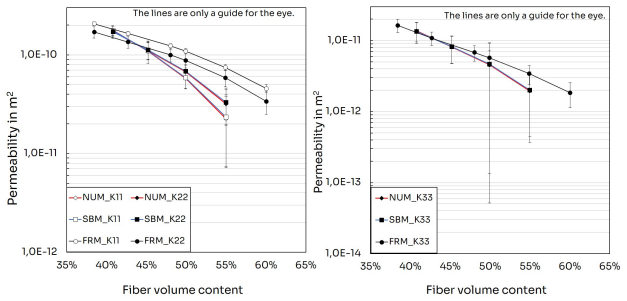
Standard physics-informed neural networks (PINNs) with periodic boundary conditions, Fourier features, and gradient-based loss balancing stagnate on the microscale Stokes problem in fiber perforations, with errors making no progress after 100,000 iterations; the paper attributes this to the limited information contained in periodic conditions and to stiff gradient flow from the no-slip penalty. The proposed hybrid dual-scale solver repairs this by adding the coarse-scale regularizer $R(\theta,\psi)$ from Eq. (14), which penalizes the distance between the microscale PINN velocity and pressure and a Taylor-Hood finite element solution of the mesoscale Stokes-Brinkman problem (15). The permeability predicted from the PINN output is projected into $[5\times10^{-5},\,5\times10^{-4}]$ by Eq. (18), and the coupled objective is updated every $T=250$ iterations. Within 25,000 iterations the hybrid solver reaches $\ell^2$ errors around $10^{-2}$ to $10^{-1}$ against the finite element reference and reproduces the reference permeability for the 25-fiber geometry inside the reported error band; for the 36-fiber geometry the flow is captured but the predicted permeability overestimates the reference and is less stable. The same paper reports that NUM and SBM reproduce FRM in-plane permeabilities with runtimes under 11 hours, while out-of-plane $K_{33}$ remains much more variable.
Load-bearing premise
The hybrid solver's success depends on the mesoscale Stokes-Brinkman solution being a reliable coarse-scale guide and on the hand-picked projection interval $[5\times10^{-5},\,5\times10^{-4}]$ and initial guess $4.5\times10^{-4}$ bracketing or seeding the true micropermeability; the paper does not test how the result changes if those choices are wrong.
Editorial extensions
If this is right
- If the hybrid dual-scale solver is correct, PINN-based microscale flow approximation becomes feasible in periodic fiber geometries, removing the need for mesh-based microscale solvers in tow permeability computation.
- NUM and SBM provide a practical route to in-plane permeability for textile composites: under 11 hours of runtime versus 88 to 120 hours for FRM, with consistent $K_{11}$ and $K_{22}$ trends.
- The segment-wise micropermeability assignment in SBM does not yield a clear accuracy gain over the uniform NUM assignment in these test cases, so structural variability inside rovings is not the dominant error source for in-plane flow.
- Out-of-plane permeability $K_{33}$ remains substantially more variable than in-plane values, with coefficients of variation up to about 99%, so through-thickness flow is the direction where simplified upscaling is least reliable.
- The hybrid solver currently needs 20 to 25 minutes of training on a single GPU for a 2D geometry, so scaling to large 3D fibrous models requires distributed domain decomposition and faster optimization.
Reading between the lines
- A testable extension is to shift the projection interval or initial guess and watch the predicted permeability; if the answer tracks the clip, the bounds rather than the physics carry the result.
- The same coarse-scale-regularization idea could rescue PINNs in other multiscale PDEs where periodic boundary conditions underdetermine the fine-scale solution, by coupling the fine network to a homogenized or coarse-grid solver.
- The contrast between the stable 25-fiber case and the overestimating 36-fiber case suggests a stiffness threshold as fiber count grows; measuring error versus fiber number would map where the regularizer stops compensating.
- For manufacturing practice, the results imply NUM with uniform micropermeability may be sufficient for in-plane permeability, so the extra complexity of segment-wise ML surrogates should be reserved for out-of-plane or local flow details.
Editorial analysis
A structured set of objections, weighed in public.
Referee Report
Summary. The manuscript proposes a multiscale permeability-prediction framework for fibrous textiles, comparing four approaches: numerical upscaling (NUM), scale-bridging with machine-learning emulators (SBM), fully resolved models (FRM), and a newly developed hybrid dual-scale solver that couples a PINN microscale solver with a Stokes-Brinkman finite-element mesoscale solver. The central scientific claim is that the hybrid solver, through the coarse-scale regularizer R in Eq. (14), achieves reasonable accuracy within 25k iterations on two 2D periodic fiber geometries, whereas standard PINNs fail. A secondary engineering claim is that NUM and SBM reproduce FRM in-plane permeabilities while requiring far less runtime than FRM.
Significance. If the hybrid claim is established, the paper would make a useful contribution by showing that coarse-scale information can regularize PINN training under periodic boundary conditions, a known failure mode. The manuscript has genuine strengths: two well-defined 2D benchmarks with finite-element reference solutions, a detailed statement of Algorithm 1, explicit hyperparameter values, and unusually candid discussion of limitations in Sections 6.2 and 7. However, the current evidence does not yet establish that the coarse-scale regularizer is the cause of the improvement, because the regularizer depends on the very permeability that the PINN is learning, and the projection interval and initial guess are hand-chosen. The engineering comparison is also weakened by unmatched fiber volume contents and hardware differences. The paper is honest about several of these concerns but does not resolve them.
major comments (4)
- [§5.3, Eq. (14), Algorithm 1 lines 8–10] The coarse-scale regularizer R is not an independent reference. It evaluates the PINN velocity and pressure against the finite-element solution of (15), but that finite-element solution is computed using dKp11[VZ] extracted from the current PINN output and then projected by (18). The same quantity the PINN is learning therefore appears on both sides of the training signal, and the projection interval [5e-5, 5e-4] and initial guess 4.5e-4 are chosen so that both reference values (2.37e-4 for VZ1 and 9.08e-5 for VZ2) lie inside the interval. The paper provides no sensitivity study varying gKp, Kp_LB, or Kp_UB, and no analysis of other possible fixed points of this feedback loop. Without such an ablation, or a comparison against a regularizer built from a fixed reference permeability, the headline conclusion that coarse-scale regularization fixes PINN failure is not established; the reported accuracy may reflect favorable manual choices rather than a property of the dual-scale coupling.
- [§6.2, Fig. 8] The accuracy numbers for the hybrid solver are single trajectories with no seed-to-seed variation or confidence intervals, and the network and optimization hyperparameters appear to be tuned on the same two benchmark geometries used for evaluation. The permeability history for VZ2 in Fig. 8(f) visibly overestimates the reference and oscillates, so the statement that the hybrid solver 'yields reasonable accuracy within 25k iterations' needs support from repeated runs with different initializations and reporting of mean and spread. Ideally the method should also be evaluated on a third geometry not used for hyperparameter selection. This is load-bearing because it is the main evidence for the claimed improvement over standard PINNs.
- [§6.1, Table 1] The claimed agreement between NUM/SBM and FRM is not quantified at matched conditions. The two families of models are reported at different fiber volume contents (NUM/SBM: 40.8%, 45.2%, 49.9%, 55.0%; FRM: 38.4%, 42.7%, 48.0%, 49.9%, 54.9%, 60.0%), on different model sizes, and on different hardware, and the paper itself warns that the FRM role as reference must be critically examined. As one example, NUM20 at 49.9% FVC reports K11 = 5.76e-11 m² while FRM30 at 48.0% FVC reports K11 = 1.23e-10 m², a factor-of-two difference that is difficult to reconcile with the statement of 'good consistency' except at the lowest FVC. Please provide an interpolation to common FVC values or otherwise quantify the comparison before claiming that NUM and SBM reproduce FRM in-plane permeabilities.
- [Abstract vs. §6.1 and Table 1] The abstract states that the scale-bridging method has 'modeling runtimes of ~45 minutes per simulation', while Section 6.1 states that NUM and SBM complete simulations in under 11 hours, Table 1 lists 9.0–10.5 hours, and the conclusion repeats 'below 11 hours'. The 45-minute figure is inconsistent with the body of the paper and must be corrected or explicitly explained. In addition, the abstract at the start of the submission uses the taxonomy SSM/SUM/SBM/FRM, whereas the abstract in the body uses NUM/FRM/SBM/PINN; the two should be aligned so that the reader knows which methods are actually compared.
minor comments (5)
- [§4] The text contains a typo: 'caluclated' should be 'calculated'.
- [§5.3, after Eq. (14)] The notation 'λSB_i > 0' is not defined; the weights appearing in Eq. (14) are λu and λp.
- [§5.1–§5.3] Notation alternates between V1/VZ1, Kp/Kp11, and dKp11/cKp without consistent subscripts; please standardize notation for the two-scale models and the permeability symbols.
- [Fig. 8 caption] The caption uses '25f' and '36f' while the text refers to VZ1 and VZ2; define these abbreviations in the caption or use the same names as the text.
- [Table 1] The column header 'R T in h' is unclear; spell out 'RT' as 'runtime' and separate it from the preceding column.
Circularity Check
The hybrid solver's coarse-scale regularizer is self-referential: the Stokes-Brinkman target in Eq. (14) is generated from the PINN's own projected permeability, so the reported accuracy is not shown to be independent of the hand-set initial guess and projection bounds.
-
self definitional
[Section 5.3, Eq. (14), Eq. (15), Eq. (18), Algorithm 1 lines 8-10]
"To evaluate (14), we need the PINN ansatz (9), as well as the following learning-informed Stokes-Brinkman equation must be solved ... where cKMe[VZ] = χZ_F · ∞ + χZ_P · dKp11[VZ] and dKp11[VZ] is computed via (7) using the outputs of the PINN ansatz (9). Algorithm 1: Update: dKp11[VZ](θk, ψk) ← Darcy's Law (dNN_{θk,ψk}) according to (7); Project: dKp11[VZ](θk, ψk) ← P[Kp_LB,Kp_UB](dKp11[VZ](θk, ψk)) using (18)."
The coarse-scale regularizer R in Eq. (14) is presented as mesoscale information that rescues the PINN, but its target (buSB, bpSB) is obtained by solving Eq. (15) with a permeability dKp11 that is itself read off from the PINN solution via Eq. (7) and then clipped by the user-specified projection Eq. (18). Thus the 'additional information' is a function of the very quantity the PINN is learning; the combined loss Jλ = J + R is a self-consistency condition rather than a fit to an independent reference. The reported agreement with FEM is therefore contingent on the un-ablated initial guess gKp = 4.5e-4 and interval [5e-5, 5e-4], both of which contain the two reference permeabilities, and the paper does not demonstrate uniqueness of the fixed point or robustness outside that interval.
full rationale
The paper is not overtly circular in the strongest sense: the FEM reference permeabilities are not used in the training loss, and the final PINN velocity fields and permeability values are not hardwired to either the reference or the projection bounds. The reported failure of standard PINNs and the relative success of the hybrid solver are empirical comparisons with independent finite-element solutions. However, the central mechanism of the hybrid solver is self-referential in a way that weakens the claim that coarse-scale regularization provides independent physical information. Specifically, the Stokes-Brinkman target in Eq. (14) is generated from the current PINN's own projected permeability estimate via Eq. (15), so the regularizer enforces consistency with a coarse-scale model that is itself built from the quantity being predicted. The projection in Eq. (18) and the initial guess in Section 6.2 bracket both reference values, and no sensitivity analysis is provided, so the favorable comparison to FEM cannot be separated from these choices. The paper also contains self-citations to the authors' prior work, notably [6] for the hybrid multiscale framework and [12, 15] for the data-driven permeability emulators, but these are not the decisive load-bearing evidence for the paper's main empirical claims, which are demonstrated here with new experiments. The authors also explicitly acknowledge limitations, including FRM's reduced size and resolution and the hybrid solver's lack of maturity for large complex geometries. Overall, the circularity is partial and localized to the self-consistent construction of the coarse-scale regularizer, meriting a moderate score rather than a charge of fully circular derivation.
Assumptions & free parameters
free parameters (5)
- gKp_11 initial permeability guess =
4.5e-4
- Projection bounds Kp_LB, Kp_UB =
5e-5, 5e-4
- Loss weights lambda_r, lambda_div, lambda_b, lambda_u, lambda_p =
not reported (adaptive scaling, then exponential annealing)
- Network and optimizer hyperparameters =
dE=256, 3x128 layers, lr=1e-3, decay=0.9, kmax=25000, kc=5000, T=250, gamma=2.5e-4
- ML emulator weights for SBM from [12, 15] =
not provided
assumptions (5)
- domain assumption Darcy's law (Eq. 3) and the Stokes-Brinkman equation (Eq. 6) describe permeability of fibrous porous media at micro and mesoscale.
- domain assumption Scale separation and homogenization: a microscale SVE permeability can be assigned to a mesoscale roving segment to predict dual-scale permeability.
- ad hoc to paper The coarse-scale Stokes-Brinkman solution is an adequate regularizer for the microscale PINN.
- ad hoc to paper The true micropermeability lies within the hand-chosen projection bounds [Kp_LB, Kp_UB].
- standard math Finite element Taylor-Hood solutions provide accurate reference permeabilities.
Cite this review
Pith. "Pith review of Hybrid machine learning based scale bridging framework for permeability prediction of fibrous structures." pith.science (2026). https://pith.science/paper/X452YMHJ
@misc{pith2026250205044,
  author       = {Pith},
  title        = {Pith review of: Hybrid machine learning based scale bridging framework for permeability prediction of fibrous structures},
  year         = {2026},
  howpublished = {\url{https://pith.science/paper/X452YMHJ}},
  note         = {Machine review of arXiv:2502.05044}
}
read the original abstract
This study introduces a hybrid machine learning-based scale-bridging framework for predicting the permeability of fibrous textile structures. By addressing the computational challenges inherent to multiscale modeling, the proposed approach evaluates the efficiency and accuracy of different scale-bridging methodologies combining traditional surrogate models and even integrating physics-informed neural networks (PINNs) with numerical solvers, enabling accurate permeability predictions across micro- and mesoscales. Four methodologies were evaluated: Single Scale Method (SSM), Simple Upscaling Method (SUM), Scale-Bridging Method (SBM), and Fully Resolved Model (FRM). SSM, the simplest method, neglects microscale permeability and exhibited permeability values deviating by up to 150\% of the FRM model, which was taken as ground truth at an equivalent lower fiber volume content. SUM improved predictions by considering uniform microscale permeability, yielding closer values under similar conditions, but still lacked structural variability. The SBM method, incorporating segment-based microscale permeability assignments, showed significant enhancements, achieving almost equivalent values while maintaining computational efficiency and modeling runtimes of ~45 minutes per simulation. In contrast, FRM, which provides the highest fidelity by fully resolving microscale and mesoscale geometries, required up to 270 times more computational time than SSM, with model files exceeding 300 GB. Additionally, a hybrid dual-scale solver incorporating PINNs has been developed and shows the potential to overcome generalization errors and the problem of data scarcity of the data-driven surrogate approaches. The hybrid framework advances permeability modelling by balancing computational cost and prediction reliability, laying the foundation for further applications in fibrous composite manufacturing.
Figures


Figures from the paper (9 more)




Reference graph
Works this paper leans on
-
[1]
S. V. Lomov, G. Huysmans, Y. Luo, R. Parnas, A. Prodromou, I. Verpoest, F. Phelan, Textile composites: modelling strategies, Composites Part A: applied science and manufacturing 32 (10) (2001) 1379–1394
work page 2001
-
[2]
N. Lubbers, A. Agarwal, Y. Chen, S. Son, M. Mehana, Q. Kang, S. Karra, C. Junghans, T. C. Germann, H. S. Viswanathan, Modeling and scale- bridging using machine learning: Nanoconfinement effects in porous media, Scientific reports 10 (1) (2020) 13312
work page 2020
-
[3]
R. Gorguluarslan, S.-K. Choi, A simulation-based upscaling technique for multiscale modeling of engineering systems under uncertainty, International Journal for Multiscale Computational Engineering 12 (6) (2014)
work page 2014
-
[4]
J. Seuffert, L. Bittrich, L. Cardoso de Oliveira, A. Spickenheuer, L. K¨ arger, Micro-scale permeability characterization of carbon fiber composites using micrograph volume elements, Frontiers in Materials 8 (2021) 745084
work page 2021
- [5]
-
[6]
M. Hinterm¨ uller, D. Korolev, A hybrid physics-informed neural network based multiscale solver as a partial differential equation constrained opti- mization problem, arXiv preprint arXiv:2309.04439 (2023)
work page Pith review arXiv 2023
-
[7]
M. Griebel, M. Klitz, Homogenization and numerical simulation of flow in geometries with textile microstructures, Multiscale Modeling & Simulation 8 (4) (2010) 1439–1460
work page 2010
-
[8]
T. Schmidt, F. Schimmer, A. Widera, D. May, N. Motsch, C. Bauer, A novel simulative-experimental approach to determine the permeability of technical textiles, Key Engineering Materials 809 (2019) 487–492. 27
work page 2019
Show all 30 references
-
[9]
P. B. Nedanov, S. G. Advani, Numerical computation of the fiber preform permeability tensor by the homogenization method, Polymer composites 23 (5) (2002) 758–770
2002
-
[10]
Syerko, C
E. Syerko, C. Binetruy, S. Comas-Cardona, A. Leygue, A numerical ap- proach to design dual-scale porosity composite reinforcements with en- hanced permeability, Materials & Design 131 (2017) 307–322
2017
-
[11]
X. Du, M. Ostoja-Starzewski, On the size of representative volume element for darcy law in random media, Proceedings of the Royal Society A: Math- ematical, Physical and Engineering Sciences 462 (2074) (2006) 2949–2963
2006
-
[12]
Schmidt, D
T. Schmidt, D. K. Natarajan, M. Duhovic, S. Cassola, M. Nuske, D. May, Numerical data generation for building machine learning models for per- meability estimation of fibrous structures, Polymer Composites (2025) 1– 17doi:10.1002/pc.2976
2025 doi
-
[13]
Syerko, T
E. Syerko, T. Schmidt, D. May, C. Binetruy, S. G. Advani, S. Lomov, L. Silva, S. Abaimov, N. Aissa, I. Akhatov, et al., Benchmark exercise on image-based permeability determination of engineering textiles: Microscale predictions, Composites Part A: Applied Science and Manufact...
2023
-
[14]
Hilden, S
J. Hilden, S. Linden, B. Planas, Flowdict user guide geodict release 2024, GeoDict 2024 User Guide. Math2Market GmbH (2024)
2024
-
[15]
D. K. Natarajan, T. Schmidt, S. Cassola, M. Nuske, M. Duhovic, D. May, A. Dengel, Data-driven permeability prediction of 3D fibrous microstruc- tures, Proceedings of ECCOMAS Congress 2024 - 9th European Congress on Computational Methods in Applied Sciences and Engineering (Sep. 2024)
2024
-
[16]
Elmorsy, W
M. Elmorsy, W. El-Dakhakhni, B. Zhao, Generalizable Permeability Pre- diction of Digital Porous Media via a Novel Multi-Scale 3D Convolutional 28 Neural Network, Water Resources Research 58 (3) (2022) e2021WR031454. doi:10.1029/2021WR031454
2022 doi
-
[17]
Stiller, F
P. Stiller, F. Bethke, M. B¨ ohme, R. Pausch, S. Torge, A. Debus, J. Vor- berger, M. Bussmann, N. Hoffmann, Large-scale neural solvers for partial differential equations, in: Driving Scientific and Engineering Discoveries Through the Convergence of HPC, Big Data and AI: 17th S...
2020
-
[18]
Escapil-Inchausp´ e, G
P. Escapil-Inchausp´ e, G. A. Ruz, h-analysis and data-parallel physics- informed neural networks, Scientific Reports 13 (1) (2023) 17562
2023
-
[19]
Shukla, A
K. Shukla, A. D. Jagtap, G. E. Karniadakis, Parallel physics-informed neu- ral networks via domain decomposition, Journal of Computational Physics 447 (2021) 110683
2021
-
[20]
Moseley, A
B. Moseley, A. Markham, T. Nissen-Meyer, Finite basis physics-informed neural networks (fbpinns): a scalable domain decomposition approach for solving differential equations, Advances in Computational Mathematics 49 (4) (2023) 62
2023
-
[21]
Boffi, F
D. Boffi, F. Brezzi, M. Fortin, et al., Mixed finite element methods and applications, Vol. 44, Springer, 2013
2013
-
[22]
S. Wang, S. Sankaran, H. Wang, P. Perdikaris, An expert’s guide to training physics-informed neural networks, arXiv preprint arXiv:2308.08468 (2023)
2023 arXiv
-
[23]
Rahaman, A
N. Rahaman, A. Baratin, D. Arpit, F. Draxler, M. Lin, F. Hamprecht, Y. Bengio, A. Courville, On the spectral bias of neural networks, in: Inter- national conference on machine learning, PMLR, 2019, pp. 5301–5310
2019
-
[24]
Tancik, P
M. Tancik, P. Srinivasan, B. Mildenhall, S. Fridovich-Keil, N. Raghavan, U. Singhal, R. Ramamoorthi, J. Barron, R. Ng, Fourier features let net- 29 works learn high frequency functions in low dimensional domains, Advances in neural information processing systems 33 (2020) 7537–7547
2020
-
[25]
S. Wang, H. Wang, P. Perdikaris, On the eigenvector bias of fourier fea- ture networks: From regression to solving multi-scale pdes with physics- informed neural networks, Computer Methods in Applied Mechanics and Engineering 384 (2021) 113938
2021
-
[26]
S. Wang, Y. Teng, P. Perdikaris, Understanding and mitigating gradient flow pathologies in physics-informed neural networks, SIAM Journal on Scientific Computing 43 (5) (2021) A3055–A3081
2021
-
[27]
Glorot, Y
X. Glorot, Y. Bengio, Understanding the difficulty of training deep feed- forward neural networks, in: Proceedings of the thirteenth international conference on artificial intelligence and statistics, JMLR Workshop and Conference Proceedings, 2010, pp. 249–256
2010
-
[28]
D. P. Kingma, Adam: A method for stochastic optimization, arXiv preprint arXiv:1412.6980 (2014)
2014 arXiv
-
[29]
McGreivy, A
N. McGreivy, A. Hakim, Weak baselines and reporting biases lead to overoptimism in machine learning for fluid-related partial differential equa- tions, Nature Machine Intelligence (2024) 1–14
2024
-
[30]
Syerko, T
E. Syerko, T. Schmidt, D. May, C. Binetruy, S. V. Lomov, S. Advani, L. Silva, Mesoscale results from the virtual permeability benchmark on engineering textiles, in: 21st European Conference on Composite Materials, Vol. 8 - Special Sessions, The European Society for Composite M...
2024
Reviewed August 8, 2026 · model on record in the stance chip above.
Discussion (0). Continue with ORCID to comment.